MANWU, an IndustriALL affiliate, wants to boost its membership in the sector.
Namibia’s automotive sector is growing. The government has backed original equipment manufacturers (OEMs), most notably Peugeot, as anchors for a domestic industry. But the Peugeot project has stalled. The carmaker has struggled to sustain sales in the local market and has not broken into exports. Fewer jobs have been created as a result.
New entrants, among them Chinese manufacturers, are expected to make in-roads into Namibia’s still-modest market. Meanwhile, the government is laying groundwork for an electric vehicle (EV) industry. This is in line with a Just Transition policy that seeks to ensure the shift to clean transport does not happen at workers’ expense.
Learning the basics
The workshop, supported by IndustriALL Sub-Saharan Africa regional office, covered occupational health and safety (OHS), workplace case handling, organizing strategies and the Just Transition.
OHS committees were described as a centrepiece of the training. Workers learnt how to establish and run such committees. When they function properly, the committees are among the most effective mechanisms available. They reduce injuries, enforce legal protections and give workers a formal voice over working conditions. In a sector where safety risks are common and enforcement uneven, health and safety are key.
“We came to learn how to handle cases at the workplace, to know our rights and what the union can do for us,”
said Stephanie Kapuka who works at Gobabis Toyota.
Case handling including navigating disciplinary procedures, grievances and disputes were discussed. For workers without specialist legal training, workplace conflicts can feel unwinnable. The workshop aimed to change that, building confidence alongside competence.
Participants were honest about the organizing challenge. Collective bargaining improves only when membership grows. Workers must trust that the union can deliver. And the union must have the numbers to sit at the negotiating table.
Just Transition
In Namibia, where mining and manufacturing are central to livelihoods and under pressure from decarbonization, the meaning of the Just Transition is contested. For MANWU’s members, just transition means the automotive sector will be transformed. The global push for EVs is reshaping the industry, even if uptake in Namibia remains low. If workers are not at the table, the costs will fall on the most vulnerable. That was the clear message from the shop stewards. MANWU is participating in national Just Transition discussions and wants to ensure that shop stewards can translate the policy language back to the shop floor.
“I want to understand what Just Transition means for our jobs, not just to hear the phrase but know what it actually means for workers like us,”
said Andreas Hochobes from Drydock and Ship Repair.
“With the transition going through the automotive industries as a result of e-mobility, unions should continue their recruitment drives and engage in collective bargaining. Social dialogue with key partners remains essential in order to protect workers’ working conditions,”
said Paule-France Ndessomin, IndustriALL regional secretary for Sub-Saharan Africa.
IndustriALL child protection policy
1. Introduction and purpose of this policy
IndustriALL applies a human rights-based approach to all its work and programmes and is committed to promote respect and human dignity, as well as providing an environment free from any form of discrimination, violence and harassment, in line with article 32 of its statutes.
This approach is also grounded in, amongst others, the UN Universal Declaration of Human Rights, the UN Convention on the Rights of the Child, and the International Labour Organization (ILO) Conventions, including Convention No. 138 on Minimum Age and Convention No. 182 on the Worst Forms of Child Labour.
These instruments affirm children’s fundamental rights to safety, health, education, protection, play, dignity, and full development.
Preventing child labour has long been an integral part of IndustriALL’s work. The organisation remains strongly committed to actively promoting the prevention of child labour and the protection of children’s rights at national, regional, and international levels. Furthermore, IndustriALL does not tolerate any form of abuse, exploitation, or harm of children, regardless of the situation or context in which it occurs.
The purpose of this policy is to ensure that, through all IndustriALL activities, programmes, partnerships, and collaborations, children are not subject to harm, abuse, or exploitation, and that their rights are respected and protected. This policy applies to all persons engaged in IndustriALL’s work, including employees, affiliates, representatives and consultants.
2. Definitions
Child labour
Child labour is defined, in accordance with the ILO, as work that deprives children of their childhood, their potential, and their dignity, and which is harmful to their physical and mental development. It refers to work that:
Is mentally, physically, socially, or morally dangerous or harmful to children, and/or
Interferes with their schooling by depriving them of the opportunity to attend school, obliging them to leave school prematurely, or requiring them to combine school attendance with excessively long or heavy work.
The working age limit shall be in line with the ILO Conventions No. 138 and No. 182.
In line with ILO Convention No. 138, child labour must be assessed with reference to the minimum age for admission to employment, including distinctions between general minimum age, permissible light work, and hazardous work, which shall not be undertaken by anyone under the age of 18.
In accordance with ILO Convention No. 182, the worst forms of child labour are strictly prohibited and include, inter alia, slavery or practices similar to slavery (including trafficking of children, debt bondage, and forced labour), the use of children in armed conflict, the use, procuring or offering of a child for prostitution, pornography or illicit activities, and any work which is likely to harm the health, safety or morals of children.
Child labour constitutes a violation of fundamental labour rights and requires immediate and effective measures for its elimination.
Child abuse, ill-treatment and exploitation
Child abuse, ill-treatment and exploitation include, but is not limited to, committing or coercing another person to commit acts of abuse against a child that are detrimental to a child’s survival, safety, health, wellbeing, dignity, or development, including:
Physical abuse: the use of physical force that results in harm, including hitting, slapping, shaking, kicking, burning, strangling, poisoning, or similar acts.
Emotional abuse: inappropriate verbal or symbolic acts, patterns of neglect, humiliation, intimidation, or failure to provide adequate emotional support that damage a child’s self-esteem or development.
Sexual abuse: any use of a child for sexual gratification, including inappropriate touching, sexual acts, exploitation, exposure to pornography, or grooming, whether offline or online.
Ill-treatment: unreasonable or degrading discipline, excessive demands, hostile use of force, or a pattern of degrading or hostile behaviour towards a child.
Possessing, producing, distributing, obtaining, or transmitting child exploitation material.
Exploiting children below the applicable minimum age for employment or exposing any person under 18 to hazardous work as defined under international labour standards.
3. Preventative measures
IndustriALL affirms a zero-tolerance policy towards any form of abuse, exploitation, or harm of children.
In accordance with this policy, and in addition to what is mentioned in the introduction on article 32 of the IndustriALL Statutes, IndustriALL will not collaborate with organisations, suppliers, or partners that are known for disrespecting the international standards on child protection mentioned in the introduction.
For any IndustriALL events that include children, IndustriALL shall, where needed, take all necessary and appropriate measures to ensure that all personnel engaged in the events do not pose any unacceptable risk to children.
4. Reporting obligations
All IndustriALL staff, consultants and partners engaged in IndustriALL’s work are required to immediately report:
Any observed or suspected case of child abuse, exploitation, harm, or child labour.
Any possession of child exploitation material.
In addition, any report of child exploitation or abuse, or suspicion, should be immediately reported to the relevant donor when the concern is related to an externally project-funded event.
It is the responsibility of personnel to report concerns, not to investigate them.
When a concern originates in an IndustriALL region where there is an IndustriALL regional office, reports should be made to the IndustriALL Regional Secretary, with a copy to the IndustriALL Assistant General Secretary responsible for the region. In a region without an IndustriALL regional office, reports should go to the global leadership of IndustriALL. If reporting through these channels is not possible due to a conflict of interest, the matter can be escalated to the President of IndustriALL.
All reports made will be handled confidentially, professionally, and efficiently. No person or organisation reporting will be subject to reprisals.
5. Responsibility
IndustriALL will treat all concerns seriously and apply a survivor-centred approach, prioritising the safety, rights, needs, and wishes of affected children. Survivors will be treated with dignity and respect and, where appropriate, supported to participate in decisions affecting them.
All reports will be promptly and thoroughly assessed, and appropriate measures will be taken in close collaboration with the concerned partners and, where applicable, the donor(s).
In case of violation of this policy, the IndustriALL statute article 32 would apply. According to the statutes all affiliates and individuals participating in IndustriALL work and activities shall respect IndustriALL’s commitment to promote respect and human dignity in the course of its work and activities. In case of a violation of these principles, individuals may be sanctioned. In case of a serious violation or repeated violations, sanctions can be adopted against the concerned affiliate, provided that the organisation knowingly failed to uphold the principles and provisions of the policy in a manner that could undermine the respect and human dignity of participants in IndustriALL activities and potentially affect the integrity of the organisation.
Where IndustriALL staff are involved, action to be taken will be in line with IndustriALL’s disciplinary code.
6. Review
This policy shall be subject to review as and when its deemed necessary.
Umbrella icon and family model, Security protection and health insurance. The concept of family home, protection,
IndustriALL raises workers’ rights concerns at Glencore AGM
Affiliates from Colombia’s Sintracarbon and Australia’s Mining & Energy Union (MEU) joined IndustriALL’s director of mining, Emmanuel Adjei-Danso, at the meeting. The delegation presented coordinated challenges to Glencore’s board covering mine closure planning, use of contract workers, as well as injured worker protections. A prolonged bargaining dispute at Ulan Underground in New South Wales was also raised.
Sintracarbon called on Glencore to publish a detailed closure framework for the Cerrejón mine, confirmed for closure in 2034. The union also called for a halt to replacing direct employees with contractor labour in the lead-up to the closure.
The MEU raised concerns about Glencore’s enterprise agreement strategy at Australian mine sites, arguing it is designed to undermine Same Job Same Pay legislation. The delegation also challenged the NSW Minerals Council’s push to reduce accident pay protections for injured coal workers.
IndustriALL made clear that regional cases must be addressed within a broader framework. This means tackling coal price volatility and developing a genuinely worker-driven just transition approach.
In response, Glencore indicated the company would engage IndustriALL through regional dialogues, with South Africa, Colombia and Australia identified as immediate priorities.
Following the AGM, IndustriALL held constructive conversations with the CEO and head of HR, from which a structured approach to resolving outstanding issues was agreed. That process will map each issue against the relevant resolution pathway, desired outcome and timeline.
Said IndustriALL mining director Emmanuel Adjei-Danso:
“The commitments made in Zug will be tested not by words at an AGM but by whether genuine dialogue is established at regional and site level. And of course whether workers’ concerns are met with concrete action.”
Iraqi oil and gas unions plan for Just Transition
A high number of female and young trade unionists accounted for more than half of the participants. A growing participation of women and young people in workshops and trade union structures is a new trend for the union. IGFOGPU aims to increase female and youth representation in activities and structures to at least 40 per cent.
Participants highlighted key challenges for the coming period, especially with regards to the energy transition. Anticipated implications for the fossil fuel sector relate not to a halt in production but to the adoption of new extraction technologies. This, together with a shift towards renewable energy, particularly solar power, is expected to render thousands of workers in the energy sector redundant.
The union representatives called for a strategy to retrain affected workers and support their reintegration into the labour market.
The trade unions expect to present their position on the energy transition to the government in the coming weeks. As the largest employer in the energy sector, the government is a key interlocutor. Participants anticipate that formal dialogue will begin once the government has been fully formed.
Participants emphasized their commitment to balancing the shift towards alternative energy sources with the protection of workers’ rights. The workshop recommended expanding the training programme to include trade unionists from various energy sectors. This should include meetings and grassroots training sessions planned to carry the discussions forward across affiliated unions.
“It is essential for unions to have a position so that they can convince the government of their demands for a just energy transition. This makes workshops on Just Transition of the utmost importance,”
said Hassan Jumaa, IGFOGPU president.
Argentina’s UOM fights back against judicial intervention
Víctor Pesino and María Dora González, the same labour court judges who endorsed the labour reform introduced by Argentina’s President Javier Milei, issued a ruling against IndustriALL affiliate UOM on 22 May. The judges declared the election held at the Zárate-Campana branch to be invalid, annulled the national re-election of the general secretary, Abel Furlán, and ordered a 180-day period of intervention.
“This judicial intervention did not happen overnight. It is the culmination of a political, judicial and corporate operation that we have been denouncing for months and that has always had a sole objective: to bring the UOM to heel, weaken our ability to fight for our rights, ensure that employers are able to pay starvation wages and that workers are unable to organize,”
The court ruling came as UOM was engaged in collective bargaining with the sector’s main employers to defend metalworkers’ wages. Workers have suffered two years of falling pay.
UOM has vowed to fight back against this attack and will defeat
“this attempt at political intervention disguised as a court ruling. (…) We will respond with trade union democracy, participation, organization and struggle. We will overturn this intervention just as the Argentine labour movement has overturned every historical attempt to subjugate it.”
On 26 May, UOM’s executive board rejected the intervention. The union has launched a process to restore statutory compliance and declared a state of alert and mobilization. In line with its statutes, the union appointed officials to ensure normal operations pending full normalization.
On 26 May, unions, including IndustriALL affiliates, staged a “hug-in” in front of UOM headquarters. The action was a direct protest against the court ruling that removed Furlán and placed the union under judicial intervention.
In a letter to Furlán, IndustriALL’s general secretary Atle Høie expressed his solidarity with Argentina’s workers. It condemned the court’s decision and urged authorities to ensure full respect for union freedom and to comply with international conventions.
“This decision constitutes serious interference in trade union autonomy and sets a dangerous precedent for trade union freedom and democracy in Argentina.
“IndustriALL notes with concern that the use of legal proceedings to oust legitimately elected trade union leaders constitutes a way of cracking down on organizations that defend wages, collective bargaining, domestic production and labour rights. We express our full solidarity with Argentina’s metalworkers, with our colleague Abel Furlán, and with the legitimately elected leadership of the UOMRA.”
IndustriALL calls for sanctions and responsible exit at ILO Myanmar session
The special sitting of the Committee on the Application of Standards addressed violations of Convention No. 87 on freedom of association and Convention No. 29 on forced labour, following the invocation of Article 33 of the ILO Constitution last year.
Addressing the ILC, IndustriALL general secretary Atle Høie highlighted the situation of the approximately 450,000 workers in Myanmar’s garment sector, who earn less than US$100 per month, around half of what is needed to survive.
The intervention detailed how garment factories in industrial zones operate under martial law, with workers subject to military checkpoints, intrusive searches including of mobile phones and sexual harassment. Workers are also exposed to forced unpaid overtime and the risk of military conscription, with factories sharing personal data with the military.
Atle Høie warned that military-backed organizations are falsely claiming to represent IndustriALL’s affiliate, the Industrial Workers Federation of Myanmar (IWFM), and called for these parallel structures not to be recognized as legitimate worker representatives.
The garment sector plays a key role as a source of foreign exchange for the junta due to a regime law requiring all incoming foreign exchange to be converted at a preferential rate within 24 hours.
Myanmar enjoys preferential access to the European Union market under the Generalized System of Preferences and the Everything but Arms scheme. Fifty-four per cent of Myanmar’s apparel exports go to the EU, with the UK and Japan accounting for much of the rest.
Despite the ILC invoking Article 33 last year, the ILO’s strongest sanction, the EU maintains its system of preferences. The EU also funds a programme called MADE in Myanmar to support manufacturing in the country. Unions in the country have condemned the programme as a sham, designed to whitewash labour rights abuses and provide political cover for garment brands. These brands continue to source from Myanmar, drawn by cheap labour and convenient production conditions.
Said IndustriALL general secretary Atle Høie:
“IndustriALL wants to see an end to preferential trade access, including under the EU’s Generalized System of Preferences and Everything but Arms scheme.
We are calling on garment brands to commit to a responsible exit from Myanmar.”
The session drew strong interventions from Myanmar trade union representatives and workers’ group delegates from across regions. The Myanmar government was not accredited and made no response, though Russia and some other governments registered their disagreement with the Article 33 proceedings.
Stop union busting at TaiDoc, Taiwan R.O.C.
After years of discriminatory treatment, including alleged restrictions on their freedom of movement and the dismissal of a pregnant worker, women workers at the medical electronics company formed the Taidoc Technology Labor Union (TTLU) in August 2025. They won reinstatement, they won four labour cases and the Taiwan Ministry of Labour fined TaiDoc NTD 200,000 (US$6,371) for violating gender equality and labour dispute laws.
TaiDoc’s response was to intensify the attack. The company terminated union president Elizabeth Basas and five executive committee members in February 2026, forcing Elizabeth out of the company hostel within hours. Under pressure, TaiDoc reinstated all six in March after the union filed complaints with the Ministry of Labour and a judicial challenge.
According to TTLU, TaiDoc arranged for 100 employees to join the union in an attempt to flood and take over it. When that failed, a group of those employees held an unauthorised general assembly during working hours and claimed to have replaced the union leadership. The local labour office rejected the move.
The company then created an entirely separate employer-controlled union. Together with this yellow union they launched multiple lawsuits against TTLU officers for defamation and forgery, demanding NTD 10 million (US$317,086) in compensation. Workers have been pressured to sign statements denying union membership.
Lennon Wang, TTLU general secretary and IndustriALL affiliate Republic of China Metalworkers’ Union spokesperson, says:
“TaiDoc must stop the union busting; drop the lawsuits, shut down the fake union and recognize TTLU. Workers are owed their recruitment fees and a seat at the bargaining table.”
IndustriALL ICT, electrical and electronics director Alexander Ivanou says:
“TaiDoc has discriminated against migrant women workers and restricted their freedom of movement, and is now trying to destroy the union they built. The Ministry of Labour must act, and TaiDoc must begin collective bargaining immediately.”
Why the right to strike matters
Updated May 2026 to reflect the ICJ advisory opinion.
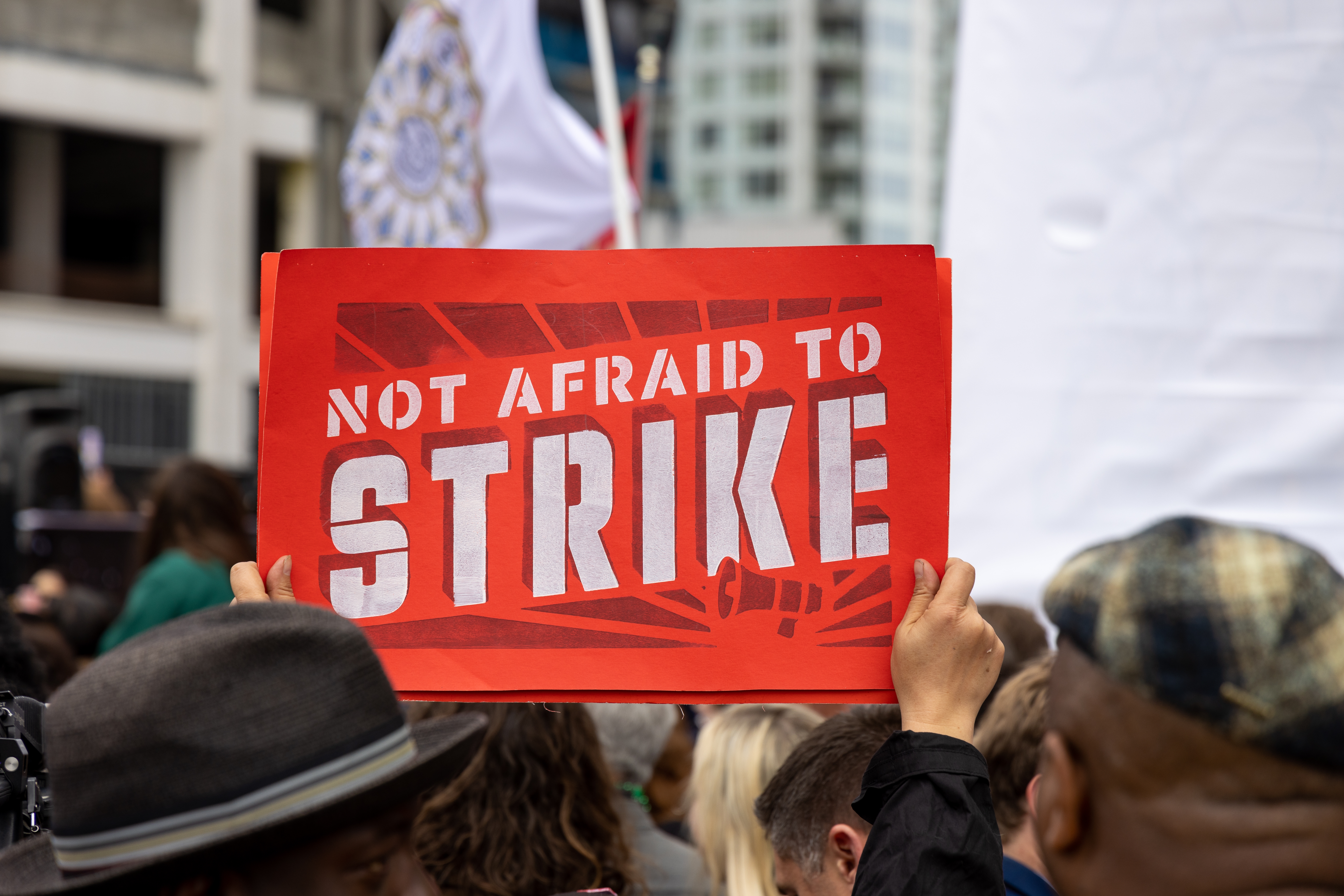
The right to strike is an essential part of freedom of association and is protected under ILO Convention 87. Withholding labour is a crucial negotiating tool during the bargaining process, its main objective is to change the balance of power between workers and the employer.
Here are five key reasons why we need the right to strike:
Striking is a last resort but sometimes the only tool for workers to protect themselves.
To avoid being at the complete mercy of employers.
To give more of a balance between worker and employer power.
Without it, more and more governments will ban industrial action and punish people who dare to strike.
Most strikes are over pay and better working conditions. Without the threat of strike action, corporations will be able to make bigger profits, while working conditions will get worse.
The right to strike confirmed under international law
In a landmark ruling in May 2026, the International Court of Justice confirmed that the right to strike is protected under ILO Convention 87 on Freedom of Association. The advisory opinion, the result of more than a decade of campaigning by IndustriALL and fellow global unions, settles a long-running dispute with employer groups who had sought to strip the right to strike from Convention 87’s protections. While advisory opinions are not legally binding, they carry significant authority. With Convention 87 ratified by 158 countries and embedded in UN labour standards, OECD guidelines and international trade agreements, the ruling has far-reaching implications for workers worldwide.
Photo 1 : Jack Quillin – Los Angeles California 05 26 2023 Writers Guild of America Grève dans le centre de Los Angeles – Picket Signs
Photo 2: Ringo Chiu – People holding signs take part in a protest at the University of California Los Angeles campus Tuesday, Nov. 15, 2022 in Los Angeles.
Fight for jailed Belarusian unionists continues
The ILC is the ILO’s annual governing body. It brings together government, employer and worker representatives from its 187 member states. The Broken Chair has become a regular gathering point for trade union solidarity actions during the conference. For example, demonstrations on Belarus were organizeddue to absence of any progress in the country on regular basis for a number of years.
Workers in Belarus face punishment simply for defending their rights. Since the 2020 pro-democracy movement, the government has dismantled all independent unions. It has dissolved the Belarusian Congress of Democratic Trade Unions (BKDP) and its member organizations including the Free Trade Union of Metalworkers (SPM), the Belarusian Independent Trade Union (BNP) and the Belarusian Trade Union of Radio-Electronic Industry Workers (REP), an IndustriALL affiliate. Also, the Free Belarusian Trade Union (SPB) was dissolved.
Dozens of union leaders and activists have been jailed on fabricated charges, with many still imprisoned. In April 2025, global unions stepped up pressure on the Belarusian government through coordinated solidarity actions and formal letters to Belarusian embassies.
The demonstration coincides with Belarus appearing before the ILC’s Committee on the Application of Standards for a special sitting. This is a significant moment of international scrutiny. Moreover, questions are being raised in the ILO credentials committee about the credibility of the official Belarusian labour delegation. This delegation is composed of members of the government-controlled national federation who do not represent workers’ interests.
This follows the Article 33 procedure invoked against Belarus in 2023. That procedure obliges ILO member states to take all possible steps to ensure Belarus implements the recommendations of ILO Commission of Inquiry first established in 2003. Despite sustained international pressure, including a special ILC session in June 2025, the appointment of an ILO special envoy and a further Governing Body follow-up decision in March 2026, Belarus has persistently failed to act. It has not implemented the commission’s recommendations. In addition, it has refused to allow an ILO mission into the country. It has not permitted independent doctors to visit imprisoned trade unionists to assess their health.
Maksim Pazniakou, the BNP chairman, said:
“International solidarity really works, we see it today. We continue to come here repeatedly every year. All imprisoned unionists must be released. Let’s bring freedom of association back to Belarus.”
IndustriALL assistant general secretary, Kemal Özkan, said:
“We are very happy that Aliaksandr Yarashuk is with us. The struggle has never ended and will continue until all our comrades in prison are freed, until Belarus becomes a democratic country and until justice arrives in the workplaces. We will never give up. We stand in solidarity with our brothers and sisters.”
Aliaksandr Yarashuk, BKDP president said:
“Colleagues, friends and comrades, I am very happy to welcome you here. Thank you for coming to support our friends, comrades and Belarusian trade unionists who are in jail. Thanks to your support I am finally free after spending three and a half years in prison. Let’s focus on the next step, which is to free the remaining prisoners, so that they too can join us next year.”
Mauritius garment maker out of style on migrant workers’ rights
Fashion Heights, an international franchise with over 40 stores on the island, which sells branded garments, shoes and accessories, is facing serious allegations of workers’-rights violations. These allegations arose after dismissed workers raised complaints with CTSP.
The CTSP, an IndustriALL affiliate, runs the Migrant Resource Centre in Port Louis. This centre is renowned for fighting for the rights of migrant workers from countries that include Madagascar, Bangladesh, India, and Nepal. Recently, they have also supported workers from the Philippines.
Dismissed, unpaid and forced to leave
On 9 January, the workers were dismissed during their probationary period. Their termination letters acknowledged obligations by the employer to pay final salaries, notice pay and outstanding overtime.
According to the CTSP, the workers have since left the country without getting paid, despite repeated follow-ups with the ministry. During their last days in Mauritius, the workers had no wages coming in. Moreover, employer-provided accommodation was withdrawn and workers were left to rely on friends and informal support networks for food and shelter.
Twenty other Filino workers continue to work under exploitation for fear of being forced to leave Mauritius and having their passports red marked. This red mark means they will not be allowed to visit Mauritius in the future. CTSP describes these violations as modern slavery.
Workers employed at Fashion Heights say they were routinely made to work between 10-12 hours a day. Hours rose to around 14 in mid-December when business was at its peak. They received no overtime pay for those extra hours, which is in breach of Section 24 of the Workers’ Rights Act 2019. The complaints have also been taken to the ministry of labour.
Further, the workers say the company held onto their passports and identity documents, limiting free movement. Requests for annual and sick leave were refused or discouraged, contrary to Sections 45 and 46 of the same Act. Also, payslips were not provided, making it impossible for workers to verify whether their wages, which are subject to deductions for food and accommodation, were correctly calculated.
Complaints can lead to repatriation
The six workers formally lodged complaints. Several continued in their jobs for fear of losing income, accommodation and of jeopardizing their immigration status. One worker says she was told that complaining could result in repatriation and the loss of employer-provided housing.
Under the Non-Citizens (Employment Restriction Act 1973), a migrant worker’s right to remain in Mauritius is tied to their employer. Losing a job can mean losing a home and a legal right to stay on the island. CTSP argues that this dependency gives corrupt employers an excuse to violate workers’ rights that are protected by the law.
Reeaz Chuttoo, CTSP president said:
“It seems that labour standards exist only on paper for migrant workers. But the union will fight to make them exist in practice by campaigning for the enforcing of the Workers’ Rights Act.”
Paule-France Ndessomin, IndustriALL regional secretary for Sub-Saharan Africa added:
“Mauritius markets itself as a rule-of-law business hub. But this is not the reality for migrant workers. International and national labour standards must be implemented to end migrant worker exploitation.”