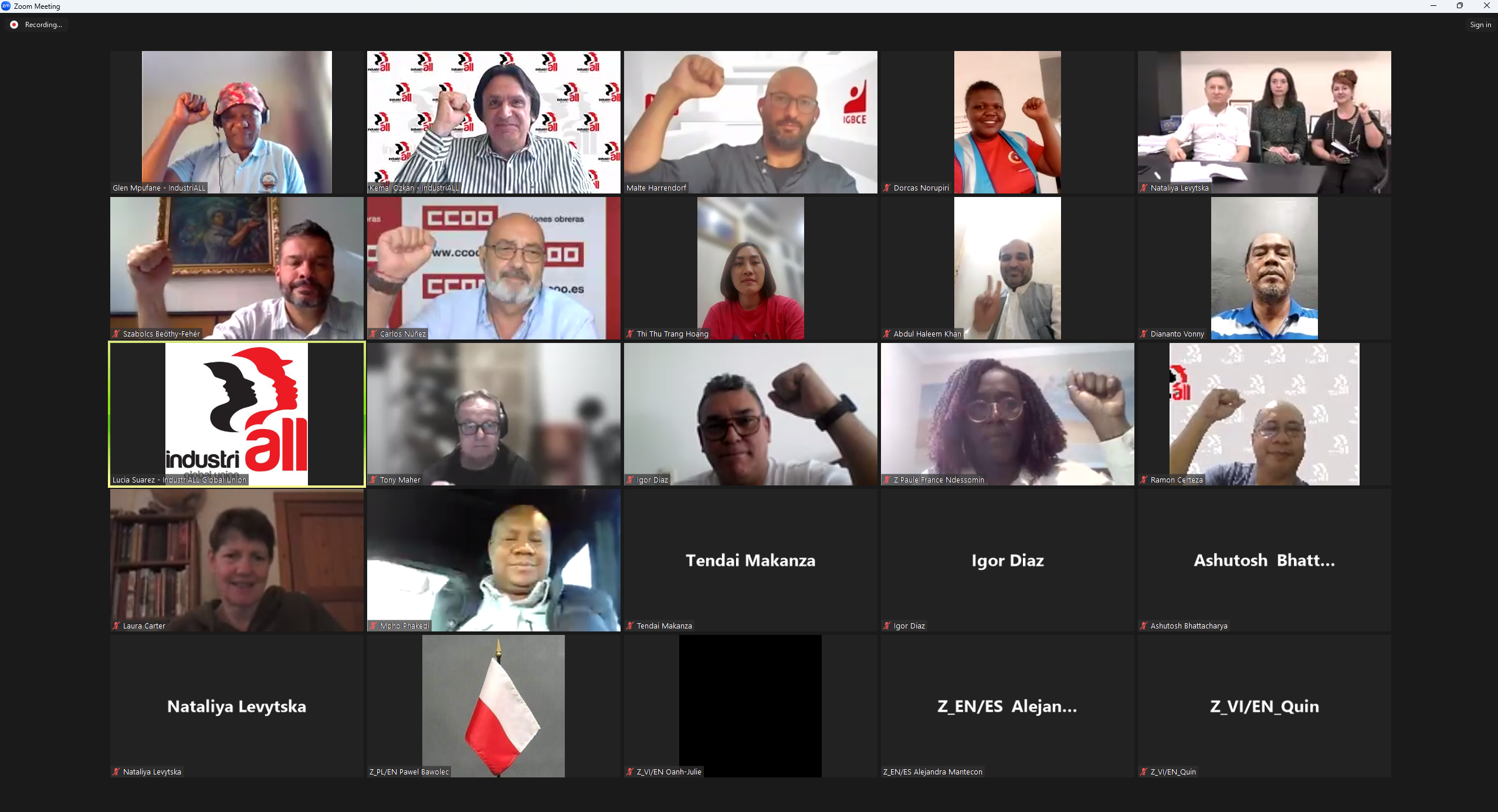
Improving the H&M Global Framework Agreement together

The meeting brought together trade union representatives and H&M staff from six key production countries: India, Bangladesh, Türkiye, Cambodia, Pakistan, and Indonesia. Australian and Japanese affiliates, representing IndustriALL’s textile, garment, shoes, leather (TGSL) global steering committee also participated. 
 
The meeting aimed to review and update the GFA, improve case handling and access to remedies, enhance the quality of collective bargaining agreements (CBAs) in H&M supplier factories, and address gender-based violence and harassment in the workplace (GBVH). The collaborative atmosphere enabled a thorough examination of the GFA's impact and effectiveness across various regions and contexts.
 
Trade union representatives shared valuable insights and experiences from their countries, highlighting successes and areas for improvement. Indian trade unions stressed importance of raising supplier awarness about the GFA’s components and requirements through proactive engagement. This initiative aims to ensure all parties understand their roles and responsibilities, fostering better compliance and cooperation.

Pinar Ozcan, president of Öz Iplik-Is an IndustriALL affiliate, provided an overview of the pilot implementation of the GBVH guideline in six supplier factories in Türkiye. 

“During the pilot of the GBVH guideline, the key takeway was the importance of clear communication and consistent implementation to address gender-based issues effectively. The experience of working with H&M was collaborative and dedicated, leading to meaningful progress in creating a safe and respectful workplace environment,”

 stated Pinar Ozcan.

The meeting in Phnom Penh showcased the commitment of all parties involved in the GFA. By sharing experiences and lessons learned, trade unions and H&M staff are now better equipped to tackle ongoing challenges and enhance working conditions across the supply chain. The continuous dialogue and cooperation during these sessions will be vital for maintaining the momentum of positive change. 
 
Julia Bakutis, labour rights and industrial relations lead, H&M Group said:  

“Our Global Framework Agreement with IndustriALL and IF Metall is a cornerstone of our supply chain social impact strategy. It is more than just a piece of paper: The National Monitoring Committees, where H&M colleagues and IndustriALL affiliates work together in different manufacturing countries, enable us to implement our agreement in a way that ultimately benefits the workers who make our products. It has been many years since we have met in person, and I can see that the great results of this meeting will lead us to even greater impact in the future.”

The updates and insights from this meeting will play a crucial role in refining the GFA, ensuring that it continues to be a strong and effective tool for promoting fair labour practices and safe workplaces globally. 

“Collective engagement and action are necessary for progress and development. Being together in the same space allows us to obtain a clear understanding of situations in different countries and to jointly develop a strategic way forward to benefit workers in the H&M supply chain,”

said Christina Hajagos-Clausen, IndustriALL textile director.  
 
The NMC consists of H&M Group representatives working on the ground alongside national-level trade union representatives affiliated to IndustriALL. They oversee the implementation of the GFA within the specific country context and part of their role is to facilitate conflict resolution for employees and employers at factories.
 

Thai confederation demands inclusion of ILO conventions in FTA negotiations

Prasit Prasopsuk, IndustriALL affiliate CILT president, said Conventions 87 (Freedom of Association and Protection of the Right to Organize) and 98 (on Right to Organize and Collective Bargaining) are particularly important to Thai workers as they are facing endless anti-union discrimination, the two conventions should be one of the main prerequisites for FTA negotiations.

“We emphasized that trade negotiations must take sustainable development and protection of labour rights into consideration. The Thai government must engage stakeholders such as ILO and CILT in FTA negotiations and monitor its outcome,”

said Prasit Prasopsuk.

EU representative, Petros Sourmelis, head of the economic and trade section confirmed that the draft sustainability chapter in the EU-Thailand FTA has included ILO fundamental conventions on freedom of association, forced labour, child labour and discrimination. The EU is now waiting for a response from the Thai government.  

He said that when the EU-Thailand FTA is ratified and in force, the EU shall conduct a two-year policy review on the compliance of sustainability chapter and ILO standards. Trade unions have the right to provide information relating to violations of workers’ rights to the EU.

Since 2023, CILT and 25 labour organizations in Thailand have formed the ILO 8798 Convention driving network to demand immediate ratification of these Conventions.

Going forward, the network is planning to submit an open letter to the EU and the Thai government, in October, in conjunction with the next trade negotiation in Bangkok.

“Trade must bring benefits to people and workers. It is IndustriALL’s position that all free trade agreements must include enforceable international labour standards. We stand in solidarity with CILT to demand protection of freedom of association and right to collective bargaining in Thailand,”

said Ramon Certeza, IndustriALL regional secretary for South East Asia.
 

NUMSA considers legal action to stop violence against strikers

Over 10 workers were hospitialized after they were injured when a heavily armed guard opened fire on striking workers.

“NUMSA condemns MAHLE Bher for this unnecessary loss of life of comrade Njabulo Mpulo, the heavy handedness of its security, and the decision by the company to use heavily armed and aggressive security during a protected strike. Workers have the right to strike. We will be considering legal action because we have lost one of our members,” 

said Mzamo Khoza, the union’s regional secretary for KwaZulu-Natal Province.

In another incident at SA Steel Mills, which trades as Alfeco Holdings, four workers were shot with rubber bullets at close range and hospitalized. The workers were protesting the dismissals of 162 workers who lost their jobs after going on a protected strike. The union is demanding protection of striking workers as per the law. The SA Steel Mills workers have been on strike since 22 May and will picket on 7 June at the offices of the Industrial Development Corporation (IDC) to demand recognition of shop stewards so as to enable them to defend workers' rights and interests at the workplace. Further, the union wants compliance with health and safety laws to curb serious regular accidents at the company in which some workers have been killed.

NUMSA has been reminding employers that workers have a right to strike according to the South African constitution and that the Labour Relations Act (LRA) also protects this right. The laws also protect the rights to form and join a trade union and to participate in union activities and programmes.

Additionally, the Occupational Health and Safety Act states that the employer must ensure that the work environment is safe and without health risks to workers. However, during strike action employers have used excessive force to break strikes often injuring workers as in these two cases that NUMSA raised. 

Glen Mpufane, IndustriALL mining director, who is also responsible for health and safety, said:

“The use of excessive force by security companies contracted by employers is unlawful. It is unacceptable that workers continue to lose their lives for exercising their right to strike. This violence against striking workers negates the social dialogue and collective bargaining approaches that unions are always using to resolve labour disputes.” 

Glencore must go beyond words

“Glencore’s extensive workers’ and human rights violations dominated the meeting yet again. We are concerned with the different treatment of workers at different plants, we are worried about lack of worker consultation when mines close and the exclusion of workers in the company’s future,” 

says Kemal Özkan, IndustriALL assistant general secretary. 

The board and shareholders were reminded about the irresponsible closure at Prodeco mine in Colombia which did not involve any social dialogue and transparency.  

“Glencore and Prodeco dismiss staff and then rehire them as a sub-workforce with no support. This often leads to conflicts. There is no social dialogue between employers and workers. This is no way to run a company sustainably. I want to know what measures Glencore will take to avoid these situations, because what you say in public is not what is happening on the ground,” 

says Claudia Blanco, from IndustriALL Colombian affiliate SINTRACARBON. 
 
Jaime Lopez, national secretary of SINTRACARBON, was concerned about the contract between Cerrejon and the government which will end in 2034 which means that the mine will close.

“Employees need to know that there is a plan in place for closure and that they can access it. Does this plan consider labour, community, and environmental aspects?” 

Glen Mpufane, IndustriALL’s mining director, highlighted that the recent strike at Mumi mine in DRC was a result of different treatment of workers employed by the same company, Glencore.  
 
IndustriALL stressed that Glencore needs to address the arsenic air pollution at the Rouyn-Noranda’s smelter in Quebec, which emits the carcinogenic 30 times more than the allowed provincial limit. IndustriALL and its affiliate Fédération De L’industrie Manufacturiere (FIM) intend to urgently push for fast tracking the AERIS initiative. 
 
The Glencore CEO and chairman tried to address the issues raised but much like last year workers were told to speak to regional management.  

“We are cautiously optimistic; the CEO and the chairman came across as engaging. They indicated that they are willing to engage further, and we intend to hold them accountable to that. They can’t portray one image publicly and behave differently on the ground, they must take responsibility for all their actions,” 

says Glen Mpufane. 

Nigerian unions suspend strike to allow for negotiations with government

The unions announced they are entering into dialogue "to achieve favorable outcomes and safeguard the rights and welfare of all Nigerian citizens and workers."

The unions, who proposed 494 000 Naira ($332) as a national minimum wage, rejected the government’s minimum wage proposal of 60 000 Naira ($40) which they say is inadequate for workers to meet the ever-increasing cost of living. According to official reports, the Tripartite Committee on the national minimum wage is meeting to consider the union proposals.

Workers strated the strike on 3 June with most economic activities brought to a halt. Other union demands are on the reduction of the electricity tariff which they say worsens the workers’ financial difficulties. 

“The indefinite nationwide strike action is therefore relaxed for one week from today to allow for a concrete and acceptable minimum wage,”

said Joe Ajaero, NLC president and general secretary of the National Union of Electricity Employees (NUEE), in a joint statement with the TUC. 

Afolabi Olawale, general secretary of the Nigeria Union of Petroleum and Natural Gas Workers (NUPENG) added:

“We urge the Federal Government to utilise this grace period of one week to do all the needful for meaningful engagement and address the concerns of Nigerian workers to avoid further escalation of the crisis.” 

both NUEE and NUPENG are affiliated to IndustriALL Global Union.

“The calls for a national minimum living wage by the union federations are important for Nigerian workers to meet their living expenses and be able to provide for their families. It is unacceptable to promote conditions that create the working poor – where wages fail to lift workers out of poverty,”

said Paule France Ndessomin, IndustriALL regional secretary for Sub Saharan Africa.

In February, unions protested the removal of petrol subsidies through demonstrations and pickets. They argued that the subsidy removal triggered food and transport costs increases and hiked inflation currently over 33 per cent according to the Central Bank of Nigeria. This is the highest level that inflation has reached since 1996, adversly affecting workers' wages. Additionally, the unions expressed concerns that the government’s austerity economic policies were anti-worker and exposing the poor and marginalised communities to poverty.

Strenghtening supply chain relations in Bangladesh

ACT Bangladesh currently operates an interim dispute resolution mechanism (DRM) for all complaints not related to health and safety. All health and safety complaints fall under the scope of the Accord/RSC. On 29 May, ACT signatory brands and trade met to discuss the priorities for effective dispute resolution.
 
On 29 May, ACT signatory brands and trade unions met to discuss the priorities for effective dispute resolution. Fifteen of IndustriALL’s affiliates and representatives from H&M, Big W, Next, Kmart, Inditex, Primark, Tesco, Tchibo, PVH, G- Star Raw, C&A, ASOS, Bestseller and Sainsbury’s participated in the meeting. Union members strongly advocated for brands to play a more active role in safeguarding workers' rights to freedom of association and preventing the blacklisting of union-active workers.
 
The head of the Ready Made Garment Sustainability Council (RSC) complaints unit, Ovijit Mutsuddi, gave an update on the Accord/RSC pilot. Under the International Accord, the parties have agreed to pilot the expansion of the complaints mechanism and the RSC Board of Directors approved the pilot to start in Bangladesh. 
 
IndustriALL textile and garment director Christina Hajagos-Clausen met with the newly elected leadership of the Bangladesh Garment Manufacturers and Exporters Association. Emphasising the need for sectoral bargaining, she highlighted the importance of supporting the Injury Insurance Pilot and maintaining collaborative efforts for industry safety under the Accord/RSC.

“IndustriALL continues to promote strong supply chain industrial relations in Bangladesh,” 

 said Hajagos-Clausen.

“We call on industry and brands to strengthen our joint engagement on building and fire safety, occupational health and safety, and to engage in sectoral negotiations for long-term benefits to workers in the textile, garment, leather, and shoe industries.” 

The mission also included a warm welcome in Chattogram from leaders of the IndustriALL Bangladesh Council (IBC), including IBC President A M Nazimuddin, BGTLWF President Kutubuddin Ahmed, and BTGWL Chattogram wing President Md. Belal Hossain. 
 
The visit concluded with a visit to Coats Bangladesh, where the Coats Bangladesh Employees Union shared their success in reducing the number of precarious workers through strong collective bargaining agreements.

“Previously, over 50 percent of Coats factory workers were on contract,” 

said Sekh Abdul Mannan, Coats union president.

“After IndustriALL’s intervention in 2020, we negotiated to reduce contract workers to less than ten per cent. Our work in the global trade union network connects us to other unions in the Coats supply chain, and we urge Coats to work with IndustriALL to negotiate a global framework agreement.” 


Excessive violence against labour protestors in Iraq

In a joint statement, IndustriALL affiliates, the General Federation of Oil, Gas and Petrochemical Unions in Iraq (GFOGPUI), the General Union of Oil Workers, and the General Union of Energy in Iraq, condemned the security forces' use of rubber bullets and electric batons to disperse the protesters. This aggressive action resulted in severe injuries to both male and female protesters and led to the arrest of several individuals. 

In their joint statement the unions hold the security services fully responsible for the injuries inflicted on the protesters and demand the immediate release of the detainees. They also called for the formation of a high-level investigative committee to examine the reasons behind the use of such force.

Since 26 May, contract workers at the South Refineries Company, part of the Ministry of Oil, have been rallying to demand permanent jobs. The protests began with a strong security interventions, during which several workers were arrested and others were forcibly dispersed. Despite this, the workers continued their week-long protest, asserting their right to demonstrate. 

The unions have expressed widespread discontent over the violent interventions and have demanded that the government address the workers' demands. They also filed a complaint with the head of the governorate council.

The protesting workers have been employed under 315 contracts for several years without fair resolution of their employment status, creating a tense social climate within the company. Although they were supposed to receive permanent contracts at the end of the legal period, management failed to take the necessary steps to ensure this. Supported by the unions, the workers began protesting to demand urgent action from the relevant Ministry.

GFOGPUI president Hassan Jumaa stated, 

“The peaceful actions will continue because the workers' demands are just. We condemn the violence used by the security forces against the peaceful protesters and call on the Ministry to respond to their demands.”

Abdelkareem Abdelsada (Abu Watan), president of the General Union of Energy in Iraq, added, 

“We condemn the unjustified attack on the workers and call on the security authorities to protect the protesters and release those who were arrested.”

Shaker Barad, president of the General Union of Oil Workers, pointed out that the General Management of the company is responsible for the tension. 

 “The management did not send the Ministry of Oil the list of workers eligible for permanent contracts, nor did they allocate the necessary budget for them. The violence committed is serious, and those who attacked the workers must be held accountable.”

IndustriALL general secretary, Atle Høie said: 

"Such relentless attacks are terrifying and completely unjustified. This is a blatant violation of the right to expression and peaceful protest. Those responsible must be brought to justice. Workers' peaceful actions should be met with social dialogue, not violence. We stand in solidarity with the injured workers and their families, we support the workers' legitimate demands and we demand the immediate release of the arrested workers," 

The fight for jailed Belarusian trade unionists continues

Delegates at the demonstration demanded that the imprisoned leaders be released and stressed that they will continue to fight for trade union rights in Belarus until leaders are free. 
 
Maksim Pazniakou, acting president of the the Belarusian Congress of Democratic Trade Unions (BKDP) said: 

“We thank you for your support. Thank you for keeping the Belarusian agenda a priority. We are aware that Belarusian state unions are trying to fool you and giving you a different picture of what is happening. They failed to tell you the truth, but the truth is being recorded in the UN reports. Long live Belarus.” 

Khaing Zar Aung, president of IndustriALL affiliate the Industrial Workers’ Federation of Myanmar (IWFM), said:

“Us in Myanmar understand your struggle. We stand with the Belarusian trade unions. We will continue to fight for your freedom and democracy. We stand with you in solidarity.” 

“I don’t know how many times we have come here to make the voices of Belarusian workers and trade union leaders heard. Our message has always been clear we will not give up. The only thing that the imprisoned leaders did is fight for their country, defend workers’ rights and defend their people and if that is a crime then we are also guilty. We will continue to fight, we will never give up. Our struggle, our fight will continue until justice prevails in Belarus,”

said Kemal Özkan, IndustriALL assistant general secretary.  
 
Last year the ILC adopted a resolution under Article 33 of the ILO constitution, challenging Belarus’ continued disregard for workers’ rights and imprisonment of over 50 trade unionists. Article 33 tackles non-compliance with a report of an ILO commission of inquiry. This commission was established in 2003 regarding violations of ILO Conventions 87 and 98 and produced a set of recommendations many of which still remained non-fulfilled.
 
To implement the resolution, the ILO held a high-level roundtable to discuss freedom of association in Belarus on 28 May 2024, in Geneva. During the roundtable Anaïs Marin, special rapporteur on Belarus characterized the situation of freedom of association in Belarus as catastrophic. She referred to the violations of the right to freedom of association having become massive over the past four years. 

Her colleague, Gina Romero, special rapporteur on the rights to freedom of peaceful assembly and of association echoed her and called on ILO Member States to provide humanitarian assistance to the persons forced into exile and to their relatives. While Margaret Satterthwaite, special rapporteur on independence of judges and lawyers spoke about rise of political interference with the administration of justice, the absence of an independent bar association, systemic violations of the right to a fair trial, and the use of criminal law to punish trade unionists for the exercise of basic rights and to dissolve independent trade unions.
 
Kemal Özkan, who participated in the session on behalf of IndustriALL, commented

“Labour issues are not isolated in the democratic space of the country and the independent union movement has tried to do its best to democratize at least economic space of the country. Due to this role the authorities tried to discredit, delegitimize and criminalize independent trade unions via their international activities and ties with us.”
 

The government of Belarus indicated that it would not participate in the event.
 

Renault workers in Brazil on strike for more than 25 days

Workers at the Renault Horse factory in São José dos Pinhais have been striking for improved health and safety conditions since 7 May, calling on the employer to return to the negotiating table.

Members of the Gran Curitiba Metalworkers' Union (SMC), part of the National Confederation of Metalworkers (CNTM), affiliated to IndustriALL, went on strike for improved conditions for assembly line workers. The union says that without enough workers, the heavy workload becomes heavy. Employees are given only 5 per cent of their total working time to rest or use the bathroom, which SMC says this puts workers' health and safety at risk.

The union’s key demands include:

As the company failed to provide solutions and to engage in a dialogue, the union had no choice but to submit its demands through two hearings at the regional labour court in Brazil. The union has repeatedly stated that it is open to negotiate with Renault for a safer working environment, which would also improve the company's productivity and competitiveness. However, it says that Renault has not been willing to engage in a dialogue on the issue. 

SMC president Sergio Butka says:

“The path to democracy is through dialogue. The company absolutely must come back to the negotiating table and discuss occupational health and financial issues with workers. All changes within the company should be discussed with and agreed by all parties to find better solutions.“

In a letter, IndustriALL reminde the Renault Group and the Renault Group Works’ Council signed a global framework agreement in 2013, where they jointly committ to promote workers' rights and sustainable development. In 2019 an agreement on the quality of working life was signed, which offers the possibility for, and encourages the launching of, new initiatives and seeks to find appropriate pragmatic solutions to improve employees' life at work, through the negotiation of local agreements.

Says IndustriALL general secretary Atle Høie:

“We urge Renault to respect the commitments made in both agreements and to encourage your subsidiary in Brazil to agree to negotiate better working conditions with the union.”

National action plans in Africa must be inclusive and participatory

Over 20 trade union delegates from 10 African countries participated in a workshop on developing national action plans (NAPs) on business and human rights in Africa in Accra, Ghana, 27-28 May. The unions participated alongside other stakeholders from civil society organizations, national human rights institutions, and governments departments.
 
The workshop, held with support from FES AU and UNDP (Regional Service Centre for Africa) RSCA, promoted learning, sharing and making effective strategies among the NAP stakeholders. There was also emphasis on the importance of inclusive engagement and participatory strategies in the making of the NAPs. 
 
Issues discussed included using NAPS as tools to engage mining companies on community concerns over loss of land to mining operations, and for measures to stop pollution of water sources. NAPs could also be used to stop gender-based violence and harassment and gender discrimination. On union demands, NAPs were key in promoting responsible business practices and human rights due diligence to end workers’ rights violations by some businesses including multinational corporations. Further NAPs were also important to enforce compliance with national and international labour standards.
 
Facilitators included those from the AU and the UNDP RSCA. Notably, the workshop took place at a time when the African Union’s draft policy on business and human rights is in the final consultative stages. So far only three countries – Kenya, Nigeria, and Uganda, have developed NAPs while others including Ethiopia, Ghana, and Tanzania, have begun the consultations to establish the plans. In sharing experiences about the NAP processes, some countries said they were at various stages of consultations. 

Delegates from IndustriALL affiliates, the United Workers Union of Liberia (UWUL), and the Tanzania Union of Industrial & Commercial Workers (TUICO) also participated in the workshop. 
 
Beatrice Francis Ouko, from TUICO said:

“We learnt a lot from experience sharing on the Ghana NAP processes and were also able to meet with Tanzania’s Commission for Human Rights and Good Governance, who are leading the NAP process in Tanzania. This will enrich union engagement.” 

Amanuel Desalegne, FES AU programme manager said: 

“Africa's abundant natural resources demand that laws be harmonised, and synergies increasingly built to ensure that human rights are protected and respected and that remedies are accessible to victims of abuses including workers and communities.” 

“This workshop is an important engagement strategy by trade unions with the African Union and other NAP stakeholders. The development of a business and human rights policy by the AU is a positive development in our campaign for the inclusion of labour clauses in AU policies including the African Continental Free Trade Area,”

said Paule France Ndessomin, IndustriALL regional secretary for Sub-Saharan Africa.