Feature
Text: Tom Grinter
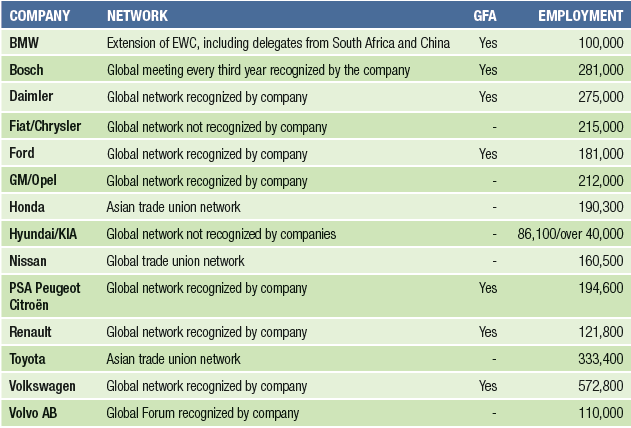
The table below illustrates the developed international trade union structures inside the market-leading automotive companies. IndustriALL Global Union serves as a network of company networks in the industry. International solidarity and union power are exerted to achieve company-recognized World Works Councils that provide top-level mechanisms for labour influence over company strategy as mentioned in the Action Plan adopted by the Founding Congress in Copenhagen in 2012. In all of these bodies IndustriALL plays an important role, recognized by the management. IndustriALL has a seat throughout the entire World Works Council meetings including for the management reporting of corporate strategy.
IndustriALL affiliates organizing internationally in the major auto companies:
Bob King, UAW President and Co-Chair of the IndustriALL auto sector:
In IndustriALL Global Union, there is a vision of economic and social justice without borders. The automotive affiliates are helping to make this vision a reality, working together in new and innovative ways. From Brazilian workers taking swift action to stop retaliation against a Nissan worker in Canton, Mississippi, to
auto unions uniting to condemn violent repression at Ssangyong Motor in Korea, the UAW has found this cooperation inspiring and effective.”
Erich Klemm, Chairman of The Daimler World Employee committee:
As companies extend and enforce their international activities, worker representations must build up transnational structures if they want to prevent workers becoming a pawn to globalized production orders and cross border decision making. The ultimate goal of the international bodies at Daimler is to create mutual trust, time and again, for worker representation across borders in the spirit of solidarity. The meetings ensure equal information for all and discussion on an equal footing with the top management.
We succeed in this with the support of international unions – and including the workers representatives from new sites. Plants and workforces need to have a face for one another.”
The Volkswagen World Works Council illustrates how effective this body can be. All local level Human Resources managers are invited to meetings where the workers’ representatives have a platform to voice local complaints in front of the full international management, CEO and unions. No local level HR manager wants an open discussion of labour complaints in his or her plant, so plant level unions have greatly increased opportunities to reach an agreement in the lead up to these annual meetings.
French auto companies are also well organized internationally by IndustriALL affiliates. The GFAs with Renault and PSA Peugeot Citroën are model agreements with strong language on decent wages, trade union rights, health and safety, coverage of the supply chain and the setting up of a World Works Council to follow implementation.
Helmut Lense, IndustriALL’s Auto and Rubber Director, on World Works Councils:
Companies have to fund trade union travel and participation costs in the meetings, not because of law but because of the power of the union. There is no question of this payment affecting the union’s independence. Depending on the home country of the company, these meetings are usually led by the respective Works Council, not by the management. The Works Council invites management to the meeting and insists that the CEO comes and reports to the union.
The unions say to management that workers need a global structure, that management does not pay for their flights to international meetings, neither should the union. You are doing your work as company management, we are doing our work as the union on a global level. Each side is doing its job and it is paid by the company’.
Numerous standard-setting industrial relations systems and agreements in the industry put pressure on other auto companies to follow suit. The Global Framework Agreement with Ford is IndustriALL’s only GFA signed with an American company. And the pattern of influence is extended down the supply chain, where most violations occur.
The supply chain has added importance in the auto sector compared to other industries, as 70 to 80 per cent of the average car’s value comes from the supply chain. The auto sector does not differ from the general trend whereby the majority of labour rights violations occur in the supply chain. Ensuring supply chain coverage in global framework agreements is a priority for the sector. The above pie chart illustrates the high number of IndustriALL GFAs with companies in the supply chain, the majority of which are German companies for example Bosch, Mann & Hummel and ZF.
Global industrial relations agreements with BMW, Renault, PSA and Volkswagen (VW) have been instrumental in solving conflicts at auto suppliers. On a regular basis IndustriALL coordinates the international intervention to a rights violation in manufacturers within the auto supply chain in Turkey. This IndustriALL response is greatly strengthened by leverage through the network of GFA with the major auto companies buying the product, whether it be rubber seals for the engine, ball bearings, or the wheels.
Exporting union power
The German union IG Metall is IndustriALL Global Union’s largest affiliate. High union density, with an ever-increasing membership has positioned IG Metall to dominate the Works Council mechanism in Germany that was originally established to weaken Germany’s unions. IG Metall uses its sway on the supervisory board of all major German companies in the sector.
Everywhere in the world people still work under appalling conditions and are persecuted and oppressed because they organize a union,”
said Berthold Huber, president of IndustriALL Global Union.
Our central task is to enforce minimum social standards in order to make globalization more humane. We are negotiating with companies on Global Framework Agreements so as to implement minimum conditions in all locations of the company and in their supply chains.”
IG BCE, also large and influential, exerts important pressure within supplier sectors such as tyre, glass and leather industries, while CNM-CUT of Brazil is very active in international auto activities with a strong presence in the sector.
Likewise, the Japanese Auto Workers Union (JAW) use their high union density and influence with management of Japanese multinational companies to lobby in support of fellow autoworkers in other countries. Concrete examples include supporting the organizing drive of the UAW at Nissan’s plant in Canton, Mississippi, the STUHM trade union at Honda’s plant in Jalisco, and Unifor’s organizing efforts at Toyota in Canada.
The JAW is also leading a number of activities to build union networks in Asia. The JAW has taken the initiative to launch, in August 2013, the Asian Autoworkers’ Network. The new network’s common understanding is:
… that it is greatly important for Asian autoworkers’ unions to come together in solidarity and exchange ideas and opinions. We hope this … will contribute to deepen relations among autoworkers’ unions in Asia and eventually lead to MNC union networks that IndustriALL envisions.
Effective international solidarity in action
IndustriALL auto union affiliates from all continents fight for each other in the knowledge that only by achieving decent working conditions everywhere can a sustainable industry be built.
Members struggle against vindictive automotive employers and complicit governments in India, Korea, Mexico, Russia, and Turkey to name a few.
Indian autoworkers similarly constantly struggle for their basic trade union rights and will gain from increased international solidarity from the global union network.
The high-profile example of current ongoing struggle in India is at the Japanese company Maruti Suzuki’s motorbike plant in Manesar. From 15 to 31 January 2014 over 2,000 demonstrators marched to New Delhi from the neighbouring state Haryana to demand the release of 147 arrested workers and the reinstatement of 2,300 suspended workers.
In December 2012, local management of the Finnish car parts multinational PKC sacked 100 workers involved in a Los Mineros organizing drive among other unacceptable tactics to maintain the protection contract at the Ciudad Acuña plant in Mexico.
IndustriALL is working to support a union of Volkswagen workers, SITIA, in becoming a federation structure that can organize especially new auto plants in Mexico. The coverage of the union will then by extended to auto suppliers.
The co-chair of the industrial sector, Gabriela Pignanelli, comes from SMATA, the Argentinian autoworkers’ union that is returning to international activities and becoming more and more active.
“When we fight, we win”
South African affiliate NUMSA regularly mobilizes to win gains for its members in the auto sector, and has established sectorwide bargaining. For example in October 2013 NUMSA’s motor component workers went on strike for four weeks to win a new three year collective agreement with wage rises per year of 10, 8 and 8 per cent.
NUMSA can regularly be counted on to take action in solidarity with fellow autoworkers in other countries. Action in support of the UAW’s organizing campaign at Nissan has been wide-ranging. In mid-2013 NUMSA hosted a UAW delegation for a week of high profile activities culminating in a noisy picket at the Japanese embassy, demanding government intervention to stop union busting at the Nissan plant in Mississippi.
The ITUWA has won good collective agreements in Russia through mobilizing members at Ford, Volkswagen and Benteler Automotive. ITUWA organizes workers at 17 automobile companies and suppliers after establishing itself in 2007 through a successful strike at Ford in St Petersburg.
VW workers in the US denied right to organize
US union, the United Auto Workers (UAW) has played a historical leading role in the sector, and continues to do so. The various UAW organizing drives at factories of non-US multinationals continue at differing stages, each has important international union support. The 12-14 February unionization vote at VW in Chattanooga Tennessee confirmed to the world that basic labour rights are not present in the US.
The important vote was undoubtedly derailed by outside political interference. The UAW has filed objections in the US with the National Labour Relations Board (NLRB) over the underlying and deviant behaviour by politically elected officials in the Volkswagen unionization vote in Chattanooga. The UAW lost the representation election, 626- 712, but despite Volkswagen’s neutrality and granting UAW right of access to the plant, an anomaly in such US labour cases, Tennessee politicians inexplicably interfered in the process, and now might have jeopardised future VW expansion in Chattanooga.
Republican Party elected officials in Tennessee, the state’s Governor, Bill Haslam; US Senator, Bob Corker; and an influential state senator, Bo Watson, all heartily joined right-wing lobbying groups invading Chattanooga to thrash the UAW and crush the 22-page neutrality agreement worked out by the UAW and Volkswagen, with assistance by IG Metall of Germany.
Forty-three votes was the difference,
said UAW secretary treasurer, Dennis Williams at a press conference following the vote.
It’s very disturbing when this happens in the United States of America when a company and union come together to have a fair election process.
Organizing Nissan workers in the US
After Nissan workers in Canton, Mississippi, began an effort to form a union and approached the UAW for assistance, local management responded harshly by conducting intensive group and one-on-one meetings and showed antiunion videos to communicate its strong opposition to the union. These activities have created an atmosphere of fear and intimidation that is clearly in breach of the workers’ right to make a free choice regarding unionization.
IndustriALL registered serious concerns regarding Renault-Nissan’s response to union organizing efforts in the United States to CEO Carlos Ghosn in March 2014.
General secretary Jyrki Raina’s letter stated:
While I applaud Renault’s signing of the Global Framework Agreement (GFA), and the Alliance’s public commitment to respect global labour standards, including those contained in the OECD Guidelines for Multinational Enterprises and the United Nations’ Global Compact, it is important to recognise that Nissan’s conduct at its U.S. assembly plants is inconsistent with these internationallyrecognized labour standards. Renault- Nissan cannot claim it is respecting workers’ human rights by merely complying with weak U.S. labour laws.”
In its support of UAW’s organizing drive at Nissan IndustriALL works with automotive affiliates in Japan, France, Brazil, South Africa, and elsewhere around the world.
Setting the common plan of action
In his role as IndustriALL Automotive and Rubber Director, Helmut Lense facilitates annual meetings of the IndustriALL Automotive Working Group that brings together autoworker unions from at least 18 countries and all of the auto companies. The working group discusses and sets common strategies and concrete actions for the sector aiming to stabilise the relationship between the unions, companies and countries to support organizing everywhere and to help strengthen existing and new unions in the sector, in line with the IndustriALL Action Plan.
The location of the working group meetings is strategically chosen; in 2010 it started in Detroit, USA, to discuss the organizing strategies of the UAW. In 2011 and 2012 the meeting was held in India and Russia to build connections between local unions struggling to begin organizing drives together with union representatives from the companies’ home union. In 2013, the meeting was conducted in Japan to develop the vitally important relationship with the Japanese unions. And in 2014 the meeting will be in Thailand to strengthen the Asian union movement in the sector and to show Asian unions that IndustriALL is focusing on the region and supporting their efforts.
Another important area of work for the sector is to focus on these specific countries: Mexico, India, Russia and China. Specific focus on India began in 2014, seeking to build unity amongst the Indian auto unions and to develop relations and solidarity between the Indians and headquarter unions from the various auto companies such as Ford and Daimler.
Next year a new focus will begin on Russia, and the country focus that began in 2013 on Mexico will continue. These country specific activities are run with a small group of key union leaders who have real influence inside their respective companies. Each workshop works to a similar structure, with the two priorities to increase awareness of the local conditions and then to build the connections between local unions and the headquarter union.
From the IndustriALL Global Union Action Plan:
To fulfill its mission IndustriALL will work towards the following goals:
- Develop cross-border recruitment and organizing campaigns by using union networks in MNCs and Global Framework Agreements (GFAs)
- Build genuine union power to rebalance the power of MNCs in favour of workers by uniting workers in networks for solidarity and joint action, including global level corporate campaigns
- Push for recognition from employers for formalized World Works Councils and networks
- Pursue agreements with MNCs to establish mechanisms of regular social dialogue at global and/or regional level to enable constructive industrial relations leading to global level negotiations
- Build up the necessary organizational procedures to enable the conclusion of agreements beyond GFAs with MNCs
Jyrki Raina, general secretary of IndustriALL Global Union:
We are proud of the advances made in the auto sector in building union power through networks. Strong networks and high levels of organizing combine in the sector to empower workers throughout the supply chain and make GFAs a strong tool. GFAs remain one of the best ways to secure workers’ rights and improve conditions in multinational companies in our globalized economy.
We will continue to support GFAs to negotiate, monitor compliance and improve conditions. Global capital is an immense force, its power must be tempered by the power of people acting together.”


