Highly globalized with millions of employees worldwide, the textile and garment sectors are a large source of precarious employment in the developing world. The sector is composed predominantly of low paid workers who are mostly young women and internal migrants working on short-term contracts.
A change is needed, including an urgent need for social protection for garment workers. The current model, where severance is the only form of social protection, led to wage theft during the pandemic.
By social protection, we mean protective measures that are part of a worker’s basic rights and that underpin a robust and more equitable workplace.
Among others, those measures include:
unemployment insurance
sick pay
social security
severance pay
In 2022, Bangladesh’ ministry of labour and employment launched a pilot for an employment injury scheme in collaboration with the International Labour Organization, covering the country’s four million ready-made garment workers. It is a social protection scheme which includes compensation for medical treatment and rehabilitation services, as well as income loss caused by occupational injuries and disease.
Says Christina Hajagos-Clausen, IndustriALL textile and garment director:
“Unions, governments and brands all have a key role in ensuring social protection. From securing fair wages and safe working conditions to building long-term sustainability, collective action is the key to progress.”
Fighting for migrant workers' rights amidst an industrial boom
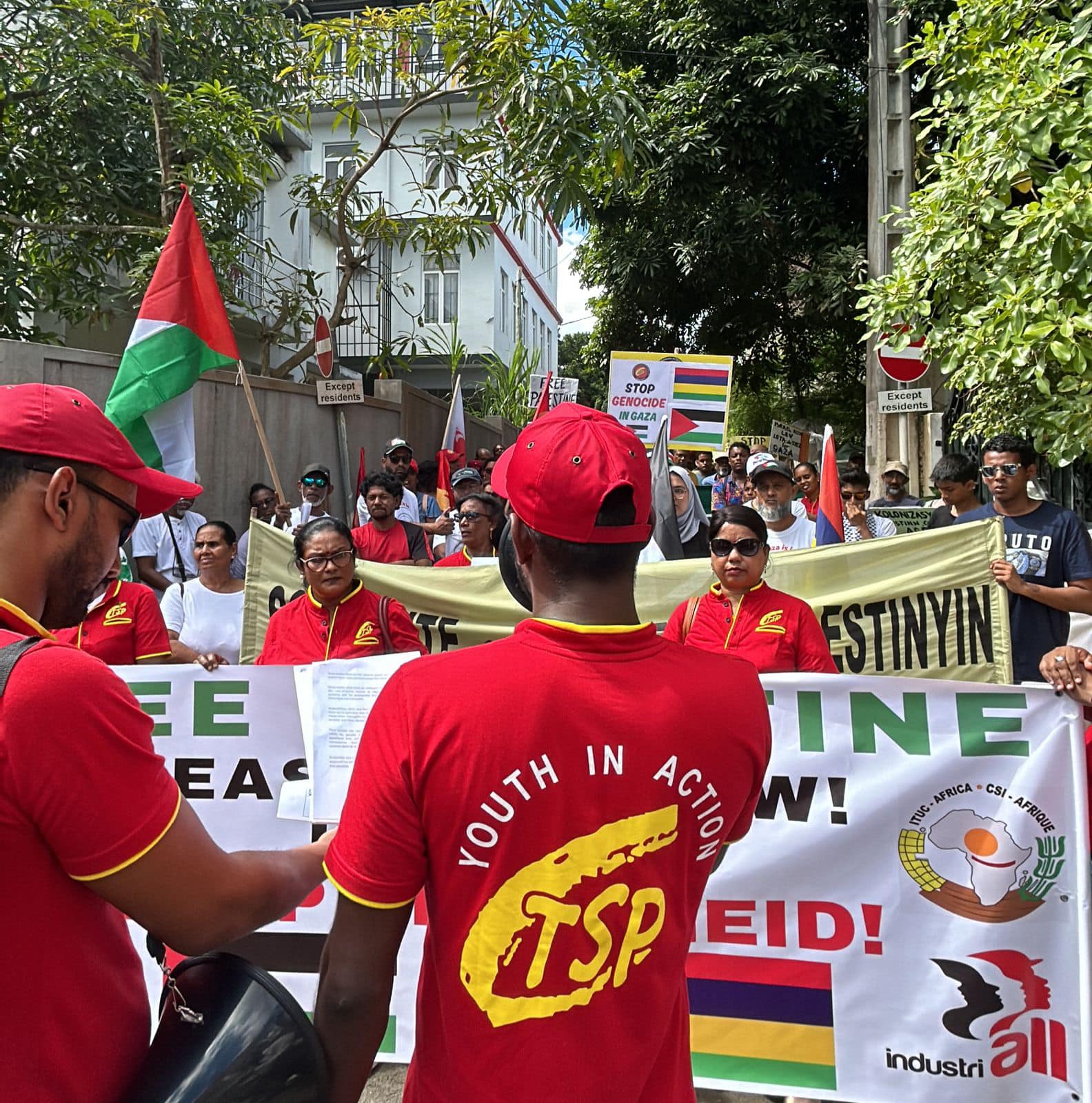
Mauritius has seen quite an industrial revolution in the textile sector, a field that "has spearheaded the structural transformation of the Mauritian economy," according to Shayn Ishwaren, a representative from the CTSP-SINNASSAMY. The industry is a major economic engine, generating substantial foreign direct investment, creating numerous jobs, and positioning Mauritius as a key exporter to major markets including the U.S., Europe, and South Africa.
However, beneath this shiny exterior lies a stark reality faced by migrant workers, who often suffer from discriminatory practices and unequal treatment.
"We've seen that more and more workers are suffering from discriminatory laws,"
Ishwaren explains, highlighting the plight of these workers, particularly women, in the textile sector.
The demographic shifts in Mauritius have exacerbated the situation. As the local youth migrate overseas in pursuit of better opportunities, the resulting labour void is filled by migrants who, while crucial, are often left vulnerable under national policies.
"This has created a lack of labour in Mauritius, and to fill in that void, the Mauritian government is encouraging the influx of migrant workers,"
Ishwaren notes, outlining the demographic crisis fuelling this dependency on migrant labour.
Addressing these challenges, the CTSP has managed to bring hope to a problem that seems insurmountable. They have implemented innovative strategies to support these workers, starting with free union membership for all contractual, migrant, and precarious workers.
"What happens is that we built a solid solidarity chain that is implemented by local workers when they contribute to our union,"
Ishwaren says, emphasizing the collective effort to uplift every worker.
Language barriers and legal complexities further complicate the lives of migrant workers. The CTSP combats this by ensuring that migrants have access to vital information and support. "One thing that I do when I welcome one migrant worker is always end by telling him or her to go back to their dormitory, to go back to the factory and spread the word," Ishwaren shares, illustrating the grassroots approach the union takes to educate and empower.
In recent years, the CTSP has also achieved significant legislative victories that protect migrant workers’ rights.
"We had a simple word in legislation that has created big obstacles for migrant workers. We've lobbied to change legislation to add employer-employee relationship. And this made the huge difference,"
Ishwaren proudly states, referencing the transformative impact of their advocacy.
Moreover, the union's proactive stance against the unfair deportation of workers and their efforts to establish the Migrant Resource Centre (MRC) with the support of ASOS, Antislavery international and IndustriALL Global Union, underscore their comprehensive support system. The MRC serves as a safe haven where migrants can seek help and information, free from the threats of violence and discrimination.
Shayn Ishwaren at a demo in Mauritius to stop the genocide in Palestine. Credit: CTSP
The efforts of the CTSP in Mauritius highlight a powerful narrative of resilience and solidarity in the face of systemic challenges. Through persistent advocacy, legislative victories, and grassroots mobilization, the union is not only protecting but also empowering migrant workers who help sustain one of the country’s key economic sectors. As Mauritius continues to evolve, the role of the CTSP remains crucial in ensuring that the rights and dignity of every worker are upheld, paving the way for a more inclusive and equitable environment.
15 coal miners killed in Pakistan
On 9 January, 12 miners were buried under tonnes of debris when a methane gas explosion caused a collapse at a coal mine in the Sanjdi area of Balochistan. Rescue efforts took four days to retrieve workers' bodies. According to regional news reports, the mines and minerals department is taking legal action against the mine owner for not ensuring adequate workplace safety measures.
On 11 January, a mudslide in Duki coalfield claimed one mine worker’s life.
A coal mine collapsed in Balochistan’s Harnai district on 12 January, killing two miners and trapping six others, who were later rescued.
Every year, Pakistan's mines claim workers’ lives due to poor gas and flood warnings, inadequate lighting, lack of training, first-aid centres and doctors close to mines, as well as a lack of supervision, worsened by weak implementation of safety laws by government authorities. In addition, occupational diseases such as silicosis, lung fibrosis, lung cancer, asbestosis, and mesothelioma remain largely ignored, often leading to fatalities or permanent disability.
These are not stand-alone incidents but a recurring phenomenon in Balochistan’s coal-rich areas. According to IndustriALL affiliates in Pakistan, at least 190 coal miners were killed in 2024 in workplace incidents. The exact figures are probably to be higher due to under-reporting.
Mining unions, including IndustriALL affiliates and the Pakistan United Workers Federation, have repeatedly urged the government of Pakistan to enforce safety protocols and improve access to healthcare for miners.
Kemal Özkan, IndustriALL assistant general secretary, says:
“IndustriALL strongly condemns the tragic loss of coal miners’ lives, a direct result of the persistent lack of proper safety measures. Structural reforms, enhanced safety protocols and accountability at all levels are urgently needed. Without immediate action, miners will continue to die in preventable accidents, leaving countless families devastated. We call on the government of Pakistan to urgently ratify ILO Convention 176, a critical step toward ensuring safe and secure working conditions for coal miners.”
Photo: Shutterstock
El-Sen fights for energy democracy in Northern Cyprus
Opposing the privatization of the Cyprus Turkish Electricity Agency (KIB-TEK), El-Sen calls for its transformation into an autonomous body. The union argues that energy policies should prioritize scientific expertise over political interests and insists on the urgent enactment of the autonomy bill, which has languished in Parliament for years.
KIB-TEK is responsible for the generation, transmission, and distribution of electricity in Northern Cyprus, operating under existing electricity laws. All KIB-TEK employees are members of El-Sen. Meanwhile, Aksa Energy, a private producer, supplies about half of the region’s energy needs but lacks union representation.
El-Sen has raised concerns about the commercialization of energy, including importing electricity from Turkey via cable, citing rising costs for consumers and mismanagement within KIB-TEK. The union has criticized political leaders for inadequate investment in renewable energy, crucial for the region’s future.
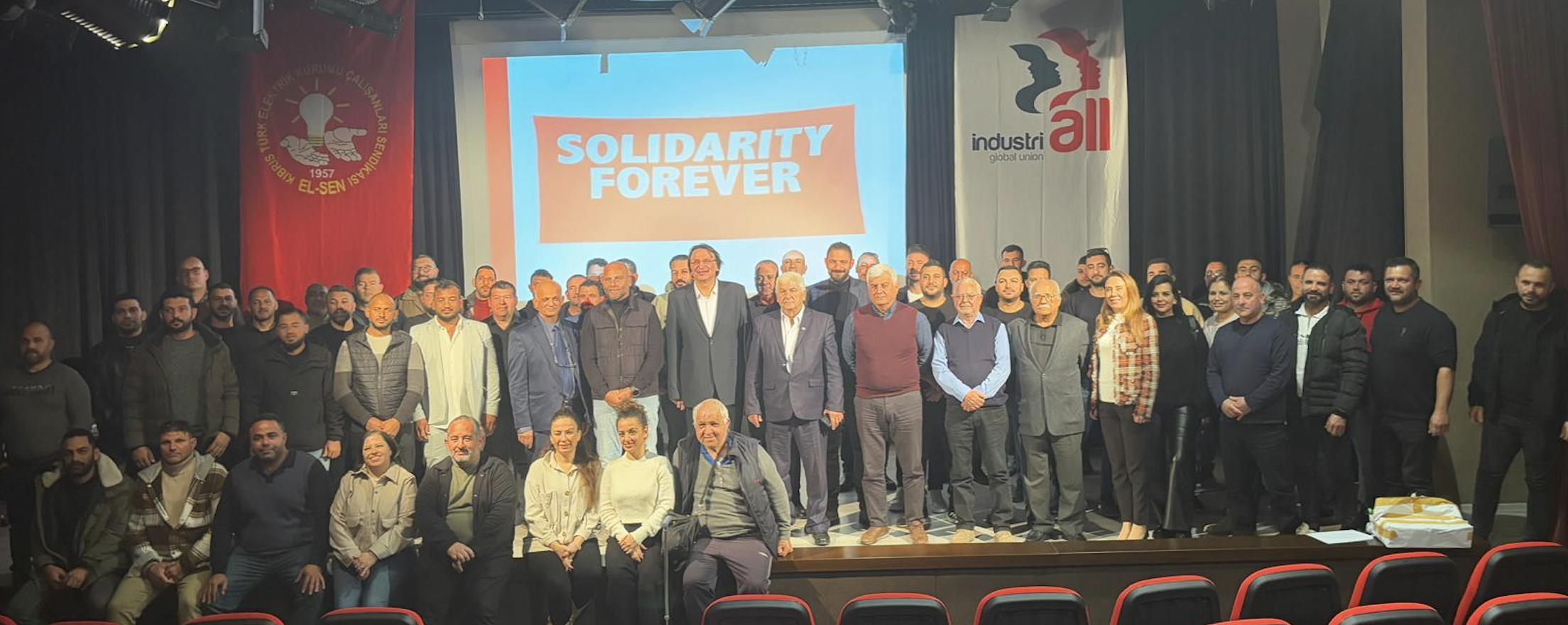
At the Sustainable energy policies and autonomous energy management from a global union perspective conference in Nicosia on 25 December, IndustriALL reaffirmed its support for El-Sen.
IndustriALL assistant general secretary Kemal Özkan said:
"Energy is a basic need and a public good. Its production and distribution must be governed by public policies in the public interest. Our solidarity with El-Sen remains strong."
El-Sen President Ahmet Tuğcu stressed that:
"IndustriALL’s backing strengthens our resolve in this struggle."
Following a general strike on 26 December, which brought Northern Cyprus to a standstill, the government withdrew the contested bills, marking a significant victory for the unions.
Turkish metal workers continue to resist
In early December last year, Birlesik Metal-Is decided to go on strike in the workplaces: GE Grid Solutions, Hitachi Electric, Schneider Electric, Arıtaş Kriyojenik (part of Dutch Broadview Group) and Green Transfo (part of French Cahors Group) companies in the transformer-production sector.
A Presidential decree on 13 December banned strikes at MESS workplaces for national security reasons. IndustriALL Global and industriAll European Union condemned the ban, urging employers not to exploit this anti-democratic measure.
Despite threats of dismissal without severance for participating in a so-called illegal strike, metal workers continued their action, asserting their fundamental right to strike and are already seeing results.
On 23 December, Birlesik Metal-Is signed a new collective bargaining agreement with Hitachi and MESS covering four different workplaces of the company with a 60 per cent wage increase in average after a 20-day strike.
Similarly, on 6 January, Birlesik Metal-Is signed another collective bargaining agreement with Schneider Elektrik after a 25-day strike covering different factories with substantial wage increases with the approval of the rank-and-file membership.
On 10 January, after 23 strike days, Birlesik Metal-Is signed a collective bargaining agreement at Aritas Kriyojenik and MESS. With this, strikes at three MESS-member companies have ended successfully with union members' approval and satisfaction.
The strikes are on the 28th day at GE Grid Solutions, on the 16th day at Green Transfo and 22nd day at Arıtaş as of 9 January. While the strike fire is still on, some negotiations are still going on.
IndustriALL’s assistant general secretary, Kemal Özkan, spent New Year’s Eve with the strikers at Green Transfo bringing the solidarity greetings of millions of members of the global and European trade unions.
Meanwhile, members of IndustriALL affiliate Özçelik-Is at Yolbulan Metal in Hatay, Türkiye, have been on strike since 20 June last year, over 200 days, demanding fair wages amid soaring living costs. Kemal Özkan was present in the picket-line delivering a strong message of international solidarity.
According to the data announced by the Turkish Statistical Institute (TUIK), the Consumer Price Index (CPI) increased by 44.38 per cent for 2024. According to the Inflation Research Group (ENAG), which consists of independent academics, the inflation rate for 2024 is 83.40 per cent.
Given the high inflation, Turkish workers and their unions continue to demand wages through minimum wage increase and collective bargaining processes accordingly so that purchasing power can be protected.
“IndustriAll Europe fully supports Turkish workers in their fight for fair and decent wages that are proportional to the countries high inflation. The fact that workers have been banned from striking is an attack on their rights and we will continue to condemn any anti-union and anti-democratic behaviours. An attack on one of us is an attack on all of us,”
said Judith Kirton Darling, industriAll Europe general secretary.
“We continue to be side-by-side with all the strikers until the victory arrives,”
said Kemal Özkan during the solidarity visits.
“Our striking Turkish sisters and brothers have the full support of millions of workers throughout the world in their fight for their rights, interests and dignity,”
continued Kemal Özkan.
IndustriALL youth forum explores the future of work with Artificial Intelligence
IndustriALL Assistant General Secretary Kan Matsusaki emphasized the importance of youth involvement, stating:
“Active participation of youth is essential in developing IndustriALL’s AI policy and to build a collective strategy that is responsive and forward-thinking in addressing the challenges and opportunities of AI.”
The forum opened with a look into the impacts of AI on the world of work. Participants explored how AI is reshaping workplaces and considered both the potential risks and benefits for workers. The discussion highlighted that AI systems could enable trade unions to amplify their power, enhance workplace safety, and boost bargaining capacity through data analysis. However, speakers stressed two crucial considerations: AI systems are costly, and their implementation must be purpose-driven.
“Before implementing AI,”
one speaker noted,
“you need to ask yourself: what is the purpose? Without a clear objective, there’s a high risk of wasted time and resources.”
AI’s impact on employment is challenging to predict and varies based on factors such as a country’s economy, workforce demographics, and implementation strategies. While AI excels at non-routine cognitive tasks, making skilled white-collar jobs particularly vulnerable, women workers face additional risks. The International Labour Organization (ILO) projections indicate that women are disproportionately concentrated in clerical and administrative roles, which are highly susceptible to automation. Furthermore, the underrepresentation of women in STEM fields exacerbates gender inequality in an AI-driven economy.
The forum underscored the urgent need to close the digital divide to ensure equitable access to AI opportunities. Participants advocated for expanding digital infrastructure in the Global South and extending it to rural and marginalized communities. Ensuring access to devices and implementing digital literacy programs were identified as crucial steps in empowering young workers to thrive in a digital landscape.
Trade unionists were advised to focus not on mastering programming skills but on understanding the objectives behind AI systems implemented by employers. This strategic analysis enables unions to effectively negotiate and advocate for fair and ethical AI use.
Participants explored existing AI regulations, with examples from the European Union and Ontario state in Canada. The consensus was to integrate new AI rules into existing frameworks, strengthening established protections rather than creating redundant systems. This approach streamlines implementation while safeguarding workers’ rights.
Speakers also encouraged young unionists to engage with broader societal debates on AI ethics, noting that collaboration with other social movements could lead to more comprehensive responses to AI-related challenges and ethics.
The ecological footprint of AI was another key focus. The energy-intensive nature of data centres and AI infrastructure raises significant environmental concerns. Participants called for greater union emphasis on addressing these issues within the broader climate change agenda. IndustriALL’s unique position at the heart of industries central to the AI value chain offers an opportunity to influence sustainable AI practices.
Dorcas Norupiri, a member of IndustriALL’s Industry 4.0 expert group, urged deliberate action to build an inclusive digital economy:
“We need to take deliberate measures to ensure equal access to infrastructure, tools, and resources for all youth, regardless of geographical location.”
The forum concluded with a strong commitment to equipping young leaders with the skills and knowledge necessary to shape AI’s trajectory. As IndustriALL continues to develop its AI policy, the active participation of youth remains pivotal to crafting a collective strategy that safeguards workers’ rights while embracing innovation.
Image 1: This article is accompanied by an AI-generated image designed to reflect the forum’s themes.
Nexperia Philippines dismisses four union leaders
Nexperia Philippines Inc Workers’ Union is affiliated with IndustriALL Global Union through Metal Workers Alliance of the Philippines (MWAP). After Nexperia Philippines Inc. Workers’ Union successfully negotiated a return to work for workers laid off in October, the union resumed collective bargaining with the employer.
But yesterday, Nexperia Philippines dismissed four union leaders, accusing them of having blocked entry and exit points on 15 November. However, the union officials were merely updating members on the status of collective bargaining.
The union says that the action demonstrates the employer’s bad faith in the CBA negotiations and aims to undermine the union. The union has been subjected to union busting and unfair labour practices throughout the year, and several strike notices have been filed for ongoing disputes.
MWAP secretary Julius Carandang, says:
“The nearly year-long CBA negotiations have caused significant pressure on the workers, resulting in a deadlock forcing them to file a strike notice. This action is a clear response to management's inaction in addressing the union’s reasonable demands for better working conditions and adequate benefits.
“MWAP’s call for unity among all workers, particularly in the electronics sector, is crucial in demonstrating collective strength against any form of exploitation. The fight of Nexperia workers is also the fight of all Filipino workers striving for humane treatment, fair wages and job security.”
Alexander Ivanou, IndustriALL director of ICT, electrical and electronics industries, says:
“IndustriALL strongly condemns the unjust dismissal of four union leaders, including the union president. This is a blatant attack on workers' rights aimed at undermining the union and its collective bargaining efforts. The retaliatory actions confirm the company’s bad faith and persistent union-busting throughout 2024. We stand in solidarity with the union and call on Nexperia to reinstate the dismissed leaders immediately and respect workers’ rights to fair treatment and negotiation.”
Photo credit: MWAP
Global unions demand progress on UN treaty on corporate accountability
The open-ended intergovernmental working group on transitional corporations and other business enterprises with respect to human rights, was established in 2014. It's mandate is to develop an international legally binding instrument to regulate, in international human rights law, activities of transnational corporations and other business enterprises.
The proposed treaty, under discussion for nearly a decade, aims to close glaring gaps in international human rights law and end corporate impunity. Despite its significance, progress has stalled. The tenth round of negotiations, initially delayed, now presents a critical opportunity to move forward.
“Workers cannot wait any longer. A treaty to hold corporations accountable is essential to ensure justice, protect rights, and restore balance in the global economy,”
says Kemal Özkan, IndustriALL assistant general secretary.
In a joint effort, global unions and civil society organizations reiterate the need for a transparent and inclusive process that prioritises the voices of working people.
Trade union priorities for the treaty include:
Broad scope: inclusion of all internationally recognised human rights, including fundamental workers’ rights.
Comprehensive coverage: inclusion of all business enterprises, irrespective of size or sector.
Extraterritorial regulation: access to justice for victims of transnational corporate human rights violations.
Human rights due diligence: mandatory policies and procedures for businesses.
Corporate accountability: clear obligations for corporations under human rights law.
International enforcement: a robust global monitoring and enforcement mechanism.
“The tenth round of negotiations for a UN binding treaty is at a critical stage. We need international binding rules on justice for workers and people, as well as accountability and responsibility for business. It is time to act together for a strong treaty,”
says Kemal Özkan.
Türkiye: metalworkers’ strike banned again
The industrial action, organized by the Birlesik Metal-Is (United Metalworkers’ Union), began on 4 December at Hitachi's Kartal, Tuzla, Dilovasi, and Dudullu plants. On 13 December, the strike expanded to GE Grid Solutions, Hitachi Electric, Schneider Electric and Arıtaş factories. Approximately 2,000 workers, all members of Birlesik Metal-Is, participated to demand wage increases aligned with Turkey’s soaring inflation.
Negotiations with employers' federation MESS had broken down after management offered a 40 per cent wage increase—a proposal deemed insufficient, as it would leave workers earning below the poverty line. The union, in contrast, demanded a 125 per cent increase to offset real wage losses and secure a living wage for its members.
On 13 December, the Turkish government issued a decree postponing the strikes for 60 days, citing national security concerns. Under Turkish legislation, once a strike is postponed, workers are effectively prevented from resuming their action, as disputes must then proceed to compulsory arbitration.
The union strongly disputes the legitimacy of the government’s justification. The affected workplaces produce transformers exclusively for export, posing no discernible risk to domestic security. “Transformer manufacturing factories cannot violate national security,” a union representative stated.
According to the union, local management has sent messages to the striking workers that they must return back the work. It is also reported that police forces were invited around the workplaces to scare workers off from industrial action, as well as reports that striking workers are receiving threats of retaliation with dismissals if they don’t go back to work.
Atle Høie and Judith Kirton-Darling, general secretaries of IndustriALL Global and industriAll Europe, call on employers to respect workers' rights and refrain from enforcing the ban.
“It is evident that legislation is being misused to undermine the right to strike in Türkiye,”
the letter states, highlighting previous rulings by the Turkish Constitutional Court and the International Labour Organization (ILO) affirming the right to strike as a fundamental labour right.
“This is totally unacceptable. Workers deserve fair and decent wages, and the right to collective bargaining must be upheld. We stand with Turkish workers and their unions in this fight.”
Photos: Birleşik Metal İşçileri Sendikası
Iranian steelworkers face retaliation for demanding decent working conditions
A strike in December 2023 was triggered by the company suspending 21 workers and not delivering on promises of wage equality and job classification. Workers demanded the reinstatement of the dismissed workers, alignment of salaries with other steel companies and the implementation of a job classification plan.
Despite management initially pledging to address the demands, little progress has been made. Tensions escalated in October, when four long-serving employees were dismissed for advocating for workers’ rights. Hosein Rezaee, has 17 years of service, Saeed Halvaei, 19 years’ service, Morteza Akbarian, 17 years’ service and Masoud Navaser, was due for retirement.
Union leaders are calling for solidarity to secure the reinstatement of all dismissed workers, emphasizing that their actions were a legitimate defence of workers’ rights and benefits.
IndustriALL assistant general secretary Kemal Özkan says:
“The workers are targeted in response to legitimate industrial action. Trade unionism is not a crime. IndustriALL Global Union strongly supports the fight for reinstatement of the dismissed workers and urges NISC to immediately engage with the workers and their representatives to address their demands.”