Union opposes De Beers plans to retrench 1,214 workers
Venetia is South Africa’s largest diamond mine, producing roughly four-fifths of the country’s output. On 14 July, De Beers and its local sales arm, De Beers Sightholder Sales South Africa (DBSSSA), issued a Section 189A notice announcing the two-year production pause. NUM, an IndustriALL Global Union affiliate, is fighting the move, calling it a devastating blow to workers, families and the communities built around the mine in Limpopo province.
Section 189A of the Labour Relations Act requires employers to consult formally with unions before large-scale retrenchments. NUM says De Beers is treating this as a formality rather than genuine negotiation, presenting a downturn it has long known about as a sudden emergency.
Masibulele Naki, NUM’s national health and safety secretary and chief negotiator for the diamond sector, said jobs should not be sacrificed whenever a company comes under economic pressure and that section 189A exists to explore alternatives, not rubber-stamp a decision already made.
Alternatives on the table
NUM wants De Beers and DBSSSA to exhaust several measures before cutting jobs: retraining and upskilling, temporary job-preservation arrangements, cuts to non-essential expenditure and a review of executive and management costs. The union argues workers’ pay is not the source of the company’s difficulties, and should not be sacrificed to protect profits and executive benefits.
NUM also suspects the production pause could become cover for replacing permanent workers with cheaper, less unionized contract labour once operations resume — a tactic increasingly used by mining companies to cut costs.
NUM says it will participate fully in the statutory consultation while calling on the Department of Mineral and Petroleum Resources and the Department of Employment and Labour to intervene.
“Workers’ wages, jobs and livelihoods cannot become the first target whenever management seeks to cut costs,” said Masibulele Naki.
Paule-France Ndessomin, IndustriALL regional secretary for Sub-Saharan Africa, said:
“Diamond market pressures cannot be used to push workers into poverty. Venetia’s workers deserve a fair process that protects their livelihoods.”
Diamond market under pressure
The global diamond industry faces an acute structural crisis. Between 2015 and 2025 the natural diamond market fell 16 per cent in volume and 33 per cent in value, driven by a flood of cheaper lab-grown diamonds mass-produced in China and India; natural diamond prices have fallen roughly 30 per cent since 2022. Industry responses, including the Luanda Accord’s coordinated marketing fund and calls for mandatory “synthetic” labelling, have yet to stop the decline.
The Luanda Accord was signed on 18 June 2025 in Angola’s capital by a coalition of African producer governments — Angola, Botswana, Namibia, South Africa, Sierra Leone and the Democratic Republic of Congo — alongside De Beers, the African Diamond Producers Association (ADPA), the Antwerp World Diamond Centre, India’s Gem and Jewellery Export Promotion Council and the Dubai Multi Commodities Centre. Signatories commit to allocating 1 per cent of annual rough diamond sales revenue to the Natural Diamond Council to fund a global marketing campaign for natural diamonds.
Five areas where intersectionality changes union work
This is where intersectionality becomes practical. It is not an abstract theory but a way of working. It asks unions to look at who their members actually are, identify where different forms of discrimination and disadvantage overlap and adapt their strategies accordingly.
At the 4th IndustriALL Congress in Sydney in November 2025, affiliates unanimously adopted a feminist resolution calling for intersectional policies where gaps exist. Following Atle Høie, IndustriALL general secretary’s recent opinion on the topic, the next question is practical: what does this look like in day-to-day union work?
Intersectionality in one sentence
An intersectional approach asks one practical question: who is being left behind and what can the union do differently to include them?
Here are five areas where an intersectional approach makes unions stronger.
1. Collective bargaining
Most bargaining teams now address the gender pay gap. An intersectional approach asks one further question: which women are furthest behind and why?
The answer is rarely uniform. It may be migrant women in outsourced roles, women on short-term contracts excluded from bonuses, or older women passed over for training that leads to promotion. For example, a collective agreement may secure equal base pay while subcontracted migrant workers remain excluded from bonuses, promotion opportunities or skills training. A pay equity clause that misses them looks good on paper but leaves the widest gaps open.
The benefit: bargaining that reaches the workers most at risk of being left behind strengthens the whole agreement. When members see that collective bargaining delivers for their own reality, confidence in the union grows and so does collective strength.
2. Organizing
Every union knows where its density is weakest. Intersectionality asks why those workers are not joining and treats the answer as an organizing problem, not a membership problem.
Meetings scheduled when shift-working mothers cannot attend. Materials produced only in the majority language. Recruiters who all look the same. Each is a barrier the union controls and can remove.
The benefit: stronger organizing in exactly the parts of the workforce where unions have the greatest opportunity to grow. IndustriALL’s Action Plan 2025–2029 commits affiliates to strategies that engage and organize young workers, women, white-collar workers and workers in precarious employment. An intersectional approach helps turn that commitment into practical organizing.
3. Education and training
A shop steward is only as effective as their ability to recognize what a member is facing. A grievance may look like a performance dispute and actually be harassment compounded by a worker’s migration status or contract type.
Intersectional union education trains stewards to see the full picture. It also examines access to the training itself: who can attend, in which language, at what time and at what cost.
The benefit: stewards who are better equipped to resolve members’ problems and education programmes that develop the union’s next generation of leaders from the full diversity of its membership.
4. Industrial policy and Just Transition
Industrial change never affects every worker equally. The transition to a greener, more automated industry is not gender neutral and it is not neutral on age, contract type or migration status either. When a plant closes or retools, the workers least likely to be retrained and redeployed are those in precarious contracts, those with care responsibilities that rule out relocation and those already at the margins of the workforce.
The Action Plan is explicit: a gender-neutral strategy towards technological change and the green transition will set gender equality back. Intersectional industrial policy means asking, in every transition negotiation, who gets the new jobs, who gets the retraining and who is quietly left out.
The benefit: a Just Transition that is genuinely just. By identifying who risks being excluded before decisions are made, unions are better placed to defend every worker affected by restructuring, not only the most visible ones.
5. Union structures and leadership
The feminist resolution calls for a change in power relations, structures and cultures within unions themselves, not just in their demands on employers.
In practice: collect data on who holds positions at every level of the union. Give women’s structures and youth structures real mandates, not advisory roles. Look at meeting times, travel requirements and unwritten expectations that filter out everyone whose life does not fit the traditional mould of a union officer.
The benefit: leadership that reflects the workforce the union wants to organize and represent. Workers are more likely to participate in organizations where they can see themselves and believe their voices will be heard.
The objections worth answering
“We don’t have the resources to cater to everyone”
This is the objection union leaders raise most often and it deserves a straight answer. A union may have policies that serve the large majority of members well and the rest only partly and no budget for special programmes on top.
The first answer is that intersectionality is not a set of special programmes. It is one extra question asked in the work the union already does. The bargaining round is happening anyway: before the demands are finalized, ask who the package misses. The steward training is running anyway: check whether it is only accessible to workers who are free at certain times and speak the majority language. Asking these questions costs nothing. Separate programmes for every group is precisely the model this approach replaces.
The second answer is that the partly-protected minority is not a separate problem from the well-protected majority. Consider a factory with 450 permanent workers on a strong agreement and 50 subcontracted cleaners and warehouse staff with little or no protection. No employer attacks the 450 head-on. That is a war with a strong union. Instead, a little more is outsourced each year, the cleaning, then the logistics, then part of production, until a cheaper workforce is doing comparable work alongside union members. From then on, every negotiation starts with a threat to move more work out the door. Retiring members are not replaced. New hires come in on worse terms.
The 450 never lose a battle. Their protection is hollowed out from the side and the 50 unprotected workers are the opening that makes it possible.
Reaching the workers at the margins is therefore not charity from the majority. It is the majority removing the employer’s cheaper alternative. The resources argument has it backwards: what a union cannot afford is to leave the opening there.
“Trying to represent everyone means representing no one”
Some worry that trying to represent everyone means representing no one. It is an old argument and it mistakes complexity for division.
A union that only fully represents some of its members has already made a choice about who matters. That choice is felt by the members at the margins and exploited by the employers who put them there. Divide and rule is not a union strategy. It is a management one.
Intersectionality does not create divisions, it helps unions remove the barriers that divide workers in the first place. When unions understand the different experiences of their members, they are better equipped to build solidarity across gender, race, age, migration status, disability and employment status. Stronger solidarity leads to stronger bargaining, stronger organizing and stronger unions.
Intersectionality does not ask unions to represent everyone at the expense of anyone. It asks unions to be strong enough to represent everyone at once. That is not a dilution of purpose. That is the purpose.
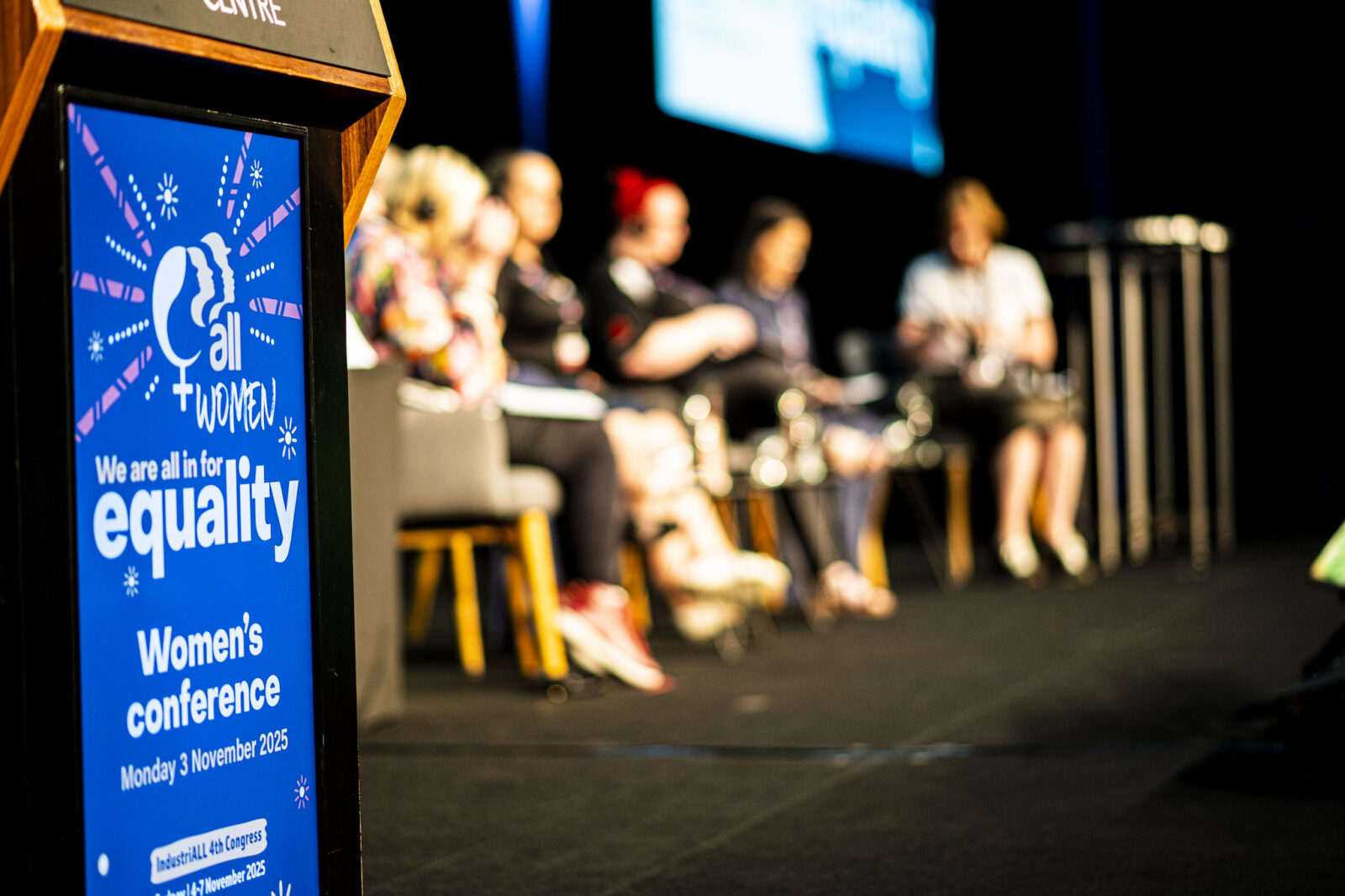
We are all in for Equality, slogan from IndustriALL’s women’s conference in Sydney Australia, november 2025
Ukrainian union leader jailed for doing his job
Zhuhaievych was arrested as chairman of the supervisory board of PJSC Ukrproftur, a company the Federation of Trade Unions of Ukraine set up to manage trade union assets and delegated him to represent as shareholder. The charges stem from decisions the board took collectively, within its lawful powers, which he was obliged to sign.
This should be a property dispute before Ukraine’s civil and commercial courts. Instead, it has become a criminal case against an individual trade union leader. A final judgment of the Supreme Arbitration Court of Ukraine confirmed the lawfulness of Ukrproftur’s establishment. That judgment dates back to January 1997.
The ILO Committee on Freedom of Association has repeatedly found that detaining trade union leaders over their legitimate activities severely violates freedom of association. This applies under Conventions 87 and 98, both ratified by Ukraine. The case forms part of a long-running conflict over trade union property in Ukraine, parts of which have reached ILO supervisory bodies. It also comes as labour law developments in the country already concern unions there.
It also sits awkwardly alongside Ukraine’s bid for EU membership. Judicial independence and the rule of law sit at the core of accession talks. A country cannot advance towards Europe while prosecuting trade union leaders for doing their job.
Together with industriAll Europe, IndustriALL Global Union has written to Ukraine’s President, its prosecutor general, the ILO and the European Commission, calling for Yarema Zhuhaievych’s release.
“The charges against him must be dropped, the property dispute must be settled in the civil courts where it belongs, and trade union rights must be respected. He is, in other words, being prosecuted for doing what his mandate and the law required of him. What concerns us is the use of criminal law, and of prolonged pre-trial detention, against a trade union leader for doing his job,”
said Judith Kirton-Darling, general secretary of industriAll European Trade Union, and Atle Høie, general secretary of IndustriALL Global Union.
KMWU strike over subcontracted workers’ bargaining rights
The strike follows a landmark amendment to Korea’s Trade Union and Labour Relations Adjustment Act. For the first time. the Act allows subcontracted workers to bargain collectively with the principal employers who actually control their pay and conditions, rather than only with the smaller subcontracting firms that formally employ them. Since the amendment came into force, KMWU has put forward collective bargaining proposals across the metal sector. But many multinational companies have simply refused to come to the table, despite the change in the law.
For KMWU members, that refusal is the point of the strike. Subcontracted workers earn just 65.2 per cent of the wage of directly employed workers, according to a survey by Korea’s Ministry of Employment and Labour. And the gap is widening: wages for regular workers grew 15.3 per cent, against only 6 per cent for non-regular workers. Union members say multinational companies are refusing to share the profits that subcontracted workers helped generate.
KMWU is striking for:
good faith bargaining from principal employers
revitalization of industry-wide bargaining, employment and human rights protections as AI is introduced into workplaces
a metal industry minimum wage of 2,608,040 won (US$1,716) per month
a flat base wage increase of 149,600 won (US$98) per month
“The international labour movement hears the voice of the Korean subcontracted workers,”
says Atle Høie, general secretary of IndustriALL Global Union.
“The right to collective bargaining is a fundamental right and has to be respected as such. We are committed to supporting our brothers and sisters in the fight for their collective bargaining rights and decent living wages. We will bring the struggle against precarious work in Korea to the attention of worldwide workers.”
Unions meet to tackle Central Asia’s investment boom
A region in rapid change
The Central Asian sub-region is going through rapid growth and change, as countries democratize and open their economies to the world. Investment is flowing in from China, Russia, the Gulf, Türkiye, European countries and elsewhere, often through joint ventures.
For unions in the region, who have traditionally worked mostly with state-owned enterprises or local private companies, the entry of global capital is a new experience. It raises new challenges, as investors have different expectations over the leeway they expect over their workforce. Different working cultures are also clashing with traditional industrial practices.
The economy is also seeing growth in self-employment and platform work.
Union representation at automobile industry
Automobile industry investments are in increasing in Central Asia, particularly in Uzbekistan. Quite a number of multinationals are already in place and struggle for union representation is a continuous effort. For example, Chinese electric and hybrid vehicle manufacturer BYD recently opened a factory in Uzbekistan with an annual production capacity of 50,000 cars. As part of the joint venture agreement, the metalworkers’ union secured recognition and collective bargaining cover and workers earn more than the national average. However concerns remain about the level of influence unions have to improve conditions further.
Investment across sectors
Investment is flowing into oil, gas and energy and the region is at the beginning of an expected renewables boom, with wind and solar projects under way.
The chemical and pharmaceutical sector is also seeing foreign investment and the commodities boom, with rising gold and copper prices, keeps the mining industry in a strong position.
The development of the Trans-Caspian Corridor, a modern revival of an ancient trade route between China and Europe, is raising the region’s profile as a logistics hub. This is likely to drive growth in supply chain manufacturing for the automotive, energy and other sectors.
New ILO convention on platform work
The ILO ACTRAV senior specialist Gocha Aleksandria spoke about the results of the recent International Labour Conference and the new ILO Convention on the Platform Economy, C193. He also spoke about ratification rates in the sub-region, which are high, and the level and quality of implementation and social dialogue.
Tools for organizing global capital
IndustriALL campaigns and organizing director, Walton Pantland, spoke about tools to tame global capital, including human rights due diligence (HRDD), investor engagement, OECD complaints mechanisms and complaints processes through international financial institutions. He also stressed the importance of organizing newly emerging sectors.
The discussion was lively and unions enjoyed exchanging views on the changing economy and opportunities for union growth.
Interest and appetite from the unions for international cooperation and solidarity
While IndustriALL affiliates re-affirmed their strong commitment for closer cooperation at international level, non-affiliated unions attended the meetings expressed their interest and appetite to learn more about IndustriALL with an intention to join and participate in the global structures.
“The economy in this region is growing rapidly as global capital moves in to invest in raw materials, manufacturing and energy. There is tremendous opportunity for union growth. We need to make sure that this vital part of the global economy is well-organized and that the unions are connected to their peers in other countries,”
said Kemal Özkan, IndustriALL assistant general secretary.
Solidarity has never mattered more: unionists ahead of Durham Miners Gala
Hosted at the historic Redhills Durham Miners’ Hall, the roundtable focused on defending trade union values in industrial communities undergoing profound economic and industrial transformation. Participants discussed the growing pressures created by geopolitical instability, economic uncertainty and the green and digital transitions, reaffirming that workers must remain at the centre of industrial change.
The discussions opened with reflections from ITUC general secretary Luc Triangle on the role of trade unions in shaping a Just Transition and safeguarding quality jobs, workers’ rights and democratic participation.
Atle Hoie, IndustriALL general secretary, said:
“Trade unionism is under attack. We need to stick together and defy anti-democratic far-right movements. We cannot allow for populists exploiting workers’ fear of losing status. Through international trade union solidarity can we push back on corporate profit maximization at the cost of decent wages and trade union rights.”
Speakers highlighted the common challenges facing industrial regions across the world and underscored the importance of cross-border solidarity in defending workers’ interests.
IndustriAll Europe general secretary Judith Kirton-Darling said:
“In volatile times it is more important than ever that unions speak up and show their power against deregulatory and trade union busting policies. As a restructuring wave rolls over Europe unions must send a clear message in defense of proactive industrial policy making with strong social conditionalities that promote quality jobs and strong social dialogue.”
Participants agreed that industrial transformation must go hand in hand with quality employment, investment in industrial communities and strong social protections to ensure that no worker or region is left behind.
The roundtable concluded by looking ahead to the 140th Durham Miners’ Gala, where participants joined trade unionists, workers and their families from across the UK and abroad in one of Europe’s largest celebrations of trade union solidarity.
Organised by the Durham Miners’ Association since 1871, the Durham Miners’ Gala—known as the “Big Meeting”— brings mining communities and trade unionists to the streets of Durham, celebrating the enduring values of solidarity, community and working-class culture.
The roundtable and the gala together sent a powerful message: in times of uncertainty and rapid industrial change, international trade union solidarity remains more important than ever. By standing together across borders, unions will continue to fight for workers’ rights, quality industrial jobs and a Just Transition that leaves no one behind.
South East Asia youth to launch labour education campaign
The co-chair of the recently formed Asia Pacific regional youth committee, Jean Faye Daguman, said:
“We will discuss with union leaders to propagate labour education videos on the social media accounts of IndustriALL affiliates in the region. In the next six months, we aim to reach out to 4,000 young workers and recruit about 700 young workers from seven countries.”
The proposal came out of the third IndustriALL-FES South East Asia youth academy. There, twenty young unionists gathered in Rizal, the Philippines. They identified a lack of labour education and relevant policy as the most pressing issues to address. Notably, labour education is central to organizing young workers into trade unions.
In general, young workers lack knowledge of labour rights. The public education system does not equip them with knowledge of basic legal protections once they leave school and enter the workforce. Popular labour education can help win the hearts and minds of young workers.
Over the four day academy, unionists from Cambodia, Indonesia, Japan, Malaysia, the Philippines, Thailand and Vietnam explored organizing skills. These included workplace mapping and analysis, increasing union density, one-on-one conversations and reaching young workers through online tools.
Building on the global supply chain module from 2025, participants deepened their understanding of decent work in global supply chains. In addition, safeguarding fundamental workers’ rights is essential to achieving decent wages. Organizing in the supply chain and building leverage for workers’ power are also essential for decent wages and working conditions.
Young unionists also had frank exchanges on the differences between senior and young unionists. While acknowledging the value of senior leaders’ experience and knowledge, they called for more opportunities to develop their capacity and make decisions. They also called for sufficient funding for youth development.
IndustriALL youth and project officer, Sarah Flores, said:
“Diversity is our strength. But that strength is worthless if it remains confined to boardrooms. When young people from all countries engage in debate, their primary mission must be to take it to the workplace and organize workers where they are. Our goal is clear: to build a future where people reclaim power over profit through mass mobilization and organization.”
South Africa: First Battery workers strike over retrenchments
The National Union of Metalworkers of South Africa (NUMSA), an IndustriALL Global Union affiliate, called for the strike after First Battery retrenched workers at plants in Benoni, East London, Cape Town and Durban, despite months of consultations aimed at avoiding job losses.
According to NUMSA, First Battery lost major contracts with vehicle assemblers in South Africa and no longer supplies BMW, Mercedes-Benz, Ford or Toyota. Instead of winning back that business through local investment, the union says the company is importing batteries from Germany for BMW rather than upgrading local production to meet automakers’ needs.
NUMSA argues that importing batteries undermines South Africa’s Automotive Masterplan 2035, which targets 60 per cent local content in the automotive industry by 2035. The current local content is about 38 per cent.
The union accused First Battery of wasteful expenditure and of withholding information needed for meaningful consultation under South African labour laws. NUMSA says the company refused to disclose key cost data, including executive pay, electricity costs, and original equipment manufacturer contract terms.
First Battery has offered retrenched workers a severance package of R10,000 (US$616), while NUMSA is demanding R200,000 (US$12,319). The union says the gap shows the company can afford better terms than what it is offering. NUMSA has also criticized Metair for refusing to meet the union before the retrenchments took effect. The union is seeking assistance from the Commission for Conciliation, Mediation and Arbitration (CCMA) to agree on strike-picketing rules after management warnings on possible victimisation of striking workers through disciplinary action.
NUMSA cited Goodyear’s closure of its local tyre-manufacturing plant last year, while retaining its distribution network, as part of a broader pattern it wants regulators to address. The union called on the Department of Trade, Industry and Competition to consider tariffs and import duties to protect South African manufacturers and jobs.
Further, NUMSA wants First Battery to withdraw the retrenchment notices, disclose more financial and strategic information and return to negotiations. The union says talks must include a joint approach to the CCMA and the Unemployment Insurance Fund for a temporary lay-off scheme that would keep workers employed while alternatives are explored.
Irvin Jim, NUMSA general secretary, said:
“There is absolutely no reason why workers should be thrown into the streets to join the sea of poverty, unemployment, and inequality. The least First Battery could have done is to agree with the Union and make an offer of a decent package targeting workers closer to retirement in some companies.”
“In a country where unemployment is high, retrenchments should be a last resort. IndustriALL supports job preservation and encourages employers to negotiate in good faith,”
said Paule-France Ndessomin, IndustriALL regional secretary for Sub-Saharan Africa.
According to Statistics South Africa the expanded unemployment rate which includes discouraged job seekers is 43.7 per cent or 13 million people.
Armenian trade unions stand strong for fundamental rights
Participants underlined the importance of freedom of association and collective bargaining. Gocha Aleksandria, senior specialist at the International Labour Organization’s workers activities bureau (ACTRAV), said one of the ILO’s core objectives is to promote and realize international labour standards, particularly fundamental principles and rights at work. He noted that Conventions 87 and 98 offer important protections against anti-union discrimination and employer interference and promote an environment for voluntary, good-faith collective bargaining.
Karine Aloyan, chairwoman of the Republican Branch Association Electrotradeunion of the Trade Union Organizations of Armenia, stressed the importance of concrete steps toward Armenia’s ratification of ILO Convention 193. She said ratification would strengthen protection of workers’ rights and promote international labour standards.
Sectoral challenges and gender equality
IndustriALL sector directors Alex Ivanou and Emmanuel Adjei-Danso presented sectoral analysis on fundamental rights and collective bargaining. Alex Ivanou covered base metals, mechanical engineering, ICT and electrical and electronics. While Emmanuel Adjei-Danso covered mining and energy.
Aristakes Danielyan, chairman of the Republican Branch Union of Trade Union Organizations of Industry Workers of Armenia, said advancing gender equality in industry is fundamental to decent work and social justice. He said trade unions have a crucial role in ensuring women have equal rights and opportunities at work, including equal pay for work of equal value, decent wages, safe working conditions and equal access to career development.
Social dialogue and safety
ILO specialists Casper Edmonds, Verena Schmidt and Igor Zemlyanskiy discussed the basics of social dialogue: the involvement of workers, employers and governments in decisions on work-related issues, including information-sharing, consultation and negotiation. They stressed the importance of collective bargaining for job quality, equality, labour relations, enterprise performance and macroeconomics, citing examples from mining, manufacturing and energy.
Eduard Pakhlevanyan, chairman of the Branch Union of Trade Union Organizations of Miners, Metallurgists and Jewellers of the Republic of Armenia, said occupational safety and health must remain a top priority in mining and metallurgy. He called for effective implementation of ILO Convention 176 on Safety and Health in Mines and urged Armenia to ratify Convention 155 on Occupational Safety and Health, saying this would align national legislation with international labour standards.
AI and the future of work
Casper Edmonds and Shreya Goel, also from the ILO, discussed artificial intelligence and social dialogue in manufacturing, drawing on international experience. Participants shared where they see or expect to see, AI in their sectors and what is driving it. All agreed that workers should be informed, involved and consulted, in good time, on AI likely to affect them.
Participants said innovation should make workplaces safer and more productive without undermining workers’ rights. AI can help identify hazards, predict equipment failures and prevent accidents, particularly in high-risk industries. But its deployment must be accompanied by meaningful social dialogue, workers’ participation, transparency and ongoing training, to ensure change is implemented responsibly and ethically, in the interests of workers and enterprises alike.
Kemal Özkan, IndustriALL assistant general secretary, said:
“There is a transformation in the Armenian trade union movement, and IndustriALL continues to contribute to it. This summer school with Armenian affiliates shows there is a huge appetite for capacity building and new capabilities in defending and promoting workers’ rights in the country. We will keep going through different programmes in Armenia in the period to come.”
Thousands of workers across Morocco participated in union protests
The Moroccan working class joined a large-scale national protest march in Casablanca on Sunday 28 June 2026. The march was organized by CDT.
Protesters denounced the government’s social policy and the persistent rise in prices. They also spoke out against the collapse in purchasing power, the refusal to increase wages and pensions and continued restrictions on trade union freedoms.
Regional marches organized by the CDT also took place across Morocco on Sunday 17 May 2026, demanding an immediate increase in wages and pensions, an end to the erosion of purchasing power, and fulfilment of social commitments. Participants accused employers of restricting trade union activity and the CDT rejected the purely formal nature of social dialogue, calling for concrete measures on wages, pensions, taxation, social protection and working conditions.
Khalid Houir Al-Alami, general secretary of CDT, said:
“The social conditions in Morocco are worrying and called for urgent intervention to address the impact of the economic crisis on the purchasing power of the working class and the general public. These protests are an expression of the working class’s rejection of public policies that have failed to meet their basic demands, foremost of which are a pay rise, a review of income tax and the fulfilment of social commitments.”
Khalid Houir Al-Alami added that Morocco is experiencing a social crisis that endangers social security, with high living costs, declining purchasing power and rising youth unemployment and that trade union rights are being violated by employers who reject union organizing.
New national march amid deepening cost-of-living crisis
Building on this momentum, the CDT has announced a further national protest march in Casablanca on Sunday 12 July 2026, in continued rejection of the deteriorating social situation and widening hardship affecting broad sections of Moroccan society.
The escalation comes against a backdrop of continued increases in the price of basic goods and services. The price of red meat has climbed to unprecedented levels and fuel prices remain another major concern given their direct impact on transport costs and the price of goods more broadly.
The CDT said the new march protests the failure of successive rounds of social dialogue to respond to workers’ core demands and the continued postponement of urgent issues, chief among them a general increase in wages and pensions, reform of income tax and fulfilment of previously agreed social commitments.
The union also criticized a recent vote by the House of Councillors, Morocco’s second parliamentary chamber, rejecting draft laws that would have capped petrol and diesel prices and reopened the Samir oil refinery, arguing this would have strengthened national energy security.
The CDT further denounced growing restrictions on trade union freedoms and the right to strike, condemning legal actions against trade unionists. For the CDT, the upcoming march is a renewed call for policies to protect purchasing power and strengthen social justice for Moroccan workers.
IndustriALL assistant general secretary, Kemal Özkan, said:
“What our Moroccan affiliates want is legitimate. Inequality is increasing in the world and also in Morocco. It cannot continue in this way, something has to change. IndustriALL is in full solidarity with our Moroccan sisters and brothers in struggle.”