| Acces to reports by day of trial | Background information |
| Gennady Fedynich and Ihar Komlik, chairman and member of the of IndustriALL Global Union Executive Committee, and chief accountant of the Radio and Electronics Industry Workers’ Union (REP), affiliateed to IndustriALL, are accused of large-scale tax evasion. They may face up to three to seven years’ imprisonment. The investigation started in 2017 lasted ten months, and at least 800 REP members were interrogated by the Investigative Committee of Belarus. According to reports, union members were mostly questioned about trade union activities, rather than about the union’s financial matters. |
Prosecutor demanded 5 years of freedom restriction with property seizure
The "trade union case" enters its final stage.
In her final opinion the prosecutor Liliana Litvinyuk has stated that in the period from January 1 to December 31, 2011, a total of US$17,467 and Euro 140,000 of gratuitous foreign aid was received on the accounts in the Lithuanian bank. Prosecutor claimed that Gennady Fedynich and Ihar Komlik "acted on a preliminary conspiracy as a group of persons," who failed to pay the income tax in the amount of BYN 22,867.10 (9,700 euro), thus, causing a large-scale damage to the State.
The prosecutor also requested to consider witnesses’ testimonies given at the stage of investigation prevailing over the ones given in court. A judge’s inquiry, which was carried out by the prosecutor, could not find evidence of psychological pressure exerted by investigators.
In the same time, the prosecutor requested to consider as pressure on witnesses both REP’s appeal to the union members to reject their earlier testimonies given to the investigation and the instruction of the union lawyer on how to protect their human rights during interrogation.
The prosecutor demanded to punish the union leaders with five years of restriction of freedom without incarceration, confiscation of property (including the country cottage belonging to Fedynich's mother-in-law), and a ban to hold senior leadership positions for five years. She also asked to preserve the previous restraint measure – the recognizance not to leave the country.
Defense insists on acquittal
After that, the floor was given to the defense lawyers.
"When I first came to the courthouse, the security guard asked me whether I was going to the 'trade union case'. This, as well as the fact that dozens of trade union members are present every day, indicates that the future of the entire trade union organization depends on the verdict. This is the case of the entire REP, not of its individual leaders," Natalia Matskevich, Gennady Fedynich’s lawyer, stated.
She quoted the international law on the inadmissibility of restriction of freedom of association, "Associations have the right to receive funding from both national and foreign and international sources. Organizations engaged in defense of human rights – civil, political, social, etc., also have the right to receive funding. Any unreasonable restrictions for associations in obtaining funding are a serious interference with freedom of association."
The advocate quoted witnesses' words describing the unprecedented volume of work carried out by the REP, and the important social role of the trade union in defending workers' rights and opposing dishonest employers.
She drew the court's attention to the fact that, a lot of evidence was illegally obtained during investigation: the numbers on CDs do not correspond; wiretapping of telephone conversation began prior to prosecutor's sanction; numerous events and facts have nothing to do with the period of alleged crime.
"What the investigator considers an exchange between REP and the Lithuanian bank is not real, because it is not translated into Russian, and it is impossible to establish the nature of this correspondence. The document, which the investigator calls a bank account statement, does not meet requirements of a bank statement. The 'statement' is a copy of a copy obtained in some unclear way," said the lawyer.
According to the defense, it is possible to talk about tax evasion in case of receiving an official response from the bank about the existence of an account and evidence of funds’ transfer. Such evidence may be deemed sufficient to initiate a criminal proceeding. Investigators tried to get legal aid from the Republic of Lithuania; however, the Lithuanian party refused to provide it. No responses were obtained from the competent authorities of Sweden and Denmark.
The lawyer drew attention to the fact that hundreds of witnesses were questioned within the case. And only few of them, subsequently summoned to the court, could state, in a very uncertain way, that they had transported some money for the needs of the trade union. However, at the trial, the absolute majority of these witnesses refused from their testimonies, explaining that they were obtained under investigators' pressure.
The lawyer expressed serious doubt about prosecutors' request to consider that the written testimonies given at the Department for Financial Investigations (DFI) have greater power than the testimonies given at the trial in presence of the judge and the parties. Besides, the witnesses Grintsevich and Potapova in their testimonies referred to the period different from the one claimed by the investigators. Only the witness Zaprivarina stated that she transported money, but she expressed personal dislike to Fedynich.
Natalia Matskevich summed up that the accusation against her client, Gennady Fedynich, has not been proved and asked for a full acquittal.
The lawyer Lyudmila Kazak, defending Ihar Komlik, also asked to fully acquit her client and abolish seizure of his property.
One of prosecutors expressed the opinion that the defense lawyer had interpreted the norms of legislation too broadly, Natalia Matskevich said,
"I believe that, from the point of view of serious lawyers, the excess of incomes over expenses shall not be established through speculative talks, but through a special inquiry conducted by tax authorities. And this was not done."
The judge Marina Fyodorova will announce the verdict on 24 August at midday.
Gennady Fedynich comments on the hearing of 17 August,
"Whatever the verdict is, it will have consequences including at the international level."
Gabriele Ibrom, German trade union IG Metall, an observer of the hearing on behalf of IndustriALL, says "We will follow the trial and we will do whatever we can to support REP."
Prosecutor's Office reveals no pressure on witnesses
The hearing of the “trade union case” on 15 August was the same short as the previous one. As expected by the defendants, Minsk Prosecutor's Office failed to find any facts of investigators' pressure on witnesses.
The court again returned to the so-called "bank statements" from the Lithuanian SEB Bank, in which the account of the REP Trade Union had been allegedly opened. The union leaders Gennady Fedynich and Ihar Komlik again stated that they do not consider these papers are real documents.
Gennady Fedynich pointed out to contradictions in the presented statement: "The name of the trade union is given incorrectly; the legal address is Vilnius, Yasinsky Street, while the address of REP is Minsk, 4 Kulman Street. This document is in no way confirming the opening of an account by REP in Lithuania. The address in Vilnius has nothing to do with us at all. Another address indicated in the case files is: Minsk, Melnikayte, 3a. This address does not exist at all."
The court also got acquainted with the materials of the check undertaken by the Minsk Prosecutor's Office of the statements of some witnesses about the pressure exerted on them by investigators. On 9 August, at about 7 o'clock in the morning, the witnesses Nikolai Gerasimenko and Nadezhda Esipovich in Minsk, and Snezhana Grintsevich in Soligorsk were suddenly visited by law enforcement officers, who brought them to the Minsk Prosecutor's Office for questioning. The witnesses did not receive any prior phone calls, SMS-messages, let alone summons.
Despite earlier declarations of the witnesses, prosecutor's check did not reveal facts of pressure on them.
As part of the accusations, prosecutor read out the instruction of the trade-union lawyer Belyakov on how to behave during the interrogation, handed over to the authorities by Yulia Yukhnovets (KGB agent who worked at REP as secretary in 2014-2016). In particular, it mentions the right not to testify against oneself and one's relatives in accordance with the Constitution and Criminal Code. Prosecutor said that the materials regarding the lawyer Belyakov have been singled out into a separate proceeding.
Union leaders' phones remain wiretapped
During the hearing it was discovered that the trade union leaders are still wiretapped. The prosecutor read out contents of the telephone conversations of Gennady Fedynich and Ihar Komlik with the union staff and witnesses. Some working issues were discussed in these talks. One conversation concerned the defense lawyers’ assistance. The witness Nadezhda Esipovich consulted with Gennady Fedynich on what to say and whether to submit a complaint to the Prosecutor's Office. Fedynich advised her to go there only with a laywer. During the conversation, they discussed the psychological pressure and threats. In a conversation of Fedynich with Nikolai Zimin, the leader of the Belarusian Independent Trade Union (BNP), it was also said that the witness Snezhana Grintsevich should not agree to answer questions in the absence of a lawyer.
Gennady Fedynich, comments outcome of the today's hearing "Public Prosecutor's check did not reveal any fact of psychological pressure on witnesses." (Video subtitled in English)
Ales Bialiatski, president of the Human rights Center "Viasna", "This is a political trial, and the decision will be political, too." (video subtitled in Russian and English)
The trial was postponed until 9 a.m. on 17 August.
The eleventh day of the court lasted only for 26 minutes, after that the judge announced a break till 15 August. The judge Marina Fedorova did not explain the reasons of the break.
Gennadi Fedynich, chaiman of the trade union REP, comments on the court hearing (video subtitled in Russian and English):
Tamaz Dolaberidze, chariman of the Trade Union of Metallurgy, Mining and Chemical Industry Workers of Georgia (TUMMCIWG), affiliated to IndustriALL Global Union comments on court hearing of the "trade union case", (video subtitled in English).
Unions leaders were wiretapped without prosecutors' warrant
On 10 August, while the court considered the evidence base for the "trade union case", half of the files would not open and many presented in English without translation.
Gennady Fedynich made a statement about the wiretapping,
"Investigators addressed the prosecutor's office for a warrant to wiretap telephone conversation on 14 June last year; the warrant was granted on 15 July. But at the court session we hear that our phones were tapped on 5, 6, 7, 10 and 11 July, that is before the warrant was granted! And if the data was received in violation of the law, it has no legal force and can't be included into this criminal case."
In course of the hearing, the court examined the CDs with audio records of telephone conversations, and the documents confiscated in the trade union office.
The defense lawyer referred to the fact that all the documents were dated to 3 March and July 2017.
In reply to the numerous questions about the e-mail account with anonymous correspondence, supposedly owned by REP, Gennady Fedynich explained,
"As for the email account [email protected], if there was no this criminal case, I wouldn't even learn about its existence… Messages from the account [email protected] were sent at 5:20 and 5:28 in the morning. I wonder who is working so early."
The court examined content of the CDs. The CD disks containing documents dated to 2008 proved to be empty. Documents for 2011, 2012 and 2013 would not open. The disk for 2014 contained one file in English.
The defense lawyer paid atention that the presented files had no information about neither the sender, nor the addressee, and were in Word format. Therefore it is dubious that they could be treated as letters at all.
Gennady Fedynich comments on today's session (subtitled in Russian and English) :
Sergey Pavlov, chairman of the Independent Trade Union of Miners of Ukraine, an observer over the trial of the "trade union case" on behalf of IndustriALL Global Union (subtitled in English):
Detention of witnesses
Witnesses Nikolai Gerasimenko, Nadezhda Esipovich and Snezhana Grintsevich were forcefully removed from their homes early in the morning on 9 August. During the trial, all three stated that their testimonies at the Department for Financial Investigations (DFI) and the Investigating Committee (IC) had been made under pressure, and were therefor retracted. Judge Marina Fyodorova instructed the General Prosecutor's Office (GPO) to establish the truth in the testimonies.
Gennady Fedynich says:
"We were informed that three men in plainclothes fetched Snezhana Grintsevich in Soligorsk, wanting to take her to Minsk to the General Prosecutor's Office (GPO). At 7 am they woke Nadezhda Esipovich, by threatening to break down the door if it was not opened."
According to Fedynich, Nikolai Gerasimenko only managed to say 'hello ….' on the phone and then the communication was broken.
"These actions were set in motion after the court yesterday instructed the GPO to clarify why some witnesses did not provide the same testimony at the trial as during interrogations at the Department of Financial Investigations (DFI) and the Investigating Committee (IC). This pressure and threats are abominable, and difficult to prove as no one knows the names of the investigators who interrogated them," added Fedynich.
Nikolai Gerasimenko was detained at 7:30 in the morning and released in the afternoon. In a video recording, he has confirmed that he rejects his testimonies given under pressure during interrogations and that his correct one had been read out at the court session.
Nadezhda Esipovich and Snezhana Grintsevich were released late in the evening. All the three were strongly warned about serious consequences, if it turns out that they have been lying.
Interrogation of Ihar Komlik
Today, the court has interrogated Ihar Komlik and several defence witnesses.
"I have the right to make use of the financial assistance of the IndustriALL Global Union! No one can take away this right from me, not even the office of the public prosecutor. It is not a crime, the prosecution party is a culprit in this situation," Ihar Komlik has stated.
He told about the pressure on REP members during the investigation, and cited facts of pressure on him during his stay at the SIZO (pre-trial detention centre):
"When my wife tried to pass some medication to me, she was told at the SIZO: 'Let him confess, and then go home and put whatever drops you want. I consider this as a torture!"
During the court session, one of the defense lawyers put forward a petition to question the defence witnesses: Vasily Naranovich, a neighbour of Yanina Borisevich (Gennady Fedynich’s mother-in-law) in the village of Sukhodoly, and Alexei Evgenov, REP’s legal inspector.
The prosecutor asked Vasily Naranovich in detail how the house of Yanina Borisevich was being built, how often the neighbour communicated with Ms Borisevich, whether Fedynich took part in the construction of the house, who paid the builders, how often Fedynich came there, etc.
Alexei Evgenov, the legal inspector of the REP Trade Union for the Mogilev Region, answered questions related to Fedynich's conflict with Zhanna Zaprivarina, the former REP lawyer, a witness, who testified against the defendants. In particular, he explained that the conflict arose because of poor results and frequent occasions, when Ms Zaprivarina was late to work, because of which the workers who turned to the trade union failed to receive consultations in time.
To the question of the defense lawyer, with what attitude to Mr Fedynich Ms Zaprivarina resigned, Mr Evgenov answered, "The relations were rather strained."
Judge Marina Fyodorova read out the prosecution's claim about the recovery from Fedynich and Komlik of compensation of financial damages in the amount of BYN 22,867.10 (Euro 9,700), considering the inflation rate.
The defendants have rejected the claim.
Sergey Pavlov, chairman of the Independent Trade Union of Miners local at the mine "1-3 Novogrodivska", Ukraine, who observed the trial on behalf of IndustriALL, says:
"The prosecutor’s questions were not related to the period in question – 2011-2012, but about 2016, 2017 and 2018. I don't understand from the judicial, legal and purely human point of view: if they move claims for 2011-2012, what do the 2016-2018 events have to do with it?"
“This morning, law enforcers, under the threat of breaking doors, removed three witnesses from of their homes. and took them away. I'm shocked by the actions of your law enforcement bodies, and the court too. This is lawlessness; the state system in a country that aspires to be part Europe should not work like this."
Gennady Fedynich and other witnesses were interrogated. The latter treated the charges unclear and refused to plead guilty.
In her testimony, Ekaterina Boyarskaya, a tax authority inspector, told the court that REP submitted all necessary tax declarations in time. She also noted, that "Gratuitous aid is not subject to income tax."
Irina Potapova, an interpreter, said about her cooperation with REP:
"I cooperated with the REP, I helped them to receive the Swedish delegation. I was working with them since 2005-2006. I went to workshops with them and provided interpretation services. I stopped working with REP after problems at the border; after I was removed from the train and searched.”
When the conversation about the weather between Fedynich and Zimin (chair of Belarusian Independent Trade Union, another IndustriALL affiliate) was read aloud in court, the entire court room burst into laughter.
Two witnesses failed to appear in court: Natalia Pichuzhkina, currently living in Vilnius, and Victor Kozlov, due to health problems.
The prosecutor read out the earlier testimonies of Ms Pichuzhkina, who previously helped with the REP's website and translations for free.
"I went to Vilnius several times with Fedynich and Komlik, but I paid for the tickets myself. I never transported any money and I never received such requests," says her interrogation protocol.
Aiming to dissolve REP
Fedynich was questioned and underlined that the charges are not clear, calling the evidence collected by prosecution "pseudo-evidence”. He stated that “this case is politically motivated and aimed not only at discrediting the trade union leader, but also, possibly, at dissolving the union in the future."
The union leader also commented on some of the things heard during the trial, including about a fake email account:
"Intelligence services have created an email account, stuffed it with content and then tried to make it legitimate. They told the prosecutor that it belongs to Komlik but it is still unclear who it belongs to.”
Fedynich called the testimonies of Zhanna Zaprivarina, a former lawyer of the REP, slander: "I was not happy with her performance at work and constant conflicts with her."
Sweden and Denmark did not even respond to investigators' inquiries
Investigators have spent around Euros 600 substantial according to Belarusian scale money for translation of the correspondence with Lithuania, Sweden and Denmark, and still failed to achieve the result they wanted. The response from Lithuania was brief, stating that it was not possible to establish the data, while no answers from Sweden or Denmark can be found in the case files. According to Fedynich, there were probably no answers at all.
Belarusian investigators asked around 20 questions, for example they addressed to Lithuanian authorities asking to investigate REP’s accounts in a Lithuanian bank, interrogate employees of the bank, report on whether REP has any affiliates in the country, as well as if there is any property registered on Fedynich and Komlik.
Investigators asked to for all the payment documents from Swedish union IF Metall, to interrogate its employees, as well as provide details on projects together with REP.
The National Bank of Belarus gave an official reply that no depository-accounts had been opened by REP, no transactions with precious metals had been carried out, and no securities had been found.
Investigators attributed a truck to Komlik, which turned out to be an old trailer, worth less than US$100.
According to the case materials, Komlik was caught speeding on 2 September 2017. However, at this time, he was held in pre-trial retention, and could not have committed the offence.
But most of all Igor Komlik was outraged over the falsification of his late mother-in-law’s identity:
"My deceased mother-in-law was born in February 1932 in the Mogilev region; the case files contain information about an unknown woman, born in 1940 in the Vitebsk region.”
Gennady Fedynich: shocking approach of Belarusian authorities (the entire video is subtitled)
“In their requests to Sweden and Denmark, Belarusian authorities asked to find trade union members and interrogate them. If there were any additional questions, the Belarusian party was ready to formulate them.
“Belarusian authorities asked to interfere in trade unions' internal matters. It is a shocking approach, trying to do in a democratic country what they do in Belarus."
Alexei Etmanov, Chairman of the Inter-Regional Trade Union "Workers' Association", Russia (the entire video is subtitled):
"The political focus of this case is quite clear. The claims against the union are still unfounded; it is clear that they want to liquidate the independent trade union. We went through this in Russia when they tried to close down (the 'Workers' Association' Inter-Regional Trade Union. International solidarity support helped us to defend our right to an independent trade union movement, now we are ready to provide it for others.”
Attack on independent mass media
In parallel with the trial, another shocking event took place on 7 August in Minsk. Offices of two independent news agencies, tut.by and BelaPAN and several independent newspapers were searched. 6 journalists were detained. According to some reports the journalists are not allowed to see their lawyers. Official grounds are that these journalists were stealing info from the state information agency. Allegedly the authorities attacked all independent mass media that widely broadcasted information about the court hearing of the 'trade union case'.
Investigation already started in 2016?
On 6 August, testimonies were given by Zhanna Zaprivarina, Olga Artyomchik, Leonid Schukin and Alexander Yaroshuk.
Zhanna Zaprivarina was a legal inspector of the REP union from 2003 to 2015. During a previous interrogation, she had stated that she had resigned because of a conflict with Gennady Fedynich.
However, in court, Zhanna Zaprivarina had difficulty defining the conflict and instead said that she had resigned of her own will.
Zaprivarina said that she had known about implementation of the joint project with the Danish 3F union and often went with REP leaders to Lithuania.
She also stated that while at the union, she received the minimum wage and an additional euros 350 per month within the Danish project. Zaprivarina explained that she got in touch with 3F representatives regarding her work functions and her remuneration. Later she forwarded this exchange to the investigators.
At the trial, Zaprivarina claimed that she transported money from Lithuania to Belarus. However, she failed to provide the exact number of times; having claimed about 15 – 20 times to the Department of Financial Investigations, four times to the Investigating Committee, and then down to twice at the trial.
Zaprivarina also said that she had received money from Fedynich and Komlik for transporting the money from abroad, but could not specify the amount.
Unexpectedly, she said that she was subject to interrogation at the DFI already in 2016, although the investigation officially started in 2017 in connection with the initiation of a criminal case against Fedynich and Komlik.
The next witness Olga Artyomchik, worked as a secretary at the union in 2006-2012. Artyomchik said that she received a salary, went abroad for workshops, and received no additional money, except for per diem compensation for participation in seminars.
Olga rejected her previous testimony given earlier during investigation. One of the prosecutors pointed out to Artyomchik that giving false testimony may result in a change from witness to accused, a statement which upset the audience in the court room.
In reply Olga explained that when she signed she was not able to read the interrogation protocol properly:
"I was powerless to read it carefully. I was exhausted, since I was interrogated by several alternating persons.”
Answering the advocate's question, the witness Olga Artyomchik also said that during her work in the trade union, there were attempts of special services to recruit her as an agent. However, she refused from such cooperation.
Leonid Schukin, a professional translator, who has worked with REP since 2011, noted that, in accordance with the agreement between Belarus and the EU, foreign aid shall be exempt from any taxes.
Schukin completely rejected his testimony given during the preliminary investigation about the transfer of money from Lithuania, saying that it was a result of blackmail and provocation by the DFI's investigator Dmitriev.
Asked by the prosecutor about the reason for the change of his testimony, Schukin replied:
"I was in a state of shock during a search at my home and during the interrogation.”
Criminal case without legal grounds
Alexander Yaroshuk, chairman of the Belarusian Congress of Democratic Trade Unions (BKDP), said that the criminal case has no legal grounds.
“This criminal case has no legal grounds, as Belarus had signed the ILO Convention stating that Belarus undertakes not to interfere with the freedom of association. It says that trade unions can apply for help from foreign organizations; therefore this case must be terminated.”
Data from confiscated memory cards and anonymous witnesses
The court continued to study the written materials of the case. During the day the judge got acquainted with 9 volumes of the book of evidence out of 11 submitted by the investigation.
The results of the data obtained from the computer hard drives and memory cards seized during a search of REP union’s office were submitted as further evidence.
There are tables and budgets for 2018-2019 with a total amount to 240,000 euros. In the text there are references to REP. The investigation concludes that the REP trade union was involved in project activities financed by foreign organizations.
Later, the prosecutor reads out a number of documents indirectly linked to the case. For instance, the text of the general program of the Danish Ministry of Foreign Affairs for supporting democracy in Belarus for 3 million Danish Krones (400,000 euros), as well as texts of various projects and intentions not related to financing of the union work.
Judging by the voiced episodes, there are a lot of anonymous letters in the case. Their origin and plausibility are not clear and raise serious doubts as evidence. Many of them date back to dates not associated with the episodes of the investigation.
Lithuanian prosecutors refused to help their Belarusian counterparts.
Following a request by the defense to announce content of some letters of the case concerning the legal assistance to the investigation of the Republic of Lithuania, it turns out that the Lithuanian prosecutor's office refused to help the Belarusian counterparts in connection with the Treaty on Legal Assistance in Family, Criminal Cases between the Republic of Lithuania and the Republic of Belarus.
In particular, they referred to the fact that:
"Legal assistance is not provided if it may damage the sovereignty or security, the rights and lawful interests of citizens or contradicts the basic principles of the current legislation of the requesting Contracting Party."
Trying to accuse at least of something
Andrey Bondarenko, Director of a human rights organization “New Platform Innovation”, comments:
– The main conclusion that can be drawn now is the complete inconsistency of the charges brought against the actual circumstances, to which the prosecution refers. On one hand, we hear that the leaders of the REP union are accused of particularly large-scale tax evasion, opening of foreign accounts, getting profits in 2011 to 2012. And during the court hearings we hear about some absolutely unclear things that happened in the period from 2015 to 2017. And it has nothing to do with finances. It seems that both at the stage of preliminary investigation, and now, at the court hearing, neither the court nor the investigation has any evidence of any illegal activity at all. And all attempts are reduced to trying to accuse at least for something."
The interview with Bondarenko in Russian:
An employee of the Department of Financial Investigations (DFI) is threatened by REP union?
On 2 August, prosecutors presented key testimonies via skype by Sergey V. Dmitriev, an employee of DFI, a division of the State Control Committee, known as the KGK. He had led the search of REP Union’s central office with 20 special service agents on 2 August 2017.
Judge Marina Fyodorova denied the demand by Gennady Fedynich, to interrogate Dmitriev in person, which is why he testified to the court via Skype. It is not clear why this witness is provided with extra security measures, as if there is a threat.
Dmitriev claimed that in 2011, Fedynich and Komlik opened an account at the SEB Bank in Lithuania, where they received 140,000 euros and US$17,000. According to Dmitriev, the money was withdrawn and handed to Fedynich and Komlik by different people. The DFI employee claims that the money was imported for trade union activities, but were instead used for personal purposes.
Dmitriev has counted that in 2011-2017, Fedynich crossed the Belarusian border more than 160 times.
The case files contain a copy of the excerpt from the bank, but Dmitriev was not able to say whose bank details were on it, or how it was obtained.
All information was found during searches and the correspondence was taken from an email account, Dmitriev said. The information about the email account was obtained as a result of intelligent operations, and some of the letters were extracted from the computer of Ihar Komlik, who supposedly used this email account. However, the case files clearly state that the access point for incoming and outgoing mail of this account were not found. The investigators also failed to discover the owner of the email account.
"Doubts about reliability of evidence arose constantly"
Mikhail Pastukhov, the former Judge of the Constitutional Court of Belarus, says that:
“Doubts about reliability arose constantly. The situation with the email that had been allegedly partially used by Ihar Komlik looks very contradictory and confusing.”
"There questions about reliability and admissibility of evidence remain. Not all the questions were answered: the DFI employee hid behind secrecy. As to the admissibility of evidence, the DFI employee had no legal grounds not to appear in court as a witness. Evidently, there were no threats, he could calmly appear in court and be questioned, same as other witnesses."
"We are ready to go through a lie detector (polygraph). Together with Dmitriev."
Gennady Fedynich is indignant at the remote questioning of the DFI employee:
"What threat there can be to the DFI employee from the trade union REP? The Investigating Committee has put you on the list of witnesses; it doesn't matter whether you are a machinist or engaged in intelligence operations – the law does not allow you not to come to court. Unless, of course, there is a threat to the health or life of you or your family members. Perhaps, the DFI employee didn't want to go to court because he confused his testimonies; for example, he said that Komlik used the mail account they found; but the materials of the criminal case state absolutely different. He is sure that my mother-in-law's dacha belongs to Fedynich; he, allegedly, was there and saw it…"
"Dmitriev brought forward doubts about witnesses' refusing from their initial testimonies, and suggested that they pass a lie detector test. Ok, then let's go through it together, why didn’t you come to court? I asked Dmitriev a simple question: what is the correct name of our trade union? Unfortunately, he couldn't answer."
Observers: talks about weather and visit to a dentist – can they be an evidence?
Nazar Djanaliev, a member of the Central Committee of the Mining and Metallurgical Trade Union of the Kyrgyz Republic, who was present at the court as an observer from the IndustriALL Global Union, believes that the defendants are under pressure:
"The main witness refused to show in person; he preferred to use technical means; he found it difficult to answer questions and referred to the secrecy of investigation; he failed to answer specific questions during the court session. We believe that the case has been fabricated; and there is direct pressure on the defendants. We also believe that the aim of this criminal prosecution is to put the union on its knees and to blacken its leaders," Nazar Djanaliev stressed.
Strange witnesses and wiretapping
On 1 August, the prosecution summoned some more witnesses, and also interrogated Gennady Fedynich’s 83-year-old mother-in-law, Yanina Borisevich.
After the death of her husband, Yanina Borisevich sold their house in the Uzda district, and in 1993 she was granted a plot of land in the village of Sukhodoly in the Dzerzhinsk District. Since 1996, she has been constructing a dacha (holiday home) there, which is still unfinished. In September 2017, in connection with the criminal "trade union case", investigators seized the land owned by Yanina Borisevich.
"I have no idea about the work of my son-in-law; I know him only as the husband of my eldest daughter. He has not given me any money, including for the construction of my dacha,” she said.
The following two witnesses attended by accident. Seven years ago, the REP Trade Union helped the builder Yuri Sekerin to obtain a salary unpaid by his employer. He has once visited Yanina Borisevich’s dacha and gave some construction advice.
A witness called Dmitry seemed to have no involvement in the “trade union case”. He was listed in Gennady’s phone as "Dima-banya", and Gennady Fedynich had once gone with him to a sauna (banya in Russian).
On what grounds and for what purpose did the prosecution summon these witnesses?
Gennady Fedynich says on the random witnesses:
"Today's session is like an absurd play. There were Yuri Sekerin and Dima, whose surname I don’t remember. We helped Yuri Sekerin and colleagues to get their wages. There are many Yuri’s in my phone book; he was mentioned there as 'Yuri-builder'. I presume that when investigators found this entry their logic was simple: 'Yuri-builder' means that he was building something. Sherlock Holmes should learn from these investigators. Yuri was summoned to the court as a witness, but he has no idea about the case. I really invited him to the dacha, when the team of builders began heat-insulating the house (I'm not a builder) – just for consulting, so that they don't deceive me. And he came once, gave some instructions and never came again.”
"The case with Dima is more serious, because I once went to a sauna with him, and I listed him as 'Dima-banya'. But the investigators, as it's clear, decided that Dima was also building a sauna for me. Dima came to the court, saying that he had no idea about the case. 'Who is Borisevich?' – 'How do I know?' (Borisevich is my mother-in-law). 'Do you know Sukhodoly? (where the dacha is located, – note of the Editor)' – 'Which Sukhodoly? I don't understand what you're talking about at all.' Guys, look what you're doing. The people were summoned (they have to come to court)," the leader of the union REP has no words to explain the actions of the investigators and the state prosecution.”
The trade union leader explained why his mother-in-law was on the list of prosecution witnesses:
"Investigators concluded that the dacha was being built by the money of the project, allegedly supervised by Fedynich. The dacha has been under construction since 1996, all the neighbours know about it, and it is still under construction. She was summoned to the Investigating Committee and gave her explanations; the tax inspectorate checked her expenses and incomes for ten years and found no violations.”
IndustriALL Global Union oversees the "trade union case"
IndustriALL Global Union is sending its representatives to every session on the "trade union case". On 30-31 July, Valery Matov, member of the IndustriALL's Executive Committee attended two seesions of the trial, on 1-2 August, Nazar Djanaliev, member of the Central Committee of the Mining and Metallurgical Trade Union of the Kyrgyz Republic, an affiliate of IndustriALL, is attending the trial.
Nazar Djanaliev comments, "Today, we participated in the court session. There was a prejudiced attitude on the part of the prosecution and the presiding judge. I did not like the fact that the prosecution was very disrespectful towards an elderly woman (the mother-in-law of Gennady Fedynich, – note of the Editor). They almost had to call an ambulance to her. This outraged all those present in the courtroom," Mr Djanaliev has emphasized. "We think that the trial will end in favour of our colleagues, whom we will support in every way from abroad."
Earlier testimonies are given under pressure
The "Trade union case continued on 31 July at the Sovietsky district court of Minsk, where seven witnesses were questioned. All referred to the psychological pressure during investigation and demanded that their earlier testimonies were not considered. During the hearing they testified in favour of the defendants, Gennady Fedynich and Ihar Komlik.
This trial coincided with Gennady Fedynitch's 61st birthday, who was congratulated by the court attendees.
As the first witness of the day, Alla Fedynich, Gennady Fedynitch’s wife, was summoned. She took advantage of her constitutional right and refused to testify against herself and her family members.
"I'm proud of my husband," she said to the court, triggering a storm of applause among the audience.
Another witness, Nikolai Gerasimenko, who worked in the trade union REP from 2012 to 2016 as a press-secretary addressed the judge and state:
"I wrote an official rejection of my testimony given at the Investigating Committee, because during the interrogation there I was provided with only one document, where I was indicated as a suspect; it just shocked me. During the interrogation, they threatened me, telling that the convoy was nearby, and that I would go to prison. For me it was like an axe over my head. Questions were asked in an ultimatum like form, to which only yes or no could be answered," Nikolai Gerasimenko emphasizes.
Galina Smirnova, head of the REP city organization in Bobruisk, said in her statement:
"I was interrogated as if I was a member of an organized criminal group. There was an impression that for them the trade union REP and an organized criminal group are the same."
Commenting on the outcomes of the second day of the trial Gennady Fedynich said:
"Almost all of the witnesses say that during the interrogations in the Department of Financial Investigations they were under a lot of pressure; and naturally, all the papers signed by them went to the Investigative Committee. It's obvious that people are not aware of their rights – indeed, they are not summoned for interrogation every day? Of course, they made a lot of mistakes, but most importantly, today people told the truth, and this needs be recorded in protocols. If these people were summoned for interrogation now, perhaps, they would behave differently; but then, the data was squeezed out of them as needed by the Department of Financial Investigations and the Investigating Committee.”
He added that, despite a colossal pressure during this period – in the course of the investigation, and now, during the trial – the union continues working and fulfilling its main mission – helping people to defend their labour rights.
On behalf of IndustriALL two observers were present at the first two days of hearing in Minsk: Valery Matov, Chairman of the Trade Union of Atomic Energy and Industry Workers of Ukraine "Atomprofspilka" and also a member of the IndustriALL's Executive Committee, and his colleague Lesya Semenyaka, international officer of Atomprofspilka.
Aiming to discredit the union
Valery Matov noted:
"In my understanding, the authorities seek for a reason to strengthen the punishment and set an example. I think the accused will be given a choice; according to which article their 'crime' should be sentenced. The goal is to force the defendants to agree to a compromise solution, but given the atmosphere around the trial I don't think that will happen.
"We saw numerous witnesses rejecting testimonies given during previous interrogations. This scenario of the authorities is failing; in addition, it should be supported by the accusations of non-payed taxes. The aim is to completely discredit and liquidate the trade union.
Lesya Semenyaka supports his views:
"The criminal case is based on events of 2011-2012. However, at the trial, witnesses were questioned about a different period. Practically all of them rejected their earlier testimonies, an indication that they had been given under pressure. Today, it is obvious that the trade union has authority; its activities are aimed at protecting people's rights; and its members are supporting these activities, while the trial is aimed at somehow punishing the union REP and restricting its activities. This goal is so obvious.”
There must be an acquittal
Oleg Volchek, head of the Human Rights Centre (HRC) "Legal Aid to Population" (registered in Ukraine), believes that the "trade union case" must end with an acquittal:
"Investigators have no evidence; it looks like we are listening to a lecture on the everyday activities of the union REP. I haven't heard of any facts confirming that the union REP had moved money, or took part in unregistered projects, everything is unjustified and superficial. And most importantly, as I am convinced, all the confessions were forced ones, made under pressure with elements of torture. By torture, I mean not providing breaks during interrogation, failure to clarify the rights to a witness or a suspect, and abuse of power … I conclude, that in any case there must be an acquittal."
Today the hearing started of the case of Gennady Fedynich and Ihar Komlik, chairman and chief accountant of the Radio and Electronics Industry Workers’ Union (REP), an affiliate of the IndustriALL Global Union, dubbed for its political background the "Trade union case". Fedynich is also a substitute member of the executive committee of IndustriALL.
The trade union leaders are accused of large-scale tax evasion. They may face up to three to seven years’ imprisonment. The investigation lasted ten months, and at least 800 REP members were interrogated by the Investigative Committee of Belarus. According to reports, union members were mostly questioned about trade union activities, rather than about the union’s financial matters.
The case against the union leaders is a clear retaliation against the union’s active engagement on issues affecting workers, like a tax for unemployed. The protests forced the president of Belarus to abolish the decree.
About one hundred people came to support the trade union leaders, including trade unionists, journalists, ambassadors, as well as representatives of the IndustriALL Global Union.
Valery Matov, chairman of the "Atomprofspilka" Trade Union of Atomic Energy and Industry Workers of Ukraine and a member of the Executive Committee of IndustriALL Global Union,
"IndustriALL's Executive Committee has decided that such a procedure should be under the close supervision of our representatives. A criminal case is an extraordinary event. The issue was repeatedly discussed at the sittings of the Executive Committee. I would call it a forgery, because such trials – the pressure on trade unions – exist in different countries; there are plenty of examples. This trial, more precisely the circus performance that we see today, is a test case."
"One thing is clear: there is a re-qualification, an obvious overlapping of one event over the other; they try to put pressure on witnesses in order to get the scenario they want. It's difficult for me to judge all the witnesses, because we haven't listened to all of them – just to a few people. I think that the pressure on witnesses is a general trend in those trials, where testimonies are knocked out."
In conclusion, Valery Matov wished the defendants in the "trade union case" to sturdily pass all the trials presented to them by their fate:
"My colleagues Fedynich and Komlik carry themselves with dignity; let them hold on to the victory; I wish them good luck!"
Sergei Antusevich, deputy chairman of the trade union centre to which REP is affiliated, the Belarusian Congress of Democratic Unions (BKDP), said: "Today we are here to look at the process from within, today is an important day for the entire trade union movement of Belarus, for the entire civil society of Belarus, the matter is that there have not been so far cases like this one." The BKDP is affiliated to the ITUC.
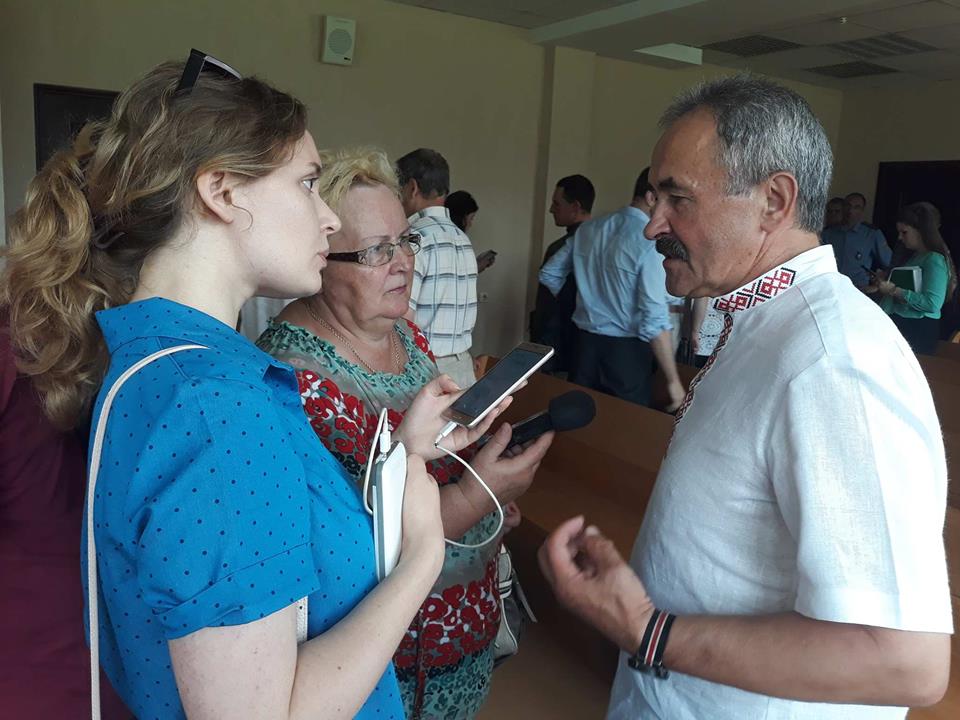
Gennady Fedynich gives interview. Photo courtesy of http://praca-by.info
According to eyewitnesses, about 50 people were able to enter the courtroom, and as many remained behind the doors. Representatives of the court refused to provide a larger room. The court attendees initiated a collective collection of signatures under the appeal to the head of the court with a request to provide a larger room so that everyone could get to the hearing. 60 people signed the complaint. The complaint was forwarded to the court secretariat.
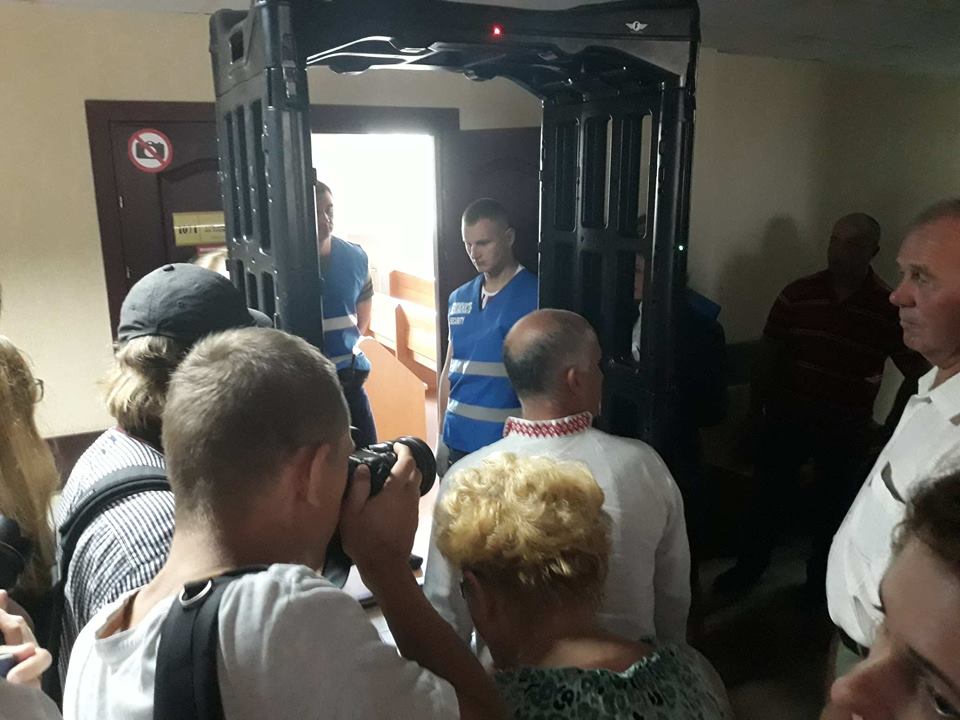
Ihar Komlik entering the court room. Photo courtesy of http://praca-by.info
The REP trade union organized a video broadcast from the hall in front of the courtroom. A broadcast from the courtroom has been denied so far.
Video from the court session (in Russian):
1) http://bit.ly/2AmO8Ui
2) http://bit.ly/2LygZKD
3) http://bit.ly/2mRIHmH
4) http://bit.ly/2v0mKpR
Full information in Russian about the court session is available on the page of the trade union REP at http://praca-by.info/all-news/item/5880-sud-idet-tekstovaya-i-foto-translyatsiya-suda-po-delu-profsoyuzov
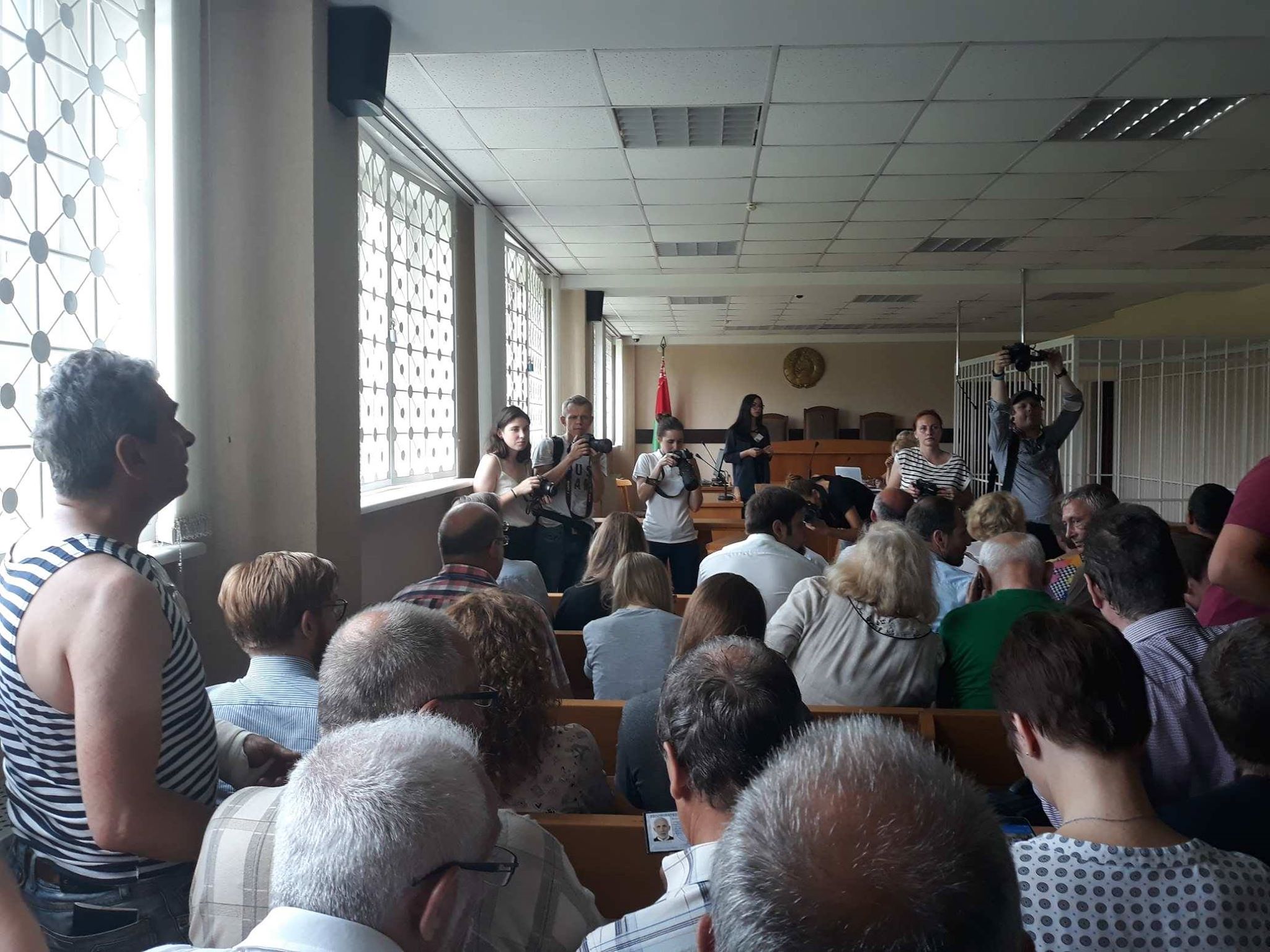
Court room, Photo courtesy of http://praca-by.info
The audience greeted both Fedynich and Komlik with supportive applause when they left the courtroom during the break. Fedynich said that so far in the course of the hearing the judge ignored all three petitions of the defendants. The petitions are: to provide a larger room, holding at least 70 people; to question the defendants before questioning witnesses, and to allow video filming. Fedynich said that if one more petition is rejected, a request will be made to substitute the judge.
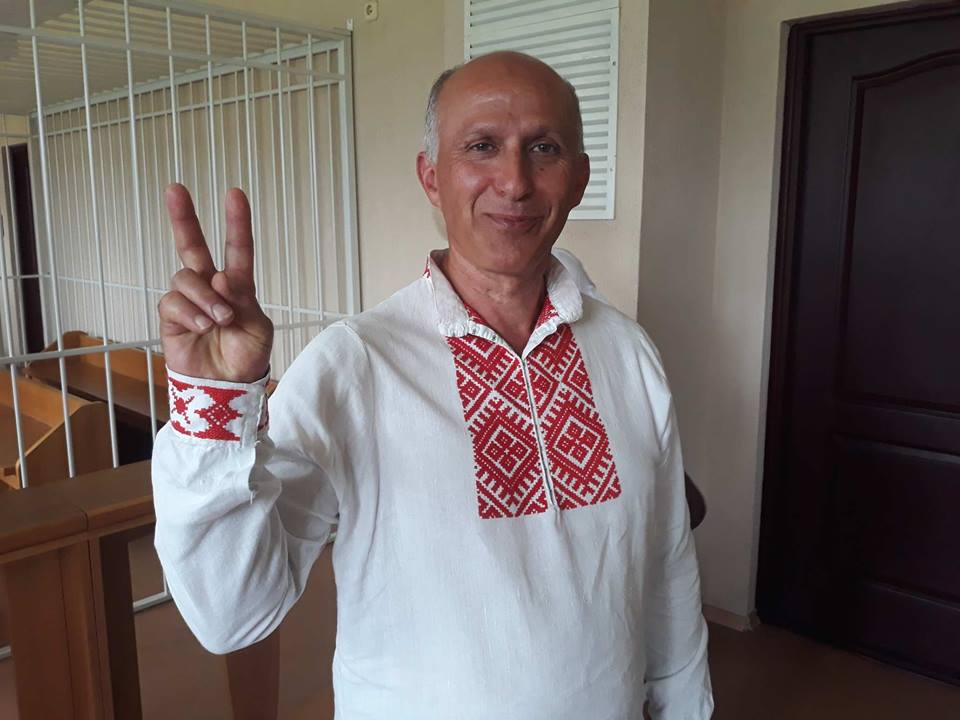
Ihar Komlik in the courtroom, Photo courtesy of http://praca-by.info
The interrogation as a witness of the former secretary of the REP started, who admitted that she had been a KGB agent since 2015 and was rewarded for it. The secretary worked in the REP trade union from 2014 to 2016. The judge rejected the protest of the lawyer who said it was not related to the case, which relates to 2011-2012.


