Many dead in Afghanistan mine collapse

Heavy snowfall caused a landslide which resulted in the mine caving in. 50 people were inside the tunnel when the incident occurred.

According to official reports, the victims were villagers mining for gold illegally, trying to increase their earnings during the cold winter.

Afghanistan’s mining industry has great potential but is currently riddled with illegal mining, often controlled by criminal networks. To counter that, Afghanistan’s government last year approved two contracts for the exploration of copper and gold deposits in several northern provinces.

In a letter to President Mohammad Ashraf Ghani, IndustriALL Global Union is calling on the government of Afghanistan to ratify ILO Convention 176:

“We attach great importance to the adherence to and implementation of preventive measures in the framework of international standards, including ILO Convention 176 on Safety and Health in Mines.”

“Union power must be developed in the mining industry in Afghanistan. IndustriALL is willing to share our experience from working with our affiliated unions worldwide, to help improve working conditions in the mines,” says Valter Sanches, IndustriALL general secretary.

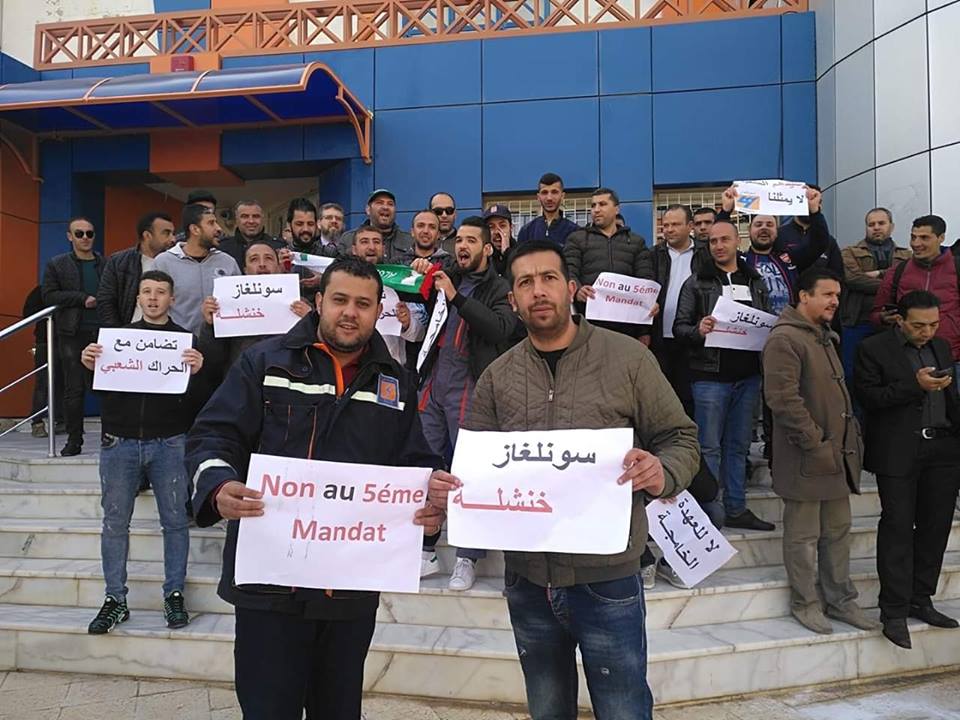
Trade unionists in Algeria arrested at protest

Police seized over 15 trade unionists including Abdelkader Kawafi general secretary of IndustriALL Global Union affiliate, the electricity and gas workers’ union, SNATEG; as well as Zakaria Ben Haddad, general secretary of energy workers’ union, SNT ÉNERGIE; and Mezayani Moussa from trade union SNSI.

The protestors were demanding the reinstatement of eleven SNATEG leaders who have been fired for their union activities at state-run electricity and gas company, Sonelgaz.

Some have been without work for more than 26 months causing much suffering to them and their families.

The protestors also demanded implementation of recommendations by the International Labour Organization’s Committee on the Application of Standards made last year in June.  Among several recommendations, the Committee called on the Algerian government to: 

The protestors also demanded an end to the criminalization of the activities of trade union rights and human rights defenders, including journalists and bloggers.

The trade unionists were held in police custody at police headquarters in Algiers for six hours and forced to sign a document denouncing their own behaviour before they could leave.

IndustriALL’s assistant general secretary, Kemal Özkan, said:

“We condemn this harassment and illegal detention of trade unionists, who were only exercising their legitimate right to peaceful protest. Trade union rights are slipping away in Algeria and the world must wake up to the government’s unlawful action.”

First-ever collective agreement reached in Turkish gold mining

Covering around 200 workers, the CBA will be valid for a two-year period in 2019-2020 in the operations ok, belonging to a multi-sector conglomerate Nurol Holding. The company is one of the first locally-owned private investors to start up a gold mine in Turkey.

Maden-Is intensified and finalized its recruitment drives at the beginning of 2018 and applied to the Ministry of Labour for certification on February 21. The CBA was signed in the final round of negotiations on 6 December.

With the new agreement, workers are entitled to get decent salaries, overtime and shift payments and social benefits such as education, heating and religious festival bonuses. The agreement also covers substantial provisions on occupational health and safety.

Turkey is the largest gold producer in Europe and the Mediterranean. From 2001 up to 2017, Turkey produced 273 tons of gold with 900 tonnes of proven reserves and 6,500 tons potential. The industry reports that since 2001 around US$ 4 billion was invested in the sector with a direct employment of around 8,000 people.

Although it is not a large producer, Turkey is among the top five largest gold importers globally. Turkey has a demand of 150 tonnes of gold annually and domestic production meets around 15 per cent of it. According to the government data, 350 search licenses have been granted to private investors in the sector, however only one license has become an internationally-classified gold mine.

In the meantime, the European Bank for Reconstruction and Development (EBRD) is providing loans to finance the construction, development and operation of two mines in northwestern Turkey – the Lapseki mine in the Çanakkale province and the Ivrindi mine in the Balıkesir province developed and operated by Tümad Madencilik.

Since early 2000s, the gold mining industry has been under the spotlight with its possible impacts on environment and society. Maden-Is union and Tümad work together in developing highest international standards in both occupational health and safety and in environmental and social management.

As part of the concept of “beneficiation”, Tümad’s operations will create new jobs for the local population, and offer training and employment opportunities, which includes teaching mining technology and on-the-job training programs.

“This new agreement signed by Maden-Is with Tümad Madencilik in the gold mining sector turns a new page for the industry in Turkey,” said Kemal Özkan, Assistant General Secretary of IndustriALL Global Union.

“IndustriALL Global Union congratulates Maden-Is and Tümad for developing such system of labour relations that benefit all parties”.

Global Diamond Network demands better conditions in the supply chain

The supply chain from “mine to finger” includes exploration and evaluation, mining and processing, grading and valuation, rough diamond sales, cutting, polishing and trading, and jewellery manufacturing and sales.

Seven Sub Saharan African countries are amongst the top 10 diamond producers that account for 99 per cent of global production. Botswana leads with the highest value and is the second producer in volume after Russia. Angola’s Catoca is the biggest diamond mine whilst Lesotho, despite being a small producer, is known for producing large diamonds. United Kingdom based company, Firestone Diamonds, unearthed a 46-carat stone in December 2018, and a 134-carat yellow gem in October 2017 at Liqhobong mine. Over 700,000 artisanal miners dig for diamonds from alluvial deposits in the Democratic Republic of the Congo.

Case studies presented by meeting participants painted a dark side. For instance, organizing diamond workers in Lesotho is difficult due its mountainous terrain, which is difficult to reach by road but accessible on horseback. Precarious work is rampant and working for 12 hours common, while the application of different laws causes confusion. As a response, the network will support an intensive organizing and recruitment drive in Lesotho.

In Botswana and Namibia, the laws favour employers, and unions are fighting unfair dismissals and retrenchments. In India there is child labour while workers in Zimbabwe earn paltry wages sometimes paid in a few grocery items like cooking oil, maize meal, sugar and salt. Further, there is no access for unions to diamond mines especially in Marange which is guarded by armed soldiers. To end this, the network resolved to put pressure on governments and offending companies to respect workers’ rights and improve working conditions. Further, protests will be made at the International Labour Organization.

The network, which was launched in Windhoek, Namibia in 2017, resolved to engage on the Kimberley Process (KP), a multistakeholder initiative to remove conflict diamonds from the supply chain. The National Union of Mineworkers will organize a workshop on KP in 2019. Collective bargaining agreements will be shared while attention given to women and health and safety. 

The network extended solidarity support to Beverly Murangi who was unfairly dismissed because of her appointment as co-chair of the network. She got financial support for eight months from ACV Transcom-Belgium which was coordinated by Yves Toutenel the network’s other chairperson.

The delegates visited Petra Diamonds’ Cullinan Mine where they went over 800m underground to see the mining operations. The mine which is 100km from Johannesburg employs over 1,000 workers.

Glen Mpufane, IndustriALL director of mining, diamond, gems, ornaments, jewellery and precious stones, said: 

“We are demanding that the riches from the diamond supply chain be beneficial to workers. Countries should also benefit through economic development and creation of downstream industries through beneficiation. We urge companies to apply due diligence through international declarations that promote United Nations Sustainable Development Goals and other voluntary mechanisms.”

New Year brings fresh tragedy for Pakistan’s coal miners

According to reports, the men were working hundreds of metres underground at a mine in the Chamalang coal mining range when the explosion took place. Miners had to retrieve the bodies of their colleagues themselves. 

All the victims of Wednesday’s blast, two of whom were brothers, were members of the same family from neighbouring Afghanistan. 

The tragedy struck just days after three more coal miners perished in the same area when a mine collapsed as they were working deep underground on 27 December 2018. A further miner was injured and rescued from the scene by co-workers.

The latest casualties came just two days after a New Year’s Eve rally by IndustriALL affiliates demanding better safety in Pakistan’s mines after 120 coal miners died last year alone. 

The Pakistan Central Mine Labour Federation and All Pakistan Labour Federation staged a rally and protest outside the Quetta Press Club carrying placards and banners inscribed with various demands on 31 December.

“In 2018 various incidents were reported in Chamalang, Shahrag, Harnai, Marwar, Sur Inj and Digari which left 120 mine workers martyred and hundreds injured, which has increased the sense of insecurity among poor mine workers,” said the unions in a statement. 

Mine workers’ union leaders addressed the protesters attacking the government’s woeful negligence towards the safety of mine workers, while also holding local contractors responsible for mining incidents.

“Despite consecutive fatal mining incidents not a single mine’s license was cancelled or any action was taken,” they said and demanded government attention to the issue of coal mining safety. 

IndustriALL is calling on the government of Pakistan to urgently ratify the International Labour Organization’s Convention 176 on safety and health in mines to improve conditions in the country’s deadly mines.  IndustriALL’s assistant general secretary, Kemal Özkan, said: 

“We say enough is enough. How many more miners need to die before safety is improved? The government must take action now and we are ready to offer our help and expertise to avoid more lives being sacrificed in the Pakistani coal industry.” 

IndustriALL decries Belgian company’s union-busting in Turkey

Workers at Recticel’s production facility, in Tuzla, Istanbul, joined IndustriALL’s Turkish affiliate Petrol-Is (the oil, chemical and rubber workers’ union) in 2015, after the Turkish Ministry of Labour decided the union had the legal right to represent workers at the company. 

Recticel, which employs around 8,400 workers in 28 countries, transforms polyurethane into flexible foams, insulation, bedding and automotive seating. 

However, Recticel used an article under the Law on Trade Unions and Collective Labour Agreements to appeal the Ministry of Labour’s decision to the local court, claiming it operates in the metal industry and not chemicals. The appeal against the decision is a common union-busting tactic in Turkey used by employers to delay the collective bargaining process.

Even though the local court confirmed that Recticel operates in the chemical industry, company management has taken the case to the upper level court, violating Recticel’s own ethical code which recognizes the right of workers to join a union, and promises to comply with the laws of all countries where it operates.  

Paradoxically, in Belgium, workers are free to join whichever union they like, and sector activity is not a barrier for trade union representation. 

On a mission to the plant on 27 December 2018, IndustriALL’s assistant general secretary, Kemal Ôzkan, urged Recticel to respect fundamental trade union rights at its factory in Turkey, and recognize Petrol-İş as the legitimate social dialogue and bargaining partner by withdrawing from the legal processes.  

Speaking at a meeting outside the plant, Kemal Özkan said:

“What the management of Recticel has been doing here in Turkey for the past three years is a scandal. They could never operate this way in Belgium. Recticel is shamefully taking advantage of antidemocratic laws to stop workers joining a union.” 

IndustriALL’s Belgian affiliates CSC-BIE and CG-FBTB also reproached Recticel:

“With our tradition of social dialogue in Belgium…we are shocked by your group's behaviour towards our Turkish counterparts from Petrol-Is. We hereby ask you to respect the basic rules of international law as well as your own code of conduct.”

In its response, company management said “the Recticel Group and all its operations all over the world fully respect the legal rights of unions and employees at all levels and we would like to emphasize that applying to the courts regarding the sector of work is Recticel’s legal right.”

Kemal Özkan added: 

“It is our global mission that each and every worker can freely join a union and have the protection of collective bargaining agreement. This must also be the case for Recticel workers. Our international solidarity, together with our Belgian affiliates, will continue until this problem in Turkey has been resolved.”

INTERVIEW: Luisa María Alcalde

Minister of labour and social welfare

Country: Mexico

Text: Kimber Meyer

How did you get into politics?

I started to get much more involved in politics in 2006. The elections that year were quite controversial, and I began to take more of an interest in what was happening in public life.

When I left law school at the age of 23, the National Regeneration Movement (Morena) party was starting out as a grassroots association and I was named national youth and student coordinator. We began working in youth circles, getting young people to take part in the movement, which had been around for several years but was developing into more of a formal organization at that point.

Then in 2012, I was elected to the LXII Legislature of the Mexican Congress as a deputy of the Citizens’ Movement party, serving as a federal congresswoman until 2015.

Do you think gender parity is important in the new cabinet and Congress?

I think it’s really important. The fact that the cabinet is made up of the same number of men and women sends out a strong message that should encourage more women to get involved in political life, and public life in general. I think it’s great that the female cabinet members have been given a range of responsibilities. Not only will there be women in various ministries, but they have be given important, high-level positions too.

Our team is gender-diverse and includes people of all ages as well, so we really represent the different visions of our society.

In the past, you’ve often said how important it is to eradicate the discrimination and harassment that women experience in the workplace. How will you do that?

We want to work on several fronts, through the attorney generals, public prosecutors and the welfare ministry. We will seek to integrate women into the workforce and set up childcare facilities at work. We will also team up with the workers’ ombudsman to tackle the discrimination and harassment that women face in the workplace. The problem is that such incidents often go unreported. We want to make sure women feel they can report violence to the authorities.

The “young people building the future” initiative has been billed as one of the government’s key programmes for enhancing the skills of young people.

Do you think the government is going to be able to resolve the issue of youth unemployment in Mexico?

The programme seeks to help young people who want to work but lack the opportunities. They will be given training and support in entering the workforce, and that will help us to ease tensions across the country. The aim is to ensure that young people have the tools and experience they need to increase their employability, and the programme includes one year of on-the-job training. Among the entities involved in the programme, 70 per cent are private, 20 per cent are state-run and 10 per cent are involved in outreach work.

We’re building a network of mentors, and so far the response has been good. Each one of them has something to bring to the table.

On numerous occasions you’ve said that one of your priorities will be to promote fair, high-quality jobs. How do you plan to do that?

We’ll do this in various ways. First of all, we want to foster a labour-related dialogue. We want to bring back genuine collective bargaining to pave the way for democracy and transparency. That will help us create a more balanced system and improve wages.

At the same time, we’re going to change how we ensure that employees’ rights are respected. We will work with the employment ministries in different states and run campaigns with clear objectives to raise workers’ awareness of their rights.

We will campaign against abusive subcontracting practices and incentivize more formal work arrangements. Many people don’t sign up for social security, which can adversely affect them when they reach retirement or want to find a home, so we’re going to address that as well. We will call on civil society organizations to promote compliance with the law. Instead of having inspectors, we’re going to set out clear priorities, with campaigns that always involve the other side.

Finally, at the centre of it all is the national welfare plan, based on the premise that higher wages will bring stability. If we manage to cut unnecessary costs – such as excessively high salaries, expensive travel arrangements and other avoidable expenses – and eradicate corruption, we will be able to boost development and improve education and health care.

One of your proposals is to end the country’s low minimum wage, which currently stands at 88 pesos (US$4.6) a day. How do you plan to increase the minimum wage?

The policy used to be to keep wages low to generate investment. This model encouraging precarious work has failed. We want workers to recover their sense of worth, so that they can live well and with dignity. We are a long way from that at the moment.

We have been working closely with analytical experts who use objective information. We’ve been speaking with the new minister of finance and the Bank of Mexico to find ways to gradually raise the minimum wage. They’ve told us that it’s possible to increase wages without prompting a rise in inflation.

Do you think that major constitutional reform to employment law is needed to prevent violations of workers’ rights?

Yes, it is fundamental. The constitution is a paradigm changer. We intend to use secondary legislation to ensure that justice exists in the workplace, since impartial judges will now be the ones to resolve employment-related disputes. There’ll also be a new, independent institute for registering trade unions and collective agreements. And to bring an end to employer protection contracts, it will become compulsory for free and secret ballots when electing union leaders in charge of signing collective agreements. We will also ensure that there is genuine representation and dialogue.

Do you think that the employment provisions of the new trade deal reached between the governments of Mexico, Canada and the United States are compatible with Mexico’s Constitution?

The labour provisions in the new USMCA trade deal, the ratification of ILO Convention No. 98, the constitutional reform of employment law, the legislation on transparency and the resulting secondary legislation are all pieces of the same puzzle. They all have the same aim and are compatible with the policy put forward by AMLO’s new government, which is to promote democracy, freedom and transparency in Mexico.

Germany bids farewell to hard coal after 200 years

The ceremony was attended by Germany’s Federal President Frank-Walter Steinmeier, EU Commission President Jean-Claude Juncker, North Rhine-Westphalia's Prime Minister Armin Laschet and Michael Vassiliadis, President of IndustriALL Global Union’s German affiliate Mining, Chemistry, Energy Industrial Union (IG BCE).

"Closing the mine in Bottrop means the end of an industrial era which has deeply influenced Germany, and especially the Ruhr area,” said Michael Vassiliadis.. “We say goodbye to an industry that has made Germany strong and rich – and not just economically, but also culturally and socially."

In 2007, the social partners in German coal industry reached a deal to phase out hard coal production by 2018. However, fossil fuels still account for an important part of the energy mix, and the lignite, or brown coal, produced in Germany still derives a part of it.

In the 1950s, German coal industry employed around 600,000 workers, a number which had declined to around 4,500 by 2017.

Mineworkers in Germany, as in other parts of the world, have a long-standing tradition of solidarity and togetherness. "This country needs more buddy culture again!" said Michael Vassiliadis.

The IG BCE and its predecessor organizations have played an essential role in ensuring a Just Transition over the last 25 years, as the workforce in the mining industry has been greatly reduced.  The collective bargaining process has seen innovative agreements with new models in the adjustment process.

“This is an emotional moment for mine workers in Germany and around the world,” said Kemal Özkan, IndustriALL assistant general secretary.

“The Just Transition model used in the German mining industry is a great example of how such a process can be handled by unions. We commend the work done by the social partners, particularly IG BCE, during this transformation.”

Turkey: 186-day strike at Mayr-Melnhof ends in victory for workers

Selüloz-İş’ members had been on strike since 20 June, when negotiations on a new collective agreement failed as management proposed a zero per cent wage increase.

With the new three-year agreement workers will get wage increases of 280 Turkish Liras (US$53) per month for 2018. In the second and third year of the agreement, workers will be entitled to 300 Liras (US$57) per month for the first six months of 2019, and the inflation rate for the second half of 2019, and the whole 2020.

The striking union members also managed to get the demanded increases in their benefits. With the deal, including the benefits, workers’ wages will be between 2,150 (US$407) and 3,700 Liras (US$700) per month.

“This agreement, approved by the workers, is a significant achievement,” says İsmail Güderoğlu, union representative at MM Superpak. “We thank everyone who has shown support and solidarity in our rightful struggle.”

Workers at the three plants will return to work on 2 January 2019.

“When IndustriALL visited the picket-line at MM Süperpak, our striking sisters and brothers were chanting that resistance brings victory,” says IndustriALL assistant general secretary Kemal Özkan.

“They have achieved what they chanted with this great result. We wholeheartedly congratulate the striking workers and their union Selüloz-İş.”

MM Süperpak Ambalaj is a subsidiary of Austrian-based Mayr-Melnhof, with operations in Izmir, Karaman and Gaziantep. 

The Turkish Commission of Minimum Wage has fixed the legal minimum wage as of 1 January, 2019, to 2,020 Turkish liras (US$380) net per month. Together with social security premiums and income taxes, this number is calculated to be 2,558 Turkish liras (US$482). According to official sources, around 7 million out of Turkey’s 30 million workers, earn the legal minimum wage.

IndustriALL mourns 13 miners killed in Czech Republic

Eleven Polish nationals and two Czech miners died in a methane blast more than 800 metres underground at the mine, which is situated close to the Polish border. 

A search of the scene had to be abandoned due to a raging fire and zero visibility, according to the mine’s state-run operator, OKD. 

It is the worst mining disaster to hit the Czech Republic since 1990, when 30 miners died in a fire at a mine near Karvina.  

IndustriALL’s assistant general secretary, Kemal Özkan, said:

“We are shocked and saddened at this terrible waste of life. All mining deaths are avoidable and safety must come first at all costs. As a global union representing miners all over the world, we offer our deep condolences to the victims’ families and all those affected by this tragedy.”