Supporting Serbian workers to win a living wage

The seminar in Belgrade on 13-14 February was part of an EU-funded project, “Strengthening the capacity of trade unions in South-East Europe to improve wages and working conditions in the garment and footwear sectors”, carried out in cooperation between industriAll Europe and IndustriALL Global Union. The project targets seven countries; Albania, Bulgaria, Croatia, North Macedonia, Montenegro, Romania and Serbia.

Serbian textile, clothing, leather and shoe industries officially employ more than 64,000 workers. In fact, employment has increased in the past two years. But there are probably tens of thousands of workers in the informal economy.

Three affiliated textile unions organize a total of 10,000 workers in the textile sector. Now there is a new focus on increasing union density and building bargaining power.

“We are growing membership in factories where we are already present, and we have recently organized nine new plants thanks to active field work”, reported Radojko Jovanovic, president of the Autonomous textile workers’ union Sindtkos-CATUS.

Following training on organizing methodology and techniques at the seminar, the unions will now work on organizing plans with the help of a detailed mapping of potential target factories. The principles of cooperation and non-competition were emphasized. With 50,000 unorganized workers in the sector, there will be enough work for everyone.

Another goal is to increase collective bargaining. The unions have only four company level collective agreements. There is no branch agreement in the textile industries, but reaching one is something the unions definitively want.

“For industry level bargaining, we need both stronger unions and a more representative employer counterpart”, said Dragan Vesic from the industrial union IER Nezavisnost.

For representativity, unions must reach 10 per cent membership in the textile industry cluster. An employer association needs to represent 10 per cent of the companies employing at least 15 per cent of the workforce.

Despite increasing employment, the textile sector suffers from a lack of workforce. Young people are not interested in working in an industry where conditions are so poor. Professor Goran Savanovic from the Textile College explained that this was very much due to low wages. Average gross wages range from 319 euros per month in clothing industries to 438 euros in textile, well below the industry average of 498 euros.

Bojana Tamindzija from the Clean Clothes Campaign network said that the net minimum wage was raised to 230 euros per month, but according to studies, as many as 50 per cent of workers receive less. There is also a lot of unpaid overtime.

Slavko Ignjatovic from the Association of Employers, also the owner of a small company, asked for support in convincing foreign garment brands to raise the prices they pay to their suppliers, which operate with small margins under constant cost pressure. That would create space for wage increases.

Professor Petar Djukic from the Faculty of Technology lamented the absence of government representatives who were invited but did not show up. He suggested that the unions together contact the ministries of labour and economy and convince them of the need to cooperate to boost collective bargaining and improve pay to reach living wages.

Luc Triangle, IndustriAll Europe’s general secretary said:

“Serbian textile and garment workers cannot be treated as cheap labour. These sectors are traditional sectors with good skilled workers and skills that went from generation on generation in Serbia. It is unacceptable that wages are paid under the level of a living wage. Our trade unions will increase their efforts to organise workers and to go with employers into meaningful collective bargaining."

Kemal Özkan, IndustriALL Global Union’s assistant general secretary stated:

“The Serbian government is attracting foreign investors with huge subsidies and other financial incentives.  At the same time textile workers are paid poverty wages to sew clothes for big brands.  Keeping wages low is not the way to a sustainable textile industry in Serbia.  We will continue to support our Serbian affiliates in their efforts to build bargaining power and negotiate decent wages for workers in this industry”. 

IndustriALL and Rio Tinto set QIT Madagascar Minerals on the path to constructive social dialogue

The mission was part of an IndustriALL union building activity in Antananarivo, Madagascar on 11 and 12 February 2019. IndustriALL and Rio Tinto are making a joint effort to set Rio Tinto’s QIT Madagascar Minerals (QMM) operation on the right path to sustainable constructive dialogue, consistent with Rio Tinto’s global industrial relations principles. QMM is 80 per cent owned by Rio Tinto and 20 per cent owned by the government of Madagascar.

The mining operation, situated near Fort Dauphin on the south-eastern tip of Madagascar, has been the scene of hostile and acrimonious industrial relations between local management and IndustriALL affiliates. A labour dispute over the implementation of provisions of a collective bargaining agreement erupted following IndustriALL’s high-level joint mission to the QMM operations in February 2018. 

The labour dispute followed a long history of industrial strife at the operation, where contractors constitute the majority of the workforce. Since then, IndustriALL and Rio Tinto have undertaken several interventions, individual and jointly, to facilitate constructive industrial relations at QMM built on dialogue.

A two-day evaluation and planning union building workshop took place on 11 and 12 February, facilitated by IndustriALL’s union building team, comprising Sub-Saharan Africa regional secretary, Paule Ndessomin, the region’s programme officer, Tendai Makanza and the programme officer responsible for the region from IndustriALL’s central office in Geneva, Switzerland, Fanja Rasolomanana.

It was followed by a two-day joint intervention facilitated by Rio Tinto’s employee relations manager for the region, Philippe Ferrie, the employee relations manager for the Oyu Tolgoi mine in Mongolia, Munkh-Orgil Lkhaasuren, and Glen Mpufane, IndustriALL director for mining, diamonds, gems and ornaments.

Late last year, IndustriALL conducted a successful joint mission to the Oyu Tolgoi mine, as part of a delegation including Union to Union and Swedish affiliate IF Metall. A comprehensive report is available here. The operation’s employee relations manager came to Madagascar to share his experiences.

The joint intervention workshop was part of ongoing efforts to build constructive industrial relations at QMM between IndustriALL’s affiliates, Sendika Kristanina Malagasy (Sekrima) and Syndicalisme et Vie des Sociétés (SVS), and QMM management.

Glen Mpufane, commenting on the importance of the joint intervention workshop, said:

“The success or failure of the joint efforts to put QMM on the right pathway towards constructive industrial relations dialogue depends on the commitment to and implementation of the outcomes of the workshop by both QMM management and the trade unions”.

The outcomes also include a commitment by Rio Tinto to its contractors’ supplier code of conduct, and to sustainable communities.

Commenting on Rio Tinto’s commitment to a constructive dialogue roadmap for QMM Philippe Ferrie said,

“The workshop will help to improve QMM processes, to learn from what went well and where there is room for improvement in terms of process and relationship, and put all of this on a roadmap (within the overall Rio Tinto roadmap) that also keeps in mind the overall business framework of QMM.”

Australian union resists Kimberly-Clark attempts to weaken conditions

Kimberly-Clark had attempted to drastically weaken terms and conditions, under the threat of closing the Millicent Tissue Mill, in South Australia. The plant employs 400 people, and produces Kleenex and other well-known brands. The Millicent Mill is the major employer in the town, with as many as 3,000 jobs depending on the plant.

In June last year, members of IndustriALL Global Union affiliate the Construction Forestry Maritime Mining Energy Union (CFMEU) started indefinite rolling industrial action after failing to reach an agreement with the company. The stalled negotiations have meant that wages have stagnated since 2014, and workers have had no assurances that the plant would remain open.

The company announced in January 2018 that it intended to shed about 5,000 jobs globally, and close up to ten plants. IndustriALL and its sister global union UNI publicly condemned this anti-worker behaviour by Kimberly-Clark, and unions around the world sent solidarity messages.

Late last week CFMEU members voted to accept a new offer from the company that includes a wage increase of 4.5 per cent, plus a AU$1,000 cash payment.

The company also committed to maintain staff on some equipment lines until 2021, and to agree training priorities for new career paths jointly with the union. However, the threat of plant closure remains.

Alex Millar, CFMEU pulp and paper workers district secretary, and chair of the IndustriALL pulp and paper sector in Asia-Pacific, said:

“Our members at Millicent have shown that by standing united, workers can win out against these attacks and threats by corporations. By their attempts to remove workers’ conditions, Kimberly-Clark has lost much more than they could ever have won, destroying 30 years of industrial harmony at the mill. Because of their actions it will take a very long time if ever for this company to win back the trust of the workers.”

IndustriALL director for the paper sector, Tom Grinter, said:

“Once again the CFMEU shows how to stand strong for members and refuse a major cut in terms and conditions. Kimberly-Clark has seriously damaged its self-branding as a family friendly company. This is especially true in the US, Australia, and Europe. The horrible threat of mass plant closures without providing details, or committing to genuine union dialogue, is unforgivable.”

Italian unions stage massive protest against government policy

Rome’s San Giovanni square was full of workers, pensioners and families from all over Italy, many held union flags and banners. Many came to Rome in 12 trains, approximately 1,300 buses and two ships. They joined together to demonstrate their unity and reiterate the values expressed in a united platform called Piattaforma.

That platform is a set of joint union proposals demanding that the government makes changes to current policies and starts a serious and respectful discussion about the future of the country.

“CGIL, CISL and UIL continue to strongly affirm the necessity for development of the country to be reinforced by expansive policies, and agree that it is necessary to overcome the austerity policies which, in both Italy and in Europe, have led to deep inequality, increased poverty, and growth of unemployment, in particular among youth and women,” reads the document.

IndustriALL Global Union’s Italian affiliates are paying the price for the lack of political will of the government to adopt economic and political measures aimed to boost the economy. 

So far, the government is planning no measures to increase public and private investment in industry in Italy, which will certainly not encourage employment growth. On the contrary, some of the laws adopted by the government would have an opposite effect. For instance, in the energy sector, unions are currently fighting against a recent law which prevent companies from searching for and exploiting new oil and gas fields. The legislation may lead to the loss of more than 15,000 jobs and make Italy energetically dependent on other countries. 

Unions’ demands focus on development, growth and employment through public investment, which in turn attracts private investment and would promote a new structure of production. The state must initiate fiscal reform, removing excessive charges from salaries and pensions, and fight tax evasion, in order to create a fairer system, say unions.

Other demands include development of a social safety net, considering the needs of enterprises completing their restructuring or finding their way out of market crises; modification of the system of social security and welfare through reinforcement of pensions, social politics, fight against poverty, and improved healthcare.

Improvement and reforming of the system of professional education and workers retraining programs need to be in place. Finally, the unions called on the government to invest in public administration, which as a linkage between citizens, enterprises and services is a fundamental tool to accompany politics of growth and development of the country.

According to the Italian National Institute of Statistics Istat, the unemployment rate in Italy reached a record high of 10.6 per cent in 2018, this is third highest in Europe after Greece and Spain. Although there was a decrease from 2017 by 0.7 per cent, it is still far from 6.1 per cent unemployment in 2007. The young generation workers suffer the most with youth unemployment reaching 32.1 percent average in 2018.

#FuturoAlLavoro

Bangladesh Government set to throw away Accord achievements

Joint statement IndustriALL Global Union and UNI Global Union

Following the Accord appeal against a court order to leave Bangladesh on November 30 2018, the Bangladesh Appellate Court has granted a number of extensions of time for the Accord, the Government of Bangladesh and employer’s association BGMEA to reach agreement with on how the Accord’s functions should be handed over.  The Accord developed a detailed and responsible plan which was submitted to both parties in September 2018. The plan is based on transferring responsibility for inspection and remediation of Accord factories in stages, based on demonstrated capacity of the responsible government body, RCC, to take over these functions.

The Government has consistently refused to accept any conditions for the handover of factories, claiming (without presenting any evidence) that the RCC has already met all readiness indicators which were developed by the ILO and agreed by the Government. Both the ILO and the European Commission have repeatedly stated that the RCC is far from being ready to take over the Accord functions. Nearly 200 international brands and retailers signed the 2018 Accord because there was still no adequate government regulation five years after Rana Plaza. Little has changed since then. The government’s claim to readiness is further undermined by its refusal to include any criteria in an agreed transition plan.

With no transparency and no verifiable assurance that the unprecedented level factory safety achieved by the Accord will be maintained, global brands sourcing from Bangladesh cannot take the risk of a return to conditions that led to the collapse of Rana Plaza in 2013.

The parties are due to appear again before the Appellate Court on February 18 to report the results of their negotiations. The union and brand representatives negotiating on behalf of the Accord have written to the Government and the BGMEA in a last ditch effort to reach agreement on a responsible transition plan. If the Government remains unwilling to provide credible assurances, the parties will need to report to the Court that no agreement was reached. It is unclear how the Court will react, but an abrupt decision that the Accord must immediately depart Bangladesh is a likely outcome.

After more than 5 years of intensive work and investment through the Accord, which has resulted in an unprecedented level of safety in Bangladesh garment factories, it is extraordinary that the Government is prepared to throw this away, to once again put the lives of its millions of garment workers in danger and to risk the reputation of the Bangladesh garment industry.

What are tailings dams?

What are mine tailings?

Tailings are the waste products from mining. Mechanical and chemical processes are used to grind up rock into a fine sand to extract the valuable mineral or metal from the rock ore. All the unrecoverable and uneconomic remnants from this process are waste. They include finely ground rock particles, chemicals, minerals and water.  Depending on the type of mining, tailings can be liquid, solid or a slurry of fine particles. Many substances found in tailings are toxic, even radioactive, and it’s not uncommon to find large amounts of cyanide, mercury and arsenic in tailings.  

What are tailings dams?

Tailings dams are used to store water and waste that come as by products from the mining process. It is estimated there are at least 3,500 tailings dams around the world. But as there are around 30,000 industrial mines, the number of tailings dams is likely to be much higher.

Tailings dams can be huge in size, as big as lakes, and reach 300 metres high. As the slurry of waste is piped into the dam, the solids settle to the bottom and the water is recycled to be used in the separation process again.

Rather than reinforced concrete, tailings dams use earth or rock to create a barrage. However, most tailings dams use the cheaper but more dangerous upstream method of construction, using the tailings themselves to create a barrier.  The dam is then continually raised to accommodate more waste. These dams are more unstable and more prone to leakage.

Tailings dams need regular maintenance and monitoring to ensure that there is sufficient drainage and the dam is strong enough to contain the mining waste.

Tailings dams can pose a threat to local wildlife as birds and animals bathe in and drink from the contaminated waters. Leakage of toxic substances from tailings dams can also cause damage to the immediate environment.

What are the consequences of collapse?

In the past ten years, there have been 31 recorded major tailings dam failures between 2008 and 2018, not including the devastating failure of mining company Vale’s dam in Brumadinho, Brazil on 25 January 2019, in which 300 people are presumed dead.

In Canada, the Mount Polley copper-gold mine dam collapse in 2014 released 25 million cubic metres of wastewater and tailings into adjacent water systems and lakes. That’s enough to fill 20,000 Olympic swimming pools.

A year earlier, the mine’s owner, Imperial Metals, reported that the tailings dam contained 84,831 kilograms of arsenic, 38,218 kilograms of lead and 562 kilograms of mercury along with other minerals and waste products. 

In 2015, the Samarco dam collapse in Brazil released 33 million cubic metres of iron ore tailings slurry into the environment, killing 19 people, displacing 600 families and contaminating waterways for 620km downriver until it reached the ocean. It is feared that precious ecosystems and fish life that support indigenous communities will never recover.

There are also grave concerns for the safety of legacy tailing dams that are no longer used but still pose a considerable threat to life and the environment if they fail.

Are tailings dams necessary?

Traditional storage facilities, such as the ones involved in the Brumadinho and Samarco tragedies, are used by the mining industry simply because they are cheap. New technologies are available that substantially reduce or mitigate the risk associated with potential dam failures, such as the filtered tailings process, which reduces the amount water to minimize volume and improve stability. Dry tailings disposal is another alternative that offers significant benefits in terms of environmental sustainability, as well as worker and community safety.    

What can be done to improve tailings dam safety?

Tailings dam failures are not inevitable and can be prevented. Mining companies must listen to workers and unions, who are frequently the first to flag safety issues but too often ignored. IndustriALL Global Union has worked with the multisector Initiative for Responsible Mining Assurance (IRMA) to set the highest standards of tailings dam safety along with the International Council on Mining & Metals which has produced guidelines on preventing catastrophic failure of tailings storage facilities. The mining industry must urgently adhere to these standards to prevent future disasters.

Zambia: Three mineworkers die in underground fire

While refuelling a loader, the engine caught fire, igniting materials around it and causing a larger fire. Noxious fumes from the fire entered the adjacent workshop making it impossible to breahte.

The deceased mineworkers were working at a level 1,380 metres below the surface. They were members of the Mineworkers Union of Zambia (MUZ) — an affiliate of IndustriALL Global Union.

Mopani Mine says in a statement that it will carry out an investigation in conjunction with the country’s mine safety department and announced that it had suspended operations until further notice. Zambia has passed an Occupational Health and Safety Act and ratified Convention 176 on health and safety in mines.

However, despite the laws there is poor inspection and compliance by companies. The companies also do not adhere to operational health and safety requirements. Further, enforcement by cash-strapped institutions to ensure compliance through inspections is often weak.

Says Glen Mpufane, IndustriALL director for mining: “Mopani should take responsibility over the death of the workers, and we hope that the investigations into the circumstances leading to the fire will provide more information as to the cause of the blaze. We reiterate once again that it is the responsibility of mining companies to always ensure the safety of the workers at their operations above all else.”

In paying condolences, the union’s president Joseph Chewe described the mineworkers in a social media post as “vibrant members who had potential to contribute immensely to the growth of the union” and said the accident was “tragic”. The youngest of the deceased workers was 27, while the other two were 32 and 33-years-old respectively, testimony to MUZ’s recent recruitment and organizing drive targeting young workers.

Chewe says “MUZ will continue to mourn with the bereaved families and work closely with the families and Mopani management to ensure that all the necessary arrangements are put in place during this trying moment.”

Mopani Mine, which produces copper and cobalt, is owned 73 per cent by Glencore. The other owners are the Zambia Consolidated Copper Mines (10 per cent) and First Quantum Minerals (16.9 per cent).

Over 11,600 Bangladesh garment workers lose jobs and face repression

According to an estimate provided by the IndustriALL Bangladesh Council (IBC), the national coordinating body of affiliates of IndustriALL Global Union, over 11,600 workers have lost their jobs.

Many of them, particularly senior grade workers, were forcefully made to resign, for the companies to avoid paying higher wages and social security benefits. The terminations came in the wake of marginal wage increases announced after protests by garment workers.

Employers and the police have filed cases against over 3,000 unidentified workers and about 70 workers have been arrested, some of them released on bail. Earlier this year, one worker was killed and many injured in the protests.

Still weeks after the protests, many workers fear being arrested on false charges. Large numbers of workers have faced threats of physical violence by hired goons if they continue to demand higher wages.

It is difficult for terminated workers to find new employment, as the biometric data linked to their employment records are used to identify workers and deny employment, based on their involvement in trade union activities and protests.

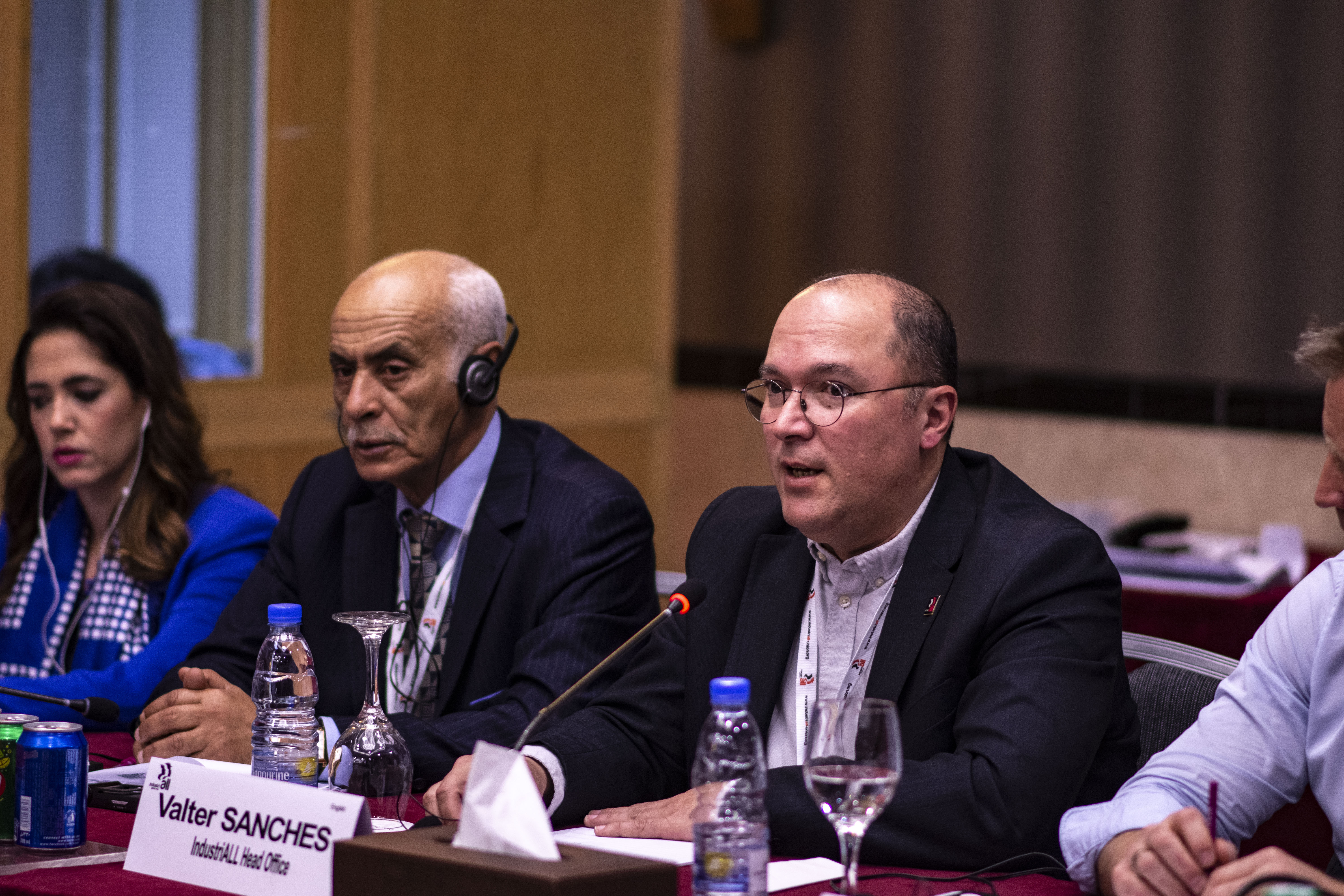
Valter Sanches, IndustriALL Global Union general secretary said:

“We are shocked to see the false cases, arrests, terminations and violent threats against workers unleashed by the employers and the state machinery.

“Employers and brands need to end the climate of fear among workers and establish a work environment which respects workers’ right to freedom of association and effective recognition of the right to collective bargaining.”

Salauddin Shapon, secretary general of IBC, said:

“The arrests targeted union leaders and office bearers with the tacit support of employers in order to cripple union activities. The harassment needs to stop immediately. Employers and the government should withdraw all false cases against workers, and all unjust terminations and suspensions should be withdrawn. Employers should pay wages as announced by the government.”

Terminated and suspended workers were working for companies producing for global brands including H&M, Inditex, KiK, Voegele, LIDL, Mango, Next, Matalan, VF, Takko, ALDI, Marks & Spencer, Puma, Wal Mart, JC Penny, Tesco, Stanley Stella and many others.

*This article was corrected on 13 February to remove the name of Tchibo and Esprit from the list of brands sourcing from affected factories.

South African unions oppose plans to privatize power utility Eskom

The proposal is to break Eskom into three parts — generation, transmission and distribution. Other parts of Eskom considered to be non-core will be privatized.

IndustriALL Global Union affiliates, the National Union of Mineworkers (NUM) and the National Union of Metalworkers of South Africa (NUMSA) are against the proposed dismantling and privatization and says they will respond through mass action, protests and strikes should the government proceed with the plans.

Says David Sipunzi, the general secretary of NUM:

“NUM is against any attempt to unbundle Eskom. It is the privatization of Eskom to enrich the elites and not about saving costs. We, therefore, call upon the government to reconsider its position because it is anti-working class and the poor. It will result in electricity being expensive and unaffordable to the poor. The NUM is going to fight tooth and nail against the unbundling.”

Irvin Jim, general secretary of NUMSA concurs:

“The government took the decision to privatize a national asset, which is owned by the public, without bothering to consult the most important stakeholder, which is labour and the community at large. The working class is opposed to any privatization plans of our state-owned enterprises, particularly, Eskom.” Jim says the government must come up with a social plan that includes a Just Transition after consulting unions. He adds that consulting after making an announcement is a “box-ticking exercise.”

The union positions on Eskom were presented to the government during a march to the Union building in 2018, and they include an energy mix policy that considers coal mines and a socially-owned renewable energy sector that benefits workers and communities and not only a few independent power producers. Last year the government gave contracts to 27 independent power producers in the renewable energy sector to the disappointment of the unions.

Says Paule France Ndessomin, IndustriALL regional secretary for Sub Saharan Africa:

“There is need for social dialogue between government, unions and communities on the Eskom proposals. Unions are willing to engage as stakeholders representing thousands of workers who will be affected by the unbundling through job losses and retrenchments.”

Brazilian metalworkers announce global action against General Motors’ threats

Leaders from all of the unions within the Brazilian Metalworkers' Movement (O movimento Brasil Metalúrgico), uniting all the federations, unions and confederations of metalworkers of Brazil including IndustriALL affiliates CNM/CUT and CNTM/Força Sindical, agreed on a plan of action to protect the rights of metalworkers at carmakers and throughout the supply chain and to support the working class as a whole. The Movement was formed in 2017 with the aim to defend workers’ rights and fight against precarious work among others.

One of the key decisions was to organize a global day of union action against the threats made by General Motors (GM), with unions in Canada and the United States invited to take part.

Even though sales are on the rise, GM leaders issued a memo threatening to shut down operations in South America unless they could find ways to return to profit.

Workers at the GM plant in Gravataí recently led a demonstration condemning the cost-cutting measures put forward by the company, which include a reduction in the wage floor and a 44-hour work week.

At the meeting, union leaders discussed these threats to undermine workers’ rights. They also talked about the impact of the blackmail that GM had conducted in the United States and Canada when it announced the closure of five plants across the two countries.

Members of the Brazilian Metalworkers' Movement also decided to publish a newsletter to inform people of their struggle against the threats made by GM and other manufacturers.

In addition, they agreed to support other campaigns, such as the demonstration of solidarity with the families of the victims of the Brumadinho tragedy on 7 February, and the national day in support of retirement scheduled for 20 February. 

The discussions were chaired by Mónica Veloso, vice president of CNTM and co-chair of the IndustriALL Global Union women’s committee. She said that it was essential to reclaim respect for the working class in order to face these intensely aggravating times.

Finally, members of the Movement agreed to set up a group that would come up with a proposal for a national collective employment agreement to help protect workers and their rights.

IndustriALL's general secretary, Valter Sanches, joined the meeting via video call and said:

"GM is blackmailing unions. We are going to coordinate a global struggle with unions in Canada and the United States in order to show solidarity at this time. We'll make sure that unions worldwide take action against this blackmail."