From union congress resolution to new law in Albania

In June, the Albanian government passed a new law on “supplementary financial treatment of workers who have worked in underground mines as well as workers of the oil, gas and metallurgical industry", effectively turning the congress resolution into national law.

Under the law, former miners who worked for the state or private sector for six years or more, will receive a substantial increase in their annual pension payments.

An additional 1 per cent will be paid to those who suffer a disability as a result of their former occupation.

300 miners who had not been paid for six months will now receive their wages in full.  

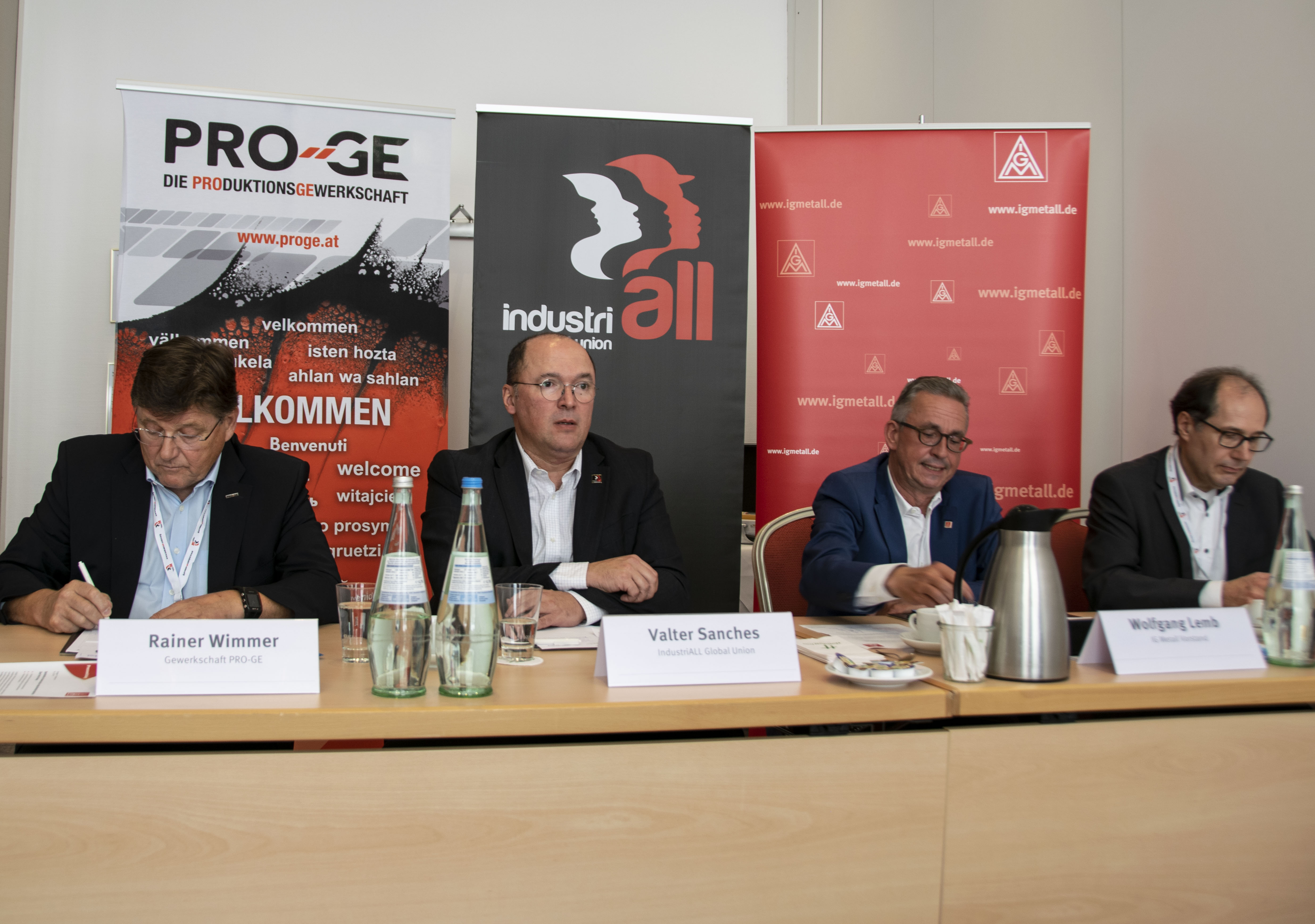
“This new law is a major achievement. Not only is it a pay and pension victory for Albanian mine workers, but it is also a testament to union power and that when we organize we win,” says IndustriALL general secretary Valter Sanches.

World chemical unions confront the future, united

The chemical unions last met in 2015 in Hannover, Germany. The meeting was opened by sector co-chairs Iris Wolf of IG BCE in Germany and Sergio Leite of Fequimfar in Brazil. Iris Wolf stressed that the industry faces tremendous change as it grapples with climate change, the backlash against plastic production and the introduction of new production technology.

Sergio Leite spoke about global attacks on trade unions, giving the example of Brazil.

Turkish union leaders Ali Ufuk Yaşar and Ihsan Malkoç, of Petrol-İş and Lastik-İş respectively, welcomed the delegates and shared their difficulties in union organizing campaigns in Turkey.

"The slowdown of the global economy is contributing to an erosion of workers' rights."

Valter Sanches

IndustriALL Global Union general secretary Valter Sanches said,

“The slowdown of the global economy is contributing to an erosion of workers' rights. In particular, we see constant violations from Turkey.”

Sanches also spoke about the necessity of acting on climate, saying:

"Young people are marching for the climate. We face a climate emergency, and we must act. But we are also responsible for quality jobs in chemical, mining and other sectors, and the communities they support. We fight for a Just Transition."

IndustriALL assistant general secretary Kemal Özkan and industry director Tom Grinter gave a detailed overview of the state of the chemical industry globally, highlighting important union campaigns. This was followed by a panel discussion, with participants from Germany, the UK, Singapore, Mozambique and Brazil comparing union actions, labour relations and social dialogue around the world.

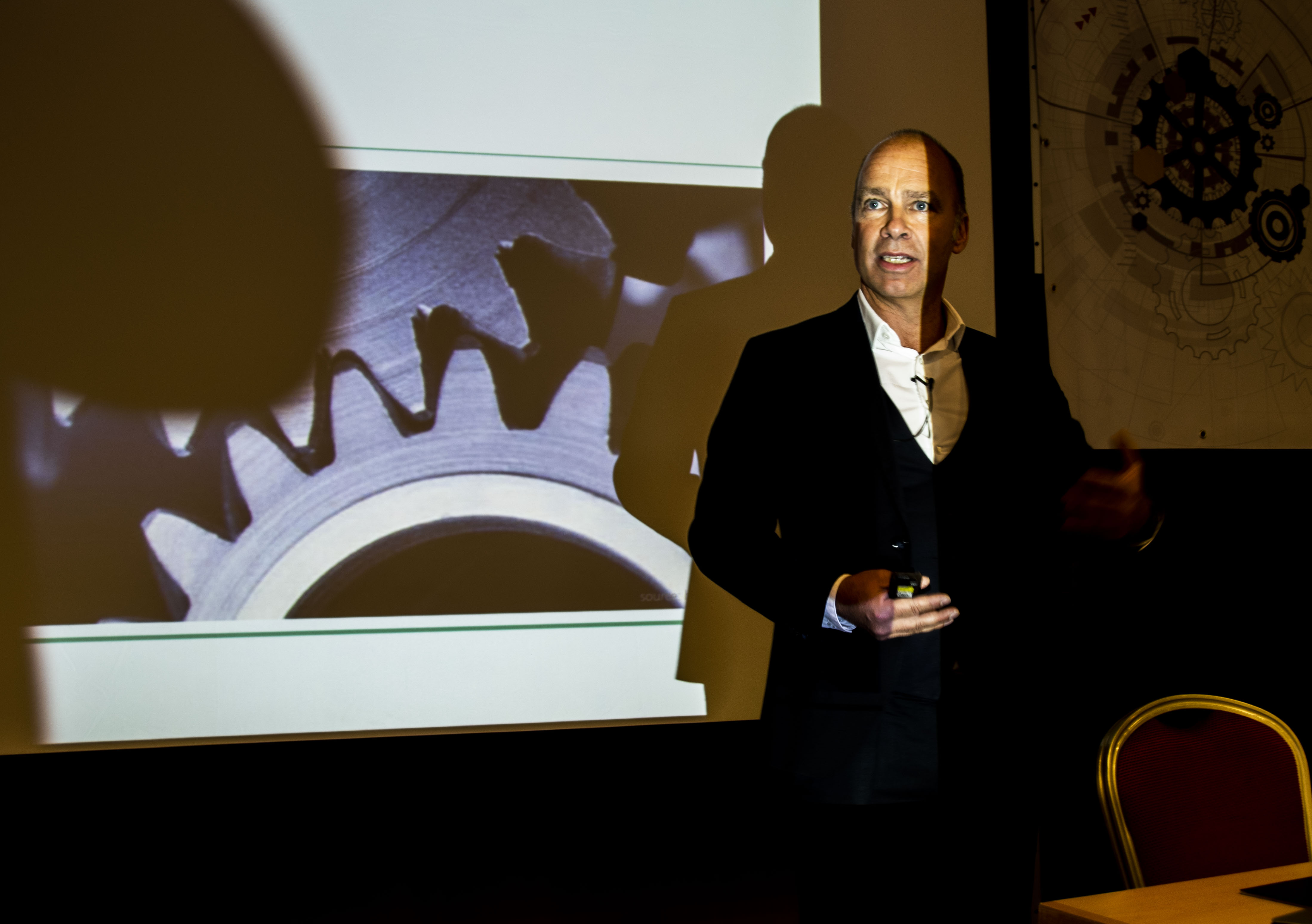
Tom Grinter

In a discussion on the Fourth Industrial Revolution, participants expressed optimism, saying that new production technology can create skilled jobs and clean up the industry, making it safer and more secure. But concerns were also expressed that jobs would be lost, and that unions were not prepared for the changes.

This was followed by a discussion on using union networks and global framework agreements (GFAs) to boost global solidarity. Raghuram Theramkudalu and Thiago Rios spoke about the regional BASF union networks in Asia-Pacific and South America respectively. Albert Kruft spoke about the model industrial relations delivered by the Solvay GFA, and USW's Kent Holsing spoke about the grassroots, local-lead DowDuPont North American Labor Council.

"We need to make place for women."

In a session on empowering women, youth and migrant workers, participants celebrated the victory of the new ILO Convention on violence and harassment at work, and spoke about the need to engage more women in male-dominated sectors like the chemical industry.

A panel on occupational health and safety considered some terrible examples of industrial actions, and confirmed the need to campaign on workers’ right to know about risks, participate in safety programmes, and refuse unsafe work.

In the closing session, Kemal Özkan praised the high level of participation at the meeting, thanking the many delegates who spoke from the floor, and introduced the sector action plan.

He said:

“It’s up to us all to deliver it.”

Kemal Özkan

Tom Grinter

“This action plan sums up the conclusions of the panel discussions, aligns them with IndustriALL’s five strategic goals, and lays out a road map for global union organizing in the sector over the next four years.

“It’s up to us all to deliver it.”

Iris Wolf and Sergio Leite were re-elected as sector co-chairs, while Masato Shinoharo of UA Zensen in Japan will continue to chair the pharmaceutical sector.

Ending migrant workers’ rights violations in Mauritius

On arrival in Mauritius, workers are paid low wages, work long hours, live in squalid conditions sometimes in dormitories behind factories, and risk deportation when standing up against the violations.

The labour and human rights violations against the migrant workers can be described as modern slavery and was discussed at a workshop organized by IndustriALL Global Union with support from the Friedrich Ebert Stiftung on 18 – 19 June. The 30 participants were from unions in Bangladesh, Madagascar and Mauritius. Ovibashi Karmi Unnayan Programme (OKUP), a civil society organization that carries out pre-departure training for Bangladeshi workers going to work in other countries, also participated.
 
ASOS, which has signed a global framework agreement with IndustriALL and whose suppliers employ over 3,000 workers in Mauritius, said they want working conditions to improve and debt bondage to end. Debt bondage is a result of the fees, sometimes as much as US$800, recruitment agencies charge that take workers more than 14 months to pay. ASOS also said that workers should not pay the cost for travelling to the country of destination, or for training.

Said Christina Hajagos-Clausen, IndustriALL director for the textile and garment industry:

“The global framework agreement with ASOS will be key to begin to develop sound industrial relations with Mauritian textile and garment suppliers. Building sound industrial relations will help curtail labour rights violations.”

IndustriALL’s affiliate, Confederation des Travailleurs Secteurs et Prive (CTSP) representing over 50,000 workers is leading the fight against the exploitation and demanding the payment of the national minimum wage of 9,400 Mauritian Rupees (US$271) to migrant workers. The affiliates from Madagascar, Federation des Syndicats des Enterprises Franches et Textiles (FISEMA) and Sendika Kristanina Malagasy (SEKRIMA) and Syndicalisme et Vie des Societies (SVS), as well as a Bangladeshi affiliate, Sommilito Garments Sramik Federation, support the work of the CTSP.

Reeaz Chutto, CTSP president, said:

“We are fighting for migrant workers to enjoy the same rights as Mauritian workers under the Employment Rights Act. This will help to stop unfair dismissals and protect their rights to collective bargaining.”

Anti-Slavery International (ASI), which campaigns to protect workers against slavery and human trafficking and supports the employer pays principle, where employers pay for travel and other costs of migrant workers added its support to stop the violations. Other participants were from the International Organization for Migration and the University of Mauritius. The Confederation of Mauritius Business and the ministry of labour also attended and said they supported social dialogue and better industrial relations.

An ASI project with IndustriALL, ASOS, OKUP and CTSP aims to end modern slavery in the supply chain by promoting predeparture training, developing a smartphone app for Mauritius modelled on the IndustriALL/ASOS Workers’ Rights app currently being used in Turkey, that will explain migrant workers’ rights, and a trade union-based support centre to be based at CTSP where workers can go for support on complaints and grievances. The centre will assist workers in Bangla – the language of the Bangladeshi workers who constitute most of the workers.

Nuclear workers building union power

Unions from Belgium, France, Japan, Malawi, Russia, South Africa, Turkey, Ukraine, United Kingdom and the US participated in the meeting, which was hosted by Turkish union Energy, Water and Gas Workers’ Union (Tes-İş). Turkey will include nuclear in its energy mix, and the first nuclear power plant in Akkuyu will be operational in 2023.

Thanking the international participants, as well as the general director of the Ministry of energy and natural resources, İbrahim Halil Dere, and the general director of labour at the Ministry of family, labour and social services, Nurcan Önder, for participating, Tes-İş general president Ersin Akma, said:

"We want to exchange information with our comrades in the unions in order to strengthen our capacity in the sector and to advocate our members and the nuclear workers in our country when they start activities in the nuclear power plant."

Valeriy Matov, co-chair of IndustriALL’s energy section in charge of nuclear and president of Ukrainian union Atomprofspilka, chaired the meeting. In his opening speech, he mentioned that 2019 marks the 33rd anniversary of Chernobyl, as well as Ukraine’s extensive experience in the nuclear sector.
 
A panel with government representatives, academia, representative from Russian State Atomic Energy Corporation, ROSATOM that are building the nuclear power plant in Turkey, as well as Yuri Borisov, vice president of the Russian trade union power and industry workers, led a discussion on nuclear energy in Turkey with a perspective on the future.

Cooperation between unions in the network is crucial for a continued exchange on experiences and information. Diana Junquera, energy industry director at IndustriALL, presented an overview on the nuclear power industry, highlighting recent developments on the global level and trade union actions.
 
Occupational health and safety in the sector was discussed, raising the differences between radioactive substances and particles, and the way they can penetrate the body. Unions reaffirmed the importance of the right to know about workplace hazards, the right to refuse or shut down unsafe work, and the right to fully participate in health and safety decision-making through joint health and safety committees.
 
Participants from Japan gave an update on the sector in their country after the Fukushima accident in 2011. The meeting agreed on the need for long-term energy policies balancing the energy mix, which don’t change with every change of government.
 
Kemal Özkan, IndustriALL assistant general secretary said:

“Energy policies should serve the general interest thorough legislative and regulatory framework supporting social cohesion, equal treatment, environmental protection and better access to energy for the world. IndustriALL fully support our affiliates worldwide in their fight against further liberalization and deregulation of energy markets."

The INWUN unanimously a statement approved about the future of the nuclear sector.

The meeting ended with a visit to the Sarayköy nuclear research and training center in Ankara.

Photos from the meeting can be found on Flickr.

BASF unions strengthen global unity

Union networking at BASF has been active at the regional level in Latin America, North America and Asia-Pacific over the years. Regional network members met for the second time after the first global meeting in 2015. Industrial relations are well established in the regions, and the aim of the meeting was to develop a common understanding about the company’s labour policies and practices in order to develop a global level social dialogue. 

The meeting was financially and politically supported by the Friedrich-Ebert-Stiftung (FES).


The meeting was opened by the general secretary of Petrol-İş, Ahmet Kabaca, and the vice general president of Lastik-İş, Ziya Ünal. Both unions strongly represents BASF workers in Turkey, but as Ünal pointed out, the Turkish labour code prevents them from cooperating to organize the same workplaces.

Kabaca spoke about global attacks on workers, saying: 

"We are getting poorer every day. We will never accept this situation. We as the working class and the union movement will continue to fight so that we won’t be the working poor."

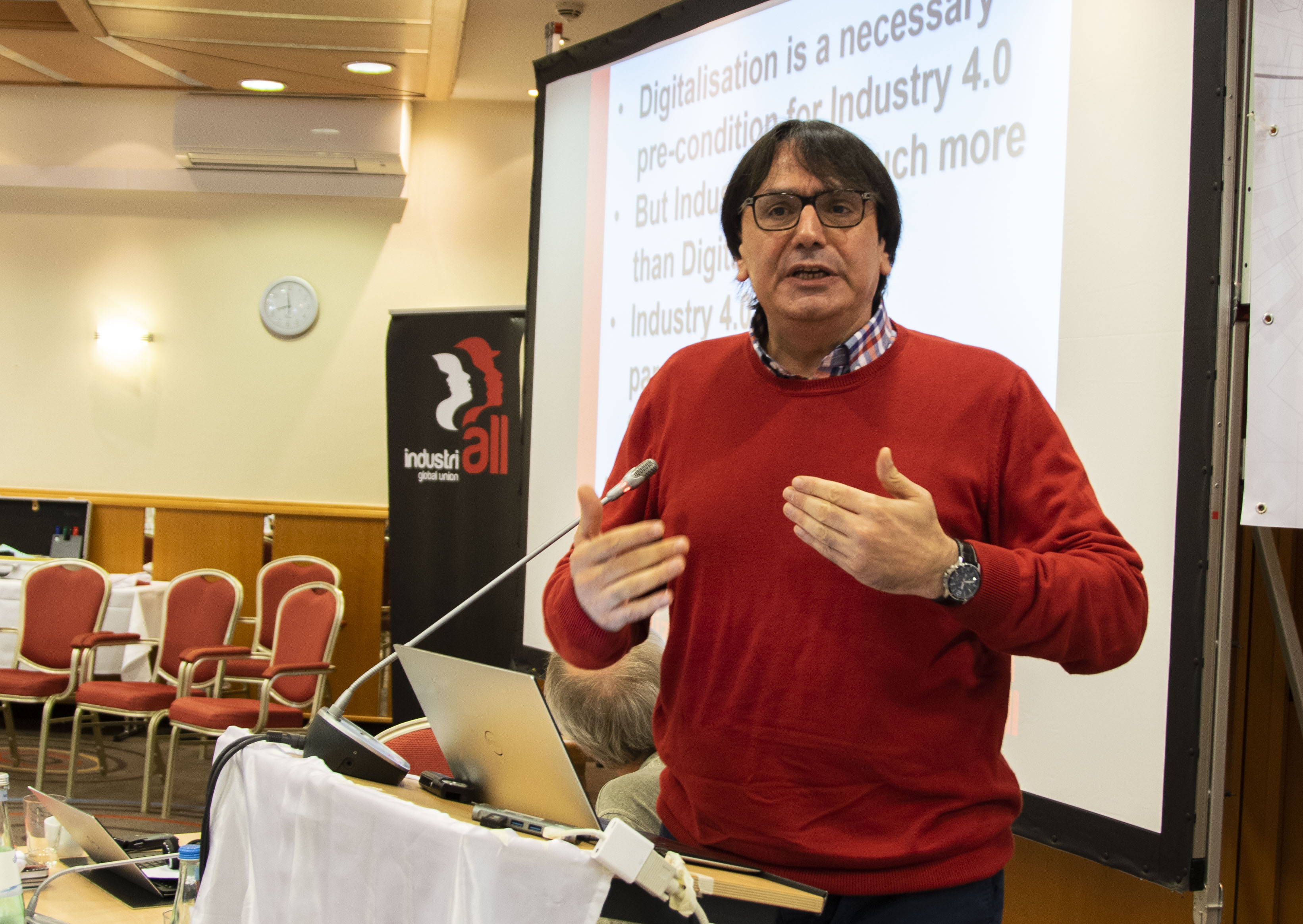
IndustriALL industry director Tom Grinter gave a detailed overview of the position of the company globally and its relationship with unions in different regions, and Michael Wolters of IG BCE spoke about Industry 4.0 and digitalization, and the emerging technologies bringing tremendous change to the chemical industry: augmented reality, the Internet of Things, 3-D goggles, 3-D printing, drones and big data.

Michael Wolters

"We can’t see the future because we are limited by our horizon. Lifelong learning and ongoing training will allow us to respond flexibly and ensure that there is sufficient employment."

Raghuram Theramkudalu

Delegates compared conditions at BASF sites across the world. Thiago Rios, Raghuram Theramkudalu and Doug Watts spoke about the situation in Latin America, Asia-Pacific and North America respectively.

Thiago Rios and Doug Watts

Doug Watts of the United Steelworkers recalled the first time Brazilian trade unionists visited his plant in the US: 

"When we bring workers together and talk face to face, the company can't undermine us by pitting worker against worker and country against country."

Lú Varjão

Lú Varjão of Brazil asked the BASF network about the position of women in the company and in the unions, and policies to improve the situation. This initiated a serious debate about the work that is needed to bring more women into the sector and into activism.

This was followed by a discussion on health and safety.

Tom Grinter said:

“The regional networks in the region are mature and they function well. We need to take everything we have learned from each other and apply it at global level. We want to establish global social dialogue with BASF, so that we can win the best possible conditions for workers and secure jobs for the future.”

The meeting adopted an action plan to take the work forward.

Unity, struggle and solidarity in the pharmaceutical industry

The meeting was hosted by IndustriALL’s Turkish affiliate Petrol-İş. Petrol-İş and another Turkish affiliate, Lastik-İş, are both central actors in the Turkish landscape and work hard to defend and protect their members in these difficult times.

The network examined and analysed the sector and discussed how unions can strategically advance worker issues globally. Participants had the opportunity to share experiences, solidarity and practices. In a number of countries, workers in the sector are being oppressed, and rights are being eroded. The meeting expressed full support and solidarity to Idris Idham, President of Indonesian Healthcare and Pharmaceutical Workers’ Union (Farkes) for his reinstatement to his job.

Masato Shinohara, UA Zensen Japan

“We exchange information so that we can all go in the same direction. This network gives us the platform to do that. The pharma sector in every country is very different, there are trends that differ from country to country. We as workers need to make sure that we make a sound effort and know which way to go in such turbulent waters,”

said Masato Shinohara, who is chair of the global network and president of Takeda Pharmaceutical Union, affiliated with UA Zensen from Japan.

In an overview of global developments and challenges in the sector, participants looked at demographics, an ageing society, climate change, new technologies, digitalization, generic drugs, the possible impacts of upcoming patent expirations, and general restructuring in the sector with possible effects on employment, and research and development trends.

Innovation and the effects of digitalization and Industry 4.0 were considered. The meeting noted digital transformation in the sector. It was concluded that there is a need for a global position with action and with the involvement and ownership of the network. There was substantial discussion about the social dimension of the pharma industry and access to medicine  .

In Brazil, in the current political climate workers’ rights violations are on the rise and social dialogue is non-existent. Despite this, unions remain confident that with international solidarity and union determination they will succeed.

In Indonesia, the pharmaceutical sector is affected by government policy. Outsourcing is a real obstacle for organizing and government reform on social security makes union work very difficult, especially when it comes to retaining members.

A panel on boosting global union solidarity through trade union networks in the pharmaceutical Industry looked at the advancement that unions are making through networking and solidarity and how these connections can still be improved.

Jan Franco, CSC-BIE, Belgium

“Networking is more than conferences. What do we do with our connections with each other outside of these meetings? Organizers say that language is an difficulty. We need to go beyond these obstacles but these are in fact limits that we put upon ourselves as trade unions,”

said Jan Franco, CSC-BIE, Belgium.

Kemal Ozkan, IndustriALL assistant general secretary

“Our important work through this solid global pharmaceutical unions’ network will continue to follow the strategic goals of IndustriALL Global Union“

said Kemal Özkan, IndustriALL assistant general secretary.

“We need to increase union density in global pharmaceutical industry through organizing campaigns. This is the only way for workers to get their deserved portion from the value created in this sector with high profits.”

IndustriALL renews global agreement with energy company Eni

The GFA was signed between ENI industrial relations manger, Fabrizio Sbarra, and IndustriALL, general secretary, Valter Sanches, as well as representatives of Italian affiliated unions FILCTEM-CGIL, FEMCA-CISL and UILTEC-UIL, which were co-signatories.

The renewed GFA includes improvements in its human rights due diligence process to ensure its alignment with the UN guiding Principles on Business and Human Rights. 

Eni has also made a strong commitment to workers’ rights by collaborating with the ILO to produce a guide named “International Labour Standards and Eni”. It serves as a useful reference book to implement the GFA and ILO Conventions in countries where Eni is operating and which haven’t ratified fundamental conventions.

As the International Labour Conference overwhelmingly adopted a new convention to eliminate violence and harassment in the world of work on the same day as the signing, a paragraph was added to the GFA forbidding any form of violence or harassment, either sexual or based on personal and cultural diversity, without exception, and affirming that that the parties will not tolerate harassment, violence or bullying of any kind, whether inside the workplace or outside.  

The strengthened GFA puts greater emphasis on improving working conditions in supply chains, and a includes a new article on sustainable development and environmental protection in which the company commits to continue reducing the carbon intensity of its operations and investing in the development of low carbon energy products.

The GFA also includes the principle of a "Just Transition" for a meaningful transition towards economies and companies that are environmentally sustainable for all, in accordance with ILO guidelines.

Valter Sanches, General Secretary, said 

“With this renewed agreement, Eni has made a strong commitment to international labour standards and has agreed on providing a platform to negotiate with unions worldwide on the impacts of energy transition. We will be able use this global framework agreement to improve the rights and interests of our members at Eni operations across the globe.”

To support parenting, and in the frame of ILO Convention 183 on maternity protection, Eni grants 10 working days with 100 per cent of the annual salary to all the working fathers and mothers in the company. Maternity protection is essential to safeguard the health and safety of mother and child and for the equality of all women in the workforce.

Marcellino Tufo, from FILCTEM-CGIL and coordinator of the GFA said:

“We are convinced that the innovations introduced in the GFA can improve the conditions of workers and support the communities in which Eni operates. From today our task, together with IndustriALL, will be to transform what's written in the GFA into reality.”

 For the first time, a list of indicators has been added to the annex of the agreement to monitor the implementation of the agreement, as well as a dispute resolution mechanism to solve possible conflicts related to the GFA.

Patrizia Pitronaci, Head of the Uiltec-Uil international office, said:

“The ENI global agreement confirms the Italian multinational's willingness to respect standards established by the ILO. Great strides have been made and many improvements added.”

IndustriALL trade union affiliates at Eni at the GFA signing

Nora Garofalo, General Secretary of FEMCA-CISL summised:

"The renewed agreement is a model for everyone and is the result of constant dialogue between unions and the company based on shared values and principles in the field of human and labour rights.”

Eni is an integrated Italian energy company with 31,000 employees in approximately 67 countries worldwide. It is a key player in the exploration, refining and sale of petroleum products; the development and extraction of oil and natural gas; and the procurement, supply, trading and transport of natural gas, LNG, electric power, fuels and chemical products.

IndustriALL sexual harassment policy

Statement of Principles

Sexual harassment is a violation of human and trade union rights and dignity. IndustriALL Global Union is committed to provide a safe environment free of any form of sexual harassment during activities and meetings that it organizes, regardless of an individual’s gender, gender identity and expression, sexual orientation, disability, physical appearance, body size, race, colour, nationality, age or religion.

Definitions and Unacceptable Behaviours

Sexual harassment is an unwanted, unwelcome and unasked-for verbal, non-verbal or bodily behaviour of a sexual nature. Sexual harassment is a display of power which can intimidate, coerce or degrade another person.

Sexual harassment can include but is not limited to: Inappropriate touching; leering; making homophobic comments; making sexually suggestive signals; sending unwanted e-mails/ text messages of a sexual nature; physical assault; making sexual comments or innuendos; telling sexual jokes; making insults based on a person’s sex or rating their sexuality; requests for sexual favours; displaying pictures or other sexually explicit material

IndustriALL will not tolerate any form of sexual harassment during activities and meetings.

Reporting and Enforcement

Prior to the start of any IndustriALL activity or event or meeting, attendees will be informed of this policy, which will also be sent to them in advance.

In large IndustriALL activities and events or statutory meetings, a participant and a staff person to whom complaints may be directed will be identified for all attendees at the beginning of the meeting.

If an attendee is subject to what they believe to be unacceptable behaviour under this policy, or witnesses such behaviour, they should inform one of the designated persons immediately. If neither person is available, the attendee may inform any other IndustriALL staff person or member of the leadership, who will work with the designated person to respond to the complaint.

IndustriALL takes these complaints seriously and may, at its discretion, take action that it deems appropriate upon assessing the situation. This includes warning the offender or expulsion from the conference [with no refund]. Additionally, where appropriate, IndustriALL may inform the alleged offender’s affiliate.

We did it! New ILO Convention on violence and harassment at work

The adoption of the Convention and Recommendation is a huge victory for workers and the trade union movement, which has been fighting for years to get an international labour instrument to address gender-based violence (GBV) in the world of work. The new Convention No. 190 represents an extraordinary opportunity for the trade union to move their fight against GBV forward.

Under these new instruments, states will be able to adopt laws, policies and mechanisms aimed at preventing violence and harassment in the world of work, protecting workers and establishing remedies for victims. 

The duties of employers, which have the primary responsibility to create a work environment free from violence and harassment, as well as the roles and responsibilities of trade unions and workers are clearly defined.

However, this is just the beginning. Trade unions must now campaign for the ratification and the implementation of both instruments in their countries.

Why is it historic?

These new instruments fill a protection gap for millions of workers, especially women, who have been suffering from violence and harassment at work. Until today, there was no law at the international level that set a baseline for taking action to address the issue.

The new Convention and Recommendation acknowledge the impact of violence and harassment in the world of work, and the right of everyone to a world of work free of violence, including GBV. Violence and harassment is unacceptable and incompatible with decent work, and a violation of human rights.

Both new instruments recognize the particular impact on women and girls and highlight the need for a gender responsive approach which will address the causes of GBV (gender stereotypes, discrimination, unequal gender based power). The specific impact of gender-based violence on other more vulnerable groups or groups in situations of vulnerability is also highlighted.

Why is the Convention a progressive and meaningful instrument?

The Convention represents a step forward with regard to protection of victims.

The term “violence and harassment” is considered as a single concept, which refers to a range of unacceptable behaviour and practices, or threats.

The Convention covers all types of harm, not only physical but also psychological, sexual or economic harm. 

The trade union movement has been fighting hard to get an instrument that would protect every worker, especially precarious workers who are particularly vulnerable. The Convention protects all workers regardless their contractual status, including volunteers and interns.

Furthermore, the Convention puts forward the notion of the world of work, which applies not only to the workplace but also in spaces and situations linked to work such as work-related travel, training, events and commuting to and from work. The new instrument also deals with the risks brought with new information and communication technologies.

Under the Convention, States shall take appropriate measures to recognize the effects of domestic violence and mitigate its impact on the world of work. This could include leave for victims, flexible work arrangements, protection for the victims, protection against dismissal, and raising awareness about the effects of domestic violence. 

How do the Convention and Recommendation promote trade unions?

Both the Convention and Recommendation outline the duty of governments to consult with social partners in developing laws, strategies and procedures related to violence and harassment at work. Governments should also provide trade unions resources and training on the issue, including GBV.

The Recommendation promotes recognition of the right to collective bargaining at all levels as a means of preventing and addressing violence and harassment and, to the extent possible, mitigating the impact of domestic violence in the world of work.

The new instruments also make provisions for workers and their representatives to take part in the design, implementation and monitoring of workplace policy, as well as risk assessment and identification of hazards. 

Workers have the right to be made aware of all hazards and to remove themselves from a work situation which they believe presents an imminent and serious danger to life, health or safety due to violence and harassment. 

In addition, trade unions join states and employers in the identification of sectors, occupations, and work arrangements in which exposure to violence and harassment may be more likely, as well as in the development of measures to protect these workers.

The Convention will enter into force 12 months after two member States have ratified it. The Recommendation, which is not legally binding, provides guidelines on how the Convention could be applied. 

Header photo: ILO, © Crozet / Pouteau

Experts group explores transformation in the auto industry

The meeting was attended by experts from auto unions affiliated to IndustriALL: IF Metall in Sweden, IG Metall in Germany, the KMWU in Korea, the JAW in Japan, NUMSA in South Africa, Unifor in Canada, the UAW in the USA, and Unite in the UK.

Georg Leutert

IndustriALL auto sector director Georg Leutert opened the meeting by saying:

“Change in the sector is uneven and complex, with competing technologies and political contexts. This makes it difficult to elaborate a trade union response, and uncertainty retards action.

“But we do have some answers. There are clear scenarios emerging, and good practice examples for a transition that secures employment. By focusing on this, we can develop a common action plan that ensures that workers’ rights are defended.”

Dr Martin Schwarz-Kocher, of the IMU Institute in Stuttgart, Germany, gave a detailed overview of the state of the sector and possible scenarios for its future development. Electric mobility is the most energy efficient solution, and without it, the world will fail to meet its Paris climate targets. There will also be a significant change in transport culture, and a switch from private to public.

Dr Schwarz-Kocher

A number of different vehicle technologies are being developed, notably hybrid (HEV and PHEV), battery (BEV) and hydrogen fuel cell (FCEV). It is not yet clear which will dominate. The future demand for labour will depend heavily of which powertrain is brought to market, and when. It is likely that that all three technology types will work alongside each other.

Dr Schwarz-Kocher explained that the mass production model of the current original equipment manufacturers (OEMs) faces competition from smaller, bespoke producers using 3-D printing, a shift from assembly lines to modular production, as well as from the shift to other forms of mobility.

The powertrain of a conventional vehicle. OSX, Wikimedia Commons

With a robust strategy, managed well, it is possible to successfully transition with only a small reduction in employment and no major impact on the industry. However, workers in research and development will be particularly affected, and the jobs of up to 45 per cent of powertrain workers could be affected negatively. Electrified powertrains have significantly fewer components and require fewer workers to assemble.

Powertrain concepts in electrified vehicles

There will be a radical change in tasks, and mechanical engineers may need to retrain as electrical or software engineers.

The auto industry is particularly reliant on an ecosystem of expertise, and maintaining regional industrial clusters that can continue to innovative is important for keeping jobs. This means coordination between local authorities, OEMs and component producers, the transformation of manufacturing plants and skills development for workers.

Representatives contrasted their experience with the scenarios laid out. Globally, development is uneven, and the role out of electric car charging infrastructure – as well as power generation – is hugely important. As governments have not lead the necessary standardization, this is likely to happen through competition and consolidation by big energy companies. Globally, eroding wages may affect the viability of the market, and only middle class people with private garages will be able to install home charging stations.

Unions need a common rights-based framework, such as a transition charter for the industry. Workers have a right to work and to employment stability, and a right to know about planned changes.

The IndustriALL automotive working group will meet in December. Before the meeting, there will be an exercise to map national policies, and best practice examples will be developed.