Fiat Chrysler and CNHi must increase dialogue with unions

The annual FCA/CNHi global union network meeting on 8 and 9 July in Toronto, brought together 38 trade unionists in nine countries. FCA and CNHi’s 24 brands include Alfa Romeo, Case, Chrysler, Dodge, Fiat, Jeep, Lancia, Maserati, New Holland and iron and castings supplier, Teksid.

The current transformation of the automotive industry is a huge challenge that will affect the future of auto companies and workers. The network shared the view that FCA has a responsibility to safeguard jobs and plants through forward looking investments. However, instead of strengthening dialogue, the company tends to ignore the expertise of trade unions and workers. Participants called on FCA to develop a comprehensive strategy based on close cooperation with trade unions and supported by governments, in particular when it comes to fundamental issues such as a possible merger with another OEM (e.g. Renault).

The network committed to taking immediate action to support colleagues at Teksid Hierro in Mexico. After a five-year campaign, IndustriALL affiliate, Los Mineros (SNTMMSSRM), won a trade union election at the Teksid plant in 2018 with a clear majority. Nevertheless, the company refuses to recognize the result and maintains a collective agreement with the defeated CTM union.

In April 2019, Teksid Hierro dismissed 123 workers who protested the company’s behaviour, including the entire plant leadership team of Los Mineros. The network has vowed to continue solidarity support until the company reinstates the dismissed workers and recognizes Los Mineros as the democratically elected bargaining partner.

The network resolved to approach FCA and CNHi on the importance of core ILO labour conventions in upholding basic social and trade union rights in a globalized economy, especially in relation to supply chains. In this context, it will propose to enter into negotiations for a global framework agreement with both FCA and CNHi.

Participants agreed to increase the exchange of information in the network, in particular by contributing to the database and by making active use of it. The network also agreed clear rules on the representation of women and younger generations in the network.

On the second day of the meeting, participants visited the Brampton Assembly plant where they met the Director of HR, FCA Canada, providing an example of how good relations with the North American management could work with the entire Group.

IndustriALL’s director for the auto sector, Georg Leutert, said:

“Fiat is the only European automotive company without a global forum providing for regular information and consultation between the company and trade unions. We urge the company to end this unsustainable position and to enter into dialogue.”

The group particularly thanked Canadian affiliate, Unifor, for hosting the meeting.

Textile and garment unions in South East Asia build networks

Sixty trade unionists from Cambodia, Indonesia, Malaysia, Myanmar, Philippines, Thailand and Vietnam gathered in Yangon, Myanmar, on 4 and 5 July for IndustriALL’s regional textile, garment, shoes and leather (TGSL) meeting on organizing in supply chains.

Cambodian affiliates condemned the dirty tactics used by Cambodian employers to thwart unions’ effort in organizing supply chains, including termination of union leaders.

Nenden Hirawati from National Industrial Workers Union Federation (SPN) said Indonesian employers were equally hostile to trade unions. She added that employers often hire thugs to intimidate unions’ organizing efforts and workers were fearful that factories would be shut down and relocated to other regions.

Nonetheless, affiliates also highlighted their successes in building worker power in the supply chain.

Unionists shared a variety of organizing strategies to overcome obstacles, including direct negotiation with employers, mediation with the assistance of global brands, and the use of ILO conventions.

“Outsourcing is a common phenomenon in the TGSL sector, that’s why IndustriALL has four key strategies to build industrial relations in the supply chain. We need to create networks amongst our affiliates that support organizing in the sector,” said Christina Hajagos-Clausen, IndustriALL’s director for the textile and garment industry.

She gave a briefing on how IndustriALL’s affiliates could be active in holding brands accountable for the business practices through the OECD’s Due Diligence Guidance for Responsible Supply Chains in the Garment and Footwear Sector. Trade unions should also use global framework agreements to establish relationships with brands and resolve disputes within supplier companies.

Another key strategy to building union power across the supply chain is the creation of trade union networks. The meeting also hosted the first South East Asia network gathering for the Coats and Birla networks. Further steps will now be taken to expand these networks regionally and globally.

“Currently, IndustriALL has 10 union network meetings in the region every year and we have many successful stories. In solidarity with their counterparts in other countries, our regional affiliates shared useful information about multinational companies, such as wage structure, health and safety issues, and direct dialogue strategy with employers,” said IndustriALL’s South East Asia regional secretary, Annie Adviento.   

The meeting also included a presentation on how to use Fashion Revolution, a movement to improve sustainability and working conditions in the garment sector, to increase union visibility in global supply chains.

Photo: Trade union leaders at the regional meeting take action using Fashion Revolution's #Imadeyourclothes tagline. 

Bangladesh young unionists demand greater role

Some 38 young representatives from IndustriALL affiliates in Bangladesh, including 22 women, took part in the meeting, where participants called for appropriate trade union structures and financial resources to achieve their demands.

Apoorva Kaiwar, IndustriALL South Asia regional secretary, said:

“Trade unions in Bangladesh need to intensify their engagement with young workers and increase youth trade union membership in order to strengthen the union movement.”

Participants at the workshop also expressed concern over increasing unemployment among youth in Bangladesh. Furthermore, a large number of young workers who are employed, are working as precarious workers with poor wages, unjust working conditions and lack of job security. Participants said the government of Bangladesh should take immediate steps to address the issue of unemployment and stop precarious work.

After intense debate and frank discussion, the young trade unionists committed to work with their union leaders and take action to fulfill the following objectives:

Sarah Flores, IndustriALL Youth and Project Officer said: 

“It is encouraging to see large number of young women participate in this workshop, which called on IndustriALL affiliates to enhance youth empowerment, representation and participation towards building union power.”

The meeting was also supported by 3F (United Federation of Danish Workers), the largest trade union in Denmark.

Social dialogue key to better industrial relations in Ghana

A seminar in Accra on 3 July attended by 38 participants from the Public Utilities Workers Union, Timber and Wood Workers Union, Ghana Transport, Petroleum and Chemical Workers Union, Ghana Mine Workers Union, and Industrial and Commercial Workers Union, affiliated to IndustriALL Global Union and Building and Wood Workers International (BWI) discussed how to improve social dialogue at enterprise, sectoral and national levels.

The seminar organized by IndustriALL Sub Saharan Africa Region, BWI Africa and Middle East Region and Industri Energi (IE) Norway discussed how to build union and employer capacity to effectively engage in social dialogue and improve the participation of women and youth who are often marginalized. Further, the seminar recommended that legal and institutional reforms be made to recognize unions’ role in social dialogue. 

Solomon Kotei, chairperson of the IndustriALL Council Ghana emphasized: “Social dialogue brings cordial industrial relations. Without such engagement it is difficult to improve working conditions at workplaces. This underlines why we need to continuously find means to improve social dialogue and build union capacity.”

Ole-Kristian Paulsen, IE international advisor who facilitated said: “The well-conducted seminar shared Norwegian experiences of social dialogue with a focus on Industri Energi and showed major differences between systems in Norway and Ghana. Through discussions Ghanaian unions saw the need to change their systems. Distinguishing between negotiations and an active-inclusive-involving social dialogue that creates development for the future at the workplaces is important.”  

The seminar discussed that social dialogue plays a critical role in not just creating a productive and progressive environment for collective bargaining, but also improves industrial relations between workers and employers. It also contributed more effectively to improving productivity in the workplace, strengthened enterprise viability and secured decent jobs. Participants urged trade unions to use social dialogue beyond considering it as a platform to put forward labour demands. Social dialogue also provides unions with an opportunity to contribute to enterprise growth and achieving development goals. 

Garikanai Shoko, regional education officer for BWI Africa and Middle East added: “Social dialogue promotes consensus building and democratic involvement among stakeholders in the world of work. For BWI, meaningful dialogue is important to improve institutional capacity and to support tripartite industry structures in our sectors.”

We don’t support low wages says Ethiopian labour minister

“We support living wages, not low wages. We are not for cheap labour,” said Dr Ergogie Tesfaye, the Ethiopian Minister of Labour and Social Affairs at the programme launch of the ILO’s Advancing Decent Work and Inclusive Industrialization Programme on 3 July in Addis Ababa.

According to a survey by Mywage and FNV Mondiaal, over 90 per cent of the garment workers in Ethiopia earn less than the 4130 Ethiopia Birr (US$144) needed to cover monthly living expenses. To reverse this, the Industrial Federation of Textile, Leather, and Garment Workers Trade Union (IFTLGWTU), affiliated to IndustriALL Global Union, is campaigning for living wages. 

The Confederation of Ethiopian Trade Unions, to which IFTLGWTU is also affiliated to IndustriALL, said at the meeting that it is unacceptable to pay Ethiopian workers such low wages.

IFTLGWTU president, Mesfin Adenew, said the union is waiting for the government to make an announcement on the minimum wages:

“The new labour law amendments passed by parliament are recommending the setting up of a wage commission to study the national and sectoral minimum wages. As part of our living wage campaign, we are waiting for the commission to make announcements first, make careful considerations, and then consult with the workers on what action to take.”

Global fashion brands, H&M and PVH, also said they were working with their suppliers to ensure that they pay better wages and improve working conditions.

Said Christina Hajagos-Clausen, the IndustriALL Director for the textile and garment sector:

“The emphasis on social dialogue is an important step towards minimum living wages and better working conditions for the textile and garment sector, especially for the women who are the majority in the factories. Global brands sourcing in Ethiopia need to join ACT in order to work with the trade unions to increase wages in the sector.”

ACT (Action, Collaboration, Transformation) is a ground-breaking agreement between global brands and retailers and trade unions to transform garment, textile and footwear industry and achieve living wages for workers through collective bargaining at industry level linked to purchasing practices. Find out more here.

Court of appeal decision threatens right to strike in Belgium

Bruno Verlaeckt, president of the Antwerp branch of IndustriALL Global Union’s Belgian affiliate, La Centrale Générale – ABVV-FGTB, was found guilty of “malicious obstruction of traffic” after his union blocked roads to the port of Antwerp in a protest in 2016. The strikers were confronted by police who broke up the demonstration and arrested union leaders.

An ABVV-FGTB representative said;

“For us, the unions, this conviction is a real slap in the face, because in the future such actions will become almost impossible if we are threatened with criminal prosecution… This judgment lacks any sense of justice, constitutes a serious threat to the right to strike and is contrary to European case law, so the FGTB has every intention of going to appeal.

“We refuse to accept that the only weapon we have, the right to strike and picket, is taken away, and that courageous activists like our union representatives are criminalized. It's going too far!”

ABVV-FGTB (stop criminalizing social action)

The FGTB have until the 25 July 2019 to go to the Supreme Court of Belgium. The Supreme Court has the power to annul a judgment only if the court of appeal has not correctly interpreted or applied certain legal rules. In this case, the judgment can be annulled and returned by the Supreme Court to another court of appeal. This court would then have to re-evaluate the merits of the case.

"Organized and non-violent action in public places is a fundamental trade union right that must be preserved. The conviction of Bruno Verlaeckt is an infringement of trade union freedoms. IndustriALL condemns the ruling of the Belgian court and expresses solidarity with trade unions, anywhere in the world, struggling to preserve the fundamental right to freedom of peaceful assembly and association,” said Valter Sanches, IndustriALL general secretary

At IndustriALL's World Conference for the Chemical Industries in Istanbul this June, 230 participants from 45 countries also voiced their support and solidarity with Bruno Verlaeckt. 

ABVV-FGTB

Victory at ExxonMobil in Australia after two-year picket

The David versus Goliath victory against the world’s sixth biggest company, ExxonMobil, by workers who refused to give in, has had a nation-wide impact.

The union campaign exposed billions of dollars of tax evasion by the energy giant and played a major role in pressuring the government to increase taxation on resource companies. It will see the Australian public receive an extra US$4 billion in revenue, with more to come.

The picket line at Esso Longford in Victoria, Australia.

The protest, which is one of the longest in Australian modern history, began on 22 June 2017, when a number of the 230 maintenance workers at ExxonMobil’s Esso subsidiary in Longford refused to accept a new contract from UGL. The agreement slashed wages by 40 per cent, proposed gruelling anti-family rotas and left workers unpaid if they had to stop work due to technical problems.

The new sham contract had been signed by five people thousands of miles away in Western Australia, without any knowledge of local workers or unions.

Now, IndustriALL Global Union affiliated trade unions in Australia, the AWU, AMWU, and ETU, have reached an agreement with ExxonMobil and UGL which will ensure that the sham contract is not used on any other site in Australia.

Furthermore, unions have forced UGL into agreeing to re-negotiate for a union-ratified collective agreement where the sham agreement has been used to date.

The campaign has received solidarity support from unions across Australia and all over the world, including IndustriALL.

Troy Carter, a leading union campaigner, and one of the nine remaining workers on the picket line, said:

“The power of the union is strongest when it is up against the biggest. ExxonMobil is one of the biggest companies in the world, yet it couldn’t get rid of a picket line of nine trade unionists. This is a very important moment for unionists worldwide in demonstrating that we are ready to stand up and fight multinational companies against union busting.”

The rat campaign mascot passes an ExxonMobil rig off  Western Australia

As the campaign grew, unions successfully lobbied the government into re-opening a Senate enquiry into corporate tax avoidance, during which ExxonMobil were forced into admitting they are owned by a shell company in the Netherlands. The Dutch company is in turn owned by another company in the Bahamas (a known tax haven) where ExxonMobil has a further 575 registered shell companies.

IndustriALL’s general secretary, Valter Sanches, said:

“This victory is down to the steadfast determination and undiminished spirit of workers who stayed on the picket line, day and night, for more than two years resisting a brutal violation. They are an inspiration for workers worldwide. Their sacrifices have exposed corporate tax avoidance by ExxonMobil and helped to bring billions back into public hands. The government of Australia must ensure multinationals pay their fair share of tax, and act to prevent these sham contracts from inflicting further suffering on workers and their families.”

Bridgestone global network builds on longstanding health and safety effort

On 11-12 June, 2019, the IndustriALL Bridgestone Global Network Steering Committee met for its 18th annual activity, in Johannesburg, South Africa.

Following the group’s protocol, the body is chaired by the Japanese Rubber Workers’ Union Confederation, Gomu Rengo, an important affiliate of IndustriALL Global Union. The Japanese Bridgestone Workers’ Union organizes and coordinates the meetings which rotate annually between Japan and other important locations for the company.

The factory visit

Both South African plants of Bridgestone are organized by the IndustriALL affiliated National Union of Metalworkers of South Africa (NUMSA), and as hosts of this year’s activity, NUMSA arranged for the group to visit the nearby Brits factory and exchange with management. The plant employs 766 workers and the local NUMSA shop stewards are accompanying the transition of the tyre factory to upskill workers and adapt to modern machines and production techniques.

Gomu Rengo president, and chair of the network, Hiroyuki Ishitsuka opened the meeting by outlining the importance of mature industrial relations at global tyre manufacturers such as Bridgestone. Under the current climate of new technologies giving the potential to new companies to grow and take market share from the big three, Bridgestone, Michelin and Goodyear, president Ishitsuka said:

“We must remain vigilant. Workers and management must establish common rules, understanding, and communication. And occupational health and safety is a huge priority. We count on IndustriALL’s unchanged support in building the strength of this network.”

The issue of dumping of cheap tyres from China, and elsewhere in Asia, is a major issue for tyre manufacturers in South Africa, Japan and Europe. The cheap tyres are flooding the market and threatening the jobs of IndustriALL members around the world.

The current global slowdown in the car industry, as well as the mining industry are directly affecting the tyre industry. NUMSA will be working with the Japanese union colleagues to seek assurances for the future of the second Bridgestone factory in South Africa, at Port Elizabeth, which employs 250 workers.

The chair of the Bridgestone European Works Council, Marco Argilli plays an important role in this global body. Marco presented to the group regarding Bridgestone’s progress in the field of health and safety, with a positive record of no serious injuries in Europe in 22 months. However, Marco raised the issue that is present in the South African factories of worker contact with carbon black.

In Europe, Bridgestone is investing US $41 million over the coming four years to digitize the manufacturing processes at its eight European plants in France, Hungary, Italy, Poland and Spain. The investment will include upskilling and training for Bridgestone employees in order to operate digital technologies that are designed to help improve resource efficiency and job satisfaction. The improvements also will address energy savings, efficiency increases, waste reduction and process simplification.

Heinz Evertz, coordinator of the Bridgestone European Works Council, made an important contribution to the meeting with a focus on cancer. Heinz argues that occupational cancer should receive more attention from Bridgestone, with health just as important as safety. The meeting agreed that further research is needed into the real cancer risks of the materials used in tyre production.

The Japanese Bridgestone Workers’ Union’s Takahiro Nakajima reported that an active union is the only way to a safe workplace:

“Safety is improving in Bridgestone Japan because of the union involvement and our improved equipment. If our members raise a safety issue from the workplace, we take it to management and make sure that they are listened to.”

Tom Grinter, IndustriALL rubber sector director said:

Tom Grinter

 “IndustriALL believes in campaigning for the core rights around health and safety. Our members have a right to know, to participate, and to act. This means that Bridgestone must make information on the risks and hazards in the workplace available to all employees, workers must always have the right to refuse a task if she or he sees a danger, and our members must have the right to jointly plan and implement the health and safety programs in their workplaces.”

NUMSA shop steward James Selala and international officer Christine Olivier reported positive action from Bridgestone management under the three core rights of health and safety. However, it was stressed that efforts are needed to increase understanding on occupational cancer. Information gathering will be conducted into health of workers retiring after a long career at the Bridgestone facilities, as it is common that workers die within three years of retirement.

Next year’s annual activity will be held outside of Japan due to the Olympic Games being held in Tokyo in 2020.

Shell unions to collaborate on organizing

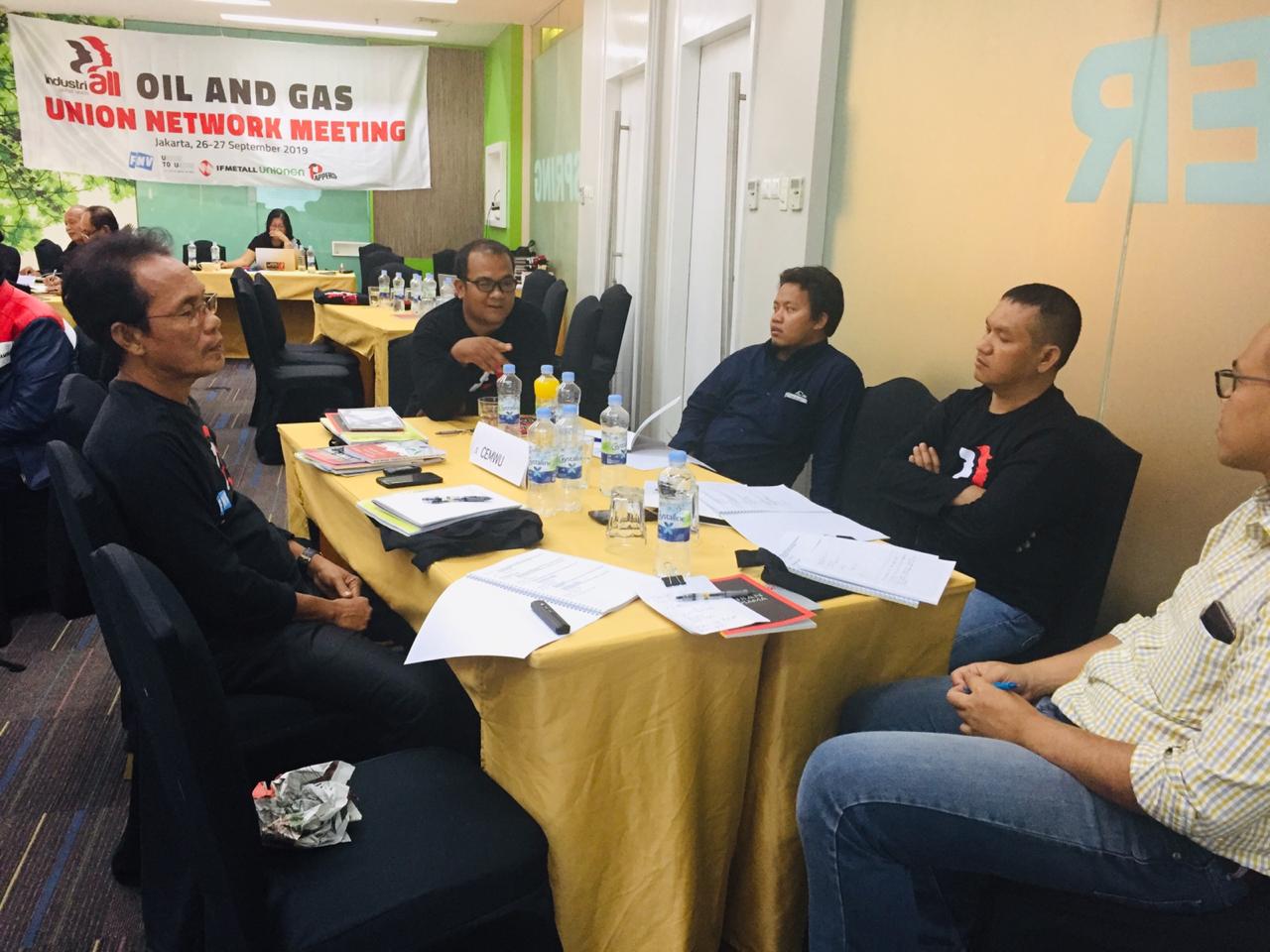
Trade union representatives from IndustriALL affiliates in Belgium, Brazil, Colombia, Morocco, Netherlands, Nigeria, Norway and USA met for the fifth annual meeting of the network which is supported by FES

The meeting opened with an update on the Shell campaign, which over the past year has included a mission to Port Harcourt in Nigeria, as well as interventions at the International Labour Conference and the UN Human Rights Council in Geneva, to highlight union busting and poverty living conditions of contract workers at Shell Nigeria. Most recently, IndustriALL raised workers’ rights at the Shell AGM in May. 

In Nigeria, IndustriALL affiliate, NUPENG, says that all blue-collar workers have been outsourced at Shell, and they have only been able to organize logistics workers due to anti-union practices by the company.

“Workers are automatically sacked if they try to talk to a union. If a contractor company talks to a union, Shell signals that they won’t renew the contract,” said Olawale Afolabi, NUPENG general secretary.

Shell has repeatedly denied the allegations but, says Afolabi:  

"The onus is on Shell to prove that workers, who are contributing to profits, are protected and have the right to good conditions. Shell is making the victim find the evidence.”

A key of the goal of the Shell campaign is to reduce outsourcing at the company, which affects all operations.

In Norway, Jorn Boe, from Industri Energi, told how workers are being hired in to work at Shell for four years as a contractor, after which time they are entitled to permanent employment. However, workers are being kicked out and replaced by someone else just before the four years is over.

In the USA, the United Steelworkers (USW), noted that the entire maintenance force at Shell’s new ethylene cracker plant, which is under construction in Pennsylvania, will be contracted out, putting a question mark over safety and making it difficult to organize the workers.

The USW also said that Shell in the US is specifically looking to award contracts to companies that are non-union. The USW and Dutch affiliate FNV committed to working together to increase organizing at Shell.

Participants heard different approaches to collective bargaining from the USW and FNV. USW has negotiated good pay rises and improvements in health and safety, while FNV has also included provisions for training and career development for its members.

Furthermore, FNV has been able to negotiate a supplementary top up payment for workers at Shell’s NUM subsidiary of up to 20 per cent of their original salary for two years if they take a lesser paid job elsewhere. This is to provide a Just Transition for workers who are moving out of the fossil fuel sector into sectors that are not as well paid.

IndustriALL’s director for sustainability, Brian Kohler, advised participants how unions can best prepare for changes in the oil sector brought about by automation, digitalization and efforts to meet carbon emission targets.

Edson Dias Bicalho, from FEQUIMFAR/FS in Brazil, which represents workers at Shell ethanol production subsidiary, Raízen, said increased mechanization has reduced the number of injuries and accidents at the firm. It has also led to women working right across the production process, not just in administration.  

Joosje de Lang from FNV and Oluchi Amaogu-Fellix from NUPENG made a presentation on how unions can help break down the barriers that prevent women working in male-dominated sectors, such as oil and gas. 

Joosje de Lang and Oluchi Amaogu-Fellix 

In Morocco, Mohamed Doumar from petrol and gaz union FNTPGPA-UMT, reported pay increases for Shell workers through industry-wide collective bargaining. He also said the country’s only oil refinery, Samir, has finally shut down after being declared bankrupt.

As Shell prepares to start operations in the Colombia, Ludwing Gozmez Almeida, from petroleum union, USO, highlighted the grave threats to trade unionists in the country. In the past 30 years, over 100 of his union colleagues have been murdered in Colombia.

Participants concluded the meeting with plans to support one another and cooperate more as the oil and gas industry diversifies and changes due to automation and digitization.

IndustriALL energy director, Diana Junquera Curiel, said:

“This is what international solidarity means. It is really important that countries with good relations with Shell, and with power, take a strong position with the company. By uniting we can achieve so much more.”

IndustriALL signs quality of working life agreement with Renault

The global agreement – "Building the world of work together within Groupe Renault” – was signed between Thierry Bolloré, chief executive officer of Renault, Valter Sanches, General Secretary of IndustriALL, the French trade union federations and the other trade union federations or unions represented within the group committee, and Eric Vidal, secretary of the group committee.

The agreement, signed by the ten trade union federations or unions represented in the Group Works Council, provides a basis for structuring social dialogue, both at Group and local level. It offers the possibility and encourages the launching of new initiatives, as well as finding relevant pragmatic solutions to improve employees' life at work, through the negotiation of local agreements.

 "I'm proud that Renault is signing such an innovative agreement, ensuring that our teams around the world will work in a safer, more attractive environment that respects the balance between professional and personal life." 

– Thierry Bolloré, Renault CEO


“New propulsion systems and digitization are massively transforming the working environment and we must prepare for this change in social terms.  This agreement allows our unions around the world to deal with these changes in a negotiated way. In particular, it provides for the development of the necessary skills for each employee, thus ensuring that today's workers are still employed tomorrow.”

– Valter Sanches, general secretary of IndustriALL

Through a sustainable approach, the new agreement addresses many aspects of life at work, and particularly those that enable employees to combine performance and well-being. 

This approach, which involves all the Group's employees, is based on five fundamental principles:

This new agreement complements the global framework agreement signed on July 2, 2013, "Committing together for sustainable growth and development". It confirms the Group's commitment to respect fundamental social rights and incorporates the Convention adopted this year by the ILO to combat violence and harassment at work. 

"The agreement puts into practice one of the conclusions of the ILO's centenary: the future of work is not written in advance, it depends on what the labour actors will do with it, particularly through social dialogue. I welcome the signatories of this agreement who are part of this voluntarist and positive perspective with regard to the challenges of labour transformation."

– Guy Ryder, director general of the ILO

"This new agreement paves the way, within the framework of local social dialogue, for concrete actions on the ground for the daily lives of Groupe Renault employees around the world. Thus, this new agreement makes it possible to reconcile economic performance for the company and social performance for Groupe Renault employees."

– Eric Vidal, group committee