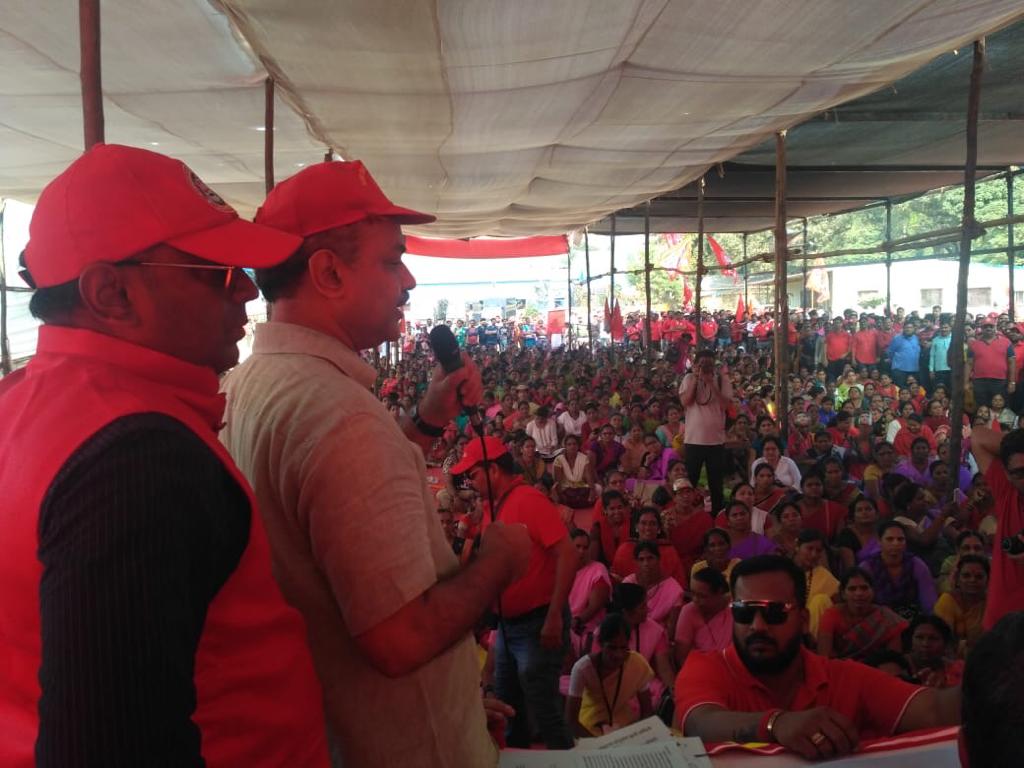
Population out in force for general strike in Algeria

Workers from industry, energy, transport, the public sector, as well as thousands of students are backing the general strike which has been called by independent trade unions in Algeria on 5, 6 and 7 November.

IndustriALL Global Union affiliate, SNATEG, which represents workers at state-owned gas and electricity provider, Sonelgaz, said 47 per cent of the population joined the first day of the general strike. Participation was particularly high at Sonelgaz, while higher education was completely paralyzed across the country as teachers and students joined workers to demand democracy, said SNATEG. The general strike has been adhered to in 37 provinces out of 48 in Algeria say independent unions.

SNATEG members strike at Sonelgaz in Algeria.

In a letter of support to independent trade union confederation, COSYFOP, which includes SNATEG, IndustriALL’s general secretary, Valter Sanches, said:

“We are very proud of the central role that the independent unions and your federation play in the democratic movement to fight for freedom of association, in order to end the repression and harassment of independent trade union organizations and to allow reintegration of all those who were fired for their union activities. We reaffirm our unconditional support for your struggle.”

High school students take part in the general strike.

Algeria’s ailing 82-year-old President Abdelaziz Bouteflika stood down in April this year, after millions of Algerian people took to the streets in outrage at his bid for a fifth term in office. Nonetheless, the weekly demonstrations have continued in an effort to oust the political regime.

A statement by SNATEG on the eve of the strike said:

“The departure of Bouteflika had given the group's workers hope for a change… (but) not only has nothing changed, our social situation continues to deteriorate.”


Elections for a new president have been announced for 12 December but all of the five candidates out of 23 that have made the final list are members of the political establishment, including two former prime ministers.

SNATEG President, Raouf Mellal, said:

“We categorically reject these rigged military elections, which aim to abort any kind of democratic change. This is our opportunity to create a law-abiding civil state, and we will go all the way to peacefully restore the sovereignty of the people.”

Release RCEP text immediately, say unions

After seven years and 28 rounds of Regional Comprehensive Economic Partnership (RCEP) trade negotiations, it was widely expected that at the third RCEP Leaders Summit in Bangkok on 4 November 2019, the conclusion of the deal would be announced.

However, against the backdrop of unprecedented domestic protest, India decided to withdraw from RCEP, as many outstanding issues remain unresolved.

According to the RCEP Leader’s joint statement, 15 countries have concluded negotiations for all 20 chapters and intend to sign the final text in 2020. The text has been sent for legal scrubbing – analysis by lawyers to ensure it is internally consistent, clear and compliant with relevant laws. RCEP countries will work together to address outstanding issues, and India’s final decision will depend on the satisfactory resolution of these issues.

Valter Sanches, general secretary of IndustriALL Global Union, said:

“We remain concerned over the lack of democratic process in the RCEP negotiations. Now that the 20 chapters are concluded, the RCEP text must be released immediately to facilitate informed public debate.

“RCEP should not affect government’s policy space to enact appropriate trade and industrial policies according to their current and future developmental needs. Any such hurdles in the current text should be removed.

“RCEP countries cannot remain spectators of violations of workers’ and human rights in member countries. The RCEP needs to include a sustainable development chapter with provisions to promote ILO core labour standards and to protect environment. It should include a commitment to an effective implementation and monitoring mechanism with the participation of trade unions.”

In line with the IndustriALL global trade and industrial policy action plan, earlier in June IndustriALL Asia-Pacific affiliates developed a regional action plan. Subsequently in July, IndustriALL affiliates along with other global union federations expressed serious concerns over the lack of a democratic process, the need to retain development policy space and other issues. They took action in August to demand a  fair trade regime during Labour 20, the union counterpart to the G20 Summit.


Trade unions and civil society have highlighted their concerns on numerous occasions, saying that it is unacceptable that RCEP governments fall short of holding meaningful social dialogue with trade unions, farmers and other sections of the society.

According to reports, some of the issues raised by India include a special safeguard mechanism to check import surge, movement of professionals, shifting the base year for tariff cuts from 2014 to 2019 and rules on cross border data transfer. India also opposed ‘ratchet’ provisions and most favoured nation treatment on investment and services.

RCEP is an agreement between ten Association of Southeast Asian Nations (ASEAN) countries and their five partners, Australia, China, Japan, New Zealand and South Korea. The twenty concluded chapters cover trade in goods, rules of origin, trade facilitation, trade remedies, services, movement of natural persons, investment, intellectual property, electronic commerce, government procurement, competition and dispute settlement.

Union-made blazers for South Africa's Rugby World Cup champions

The House of Monatic is a garment factory in Cape Town that specializes in suits and formal wear. It has made suits for South African President Cyril Ramaphosa and recently blazers for the Rugby World Cup champions, the Springboks.

Buy local is a campaign initiated by SACTWU, affiliated to IndustriALL Global Union, to source textile, garments, footwear and leather products in the country instead of importing.

The campaign aims to create jobs in the sectors which are important in a country with high unemployment levels. SACTWU is working with the South African Rugby Union (SARU) to produce, among other things, replica shirts for rugby supporters. The union is also working with the South African Football Association and Cricket South Africa on the local procurement campaign.

Part of the union’s victory is that the buy local campaign demands are included in the retail, clothing, textile, footwear and leather masterplan which was signed at the second South Africa Investment Conference in Sandton, Johannesburg on 6 November.

Welcoming the signing of the masterplan, which will create 70,000 new manufacturing jobs, the union says that the plan provides “a firm basis for future growth and sustainability” of the sectors. The masterplan was signed by major retailers, manufacturers, labour, and government.

Andre Kriel, SACTWU general secretary, says:

“Major retailers will procure more clothing, textile, footwear and leather goods locally, up to 65 per cent, and manufacturers will increase investment in modernizing productive capacity in our industry. We are pleased with the commitments made by the government to help strengthen the inspections and compliance enforcement capacity of the South African Revenue Services to stamp out illegal imports and under-invoicing.”

“We look forward to the constructive and effective implementation of this new and innovative tripartite social compact; the first of its kind to be signed by our industry's major stakeholders.”

Proudly SA, a company that promotes locally manufactured products, is also a partner in the campaign.

Photo credit: The South African rugby team celebrates. Photo: GCIS/South African Government

Unionists, human rights activists and opposition politicians under siege in Zimbabwe

“We were at the balcony of the ZCTU offices when the police started manhandling the [ZCTU] President [Peter Mutasa]. I thought it would be a good idea for us all to either sit down or follow the president to the police vehicle.

“That was when one of the police officers dragged me outside and began hitting me with a baton all over my body. He then bundled me into the police vehicle, together with President Mutasa and others,”

he says, narrating his ordeal to Equal Times. “They beat us all the way to the police station, where we spent the night before appearing in court the following day,” he adds.

Chirowamari and six others arrested on that day were charged with bigotry (words or deeds that can result in a crime against public order) although the charges were later withdrawn.

And in September, the acting president of the Zimbabwe Hospital Doctors Association, Dr Peter Magombeyi, made international headlines after he was abducted from his home in Harare by suspected state security agents for organising a strike by government doctors to demand better salaries.

Magombeyi was discovered four days later after being dumped in the bush 40 kilometres west of Harare. Allegedly tortured and poisoned by his captors, he underwent medical treatment in South Africa.

Worsening climate of fear

The stories of Chirowamari and Magombeyi are shared by hundreds of other trade unionists, opposition politicians and human rights activists whose right to freely assemble and associate is being trampled on by the Zanu-PF government, currently headed by President Emmerson Mnangagwa.

While Zimbabwe has ratified a number of international laws, including the International Labour Organization’s Right to Organise and Collective Bargaining Convention (No. 98) and the Freedom of Association and Protection of the Right to Organise Convention (No. 87), the country lags dangerously behind in terms of implementation.

The repression of trade unionists has been a permanent scar on Zimbabwe’s political landscape since the early 1990s, but ever since President Mnangagwa took over from the late President Robert Mugabe in 2017, many say the climate of fear has worsened.

According to the Zimbabwe Association of Doctors for Human Rights, at least 18 people have been killed in demonstrations since Mnangagwa took power.

Meanwhile hundreds of trade unionists and campaigners continue to be harassed, arrested, raped and abducted for peacefully gathering to express their frustration at living in a country with the second highest inflation rate in the world after Venezuela (161.8 per cent according to the IMF, although some economists have talked about an inflation rate of 570 per cent).

Zimbabwe is also a country where unemployment levels and the cost of living continue to soar beyond all reasonable proportions, even by the minute, and where those who have jobs are rarely paid enough to survive – if they are paid at all.

ZCTU leaders President Peter Mutasa and Secretary General Japhet Moyo are currently on trial for “attempting to overthrow a constitutionally elected government or alternatively inciting violence” as a result of organising a six-day work ‘stay away’ in January 2019 against inflation, rising fuel costs and shortages of daily food essentials.

Mutasa, Moyo, other members of the ZCTU leadership and their families have faced harassment and death threats in recent weeks. The court case has been postponed until 20 November and Moyo and Mutasa are facing a 20-year jail term if convicted. Twenty other trade unionists in the eastern border town of Mutare are also on trial (for bigotry) for engaging in a demonstration.

In February this year, Kwasi Adu Amankwah, secretary general of the International Trade Union Confederation’s (ITUC) regional body ITUC-Africa was detained for several hours while visiting Zimbabwe on a solidarity mission with the ZCTU.

“A toxic environment”

In September, thanks in part to lobbying from the international trade union movement, the Zimbabwe government invited the United Nations Special Rapporteur on the Rights to Freedom of Peaceful Assembly and of Association, Clément Nyaletsossi Voule, to assess the situation in the country – the first such visit to Zimbabwe by an expert appointed by the United Nations Human Rights Council.

During his 10-day mission, Voule met with the ZCTU leadership, opposition political party leaders, community and civil society leaders, chiefs, the judiciary, the UN’s country team and a number of government ministers (though, notably, not the Minister of Labour, Sekai Nzenza).

Although a final report from the Togolese human rights expert will be presented at the Human Rights Council meeting in June 2020, he told members of the press at the end of mission:

“Due to the current economic situation the country is facing, mass striking appears to be taking place regularly in the country. However, reactions by the authorities do not appear to be in line with their constitution and international commitments.”

Voule said he had heard “extremely disturbing reports of excessive, disproportionate and lethal use of force against protesters, through the use of tear gas, batons and live ammunition” and how trade union leaders had spoken of the “toxic environment of constant retaliation and fear” currently facing labour activists.

Although the draconian Public Order and Security Act of 2002 – which gives police the power to restrict marches, demonstrations and protests actions – will soon be replaced by the Maintenance of Peace and Order Bill, Voule said the latter still falls short of protecting the rights of citizens to peacefully assemble as it continues to “give law enforcement agencies broad regulatory discretion and powers”.

During his visit, Voule went to Hwange in north-west Zimbabwe to meet with the female relatives of workers at the Hwange Colliery who have not been paid in full since 2013. Until last year, the women had been peacefully camping on the mine premises in protest over US$4.6 million in unpaid salaries on behalf of their husbands, fathers and brothers, who were unable to strike for fear of dismissal.

The company took the women to court on civil and criminal charges for trespassing, and some of the protesters received death threats. Voule described the Hwange case as demonstrating the “the role that non-state actors also play in creating an environment of fear” in Zimbabwe.

Government “desperate for re-engagement”

Voule also expressed concern at the slow pace in which much-needed labour law reforms are taking place. Zimbabwe’s unions urgently want public sector workers to enjoy the same rights to collectively bargain and strike as workers in the private sector. Amongst other measures, unions are also calling for an end to the casualisation of labour, an end to the late and non-payment of wages, the introduction of minimum redundancy packages and end to the victimisation of workers’ representatives.

The special rapporteur called on the government to create an enabling environment for civil society, protect the rights of citizens to organise and assemble, and withdraw all criminal charges against trade unionists. But Moyo tells Equal Times that he sceptical that Zanu-PF are prepared to make the radical changes necessary to improve the situation for Zimbabwe’s people.

“We still do not believe that the government is honest in its dealings with the United Nations. They are just desperate for [international economic] re-engagement with Zimbabwe but they have not displayed any real willingness to reform,”

says Moyo.

”The government does not need the special rapporteur to motivate reforms; it needs the political will to do things differently.”

Mnangagwa has been trying to restore ties with the United States and the European Union since he came to power in November 2017, and although his ‘open for business’ mantra was meant to attract foreign capital to the country, investors have largely stayed away. Meanwhile, the government is unable to borrow from international lenders due to an outstanding external debt of US$9 billion.

On Voule’s recommendation for the government to the drop charges against trade union leaders, Moyo says that the International Labour Conference had made a similar demand in June but that in response, unions have faced nothing but escalating violence and threats against their families.

”The government has failed to protect its citizens and has become an accomplice to rogue elements that are freely tormenting those perceived to oppose the government policies,”

says Moyo.

This article was originally published on Equal Times

Workers education conference discusses revival of textile and garment sector in Nigeria

The 31st education conference of the National Union of Textile, Garment and Tailoring Workers Union of Nigeria (NUTGTWN), which is affiliated to IndustriALL Global Union, evaluated current initiatives to revive the sector, especially the cotton, textile and garment (CTG) policy of the federal government of Nigeria and its implications on workers’ welfare. The policy aims to create 2.5 million jobs and revive the sector which has been in decline over the years. 

NUTGTWN welcomed the CTG which will facilitate bank loans for cotton farmers from the Central Bank of Nigeria. The loans will promote and support the cultivation of cotton. Further, the Bank of Industry will also finance spinning and weaving mills. In addition, the government’s memorandum of understanding with the textile mills and the uniformed services for procurement from the local garment factories will benefit the sector.

The union said the cotton to clothes value chain approach of the CTG policy came out of extensive consultations with key stakeholders.

The conference commended the union for signing a wage agreement with employers for a minimum average wage of 45,000 Naira ($125) for the sector which is above the national minimum wage of 30,000 Naira ($83).

Alhaji Adamu Adamu, the minister of education, officially opened the conference. Other guests included Pauline Kedem Tallen, the minister of women affairs.

John Adaji president of the NUTGTWN said the conference resolved that:

“The textile and garment industry remain the key driver of sustainable jobs and development for most national economies of developing nations like ours.  Indeed, for Nigeria and Africa to meet the Sustainable Development Goals 2030, especially SDG 9 dealing with industry and innovation, the continent must innovate and industrialize.”

The conference urged the government “to develop a comprehensive strategy to fully optimise the benefits of the African Continental Free Trade Area with safeguards in place to prevent and apprehend unfair trading practices such as smuggling and dumping.” 

Issa Aremu, general secretary of the NUTGTWN and vice president of IndustriALL said:

“For the textile and garment industry to be competitive, the existing workforce must be trained and retrained to acquire new skills to meet the challenges of competition within the context of the Fourth Industrial Revolution.”

The conference was held with support from the Nigerian Textile Garment and Tailoring Employers Association, and facilitators were drawn from the Central Bank of Nigeria, ministry of labour and productivity, ministry of industry, trade and investment, UNIDO, FES, academia and civil society organizations.

Young workers in Asia-Pacific planning ahead

More than fifty young workers from IndustriALL affiliates in South Asia and South East Asia participated in the exchange. Young workers shared their union’s activities; in addition to organizing and building leadership, there were examples of youth camps, websites to reach more young workers, English and computer training.

During the two days of the exchange, issues like the situation of young workers globally, gender equality, the newly adopted ILO Convention 190 on gender-based violence and harassment in the world of work and communication techniques were addressed.

Isabelle Olausson, from Swedish union Vision-Sweden, told of how students at Swedish universities are encouraged to join a union and to continue their membership once they graduate and start working.

“There will be a global youth meeting in conjunction with IndustriALL’s Congress in Cape Town in 2020,”

said IndustriALL youth coordinator Sarah Flores.

“It’s important to hear your voice for the agenda of the upcoming meeting. Young workers needs to be pro-active and engage union leadership in youth activities; we need to train the future union leaders.”

Looking forward, participants discussed national action plans focusing on organizing and training young workers to build union power, and plans for youth committees, on both union and regional level.

Activities planned for next year include learning about Industry 4.0, action on 7 October, World Day for Decent Work, and to campaign for the ratification of ILO Convention 190.

Another forum was proposed for 2020, in either Indonesia, Myanmar or Thailand.

IndustriALL SEA regional secretary Annie Adviento urged participants to take up the difficulties and successes of becoming trade union leaders in the fast-changing work environment.

”This can only be realized if young workers continue to get involved in trade unions. Young workers are facing the challenges of Industry 4.0, and you, as young workers, are the ones that can put forward relevant union initiatives. IndustriALL’s regional office strongly supports activities to empower youth as well as the formation of youth structures at national and regional levels.”

Italian metalworkers strike for sustainable industry

The strike, which took place at sites throughout Italy, comes at a time of great uncertainty about the future of the metal industry in Italy given decreasing industrial production, declining wages, and a growing number of accidents and deaths at work. Core demands include: ending the industrial and employment crises; reviving economic and social growth; restarting investments; increasing wages; respecting fundamental workers’ rights; involving workers in decision-making over the creation of new jobs; sharing the benefits of productivity increases stemming from new technologies; reforming social safety nets; and pushing for improvements in health protection and safety at work.

“Metalworkers are aware of their overall responsibility for the industry and the country and want to be protagonists in the great technological and ecological changes necessary to safeguard life and employment of those who work,” reads the joint statement of the unions FIOM, FIM and UILM.

They see the strike and mobilization as a necessary measure to pressure employers, the government and parliament to act as industry suffers in Italy. The unions said:

“There are currently 160 enterprises in crisis in the country with no solution in sight. It is necessary that companies and labour problems return to the centre of the political agenda through public and private investments aimed at relaunching economic and social growth and safeguarding employment and protecting health and safety.”

The joint statement further reads:

“In Italy we are witnessing an unbearable situation: the use of social safety nets is growing, announcements of closures of entire factories in all sectors from household appliances to the steel industry, automotive industry, electronics, information technology and installations. Restructuring processes too often guarantee profitability to companies while shifting the costs on workers. At the same time, work-related injuries and deaths increase. This situation is no longer acceptable.”

IndustriALL Global Union and IndustriAll European Trade Union sent a joint solidarity message to FIM-CISL, FIOM-CGIL and UILM before the strike and said:

“We fully support your struggle to increase employment through public and private investment in strategic sectors, generating quality jobs in an environmentally sustainable fashion.”

The unions Fim, Fiom and Uilm announced that this mobilization will continue with a national assembly of metalworkers on 20 November in Rome.

Unions can shape the future of work in the Fourth Industrial Revolution

The topic was: the future of work and the role of trade unions, social dialogue, industrial relations and co-determination.

Commending the GLU programme, Thulas Nxesi, the South African minister of employment and labour, who was at the conference, stressed:

“Skilling and reskilling of workers is important to match current trends in the world of work. Strong unions and social compacts on 4IR are critical.”

The panel said trade unions can be involved in lifelong learning and ensure that workers’ rights and participation is guaranteed. The co-determination approach of the German trade unions should also be protected and the campaign for living wages intensified.

Collective bargaining agreements and social protection should be preserved. Although the national social and economic context is key, trade unions should also develop global strategies and work with the International Labour Organization to respond to the digital economy and demand Just Transition plans as the world moves from fossil fuels to renewable energy.

Bastian Schulz, director of the FES Trade Union Competence Centre, said:

“New instability of work characterizes labour relations in the 21st century. Unions face challenges on the digital economy especially the way it transforms jobs, and employment relationships as well as the social divide between workers with stable paying jobs and those with unstable, poorly paid or precarious jobs, or no jobs at all.”

Reiner Hoffman, president of the German federation of trade unions the DGB, said:

“In discussing the 4IR we must not forget that labour is also changing. The fear of technology displacing workers is not new; it was there in the 1970s and 1980s. In Germany we are focusing on opportunities from the 4IR and not only discussing risks. These opportunities arise from new types of work that will result from technological innovation and digitalization.”

He cautioned that trade unions must not sit back and allow big corporations to dominate the 4IR debates.

Zingiswa Losi, the president of the Congress of South African Trade Unions said:

“Unions must ask if the South African economy is ready for the 4IR. What are the consequences and impact on the workers? We should not support jobless economic growth. Currently unemployment is very high at 29.1 per cent and at the expanded rate of 38.5 per cent. Unions must engage to stop workers’ exploitation under the 4IR.”

Ruth Ntlokotse, second deputy president of the National Union of Metalworkers of South Africa, affiliated to IndustriALL Global Union, said:

“Data and artificial intelligence are central to the digital economy. Who owns this data and what are the effects on workers? We are already facing issues with biometrics at the workplaces. Employers are using surveillance systems to infringe on workers privacy. We need studies that will inform us on how to respond to the 4IR.”

Workers from IndustriALL affiliates, the Industrial Commercial Workers Union (Ghana) and the Commercial , Industrial and Allied Workers Union (Malawi) who are former students of the GLU programmes, were part of the 100 participants who attended the conference. The conference was held with support from FES, the University of the Witwatersrand and GLU.

Kazakh union leader Erlan Baltabay imprisoned again

Baltabay was released from prison in August 2019 after being pardoned by the President of the Republic of Kazakhstan, following a massive international union campaign for the liberation of the union leader. However, Baltabay's release from prison in August did not put an end to legal procedings. The remaining portion of his seven-year prison term was replaced by a fine.

Baltabay insists on his innocence and refuses to pay the fine or recognize the presidential pardon. He wishes to appeal, prove his innocence and restore his fundamental rights. Instead, on 16 October he was given a new prison sentence of five months and eight days for failing to pay the fine.

IndustriALL and the ITUC have launched a new LabourStart campaign, urging the Kazakh authorities to drop all charges against Erlan Baltabay, release him from prison and restore his freedoms, as well as lift a ban on conducting any public activity, including trade union activity.

Initially, Erlan Baltabay was convicted on bogus charges for misappropriation of funds in retaliation for his trade union work and support for leaders of the dissolved Confederation of Independent Trade Unions of Kazakhstan (KNPRK). He was sentenced to seven years in prison and banned from any public activity, including trade union activities.

“Erlan Baltabay’s imprisonment in the first place was completely unjustified. The entire criminal process against him was a travesty of justice, and we welcomed his release under the President’s decree. We urge the authorities to release Baltabay, in the spirit of the Decree of the President. We also call for the withdrawal of the unjustified and politically motivated sentence that put him in prison in the first place,”

said ITUC General Secretary Sharan Burrow.

During the International Labour Conference in Geneva in June 2019, as well as during the session in 2017, Kazakhstan was put under a special scrutiny for systematic violations of the trade union and human rights.

Kemal Özkan meets Erlan Baltabay

“Erlan Baltabay is innocent,” said IndustriALL assistant general secretary Kemal Özkan.

“There was never accountability and justification in the judicial process and his imprisonment. We were pleased with his release; however, his recent imprisonment is another shameful act. We once again urge the Kazakh president to restore full freedom to Erlan. This case is a litmus test to see if there is real rule of law and a fair trial in Kazakhstan. Our campaign will continue until there is justice for Erlan.”

Saint-Gobain union network demands genuine dialogue

Hosted by IndustriALL Global Union’s French affiliate FO-Métaux at its premises, the fourth meeting of the global union network extensively debated the transformation programme. Transform and Grow is based on two pillars: acceleration of products and solutions portfolio management, and market-oriented reorganization through simplification and digitalization at every level of the group operations.

The global union network members expressed their concerns and dissatisfaction over the lack of information and consultation on the programme and its implementation with unions at different levels, factory, national and global. The reports showed that the company has not fully consulted with unions about the consequences of the implementation of the programme, let alone debating the programme itself. Unions consider the risks for workers, their conditions and rights to be substantial.

Participants also discussed the application of digitalization and its impact on workers of the company. It was decided to deepen the work started a few years earlier and to continue collecting data about the impact via an online questionnaire.

The meeting welcomed a representative from Saint-Gobain global management, Mr Jean-Philippe Lacharme, who reported on the current situation in the company and answered questions from the participants. The participants demanded better dialogue on the basis of information, consultation and fundamental rights, particularly at international level around the cross-border challenges.

Kemal Özkan, assistant general secretary of IndustriALL, said at the meeting:

“We appreciate the perspective given by management on the current transformation process inside the company. However, we are concerned about the absence of a proper consultation with workers and their unions during this process.

“We urge and invite Saint-Gobain to make a further step and start a proper dialogue to reinforce genuine dialogue with IndustriALL and affiliated trade unions in order to improve working conditions of workers in the company’s own operations and supply chain.”

Saint-Gobain is a group of French origin covering a vast variety of activities in construction materials and services, insulation, glass and other materials used in buildings, transportation, infrastructure and in many industrial applications. The group currently employs more than 180,000 people in 67 counties, additionally generating over 549,000 indirect and 190,000 induced jobs.