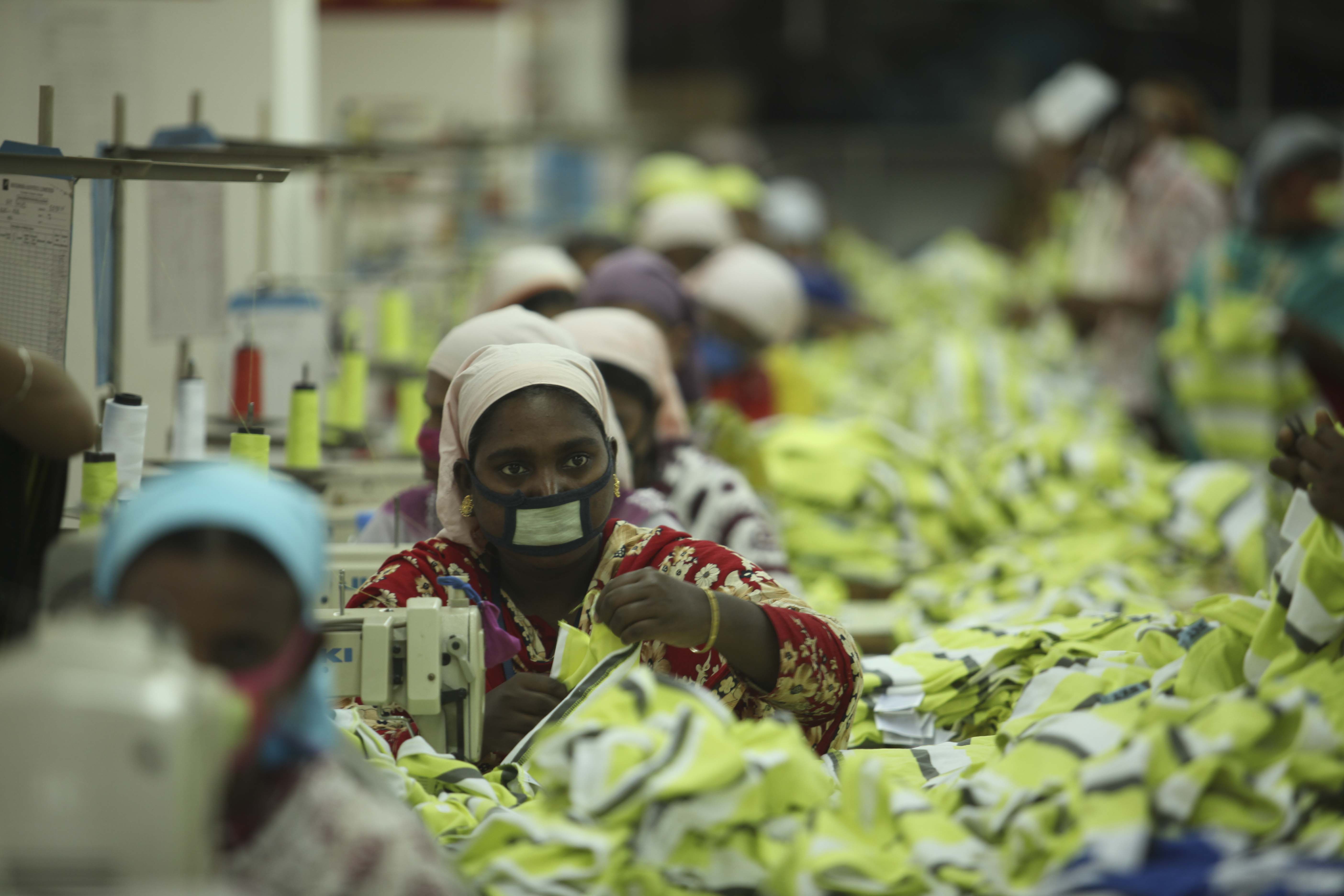
As retailers have closed shops around the world, garment factories have shut down at an alarming rate with devastating impacts for millions of garment workers. Urgent action is needed to protect their livelihoods during the shutdown and beyond.
The statement of priorities and commitments, COVID-19: Action in the Global Garment Industry reflects a broad consensus on joint action to protect garment workers’ income, health and employment and help manufacturers survive the economic disruption caused by the Covid-19 pandemic, as well as to improve social protection for garment workers for the long term.
It has so far been endorsed by a number of leading brands including Adidas, C&A, H&M, Inditex, Primark, Bestseller, PVH, Tchibo, VF Corporation, and Zalando, as well as IndustriALL and ITUC. The document will enable the ILO to work with the industry on securing funds and developing social protection.
Organizations that endorse the statement commit to working with governments and financial institutions to mobilize sufficient funding to enable manufacturers to ensure business continuity including payment of wages, as well as income-support and job-retention schemes to address the impact of the crisis.
IndustriALL general secretary Valter Sanches says:
“These principles are the essential first step towards mobilizing the funds needed to maintain the livelihoods of garment workers through this crisis and beyond. Concrete action is now needed by the industry to protect supply chains and the workers they depend on.
“We will continue to demand that brand and retailers contribute to securing their own supply chains and ensuring better social protection for garment workers.”
An international working group will be established within the next two weeks convened by the ILO and including brands and manufacturers, unions and governments, to further elaborate the implementation steps necessary to deliver on these commitments.
In search of best practice protocol in the global mining industry
IndustriALL Global Union’s mining and diamonds, gems, ornaments and jewellery production has called for a consistent best practice approach that contain the fundamental elements – consultation with unions, income security and respect for negotiated collective bargaining in the event of operations shut down or put in care and maintenance, compliance with country lockdown measures, the highest level of occupational health and safety, testing, screening and monitoring, reduced densification for underground and transported workers, screening contractors and visitors and keeping social distancing, quarantine measures for affected workers, appropriate travel and accommodation conditions for FIFO and DIDO workers, education and communication with workers and local communities etc.
IndustriALL affiliates have made joint statements at bilateral or tripartite levels:
In South Africa, the government, the Minerals Council of South Africa and Trade Unions have emerged with a ten point plan that emphasizes consistency of application and adherence to best practice protocols
In Canada, there has been a mining sector compilation of statement of commitment to best practice by the Mining Association of Canada’s member mining companies that includes almost all global mining companies operation in Canada
IndustriALL has taken a further step by inviting the CEOs of all the major global companies with which it has global framework agreements to share their responses to the global pandemic to ensure best practice protocol alignment. This invitation was extended to the other companies that enjoy a global dialogue relationship with IndustriALL.
Global mining companies fall into this category and IndustriALL has held several fruitful discussions with Anglo American and Glencore over their approaches to best practice application against Covid-19. Similar discussions have also been held with the International Council on Mining and Metals.
Some of the other mining companies, like Rio Tinto, have issued guidance on approaches to the pandemic.
The bilateral with Anglo American in particular found best practice alignment between Anglo American and IndustriALL Global Union’s approaches to the pandemic. Anglo American’s press release on the pandemic was further evidence of this alignment with our affiliates in Australia confirming Anglo’s lead in Australia on best practice approaches to the pandemic and the alignment of that approach with the union’s own determination of best practice.
In a message to IndustriALL general secretary Valter Sanches, Mark Cutifani, the Chief Executive of Anglo American, shared his company’s response to the pandemic:
“I wanted to write to assure you that we are continuing to manage our business, and in particular our Covid response efforts, in line with the spirit of our earlier discussions. As you would expect, we are being uncompromising in protecting the health and safety of our employees, and are also focusing on protecting our workers’ livelihoods, and also the livelihoods of workers at suppliers and customers and of stakeholders in our host communities.”
“I wish to thank you for sharing Anglo American’s comprehensive response to Covid-19 with the set of actions the company is taking in the various countries. Although I would say there’s always the need for improvement, I wish to commend the way the company is dealing with the situation,”
Valter Sanches said in his response.
Protecting workers’ rights during lockdown in Mauritius
The lockdown in Mauritius started on 20 March and will end on 4 May.
In a letter to the Prime Minister, IndustriALL Global Union affiliate, the Confédération des travailleurs des secteurs public et privé (CTSP), is proposing the introduction of a universal minimum wage to cater for workers who will lose jobs as a result of the pandemic. Further, the union wants the national tripartite forum to be set up immediately as per the provisions of the Workers’ Rights Act, as this will promote social dialogue during the pandemic.
Reeaz Chutto and Jane Ragoo, president and general secretary of CTSP respectively, say:
“The proposal of the private sector to move for the derogation of some sections of the Workers’ Rights Act (2019) is the worst signal that your government can send to the workers, if their wish is granted. The introduction of the Workers’ Rights Act has not been made to increase corporate expenditure. Workers consider it as a law that has restored social justice to the working class.”
Unions in Mauritius are against attempts to reduce the amounts payable for years of service under the Portable Retirement Gratuity Fund and describe this as “social blackmail” of the government by employers, especially as it comes with threats of job losses.
Unions also recommend setting up a solidarity fund to support informal sector workers. The banking sector, parliamentarians, corporates, and individuals will contribute to the proposed fund. Further, refunds to the private sector for training should go to the workfare programme that gives immediate assistance to retrenched workers to find other jobs or to go for skills training. The programme should also benefit contract workers and prioritize Mauritian workers in job placements.
The unions want amendments to the Operational Health and Safety Act to include provisions for workers’ access to hygienic facilities at workplaces. COVID-19 sensitization and basic hygiene campaigns should also include migrant workers and be made available in their native languages.
Paule France Ndessomin, IndustriALL regional secretary for Sub Saharan Africa, says:
“The Covid-19 pandemic calls on us to reimagine the workplace in terms of workers’ rights, health and safety, decent work, and the future of work after the pandemic. It is commendable that the CTSP is taking this initiative.”
Cambodian garment workers need support from brands
Official numbers show that the Covid-19 outbreak has led to a halt of production in 91 garment factories and 91,500 garment workers have been laid off. According to the unions, garment workers and their dependent families cannot survive on US$70, a substantial drop from the minimum wage of US$190.
On 7 April, the Cambodian government announced that temporarily laid-off garment workers would only receive US$70 per month, instead of a previous proposal of US$114, where employers were to pay 40 per cent and the government 20 percent.
“We hope brands can shoulder part of the responsibility by paying 40 percent of the minimum wage to support the garment workers. Manufacturers should increase their share to 40 percent, given the profits they have made for years in Cambodia,”
says Athit Kong, president of Coalition of Cambodian Apparel Workers' Democratic Union (CCAWDU), affiliated to IndustriALL Global Union.
“1,180 of our members lost their jobs when 15 garment factories suspended operations and 8,000 members have been temporarily laid-off. There are protests against employers’ failure to pay wage owed last month,”
says Pav Sina, president of Collective Union of Movement of Workers (CUMW).
IndustriALL regional secretary Annie Adviento suggests that the Cambodian government enter into social dialogue with all trade unions:
“In times of crisis, national dialogue with trade unions is essential to find a tenable solution.”
Brazil closes 47 unsafe mining dams
31 March was the deadline for submitting a safety certificate. On 2 April, Brazil's National Mining Agency announced that 31 dams failed to prove that the facilities were safe, and the required paperwork had not been filed for a further 16 dams.
As the sites do not meet safety requirements, tailings and sediment can no longer be deposited there. Fines will be served where no paperwork was filed.
Thirty-seven of the closed dams are located in Minas Gerais, where two Vale dams collapsed in just four years. In 2015, 19 people were killed when the Mariana dam collapsed, and 272 people lost their lives in the Brumadinho tragedy in 2019.
"Even after large-scale crimes, like Mariana and Brumadinho, many companies continue to show a total disregard for health and safety, putting profits before lives. In addition, workers now have to deal with Covid-19, where workers are getting infected but the mines are still running.
“The mines need to be closed now, and the time should be spent taking the necessary steps to safeguard workers’ health and safety and to protect the environment."
On 1 April, Vale announced three of its dams were at an emergency-level risk of collapsing. The company said it was building containment structures for those dams, expected to be completed in the first half of 2020.
Nilton Freitas, regional representative for Latin America and the Caribbean at Building and Wood Workers’ International (BWI), says:
"Of the 47 dams that have been shut down, more than half of them are run by Vale. But the authorities are doing their job and protecting people, thanks to the huge pressure from civil society organizations and local and international unions. We have all worked together since the Mariana disaster, combining local campaigns with firm international action, including from the OECD."
Following on the Mariana tragedy, IndustriALL and BWI filed an OECD complaint against BHP and Vale SA, for violating OECD guidelines.
How is the global oil sector responding to Covid-19?
In most countries, the oil industry is considered a core sector, and is not subject to imposed shutdowns. However, the global lockdown and consequent fall in economic activity has drastically reduced demand.
There has also been a dramatic fall in the oil price, both as a consequence of falling demand, and unrelated geopolitical tension. However, oil prices fluctuate and it will take several months before the effect on employment is known.
IndustriALL wrote to all companies that it has global framework agreements with, calling on them to work with unions to protect the health, safety, jobs and income of workers. ENI and Equinor replied, outlining their response to the crisis and committing to working with their unions.
There are significant differences from region to region and between companies, but overall, there are two distinct trends from oil companies:
Oil companies have maintained production and protected core staff, sometimes with generous allowances for working in difficult situations. However, they have terminated relationships with contractors. Given that 82 per cent of work in the sector is carried out by a contracted workforce, this is having a devastating effect, as many have lost their income.
Generally, decisions have been taken without consulting unions.
One exception is Norway, where a national agreement was reached between unions and employer organizations through the existing KonKraft framework to prevent permanent layoffs by maintaining activity. Strategies to solve temporary layoffs include enhanced research and development.
In Russia, most Lukoil white collar workers are working remotely, but although the company plans to reduce production, work continues, with additional personal protective equipment (PPE) and measures to combat the spread of the virus.
The Australian Workers’ Union has requested that operators provide ongoing financial support to contract workers, and that all workers are paid during quarantines. This has been largely successful, with the notable exception of Woodside, which stood down 1,000 workers without pay.
In Nigeria, NUPENG represents workers in the distribution network, including tanker drivers and petrol station workers. Union members are delivering hand sanitizer, masks and gloves to depots. Some companies have stood down contractors, and NUPENG expects many job losses over the coming year.
In the US, the effect on workers has so far been minimal, and the United Steelworkers (USW) has negotiated schedule changes to reduce exposure. The USW is also pushing for health screening and temperature checks at plants.
In Morocco, unions united to push for a pandemic management fund, made up of employer and worker contributions to social security, to pay affected workers. The unions are also calling for a moratorium on debt repayments.
Oil companies changed shift patterns in Iraqi oil fields to minimize contact after union demands. The union produced educational videos for members, and reached an agreement that the salaries of contract workers will not be affected.
In Brazil, the Covid-19 crisis comes shortly after the huge Petrobras strike. The company and its 63,000 workers are seriously affected. Unions are deeply concerned that President Bolsonaro is downplaying the crisis.
Energy director Diana Junquera Curiel said:
“We face an unprecedented situation. In the short term, we have to protect the lives and livelihoods of workers in the sector. In the longer term, we must prepare for the huge changes that this unfolding crisis will bring.
“At this difficult time, we must share information with each other, and act in solidarity. Together we can get through this.”
Push governments to legislate the right to paid sick leave and free access to health care for all workers irrespective of their employment status
Ensure women representation in health and safety committees or other bodies at all levels that define measures to protect workers from Covid 19
Push for specific protection of pregnant women workers during the crisis
Urge governments to maintain access to reproductive health services and not to divert resources allocated to these life-saving services
In Indonesia, GARTEKS and SPN are fighting for the temporary closure of garment factories where majority of workers are women.
In Morocco, the UMT negotiated for an increased staff rotation in cabling factories to decrease the number of workers on site at the same time, as well as for masks, gloves and disinfectant.
In Japan, trade union confederation RENGO is promoting teleworking and changed commuting times for pregnant women to avoid the most crowded hours on public transport.
TUC is reminding pregnant workers of their employers' obligations for protecting their health during the Covid19 crisis: prevention and removal from exposure to risk measures for pregnant women; transfer to other employment with same remuneration and, if not possible, adjustment of working conditions and teleworking or leaves with full pay.
The current pandemic has disrupted access to sexual and reproductive health care services. UNFPA is calling for these services to be maintained to avoid an explosion of pre and post-natal mortality.
Concerned about women's increasingly limited access to reproductive and sexual health services during the Covid 19 crisis, the CGT has called for international action to guarantee access to contraception and prevent maternal and child mortality during this crisis.
Combating violence against women
Lobby governments to ratify Convention 190
Condemn all forms of gender-based violence and harassment, including domestic violence, publicize and circulate the hotline number for victims of domestic violence
Ensure that policies and measures against violence and harassment at work are put in place and implemented even during the Covid-19 crisis
Urge governments to increase resources allocated to the prevention of domestic violence and protection of victims, maintaining shelters and increasing their capacities if need be
In Uruguay unions have sent a strong message on their websites and social media: "Violence against women is not collateral damage! You are not alone!" advertising hotline numbers for victims.
In Italy, CGIL and UIL worked together to promote the establishment of special measures during the covid 19 crisis and after including a broad campaign to promote hotline number and disseminate information on protective measures for victims; the identification of new possible shelters; the extension to at least six months of leave for women victims of violence; the establishment of a fund aimed at ensuring the exit of women from the spiral of violence.
In Spain, the CO OO is urging the government to ratify the new ILO Convention 190 which provides for the mitigation of the impacts of domestic violence in the world of work. Recommendation 206, in connection with the new convention, provides, among others, leaves for victims of domestic violence; flexible working arrangements and temporary protection against dismissal for these victims, as well as raising awareness on domestic violence.
Maintain the income and protect the jobs of women workers
Conduct national tripartite or company /workplace level negotiations to guarantee the income of workers and to protect employment during the crisis
Negotiate measures at the global level with multinational companies to protect the jobs and incomes of workers in their supply chains
Extend access to unemployment benefits and insurance to precarious workers and workers in informal economy
Negotiate with governments for specific social protection and emergency support for vulnerable workers who do not benefit from existing social protection and safety net (workers in the informal economy; migrant workers…)
Negotiate with governments for the establishment of targeted support for low-income families, in particular for single-parent families, as well as for the temporary suspension of loan and mortgage repayments
Women make up the majority of the workforce in some of the supply chains of IndustriALL's sectors most affected by the crisis, like the garment sector.
In the garment industry, the situation is alarming. The drop in orders from major brands, the lockdown in many producing countries lead to the closure of thousands of factories and the temporary suspension furlough or dismissal of millions of women workers.
Many workers have not received any salary or allowance and do not benefit from any social safety net.
IndustriALL affiliates have managed to guarantee the income of workers like SACTWU in South Africa or Garteks and SPN in Indonesia. At a global level, IndustriALL has been negotiating with brands to take the necessary measures to pay workers' wages and allowances and protect jobs.
Globally, women workers make up the majority of precarious workers and workers in informal economy. In order to provide protection for precarious workers, UNIFOR has demanded that the federal government in Canada implement special emergency income assistance payments to vulnerable workers, including precarious workers, who would otherwise not receive employment insurance benefits.
In Morocco, the UMT has succeeded to negotiate measures to protect the jobs of outsourced female (and male) workers in cabling factories in auto sector by having these workers taking their annual leave rather than having their contracts ended.
SEWA has been supporting the most vulnerable informal women workers in India. In Gujarat, the organization distributes food, especially to migrant workers during the lockdown. The organization has asked the national ministry of labour for income support for the families of the informal economy workers to be able to sustain basic needs, Free Public Distribution System for Ration supply as long as the crisis last and six months amortization on repayment of all loans.
Flexible work arrangements and paid leaves for parents
Conduct national tripartite or company level/workplace level negotiations for flexible working arrangements (flexible working hours, teleworking), reduction in working time (with income maintenance) or paid leave for the respect of the right of all workers to make all necessary arrangements to care for their families during the crisis
Negotiate for alternative emergency childcare for parents who must continue to work
Call for a change in social norms and a more equitable distribution of housework and childcare between men and women
The closure of schools, as well as specific risks faced by elderly have an impact on women who are the main caregivers in families. The establishment of measures enabling workers and especially women to maintain their employment and income in this context is key. Many governments, after tripartite negotiations, have adopted measures to this end.
Develop gender responsive approach to address the crisis
Push governments and employers to collect gender-segregated data to analyze the impacts of Covid-19, and to develop short-term and long-term gender responsive approaches
Monitor trends in unemployment at the national level, as well as layoffs at the company level, to ensure that consequences of Covid-19 do not exacerbate existing inequalities in the world of work
The CC OO in Spain is monitoring the gender impact of measures addressing consequences of Covid-19 in its Miradas violetas (Purple perspectives).
40 Brazilian companies call for a no-layoffs pledge
The aim of the "Não demita!" (No layoffs!) initiative is to promote corporate social responsibility. They are urging other companies to pledge to keep on all of their workers during the first two months of the coronavirus crisis in order to prevent, or at least minimize, a possible economic and social meltdown.
The companies are urging for other options during this exceptional period before shutting down operations and conducting mass layoffs. Companies needed to look after their employees, who depend on their wages. It is up to companies to ensure their supply chains are intact and that factories are operational.
They called on business leaders to comply with the workplace health and safety measures recommended by the World Health Organization and Brazil’s Ministry of health, for example providing a safe work environment where workers can maintain the recommended physical distance.
They also called on financially solid companies to support local communities, as local entrepreneurs have an important role to play.
At least seven of the 40 companies involved operate in sectors represented by IndustriALL Global Union, including:
WEG (electrical and electronics sector, and energy)
Suzano (pulp and paper)
Unipar (chemicals)
SEB (domestic appliances)
Cosan (biofuels, and oil and gas)
Alpargatas (textiles and garments)
Natura (cosmetics)
IndustriALL's general secretary, Valter Sanches, recently wrote to 50 companies with which IndustriALL has global framework agreements with, calling for cooperation with unions to protect the health, safety, jobs and wages during the coronavirus pandemic.
Sanches welcomes the initiative by Brazilian companies and encourages companies in other countries to follow:
"Workers will need to have jobs, wages and spending power in order to take us out of the economic crisis as quickly as possible. This is the type of commitment we would like to see from companies all around the world."
A right is something that you are morally or legally entitled to do, or to have.
Workers do not automatically enjoy the legal right to refuse or shut down unsafe work in every jurisdiction or in every circumstance. However we always have the moral right to refuse or shut down unsafe work. In serious circumstances, we believe that not only do we have the right to refuse or shut down unsafe work, we have a duty to do so.
Our problems arise when the exercise of that right is not protected from reprisals by the employer.
Notice that wherever workers enjoy the legal right to refuse unsafe work, either in national or regional laws, or in collective bargaining agreements, it has always followed worker activism and demands; never preceded it. Our rights are rarely given to us freely – we must demand and fight for them.
International Law
The United Nations’ Universal Declaration of Human Rights, Article 3, states “Everyone has the right to life, liberty and security of person.” It does not state that these rights disappear when you go to work. Indeed, the right to favourable conditions of work is also mentioned in the Universal Declaration of Human Rights. Another United Nations document, the International Covenant on Economic, Social and
Cultural Rights, provides that everyone should have the right to safe and healthy working conditions.
However, the most important references to the right to refuse unsafe work come from the International Labour Organization (ILO), a specialized United Nations agency dealing with international labour standards. The ILO has several Conventions and Recommendations that mention the right to refuse unsafe work. The most generally significant of these is Convention 155, the Occupational Safety and Health Convention, 1981.
Convention 155 states (excerpts):
“Article 4 (1) Each Member shall, in the light of national conditions and practice, and in consultation with the most representative organisations of employers and workers, formulate, implement and periodically review a coherent national policy on occupational safety, occupational health and the working environment. (2) The aim of the policy shall be to prevent accidents and injury to health arising out of, linked with or occurring in the course of work, by minimising, so far as is reasonably practicable, the causes of hazards inherent in the working environment.
“Article 5 (e) the protection of workers and their representatives from disciplinary measures as a result of actions properly taken by them in conformity with the policy referred to in Article 4 of this Convention.
“Article 13. A worker who has removed himself from a work situation which he has reasonable justification to believe presents an imminent and serious danger to his life or health shall be protected from undue consequences in accordance with national conditions and practice.
“Article 19. There shall be arrangements at the level of the undertaking . . . (f ). a worker reports forthwith to his immediate supervisor any situation which he has reasonable justification to believe presents an imminent and serious danger to his life or health; until the employer has taken remedial action, if necessary, the employer cannot require workers to return to a work situation where there is continuing imminent and serious danger to life or health.”
In plain language, this says that within the context of national law, workers can, with reasonable justification, remove themselves from unsafe work and not return until the employer has remedied the situation, and if they have exercised this right in good faith they cannot suffer undue consequences.
Other ILO Conventions also make reference to this right. For example, Convention 176, the Safety and Health in Mines Convention, 1995; Recommendation 183 on Safety and Health in Mines, 1995; Recommendation 172 on Asbestos, 1986; and Recommendation 177 on Chemicals, 1990.
ILO Conventions have legal standing when ratified, but your national government may not have ratified these Conventions. Recommendations, as the title suggests, are not necessarily legally enforceable. However, both ILO Conventions and ILO Recommendations can be referred to as part of international best practice – sometimes, even in countries that have not ratified the relevant Convention.
National or Regional (State; Provincial, or other) Occupational Health and Safety Law
National or regional law varies widely across the globe, and you must verify what the law says in your jurisdiction.
If the legislative and regulatory framework for occupational health and safety in your jurisdiction protects the right to refuse or shut down unsafe work, there will normally be a strict procedure to be followed in exercising this right. The procedure will outline what kinds of hazardous or risky work will be considered legally refusable, and the steps you must take to refuse to do it. Normally this will include reporting the danger to your supervisor, removing yourself from immediate harm while waiting for the matter to be investigated, and a dispute resolution procedure. Make sure you familiarize yourself with the procedure that applies to you, and follow it closely, to protect yourself from discipline or discharge.
Even if the occupational health and safety law does not specifically guarantee the right to refuse unsafe work, the general laws of most nations protect your right to defend your own life. This right does not disappear when you enter a workplace. Check with someone knowledgeable about the laws in your jurisdiction.
Collective Bargaining Agreements
Check your collective bargaining agreement (CBA). Many collective bargaining agreements make reference to the right to refuse or shut down unsafe work. Often, a strict procedure for exercising this right will also be specified. Make sure you familiarize yourself with the procedure and follow it closely, to protect yourself from discipline or discharge.
Conclusion
When there is a disagreement in the interpretation of labour law or collective agreements between an employer and a worker, the general rule is to comply now, and grieve later. This advice serves to protect the worker from immediate discipline or discharge, on the belief that if a labour arbitrator or judge later rule in favour of the worker, an appropriate remedy can be applied. Lost wages can be repaid, workers can be restored to their rightful positions, indignities can be compensated.
However, in the case of occupational health and safety this general rule cannot apply. There is no remedy that an arbitrator can impose that will restore life or health, if it is lost.
The right to refuse, or to shut down, unsafe or unhealthy work is not automatically guaranteed by law or by CBA. Like all human rights, we assert our moral authority when we demand it. It is a right that we must win, or lose it along with our health or our life.
That’s what trade unions mean when we say “you have the right to refuse unsafe work”.
Don’t take your rights to the grave.
Massive crisis for Bangladesh’ garment workers
As part of its Covid-19 containment, the Bangladesh government has suspended all forms of transportation services and closed public and private establishments, except essential services. Initially announced until 4 April, the closure has been extended to 14 April.
The initial announcement triggered panic among garment workers, most of whom are internal migrants. Many left Dhaka to reach their hometowns. Heart-wrenching photos from the country’s capital show workers leaving the city on crowded ferries, trucks and other unsafe modes of travel.
On 5 April, it was announced that no one is allowed to enter or exit Dhaka except for emergencies. A lack of coordination in implementing containment measures created confusion when many employers insisted workers needed to report to work to receive wages and retain their jobs.
Hundreds and thousands of workers used crowded and unsafe transportation, while many walked in groups to report to work at Dhaka, Gazipur, Narayanganj and other areas.
Without the appropriate safety measures, hundreds of factories operated with the risk of spreading Covid-19. Several factories, after subjecting workers to a dangerous commute to work, informed workers at the gate that the factory is closed until 14 April, without informing on how wages are paid.
On 6 April, the confusion triggered spontaneous protests demanding wages. A group of protesting workers were blocking the Dhaka-Mymensingh Highway after seeing their factories shut down without prior notice. A clash erupted and two workers were crushed by a truck.
Nazma Akter, president of Sommilito Garments Sramik Federation (SGSF) a member of IndustriALL Bangladesh Council, says:
“The majority of Bangladesh’ garment workers have been unfairly thrown out of their jobs, denied wages and threatened to be blacklisted if they demand their rights. Some employers have said workers would only be paid on 16 April when returning to work.
If the lockdown is extended and wages are not paid, workers’ livelihoods are under threat and they are facing starvation. Hard-earned benefits including the forthcoming EID festival bonus is also threatened. Forcing workers to work despite the risk of Covid-19 must be stopped immediately.”
Valter Sanches, IndustriALL general secretary, says:
“Brands and suppliers must realize that no worker should be left behind in this unprecedented struggle against Covid-19. The government, brands and suppliers need to work together with unions to take coordinated action to ensure wages are paid and that workers and their families are protected from the negative economic impact the lockdown may bring.
“The government of Bangladesh should ensure that workers get their share in the recently announced economic package. of 72, 750 crore Taka (US$8.5 billion).”
In a statement issued on 8 April, the IndustriALL Bangladesh Council (IBC) stated:
“Wages for the month of March have to be paid as soon as possible. In the prevailing circumstances, employers should ensure that payments are made through mobile banking system and those do not have access to it, should be paid in cash by 16 April. Lay offs, retrenchment and terminations should stop immediately. A tripartite committee consisting of government, employers and IBC has to be formed and all factories should closed during the lockdown period.”
According to the Bangladesh Garment Manufacturers and Exporters Association (BGMEA), on 7 April, the 953 million pieces of readymade garment for export worth US$ 3.05 billion have been cancelled. The cancellations affect more than 2.19 million workers.