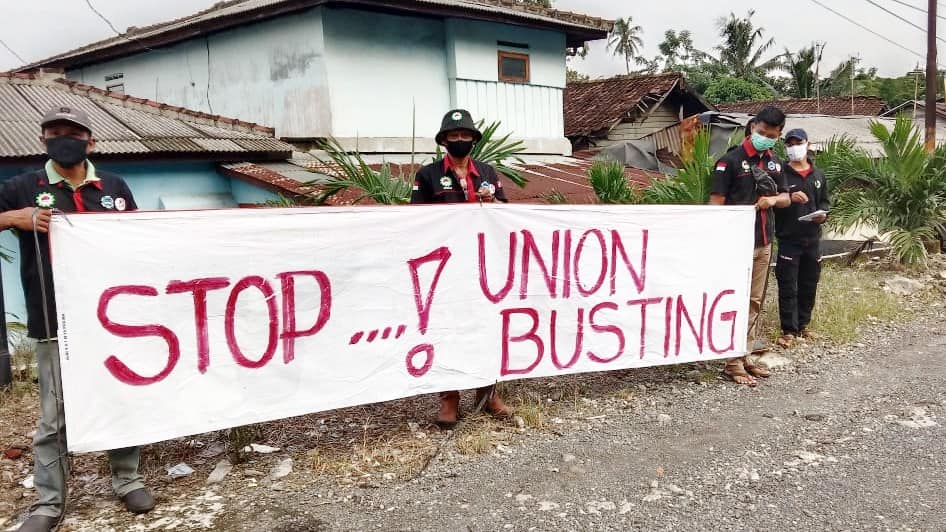
Victory for Indonesian unions as parliament postpones debate of controversial bill

Said Iqbal, president of the Confederation of Indonesian Workers Unions (KSPI), welcomed the announcement and announced that a rally planned for 30 April was cancelled.

“This is the correct decision. Our country is fighting Covid-19 and the government should concentrate on preventing mass layoff of workers. The postponement will ensure unity of all stakeholders including the government and workers,”

says Said Iqbal.
 
On 16 April, the Confederation of All Indonesian Workers' Union (KSPSI), All Indonesian Trade Union Confederation (KSBSI) and KSPI came together under the Indonesian Labour Workers Assembly (MPBI), calling on the government to drop the Omnibus bill to announce a rally on 30 April.
 
However, on 23 April Said Iqbal, together with KSBSI president Elly Rosita Silaban and KSPSI president Andi Gani Nena Wea, met Indonesia’s President Jokowi over the planned rally and the impact of Covid-19 on workers.

“The unified force of MPBI is a key to success, but the struggle continues until the government cancels the Omnibus bill. The draft bill needs to go through tripartite discussion; trade unions have the right to provide input,”

says Elly Rosita Silaban.

“Rushing through the bill while Jakarta was under a state of emergency as a measure to fight Covid-19 ignores due process of law-making while keeping important stakeholders like trade unions in dark.

“We congratulate KSPI, KSBSI and KSPSI for the victory in postponing the debate,”

says IndustriALL Global Union general secretary Valter Sanches.

The massive Omnibus bill contains 1,028 pages, 1,194 articles in 82 Indonesian laws concerning various labour aspects, like abolishing the monthly minimum wage, reducing severance pay and increasing labour flexibility.

Just Transition for Spanish thermal power plant workers

The agreement involves creating a framework to monitor the workers involved through training plans and measures aimed at outplacement.

In recent years, the operating prospects of thermal power plants have been affected by a range of technical, economic and regulatory factors, such as policies to transition to renewable energies, while utility companies need to do investment to reduce the emissions of the power plants. According to a European directive, power plants that do not invest to reduce their emissions must close in 2020.

The closure of 12 out of 15 thermal power plants in Spain will affect some 2,300 workers, 1,300 of whom are directly employed by the three companies while 1,000 are with subcontractors.

In the agreement signed on 17 April, the government and the companies undertake to proactively search for investors with projects that can be located in the affected areas, namely, Asturias, Aragon, Castile and Leon, Galicia and Andalusia taking into account the characteristics and particularities of each territory.

The signatory companies have committed to develop support plans and will work to maintain employment through the relocation of direct jobs and prioritizing the recruitment of workers from auxiliary companies. The companies are looking at outplacement plans for their own staff and considering the priority of hiring workers from auxiliary companies for tasks related to new activities and the dismantling and restoration of the plants.

There will be specific measures to facilitate employment for workers over the age 52, helping companies with bonuses for their hiring. Companies will also make proposals for new investments in the same territories related to energy generation through renewable energies.

The unions are committed to facilitating the fulfilment and monitoring of commitments in the areas of training, occupational risk prevention, reindustrialization and dissemination of the agreement.

The parties have agreed to set up a monitoring committee to ensure compliance with the agreement, which will meet every six months or whenever one of the parties so requests.

Agustín Martin, general secretary of CC.OO. de Industria comments:

“We are working tirelessly with energy transition, demanding that it is done in a fair way for the workers and the affected territories. We will continue proposing, negotiating and signing agreements to seek new opportunities for those affected. This agreement is a base for signatories at all levels (state, regional, provincial, county and local) to seek solutions for workers affected by the closure of coal-fired power plants.”

Says Pedro Hojas, general secretary of UGT-FICA:

“We have worked to guarantee a Just Transition for workers from the main company and contract company  and that the territories have industrial and employment alternatives since negotiations began more than a year ago. The companies that own the thermal power plants have committed to investing in these territories through their own projects and to attract other types of projects.

"All levels of administration, both the government, the autonomous communities and town halls, have committed to work together and provide the necessary economic resources so that no one is left without a job. This agreement lays the foundations for meeting the objectives we set at the beginning of the negotiations."

The electricity sector in Spain employs 85,000 people and represents almost a quarter of the country's final energy consumption and contributes around 2 per cent to GDP.

Chemical sector unions respond to Covid-19

Especially in Europe and in the large multinational companies, strong social measures have been taken to protect employment.

In Germany, IG BCE has reached an agreement for the entire chemical sector with the employer confederation BAVC called the “Crisis Agreement“, which runs to the end of this year. The agreement enables wage increases for workers placed on short-time working. IG BCE says that short-time working will quickly become commonplace in the sector in Germany, which employs some 1.1 million people. The union is running information webinars for its works council reps.

In Brazil, almost all plastics, and some chemical factories are closed, while pharmaceutical factories are developing treatments. Workers sent home because of the virus are paid in part by the state, and part by the company, depending on state legislation and union strength at the factory. At least half of the salaries are covered by the state.

On 17 April, Fequimfar signed a sector-wide collective agreement for the state of Sao Paulo, covering 150,000 chemicals, plastics and fertilizers workers. The agreement means that workers will not lose wages due to the downturn in working hours. The CNQ-CUT has negotiated a benchmark agreement with BASF that serves as a strong example for the sector in Brazil.

IndustriALL assistant general secretary Kemal Özkan says:

“The chemical industry underpins the global economy, and our affiliated chemical unions are responding to this crisis with strength and maturity. We see strong national agreements, many specific crisis agreements with national and global companies, and a flexibility of production to make important equipment for the fight against the pandemic.”

Several major chemical companies have switched their production to make sanitisers, and the raw material for sanitisers, to be used in the pandemic effort. This includes BASF, Dow Chemical, Ineos, Shell, DSM, and Mol.

GFA partner company Solvay has launched a solidarity fund to provide additional support, both financial and non-financial, to any employee and dependents who may experience hardship due to the impact of the coronavirus pandemic.

Several major companies in the sector have announced they will ensure paid sick leave and guarantee full pay for three months in case of temporary layoffs. Examples being Solvay, Yara, and Unilever.

In the US, the USW negotiated a COVID-19 coronavirus protocol with BASF that may serve as a model for the rest of the US chemical industry in keeping facilities operating and workers safe.

In Austria, a national standard has been reached on short term employment to avoid job losses. It applies to all sectors, for a period of three months but can be extended. Works Councils and trade unions have guaranteed participation rights, and proposals must have their agreement.  
 
In Belgium and Italy, IndustriALL affiliates have been in conflict over the categorising of the entire chemical sector as essential services, which has meant that workers making products like sellotape are not sent home for isolation. Italian chemical unions have signed agreements with the chemical employers’ organisations on joint management through the crisis.

In Japan all factories in the sector are following similar measures to prevent the spread of infection, including temperature checks of everyone entering.

In the UK, unions including Unite joined together with the Chemical Industries Association employer body to deliver a joint message to the government that they are “united in their efforts to do all that is possible to put an end to the coronavirus pandemic and mitigate the social and economic impact.”

In Hungary, IndustriALL’s chemical sector affiliate VDSz is struggling against a unilateral extension of the Orban government’s “Slave Law”, announced on Good Friday to further limit opportunity for backlash. It gives unilateral power to employers to order workers into a 24-month reference period, under which collective agreement measures are suspended. The government consulted employers but not unions in preparing this measure.

In Norway, government is stepping in to cover most costs of workers unable to work due to the pandemic.

In Sweden most industry has continued production.

In Finland, the chemical sector has been nominated as an essential service and the unions are satisfied with that.

In Uruguay, the tripartite negotiation system has been used to establish measures for affected workers in the sector including a social fund, and measures for working from home.

In Colombia and Peru workers in the sector are suffering from the severe lack of legal social protection.

Join IndustriALL webinar on 28 April

On International Commemoration Day for Dead and Injured Workers, IndustriALL health and safety expert Brian Kohler will share the latest advice on Covid-19 in the world of work.

The webinar will be streamed live on this Facebook page:

IndustriALL general secretary Valter Sanches and assistant general secretary Kemal Ozkan will also speak, to place Brian's comments in the context of the global labour movement.

After the presentation, Brian will take comments and question. You can ask your questions now, by commenting on the post, or during the livestream."

Tunisian unions sign agreement over salaries in time of pandemic

Tunisia has been under lockdown since 22 March, recently extended till 3 May. The economy has been fully shut down, with only essential services allowed to operate. Although the majority of companies paid their workers full salaries for March, some workers were paid only partially, and the situation with April wages remained uncertain. Some 1.5 million workers employed in Tunisia’s private sector are concerned.

As per common national practice, workers receive 200 TND (US$69) monthly as part of the government support for work stoppage in time of confinement, however this amount is not enough to live on.

According to the agreementthe employers will make their contribution to top up the missing part of the wages to each private sector employee.  UGTT secretary general, Noureddine Taboubi, commended the employers’ association UTICA for this commitment. The agreement will allow workers to enjoy full wages till the end of April. Taboubi also, said that the newly signed agreement would protect workers in the private sector from dismissals during the country's exceptional circumstances.

Following up on the implementation of the agreement, on 21 April UGTT clarified that “the agreement corresponds to the social entitlements of companies towards their workers. It is clear and does not need further interpretation, it has to be applied accurately and workers’ wages must be paid as stated in the agreement.”

This agreement is extremely important to the workers employed in petrochemical, metal and textile sectors represented by IndustriALL Tunisian affiliates.

Habib Hazami, general secretary of the Fédération Générale du Textile, de l'Habillement, Chaussure et Cuir – FGTHCC-UGTT said,

“In the textile sector we are determined to implement this agreement and ensure the full payment of April salaries. We reject any interpretation or confusion that might affect workers and companies in this regard as we are in urgent need of cooperation to overcome the crisis.”

Tahar Berberi, general secretary of the Fédération Générale de la Métallurgie et de l'Electronique – FGME-UGTT comments,

“For our sector in Tunisia, in light of the exceptional and delicate situation, we managed to negotiate agreements at company and national levels. In addition, we have companies which are keen to make up for lost hours. Thus we managed to guarantee wages to all workers and at the same time safeguard their health.”

IndustriALL affiliates in the Middle East and North Africa (MENA) are taking different actions in response to Coronavirus outbreak.

Saving ourselves

ENGSPAFRA
BahasaThaiKhmer

What is the biggest challenge to health and safety in the workplace? 

“The biggest challenge is to understand that health and safety at work is neither a perk to be bargained for nor a favour to be asked. It is our right. 

“No wage is worth our health or our life, and no remedy can be granted by an arbitrator that will restore our health or our life, once it is lost.”

Is there a quick fix? 

“If there is a quick fix, I have not found it in over 40 years of health and safety activism! Our rights are never granted easily, they must always be won by activism and determination. Indeed, every right that we now enjoy followed, and never preceded, the demands and determination and activism of people. 

“There is no silver bullet; a safe and healthy workplace is the result of ongoing effort and attention.”

What is IndustriALL’s role in promoting health and safety in the workplace?

“IndustriALL can support union activists in their struggle by providing a framework for understanding occupational health and safety from a trade union point of view. Safe and healthy workplaces are the result of effective and overlapping safety systems: materials, tools, equipment, workplace environment, management priorities, policies, programmes, work procedures – and of course people. 

“All of these must be designed, tested, educated or trained to be as safe and healthy as possible.” 

How do we stop the corona virus at work?

“The Covid-19 pandemic that we now face is an extraordinary situation, but the principles of infection control are known and have been known for decades. Keep yourselves – especially your hands – clean. Keep equipment, tools, controls and surfaces clean. If social distancing cannot be maintained in your workplace, consider masks – but make sure you wear the correct mask and implement the mask program with appropriate education and training and auditing. (Any respiratory protection programme, whether to wear a simple surgical mask or a supplied-air respirator, needs careful implementation and follow-up to succeed.) 

“Think about routes of transmission: during the commute to work and home again, at shift changes, near particular pieces of equipment, in the lunch room, washrooms – wherever people will share breathing space. 

“Ensure that workers have sufficient “sick leave” so that they do not feel the need to come to work while sick. Implement a testing program when tests become more readily available. Have a plan to accommodate workers who have higher risk levels. Have a plan to deal with a worker who begins to feel symptoms while at work – how will you get them to medical care, and how will you trace and track every worker that they came into contact with? 

“These are just examples, there are extensive guidelines available from the World Health Organization and from national governments and other credible sources. There is also a lot of misinformation out there, so make sure you are getting your guidance from a credible source!”

What rights do workers have?

“Trade unions insist on three basic occupational health and safety rights for workers: the right to know, the right to participate, and the right to refuse or shut down unsafe work.

“The right to know means to know everything there is to know about the hazards of our work, and to receive the necessary education and training to do the job safely.

“The right to participate means to be full partners in the development and implementation of all workplace health and safety policies, programmes, procedures, accident/incident investigations, inspections, audits, risk assessments – everything. We want health and safety done with us, not “to us”. The only people with the moral authority to assess a risk are those who face the risk.

“Finally, we demand the right to refuse to perform, or to shut down, any work that a worker believes to be unsafe or dangerous to health – without negative repercussions.” 

كورونا (كوفيد-19) – أزمة وجودية لصناعة الملاب


راسل الاتحاد الدولي للصناعات جميع النقابات الأعضاء التي تنظم عمال الملابس، وطلب معلومات عن عدد المصانع التي يتم إغلاقها، وعدد العمال المتضررين، وعن التدابير التي تتخذها الحكومات وأصحاب العمل للتخفيف من الآثار.

تبدو الصورة الآخذة في الظهور مدمرة. تؤدي تدابير التباعد الاجتماعي المتخذة في البلدان الأكثر تأثرًا حاليًا بـكوفيد-19 إلى إغلاق آلاف مصانع الملابس وتسريح الملايين من العمال بدون شبكة أمان اجتماعي. ومع انتشار الفيروس داخل البلدان المنتجة للملابس نفسها، ستضطر المزيد من المصانع إلى الإغلاق مما قد يؤدي إلى فقدان ملايين العمال الآخرين لعملهم.

بينما يغلق تجار الملابس بالتجزئة متاجرهم في البلدان المتضررة، من المتوقع أن يدفع عمال الملابس ثمن الملابس التي صنعوها بالفعل.

لا تقوم العلامات التجارية الرئيسية وتجار التجزئة بإلغاء الطلبات المستقبلية فحسب بل يرفضون تحمل مسؤولية الملابس التي تم إنتاجها بالفعل، من خلال استخدام أحكام الطوارئ في العقود لوقف الشحنات وتجنب دفع ثمن البضائع التي طلبوها. الأمر الذي يجعل المصانع المحتفظة بالبضائع غير قادرة على بيعها للعميل الذي طلبها، وفي كثير من الحالات غير قادرة على دفع أجور العمال الذين صنعوها.

يجب الترحيب بالتدابير التي أعلنتها الشركات لحماية أجور عمال التجزئة وغيرهم من العاملين المباشرين، ولكن في الوقت نفسه يجب عدم تجاهل أمن وصالح عمال سلاسل توريد هذه الشركات الذين صنعوا المنتجات التي بنيت عليها أعمال الشركات.

هناك ثلاث مراحل حاسمة تتطلب التدخلات، وقد وصل العديد من البلدان بالفعل إلى المرحلتين 1 و 2:

  1. دفع أجور العمال فوراً عن الطلبات المقدمة التي لن يدفعها عملاء العلامة التجارية
  2. الدفع للعمال خلال فترات إغلاق المصانع إما بسبب عدم وجود الطلبات أو بسبب التدابير الحكومية ضد انتشار كوفيد-19
  3. الدعم لإعادة الإنتاج

بمجرد انتهاء الأزمة وتمكن العلامات التجارية العالمية وتجار التجزئة من بدء التداول مرة أخرى، كم سيكون عدد المصانع التي ما زالت في الخدمة ولديها قوة عاملة جاهزة لإعادة الإنتاج؟

ما لم يتم الآن اتخاذ تدابير لحماية المصانع والعمال لتمكينهم من النجاة من الأزمة، فإن القرارات قصيرة المدى التي تتخذها العلامات التجارية وتجار التجزئة للتراجع عن العقود الحالية ستؤدي في نهاية المطاف إلى تدمير الأعمال التجارية ذاتها التي يسعون إلى حمايتها.

يجب على العلامات التجارية وأصحاب العمل والحكومات أن تتعاون بشكل عاجل مع النقابات لإيجاد طرق لدعم عمال الملابس خلال هذه الفترة غير المسبوقة لضمان استمرارية الصناعة في المستقبل بمجرد انتهاء الأزمة

IndustriALL calls on Mexican government to restore workers’ rights at Goodyear

The plant in the industrial Mexican city of San Luís Potosí has a bogus labour representation with the employer-aligned Confederation of Mexican Workers (CTM).

The sham union was not elected by the workforce to represent them, and workers have no way of raising issues or setting priorities to be raised with management.

The CTM signed a protection contract, fake collective bargaining agreement, with Goodyear for the site in 2015, two years before the plant began operating.

Addressing Mexico’s labour secretary Alcalde, IndustriALL Global Union general secretary Valter Sanches calls for government intervention to uphold the law. Specifically, the company continues to deny its employees important worker protections provided for under the newly enacted labour law reform.

The mass dismissals of around 50 people, made on 9 July 2018, were heavily condemned by IndustriALL at the time. Goodyear unions from around the world took solidarity actions in support of the Mexican workers’ demand for reinstatement and the right to choose how to organize themselves.

The lead union in that effort is the USW in North America, which represents a significant number of Goodyear employees in the company’s home country, USA.

Addressing the Labour Secretary, Valter Sanches says:

“I am troubled that Goodyear has not reinstated any of the workers who have protested their firings. I urge you to closely monitor the progression of the legal cases regarding the reinstatement of and full back pay for the workers who were wrongly fired for protesting representation by the CTM and unsafe working conditions."

The Goodyear facility in San Luis Potosí has been closed since 18 March due to the Covid-19 outbreak. Workers have been told they will continue to receive 75 per cent of their wages while the factory is shut down. However, the Mexican Government has repeatedly stated that workers should be paid 100 per cent of their wages during this period.

The Mexican government has declared a health emergency through the month of April, and Goodyear is forcing workers to use their vacation pay and threatening to dock future vacation accrual to compensate workers now, in contravention of official orders.

“When the workers return to work, it is critical that they are able to exercise their right to freedom of association and collective bargaining. It is also essential that the company not use this pandemic to remove workplace activists from their payroll. The new Mexican labour law will not benefit workers if employers are permitted to violate it with impunity,”

says Valter Sanches.

Bárbara Figueroa receives the 2020 Arthur Svensson Prize

Congratulations to the award!

I want to thank those who put my name forward, even though I haven’t been a union leader for very long. There are so many leaders in Chile and the wider region who have spent longer in the unions and who more than deserve to receive an award like this one.

I want to thank Víctor Báez, deputy secretary general of the International Trade Union Confederation, who thought it was important to nominate me because I'm young and the first female president of a central union, in both Chile and Latin America as a whole.

The prize committee voted for me unanimously, but the award is not just for me. I'm very proud to have received the prize, but this is an acknowledgement of the collective work of everyone at the CUT and of what the organization has achieved over the years. I'm also very proud that the workers can share in this happy moment.

The prize committee indicated that by awarding you this year's prize, they hope to help raise awareness of the current situation in Chile and to strengthen unions in their fight for workers' rights. Do you think it will help?

We hope so. One of the great benefits of this prize is that it will draw attention to the situation in Chile. Workers around the world are dealing with the pandemic, but the situation in Chile is quite unique.

The social uprising that began on 18 October last year has brought out a number of the usual negative views about our development model. These are dominant views in countries like Chile, which have a very aggressive economic model and where tensions with big business run high.

A prize like this helps to draw attention to these issues. It's no longer just about what people in our country think – we also get a more critical view from the international community of how industrial relations should be managed and how valuable unions can be. We hope this message will hit home.

Although it hasn't yet, unfortunately. The government's response to the pandemic has been very poor. Other countries have handled the crisis better by fostering a social dialogue – our government is a long way from that.

We know that this prize is a recognition of the role unions play. And with the current public health crisis, that role will probably become one of the key topics in the international debate. We hope that Chile will be part of that debate as well.

The prize committee also highlighted that CUT, through a combination of mass mobilizations and negotiations, has managed to raise the minimum wage and reduce the working week despite large-scale political resistance. Does this type of victory strengthen your drive and commitment to employment rights and union work?

Yes, it does. Prizes like this help us to ensure that labour relations are part and parcel of any process to advance democracy on the national agenda.

We cannot create fair, equal and democratic societies without including the world of work. We can do this as leaders, or by taking on a secondary role. Ensuring that industrial relations are viewed as vital to democracy is a very topical issue. It is one of our greatest challenges, and it will also require us to look carefully at our own organizations.

Unions are becoming increasingly democratic. By setting our own standards high, we can project our view of what society should look like in the future. This is what we have to try and achieve in Chile, even though everything is against us and the authorities are more committed to big business. This doesn't mean that society has fallen asleep at the wheel. Quite the opposite: it has woken up and is ready to fight.

We have an important task – we have to keep unions at the heart of every debate. We need to redistribute wealth and shift the balance of power in industrial relations if we are to build fairer and more equal societies. And we have to do this alongside other movements, like the feminist movement. We have to work together to achieve our demands.

You are the only female leader of a central union in the region; do you think you are paving the way for other women in a male-dominated culture?

We hope that prizes like this will help draw attention to inequalities among workers – men and women don’t join the workforce on equal terms.

I hope that the debate in the union movement will allow us to gain greater insight into these inequalities. This is one way that we can drive change and bring unions more in step with the times.

If you look at the figures, there are a lot of women in union leadership roles in Chile, but that's not enough. We have to ensure that getting women into the workforce and into leadership positions in unions is not just about gender, but rather about addressing all forms of inequality among workers. It should always be on our agenda, as should ensuring that young people have jobs.

Winning an international award because we have women leading our unions should help us to rethink our structures and organizations. Times have changed: we face different challenges and varied needs.

This process was already under way at CUT before I took over. It's always going to be a struggle, especially when the president of the union is a woman.

We were the first central union to introduce a quota of 30 per cent of women in all management bodies. We did this even before the labour law reform which set a one-third quota. We have moved forward, but we still have a long way to go.    

South African court blocks Mondi from exploiting workers

IndustriALL Global Union affiliates the Chemical Energy Paper Printing Wood and Allied Workers Union (CEPPWAWU) and the United Association of South Africa (UASA) argued that employers cannot change conditions in collective bargaining agreements without negotiating with unions.

The Mondi Group wanted permission to extend shifts from eight to 12 hours during the lockdown period without complying with existing collective agreements and wage rates. The company did not want to pay overtime and requested the Labour Court in Durban to allow it to suspend conditions in the collective agreements signed with the unions.

However, on 16 April the court ruled in favour of the unions and dismissed the application.

Welile Nolingo, CEPPWAWU general secretary says:

“We applaud the Labour Court for dismissing the application and for protecting workers rights to fair wages. Employers should never be allowed to tamper with collective agreements that we fought so hard for them to be signed.”

Tom Grinter, IndustriALL director for pulp and paper, says:

“We welcome the unions’ court victory against the Mondi Group. It is unacceptable that an employer tries to use the Covid-19 pandemic to exploit workers. Collective agreements should always be respected to protect workers’ incomes, especially for those reporting for duty at the risk of infection from the deadly coronavirus.”

The pulp, paper, packaging, recycling and tissue value chains are some of the industries designated as “essential services” according to the lockdown regulations in South Africa. The sector produces paper for printing, stationery such as note pads, for packaging and toilet tissue paper. Other products include hospital gowns, masks and personal protective equipment for medical use. Currently, the hygiene and medical products are crucial in the efforts to stop the spread of the coronavirus.

South Africa is one of the world’s top producers of pulp and paper for domestic consumption, as well as for exports. According to the Department of Environment, Forestry and Fisheries, the pulp and paper sector employs about 24,000 workers who are part of a value chain of over 150,000 workers. These include informal workers who supply recycled fibre to the paper mills.