IndustriALL and ASOS renew global agreement to strengthen workers’ rights

ASOS has remained the only ecommerce brand to hold a GFA with IndustriALL since signing its previous GFA in 2017.

The new agreement reaffirms ASOS’s and IndustriALL’s commitment to work together to tackle human rights challenges and support workers. Under the new agreement, IndustriALL and ASOS will jointly develop a binding dispute resolution mechanism to handle worker grievances regarding violation of freedom of association and right to collective bargaining. 

IndustriALL and ASOS will also implement a joint training programme for key suppliers, ensuring they understand and meet their responsibilities to uphold workers’ rights. This will help to create an enabling environment for workers and build sustainable internal dialogue in factories.

Says IndustriALL general secretary Atle Høie: 

“The renewed global framework agreement reflects years of joint work and shows that lasting change comes from strong implementation and monitoring, not voluntary pledges. It demonstrates a sustainable approach to labour rights, ensuring that trade unions can represent workers effectively and that their voices are heard on the ground in supplier factories.”

José Antonio Ramos, CEO, ASOS, says:

“Renewing our global framework agreement with IndustriALL was one of the first commitments we set ourselves when we relaunched our updated Fashion with Integrity sustainability strategy last year. In the eight  years since we signed our original agreement, our relationship with IndustriALL has helped us to improve resilience in our supply chain, mitigate human rights risks, and deliver positive long-term change for the people who make our clothes. Our new agreement will strengthen our relationship and will be vital in driving further improvements for ASOS and for workers in our supply chain.”

The renewed agreement covers all core International Labour Organization (ILO) conventions, including Convention 190 on violence and harassment, reinforcing commitments to workers’ rights, trade union access and responsible supply chain practices.

Health and safety remain a central focus, with ongoing monitoring and due diligence to ensure commitments are met. Both parties emphasise that voluntary initiatives alone are insufficient, and that robust implementation, monitoring and enforcement are essential to safeguarding workers’ voices across ASOS’ supply chain.

Turkish garment workers expose systematic harassment and union busting

The event was framed by a striking poster listing the abuses workers face daily: “Mobbing, psychological violence, hazing, pressure, intimidation, occupational bullying, sexual harassment, unlawful dismissal, discrimination, insults, workplace practices against human and women’s dignity.” According to IndustriALL affiliate, TEKSİF, these words reflect real and ongoing experiences reported by hundreds of Digel workers, especially women, over a period of several years.

The findings, based on dozens of testimonies from workers, most of them women, are described by TEKSİF as revealing a disturbing picture of life inside the factory. The union’s newly released report details claims of mobbing, psychological violence, sexual harassment, unlawful dismissals, and gender-based discrimination that it says have intensified since workers unionized in January 2025.

The press conference highlighted that on 17 January 2025, after workers protested low wages and degrading working conditions, Digel dismissed four leading union members without severance on the very same day they joined TEKSİF and won official recognition from the Ministry of Labour. Further dismissals followed on 6 February and 13 June, bringing the total to 15 members fired during the unionisation process.

The report alleges disturbing cases, including:

TEKSİF underlined that these accounts span roughly seven years and demonstrate not isolated incidents but a persistent workplace culture where women are subject to gender-based violence, discrimination, and humiliation. The union stated that complaints have often been met with inaction, and in some cases perpetrators have been rewarded rather than sanctioned.

Since January, Digel has fired 15 union members without compensation, in what TEKSİF calls a deliberate campaign to break the union. Many of those targeted were leading voices in the fight for decent wages, safety, and dignity at work.

Digel workers first made headlines in January when they staged a factory protest against poverty wages and degrading conditions. That same day, they joined TEKSİF and won official recognition from the Ministry of Labour. Instead of respecting workers’ rights, management is said to have launched a wave of retaliatory dismissals and intensified harassment.

For nearly 210 days, dismissed workers have held a determined protest outside the factory gates, in what TEKSİF describes as both a fight for reinstatement and a broader struggle for safe, equal, and harassment-free workplaces

IndustriALL assistant general secretary Kemal Özkan said:

“Digel Textile’s behaviour is a shameful violation of workers’ rights and human dignity. We fully support TEKSİF’s fight to end the abuse, reinstate the dismissed workers, and secure a workplace where women and men are treated with respect.”

Two workers killed in explosion at US Steel plant

The cause of the blast remains under investigation. Reports indicate the workers had been carrying out routine operations at the time.

The Clairton Coke plant, which processes coal into coke, has experienced several explosions in recent decades. In 2009, a maintenance worker was killed in a blast, and the following year an explosion injured 20 workers. In February this year, two workers sustained minor injuries when a battery fault caused a build-up of combustible material that ignited.

Bernie Hall, USW District 10 Director, said in response to the accident:  

“The USW has occupational health and safety experts and other representatives on the ground at the Clairton Works assessing the situation and aiding our members. While we are still determining the scope of the tragedy, we are aware that multiple workers are receiving medical treatment for their injuries. In the coming days, we will work with the appropriate authorities to ensure a thorough investigation and to see that our members get the support they need.”
 

Photo: Clairton plant. Credit: Joseph, Flickr

Sub-Saharan Africa youth demand a voice in shaping the future of work

The SSA youth committee, the first regional youth structure established within IndustriALL, brings together twelve representatives from across the region.  

“Since its creation, it has been a driving force in youth work, ensuring that young voices are heard in union strategies and global debates,”

said Sarah Flores, industriALL youth officer.

This year’s International youth Dday coincided with preparations for the committee’s regional meeting to be held in Ghana on 1 September, under the theme “embracing technology and innovation at work”. The theme reflects years of engagement by young trade unionists on the impact of new technologies, from Industry 4.0 and platform work to artificial intelligence and on the future of work.

Since the pandemic, IndustriALL has facilitated discussions in most regions on the opportunities and challenges of technological change. Young workers have consistently demanded a seat at the table, recognizing that these changes will shape their working lives for decades to come. 

A concrete outcome of this demand is the inclusion of two youth representatives in IndustriALL’s Industry 4.0 expert working group, including Dorca Norupiri from IndustriALL affiliate Zimbabwe Diamond Allied Minerals Workers Union (ZDAMWU), representing the SSA region. 

The committee’s International youth day statement highlights urgent issues facing young workers in Sub-Saharan Africa:

“Despite these challenges, young trade unionists in the region are organizing, innovating and pushing for change. They are advocating for safer workplaces, digital access, gender justice, climate-responsive policies and inclusive leadership. Through campaigns for digital skills and active engagement in union decision-making, they are redefining what it means to be a worker in the 21st century,” 

said Paule Ndessomin, IndustriALL SSA regional secretary.

As the SSA youth committee prepares to gather in Ghana, their message is clear: investing in youth is essential for building strong, sustainable unions capable of advancing workers’ rights, confronting global capital, and driving sustainable industrial policy.

Connecting paper workers internationally to fight back

At the pulp and paper trade union network meeting on 5-7 August in Jakarta, Indonesia, 70 paper union representatives from Indonesia, Thailand, Philippines, Malaysia, Vietnam, Australia, Belgium, Brazil, Finland, Japan, New Zealand, Sweden, USA and Uruguay discussed key challenges facing the sector. Originally a regional network meeting, it was opened up to the global sector work group unions to showcase progress made in building a powerful regional sector network over the last decade, with the global co-chairs from USW and Pappers attending.  

Paper workers face widespread precarious employment, unsafe and unhealthy working conditions, underrepresentation of women, excessive working hours, automation, early retirement schemes, and declining appeal of the sector for younger workers.

Denise Campbell-Burns, chair of the regional network, said: 

“We recognize the need to strengthen information exchange and collaboration to manage industrial relations with global companies in the face of aggressive multinational acquisitions. IndustriALL’s coordination role is crucial in bringing affiliates together and supporting our sector.”

While packaging and tissue markets continue to grow, printing paper demand is falling. New sustainability regulations and digitalization pose further challenges. Major mergers, such as Suzano’s acquisition of Kimberly-Clark’s global tissue operations, the merger of International Paper and DS Smith, and that of Smurfit Kappa and WestRock ,have led to factory closures and job changes, affecting workers in all regions.

Unions committed to intensifying organizing efforts through recruiting young and outsourced workers, and rolling out organizers’ developments programmes, a joint initiative between IndustriALL’s South East Asia office and German union IG Metall.  

Japanese union KAMPIA RENGO has launced gender initiatives to boost women’s membership and make paper companies a place both men and women can work comfortably.

In the Pacific region, Australia’s CFMEU manufacturing division have formed a new Timber, Furnishing and Textiles Union (TFTU). In New Zealand, the Pulp and Paper Workers' Union is contending with closures, including Winstone Pulp and Kinleith Tokoroa Paper Division.

In Indonesia, following a successful constitutional court challenge to the Omnibus Law, unions are now prioritizing strong collective agreements to safeguard rights. Unions in the Philippines and Thailand are facing the issue of long working hours, which could compromise union work, as well as health and safety.

Belgian unions are taking industrial action against job losses caused by deindustrialization, calling for a sustainable transition with retraining and upskilling supported by social partners. Brazilian unions are highlighting environmental concerns in the paper industry and pressing for more cross-regional union collaboration.

The meeting concluded with an action plan to:

Tom Grinter, IndustriALL pulp and paper director, said:

“New technology, including artificial intelligence, must be human-centred. Technology oligarchs are shaping the rules of work, but workers must rewrite them to ensure dignity and a voice, free from algorithmic control and ratings.”

Sector director Tom Grinter

During the meeting, unionists visited Fajar Paper and Pindo Deli, supported by Indonesian unions CEMWU and FSP2KI, along with company management. Both sites have over 2,000 union members, demonstrating examples of constructive industrial relations.

Visit to Pindo Deli

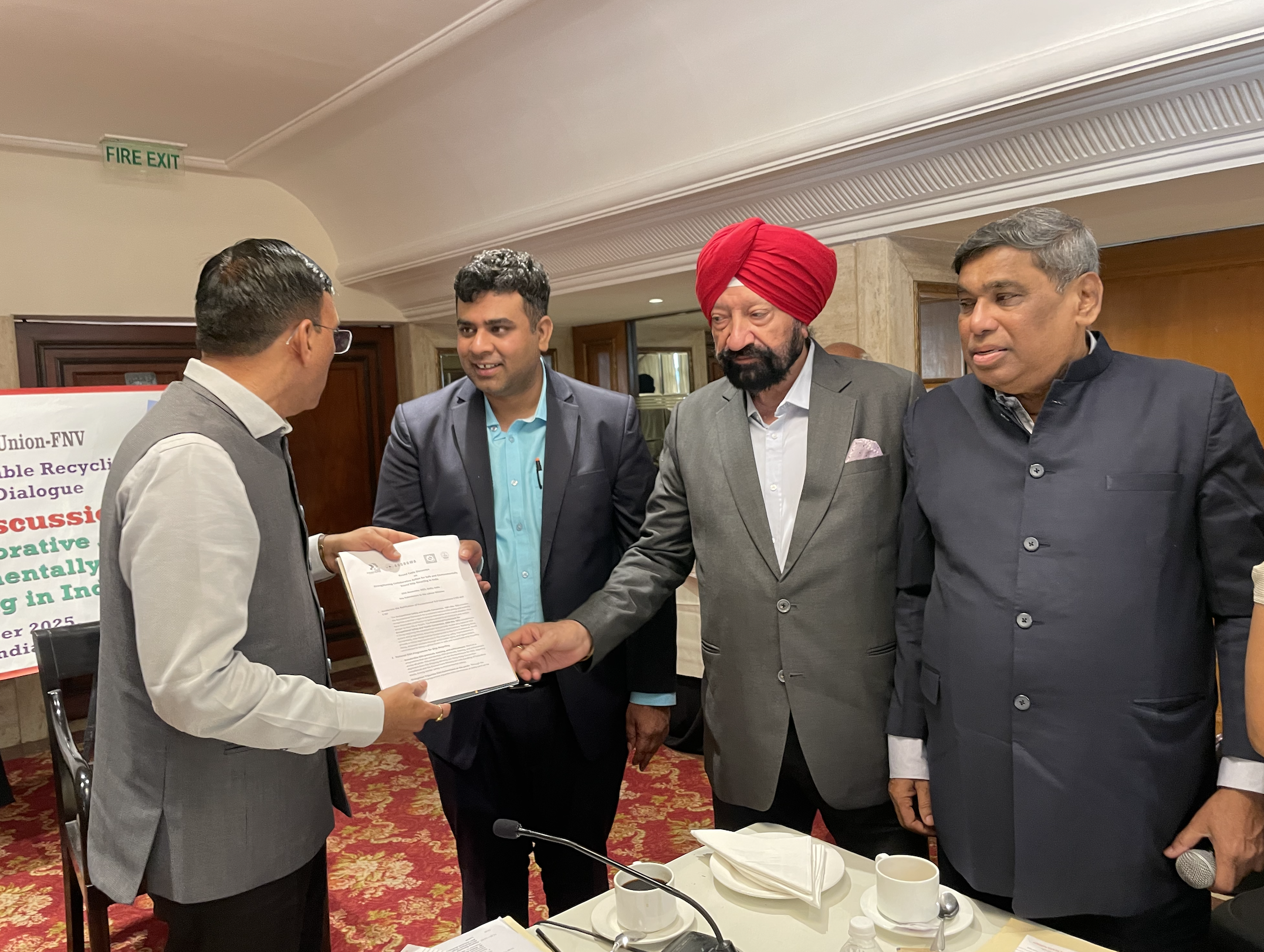
Indian unions demand Just Transition in coals and renewables

IndustriALL, in collaboration with APHEDA and ITUC’s Just Transition Centre, has conducted research from the perspective of workers’ unions to develop strategies that safeguard workers’ rights during the country’s energy transition. The dissemination meeting for the coal mining sector transition study was held on 25–26 July in Ranchi, while the meeting for the study on challenges and opportunities for organising in renewable energy projects took place in Delhi on 28–29 July.

The study on the renewable energy sector highlights that, as production costs fall and government support grows, the sector is likely to attract increasing investment in the future. India has already achieved its Nationally Determined Contribution target of reaching 50 per cent of its installed electricity capacity from renewable sources. But the sector is rife with low-paying temporary jobs with harsh working conditions and a poor unionization rate. The renewable energy sector has created over 1.3 million jobs, but the majority are precarious in nature. 

Workers involved in installation and maintenance of solar panels are forced to endure heat stress as the large solar fields are deprived of any shade. Workplace safety issues such as snake bite and electric shocks are rampant. Workers employed at these sites are temporary, hired through contracting agencies and are paid poverty wages. In Rajasthan, one of the top provinces in India where solar power plants are coming up rapidly, wages are as low as INR 285 (US$ 3.2) per day.

Coal unions warn of declining job security

The coal mining sector study found that trade unionists reported around 300,000 permanent and 500,000 contract workers are currently employed in the industry. In addition, over 1.4 million people depend on the industry for their livelihoods. Coal unions expressed concern over the decline in permanent workers, as recruitment for these positions has been frozen, weakening union influence in the sector. At the same time, the hiring of contractual staff is increasing, leading to a complete erosion of the decent work regime. Growing privatisation, along with the outsourcing of tasks such as mine development, operations and equipment hiring, has further undermined workers’ rights and benefits. 

The study highlights that considering India’s net-zero commitments, several public sector mines have been ‘closed’ or abandoned, and unplanned mine closures have neglected workers’ rights or rights of communities dependent on mines. Union leaders highlighted several concerns during the meeting, including abrupt redeployments to distant mines or workplaces, the lack of consultation with unions on the transition, and the failure to retrain workers for future jobs.

While discussing the adverse and disproportionate impact of transition on women workers and women dependents, unionists emphasized the importance of integrating women’s needs into transition processes. They stressed the need to ensure access to quality jobs, decision-making roles, training opportunities and social infrastructure, supported by gender-disaggregated data and actions to address structural barriers and transition.

Sharan KC from APHEDA, Jacquie MacLeod from ITUC, and Dr S.M.F. Pasha from ITUC-AP shared examples from other parts of the world like Indonesia Spain, Brazil, Germany and South Africa. There, unions work collectively and through intensive advocacy have been able to hold dialogue with governments on the issue of Just Transition and ensure workers’ rights are protected.

Action plans to drive change

In both meetings, participants drafted action plans to push for Just Transition. Some of the key actions include:

Ashutosh Bhattacharya, IndustriALL South Asia regional secretary, says:

“IndustriALL supports the demands of unions for a Just Transition and social dialogue in India that protect jobs and workers’ interests. Just Transition conversations in India are dominated by top-down policy framings, and in these research studies, we have attempted to invert that logic by placing their concerns, insights and aspirations at the heart of the transition debate. IndustriALL remains committed to strengthening the role of unions and engaging with all stakeholders in shaping Just Transition processes, ensuring that no one is left behind. These reports are a step in that direction.”

Kenyan oil workers win key concessions in dispute with pipeline company

The agreement follows a seven-day strike notice issued by the union on 24 July, citing long-standing disputes over workers’ rights, performance incentives, and the fate of employees from the soon-to-be-dissolved Kenya Petroleum Refineries Limited (KPRL). The deal also brings critical issues into focus regarding KPRL’s closure and the future of Kenya’s energy infrastructure.

KPOWU, representing workers from both KPC and KPRL, had raised a range of pressing demands. These included the seamless transfer of KPRL workers to KPC with retention of existing terms and conditions, the elimination of discriminatory performance incentives, protection of union officials from intimidation, and urgent attention to unresolved claims, some dating as far back as 2016, related to overtime, standby allowances, and meals.

The union also flagged concerns around corruption at KPC’s Eldoret depot and called for accountability and transparency within the company.

Negotiations, mediated by the energy and petroleum cabinet secretary Opiyo Wandayi, led to meaningful concessions from KPC. Among them:

These outcomes mark a significant victory for KPOWU in its ongoing fight for fairness and justice in Kenya’s oil and gas sector.

“The agreement is a step towards ending serious injustice to workers,”

said George Okoth, KPOWU general secretary.

IndustriALL regional secretary for Sub-Saharan Africa, Paule-France Ndessomin, welcomed the outcome, expressing solidarity with the union:


“We support KPOWU in their demands for better working conditions and defending workers’ rights,” she said, calling on KPC to continue negotiating in good faith.

KPC, a state-owned enterprise under the Ministry of Energy, plays a central role in Kenya’s petroleum logistics, transporting and storing fuel via a pipeline network that spans from the port city of Mombasa to key inland centres including Nairobi, Nakuru, Kisumu, and Eldoret.

The company’s acquisition of KPRL in 2023 was aimed at enhancing Kenya’s storage and distribution capacity. As KPRL’s operations are wound down, the integration of its workforce into KPC represents not only a labour victory but a critical step in maintaining stability in the country’s energy supply chain.


Oil workers at the intersection: tariffs, AI, climate policy and global tensions

A coordinated model of bargaining

The National Oil Bargaining Program, established in 1965, is a unique example of structured union coordination. It brings bargaining units together to align contract timelines and build a common platform. Proposals from local councils are reviewed and consolidated by a rank-and-file National Policy Committee, which then enters negotiations with Marathon Petroleum, the lead employer.

Once a national agreement is reached, it becomes the pattern for all participating companies and sets a minimum standard across the industry. This structured approach prevents fragmentation and strengthens bargaining power.

Mike Smith (USW) adressing Conference (NOBC)

“Your presence here is an investment in our future. The time we spent together sharing strategies and building solidarity will determine the strength we take into bargaining,”

said Mike Smith, national oil bargaining program chair.

The program’s strength lies in unity and timing, ensuring that companies cannot play workers or worksites against one another. While this model is specific to the U.S., its underlying principle, building collective power through coordination, offers lessons for unions globally.

Global pressures on national negotiations

The context surrounding the 2025 conference was shaped by a broader sense of uncertainty. During the opening session, union leaders highlighted key challenges facing the sector, including the rollback of promised investment in future energy technologies like hydrogen and carbon capture, rising inflation, tariffs, and international instability. These factors are already leading many companies to delay or reduce investment in their facilities, despite continued profitability in the refining sector. Delegates were urged to bear these dynamics in mind as they prepare for the upcoming round of negotiations.

“We’ve seen a lot of canceling of funding… the global market is kind of unknown,”

said Smith.

Much of this instability stems from the shift in U.S. federal energy policy between administrations. Under President Biden, the sector saw significant investment linked to clean energy expansion and industrial transition. But with the change in political climate and expectations of deregulation under Trump’s return to influence, many companies have withdrawn funding or frozen projects. Workers now find themselves caught between two competing visions of the energy future, with little say in either.

Delegates also raised concerns about rising health care costs, inflation, severance protections, retirement security, and job stability, all of which will be central to negotiations starting in January 2026.

In an industry still grappling with post-COVID instability, it is clear that economic and political volatility is being offloaded onto workers. The question at the core of this year’s negotiations is: who pays the price when energy companies shift priorities?

Technology and exclusion from transition

As the industry evolves, so too do the threats, and they are not only economic. Diana Junquera Curiel, IndustriALL’s energy industry and Just Transition director, addressed the growing risks of workers being excluded from key decisions on energy transition and technological change. She warned that artificial intelligence (AI), deregulation, and emerging trade deals are reshaping the sector at a rapid pace.

Diane Junquera-Curiel adressing NOBC in Pittsburgh

“Energy companies are already using AI in their processes, I analyzed the risks and opportunities of AI in the sector. Unions must be at the table in technological transitions,”

said Junquera Curiel.

Across the oil sector, AI is increasingly being used for predictive maintenance, process automation, and even safety monitoring. While these technologies can improve efficiency, they also pose serious threats to job security, skill requirements, and oversight, especially when introduced without worker input or bargaining.

She stressed that outcomes in the United States have global implications:

“Your battles and negotiations here in the United States don’t just stay in Texas, California, or Pennsylvania. They ripple across oceans, shaping the realities of oil workers in the UK, Nigeria, Mexico, and beyond.” 

The outcomes of U.S. national bargaining talks often set precedents that companies mirror in other parts of the world. When U.S.-based multinationals negotiate wages, safety standards, or severance protections at home, they frequently influence what is offered, or withheld, at facilities they operate or contract in the Global South. Moreover, global supply chains are tightly interlinked; if U.S. refineries face labour disruptions or win gains that increase costs, those effects are often passed down to workers in outsourced or subcontracted operations abroad. For unions in countries where labour protections are weaker or union density is lower, U.S. union victories can offer leverage, or put pressure on them to defend gains. That’s why global coordination and solidarity remain essential. 

Safety, recognition, and resilience

USW International vice president and IndustriALL vice president, Roxanne Brown, warned of cuts to key safety institutions such as the Occupational Safety and Health Administration (OSHA) and the National Institute for Occupational Safety and Health (NIOSH), which would limit inspections and weaken enforcement, putting workers at increased risk.

Roxanne Brown (USW) and IndustriALL VP adressing NOBC

“Thank you, oil workers, for everything you do every single day, the unsung heroes who keep this country running. From the energy that powers our homes to the materials in everyday products, your work touches every American life, and it’s time the nation recognized it,”

said Brown.

Delegates affirmed that health and safety must remain a priority at the bargaining table.

With reduced oversight and growing automation, workers are increasingly expected to monitor their own safety in high-risk environments. Strengthened safety language in collective agreements is therefore not just protective, it is essential.

International perspectives and shared challenges

The conference also hosted international labour leaders who provided critical perspectives on the global energy landscape.

Frode Alfheim (Styrke) adressing NOBC

Frode Alfheim, President of Norwegian union Styrke (formerly Industri Energi), highlighted the power of high union density in Norway’s oil and gas sector and its central role in energy security across Europe.

“On the Norwegian continental shelf, around 90 percent of workers are union members, a level of strength and unity that is rare in the world. That strength must be carried to the global stage, because the challenges we face do not stop at national borders.”

Read more on Norway’s role in securing a just energy transition.

Across the Global South and in established producer nations alike, workers are grappling with uneven protections, job insecurity, and exclusion from transition planning. These shared challenges demand coordinated responses.

In Nigeria, job casualization is widespread: many oil workers are hired as temporary contractors, often with lower pay, no benefits, and no union representation. This structural precarity excludes workers from meaningful participation in the energy transition and undermines safety and skill development.

In Mexico, while many workers at the state-owned Pemex benefit from union representation, international companies frequently rely on short-term contracts without protections. This dual system creates serious disparities in wages, training, and long-term career prospects within the same sector.

In the UK and Scottish North Sea sector, the transition is marked by downsizing, underinvestment, and uncertainty. The workforce is expected to shrink from 115,000 to just 57,000 by the early 2030s. Restrictive tax policy, unclear planning frameworks, and lack of new projects are driving skilled professionals out of the industry, and often out of the country.

These cases reflect a broader pattern:

These are not isolated national problems, they are symptoms of a global energy model in transition without a coherent social dimension. The voices raised in Pittsburgh remind us that any real progress must put workers at the centre of transition planning, investment, and decision-making.

The way forward

As energy systems shift and global competition intensifies, workers in the oil sector are being asked to bear the consequences of decisions they did not help shape. From AI and climate policy to trade agreements and deregulation, unions must fight to remain at the center of these transformations.

 “Trade unions are not satisfied with efforts by energy companies so far. Existing climate and business initiatives are not getting enough results,”

said Junquera Curiel.

The bargaining model seen in Pittsburgh shows that coordination, solidarity, and preparation can build real power. While each country faces unique circumstances, the principle remains: strong, united unions are essential to ensuring a just and equitable energy future.

“The scale of your influence is global,and so is the responsibility that comes with it,”

Junquera Curiel concluded.

The future is being written. Workers deserve a pen

Here are five reasons why joining a union right now is more important than ever.

1. AI won’t negotiate with you, but we will

Across industries, from aerospace and mining to fashion and electronics, artificial intelligence is transforming how work is done. Predictive algorithms assign shifts. Machines perform tasks once done by people. Jobs are disappearing, or changing beyond recognition.

The tech industry likes to sell AI as “inevitable progress.” But who benefits from these changes and who bears the costs, is a political choice.

Unions are the only force fighting to ensure a Just Transition: one where workers have a say in how technology is introduced, are trained for the future and are not discarded in the name of efficiency.

IndustriALL affiliates are already negotiating with multinational companies to ensure that AI serves people, not the other way around. In the absence of rules, it’s the organized voice of workers that brings ethics into the equation.

2. Oligarchs are writing the rules. Workers must rewrite them

As political strongmen rise again, Trump in the US, Milei in Argentina, Wilders in the Netherlands, Meloni in Italy, the rhetoric is clear: blame the vulnerable, deregulate the economy and hand power to the rich.

This shift is not just rhetorical, it affects labour laws, union rights and public services. When right-wing populists attack collective bargaining and weaken unions, it becomes harder to fight for better pay, safety, or climate justice.

Meanwhile, corporate giants are consolidating their power. Today, a handful of billionaires control everything from supply chains to social media to artificial intelligence.

Joining a union is a way of saying: we won’t be ruled by algorithms or autocrats.

3. Your boss has an app. You deserve a union

In many industries, workers are now managed by software, watched by cameras, scored by customers and timed to the second. It’s efficient, for profits.

 But where’s the dignity?

Whether you’re in a factory, a warehouse, or an office, if your work is dictated by a system you can’t question, then you need a collective voice.

Joining a union gives you the power to set boundaries, challenge unfair systems and demand transparency in how decisions are made. It’s not about resisting technology, it’s about demanding a human-centred future of work.

4. There’s no climate justice without worker justice

As the climate crisis deepens, industries are being forced to change. But too often, that change is chaotic, layoffs, plant closures, or greenwashing without real transition plans.

A true Just Transition means workers are part of the plan from day one. It means retraining, income protection and investment in communities, not just vague promises.

Unions are fighting for climate policies that protect both the planet and the people who power it. If we don’t organize, the transition will be done to us, not with us.

5. We work, and so do unions

In a time when disinformation spreads fast and democracy is under pressure, it’s easy to feel powerless. But there’s one thing that we know works: organizing.

 Unions remain one of the few democratic structures that exist outside the control of governments or corporations. They are built by and for workers, regardless of nationality, gender, or background.

When you join a union, you gain more than a contract, you gain a community. You gain support when you’re in crisis. You gain the tools to fight back. And you help build a world where fairness, equality and solidarity aren’t just slogans, but realities.

The same reasons, and even more urgency

Back in more stable times, IndustriALL laid out five reasons to join a union: better pay and conditions, a safer workplace, dignity and equality, a collective voice and a better future. Those reasons are still true and they are more urgent than ever.

But in 2025, we also face a world where entire industries can be upended overnight by artificial intelligence, where climate chaos threatens livelihoods and where the very concept of democracy is under attack in many places.

That’s why joining a union today isn’t just about what you earn, it’s about what you stand for. It's about protecting yourself, shaping the future of work and defending the idea that workers have a say in how the world changes.

In the face of disruption, solidarity is not old-fashioned, it’s revolutionary. And it may be the only force strong enough to ensure that this new era is fair, humane and built for all of us.

Don’t watch history unfold from the sidelines. 

Be part of shaping it. 

Join a union.

IndustriALL demands immediate humanitarian access to Gaza and an end to the war, blockade and occupation

The world bears witness to an unfolding tragedy: the people of Gaza are suffering extreme starvation and malnutrition because of the illegal blockade imposed by the Netanyahu government and the killing of civilians attempting to access food. These actions constitute a clear violation of international humanitarian law and are an affront to the fundamental values of humanity.

Reports confirm that over 1,000 Palestinians have been killed while seeking food in the past two months. IndustriALL condemns this horrific situation in the strongest possible terms and urgently demands that humanitarian aid be granted unimpeded access to the people of Gaza, with an immediate ceasefire implemented without delay.

IndustriALL strongly supports the vital efforts of UNRWA and the International Labour Organization (ILO)’s Recovery Programme in the Occupied Palestinian Territory.

Furthermore, IndustriALL demands the immediate release of the civilian crew of the humanitarian aid vessel Handala, which was intercepted and detained by the Israeli military in international waters. The ship was carrying vital humanitarian aid to Gaza, accompanied by 21 peaceful activists, including several trade unionists. 

IndustriALL reaffirms its solidarity with the Palestinian people and workers in their peaceful pursuit of dignity, and its support for a lasting resolution based on the two-state solution and formal recognition of the State of Palestine.