This time standing in solidarity is just not enough

There is no question that systemic racism exists and is so deeply embedded in our societies that it has become easy to turn a blind eye to it, especially if we are not directly affected.

If standing in solidarity is not enough, how can trade unions be part of the solution?

While we reflect on this global outcry which has once again brought racial injustice to light, it is time for us to also reflect as trade unionists. We need to look within our own system and structures and turn a critical eye on ourselves if we are to be part of the solution.

This crisis is an opportunity that we can either seize or ignore. Fighting for justice, accountability and reform is not new to us; we have fought for hundreds of years and we know how to fight. But this fight must start from within, we must question ourselves and ensure that we do not perpetuate inequality within our movement that unjustly affect minorities. 

We have all seen the disregard for black and brown life through the unjustified killings and abuse by law enforcement, not only in the US but around the world. 

Disregard for black life does not only show itself through vicious killings by police but also through economic injustice; economic policies that in various ways continue to perpetuate poverty and violence in black and brown communities.

The Covid-19 crisis has put into question the value of labour and how essential and dangerous jobs are often the lowest paid. Looking closely at this, it is apparent that these low paid jobs are disproportionately held by people of colour, minorities and migrant workers who have been harder impacted by this pandemic. 

Three young girls at the Black Lives Matter march in Geneva where over 10000 protesters took part –  9 June 2020

The beauty of the black lives matter struggle is that it is much more inclusive than we may think. People of colour, women and youth are at the forefront of this struggle and they are part of our ranks. If we as unions don’t become more critical of ourselves we will not be relevant to them. 

This generation of youth have demonstrated their understanding of the importance of unity and how powerful it can be. They feel empowered and understand that they can make their voices loud enough to be heard. We know unity and we know how strong it makes us, we have experienced it.

We are a direct threat to racism.

As unions, we have the responsibility to fight for racial and economic justice with all of our might. Not only outside but also within ourselves. Now we must do the uncomfortable but necessary job of fighting systemic racism no matter where it is happening because we know that it aims to divide workers too.

It is time for the global labour movement to come together and challenge racism everywhere. 

MTN Plastik in Turkey sacks 26 union members

A sufficient majority of the factory’s employees exercised their right to join DISK/Lastik-Is (Petroleum, Chemical and Rubber Industry Workers’ Union of Turkey), and on 22 May the union applied to the Ministry of Family, Labour and Social Services for official certification that Lastik-Is has the right to begin collective bargaining with MTN Plastik.

However, with the Covid-19 crisis, the Turkish government issued a decree to suspend its services of certification and collective bargaining until mid-July. The government suspending fundamental trade union work with organizing, bargaining and striking is similar to the practice during the country’s military coup period in the 1980s.

Instead of opening a dialogue with the union, the company attacked the organizing effort, sacking 26 workers, sending people on unpaid leave, threatening the remaining workers with unpaid leave and dismissal if they refuse to leave the union, and creating a general atmosphere of intimidation.

“This harsh reaction from the company is unacceptable and our fight will continue until justice is received,” says general president of Lastik-Is Alaaddin Sari, who is vice-president of DISK national centre.

MTN Plastik workers are demonstrating at the site for the right to join a union, which is enshrined in Turkish law, international core labour standards, and the supply chain commitments of MTN Plastik’s customers.

On 8 June, IndustriALL Global Union general secretary Valter Sanches wrote to MTN Plastik to demand reinstatement of the sacked trade union members, respect for labour rights, and a start to dialogue with Lastik-Is.

“Once the intimidation and defamation against union workers did not work, your management resorted to economic pressures against workers. The very first thing your management did was to misuse the “temporary unpaid leave” practice as a manner of punishment. Thus union members sent into forced unpaid leave, with the consequent financial difficulties this unfair situation has created.”

IndustriALL Global Union expects swift remedial action from MTN Plastik management, and if that does not come, the international union will take the case to the multinational companies that purchase from MTN Plastik.

The factory in the town of Çerkezköy manufactures plastic products for the automobile and household appliance supply chain.

Union in Tanzania stops attempt to cut wages

Over 90 per cent of the workers at the sports jersey factory in Morogoro’s export processing zone are women. Monthly wages range from 120,000-180 000 Tanzanian Shillings (US$52-78).

The company said the closure, effective from 24 May to 6 September, was caused by cancelled US orders  due to Covid-19.

IndustriALL Global Union affiliate, Tanzania Union of Industrial and Commercial Workers (TUICO), challenged the company’s decision that was made without consulting the union.

On 12 May, TUICO filed a dispute with the Commission for Mediation and Arbitration (CMA) Morogoro Region against the employer for not involving the union in the matter, and for violating  workers’ rights and interests of the union’s 819 members and other workers at the factory.

The employer argued that it did not consult TUICO because the union did not have a majority at the factory.

After two weeks, TUICO won the dispute at the CMA and the employer agreed to pay 70 per cent for the period when the factory will be closed.

The victory at the CMA saw TUICO gaining 229 new members at the factory, thus making the union reach a majority of over 50 per cent. With this majority, the union is now preparing for collective bargaining agreement negotiations when the factory reopens. The union also intends to organize the remaining workers as well as introduce programmes on health and safety.

Margaret Ndagile, TUICO’s head of sector services says:

“Workers at Mazava fabrics now see the union as one that fights for their rights. The union continues to build trust and confidence among the workers who now realise the power of solidarity. We will continue emphasizing to our members that solidarity remains one of our key strategies.”

Paule France Ndessomin, IndustriALL regional secretary for Sub Saharan Africa, says:

“The cost of the Covid-19 pandemic should not be paid by workers alone. This is a crisis which calls for negotiations between employers and unions. We commend TUICO for going for conciliation and mediation to protect workers’ rights and wages.”

BHP violates enterprise agreement to change shift system

According to IndustriALL Global Union affiliate, CFMMEU Mining and Energy, the changes are part of an ongoing and incremental war of attrition that the company is waging against the union. Across the world, unions organizing BHP workers argue that the company is undermining collective agreements in efforts to further casualize the workforce.

In May, the CFMMEU won an employment tribunal appeal against BHP’s outsourcing policy.

The CFMMEU was forced to launch a further court challenge against unilateral changes to the roster cycle introduced by BHP Coal at the Saraji mine in the Bowen Basin coalfields of Queensland. The union argues that by replacing the existing roster system without consultation the company is violating the 2018 enterprise agreement.

The company claims that the new roster system is necessary to manage Covid-19 related risks. Globally, the company has a poor track record in responding to the health crisis: at a mine in Peru, 216 workers tested positive, and unions in Chile had to stop work to force the company to take safety seriously.


Most of the 400 workers at the Saraji mine were on a shift system of three day shifts, a day off, three night shifts, and then six days off. The company moved the entire workforce to a system of seven days on, seven days off, followed by seven night shifts. BHP has imposed the new system for the next six months.

The enterprise agreement accepts shift changes but limits them to a maximum four week period. The company also failed to seek agreement or to identify if the workforce supported the change.

At the end of the four-week cycle allowed by the agreement, the union requested that the shift change be terminated. The company refused. Because the industrial relations tribunal the Fair Work Commission had previously ruled on this issue, the union filed legal action.

IndustriALL mining director Glen Mpufane said:

“Using Covid-19 to push through unpopular changes is a dirty tactic that employers are resorting to across the world. BHP tried this in Peru and Chile too. We need to be firm in putting a stop to it.

“A shift change may seem like a minor issue, but an enterprise agreement exists for a reason and must be respected. Changing shifts unilaterally is part of a global attempt by BHP to undermine unions and casualize the workforce.

“We won’t stand for it.”

Unions call for non-cooperation against Modi government

In a statement on 5 June India’s central trade unions expressed discontent as Modi’s government has failed to ensure payment of wages for a large number of workers and to stop retrenchments during the lockdown.

The government’s indifference towards social dialogue with unions and its disregard of measures suggested by unions to protect workers has had a severe impact on workers.

The unions are demanding:

It is estimated that around 240 million workers have lost their livelihood. Although factories are restarting operations, many are taking on fewer workers and reducing their wages.

The ILO has warned that about 400 million people might be pushed into deeper poverty. Unions are demanding increased support for the rural employment scheme to create employment opportunities for the millions of migrant workers who have returned to their villages, and for similar schemes to in urban areas as well.

The government has used the pandemic to introduce anti-worker labour law changes, and to announce corporate friendly policy measures including privatization of public sector enterprises (PSEs), many of which serve critical national interests, public purpose and were established with enormous public fund. The announcement also included decisions to the pay benefits for 4.8 million central government employees and 6.8 million pensioners.

Unions underline that the government’s US$265 billion stimulus package is a cruel joke on working people. The actual relief package is paltry and a major chunk of the amount consists of loan guarantees to various sectors.

Dr. G Sanjeeva Reddy, president of Indian National Trade Union Congress and IndustriALL Executive Committee member, says:

“The government’s insensitive handling of the lockdown and its anti-worker policy announcements show that it does not respect workers’ rights and does not deserve the cooperation of working people. The inaction has caused untold misery to millions of workers.

“After the massive countrywide protest on 22 May, we are now intensifying our protests with a call for non-cooperation on 3 July to ensure that the government address our demands.”

Valter Sanches, IndustriALL general secretary, says:

“We are concerned that the Modi government is taking advantage of the pandemic to attack workers’ rights and the anti-worker labour law changes must be withdrawn. The government should take urgent steps to protect the livelihood of millions of workers and engage in genuine social dialogue with the unions for solutions.

“IndustriALL stands in solidarity with the Indian union movement and will take international solidarity actions to support their efforts.”

The Non-Cooperation movement, with the Gandhian method of non-violent protest, is a milestone in India’s independence struggle. It was launched against the reforms of colonial rulers with the demand for India’s self-government in 1920.

Central unions INTUC, AITUC, HMS, CITU, AIUTUC, TUCC, SEWA, AICCTU, LPF and UTUC and a large number of federations and associations will participate on 3 July.

All-night picket over 1,200 illegal lay-offs

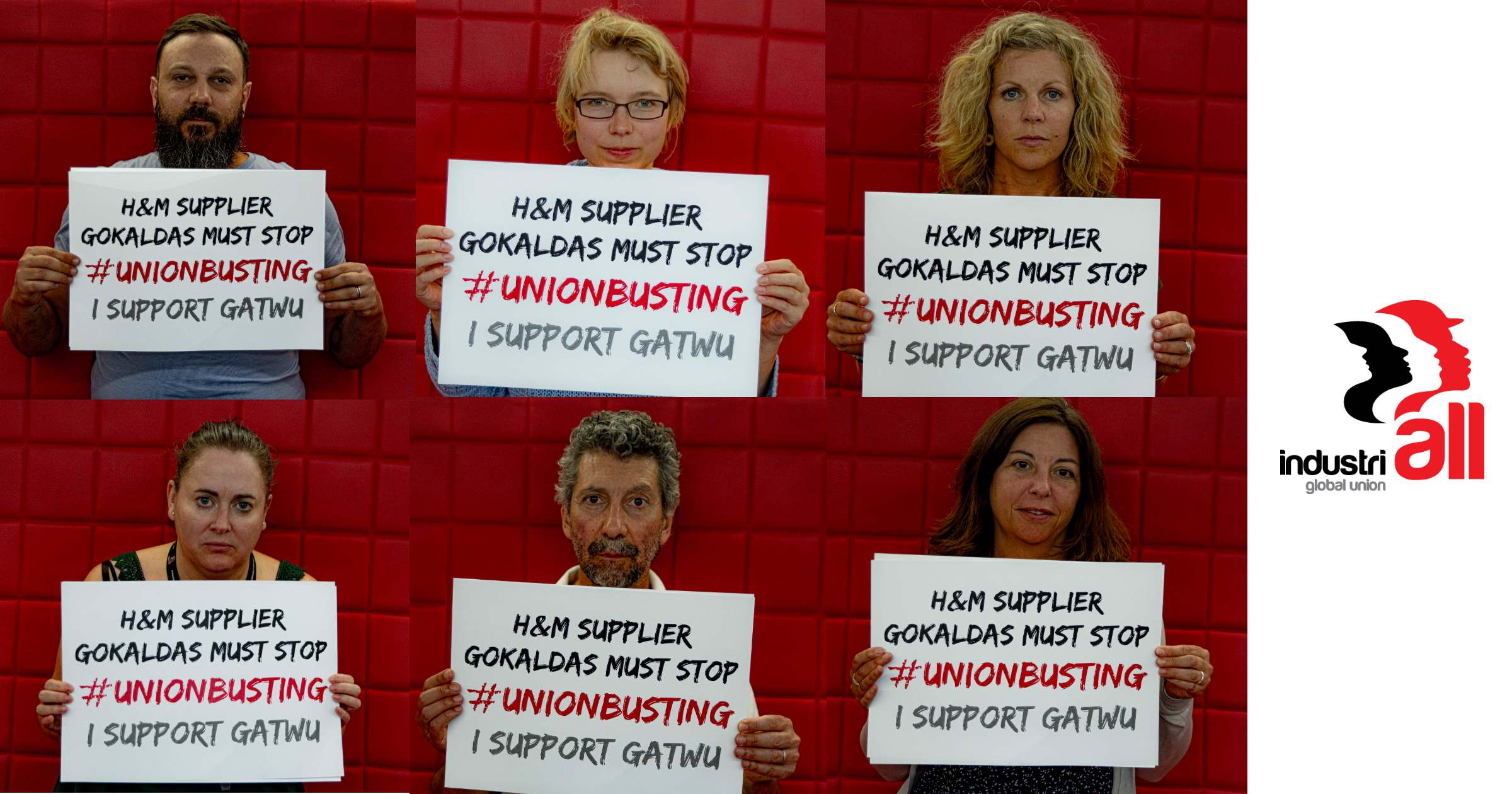
On 8 June, management at Euro Clothing Company, owned by Gokaldas Exports Group, announced a lay-off of 1,200 workers, in clear violation of the labour law. In Indian labour law, lay-off is an act by which there is no production and workers are paid 50 per cent of their salaries. According to the law, a permission from the government is needed for lay-offs in workplaces with more than 100 workers.


Union busting at the factory had begun a few weeks earlier. With the easing of the lockdown, industries were allowed to resume operations on 5 May and workers reported for duty, despite difficulties as public transport had not restarted.

Only 30 per cent of the workers were provided work. They were paid 50 per cent of the wages for the period they worked. No wages were paid at all during the lockdown to any of the workers of ECC-2.

During the night of 30 May, management started removing machines without informing the workers or the union, and only stopped when workers gathered at the gate, blocking the removal.

However, management continued to remove machines, provided work only in the ironing section, and put up a notice that only 50 per cent of the workers would be provided work. Remaining workers would either be transferred to other factories of the group or laid off.

The majority of the workers are members of Unions United, affiliated to IndustriALL Global Union. The union says the actions are not business related; it is a clear case of union busting. The matter has now been brought before the labour department of the state government.

ECC-2, supplier to H&M, is also bound by the global framework agreement signed between IndustriALL and the Swedish clothing giant.

IndustriALL stands in solidarity with the union and its members who picketed the factory all night, and has sent a letter to Euro Clothing Company, calling on them to immediately withdraw the illegal lay-off.

General secretary Valter Sanches says:

"We commend the courage of the workers  fighting for their jobs. We strongly oppose the illegal actions of the management, especially as we see a trend to close unionized factories and retrench union members using the Covid-19 crisis as an excuse.

"We call on ECC management to engage in negotiations with GATWU and on H&M to intervene and fulfill the commitments at our joint global framework agreement.”

Principles for action on Covid-19 in textile, garment, shoes and leather industries

FULL PDF

IndustriALL principles for action on Covid-19 in TGSL industries

ENGLISHFRENCHSPANISHARABIC


According to IndustriALL affiliates, order cancellations are driving wholesale closure of thousands of garment factories with millions of workers being laid off without a social safety net. As the virus spreads within the garment-producing countries themselves, more factories are being forced to close, putting potentially millions more workers out of work.

Measures being taken by employers and governments to reduce the impacts on workers are insufficient to protect the huge number of garment workers affected. Tens of thousands of workers in the garment industry have lost their jobs and are being denied wages as more and more countries implement lockdowns. In some cases, workers left without wages are taking to the streets to protest, increasing the risk of infection.

Where factories continue to operate some are doing so without appropriate safety measures, putting workers at risk and potentially further spreading Covid-19.


Facory in Bangladesh /IndustriALL

To guide our work in the TGSL sector during the Covid-19 pandemic and its aftermath, we endorse the following principles: 

There is a great urgency to deal with the loss of employment and income by workers in the TGSL sector in many countries. We need immediate action by employers, brands/retailers and governments to establish measures that will assure the income and future employment of workers. 

Incomes must be assured for all workers, including permanent, temporary, subcontracted, home-based and other workers that are involved in the production process.

Incomes must be provided to workers that are sufficient to support them and their families through this period of disruption, understanding that even during normal times, salaries in the industries are so low that workers are dependent on overtime and attendance bonuses to survive.

Lay offs, retrenchment and terminations should stop immediately.

Workers should be kept on the payroll of suppliers, and the employment relationship maintained, with income maintenance administered through the suppliers’ payroll, monitored by unions, governments and civil society organisations. 

Freedom of association must be respected, with no penalties for raising safety concerns or demands for unpaid wages.

No workers should be forced to work in unsafe workplaces. Where factories continue to operate, health and safety should be guaranteed in accordance with IndustriALL’s ‘Covid-19 Advice for Workers and Employers’

ENGFRASPATUR

Where possible, production should be redirected towards the production of healthcare and sanitary material.

Brands must adopt responsible purchasing practices, guaranteeing that no orders are cancelled, assuming responsibility for manufactured garments and engaging in responsible discussions regarding future orders, not applying emergency clauses that may be included in contracts to stop orders that are under way or as a pretext for not paying manufactured products. Investment must be made into necessary skill development and retraining to enable factories to adapt to new products and technologies and remain viable.

Governments, brands and suppliers need to work together with unions to take coordinated action to ensure wages are paid and that workers and their families are protected from the negative economic impact of lockdowns.

Existing industrial relations structures, including ACT country groups and GFA monitoring committees, are a means for trade unions to engage with manufacturers and brands on measures to ensure that workers are supported through the crisis.

Recognising that action by governments and employers at national level will not be sufficient to guarantee garments worker wages for the duration of the crisis, IndustriALL endorses the document  “COVID-19: ACTION IN THE GLOBAL GARMENT INDUSTRY”, convened by the ILO, and calls on all brands and retailers, manufacturers, agents and other industry actors to do the same. On the basis of these principles, IndustriALL will continue to work with the industry to:

Safety crisis in Indian mines call for ratification of ILO C-176

Four contract workers were killed and five seriously injured on 2 June at the Godavarikhani open cast mine of Singareni Collieries Company Limited (SCCL) in Telangana. The accidents occurred as workers were engaged in blasting operations. According to union sources, six workers have been killed at SCCL during the Covid-19 lockdown.

A vehicle operator was killed at Rajapur open cast mine of Bharat Coking Coal Limited on 29 May.

On 27 May, there was an accident at Dudhichua project of Northern Coalfields Limited as a machine fell on a dumper. According to the union, a similar accident occurred a few days before, violating safety norms.

One worker was killed and two others injured on 25 May at the Parascole mine of Kajora Area in Eastern Coalfields Limited due to a roof fall.

On 22 May, a contract worker died while four others escaped unhurt in an accident while cleaning a clogged chimney at a coal mine owned by Steel Authority of India Limited in Chasnala. An internal enquiry has been launched and three managers have been suspended pending the enquiry.

One worker was smashed by a dumper on 19 May in the Nandgaon project of Western Coalfields Limited.

A worker at the Ananata open cast project of Mahanadi Coalfields Limited was killed on 3 May while filling diesel into heavy earth moving machinery.

Nathulal Pandey, president of Hind Khadan Mazdoor Federation and S Q Zama, secretary general of Indian National Mineworkers Federation, say:

“A shortage of manpower, high production targets, unplanned extraction of coal, outsourcing coal production to third parties, engagement of a large number of untrained contract workers in critical areas, not fully using safety budgets for the past three years, a shortage of safety equipment for all workers and negligence of safety measures continue to cause avoidable accidents and a loss of workers’ lives in the mines of CIL and in SCCL.

“The government’s attempts to allow commercial mining and privatisation of CIL may actually worsen the safety situation.”

Kemal Özkan, IndustriALL Global Union assistant general secretary, says:

“These fatal accidents underline the safety crisis in Indian mines and the government can no longer ignore it. Before losing more lives, we reiterate that it is urgent that India take steps to ratify ILO Convention C176 on safety and health in mines.

“National laws should be in line with C176, and unions should be involved in decision making processes to create a robust safety culture in Indian mines.”

Stopping gender-based violence in the midst of a pandemic

EnglishFrenchSpanish

“There have been reports of increasing incidents of violence and harassment against staff in the frontline services. We have heard from informal workers who also faced increased violence from authorities. For many women staying home does not mean staying safe. Those who have lost their jobs and women working from home are all at increased risks of domestic violence. Lockdown measures resulted in women being confined with violent partners. During the C190 negotiations, we spoke about all of this and what would be needed to ensure a world the instrument provide ways to deal with all of this,”

said  Marie Clarke, Secretary-Treasurer of the Canadian Labour Congress

“When women are facing domestic violence it is only in the workplace that they can get some kind of support. They want to be able to talk to somebody about their problems and they can do that in their workplace.  This is somewhere we can provide the necessary support, we have to find the solution with them, we have to put them in touch with the righ services. […] It is at the workplace that they find the strength to fight against domestic violence. If you are looking at C 190 and if you listen to the experiences of women, the importance of the workplace is very clear and it is why we need to provide them with as much support as possible,”

said Sheela Naikwade, Vice President, MSTKS in India

“We are talking about power balance. Why women workers are facing violence is because we have less power. Bearing this in mind we have to continue organize. We have to keep our community, our union members together to protect ourselves, to build our power.”

“I would like to call on all unions, leaders, organizers to look into this issue of discrimination, keep on doing trainings and help our members and workers to reflect on our own existing discrimination, and fight against discrimination so that we can fight against violence and the abuse of power in times of Covid-19,” said, Fish Ip, International Domestic Workers Federation (IDWF)

Stay tuned for the next webinar:

Schlumberger workers win recognition

Schlumberger employs about 900 workers at various sites in Pakistan. Only around 320 of those are permanent; the remaining 580 employees are contract workers.

Many of the contract workers have worked in the company for more than ten years, usually with long hours, sometimes made to work in very difficult circumstances in fields far away and even exposed to armed groups.

As opposed to permanent workers, contract workers were faced with job insecurity, paid less and denied bonuses and benefits.  Whenever they demanded their rights, they were threatened with assignments further away.

In February, a contract worker Ahmed Nawaz Khan, died at work. Despite official acknowledgement that Khan died while working in the factory, management refused to provide due compensation.

Against the backdrop of continued denial of their rights, contract workers decided to form a union, reaching out to IndustriALL affiliate All Pakistan Oil & Gas Employees’ Federation (APOGEF) for support. IndustriALL called on Schlumberger to respect union rights, provide appropriate compensation, adhere to labour laws and regularize contract workers.

The workers made significant progress towards achieving the right to freedom of association when their union was registered with the National Industrial Relations Commission in May 2020.

Malik Abdul Hameed, general secretary of the Schlumberger Pakistan workers union, says:

“We registered our union after our members’ steadfast struggle. We acknowledge the valuable solidarity support extended by APOGEF and IndustriALL.

“Currently, all our union members are contract workers and are looking to engage in collective bargaining and social dialogue to win decent work in our workplace.”

IndustriALL Global Union congratulates Schlumberger workers and their national union APOGEF for their determined struggle for dignity, fundamental rights and finally union recognition. This is the best way to protect and advance workers’ rights and interests.

Schlumberger is one of the world’s leading oil services providers with drilling, production and processing, employing 103,000 people in more than 120 countries.