Government of India must take swift measures to prevent another Bhopal disaster

India has recently witnessed a number of industrial accidents, a toxic gas leak at LG polymers, an explosion in a chemical factory at Dahej, a boiler explosion in Tamil Nadu, a toxic gas leak in a paper mill Chhattisgarh, a boiler explosion in Lucknow chemical factory, as well as several accidents in the coal mining industry. Workers have been injured and killed and communities have been exposed to toxic chemicals.

The accidents reveal  a pattern of failures. If the causes are not addressed the possibility of a major catastrophe on the scale of the 1984 Bhopal disaster cannot be ruled out. It is also significant to note that the series of accidents occurred as factories were reopening after Covid-19 shutdown measures. 

In a letter to the Prime Minister of India, IndustriALL Global Union underlines that serious accidents on this scale are beyond the control of individuals and difficult to analyze and prevent using traditional occupational health and safety protocols. All aspects of safety, including materials, tools, equipment, work environment, job and task procedures, and people (both management and workers) must create a system of multiple layers of prevention, with little opportunities for failure.

Valter Sanches, IndustriALL general secretary, expresses concerns over the accidents causing an avoidable loss of lives and serious health consequences for hundreds and thousands of people.

“We call on the government of India to undertake an immediate review of safety regulations and enforcements, and to take steps to integrate the principles of process safety management in the legislative and regulative frameworks.

“The government should call for a public consultation, involve unions and ensure full transparency to improve safety measures and prevent potential accidents. IndustriALL Global Union is ready to work with the government, employers and all relevant stakeholders for the benefit of workers and society at large.”

The Bhopal gas tragedy, one of the worlds deadliest industrial disasters, was caused by a gas leak in December 1984, at the Union Carbide India Limited (UCIL) pesticide plant in Bhopal, Madhya Pradesh, India. More than 15,000 people died and over 500,000 people who lived around the plant were exposed to methyl isocyanate (MIC) gas.

Precarious working conditions of diamond cutting and polishing workers in Botswana expose jewellery brands

Companies, including Yerushalmi Brothers Diamonds, Motiganz Botswana, Dalumi Diamonds, Leo Schachter Diamonds, and Signet Jewelers have dismissed staff. At Safdico Botswana, BDWU, successfully challenged the retrenchments resulting in their reversal. The union is also challenging the job losses with the country’s labour department, while some cases have gone to the Industrial Court. Some workers were retrenched because they are union members. In other cases, workers were dismissed after dubious disciplinary actions.

Over 51 workers have been retrenched at Signet Jewelers since March with Covid-19 cited as the reason for the retrenchments. In some instances, the companies refuse to disclose the reasons.

Most employers in Botswana’s diamond cutting and polishing sector use union busting to weaken unions, like encouraging the formation of associations at factories and not recognizing registered unions.

The sector is plagued by low wages; workers are paid from 1300-3500 Pula (US$113-303) per month.

The BDWU says that in addition there is no job security for local workers, with some having been employed for ten years on short term contracts. This makes it hard for the workers to access bank loans as they are considered risky clients and are unable to buy their own homes.

Employers are failing to fulfil training requirements for Batswana, whose contracts say foreign workers should train locals in special skills. Instead, workers are hired to simply do the job.

Dominic Obusitse Mapoka, BDWU vice chairperson, says:

“Despite the industry making huge profits every month, workers are getting paid a pittance. The wages are low, and we want our members to be paid living wages. Local workers should also be trained in special skills that are required in the sector.”

On 21 February, the BDWU met with the Minister of employment, labour productivity and skills development, and the Commissioner of labour, who promised to assist. However, there has since been no further communication from the government.

Glen Mpufane, IndustriALL director for mining, gems, diamonds, ornaments and precious stones, stresses that employers must stop paying starvation wages.

“Workers toil daily cutting and polishing precious diamonds and yet are unable to buy food and other basics because of poor wages. The companies must pay decent wages, respect workers’ rights and labour standards. They must also consult with unions on COVID-19 protocols.”

Asia Pacific energy unions urge governments to enforce health and safety

IndustriALL Global Union’s Asia Pacific affiliates in electricity, nuclear, oil and gas sectors held two virtual meetings on 22 and 23 June to discuss workers’ situation during the outbreak of Covid-19.

Electricity demands declined during lockdowns, and workers are concerned about their safety and health while carrying out installations, repairs, and meter reading. Unions have negotiated for personal protective equipment and extended the schedule of meter readings.

“Our union will make sure every workplace provides face masks and hand sanitizers to workers. It is compulsory to check body temperature before entering the workplace,”

said Lamyuang, secretary of Labour Union of Electricity Generating Authority of Thailand (LU-EGAT).

Similarly, the demand of oil and gas has dropped across the region due to restricted economic activities. All Pakistan Oil and Gas Employees Federation (APOGEF ) from Pakistan was hit hard, as many refinery plants were closed and workers laid off as a result of the plunge of oil and gas demands.

“Pakistani oil and gas workers have been critically affected by the pandemic. Workers have been terminated, as drilling and refinery companies have stopped its operations and transport companies are not receiving any orders,”

said Syed Ejaz Hussain Shah, APOGEF general secretary.

The chairperson of Asia Pacific energy union network and the president of Denryokusoren, Koji Sakata urged unionists to remain vigilant on the impact of Covid-19 on employment and working conditions in the energy sector.

He also urged unions to take on numerous policy challenges, like eradication of poverty, reducing inequality and adapting new technology.

“Governments should provide more comprehensive employment protection packages to retain jobs and decent working conditions. Employers’ unilateral decision to cut benefits must stop,”

stressed Chuang Chueh An, chairperson of Asia Pacific oil and gas union network and president of Taiwan Petroleum Workers Union.

IndustriALL energy director Diana Junquera Curiel called on the unions to remain united and extended solidarity to the workers who are suffering:

“If the struggle continues, we will find strategies to overcome the challenges. Let’s build stronger union networks to create safer and healthier workplaces.”

Increasing global strength

With key membership in shipbuilding and repair, metal and energy sectors, General Federation of Bahrain Trade Unions (GFBTU) is IndustriALL’s first affiliate from Bahrain. GFBTU organizes workers in a number of major companies, such as Aluminum Bahrain (Abla), Bahrain Petroleum Company (Bapco) and Arab Shipbuilding & Repair Yard (ASRY).

Palestine General Union of Electricity & Energy is affiliated to the national center Palestine General Federation of Trade Unions (PGFTU). It was established in 2018 and organizes workers in the electricity sector.

FISMECA, the Ivorian Federation of Trade Unions of Mines, Metals, quarries, and Related activities has members in quarries, mines, cement, aluminium and metal.

AUTOBATE from Nigeria organizes senior staff workers in the auto industry. Members include administrative officers, supervisors, managers, and senior managers in auto companies such as TATA Africa Services, Boulos Enterprises, Mandilas Group Nigeria, Niger Dock Nigeria, Motor Parts Industry, Honda Manufacturing Nigeria, Steyr Motors, GALBA Nigeria, Plantgeria and Nigeria Ship Builder.

Registered in 2019, the Zimbabwe Diamond and Allied Workers Union (ZDMAWU) initially organized diamond workers, but the union has expanded the scope to include mining activities in chrome, gold, and platinum mines. These include Chiadzwa and Murowa diamond mines, mines owned by the Zimbabwe Mining Development Corporation and Anglo American Platinum’s Unki mine, amongst others.

The All Pakistan WAPDA Hydro Electric Workers Union (APWHEWU) represents the majority of workers at the largest National Public Utility Pakistan Water and Power Development Authority and Electricity Distribution, Generation and Transmission Companies.

“We welcome the new unions that are joining our global family. This means a recognition of the importance of global solidarity. With more unions we can strengthen our global network and our capacity to defend workers’ rights,”

says IndustriALL general secretary Valter Sanches. 

Lockout ends for refinery workers in Canada

The dispute started when Federated Co-operatives Limited (FCL) locked out 730 workers after the union refused to accept a major downgrade of the pension scheme. During the bitter struggle, 14 union members were arrested at a legal picket line.

After six months, the union members have now ratified a tentative agreement with Co-op Refinery.

The new collective agreement maintains the defined benefit pension plan and the company matched employee savings plan for existing workers. Wage improvements in the new collective agreement match the National Pattern.

“Wealthy corporations have been allowed to act with impunity for too long, exerting their power on workers in order to profit, while eroding wages, pensions, and benefits,”

says Jerry Dias, Unifor National President.

“Unifor members took a stand against this aggression, and Co-op locked them out in the cold. In this fight, we showed that Canada’s workers are united and will fight to defend good jobs.”

During the dispute, IndustriALL Global Union reached out to the Provincial Government of Saskatchewan to ensure implementation of the mediators’ recommendations. IndustriALL affiliates took to social media to extend support and solidarity to the locked-out union members.

“We congratulate all members of Unifor Canada Local 594 and of Unifor across Canada on a victory they fought long and hard to achieve. The bravery they showed in the long-lasting picket lines throughout winter and pandemic times, even fighting the harassment from the company and the local police, is an inspiration for unions around the world,”

says Valter Sanches, IndustriALL general secretary.

ITUC calls out ten worst countries for workers

Governments and employers have restricted the rights of workers through violations of collective bargaining and the right to strike, excluded workers from unions by impeding the registration of unions in the number of countries.

According to the findings of the Global Rights Index 2020, 85 per cent of countries violated the right to strike, and 80 per cent of countries violated the right to collectively bargain. 

While workers were subject to violence in 51 countries and experienced arbitrary arrests and detention in 61 countries, their access to justice was either denied or restricted in 72 per cent of countries. 

The report notes an increased number of countries that have denied or constrained the freedom of speech. The report flags another alarming trend of a number of scandals about governments’ surveillance of trade union leaders, attempting to instil fear and put pressure on independent unions and their members.

Valter Sanches, IndustriALL Global Union general secretary, says:

“Even before Covid-19 we witnessed unprecedented attacks against the labour movement and an increasing gap between the poor and the rich across the globe, leading to a new global economic crisis. The ITUC Global Rights Index is the quantitative reflection of this situation. We regularly report on the violations in IndustriALL’s sectors and the situation is no better in textile, steel, auto or mining. But after the Covid-19 outbreak most of our members are facing violations on an even bigger scale. Our only way to fight back is through increased organizing, strengthened unions and higher global solidarity.”

The situation of violations is particularly serious in Bangladesh, Brazil, Colombia, Egypt, Honduras, India, Kazakhstan, The Philippines, Turkey and Zimbabwe, which this year’s report ranks as the most dangerous countries for workers.

Full report with infographics is available on ITUC website in ArabicEnglishFrenchGermanRussian and Spanish.

Unions under threat in Kyrgyzstan

FTUK chair Mirbek Asanakunov was dismissed by the FTUK Council on 5 February 2020. The leadership passed to FTUK vice chair, Ryskul Babayeva. Since then, state authorities have increased pressure on current FTUK leaders and activists by conducting investigations and interrogations, searching their homes and initiating criminal procedures.

On 3 June, Babayeva was taken from hospital for police interrogation. On 10 June, the district court decided to place FTUK deputy chair Kanatbek Osmonov under house arrest for two months without the right to use telecommunications and internet, effectively suspending his trade union work. Other FTUK Council members fear they will be next.

The investigative measures are a result of false accusations from Asanakunov. Asanakunov is also using media to discredit unions and FTUK Council members. In contrast, several statements against Asanakunov are not considered by law enforcement agencies, showing the bias and pressure on trade unions in Kyrgyzstan. The FTUK work is paralyzed, as their bank accounts have been frozen, making impossible to pay wages to FTUK employees and carry out regular activities.

Asanakunov was elected FTUK chair in 2017, on false pretences. The FTUK Council repeatedly tried to dispute Asanakunov’s election, but meetings were disrupted by his supporters. The district court and the city court ruled that Asanakunov’s election as FTUK chair was invalid. But despite that, ex-chair is still trying to seize power illegally and has tried to return to the office several times.

In April 2019, Asanakunov’s wife, together with other members of parliament, initiated a draft law on trade unions that violates freedom of association by establishing absolute power of FTUK’s chair, complicating the procedure for electing and removing chair, and setting full personal, financial and information dependence and accountability of unions to FTUK.

The chair of Mining and Metallurgy Trade Union of Kyrgyzstan, Eldar Tadzhibayev, says:

“If this draft law is adopted, the principle of collegial decision-making, the system of checks and balances will disappear, board members will become completely dependent on the FTUK chair, who will not be responsible for anything. There will be rampant corruption, the unions’ property will be sold for a penny. Trade unions will weaken, as there will be mass withdrawal from unions. As a consequence, respect for workers’ rights will sharply deteriorate and the level of social and economic protection will decrease.”

During the last year, unions have protested against the draft law, which has passed two readings at parliament.

IndustriALL and the ITUC has urged the President of Kyrgyzstan to immediately act to stop the interference in internal union affairs by law enforcement agencies and any pressure and prosecution of FTUK Council members who decided to dismiss Asanakunov from his post and express their opinion against the adoption of the draft law on trade unions.

IndustriALL also urged that the draft law on trade unions violating core principles of ILO Conventions 87 and 98 ratified by Kyrgyzstan be withdrawn.

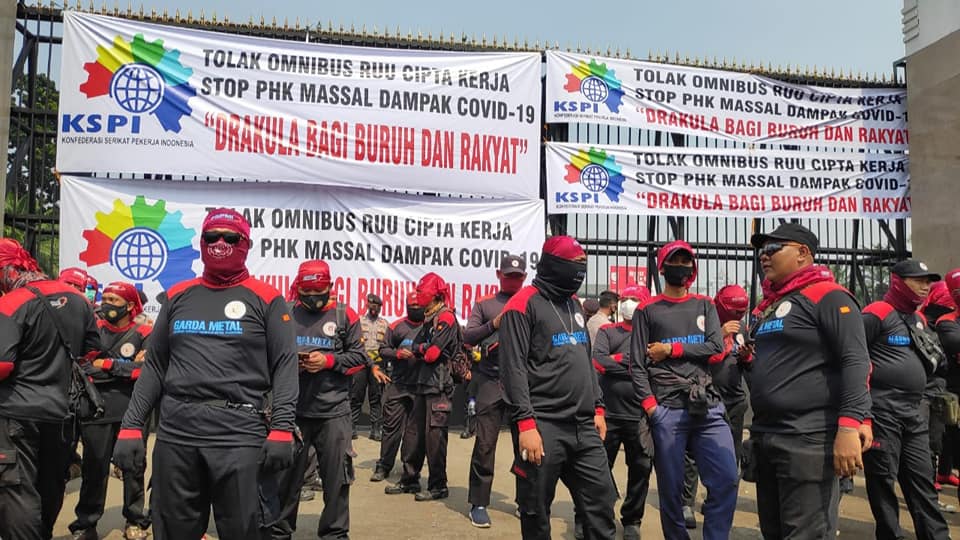
Indian cement unions decide on joint action

With the assistance of IndustriALL, union leaders developed a number of demands of the government and Cement Manufacturers Association (CMA), to improve health and safety, end the extensive use of precarious workers and underpayment of wages and arrears.

India is the second largest cement producer in the world after China. The country faces an enormous challenge due Covid-19. During the pandemic, cement production fell by 86 per cent from 29.2 to 4.1 megatons yearly.

Women workers, migrant and contract workers have paid the highest price and have been the first to lose their jobs.

The unions denounced exploitation at cement companies, including LafargeHolcim and HeidelbergCement. While these companies have fully restarted production, manpower has been reduced by up to 30 per cent. This trend, combined with concerns over health and safety, leads to serious health problems and unsafe working conditions.

Many cement enterprises, including ACC and Ambuja, are not renewing third-party contracts and have started working with new contractors at reduced commissions. According to unions, the result is that those third-party workers who do not lose their jobs often see their already low wages reduced by 30 per cent.

Cement production workers are not the only victims: 320 white collar employees lost their jobs at Bangalore based OneIndia BSC, an ACC and Ambuja Cement joint venture.

On 12 June, the Supreme Court of India asked employers to negotiate terms and enter into settlements with workers and trade unions on the payment of wages for the 54-day lockdown period. However there are no sanctions on employers who take advantage of the situation and fail to pay the wages or give regular jobs to contract workers. Contract workers saw their wages slashed by 50-60 per cent at Maratha cement works in Ambuja, ACC (Bargarh), Ambuja (Bhatapara), ACC (Jamul), and Mangalam cement. Despite a signed wage agreement, arrears and wages have not been paid at Ultratech cement in Uttar Pradesh.

Unions demand that the CMA and all cement companies:

Deoraj Singh, general secretary, Indian National Cement Workers’ Federation (INCWF) said,

“The time is really challenging for workers and trade unions, but we cannot afford to keep our workers out of job and income and allowed unsafe working environment. Cement workers actively participated in the 22 May nationwide struggle and will participate in the 3 July nationwide non-cooperation movement, to engage the government and CMA to respect the labour and social rights and engage with unions to make the roadmap for the cement industry.”

Alexander Ivanou, IndustriALL materials industries and communications officer said,

“Underpaid and overexploited workers in Indian cement industry is simply shameful. This industry is one of the biggest contributors to the national GDP. Yet, the workers on whose shoulders this is all built are again the last in line. We will not abandon our members in India in their fight for  fair compensation and decent conditions in the cement sector. IndustriALL will apply all our efforts and help Indian unions to repel the anti-worker labour law changes that bring unfair dismissals and wage cuts.”

Myanmar: call for social dialogue over dismissals

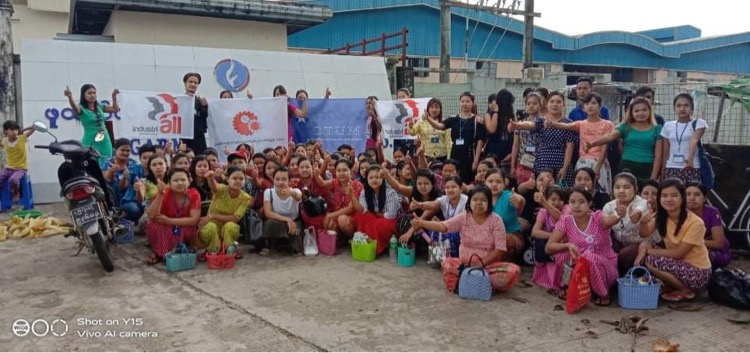
On 11 June, more than 400 leather workers at Jia Hao went on strike in protest of the dismissal of 79 workers. The dismissed workers include the factory union president and all the executive committee members. The company says that the redundancy plan was necessary as there was not enough raw materials for production and work orders had dropped.

But the dismissals happened after local union leaders had filed a complaint to the Labour department over unpaid wages in May.

As the management of Jia Hao refused to negotiate with the local union leaders and locked down the factory for more than 400 workers, the workers had no choice but to hold the strike at the entrance of the company in heavy rain.

IWFM president Khaing Zar says:

"IWFM wants an urgent intervention from the government and the Chinese Chamber of Commerce to resolve the dispute. The company has committed numerous violations of labour rights and the current safety and health practice might expose 400 workers to the risk of Covid-19.

“The company should explore other options, such as applying for the EU Myan Ku fund. For companies affected by the pandemic and forced to shut down, the fund will pay workers at least half of the minimum wage.”

IndustriALL is urging Jia Hao to reconsider the decision and heed the call of International Labour Organization that fighting Covid-19 and economic shock requires full cooperation of employers, trade unions and the government through social dialogue.

The role of Uruguayan unions in the ratification of C190

PROFILE

The new Convention and Recommendation to end violence and harassment in the world of work was adopted at the International Labour Conference of the ILO, in Switzerland in June 2019. It recognizes that violence and harassment are a threat to equality of opportunity, and are unacceptable and incompatible with decent work.

The government under the former president of Uruguay, Tabaré Vásquez, presented the initiative to Parliament in September and the House of Representatives approved it unanimously on 17 December 2019.

The Ambassador and Permanent Representative of Uruguay to the United Nations in Geneva, Ricardo González Arenas, deposited the instrument of ratification with ILO Director-General, Guy Ryder, in a virtual ceremony held on June 12, 2020.

Uruguay thereby became the first ILO member state to ratify C190.

Uruguay has legislation that covers some of the issues mentioned in C190, which helped with its ratification. For example, Law No. 18561 on sexual harassment, prevention and penalties in the workplace and concerning student-teacher relationships, and Law No. 19580 on gender-based violence against women.

Ana Aguilera, member of the Gender, Equality and Diversity Secretariat of the Uruguayan trade union centre PIT-CNT

Ana Aguilera, member of the Gender, Equality and Diversity Secretariat of the Uruguayan trade union centre PIT-CNT, says:

“This Secretariat has been working for many years on sexual harassment at work and on gender-based violence against women. 15 or 20 years ago we worked in coordination with the legislators to submit a proposal for a law on sexual harassment in the workplace and education, through a tripartite commission. Law No. 18561 was enacted in 2009 and since then there has been an increase in complaints of workplace harassment received by the Ministry of Labour.

“Law No. 19580, enacted in 2017, has a chapter that defines what is considered to be violence, and includes women who suffer workplace harassment. This also helped to make it more possible to report and complain about these issues.”

Aguilera explains that based on this legislation a successful campaign was carried out in favour of the ratification of ILO Convention 190 in Uruguay. It consisted of a united campaign by the unions that are part of the PIT-CNT, the Ministry of Labour, the government, women's organizations and trade union centres in the region.

Thanks to the ratification of the new Convention, Uruguay will also have to adopt an inclusive, integrated and gender-responsive approach to preventing and eliminating violence and harassment at work. This will apply to both the public and private sectors, to the formal and informal economy, and in both urban and rural areas.

Also, this legislation should require employers to take appropriate measures to prevent violence and harassment in the world of work.

Unions fight for a world of work free from violence and harassment

Through the Gender, Equality and Diversity Office of the PIT-CNT, IndustriALL’s affiliates in Uruguay were actively involved in the previous tripartite talks on the ratification of the Convention.

Marcelo Abdala, general secretary of the PIT-CNT

Marcelo Abdala, general secretary of the PIT-CNT and of the National Union of Metalworkers and Related Branches, says: 

“After the international ILO conference where C190 was adopted, the previous government called a tripartite meeting where the women delegates of the PIT-CNT acted to ensure that it was quickly implemented in legislation. The Vázquez government voted in favour of it, together with the labour movement, and the employers abstained. The PIT-CNT organized workshops to explain the content of the Convention and why it was important for unions to use it as a tool. The unions affiliated to IndustriALL in Uruguay participated actively in this.

“We were pleased that Uruguay became the first country in the world to ratify the Convention and include it in its national regulations. For us, anything that can increase awareness and promote eradication of the different components of harassment, both sexual and at work, is a victory for democracy.”

Fernanda Ceballos, member of the Gender, Equality and Diversity Office of the PIT-CNT and UNTMRA

Fernanda Ceballos, member of the Gender, Equality and Diversity Office of the PIT-CNT and UNTMRA, adds:

"We have been working for a long time on the issue of sexual harassment and zero tolerance for violence in the workplace, and we organize workshops to raise awareness among unions concerning this issue. We are also working on gender-related clauses in collective bargaining agreements, in conjunction with companies and the Ministry of Labour. After ratifying C190, we held meetings with UNTMRA to inform people of its scope. A large number of women workers have faced sexual harassment at work, so we believe that ratification is very important to fight for a world of work free from violence.”

Both the Union of Tanning Workers and the Federation of Paper and Cardboard Workers of Uruguay have few women members as the companies where they work do not have women on their payroll.

However, both unions support policies favouring gender equality and push for the same rights for both men and women in their collective agreements.

Washington Cayaffa, general secretary of the FOPCU, says:

“Our industry is characterized by not having a large female workforce in manufacturing plants. There are more women in the office-workers section, but we haven’t managed to organize many of them.

“In our collective agreement there is an item where we ask for the application of policies to protect equal rights for women in the workplace. The ratification of C190 is one of the policies that we support.

“Our Federation is encouraging affiliated unions to defend women's rights as regards equality. For example, they should support the same salary definition so that women workers earn the same wages as a man doing the same job”.

UOC general secretary, Carlos Bico

“There are not many women in the leather industry, but some of them attended the meetings of the PIT-CNT Gender Office to discuss how to support ratification of C190,”

says UOC general secretary, Carlos Bico.

“Currently, five per cent of the workforce in our factories are women. In the Wage Councils’ collective agreement structured by branch of activity, the UOC proposed that more women should be integrated into the staff of tannery workers.”


Uruguay demonstration

The united work of Uruguayan unions

The UOC, UNTMRA and FOPCU are some of the oldest union organizations in Uruguay. Their origins date back to 1904, 1953, and 1958 respectively. Together they form part of the PIT-CNT trade union centre.

Since they belong to the same trade union centre, the unions have been working together for many years to support common goals. For example, they carried out a successful campaign for Uruguay to withdraw from the Trade in Services Agreement (TiSA), and another successful campaign against a plebiscite that aimed to lower the age of criminal responsibility from 18 to 16 years.

Currently, the three unions are part of a project called "Integrated Industry". Over the course of two years they will analyse the scientific and technological revolution, and draw up proposals to stimulate employment, the growth of productive activities and the creation of a sustainable industrial policy. Unions will work alongside governments and businesses to negotiate public and private policies that allow for a just transition, strengthening national industry and securing decent jobs.