Support picketing Indonesian paper workers

Download the posterThey were collectively dismissed over two months ago as the large pulp manufacturer Tanjungenim Lestari switched to a new service provider at the site in Lampung Province, Indonesia. It is union busting and unfair dismissal.

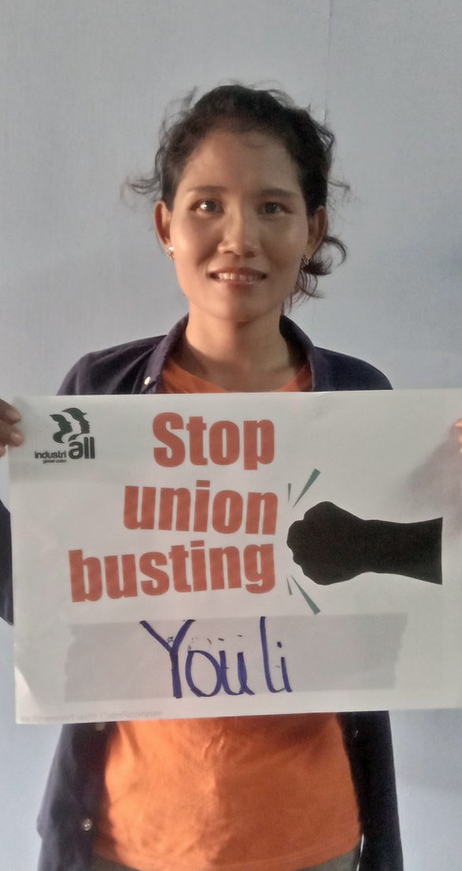
IndustriALL Global Union’s pulp and paper sector at global and regional levels has set the campaign for reinstatement of the 38 as a top priority. While the 38 are members of the IndustriALL affiliate FSP2KI, their determined picket at the entrance to the factory has won wide support from civil society and other Indonesian unions.

IndustriALL places responsibility for this union busting attack primarily with the company that runs the entire worksite, PT. Tanjungenim Lestari Pulp and Paper. The new service provider PT Kamigumi should rehire all the 38 workers who have been in their jobs several years, and Tanjungenim must require them to do so.

Send your demand to the top management of Tanjungenim using these contact details. You can use this model letter and your union's letterhead, and send to:

The picket has been conducted around the clock since the mass dismissals, including through difficult weather conditions. The IndustriALL flag flies high at the picket. IndustriALL condemned the 8 August aggressive police intervention to break up the workers’ protest outside the site.

While consumers generally do not recognize the company name Tanjugenum Lestari, the pulp manufactured at the site is shipped to various countries and made into every type of paper and tissue product.

IndustriALL is also working to raise this case with companies along the supply chain.

IndustriALL director for the pulp and paper sector, Tom Grinter, said:

“Please add your voice to this demand for justice in Indonesia. It is a simple demand, get these 38 people back in their jobs immediately. Our message to Tanjungenim Lestari is that we will not go away until that happens.”

What you can do

  1. Send the model message on your union letterhead to the company management
  2. Sign the petition and ask your members to do the same;
  3. Download the poster and take a photo of yourself and your co-workers. Send us the pictures to be uploaded online, and post them on your own social media accounts
  4. Use the temporary Facebook profile overlay to show your support for the campaign.

The FSP2KI represents around 15,000 pulp and paper workers in Indonesia.

Covid-19 has made workers’ health and safety a priority in Mozambique

These are some of the issues that were discussed during a virtual workshop on health and safety under Covid-19, held on 11 August. Leaders and shop stewards from IndustriALL Global Union affiliate SINTIME participated in the meeting. SINTIME organizes workers in the mining and base metals sector in Mozambique, including at South32 – a demerged mining and metals multinational created in 2014 by BHP Billiton.

The workshop emphasized the importance of International Labour Organization Convention 176 on health and safety in the mines, the right to refuse dangerous work, and how unions can use collective bargaining agreements to deal with Covid-19 at the workplace.

Americo Pedro Macamo

Americo Pedro Macamo, SINTIME general secretary said:

“Workers are heeding the calls and adhering to government regulations on the state of emergency and production is at one third capacity. The union has successfully negotiated with companies not to dismiss workers and there have been no retrenchments or job losses.”

Brian Kohler, IndustriALL director for health and safety said:

“Unions should continue demanding workers’ rights to occupational health and safety through full knowledge of hazards and how to work safely. Additionally, workers demand the right to refuse or shut down unsafe work without fear of discipline or discharge; and to participate in the development and implementation of all health and safety policies, programmes, procedures, hazard and risk assessments, accident and incident investigations, workplace inspections and audits. These rights must be fought for.”

Further, the workshop concurred on the importance of knowing some of the ways in which multinational mining and commodity companies like BHP organize their businesses. For instance, knowledge of the global value chain approach is critical as it shows linkages to different production sectors in which multinational companies are involved such as oil and gas, fertilizer manufacturing and commodity trading. Trade unions must know how low-cost and long-term assets models exploit workers through precarious working conditions of short contracts, low pay, and dangerous work.

With BHP Billiton Holdings having demerged South32 in 2014, it was recommended that the IndustriALL BHP Billiton network should consider including the company in its campaign activities to consider BHP’s environmental, social and governance legacies that still remain with South32.

South32 owns 47.1 per cent of Mozal Aluminium, with other shareholders Mitsubishi Corporation Metals Holding with 25 per cent, Industrial Development Corporation South Africa 24 per cent, and the government of Mozambique 3.9 per cent.

Glen Mpufane, IndustriALL mining director said:

“Knowing the value chain dynamics allow unions to engage more effectively on health and safety and Covid-19 protocols through sharing of joint strategies and campaigns. For example, the BHP Billiton network brings together workers solidarity from Latin America, Southern Africa, and Australia. The formation of a South32 global network seems a very practical approach to dealing with the challenges workers experience across South32’s operations globally where violations occur.”

Image credit: Mozal Aluminium, South32

Thai unions campaign for ratification of ILO C 190 during pandemic

Visiting the department

On 30 June, women leaders of Thai Labor Reconciliation Committee paid a visit to the Department of Women's Affairs and Family Development. The delegates briefed government officials on the importance of ratifying ILO Convention 183 on maternity protection and Convention 190.

Talking to government

Moreover, the union urged the government to strengthen women’s empowerment measures, encouraging men to share responsibility for nurturing children and develop paternity skills. These steps can reduce the routine family work of wives after giving birth.


Two week later, the Confederation of Industrial Labour of Thailand (CILT) organized a meeting on sharing knowledge during Covid-19. The meeting also explained the importance of ratifying Convention 190.

Ruengrung Vichianpong, the women leader of CILT says:

“Gender equality is a crucial part of our union work. We endeavour to utilize every channel we have to promote women rights. I took part in television interviews, attended meeting with local unionists to talk about gender issues, including Convention 190.

“The CILT women’s committee joined a programme organized by the department with the aim of eliminating discrimination against women. On 14-15 August, we will organize a youth seminar on gender-based discrimination, Convention 190 and realizing equality at workplaces.”

IndustriALL South East Asia regional secretary Annie Adviento says:

“Right after Uruguay ratified Convention 190 in 2019, Fiji ensued and ratified the convention in June 2020. I really hope that Thailand becomes the first Asian country to ratify the convention, sending a bold message to Asian leaders.

“I wish Thai affiliates continue the good work on gender equality and women rights, particularly the yearly activities in conjunction with International Day for the Elimination of Violence against Women on 25 November.”

Asian paper sector unions unite

Focusing on sharing analysis and union action in face of the Covid-19 pandemic, this group identified common challenges throughout the region for paper workers and their communities.

The burning issue of the group is the ongoing struggle for reinstatement of 38 trade union members at the Indonesian pulp maker Tanjungenim Lestari. When the outsourced contract expired for these workers, the employer took the opportunity to bust the union and replace the workers, who are all members of IndustriALL affiliate FSP2KI. This is illegal under Indonesian law and in contradiction to international labour standards.

The network of IndustriALL affiliates conducted a session on the case and agreed on solidarity action to support the campaign for reinstatement.

The network analyzed the trade union situation in the sector in Australia, Japan, Philippines and Thailand, as well as Indonesia.

Throughout these countries working people are suffering from the economic impact of the virus, with many job losses. However, the pulp and paper sector is much less badly affected in this regard than other industries.

The Thai trade union delegates updated the group on their progress in formalizing their national network of paper sector unions. This increased coordination will continue and the group aims to grow.

Throughout the region similar measures are being taken in the pulp and paper workplaces to combat the spread of the virus, with testing, track and tracing, mask wearing, increased hygiene, and social distancing. The unions are demanding strong worker involvement in the management of those safety rules and procedures.

It was noted that several scrupulous employers were attempting to take advantage of the pandemic to cut employment benefits, and the unions discussed how to use national legislation to resist those efforts.

Government aid schemes have mitigated much of the severe impact in the countries, but there is significant concern about economic hardship when those schemes end.


The Chair of the network, Denise Campbell-Burns of the CFMEU Australia said: 

“Again, we see so many of the same issues across the sector. Our responsibility is to hold the employers to account to make sure that our members are safe at work, with the best job security possible in these uncertain times. It is important for us to share information and knowledge, throughout the region, and we will continue to do so.”

IndustriALL Pulp and Paper Sector Director Tom Grinter said:

“Over the last four years, this group has built itself into an affective campaigning group through annual physical meetings, and constant communication. Now the group will take unified action to stand with the 38 FSP2KI members in their fight for their jobs.”

Workers in Belarus down tools to protest oppression

During the sixth days of protests, work stoppages rapidly spread across the country. According to recent reports, workers at as many as 100 different companies have downed tools to protest against the failure of company bosses to provide safety from brutal police repressions.

Workers at Belaruskaliy, a fertilizer producer, reported that several of their colleagues had been detained and brutally beaten by the special riot police, OMON, on 11 August while going to work for the night shift. One of the workers was sentenced to 25 days and another for 15 days.

Earlier, IndustriALL received reports of a series of detentions and severe beatings of union leaders who peacefully participated in the elections as independent observers. These include the former president of the Independent Trade Union of Belarus (BNP) Mikalaj Zimin, his colleague Maxim Sereda, and Jan Roman, a journalist and activist of the Free Metal Workers’ Union (SPM). The police have not allowed any contact with the detained.

In addition to continued reports of violence and arbitrary detention, people released on 13 and 14 August from the detention centres in Minsk and other cities have shared extremely alarming accounts of brutal torture, heavy beatings and other inhuman acts of violence while in detention.

According to reports from the Belarusian media and IndustriALL affiliates in the country, workers have stopped work to hold spontaneous assemblies at big manufacturing companies, including BelAZ (off-road trucks, Zhodino), MAZ (trucks and buses, Minsk), MTZ (tractors, Minsk), Keramin (ceramic tiles, Minsk), Integral (electronics, Minsk), Grodno Azot (chemicals, Grodno), Belaruskaliy (potassium fertilizers, Soligorsk).

Workers demand that company bosses and city leaders guarantee their safety and stop violence against workers the general population. At many meetings, workers express mistrust of election results that were announced, and demanded the resignation of the Lukashenko and a re-run of the elections.

The European and international community have started discussing additional sanctions against those involved in the process of falsifications during the elections in Belarus.

IndustriALL Global Union and industriAll European Trade Union jointly expressed their outrage, anger and protest at the disproportionate violence, persecution and arrests directed at people peacefully protesting the results of the presidential elections on August 9.

Union approves agreement to save jobs at Renault Brazil

Hundreds of SMC union members attended an assembly on 10 August to learn the details of the latest proposal negotiated with the company. On 10 and 11 August, they voted online, with 95 per cent of members approving the agreement that reinstates 747 workers who had been laid off.

SMC president Sérgio Butka said:

"It's been a fight for jobs and for our lives. The challenge over the next four years will be to keep the plant growing and generating jobs. We need to put the interests of the local population first.

This has been a new experience for us, since we had the backing of the employment authorities and the whole community as we sought to reach an agreement with Renault. We now need to get back to the plant, think positively and start forging a strong and healthy relationship with Renault. We all need to play our part."

The leaders of the SMC union, which is part of CNTM/FS, an affiliate of IndustriALL Global Union, said that the agreement also includes a four-year wage plan with profit-sharing and pay allowances.

As a result of the agreement, the union ended the strike that began on 22 July. Normal work will resume 12 August for all but the 747 reinstated workers, who will stay at home with full pay until the voluntary layoff plan ends on 20 August.

CNTM/FS president Miguel Torres said:

"This victory wouldn’t have been possible without the workers, the SMC union and Sergio Butka's leadership. This outcome once again shows how important it is for union members to be united. The union’s work has been fundamental for employees and the country and for creating more dignified industrial relations. I'd like to congratulate the Curitiba workers and Butka. Let’s bring jobs, income, rights and health to all."

The strike began when the company dismissed 747 workers, many of whom were on sick leave. In addition to the strike at the entrance to the plant, protests were held at Renault car dealerships in cities across Brazil.

IndustriALL general secretary, Valter Sanches, wrote a letter expressing support for the workers and calling on Renault to fulfil its commitments under the global framework agreement (GFA) that it signed with IndustriALL in July 2019. Under that agreement, the company agreed to hold talks on all restructuring plans.

The SMC took Renault to the regional employment tribunal, which issued a document on 5 August mentioning the GFA between Renault and IndustriALL. The document also pointed out that the company had not complied with the terms of the commitment entered into with the Employment Ministry, in which it undertook to negotiate any layoff programme with the union. The tribunal therefore ruled that the dismissals were not valid and the workers should be reinstated.

Sanches welcomed the outcome of the negotiations:

"We congratulate the workers at Renault for their resilience and their solidarity with the dismissed workers. Their determination helped to ensure that the authorities ruled in favour of the workers and required Renault to return to the negotiating table. We are happy that our GFA helped to achieve this positive outcome. We will continue working to ensure that Renault doesn't undermine its workers and fulfils its local and global commitments."

VW neglected Covid-19 health and safety protocols, says union

On 17 July, workers at the plant exercised their right to withdraw from an unsafe workplace as granted by the Occupational Safety and Health Act after 120 workers tested positive for the coronavirus.

An investigation by the department of employment and labour confirmed that the auto company had violated the return to work regulations.

The union disputes the claim by VW that the workers were infected in the community and not at work. NUMSA says workers' health and safety was further compromised by VW’s “irrational and unfair policy” that workers who get Covid-19 through community transmission are not entitled to special sick leave, and periods of isolation. Instead the quarantine days are taken off the normal annual leave.

Fourteen shop stewards were suspended for refusing to work in an unsafe workplace. NUMSA has negotiated the lifting of their suspension, and says VW must stop threatening workers for exercising their rights. Instead the company should deal with the workers’ demands for a safer workplace.

The Volkswagen global works council has raised the issue with the headquarters of the company, and negotiations are now underway to resolve the issue.

Irvin Jim, NUMSA general secretary says:

 “VW insulated its managers and office staff from Covid-19 by allowing them to work from home, whilst ordinary workers were required to return to work in May 2020 without complying with the 50 per cent stipulation in the regulations.

“Morning and afternoon shifts continued to operate at full capacity, thereby not only transgressing the regulations, but also forcing ordinary workers to work in unsafe circumstances where social distancing is impossible. Not surprisingly, from an initial two confirmed cases, the infection rate amongst workers increased rapidly.”

Paule France Ndessomin, IndustriALL regional secretary for Sub Saharan Africa says:

“Social distancing is a challenge in the automotive plants, and this means companies like VW should carefully follow the regulations as stipulated in the return to work controls in order to minimize the spread of the coronavirus.”

With the Covid-19 pandemic spreading, South Africa’s national department of health said on 11 August the Eastern Cape had 82,715 confirmed cases, 2,286 deaths, and 13,478 recoveries.

However, workers welcomed VW’s donation of a disused vehicle parts warehouse and ZAR 25 million (US$1,4 million) for use as a Covid-19 field hospital in Port Elizabeth saying it is a “good gesture” that will help the public. The field hospital, which is also supported by the German government, will have a capacity of 3,300 beds that will help to ease the pressure on public hospitals that are running out of beds due to the pandemic.

Repression in Belarus must end, demands IndustriALL

IndustriALL Global Union and industriAll European Trade Union jointly express their outrage, anger and protest at the disproportionate violence, persecution and arrests directed at people peacefully protesting the results of the presidential elections on August 9.

Independent observers report serious fraud, manipulation and irregularities before, during and after the elections. Lukashenko’s authoritarian regime responded by cutting internet access for several days, and arresting protestors and independent journalists.

Reportedly, at least one person was killed and many were hospitalized with severe injuries during three days of protests in Minsk and other cities in Belarus.

According to reports, many people were detained and severely beaten, including union leaders who peacefully participated in the elections as independent observers. The former president of the Independent Trade Union of Belarus (BNP) Mikalaj Zimin, together with at least three other activists, were arrested. Zimin was sentenced to 25 days of detention while attending peaceful protests in the city of Soligorsk. His colleague Maxim Sereda was sentenced to 12 days. Jan Roman, a journalist and activist of the Free Metal Workers’ Union (SPM), was brutally beaten and detained at the police station, after going to enquire about the fate of colleagues who had been arrested earlier.

During more than a quarter century of anti-democratic authoritarian rule, the international union movement has witnessed repressive rule and economic downturn accompanied by the disappearances of political opponents, and the repression of independent trade unions and their leaders. Most recently, the regime’s inability to manage COVID-19 lead to a further crisis of legitimacy, culminating in fraudulent results being announced after the recent elections. Lukashenko was declared the winner despite evidence that the choice of the majority was the complete opposite. This was the last straw, triggering protests throughout Belarus to demand a re-run of the elections.

From the perspective of the global union movement, Belarus has a reputation for the continuous systemic violation of freedom of association and fundamental workers’ rights. This included the introduction of compulsory fixed-term contracts with the aim of intimidating workers, the denial of basic freedoms and the suppression of independent and free civil society institutions and trade unions.

IndustriALL Global Union and industriAll European Trade Union jointly express their solidarity and sympathy with the people, civil society and trade unions of Belarus. Both organizations stand for the universal principles of democracy, including freedom of association, freedom of speech and freedom of access to information as the fundamental prerequisites of a democratic society. The use of extreme measures such as stun grenades, tear-gas, rubber bullets and other military equipment against peaceful protests is inacceptable and will only lead to an escalation of the situation in the country.

Therefore, both our organizations urge the Belorussian Government to immediately halt the violence, persecution and arrests, and release all imprisoned union leaders, activists, and civil society representatives. 

The Belorussian Government must enter into constructive dialogue with representatives of civil society and carry out accurate and transparent elections with free access for independent observers and journalists.

IndustriALL Global Union and industriAll European Trade Union jointly call on the international community, particularly the European Union, to use all necessary means to stop the anti-democratic and violent acts of the Belorussian Government, and to review the current political and economic relationship with Belarus.

Image: Kind permission of Gazetaby.

Metalworkers face vicious employer attacks in Turkey

Over the past few weeks, in the metal industry, more than hundred workers have been fired for joining a union, all at companies in the supply chains of major multinationals.

In Turkey, individual union membership is registered with the e-state system, an online tool that allows citizens to update their personal information with the government. If a union recruits a simple majority at a workplace, then they can apply to the labour ministry for automatic certification as a collective bargaining partner. Employers, including multinationals, resort to illegal and underhand tricks to avoid recognizing unions.

The most common tactic is to fire enough union members to bring the numbers below the recognition threshold. This is illegal, and unions challenge the dismissals in court. These cases almost always result in a settlement for the workers. But the legal proceedings take time, and employers hope that workers will become dispirited and the organizing campaign will falter.

MT Reklam

The MT Reklam picket in Gebze

A case at MT Reklam has been ongoing for seven years. IndustriALL Global Union affiliate Birleşik Metal-İş organized the majority of workers there in 2013. Since then, the company has used every possible tactic to break the union, including the dismissal of union members, intimidation, threats and violence. After a legal process ruled in favour of the union, the remaining members have gone on strike for their dignity and fundamental rights.

Another trick is to intimidate workers into leaving the union, or into sharing their e-state passwords with the employer. Surrendering the password allows the employer to log in to a workers’ account and remove their union membership.

A number of affiliated have reported a recent intensification of these tactics.

Özer Elektrik

The Özer Elektrik picket in Dilovasi

Birleşik Metal-İş organized the majority of workers at Özer Elektrik, an electrical appliances producer, but before their application to the ministry, the company fired ten members and called security forces to disperse union members. Union leaders were taken in custody to frighten the workers away from union membership.

Ünal Kablo

A march at Ünal Kablo in Ergene

In August, shortly before Türk Metal filed its petition for recognition, cable manufacturer Ünal Kablo fired 31 union members, bringing the numbers below the threshold. Union members are picketing outside the factory.

Sampa Otomotiv

Sampa Otomotiv

In August, another affiliate, Özçelik-İş, applied for collective bargaining certification at Sampa Otomotiv, showing that it represents a majority of workers. The company responded by dismissing 71 union members. Cynically, Sampa used the pandemic as an excuse, saying the workers were fired for not wearing masks – despite the fact that some were on sick leave and not even in the plant.

These actions violate the international labour standards that Turkey adheres to, as well as the Turkish Constitution and labour law.

IndustriALL assistant general secretary Kemal Özkan said:

“These are underhand, dirty and dishonest tricks, and IndustriALL condemns them in the strongest possible terms. Turkish workers have a constitutional and legal right to join the union of their choice.

"It is illegal and despotic for employers to deny them this right, and we need to see stronger measures against these companies. Their customers, the big multinationals, must take responsibility as part of their supply chain obligations.”

Workplace health and safety training for BHP workers in Latin America

The online workship was held as part of IndustriALL Global Union's global campaign to get multinational BHP to show respect for workers' rights.  At the latest regional meeting in May, workers from Chile and Peru raised questions about BHP's response to the Covid-19 pandemic, so IndustriALL arrtanged training on occupational health.

"It's important to talk about health and safety in relation to the pandemic. There are numerous safety issues in Latin America’s. And some mining companies have taken advantage of the situation to bring in changes that wouldn't have been possible under normal circumstances. Work conditions in the mining sector have become more precarious, and BHP is no exception,"

said Laura Carter, IndustriALL's deputy regional secretary and regional director of the mining sector.

Union representatives from Colombia also took part in the workshop, along with the workers from Chile and Peru. Representatives from all three countries said that cases continue to rise in the mines in their countries. Igor Díaz López, president of Sintracarbón in Colombia, said:

"Initially, we had two cases at Cerrejón, and now 200 miners have been infected. The company has manipulated the data about the number of cases and does not implement the necessary protocol when positive cases are reported."

Sergio Cruz and José Pineda, workers at Antamina in Peru, also said that even after an employee passed away from Covid-19, the number of infections continued to increase sharply. In some mining units, infection rates currently stand at 70 per cent, but the company is still prioritizing output over the lives of its workers.

Gustavo Tapia and Nelson Pérez, from Minera Escondida in Chile, added that safety appeared not to be a priority for the mining companies in their country. Although BHP had removed workers over the age of 60 and those with pre-existing health conditions from its facilities, it had ramped up production, which was detrimental to health and safety. And the situation is even more difficult for contracted workers.

During the online workshop, the BHP workers listened to presentations by Kemal Özkan, assistant general secretary at IndustriALL, Glen Mpufane, the director of the mining sector, and Brian Kohler, the director of sustainability and a health and safety expert. Their presentations covered IndustriALL's coronavirus response, the need to apply ILO Convention 176 on Safety and Health in Mines during the pandemic, Covid-19 risk assessments, and the role of health and safety representatives with regard to union representatives.

Glen Mpufane stated that:

"The mining sector is the epicentre of Covid-19. That's why we need to put pressure on companies to apply Convention 176, which sets out preventive and protective measures, and the responsibilities of employers, employees and their representatives.

In our campaign, we say that the stronger the union, the safer the mine. If the union is weak, it cannot help to ensure that health and safety standards are met. We need to strengthen unions and train union members on the challenges we face in Latin America."

Özkan concluded:

"The circumstances may have totally changed because of the pandemic. But the attacks on workers' rights continue. We are campaigning for health and safety to be recognized as a fundamental right of workers. We also continue to fight for justice in all BHP workplaces."