Historic Just Transition plan to phase out coal mining in Poland

The agreement was reached less than ten days after an ambitious announcement by the European Commission to obtain a 55 percent reduction in greenhouse gas emissions by 2030, based on 1990 levels, with a final goal for the EU to become climate neutral by 2050.

As part of the negotiations, the parties agreed to develop a social agreement by 15 December 2020, which will regulate the operation of the hard coal mining sector of the country. The agreement will be presented to the European Commission for approval to secure access to public funding and to be able to implement the social plan.

Among other things the agreement promotes investment in low and zero carbon emission energy generation projects, creates a company for the development and application of clean coal technologies and finances the closure of hard coal production in individual mines by the end of 2049. The timetable of the closure of individual mines is also part of the agreement.

Jarosław Grzesik, president of the NSZZ Solidarnosc SGIE, IndustriALL Global Union affiliate , took part in the negotiations and is cautious about the final text of the agreement. The union’s main concerns regard the deadline for the closure of the mines in 2049.

According to the union, Poland’s initial plan was to have its own path to climate neutrality, to be achieved by 2060. Some mines could have remained operational until this deadline.

Grzesik draws attention to the deficiencies of the agreement, in particular that it only covers the region of Silesia. The deal foresees the modernization of the Łaziska and Rybnik power plants, but no plans were announced regarding other power plants.

Grzesik comments:

“This agreement only applies to hard coal, and the solutions included in the assumptions of the Polish Energy Policy will also affect other industries, i.e. lignite mines, energy, metallurgy, cement plants, steel industry, automotive industry and all energy-intensive sectors. Now, another social agreement is important for other industries that will be liquidated as a result of the European Union's climate policy.”

NSZZ Solidarnosc SGIE believes, that the European Union's climate policy is dangerous for Poland as the resources devoted to just transformation are unfortunately not enough and that the proposed solutions will result only in job destruction, which has nothing to do with the concept of Just Transition. There are plans to build an electric car factory and a photovoltaic installation factory in Silesia, but according to the union these will generate only a few thousand jobs, while several million Polish citizens will lose jobs in energy-intensive industries and mining.

Kemal Özkan, IndustriALL assistant general secretary, comments,

“IndustriALL strongly support our affiliate NSZZ Solidarnosc SGIE and other Polish trade unions involved in their decision to address the challenges of climate change and sign this agreement defining the future of the national energy policy. IndustriALL Global Union supports the goals of the Paris Agreement, but we insist that all workers affected by the industrial transformation be completely protected – financially and socially – through a Just Transition process.”

IndustriALL concept on the transition to a cleaner, more sustainable economy, which is economically and socially just and fair for workers and their communities is defined in the IndustriALL position on Just Transition

Uproar over passing of omnibus law in Indonesia

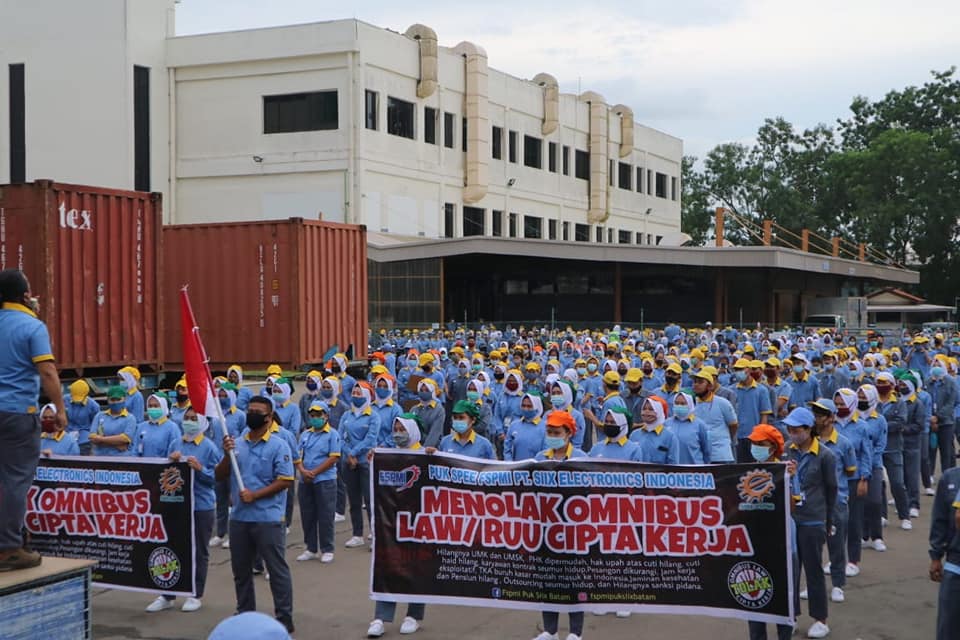
Workers chanted the slogan “Long live the workers” and walked out of factories. They held placards with the messages "Rest in Peace, Parliament", “Omnibus law kills the future of our grandchildren” and “Colonization has ended but colonization of workers begins”.


The national strike on 6-8 October was organized by the Indonesian Trade Union Confederation (KSPI), Confederation of All Indonesian Workers' Union (KSPSI AGN), KSPSI Yorrys, Indonesia United Workers Confederation (KPBI) and national welfare movement (GEKANAS). Seven affiliates of IndustriALL Global Union mobilized members to join the strike.

The president of KSPI and FSPMI, Said Iqbal, said:

“Two million workers affiliated with KSPI will join the national strike to reject the omnibus law. We reiterate that the law severely erodes workers’ rights. It will eliminate sectoral and municipal minimum wage, decrease severance pay and increase labour flexibility.

“The government must not change existing protection measures in the Manpower Act 2003, particularly provisions relating to layoffs, criminal sanctions against employers and employment of foreign workers.”

The president of All Indonesian Trade Union Confederation (KSBSI) Elly Rosita Silaban said:

“The actions taken by workers are the result of the government not understanding the situation of workers during the pandemic.  In addition, the new law degrades workers’ rights, eliminating most of what they receive today. These are crucial issues, especially regarding wages, employment contracts, outsourcing and severance pay. We oppose it and hope the president can withdraw this law. We have prepared a lawsuit for a judicial review to the constitutional court regarding articles that contradict the law.”

On the eve of the national strike, the Council of Global Unions issued a joint statement, calling the Indonesian president Joko Widodo to repeal the omnibus law and renegotiate with trade unions. It urged the government to ensure that any future legislation does not diminish rights and benefits guaranteed by the Manpower Act.

The general secretary of IndustriALL, Valter Sanches, said:

“Since the last global crisis, over 27 countries have pushed for some form of labour law reform, under the false goal of being more attractive to foreign investment with lower labour costs, but effectively, most of them only brought precarious work. We don't want that to happen in Indonesia.

“IndustriALL congratulates you on your initiative in carrying out the national strike. We are in solidarity with your action. I wish you all success.”

There are reports of arrests and police violence against trade unionists, which IndustriALL is investigating.

Fighting for decent work in South East Asia

In the Philippines, neoliberal policy with low corporate taxes and a business-friendly labour code has become the norm.

Louie Corral, vice president for national and international affairs of Associated Labor Union, says:

“The Trade Union Congress of Philippines estimates that 12 million workers are contractual workers without retirement and welfare benefits. That’s why unions have  formed the Nagkaisa Coalition to lobby for and sponsor Security of Tenure bill in the Congress and Senate.

“We are disappointed that President Duterte vetoed the bill, but are now working on a compromise position to close loopholes and determine the scope of contractual work through national tripartite industry councils.”

The new Malaysian government has been ambiguous on its commitment to labour law reforms started by the Pakatan Harapan (PH) government in 2018.

“The PH-led parliament passed the Industrial Relations Act 2020 which has yet to be implemented. We are caught in political uncertainty after the collapse of the PH government. However, our Labour Law Reform Coalition will continue to campaign for reforming the Trade Union Act and the Employment Act.”

Indonesian president Joko Widodo (Jokowi), a businessman prior to joining politics, has been exploring avenues to attract foreign investment and boost the economy. The Omnibus law on job creation has created much discontent in Indonesia and triggered national strikes on 6-8 October.

Iwan Kusmawan, president of IndustriALL Indonesia council, says:

“We mobilized a million members against the Omnibus law which accentuates the erosion of worker’ rights protected in the Manpower Act 2002. Various workers’ benefits have been cut, for example severance pay was reduced from maximum 32 times to 25 times.”

IndustriALL Global Union assistant general secretary Kemal Özkan says :

“Democratic institutions and workers’ rights are under attack due to rising authoritarianism. We stand together with our affiliates in fighting back against a deterioration of labour legislation.”

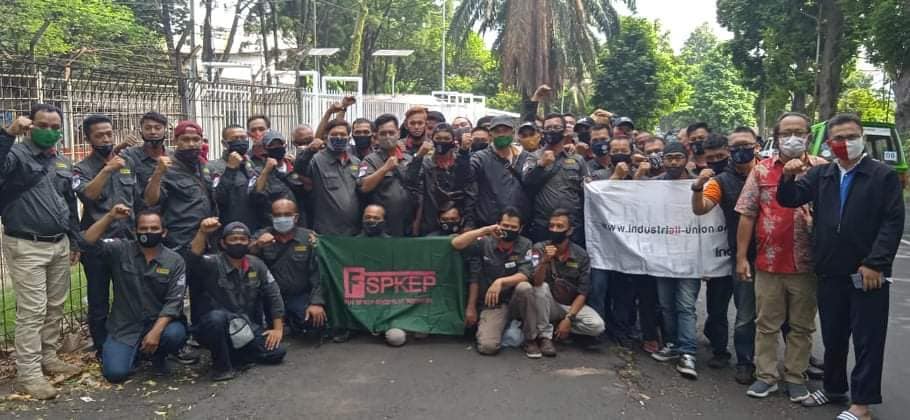
Photo: Participants showing solidarity with Indonesian workers during the national strike. 

Union federations unite in South African national strike

The national strike, on 7 October, which coincided with World Day for Decent Work, was called by the Congress of South African Trade Unions (COSATU) with support from the other main federations: the Federation of Unions of South Africa (FEDUSA), the South African Federation of Trade Unions (SAFTU), and the National Council of Trade Unions (NACTU).

IndustriALL Global Union’s five affiliates in South Africa belong to three of the federations. The combined membership of the federations represents millions of workers. The unions say the law should be used to deal with corruption through prosecution, and anti-corruption strategies should be put in place.

The unions wanted an end to gender-based violence and for the government to ratify Convention 190 on curbing violence and harassment at work, and to develop an implementation plan. The gender pay gap must also be closed.

On health and safety, unions want employers to comply with labour laws and not leave the burden on workers and their families.

Petitions presented by the unions called upon the government to act on preventing retrenchments of workers after over two million jobs were lost during the country’s Covid-19 lockdown which began in March. The retrenchments, which were high in sectors such as mining, added to the already high unemployment levels. According to Statistics South Africa, the expanded rate of unemployment is 42 per cent, which includes those who have given up looking for jobs.

The unions say there is an attack on collective bargaining and demand that sections of the labour laws must be amended to force employers to comply. Additionally, employers were not promoting social dialogue but are instead ignoring labour laws and existing agreements.

Joseph Montisetse, the president of the National Union of Mineworkers (NUM), said unions were shocked “by corruption involving the Unemployment Insurance Fund Temporary Employer/employee Relief Scheme which were meant to benefit retrenched workers and also those employers who were in financial problems because of Covid-19.” Some employers claimed Covid-19 relief funds but did not pay them out to workers and have since been arrested for fraud.

Irvin Jim, the general secretary of the National Union of Metalworkers of South Africa (NUMSA) said: “Employers did not waste the crisis imposed by Covid-19 and the lockdown, which they used to attack workers’ wages by unilaterally imposing wage cuts of between 20-25 per cent without consulting with the union.” But the unions are fighting back.

As part of the national strike, the Southern African Clothing and Textile Workers Union (SACTWU) picketed outside the offices of garment retailer Cape Union Mart in Johannesburg, demanding that the employer respect signed collective bargaining agreements and stop using threats and intimidation to force workers to sign new contracts that are inferior to existing ones.

André Kriel, SACTWU general secretary said: 

“The COSATU strike is significant because it is unifying. It confirms concretely that all South African workers, irrespective of union federation affiliation, are crystal clear about common core issues which they must fight in the current conjuncture: corruption in the public and private sector, job losses, attacks on collective bargaining and gender-based violence”.

IndustriALL general secretary Valter Sanches said:

“We are in solidarity with the millions of South African workers who are fighting for jobs, against gender-based violence, and for the protection of collective bargaining. These are issues at the core of union activities, and employers should not be allowed to destroy what the union has gained through years of struggle.”

Indian unions mobilize for national strike

On 22 and 23 September, while the opposition parties were boycotting the Parliament and protesting against an anti-farmers bill, the Modi government passed three labour codes without proper debate.

During a national convention on 2 October, trade union leaders from INTUC, AITUC, HMS, CITU, AIUTUC, TUCC, SEWA, AICCTU, LPF, UTUC and Independent Federations/Associations called for a nationwide strike, underlining the undemocratic means used to pass sweeping labour law changes, as well as the poor government response to the debilitating impacts of Covid-19 lockdown on people’s livelihood.

Dr. G. Sanjeeva Reddy, president of Indian National Trade Union Congress, says:

“The Covid-19 lockdown has resulted in misery as millions of workers have lost their livelihoods. The Modi government is one of the most anti-workers government India has ever had and its approach to workers’ welfare is worse than during colonial rule. Established democratic and constitutional norms and principles are not respected. We have to keep up a relentless struggle.”

Union leaders are concerned about the impact of the Covid-19 lockdown, as millions of workers have lost their livelihoods, and hundreds of thousands of workers have returned to India as they lost their jobs abroad. While some factories have resumed operations, it is far from the pre-pandemic situation.

The Modi government has failed to deliver credible relief measures and is refusing to hold genuine consultations.

As a response, union leaders are calling on workers to mobilize on 26 November with demands including monthly cash transfers for poor households, free food rations, withdrawal of anti-farmer laws and anti-labour codes, an end to privatization of the public sector and an end to the corporatization of public sector manufacturing facilities and service institutions like railways and ports.

Kemal Özkan, IndustriALL assistant general secretary, says:

“Indian trade unions are vehemently opposing labour law changes and the indiscriminate privatization of public sector undertakings. We appeal to the government of India to no longer ignore workers’ voices and to consult with unions to find solutions to the concerns. Together with other global unions, IndustriALL stands in solidarity with the Indian trade union movement.”

Young workers organizing drives in Ghana show strength of solidarity

IndustriALL Global Union Sub Saharan Africa region and Building and Wood Workers International (BWI) Africa and Middle East affiliates carried out joint organizing activities at workplaces in Ahafo, Kumasi, Obuasi, and Sunyani from 28 September to 2 October.

The affiliates are the Ghana Mine Workers Union (GMWU), General Transport, Petroleum and Chemical Workers Union (GTPCWU), Industrial and Commercial Workers Union (ICU), and Public Utilities Workers Union (PUWU) – together with the Timber Workers Union that is affiliated to BWI.

The joint organizing drives aim to increase union membership through sharing ideas, strategies, and experiences on how to build union power.

In August, the unions held workshops on developing capacity for social dialogue in the prevention and management of Covid-19 at the workplace, and on how to improve the participation of youth and women in union activities. Often women and the youth are marginalized. Yet they are the solution for rebuilding trade unions.

The joint organizing activities are supported by Industri Energi, a Norwegian trade union for workers in the industrial and energy sectors. Industri Energi has been supporting a lot more collaborative work between IndustriALL and BWI to build collective union power from sharing skills, knowledge, and ideas for improving the organizing and mobilization of workers.

The nine organizers, including six young workers, were drawn from participants who attended online training on organizing.

Agness Ayittey from GMWU, chairperson of the IndustriALL affiliates youth committee in Ghana, who is one of the organizers said: 

“The emerging issues from the organizing drives include union busting by some employers who are stopping workers from joining the union, not paying living wages, and ignoring health and safety standards.”

Paule France Ndessomin, IndustriALL regional secretary for Sub Saharan Africa said:

“Global unions are working together on Covid-19 responses because workers are adversely affected by the coronavirus irrespective of the sectors where they work. We hope that by working together, union solidarity will be strengthened in Ghana.”

Crecentia Mofokeng, BWI regional representative for Africa and Middle East said:

“We are satisfied that BWI and IndustriALL affiliates in Ghana are jointly engaging employers and government on social dialogue for better working conditions and wages in most industrial sectors. They have developed more joint actions on training and organizing because issues and challenges are the same across the sectors.”

A youth activist school planned for November will focus on trade unions and activism in the community and will establish a youth activists’ network for the unions in Ghana.

Union campaign brings improvements to Georgian labour law

The 2014 EU-Georgia Association Agreement introduced a preferential trade regime for Georgia and set a list of priorities to ensure respect for human rights and fundamental freedoms. These include bringing the Labour Code further in line with ILO standards and defining supervision functions of labour inspections and remove existing restrictions to inspectors’ responsibilities.

Georgia’s parliament has approved a number of amendments to the labour law, the major one is changes in the expansion of the labour inspection mandate.

Until now, labour inspections only checked violations of occupational safety and needed to give prior warning or a court order to have access.

That requirement is removed with the changes, and labour inspections will oversee all labour rights in Georgia, identify violations, warn and fine employers, or in some cases temporarily suspend workplaces over poorly implemented labour rights, and will come into effect on 1 January 2021.

Further approved amendments to the Labour Code include new provisions on anti-discrimination and gender equality, mandatory daily and weekly rest time, better protection for interns, part-time workers, pregnant women and new mothers.

Tamaz Dolaberidze, president of the Trade Union of Metallurgy, Mining and Chemical Industry Workers of Georgia, says:

“The amendments define the concept of a company transfer to a new owner and prohibit the restriction of workers' rights during such transfer; all employment contracts remain valid, and a collective agreement shall remain in force for at least one year.”

Despite many positive amendments that will improve labour rights in Georgia, some of the unions’ proposals were removed after corporate pressure, like the proposal to set an overtime rate at 125 per cent and the right for workers to hold strikes in solidarity with workers from other companies. The law still does not define the concept and amount of a minimum wage.

Amiran Zenaishvili, president of the Georgian Trade Union of Energy Workers, says:

“The amendments provide an opportunity for a minor under the age of 14 to work, but the number of working hours has not been set. There is a lack of clear grounds for termination of employment, as the labour code has a wording “on other objective circumstance.”

Kemal Özkan, IndustriALL assistant general secretary, says:

“IndustriALL welcome the positive amendments to the Georgian labour law and congratulate unions and workers on this achievement. It is important to ensure the changes are implemented, and that work continues on further improvements, including a minimum wage, to bring workers’ rights in Georgia further in line with core ILO standards.” 

Cerrejón mineworkers hold firm: show your support

Members of IndustriALL affiliate Sintracarbón are in the fifth week of a strike at the Cerrejón coal mine in Colombia.

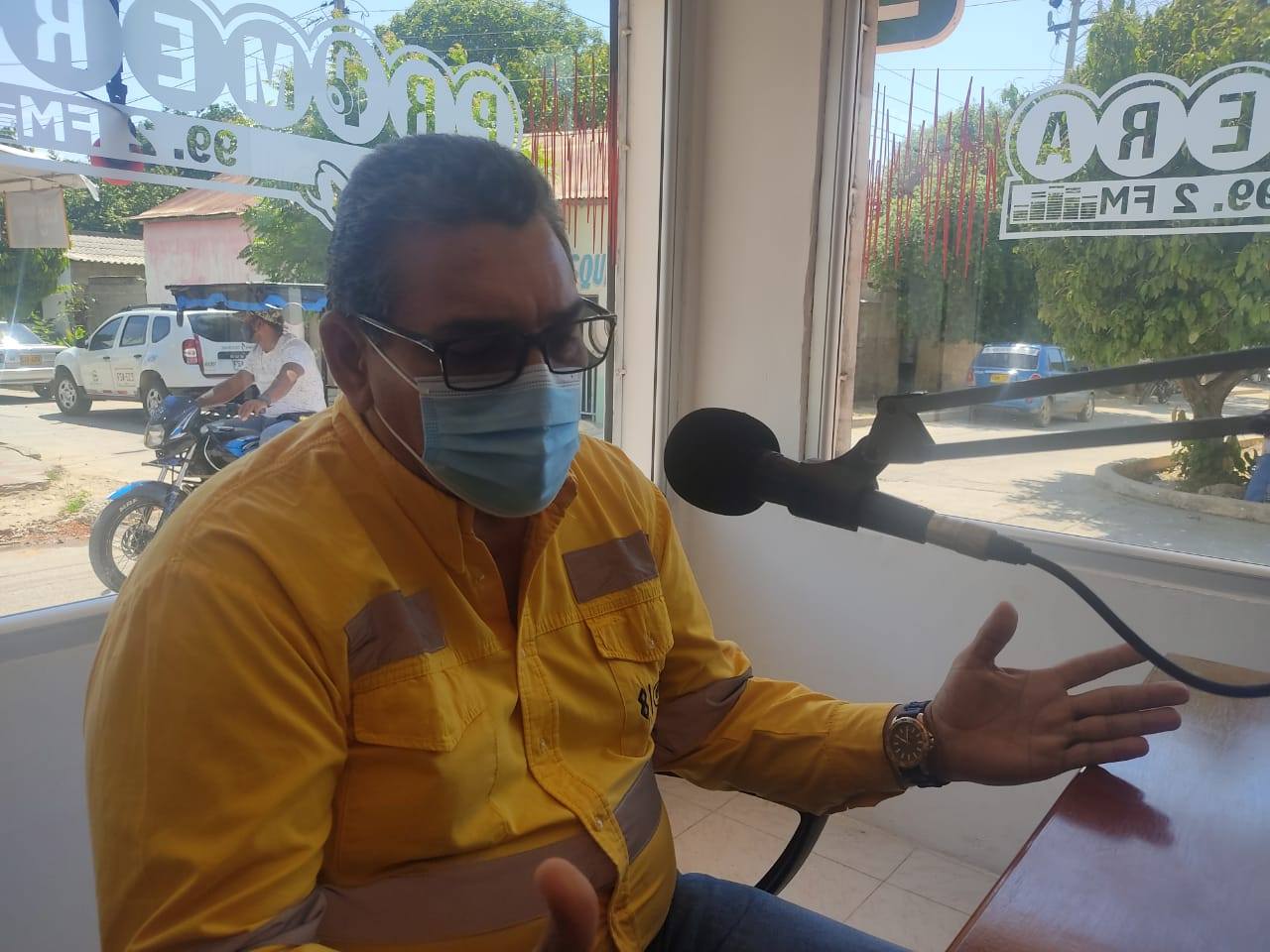
Union president Igor Diaz gives a strike update in a radio interview on Monday

When the Covid-19 restrictions began, collective bargaining negotiations were suspended. When they resumed this summer, Cerrejón unilaterally announced a radical change to the shift system, without consulting the union and in violation of Colombian law. The new shift roster, which workers call the 'death shift', will lead to the loss of 2,500 direct and indirect jobs, and require workers to work an additional 72 days a year for the same wage.

Sintracarbón members voted for strike action to resist this assault on their terms and conditions. The Colombian labour ministry offered facilitation to end the strike, but Cerrejón boycotted the process. The mine is jointly owned by three multinational mining companies, AngloAmerican, BHP and Glencore, who have refused to intervene. IndustriALL has written to the companies more than once to demand they take responsibility for the crisis.

IndustriALL has also written to Cerrejón’s customers – major energy companies in Europe and Turkey, including Vattenfall and Engie – asking them to conduct due diligence over Cerrejón’s violations of workers’ rights. In addition, IndustriALL is contacting institutional investors in the three mining multinationals, including pension funds, to make them aware of the situation.

Sintracarbón workers need your support. Please sign the LabourStart petition and tell the company to return to the negotiating table.

#UnionWin as garment workers are reinstated

In May, Glory Fashion dismissed three union leaders, accusing them of violating employment contracts. Union leaders said it was a case of unionbusting, as the dismissals occurred after workers at Glory Fashion had set up a local branch of Industrial Workers Federation of Myanmar (IWFM).

In the weeks after the local union was formed, factory management was harassing the families of the local union leaders. They visited their parents in remote areas of Myanmar, threatening them to make their children move back. Thugs were also used to intimidated the union leaders.

Immediately after the dismissals, IWFM referred the case to the Township Conciliation Body, which ruled that the three union leaders did not violate the employment contracts and instructed the company to reinstate the workers.

As Glory Fashion refused to accept the ruling, IWFM referred the complaint to the Arbitration Body, which made same ruling, which the employer stubbornly refused to comply with. Not giving up, the union referred the case to the Arbitration Council, where the employer won.

In an attempt to resolve the situation, Irish fashion retailer Primark, who sources from the factory, engaged in negotiations with Glory Fashion and IWFM. The three union leaders were reinstated on 1 October with full back pay and benefits.

IWFM president Khaing Zar says that Primark’s support was important in reaching an agreement with the employer.

Christina Hajagos-Clausen, IndustriALL textile director, says:

“This is yet another example of how the ACT dispute resolution mechanism, developed under the FoA guidelines, is proving to be effective in ensuring that workers’ fundamental rights are respected.”

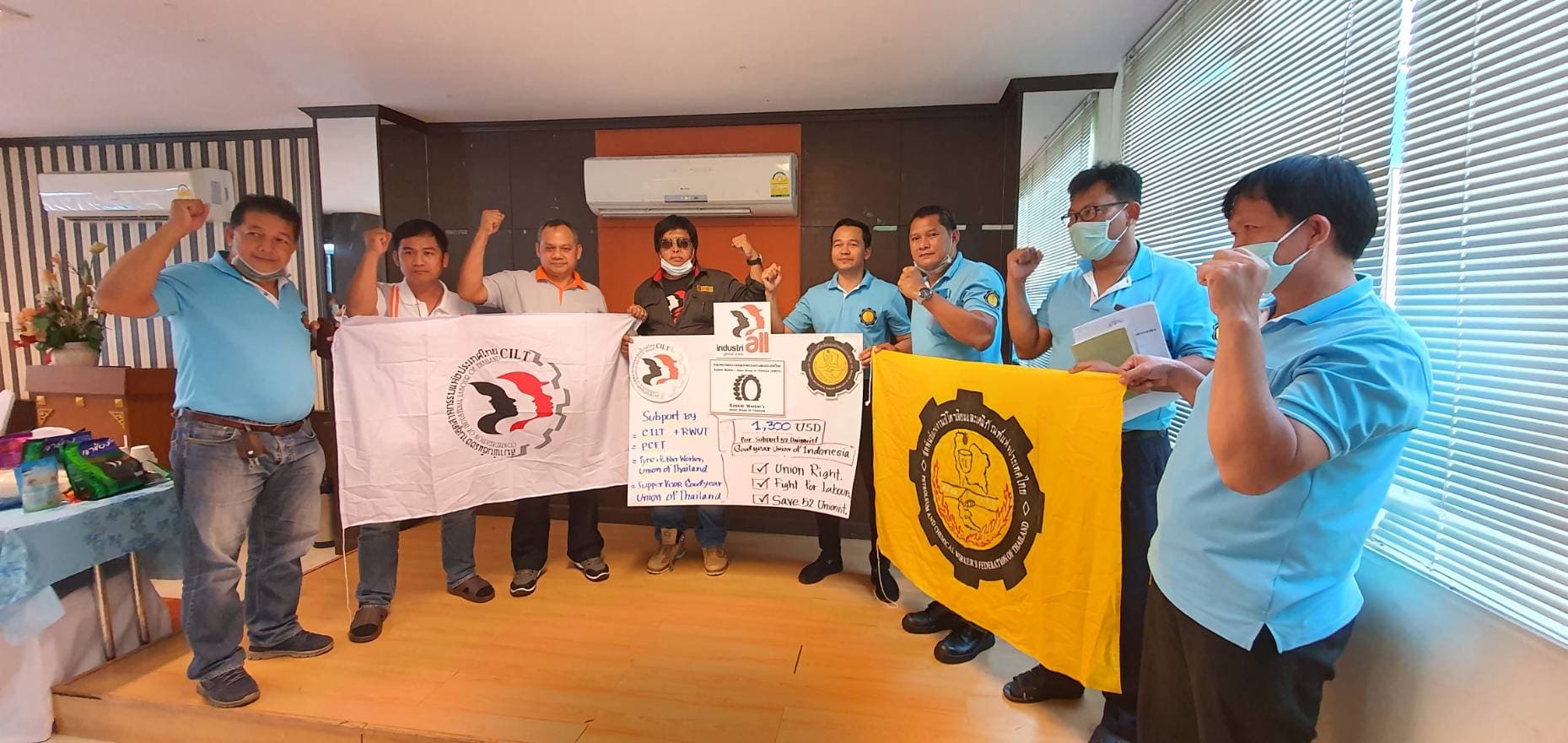
Thai rubber unions raise funds for fired Indonesian Goodyear workers

The Indonesian and Thai unions are part of the IndustriALL Asia-Pacific rubber trade union network, and have experience with regional solidarity. At a network meeting in August, the Thai workers heard that their Indonesian colleagues had been fired from the Goodyear plant in Bogor.

Thai unions raise money

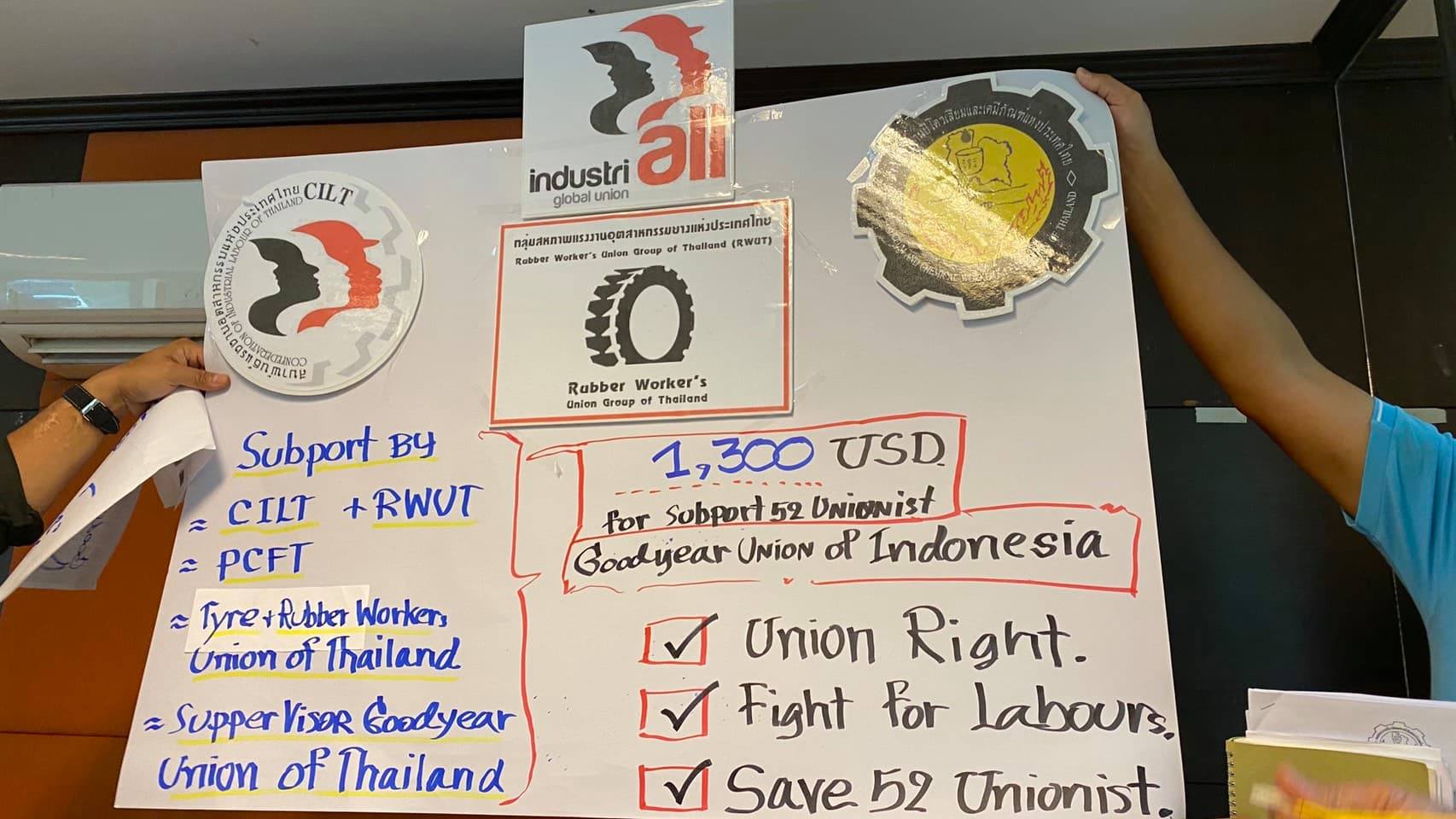
They quickly organized a fund-raising drive, raising US $1,300. The fund was donated to the Indonesian union, FSP-KEP, and will be used to cover the healthcare costs of the dismissed workers and their families. IndustriALL Global Union also contributed to the fund.

The Indonesian workers

The Goodyear union in Indonesia reports that official mediation was conducted over the case. The mediator recommended the reinstatement of the 44 workers. Goodyear management has refused to reinstate them. The case will now go to the Labour Court. As the company is no longer paying the 44 workers, they are not receiving health care from the BPJS social security system. Production continues at the factory as usual.

Thai Rubber Unions

Iwan Ibnu, the chair of the Goodyear union in Indonesia said:

“On behalf of Goodyear union, we would like to say thank you for the solidarity support from IndustriALL as we received the solidarity from Thailand rubber union as well. It really means a lot to us.

“The 44 dismissed workers are in difficult situation now since the company stop the health insurance coverage for them and their family members. So we will manage the fund support to maintain the health care for dismissed workers and their families.

“Thank you very much, we hope that IndustriALL will always support our struggle.”

Explaining how the Thai workers came to support their Indonesian colleagues, the president of the Rubber Workers’ Union Group of Thailand, Saman Pornprachathum, explained that after hearing about the situation in the meeting convened by IndustriALL, he raised the issue in a monthly meeting of the union federations CILT and PCFT.

Delegates agreed that it was important to show support, and five unions contributed funds.

“Although the amount of money we gave is not large, I believe that it will be enough for them to live comfortably”, he said.

“I encourage all of them. They won’t walk alone. I understand what they felt. I would like Goodyear, Indonesia, to discuss with the 44 laid-offs to look for a way to hire them back.”

IndustriALL director for the rubber sector Tom Grinter said:

“Goodyear’s behaviour has been appalling. It’s unacceptable to dismiss workers without reason, and to leave them without health care in the midst of a pandemic. But the solidarity support from the Thai rubber workers shows that the trade union movement is a global family. We stand with each other in hard times, just as we celebrate our victories together.”