Colombian organizations march in support of Sintracarbón

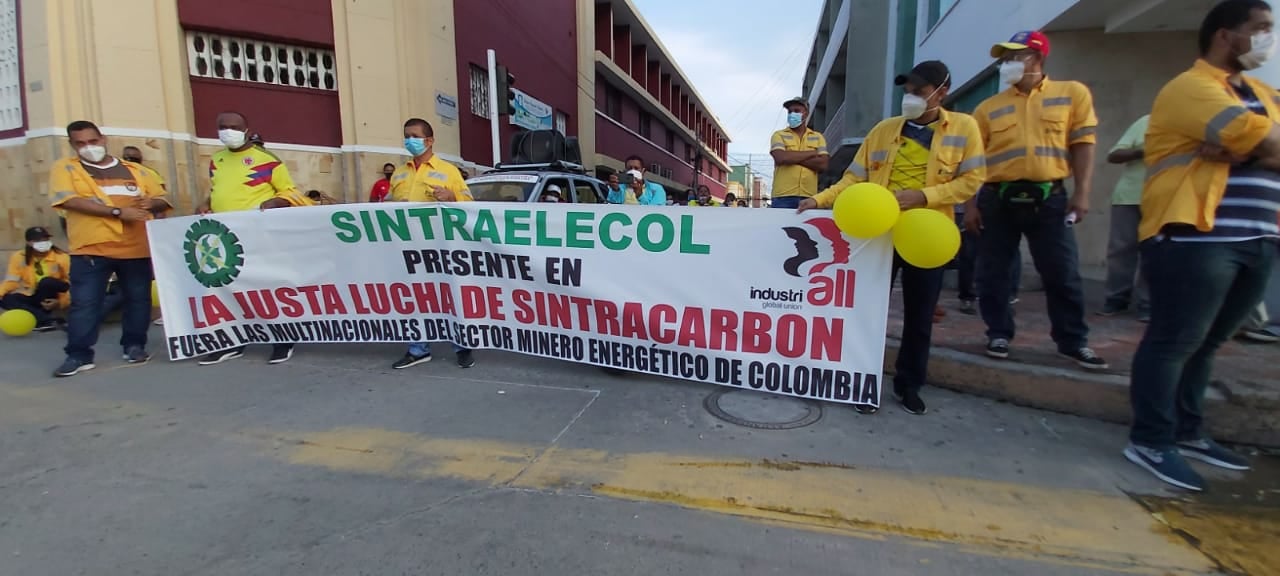
On 9 October, dozens of people marched peacefully through the streets of Riohacha, capital of the Guajira region, to show community support for the strike by IndustriALL affiliate Sintracarbón.

Workers in the Cerrejón mine went on strike when talks with the employer collapsed after the union rejected a shift change that would add 72 working days per year without any pay increase.

“The march was a way for the community and workers to let both Cerrejón and the governor of La Guajira, who remains silent in the face of the conflict, know that we are taking action and ready to negotiate.

We have always said that we want dialogue and that the strike is merely a tool. The union wants reach an agreement that is beneficial for La Guajira and the workers, and that allows the company to restart production,"

says Sintracarbón president, Igor Díaz.
 

A week ago, a roadmap proposed by the Ministry of Labour was launched. Both the union and the company have met individually with the labour authorities. The next step is announced to be a tripartite discussion, but Sintrcarbón says that details have yet to be communicated.

“So far, Cerrejón has refused to come to the negotiation table and we don’t know how the employer feels about a tripartite meeting. We hope there is a will to find an agreement, which both the country and especially Guajira, needs,”

says Igor Dias.

IndustriALL has contacted the three mining companies more than once to demand that they take responsibility for this crisis. IndustriALL has also informed Cerrejón's clients and institutional investors about the situation.

IndustriALL regional secretary Marino Vani said:

“We appeal to the company, who is earning money off the land, not to abuse its economic power and to do its part in finding an acceptable and dignified solution through dialogue. IndustriALL is standing in solidarity with the continued fight."

If you haven’t already, please sign and share the LabourStart campaign to show support for Sintracarbón.  
Kyrgyzstan must respect democracy and human and workers’ rights

During mass protests in Kyrgyzstan's capital Bishkek, triggered by allegations of a rigged parliamentary election on 4 October, the government building was seized by protesters and political prisoners were released.

The election results were subsequently annulled, the government was dismissed, and a new prime minister was elected. The President of the country announced his resignation on 15 October.

In addition to the political chaos, the economy has been deeply impacted by the unrest. The mining industry is important for the country’s economy and many mining fields were seized and some mining companies had to halt operations.

Following appeals from trade unions and employers, police forces are now guarding the facilities and operations are slowly resuming.

According to Eldar Tadjibaev, chairman of the Mining and Metallurgy Trade Union of Kyrgyzstan (MMTUK), more than 5,000 of the union’s members still cannot return to work due to damages in the workplaces.

Kyrgyz unions are rather optimistic and expect the political change in the country’s legislative and executive powers to have the potential to improve the situation for unions. Kyrgyz unions expect that with fair elections an anti-union draft law violating the core principles of ILO Conventions 87 and 98, ratified by Kyrgyzstan, will be abandoned.
 
Valter Sanches, IndustriALL general secretary, says:

“Kyrgyzstan needs to move towards a genuine and well-settled democracy and democratic institutions. Our struggle, together with our Kyrghyz affiliates, will continue to strengthen democracy and human rights, particularly the full respect and implementation of workers’ rights.

We urge the new government to make sure that law enforcement agencies stop interfering in union affairs and prosecuting trade union leaders.”

Unions not consulted on Chevron Nigeria plans to lay-off 1,000 workers

The unions say Chevron’s failure to consult is part of the company’s “anti-labour practices” that are aimed at laying off 600 permanent and 400 contract workers in violation of Nigerian labour laws. Consultation would allow unions to understand why such a drastic decision was made and also gives them the opportunity to suggest alternatives to the lay-offs.

Ofolabi Olawale, NUPENG general secretary and Lumumba Okugbawa, PENGASSAN general secretary wrote in a letter to the company on 2 October:

“It is so disconcerting to receive the news that management has commenced the process to sack about 600 regular employees of Chevron Nigeria Limited without any form of engagement or discussion with the leadership of NUPENG and PENGASSAN. Such action is nothing but violation of the existing labour laws concerning disengagement of employees and a clear affront on the union and association.”

Further, the unions say Chevron has been involved in unfair labour practices that include failure to carry over leave days from 2018 into the current contracts. The company also owes workers money after excessive deductions were made to terminal benefits in 2012.

The unions propose that there should be immediate consultations on the lay-offs, that negotiations for collective bargaining agreements should begin, and that NUPENG workers who have attained new qualifications should be promoted. Stagnation of workers for 5-11 years is unfair and should be reversed. Contract workers should also be allowed to ride on the company buses and workers working from home should be given data and ergonomic allowances.

Okugbawa said: “The bone of contention is on the modalities of the exit. While the management want redundancy; the unions want the process to be voluntary. We are also not convinced about the numbers being proposed by the Chevron management. They want 25 per cent of the workers to be laid off.”

Diana Junquera Curiel, IndustriALL director of the energy industry said:

“We call upon Chevron Nigeria to engage with the unions. To build better industrial relations oil companies must consult unions on lay-offs instead of making unilateral decisions. It is important for labour practices to be fair to the workers and this can only be reached through negotiations with the unions.”

Photo: Roo Reynolds

Cement workers locked out three hours after strike starts

Syndicat des travailleurs de Demix Béton (St-Hubert), affiliated to IndustriALL, represents workers at the collective bargaining negotiations. On 23 September, workers unanimously rejected the employer's final offer and went on a 24-hour strike.

A few hours after the strike began, on 24 September, the employer locked out the workers. That same evening, an unlimited general strike vote was unanimously passed.

The union wants to renew the collective agreement, and the main area of contention is over pay parity with other Demix workers in the region.

Currently, union members at Demix Concrete earn about 3 CAD(US$2.2) less an hour than fellow operators and drivers elsewhere in the region, even though they perform the same job for the same employer.

The union says that there is no argument that can justify this difference in salary. By acting this way, the employer is trying to break the union and set the table for other unions, who’s round of negotiations are coming up.

IndustriALL sent a message of solidarity and support to the striking cement workers. In the message Valter Sanches, IndustriALL Global Union general secretary, said:

“We were outraged to learn that the CRH/Demix management locked out the workers three hours after the officially announced strike, instead of addressing their fully justified demands. This is completely unacceptable.”

IndustriALL pledged to inform the entire union cement network in North America and European Works Council of cement workers struggle, and suggest to also express their support to the strikers.

Finnish paper makers break national bargaining

The existing national collective agreements expire at the end of 2021, giving the parties over a year to build a new negotiation model.

The three unions affected by this decision are all IndustriALL affiliates: the Finnish Paper Workers’ Union Paperiliitto, the Finnish Industrial Union Teollisuusliitto, and Trade Union Pro.

The three unions’ joint briefing paper today says:

“The trade unions deplore the reform, which is undermining the Finnish labor market system. This well-functioning system brings a lot of stability and predictability to the Finnish labor market. The current collective agreements have considerable scope for agreeing on company level, for example, on working hours. The national collective agreement guarantees the employer a fair competitive environment and industrial peace, as well as more equal treatment for employees.”

The national agreement assures minimum conditions for workers throughout the sector in Finland, including at the companies which are not members of the Forest Industries group. On top of financial conditions, the agreements bring paid parental leave, sick leave, holiday bonus, and more.

The national agreements cover about 28,000 blue-collar workers and white-collar employees, at 80 companies and more than 100 production plants.

The Finnish Forest Industries group comprises 72 well-known companies operating in forestry, pulp and paper.

IndustriALL pulp and paper director, Tom Grinter said:

“This decision by the employers’ group is based on greed. Greed for short term profits, at the detriment of stability and strong industrial relations. The Finnish unions have our full support.”

HeidelbergCement network commits to fight back new challenges

Covid-19 has impacted the industry, and although the situation differs from region to region, sales are down on a global level. There has been some recovery since June, when governments eased out of lockdown.

Due to the shrinking market and economic crisis, participants expressed their concerns over the lack of investments, difficulties to bargain in tight markets, and subsequent layoffs and redundancies.

The network also discussed the company policies and targets in terms of reducing of CO2 emissions and digitalization.

Representatives from HeidelbergCement attended the meeting and presented the company’s policy on health and safety with a special focus on preventing Covid-19 in the workplace.

The union network agreed on an action plan to:

“Workers are worried about their health and safety and their future. It is encouraging that HeidelbergCement wants to ensure full union recognition, protection of health and safety and benefits negotiated in collective bargaining agreements and by law. We need and hope for a greater social dialogue at the global level and see this is as a good step in the right direction.”

Kemal Özkan, IndustriALL assistant general secretary, said:

“In the light of the unstable economic situation and imminent danger of a second wave of Covid-19, we demand that HeidelbergCement takes full responsibility for their workers. We believe that full respect of workers’ rights and safe working conditions is a must that should be unconditionally provided, both in the company and along its supply chain. There is only one way to address the issue, through the establishment of a global social dialogue.”

The meeting was organized with the support of German Friedrich Ebert Foundation.

Kumho Tire broke the law to attack union

The NLRB upheld a ruling that Kumho Tire illegally threatened and coerced workers to discourage them from joining the USW during a 2017 unionization drive. The Board ordered the company to call a plant-wide meeting and read a detailed statement that acknowledges the company’s unlawful conduct and pledges future compliance with workers’ rights.

The ruling is the latest development in a longstanding union busting campaign by the Korean multinational at its Georgia plant. In 2017, the company fired a union leader and intimidated workers, leading to the USW narrowly losing a unionization vote.

The company employed seven full time union busters and spent hundreds of thousands of dollars attacking the union. In 2019, a judge ruled that a new vote must be held due to the company’s illegal conduct. The workers subsequently voted to be represented by the union, with the NLRB upholding the vote of 141-137 in favor of the USW, but the company has filed objections that continue to delay the certification of the election results. 

IndustriALL’s rubber sector affiliates took solidarity action on several occasions in support of the USW organizing drive.

Kumho Tire management should now recognize the USW as its employees’ bargaining agent, and start collective bargaining. However, the company is instead pursuing other legal avenues to oppose the will of the workers.

IndustriALL director for the rubber sector, Tom Grinter, said:

“Kumho Tire wasted a fortune hiring union busters and fighting legal battles. They could have invested that money in their business, but instead they chose to spend it attacking their loyal workforce. They failed. Even in the current anti-union environment in the US, their violations have been so egregious that the courts and NLRB have found in favour of the union every time.

“It is time for the company to learn from this disastrous episode, and take the necessary steps to build a good working relationship with the union.”

BASF unions maintain unity against Covid-19 challenges

Several international BASF trade union meetings were conducted digitally in recent weeks. Unions in Asia-Pacific came together, with IndustriALL, German union IG BCE, and the coordinator of the Latin American network of BASF unions. This group includes BASF unions from India, Indonesia, Malaysia, Korea, Australia, Singapore and Vietnam, and has grown in recent years through a project by IndustriALL and German social rights organization FES.

A powerful network of BASF unions in Asia Pacific completes a global picture of coordination and mutual support between all unionized BASF employees. Now the unions seek to continue growing their structure, and are now ready to start regional dialogue with management in a coordinated way.

 IndustriALL affiliated BASF unions of India

The Latin American BASF trade union network is a long-established structure that has maintained official social dialogue with the company for 20 years.

The coronavirus pushed the 2020 meetings online also in Latin America, with both union networks and dialogue sessions being held at regional and national levels. The union and company response to coronavirus were addressed, as well as the issue of job cuts in Argentina and Peru, gender issues, environmental impact, and responding to increasing digitalization in production.

Michael Wolters represented the largest BASF union, IG BCE in recent meetings:

“Cementing the communication channels in and between the regions strengthens unions throughout the BASF operations. The BASF network in Latin America stands as a model to be replicated at other companies. Now it is clear that the Asian colleagues are functioning to a high standard also.”

Thiago Rios, coordinator of the IndustriALL Latin American BASF Union Network said:

“We must face our challenges together, combining our strength in the different regions into a global network of BASF workers. We cannot accept so much difference in conditions of BASF workers from one place to another.”

IndustriALL chemicals director Tom Grinter said:

“This networking effort is beneficial to all BASF workers. The rank and file members are the owners of our organization, and we must continue to make a difference for them, especially at this time of crisis. We expect BASF to recognize the Asia Pacific union network as a dialogue partner.”

Photo caption: IndustriALL participated at the BASF regional dialogue and celebration of 20 years of regional BASF union networking and dialogue with the company in November 2019, in Sao Paulo.

Mizuno

Mizuno mainly produces sport related goods such as sport clothing, golf clubs, and athletic shoes among others.

Agreement renewed: 1 October 2020

Other signatories: UA Zensen, Mizuno Workers’ Union, Japan

Nuclear workers join forces

In his opening statement, Valeriy Matov, vice co-chair of IndustriALL’s energy section in charge of nuclear and president of Ukrainian union Atomprofspilka, said:

“Energy can only be produced in real time and we have continued to work and produce power during the pandemic. Social distancing is not always possible in the workplace, and as unions we have to make sure health and safety is implemented.”

As Covid-19 is picking up speed again in many parts of the world, participants exchanged good practices in the workplace, as well as specific action taken by unions. Unions in Ukraine have purchased individual medical protective equipment, Japanese unions have cooperated with members of parliament within the organization and raised opinion on the situation at the national council,and unions in France have made sure to stay in touch with members.

“Despite an uncertainty in nuclear energy policies in many countries, the sector remains stable,”

says Diana Junquera Curiel.

“But we need to continue to meet, albeit virtually, to learn from each other and exchange experiences."

The meeting addressed the global supply chain of the nuclear industry. IndustriALL’s mining director Glen Mpufane and mechanical engineering director Matthias Hartwich participated and introduced the role of their respective sectors and how they interact in the value chain.

In the near future, the network will invite unions from uranium mining and mechanical engineering sectors to join, in order to try to get the same conditions along the supply chain as nuclear workers have.

Brian Kohler, IndustriALL health and safety director, talked about the impact of Covid-19 in the workplace and the importance of workers’ rights in health and safety; “health and safety has to be done with us, the workers, and not to us.”

In his closing remarks, IndustriALL assistant general secretary Kemal Özkan stressed the need to make the system fair for workers:

“Health and safety is crucial for union work and solutions don’t come automatically. We have to fight together. IndustriALL will continue to provide a platform for workers to exchange experiences, as well as to be part of intergovernmental organizations.”

IndustriALL has published several guides to support workers and unions: Advice for workers and employers, as well as a guide on the safe return to work as lockdowns eased.