PROFILE: Struggle for democracy in Belarus

PROFILE

From Global Worker No. 2 November 2020

Text: Alex Ivanou

Country: Belarus

Union: Belarusian Independent Trade Union (BITU), Free Metal Workers’ Union (SPM), Belarusian Radio and Electronic Industry Workers' Union (REP), Belarusian Trade Union of Chemical, Mining and Oil Industries Workers (BELKHIMPROFSOYUZ)

Belarus has a reputation for systemic violating of freedom of association and fundamental workers’ rights, including the introduction of compulsory fixed-term contracts aiming to intimidate workers, the denial of basic freedoms and the suppression of independent and free civil society institutions and trade unions.

For 26 years Lukashenko’s regime ruled Belarus more or less uncontested. Despite the absence of economic and political reforms and modernization, the support from neighbouring Russia through preferential oil and gas tariffs simplified access to the Russian market, allowing the regime to remain in power. 

Workers and unions never stopped fighting for their rights, even in a shrinking space for protests. The first time riot police was used in independent Belarus was at the subway drivers’ strike in 1995. To curtail workers’ resistance, Lukashenko limited the possibility of receiving foreign financial solidarity aid and introduced fixed-term, typically one-year, contracts in 1999.

In the face of massive repression against workers’ rights, in 2000, democratic unions, including IndustriALL affiliates, submitted a complaint to the International Labour Organization (ILO) over continuous workers’ rights violations in Belarus. Since then, Belarus has constantly been subject to a scrutiny process by the ILO.

Despite a limited membership due to constant oppression from authorities and company management, independent unions have become popular among workers as they show their desire for democratic and have had a leading role in the demonstrations. 

In a recent attempt to stop protests, Lukashenko announced of a compulsory creation of local trade unions affiliated to his pocket union federation at all private companies, threatening to close the companies if they refuse. In the same time he also promised to remove collective agreement benefits from workers who are not part of the official unions in the companies where these unions are already present.

The struggle continues

However, independent unions in Belarus continue their organizing efforts. Despite the difficulties of the pandemic and a lack of human and financial resources, they recruit more and more members. New local unions are formed, raising their voices and demands.

Some workers directly reach out to the existing democratic unions while others use the online platform called Trade Union Online (ПРОФСОЮЗ ОНЛАЙН), designed by the Belarusian Congress of Democratic Trade Unions (BKDP) where IndustriALL’s three affiliates  SPM, BITU and REP are members. 

After years of political and economic repressions, new union members lack the basic knowledge about independent unions free from the government’s and employers’ influence. Independent trade unions have responsibility to mobilize, organize and educate their members, and they need international solidarity and support.

But this is not an easy mission since the entire machine of repression is directed against workers and their activists; many are fired, put in jail or harassed. 

Repression continues

In August, the former president of the Belarusian Independent Trade Union (BITU) Mikalaj Zimin, was jailed together with other activists. Zimin was sentenced to 25 days of detention after having attended peaceful protests in the city of Soligorsk. His colleague Maxim Sereda was sentenced to twelve days of jail, while Jan Roman, a journalist and activist of the Free Metal Workers’ Union (SPM) was brutally beaten, detained at the police station and fined, simply for enquiring about the fate of his colleagues.

Strike committee members and BITU leaders and activists Sergei Cherkasov, Pavel Puchenya, Yuri Korzun and Anatoly Bokun, have been arbitrarily detained several times. They faced renewed punishments while in prison and were finally released after 55 days in police custody following the international solidarity campaign.

Lizaveta Merliak, BITU’s international secretary, was arrested in front of her house over a protest action in the city of Grodno. Thanks to national and international pressure, she was released from the custody, but fined for participation in illegal mass gatherings.

The most recent cases were the arrests of acting president of the Belarusian Radio and Electronic Industry Workers' Union (REP) Zinaida Mikhnyuk, regional REP activist Alexander Zakharuk and youth network coordinator Daria Polyakova. They were detained during a peaceful protest action in Brest on 25 October. 

At the end of October, 26 SPM members at Minsk electrotechnical plant, including the local union chair V. Chichmarev, his deputies M. Marynich and D. Krivonos and other elected members of the local union council, were dismissed without explanation, violating national law. 

International solidarity

IndustriALL Global Union, together with industriAll European Trade Union, has expressed its outrage, anger and protest at the disproportionate violence, persecution and arrests directed at the peaceful protests against the results of the presidential elections on 9 August. Together, they have asked Josep Borrell, High Representative for Foreign Affairs and Security Policy of the European Commission, to call on countries in the European Union to use all possible means to stop the intimidation of independent trade union leaders. 

On several occasions, IndustriALL has written to Belarussian authorities, urging them to stop the intimidation, pressure, violation and imprisonment of independent union leaders and striking workers, as well as to multinational companies with business relationship in Belarus asking them to conduct due diligence on violations of human and labour rights.

The global union movement stands united in its support for democracy in Belarus. Belarusians have showed an incredible ability to organize, and in the face of repression, workers continue to fight for democracy. International solidarity for the Belarusian unions’ fight for their country must continue. 
Nationwide demonstrations against regressive labour law in Korea

IndustriALL affiliate Korean Metal Workers’ Union (KMWU) joined sister unions in the Korean Confederation of Trade Unions (KCTU) in demonstrations and marches across the nation, including 26 rallies in the capital Seoul and 13 in the regions.

In Seoul, only 99 union members participated in each street march according to guidelines, while other union members kept sufficient distance following on the sidewalk. But on the assumption that “union members might try to join the street march,” police blocked the movement of workers on public sidewalks and closed in on pockets of unionists with police shields up so unionists could not socially distance.

Police also violated quarantine measures by concentrating large clusters of uniformed and plainclothes policemen who pushed up against marchers.

Pink signs: Resist retrogressive labor law revision! Green signs: Trade union rights for all workers!

Member of IndustriALL Executive Committee member and KMWU president. KIM, Ho Gyu, is urging members to stand up for the rights for all workers in Korea:

“It is no exaggeration to say the history of the democratic workers’ movement in Korea is the fight over labor law reform, begun 50 years ago when CHUN, Tae-il set himself on fire holding a copy of the labor law. The government’s revision of the trade union law as barter for ratifying ILO core conventions is undermining trade unions and leaving intact only the trade union signboard.

“We failed to stop the "CHU, Mi-ae” labor law revisions a decade ago and we are wearing the shackles of restrictions and the multiple union bargaining channel machinery today. But we still have our spirit of struggle and resistance. We must stand together and we must gather our forces and rise up to this.”

South Korea's repeated violations of fundamental trade union rights has made it a first litmus test on the effectiveness of “trade and sustainable development chapters” in EU Free Trade Agreements.

The EU dispute settlement with Korea over workers’ rights began in 2018 and entered the Panel of Experts stage in 2019, with unions cooperating with human rights organizations to submit an Amicus curia to the panel. But with Korea's National Assembly Environment and Labor subcommittee bill markup scheduled for 30 November 2020 and repeated delay of the panel's report, it appears any report delivered would happen after the conclusion of subcommittee negotiations on revision content.

In addition to violations of the principles of freedom of association, the revisions fail to address existing recommendations by the tripartite ILO Committee on Freedom of Association. including promoting collective bargaining for precarious workers, sufficiently dissuasive sanctions on employer unfair labor practices, and revising Penal Code 314 (Obstruction of Business) to bring it in conformity with Freedom of Association principles.

While calling on the government to withdraw the 30 June 2020 labor law revisions, the National Workers’ Rallies also commemorated the spirit of CHUN, Tae-il, who died on 14 November 1970 after setting himself on fire and running through the factory district shouting, “We are not machines!” and “Don’t let me have died in vain!”, after futile attempts to access rights for workers.

At one of the dispersed rallies in Seoul, a statue of CHUN, Tae-il holding a book labeled the “Three CHUN, Tae-il Laws”

Trade unions proposed the “Three CHUN, Tae-il Laws” and gathered over 100,000 signatures in September to put the bill before parliament by petition. Among other things, it proposes to broaden the definitions of "worker” to give precarious workers access to trade union rights and to close loop-hole “exceptions” and enable application of minimum standards and protection at small companies with four employees, or less.

The Environmental and Labor Committee of the National Assembly plenary session decided on 12 November to refer the 3 CHUN, Tae-il Laws bill to subcommittee where it awaits deliberation.

Unions also gathered over 100,000 signatures to place a bill to hold accountable companies that neglect to redress conditions leading to industrial disaster and collective deaths caused by their products and production processes. Despite the popularity of the bill, the ruling party has decided to submit a competing proposal.

Valter Sanches, IndustriALL general secretary, says:

“IndustriALL stands in solidarity with its Korean affiliates in their struggle against the regressive draft law. We urge the South Korean National Assembly to immediately drop the proposed revisions. Instead, Korea must ratify ILO’s Fundamental Conventions as per its earlier commitment.

“In line with the Executive Committee resolution from May 2019, IndustriALL Global Union will continue to support its Korean affiliates.”

Action needed on Uyghur slave labour

The Uyghur region of China, which has had a Turkic Muslim majority for centuries, produces 20 per cent of the world’s cotton. China has renamed the region Xinjiang – which means “New Frontier” – and is suppressing the local population and encouraging migration from other regions.

The Chinese government has taken dramatic measures to restrict Uyghur birthrates, and is attempting to eradicate the language and traditions of this group. More than a million people per year have been detained in forced labour camps.

IndustriALL Global Union has endorsed the global Call to Action to end Uyghur forced labour. The Call demands that leading brands and retailers ensure that they are not supporting or benefiting from forced labour in the Uyghur region.

IndustriALL is maintaining pressure on major multinational companies, particularly those which have signed global framework agreements (GFAs). When companies sign GFAs, they commit to ensuring decent standards across their supply chains, with monitoring systems put in place to ensure compliance.

Some multinationals – including H&M, who have a GFA with IndustriALL – have cut ties with all suppliers in the region. Others, including Volkswagen, have refused, as a highly critical BBC article points out.

IndustriALL previously suspended its GFA with Volkswagen, after the company violated the terms of the agreement by allowing union busting to take place at its plant in Chattanooga, USA.

Research conducted by IndustriALL and the monitoring committees has confirmed that none of the brands who have signed GFAs with IndustriALL maintain links to production in the Xinjiang region. However, global supply chains have become so long and complex that it is very difficult to conduct a completely reliable audit.

Global fashion brands order ready-made garments from factories in Bangladesh, Pakistan, Cambodia, Myanmar and many other countries in the region. These factories order cloth from textile mills, who order cotton from bulk suppliers. The cotton suppliers in turn buy and aggregate cotton from many different sources. Because global legal frameworks governing supply chains are still weak, it is possible for fraud in the supply chain to go undetected, and for suppliers to hide the origins of cotton.

IndustriALL general secretary Valter Sanches said:

“It is horrifying that in the 21st century, global capital is still benefiting from slave labour in different business areas, including cotton fields. Because of the urgency of the situation, in the short term it is vital that all global companies heed the Call to Action, map their supply chains, and break any relationships they have with the Xinjiang region of China – whether there is evidence of forced labour or not.

“But this is only a short-term solution. In the longer term, we need coherent international law on supply chains, such as the UN binding treaty on business and human rights, which is currently being negotiated.

“We also need compliance systems that bring all actors in the production and distribution process together to negotiate a better way to do business. This includes global brands, global unions, national governments, national employer associations and local unions.”

BHP workers tell investors about their reality

The objective was to give voice to the concerns of workers at BHP operations in South America and to allow investors to engage in direct conversation with the workers. Major investors from the UK, France, Sweden and the Netherlands, as well as a number of key responsible investment service providers, participated.

Igor Díaz, president of IndustriALL affiliate SINTRACARBON, spoke about the situation at the Cerrejón coal mine in Colombia, jointly owned by BHP, AngloAmerican and Glencore, where workers have been on strike since late August.

Cerrejón has unilaterally – and illegally – imposed a schedule change that workers call the “shift of death”. It will lead to 12-hour workdays, increased working time, the elimination of benefits, the sacking of over 1,000 workers and serious impacts on workers’ health and family life. Far from driving productivity, the move threatens the well-being of miners and their communities.

Marcelo Franco, president of the workers’ union at BHP’s Cerro Colorado mine in Chile and head of the Coordinating Committee bringing together six BHP unions, discussed conditions at the company’s three owned assets in that country. Marcelo spoke of the mishandling of Covid-19 by BHP, with workers in many cases left to fend for themselves, isolated in squalid accommodations with insufficient food and medical attention or simply sent back to their families to be cared for.

The company took advantage of the government’s discrimination against workers with pre-existing conditions, leading to mass firings of these workers and their inability to find work elsewhere.

Marcelo Franco also underlined the company’s weakness in handling gender mainstreaming, including pushing male miners out to make room for female counterparts, and the lack of necessary adjustments made for women workers, such as adapted PPE for mining and appropriate health and safety conditions to protect women in the workplace.

Conditions for women workers at Cerrejón mine are also poor, with no childcare or breastfeeding facilities.

IndustriALL mining director Glen Mpufane said:

“BHP – along with AngloAmerican and Glencore – continues to claim that it cannot control what happens at Cerrejón, as it is only a part-owner. But they cannot reap the profits without taking any of the responsibility: as companies that have endorsed the UN Guiding Principles on Business and Human Rights, they know that claims of “minority ownership” are no longer acceptable excuses for avoiding accountability. And while the other two MNCs have at least agreed to a dialogue with IndustriALL, BHP will not do even that.”

The round table touched on corporate governance and human rights-related risks to which BHP is exposing itself: namely, the disjuncture between its handling of Covid-19 in the global North versus the global South, and its extensive use of contract workers.

These workers have been particularly vulnerable during the pandemic, as they often cannot access sick leave or medical insurance, nor are they likely to speak up about health and safety at worksites due to the fear of losing their jobs.

The Australian Fair Work Commission recently threw out an appeal by BHP regarding its outsourcing model, Operations Services, and agreed with the CFMEU and several other IndustriALL affiliate unions that genuine agreement with the workforce had not been demonstrated and that the agreements may not pass the “better off overall test” compared with the industry award, as it is based on lower pay for the same work by contracted workers.

While the Australian unions had recourse because of a strong regulatory framework and judiciary, unions in the global South generally do not have access to remedy in the face of human rights abuses by foreign multinational corporations.

The main “ask” of investors at the round table was that they engage BHP on the concerns raised.

As Kemal Özkan, IndustriALL assistant general secretary said:

“The company must face the risks to which it is exposing its workforce, and address poor labour, environmental and governance practices at the South American assets that it either owns or co-owns. BHP has repeatedly refused to enter into direct dialogue with IndustriALL, thus closing off a major route to resolving problems locally.

“The question arises as to why the company is so willfully avoiding sitting down with workers and their representatives.”

Photo 1: Igor Díaz, president SINTRACARBON, Colombia, on the virtual round table.

Photo 2: Marcelo Franco, president of the workers’ union at BHP’s Cerro Colorado mine in Chile and head of the Coordinating Committee bringing together six BHP unions.

Tunisia experiments with a gradual transition to more sustainable jobs and businesses

Walking between the machines at the Sobref textile factory, Mohamed Ali takes a pair of scissors, cuts a piece of fabric and dips it into a cup of water. Poof! The magic of chemistry works immediately and the piece of cloth is transformed into a translucent, sticky paste. As it dries, it hardens and turns into plastic.

“It’s viseline,”

explains Ali, proud of his demonstration. Made using synthetic fibres, it is used to reinforce embroidery.

“In the past, we polluted the environment with our discarded production waste. From now on, we’re going to recover the scraps to recycle and reuse them.”

Until 2016, dozens of workers at the factory, located in Mahdia, central-eastern Tunisia, worked night and day on the large precision machines that now sit motionless and desperately silent. While waiting for activities to resume, Ali has been sleeping here, upstairs on a simple sofa, to make sure there aren’t burglaries. He keeps a watchful eye and a loving gaze on the company that now belongs to him and 40 or so other former employees who decided to buy their factory.

The idea of becoming their own bosses was suggested by the Tunisian General Labour Union (UGTT). The trade union centre has been supervising the project for several months with the help of Spanish NGO l’Asamblea de Cooperación por la Paz, which also provided financial support in addition to the €250,000 contributed by the Valencian Autonomous Community (Spain).

A total of €300,000 has been devoted to the project. UGTT has also provided legal support to the workers, who were able to obtain compensation from the previous owner who had decided, illegally, to close the business overnight. They chose to invest the money in taking over their working tools by creating a cooperative in which they are all majority partners.

“So that we will never again experience injustice,”

says Afifa Najjar – injustice linked, amongst other things, to pollution and environmental damage.

The embroidery sector, and the textile sector in general, has a significant environmental impact that directly affects workers. As a 48-year-old mother who has worked half her life at the Sobref factory explains:

“We suffer the direct consequences. The unbearable smells…they used to burn the waste not far from our houses.”

Scraps of viseline were disposed of haphazardly. This will no longer be the case when the factory reopens at the end of the year, explains Karim Chebbi, a consultant for UGTT

An environmentally responsible company

Chebbi is very familiar with these environmental issues, which is why he was chosen to coordinate the Sobref project.

“There are important ecological as well as economic stakes involved for the cooperative. Part of the waste can be resold in a collaborative network in solidarity with other recycling factories to generate a small income,”

he says. The future industrial site will also be able to generate 30 per cent of its own electricity thanks to solar panels.

“We want to make it possible for the company to be partially energy-independent and reduce its dependence on fossil fuels.”

On 11 September 2020, the tables at UGTT’s local branch headquarters have been arranged in a ‘U’ shape for a very special meeting. The workers of the Sobref factory are gathering for the first time since their meetings were interrupted by the coronavirus. Chebbi has invited a university professor, the director of Tunisia’s first master’s degree in management, treatment and reuse of waste, to speak on the occasion.

Professor Lotfi Soussia of the Institut Supérieur des Sciences Appliquées et de Technologie (ISSAT) of Mahdia was responsible for providing 20 hours of training, theory and practice.

“Respect for nature is above all a culture! It’s our children’s future,”

says the professor to his very studious audience” .

"The phrases ‘ecological transition’, ‘green economy’ and ‘greenhouse gasses’ are not mentioned. While the factory’s staff may not be familiar with all of these concepts, it is of little importance: everyone knows that they are “doing something positive.”

All of them support the environmentally responsible aspect of the project, including Hedi Ben Hamza, 50, who spent the last 22 years with the company:

“It’s new but now every company has to become a friend of the environment. It wasn’t possible before. Why? Because there was only one owner and he thought of nothing but making profits. With this transformation into a cooperative, we will be able to think about ourselves and nature first.”

The factory workers may not be familiar with the principles of just transition but they are applying them all the same. And while UGTT may not focus on the idea of decarbonising the economy while mitigating effects on employment and resources for workers in vulnerable industries, they have gotten there through an intermediate concept: for the union, the priority remains the improvement of working conditions.

“While it may not be central, UGTT has always had an approach to the question of the environment,”

says Chebbi.

“Because it’s part of ‘decent work.’ Decent working conditions are how we get to ecology.”

New ideas

Some members of UGTT, however, are working to advance thinking on environmental issues. One of them, Mansour Cherni, has been a pioneer in this regard. He is the national coordinator of the affiliates of Public Services International (PSI) in Tunisia, as well as the number two of the climate section of UGTT’s department of Arab and international relations and migration. He has been involved with the subject since the early 2000s,

“especially since 2007, thanks to the former secretary general of the UGTT, who was interested in climate change,”

he explains.

“Houcine Abassi, the Nobel Peace Prize winner, he was the one who pushed me and encouraged me. And we started to tackle the problem of the environment,”

says Cherni.

“We formed a small group of people who are interested in the issue.” It’s been a year now since the climate change section was created. “It’s to raise awareness amongst the decision makers at UGTT, to say ‘pay attention, this is serious.’ It’s made up of five people but we don’t have the necessary means to really exert influence,”

says Cherni.

Since 2014, Cherni has attended the climate COP every year at his own expense. And almost every year, he has been the only UGTT-affiliated trade unionist to participate.

“It’s to better understand. There’s a very high level of discourse at the COP, but in reality it has no effect. But when you look at civil society, that’s where the work is being done, that’s where the discussions are, where the pressure is. I saw it when the climate agreement was signed in Paris. It was civil society, it was the unions essentially that took action.”

He is aware of the role that workers’ organisations have to play and he knows that the UGTT is lagging behind. Naïma Hammami was the first woman to join the centre’s executive board in 2017 and is also a pioneer in ecological transition within her union.

As deputy general secretary and head of Arab and international relations and migration, she helped to set up the climate change section in her department.

“We are motivated to make progress on this issue, which has a significant impact on workers,” but “UGTT is just starting out in this area”.

Cherni looks forward to the day when the centre truly tackles this issue.

“It’s my hope, but they’ve been timid so far,”

says the soon-to-be septuagenarian.

“It’s still not given importance.” As he explains, the union remains fixated on daily struggles instead of coming up with a strategy to “save jobs threatened by climate change.”

He explains:

“It’s much more important in the long term. My children are the ones who will pay for it very dearly.”

While reversing priorities is difficult in a country that continues to spiral into an interminable social and economic crisis, Cherni would at least like to increase his union’s understanding of the concepts that he has come to understand so well. With the support of PSI, which helped him to secure funding, he was able to help organise four seminars. About 120 people attended these modules, one of which dealt with greenhouse gases produced by fossil-fuel power plants.

Green energy

The energy sector will be one of the most affected by the transition to a low-carbon society. While green energy is still struggling to get off its feet in Tunisia, authorities have an ambitious objective: increasing the share of renewable energy from 4 per cent where it stands today to 30 per cent by 2030. But delays continue to pile up, even as numerous projects have been announced in recent months. Tunisian authorities are highlighting job creation and the advantages it represents for the country’s energy independence.

But UGTT remains sceptical. The trade union centre considers energy to be a public good and as such defends tooth and nail the quasi-monopoly of STEG (Société Tunisienne de l’Électricité et du Gaz), which dominates the production, transport, distribution and sale of energy in Tunisia. The General Federation of Electricity and Gas, the union’s STEG branch, regularly denounces attempts to privatise the sector and what it calls the “commodification of electricity.”

This summer, UGTT butted heads with the government, refusing to connect the Tataouine solar power plant to the network, a project resulting from a partnership between the state-owned Entreprise Tunisienne d’Activités Pétrolières and Italian oil and gas giant Eni.

In a Facebook post published in July, then Energy Minister Mongi Marzouk decried the union, referring to their actions as “sabotage”: “Instead of standing on the side of clean energy, the Electricity Federation… is working to undermine initial achievements in this area in violation of the law. Their understanding of the interest of the energy sector and the role of renewable energies is narrow and incorrect,” he said.

Abdelkader Jelassi, secretary general of the General Federation of Electricity and Gas, who could not be reached for interview for personal reasons, gave his reaction through Cherni:

“We are not against renewable energy,”

he says,

“but against people who for 60 years have continuously fed off of the state. They take without giving anything in return. If the private sector wants to use the grid, it has to pay.”

Depending on your perspective, UGTT is either an obstacle to the development of the renewable sector in Tunisia, or the last bulwark protecting public sector workers and consumers. Opening up to the private sector could have very harmful consequences, leading to job destruction and tariff increases. Once again, UGTT is applying the principles of just transition, whether they know it or not. It is difficult to predict how the Tataouine power station project will be managed in the future.

Since the legislative elections of October 2019, Tunisia has already had three governments and as many environment ministers. Each time, UGTT has to start from scratch and explain each project again.

“It can cause us to lose several months,”

laments Cherni, who believes that just transition can play a role in political stability. As he explains, by initiating a virtuous circle, creating jobs and new prosperity, it can represent an opportunity for Tunisia.

And UGTT will end up playing an essential role in this process. The union wields significant influence in Tunisia’s political life. It played a decisive role in the first years of Tunisia’s democratic transition and was awarded, along with three other Tunisian organisations, the Nobel Peace Prize in 2015. Just transition in Tunisia will not happen without UGTT. This 21st century idea will need to be realised by this 20th century union. At the Sobref factory, the union has already begun to act. It must now give serious thought to an environmental strategy in order to replicate Mahdia’s innovative experiment.
 

Photo: Former machine operator Mohamed Ali, 37, next to a machine used to make embroidery at the Sobref factory. (Matthias Raynal)

This story, originally published on Equal Times, was supported by the Friedrich-Ebert-Stiftung as part of a series of articles on trade unions and the just transition.

Malaysian union victorious after seven year battle over unfair dismissals

The 18 workers from Hicom Automotive Manufacturers and Isuzu Hicom Malaysia were dismissed by the company in 2013 for supporting an opposition party candidate in an election activity while wearing company uniform.

During the general election, the workers supported an initiative of the Malaysian Trades Union Congress (MTUC) that aimed to submit workers’ demands to all political party candidates.

The car manufacturer accused the workers of tarnishing the image of the company and violating disciplinary rules. But the workers stressed that it was their right to support the MTUC’s worker-related demands, and rebutted the accusation by claiming that the company had allowed the Prime Minister from the ruling party to meet workers in uniform at the plant during election campaign period.

In 2018, the industrial court ruled that the punishment by the company was disproportionate, and awarded a total of MYR 1.1 million (US $267,000) in back pay to the 18 workers. The high court sustained the decision but deducted 30 per cent of the back pay in 2019. Eventually the federal court dismissed the company’s appeal on 4 November 2020.

The general secretary of NUTEAIW, N. Gopal Kishnam says :

“Although we are not fully satisfied that the 18 workers were not reinstated, the award shows Hicom has committed unfair dismissal and deprived workers’ political rights. Workers, like other citizens, have freedom to take part in political activity to improve the well-being of workers, it cannot be taken away just because they incidentally wear the company uniforms.”

IndustriALL Global Union regional secretary for South East Asia, Annie Adviento says :

“We call on Hicom to respect the freedom of expression of NUTEAIW members. The principle of the Declaration of Philadelphia that ‘freedom of expression and association are essential to sustained progress’ must be upheld.”

Oil and gas unions must fight for a Just Recovery

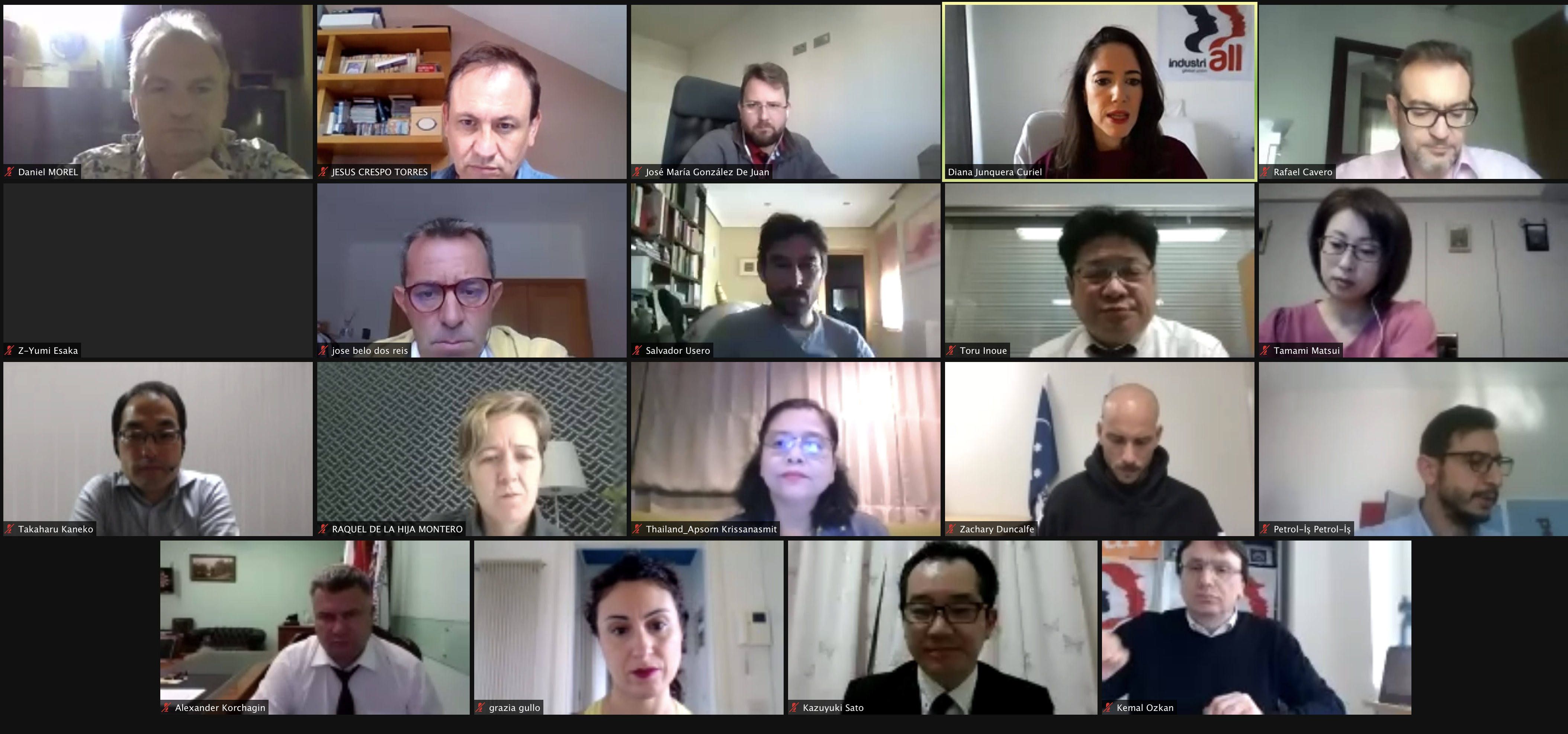
This was the message delivered by IndustriALL Global Union energy director, Diana Junquera Curiel, to a network meeting of oil and gas sector trade union activists, held online on 12 November.

Junquera explained that there has been a collapse in demand for petrol, jet fuel and other refined petroleum products due to the global economic slowdown caused by the pandemic. The collapse in demand for oil had led to a price crash. Most oil companies are maintaining extraction, because oil rigs are a sunk cost that are comparative cheap to operate. However, they are significantly reducing their refining capacity. Many companies plan to close refineries, and tens of thousands of refinery workers are likely to lose their jobs.

The effect of the low oil price is different in producer and importer countries. Producer countries have seen a major reduction in income and often a currency crash. This has had a devastating impact on the economies of those countries, particularly those with large public sectors funded by fossil fuel income.

By contrast, importing countries such as China and India have taken advantage of the lower price of crude and increased their storage capacity.

Junquera presented research commissioned by IndustriALL into trends in the industry. The research showed that despite the public relations offensive launched by energy companies about their embrace of renewables, there was very little real investment. The company which had invested the most – Total – had invested less than 4.5 per cent of its capital expenditure on renewables. Other companies have invested far less.

Oil and gas companies are spreading their bets by investing comparatively small amounts in a number of different renewable, storage and energy management technologies. Companies are cutting their losses to free up capital for future investment. They are waiting for market signals and government decisions before making major investments.

Junquera warned that trade unions would likely go through a difficult period due to refinery job losses, and that the lack of investment in renewables means that Just Transition will not happen on its own. Unions must be aware of developing trends, stay united and start to negotiate Just Transition plans now.

The meeting heard reports from oil and gas trade unionists around the world, including Algeria, Australia, Belgium, Italy, Japan, Norway, Russia, Spain, Thailand, Turkey and the US. The delegates confirmed the trends which has been identified, and spoke about how it was affecting the industry in their countries. Many had played active roles in defending the jobs and health of oil and gas workers as the pandemic spread around the world.

Placing the meeting in a wider political context, IndustriALL assistant general secretary Kemal Özkan urged unions to be vigilant about how recovery funds are spent.

“The current system has failed,” he said.

“It has only created inequality. How will the money in stimulus packages be spent? Will it be spent on making things worse, or on building a fairer world?”

Image: Lindsey G on Flickr CC

Mongolian union fights sexual harassment at work

According to Breaking the silence for equality: 2017 National Study on Gender-based Violence in Mongolia commissioned by United Nations Population Fund (UNFPA), 57.9 per cent of surveyed Mongolian women experienced either physical, sexual, emotional and economic violence. 31.2 per cent experienced physical and/or sexual violence.

The Mongolian government has taken active measures to eliminate gender discrimination. A law on Promotion of Gender Equality was enacted in 2011, which allows trade unions to lodge complaints on gender discrimination at the workplace, including sexual harassment, with the National Human Rights Commission.

In 2015, the government introduced a Law on Sexual Harassment,. However, it was scrapped after two years after a parliamentarian argued that sexual violence was already prohibited, and a standalone sexual harassment law could be misused and unfair for men.

Speaking to 40 women participants at the Federation of Energy, Geology and Mining Workers’ Trade Unions of Mongolia (MEGM) women conference in Ulaanbaatar on 5-6 November, MEGM president Buyanjargal Khuyag said:

“30 percent of our members are women, working side by side with men 12 hours a day, in difficult and harmful conditions. After 28 days of work at the mine site and 14 days off, there is risk of child abuse and divorce. It is important to revise the labour law to protect women and their rights.”

Secretary for energy and women committee leader of MEGM, Dolgor Duinaakhuu, said:

“Many victims are reluctant to come forward because confidential information on sexual violence is often revealed in court proceedings. The government must establish easy and comfortable procedures to handle sexual harassment complaints, so women won’t feel intimidated.

“The tendency to blame women persists in all spheres of society, gender stereotypes require women to tolerate domestic violence and blindly obey their husbands.”

IndustriALL South East Asia regional secretary Annie Adviento says:

“I congratulate MEGM for organizing the successful women conference highlighting issues on gender equality including Convention 190. It is crucial for unionists to campaign for the elimination of violence and harassment at work, especially after the violent incidence at Thermal Power Plant 2 SSH Co. in October.”

Uganda unions engage social partners on African industrialization strategies

On 10 November six IndustriALL affiliates in Uganda organized a conference that was attended by 80 participants, including key social partners, to discuss strategies for the economic development of the country and how this links to the industrialization of the continent through the integration of regional economic communities.

The unions agreed that the country’s third National Development Plan (2020-2025) is an important policy document for Uganda’s industrialization, and that unions must ensure its implementation. The plan promotes value addition in the mining, oil and gas and other sectors as well as employment creation. The unions emphasized that industrialization must bring decent jobs and that workers’ rights must be respected. The meeting also called on the country to ratify International Labour Organization Convention 190 on eliminating violence and harassment in the world of work.

Further, living wages and ending precarious work should be considered in the implementation. While investments in industrial development should also bring new skills to the workers. The government should also build more export processing zones for the textile, garment, leather, and shoe sector which can create more jobs for Ugandans along the value chain. Small to medium scale industries should also be supported.

At the meeting were Members of Parliament representing workers, government officials, business organizations, and trade union leaders. The trade union federations present were National Organization of Trade Unions (NOTU) and Central Organization of Free Trade Unions (COFTU). Civil society organizations, employer organizations, and experts also attended the conference.

The five Members of Parliament for workers promised to take the industrialization debate to parliament. Uganda’s constitution allows for the election of MPs to represent workers.

Speaking at the conference, Hajji Twaha Sempebwa, chairperson  of the IndustriALL Coordinating Council for Uganda said:

“Industrialization is key to the development of Sub Saharan African countries including Uganda as it creates opportunities for decent jobs. However, we should ensure that workers’ rights and decent work are part of the agenda. Our governments have taken great strides to ensure success, but there is still a lot to be done to overcome the challenges in implementation especially under the COVID-19 Pandemic.”

Kemal Özkan, IndustriALL assistant general secretary said:

“We applaud the Ugandan IndustriALL affiliates for bringing the social partners together to discuss the industrialization of Africa. Sustainable industrial policymaking should be inclusive and be done through social dialogue. Further, industrialization is important as it creates decent manufacturing jobs that will reduce the high levels of unemployment and end poverty.” 

IndustriALL affiliates in Uganda are the Uganda Textiles, Garment, Leather and Allied Workers’ Union (UTGLAWU), Uganda Hotels, Food, Tourism, Supermarkets & Allied Workers’ Union (HTS-Union), Uganda Chemical, Petroleum, and Allied Workers’ Union (UCPAWU), National Union of Clerical, Commercial, Professional and Technical Employees, (NUCCPTE), and Uganda Mines, Metal, Oil, Gas & Allied Workers’ Union (UMMOGAWU) and Uganda Printers, Paper, Polyfibre and Allied Workers’ Union (UPPPAWU).

Tchibo and IndustriALL commit to support suppliers

The impact of the global Covid-19 pandemic on workers, businesses, trade unions and governments has underlined the need for social dialogue in preventing, averting and mitigating negative effects on the industry and its employees.

IndustriALL and Tchibo have signed a joint declaration, publicly reaffirming and strengthening their commitment to work together to support the garment industry in recovering from the crisis created by the global pandemic.

Among the joint commitments are:

Through the joint statement, IndustriALL and Tchibo express their commitment to contribute to the economic recovery of garment industry and the security of workers in Tchibo’s and the global garment supply chains, according to their respective roles.

IndustriALL general secretary Valter Sanches says:

“The brands in the garment industry must assume their responsibility to protect the workers along their supply chains. This joint declaration is a welcome step in the right direction to prepare the sector for the future. We call on other international and national stakeholders to commit to this goal thereby contributing to the global economic and social recovery.

"A commitment with stable orders, payments and financial conditions towards suppliers will help us fight to guarantee  jobs and income along Tchibo’s supply chain.”

Tchibo is one of the leading retailers for consumer goods in Germany, Switzerland and Austria. IndustriALL and Tchibo signed a global framework agreement in 2016. It is the second major global garment brand to commit with IndustriALL on suppliers’ resilience after Inditex, who signed a joint statement with IndustriALL in early August.

Photo 1: Tchibo supplier

Photo 2: Tchibo shop

Photo 3: Tchibo CEO Linemayr signing the document