Sintracarbón signs agreement with Cerrejón to end historic strike

Colombian coal workers' union Sintracarbón, which is an affiliate of IndustriALL Global Union, and Cerrejón, a mining company owned by the multinationals Glencore, BHP and Anglo American, signed a collective employment agreement on the evening of 30 November, bringing an end to a dispute that had lasted 91 days.

Igor Díaz, president of Sintracarbón, said:

“We've put up a good fight against the three multinationals, who were dead set on implementing a business strategy that went against their workers' interests. Luckily, they didn't succeed, and our collective agreement remains intact.

I'd like to thank IndustriALL, its affiliates FNV, SASK, USW, IG BCE and CUT and all the other organizations that have shown solidarity and provided financial support. This wasn't a fight by Sintracarbón alone but by the whole union movement – it was a real show of international unity.”

Sintracarbón says that the new agreement meets its key demand, which was that workers get to keep the same benefits as before. The main features of the three-year agreement are as follows:

Both the company and the union had previously taken steps to try and resolve the dispute. To start with, talks were held between the two parties over a 60-day period. Several meetings then took place with the Committee for the Concertation of Wage and Labour Policies (CCPSL) and the ombudsman's office acting as mediators.

Lastly, to avoid bringing the dispute before an arbitral tribunal at the employment ministry, the two sides opted to continue their negotiations. After six days, they agreed on the new collective employment agreement.

They also agreed to hold talks over a 30-day period to address another sticking point: the shift change proposed by the company, which would result in what the union refers to as a "shift of death". Sintracarbón has said that even though the strike has ended, it will fight to ensure that the new shift system is not implemented, as it would impact workers' health and wipe out 1,250 jobs.

IndustriALL assistant secretary general Kemal Özkan said:

“With their 90-day strike, Sintracarbón and its members have put up a historic and exemplary fight. They fought for their dignity, their rights and their future, and they achieved justice. They should be applauded for their heroic battle.

“Led by Sintracarbón, we came together as a global union movement to support our colleagues on strike at Cerrejón. The strike showed that international solidarity is of utmost importance, especially when so many of our affiliates are going through tough times – the Covid-19 pandemic has hit the mining sector particularly hard. Thank you to everyone who supported Sintracarbón during this time.”
Union office building in the Lesotho highlands shows the power of global solidarity

This is a dream come true for the union which has been tirelessly organizing mineworkers but facing difficulties in accessing the very remote diamond mine sites. At a strategic organizing meeting of the IndustriALL Diamond Global Network two years ago in Johannesburg, South Africa, IDUL explained how difficult it is to reach and organize the mineworkers because the mines are located at high altitude in the mountains.

The unions that were present at the network meeting listened to IDUL’s plight and a plan was made to build an office closer to the mines. An organizing team led by Glen Mpufane, the IndustriALL director for mining, diamond, gems, ornaments, jewellery and precious stones, South African unions, and IDUL organizers, visited the site during a recruitment drive at Storm Mountain Diamond mine in 2019. The construction, which was supported by IndustriALL and Belgian union ACV-CSC Transcom, then started.

Mpufane said:

“During the mission we concluded that it is strategic for the union to build the offices as this would reduce the need to commute from union offices in Maseru – about 190km away – to organize meetings with the workers. We also identified the visibility of the union in the mining area as a critical factor in unionizing the mineworkers.”

Now the union can organize and better coordinate its activities among the diamond mineworkers from the recently completed offices at Kao Village, Butha Buthe District.

The office is located next to Storm Mountain Diamond mine and a few kilometres from Letseng and Liqhobong mines. In recent months, the Lesotho mines have dug large stones worth millions of dollars. Letseng mine is considered the highest dollar per carat Kimberlite diamond operation in the world.

With resident organizers, the office will enable the union to recruit and organize more workers as well as provide better services to its members. The office will also be a place for workers to meet and get information about the union, about labour laws especially on workers’ rights and collective bargaining, operational health and safety, HIV and AIDS information as well as materials on the Covid-19 pandemic.

Yves Toutenel, general secretary of ACV–CSC Transcom said:

“It is of course essential that in order to help members you need the necessary resources to be at your disposal. We are therefore very pleased that in collaboration with IndustriALL Global Union we have been able to support IDUL through a financial injection so that the union can grow and expand into the future.”

 Valter Sanches, IndustriALL Global Union general secretary said: 

“Even the Covid-19 pandemic has not stopped IDUL’s efforts to organize Lesotho’s mineworkers and has not deterred global workers’ solidarity which remains resilient as seen through initiatives to strengthen trade union power through organizing. We commend the ACV-CSC Transcom for providing support to IDUL so that the union can build power through organizing and shop steward capacity development programmes for the diamond mineworkers.

“We commend also IndustriALL affiliates in South Africa – the National Union of Mineworkers, the National Union of Metalworkers of South Africa and UASA the union – that are training shop stewards from IDUL through political schools and training programmes. This is an exemplary case how union strength on the ground and global solidarity can help workers improve their working conditions.”

Union win in Tunisia

The 56 workers, including the elected leadership of the company union and members of the advisory committee, were dismissed in February. As attempts to resolve the conflict were unsuccessful, workers led by IndustriALL affiliate FGTHCC-UGTT organized a strike in May, protesting against the violation of the right to organize and the dismissals.

As the employer still refused to engage with the union, IndustriALL Global Union intervened; sending protest letters to the company management, publishing, contacting fellow global unions for solidarity, as well as providing the necessary expertise on site.

In May, members of German union Ver.di, affiliated to Uni Global Union, protested in solidarity with the Tunisian workers.

“The support from IndustriALL gave us a moral and practical push. After a long period of silence, we first met virtually and negotiations then continued in person. We demand the company to fix the issues that caused the dispute and to engage with us in a regular dialogue,”

says Habib Hazami, FGTHCC-UGTT general secretary.

IndustriALL general secretary Valter Sanches says:

“We congratulate the union on resolving the conflict with the employer. When we come together, we win. We urge Gartex to establish for a genuine dialogue with the union for a sustainable future of the company and its workers.”

As per agreement, the remaining dismissed workers have been referred to the legal system and will be provided legal support by FGTHCC-UGTT.

Gartex employs around 1,000 workers and is owned by German garment manufacturer Gardeur, which in its turn is owned by the Dutch Duijndam Group.

Korean metalworkers' warning strike

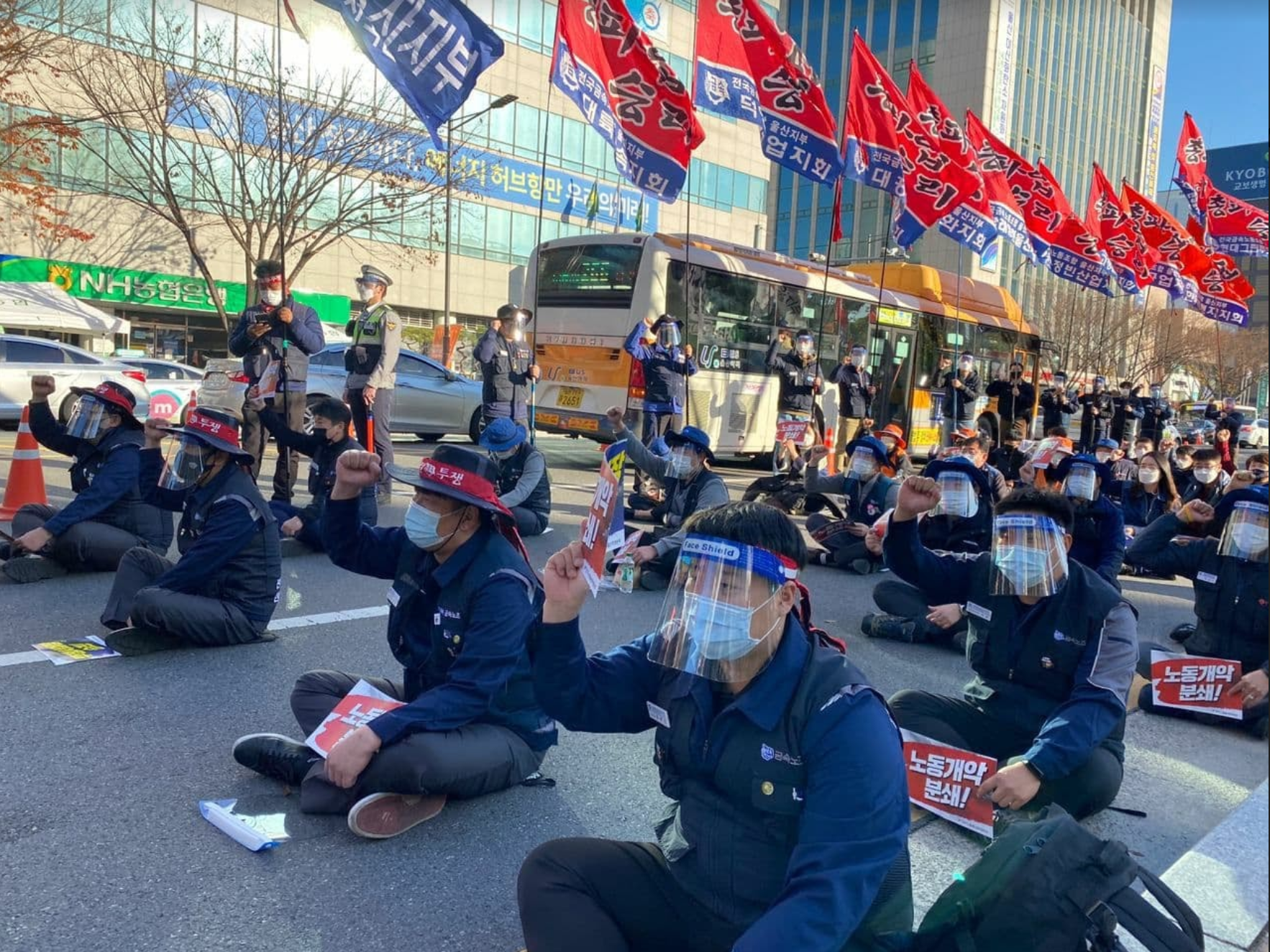
Korean Metal Workers' Union (KMWU) members in automotive, electronics, shipbuilding, steel and machinery heeded the KCTU general strike call, sending a message to the government: no to the partial revisions of the Trade union and labour Relations adjustment act (TULRAA).

KMWU president KIM Ho Gyu says:

"The playing field is already tilted against workers. But if these union-busting revisions of TULRAA are passed, trade unions will be ousted from the playing field altogether. Members must stand up and fight to keep a democratic union."

Proposed amendments include criminalizing partial occupation of non-production facilities during a dispute, where peaceful picketing or walking through the workplace could be punishable with three years in prison; creating more grounds for employers to bar union representatives from workplaces they represent if deemed to impair the “employer’s efficient business operations” or for any “rational reason,” employers can block union activities of non-employees such as union safety officers.


“We are witnessing a wave of labour law amendments in many countries, which are always lowering workers’ rights. Unions are  fighting back and IndustriALL stands in solidarity with the Korean workers and call on the government to engage in dialogue with the unions to ensure that the workers are not bearing the brunt of the so-called reforms and moreover, their demands are taken into the revision of the law,”

says IndustriALL general secretary Valter Sanches.

Unions demand ratification of ILO Fundamental Conventions, arguing TULRAA can be upgraded with ILO technical assistance after ratification.
 
Unions are calling for legislation of the “three CHUN, Tae-il Laws,” which would:

Union fights Caterpillar plan to cut 700 Northern Ireland jobs

US-based multinational construction equipment manufacturer Caterpillar has announced that it will cut 700 jobs from its facility at Larne, a port city close to Belfast in Northern Ireland. The job losses will be a severe blow to the region’s manufacturing capacity and to the wider local economy, as Caterpillar has a large supply chain in the area.

The workers who stand to lose their jobs remained at their posts throughout the Covid lockdown. They were were exempted from the lockdown as they were essential workers, producing equipment, including electrical generators, of vital importance to the health and social care sector in its fight to save lives and cope with the pandemic.

Northern Ireland is part of the United Kingdom, and is administered locally through the Northern Ireland Executive at Stormont. There have been multiple job losses in the region’s manufacturing sector, as well as a high profile campaign that saved the historic Harland and Wolff shipyard despite a lack of concrete support from Stormont or the UK government at Westminster.

Unite believes that losing jobs and productive capacity at Caterpillar will further undermine the region’s industrial base, and argues that Stormont must develop a strategy for the manufacturing strategy in conjunction with unions and business representatives.

Caterpillar has around 3,000 employees at four sites in Northern Ireland. The cuts in Larne are largely due to the company offshoring production to cheaper, non-EU locations, in a move Unite denounced as “corporate greed with no moral or ethical justification from a company which last year reported gross profits exceeding $17 billion.”

IndustriALL general secretary Valter Sanches wrote to the CEO of Caterpillar, saying:

“IndustriALL Global Union urges Caterpillar to reconsider its plan to offshore the production from Northern Ireland, UK and to engage in a meaningful dialogue with the Unite the Union to develop a common strategy to retain the productive capacity and avoid any job losses at the Larne facility.”

A global network of unions at Caterpillar was formed in 2011, lead by US affiliate the United Autoworkers. The network covers most countries where Caterpillar operates and participants are in constant contact. Caterpillar has already gone through harsh restructuring schemes over the past few years, cutting thousands of jobs around the world, including several European countries, the USA and Australia. The network met in October, before the Northern Ireland cuts were announced, and wrote to the company seeking global dialogue. The network immediately took up the Northern Ireland case, informing all participating trade unions about these new redundancies.

IndustriALL mechanical engineering director, Matthias Hartwich, said:

“Caterpillar has become one of the worst and greediest multinationals, with no respect for their workers, no decency and instead job cuts combined with high profits and dividends. This is shameful and unacceptable.”

Spanish unions announce strike at Repsol

The joint union committee announced strike action from December 9 to 12 and from December 21 to January 9, 2021, after the company refused to negotiate. The decision to close commercial offices with more than 100 customer-facing and administrative jobs was announced in September. In addition to the closures, the company announced a reduction of the workforce that will lead to an increased work load, and decrease the possibility of teleworking.

Unions regret the lack of dialogue from the company, which is taking advantage of the Covid-19 pandemic, and the empty rhetoric about Just Transition. The measures were introduced without the involvement of the union, without dialogue and transparency, and without referencing the transition that is taking place in the company to adapt to changing business needs.

Like many companies in the sector, Repsol wants to divest itself of assets to free capital for potential future investments. The LPG (Liquefied Petroleum Gas) division, Repsol Butano, is in good financial health, reporting a profit of more than 80 million euros at the end of September 2020, despite the Covid-19 crisis and the economic shutdown. Other business areas of Repsol have been less successful, partly due to the dramatic fall in the oil price. A previous restructuring in 2015 saw the collective dismissal of 226 workers in Repsol Butano.

Repsol has a reputation for corporate social responsibility and model industrial relations, reaching pioneering agreements with unions on issues such as harassment and prevention of violence, work-life balance, time banking, digital disconnection and teleworking.

But unions feel that this image hides a breakdown in dialogue and a growing tendency of the company to act unilaterally. Unions are also concerned that the company is increasingly reactive to short-term market trends, and is not thinking strategically about energy transition.

Agustín Martín CCOO de Industria said,

“We are not going to allow an energy transition to take place as a fait accompli. We are going to fight for a Just Transition and jobs with a guaranteed future. We are fighting for a real industrial plan.”

Pedro Hojas of UGT FICA said,

“We rallied at Repsol to ask management to listen to the workers and to ask that the energy transition in the company will be done in an orderly manner, without losing jobs or rights. Maintaining the dialogue and social responsibility that has characterised management's relationship with the workers in the past is critical for the future of Repsol.”

Pedro Ayllón of USO Federación de Industria said, Pedro Ayllón of USO Federación de Industria said,

“We show our firmest opposition to the way in which Repsol is acting, despising its workers, not giving them a stake in the future of their company, using a policy of imposition and not negotiation. This is why we have mobilized at Repsol, to fight for a just energy transition and to defend the jobs and rights of all its workers.

In a solidarity letter to the unions, IndustriALL Global Union general secretary Valter Sanches wrote:

“At IndustriALL we believe that any energy transition must be a Just Transition for workers and must consist of social dialogue between the company's stakeholders and union representation. Through this dialogue, sustainable industrial policies must be created and workers must be supported with training and the development of new skills. They must then be promoted to fill the new positions that will be created.”

Kyrgyzstan: Stop pressure on trade unions

Over the past two years, unions of Kyrgyzstan have been fighting against the adoption of a draft law on trade unions that deprives workers of freedom of association, significantly restricts union activities, dictates the internal structure of unions and puts unions under state control.

In the parliament’s third reading, unions managed to convince the majority of parliament members to reject the draft law and send it back to the second reading. However, with the recent change of government and political turmoil, the draft law initiators have decided to push through the draft law with no amendments made to the previously rejected edition. The anti-union draft law passed a second reading in the parliament on 5 November.  

Unions in Kyrgyzstan held multiple protests against the draft law. The authorities responded with prosecuting union leaders, constant interrogations, provocations, and pressure. A few union leaders were removed from their posts. 

Please send a message of protest to the President, government and parliament of Kyrgyzstan to express support for trade unions and urge authorities to withdraw from considerations on the draft law on trade unions.

Any pressure on trade unions, their leaders and activists, as well as interference of state and law enforcement agencies in the activities of unions must stop immediately.

Coal mining unions demand comprehensive framework to solve industry problems in Ukraine

Both the Independent Trade Union of Miners of Ukraine (NPGU) and the Trade Union of Coal Industry Workers of Ukraine (PRUPU), insist that a reform of the coal industry need to be gradual, with agreed detailed plans and dates.

Coal miners need to understand the future of their regions and have employment opportunities. Before any reform, detailed calculations with all social partners, determining social consequences, developing social support and protection for coal miners, their families and people living in coal mining regions, providing necessary funds to ensure effective reform and continuous operations of active enterprises, as well as protecting workers’ socio-economic and labour rights, are needed.

Adaptive programs, including measures to diversify the local economy, create jobs, retrain workers, as well as compensation and addressing economic, social, environmental and energy issues for communities, need to be developed.

There should be a clear and transparent structure of electricity generation and a sound long-term policy for its development to determine how long the coal mines can continue to operate and the volume of coal resources required by the state to ensure energy independence and security. The government must ensure effective industry coordination.

NPGU president Mikhailo Volynets talked about the lack of social dialogue at the national level. Wage arrears to coal miners at state-owned mines are a constant problem, which the government ignores. The amount of wage arrears has once again reached UAH 1.2 billion (US$42.1 million).

There is a significant decrease in coal mining from 80 million tonnes extracted in 2013, to 31 million tonnes extracted in 2019, with dozens of towns and villages around Ukraine are falling into decline, as there is no other employment. The lack of a comprehensive state plan on the future of the coal mining industry has negative social and environmental consequences.

PRUPU deputy chair Andrey Zimin called the situation in the coal industry disastrous, as many coal mining companies have come to a complete halt.  There is no funding for renovation and purchasing new equipment, and the old is extremely worn. Coal miners have not received wages for three month and do not know how to survive the winter.

Marcel Roethig, director of FES in Ukraine, said that only constructive dialogue may ensure successful planning and liquidation, and trade unions play a significant role in ensuring a Just Transition. 

Glen Mpufane, IndustriALL mining director, said that although, global coal consumption experienced a record fall in 2019, globally coal investments are increasing due to further expansion of capacities in emerging economies. The global power sector has seen a gradual shift toward renewable energy sources in order to reduce the greenhouse emissions. Governments worldwide are providing support measures and have committed to a certain share of renewables in the overall power mix, with Europe and American countries having the most advanced renewable energy strategies. Back in August 2020, Ukrainian government prepared proposals for Ukraine’s participation in the European Green Deal. The challenge for the unions is to get invited into the table.

Norbert Maus from German union IG BCE spoke about the German experience of closing the coal industry by gradually reducing the number of coal miners from 180,000 in 1969 to 4,800 at two remaining coal mines in 2018, while properly planning the close of coal extraction, helping people to get requalification and find new jobs through employment centres. The shut-down process could not ignore miners’ contribution to the economy, so actions were human-focused and left no one behind.

The deputy minister of energy Aleksander Zorin said reforming the coal mining industry needs funding, which has not been allocated in the state budget this year. The government is trying to attract investors and hopes for support from European countries. It is working on a reform concept, and a crisis headquarter has been established this year to develop a plan of transformation for coal regions.

IndustriALL assistant general secretary Kemal Ozkan underlined the responsibility of the government to address the wage arrears to coal miners:

“Unions have a vision that the government should take into consideration. We see no steps towards a Just Transition in Ukraine; we want to see a genuine dialogue and policy implementation together with unions, addressing the problems of workers. Ukraine needs to deliver the framework of Just Transition, in line with the European Green Deal and involve unions before the country can get any international financial support. We once again call on the government to withdraw anti-union and anti-labour draft laws.”

Ukrainian energy unions demand dialogue for Just Transition

Most Ukrainian speakers stressed the critical situation in the energy sector, with a lack of state control and coordination; companies in the same industry may belong to different ministries, there is a lack of responsibility for failure to implement strategy and programmes, the non-fulfillment of strategic energy sector tasks, non-transparency of decision-making at the top level of power, artificial bankruptcy of strategic companies, wage arrears, concessions to private investors with harm to the state, and company closures without adaptive programs.

Participants from five energy unions noted that social dialogue at all levels is the only way to solve issues while reforming the energy sector. They agreed on the need to develop a common union position and an updated strategy to defend workers’ rights. A resolution on the energy sector was adopted with the motto: “Everything that affects us shall be decided together with us”.

Valery Matov, IndustriALL coordinator in Ukraine and the president of the Nuclear Power and Industry Workers’ Union, spoke on what led the energy sector into its current critical state, the need to protect jobs and interests of both workers and businesses, and the need to force authorities to ensure a Just Transition in the energy sector taking into account the unions’ opinion.

In the resolution, his union insists on the implementation of the Energy strategy of Ukraine until 2035, where the nuclear energy composes a 50 per cent share in the country's energy balance, and that the policy of decarbonization of Ukraine's energy sector until 2050 should include the development and modernization of the nuclear-industrial complex.

Aleksander Davydenko, president of the Епеrgу аnd Electrotechnical Industry Workers' Union of Ukraine, said that authorities are not dealing with the crisis in the energy sector. Due to the pandemic, energy consumption has fallen, at thermal power plants, production has fallen by more than a third.

In the resolution, his union is calling on the Ukrainian government to speed up the process of synchronization of the Ukrainian energy system with the EU energy system and to accelerate the process of exporting Ukrainian electricity to the EU countries.

Vladimir Dmitrishin, president of the Oil and gas industry workers' union of Ukraine highlighted the main industry challenges, like the concessions by the state to private investors at the expense of workers that includes anti-worker and anti-union draft laws, mass layoffs, transfer of task to the remaining workers, low wages, and increasing wage arrears. Oil production is not growing, and 80 per cent of consumed fuel is imported from outside the country.

In the resolution, his union is calling on the government of Ukraine to eliminate discrimination and ensure equal access for public and private companies to the development of new oil and gas fields, upon issuing appropriate special permits.

Glen Mpufane, IndustriALL mining director, spoke on the need for urgent action by political leaders to rapidly reduce global greenhouse gas emissions to prevent severe climate change. The main share of annual greenhouse gas emissions come from power stations (21.3 per cent) and industrial processes (16.8 per cent).

IndustriALL energy industries director Diana Junquera, said that energy demand in all sectors decreased, as well as the amount of energy investments. In the CIS region, the leading electricity generation source is natural gas, with a lack of renewables. But the transition is coming and it should be a Just Transition, based on sustainable industrial policy, strong social protection and creative labour adjustment programmes, and made with unions as a part of planning and implementation.

Jesper Nielsen from 3F shared the Danish experience on energy transition and the union’s role in tackling challenges by attracting the best scientist, the most progressive industrialist, elaborating technological proposals and promoting investments, all together with government. He advised the Ukrainian unions to become proactive, combine green transition with social policies, have social security and active labour marker, so that if worker loses a job union helps him to upgrade knowledges and to find new job in green industries. Nielsen noted that new technologies are not profitable in the beginning, but with more production, the price gets lower over the years.

Corinna Zierold from industriAll Europe spoke on the European Green Deal, the EU action plan on climate change with the 2030 target to reduce EU greenhouse gas emissions by at least 55 percent, compared to 1990 levels, in order to reach climate neutrality by 2050, which means a modern, resource-efficient and competitive economy where there are no net emissions of greenhouse gases and where economic growth is decoupled from resource use. This ambitious target means a quick and deep structural change for industries, and requires a Just Transition for all sectors and regions. A Just Transition Fund of €25 billion has been created to support regions with high dependency on fossil fuels and high emission industries, to address social, economic and environmental impacts in most affected regions, to finance diversification and modernization of the local economy and mitigate negative employment impacts.  

IndustriALL assistant general secretary Kemal Ozkan said that despite the March 2019 resolution on the development of national industry and solidarity actions agreed on by twelve IndustriALL affiliates in Ukraine, the country still lacks a clear industrial policy, including energy policy:

“Unions are important actors in the society and economy and need to be recognized, respected and at the head of the debate and policy making. Ukraine can’t continue without a vision of industrial future and it can only be done in consultation with the unions”.

Trade unionism is not a crime; activists are not terrorists

In the darkest time since the end of the dictatorship of President Marcos in 1986, the trade union movement in the Philippines has come together to fight to save democracy. The Council of Global Unions (CGU)  has joined and supports their struggle. Today, 30 November marks the most recent global union mobilisation. The action day shines a light on advancing despotism and calls on the Government of the Philippines to honour its international human rights commitments.


During the rule of President Duterte, there have been unrelenting attacks on trade unions, independent media and journalists, opposition politicians and human rights activists. Government authorities have orchestrated harassment, which often targets women and representatives of Indigenous peoples and disadvantaged groups, “red-tagging” and disinformation on social media.

According to a June report of the UN Commission on Human Rights, “Facebook has removed at least 200 instances of coordinated inauthentic behaviour found in Facebook and Instagram pages, groups, and accounts, which it found were linked to a network organized by the social media manager of the President’s electoral campaign.” According to that same report, “harmful rhetoric from the highest levels of the Government has been pervasive and deeply damaging. Some statements have risen to the level of incitement to violence.”

Detentions, arrests, trials based on fake evidence, and red tagging have accelerated. The body count of trade unionists, journalists, and human rights defenders continues to grow. With rare exceptions, these abuses take place with impunity. Dramatic examples of the clamp-down on the free press are the conviction of media CEO Maria Ressa for “cyber-libel” and the shutdown of ABS-CBN broadcasting. The manipulation of social media, however, obscure these human rights violations for much of the population.

Red-tagging is increasing. The practice of labelling individuals or groups as communists or terrorists, has resulted in threats and violence. In some cases, it has been, in effect, a death sentence.  
Already weak legal protections of human rights, including freedom of expression and association, suffered another blow with the adoption of the Anti-Terrorist Act in July. It broadened and made more arbitrary the existing legislation. It expands the definition of terrorism to chill dissent and opposition and allows detention without a warrant from three to fourteen days, renewable for another ten days. It is another instrument to terrorise those who dare to speak up and organise by accusing them of being terrorists.

The CGU, once again, calls on the Government of the Philippines to end its violations of human rights and re-join the family of democratic nations. However, our calls as well as the repeated decisions of the International Labour Organisation and the UN Council on Human Rights have been ignored or have yielded, at best, empty promises.
The European Parliament adopted a “resolution on the situation in the Philippines, including the case of Maria Ressa”. It details human rights violations and calls on the European Commission to review GSP+, which provides privileged access to the European market. There are GSP systems elsewhere, including in the US, an important trading partner of the Philippines.

Governments, individually and collectively, should make it clear that they will not condone Philippine government atrocities for favourable economic agreements, while corporations and economic employers should respect universal human rights standards in the country, including in their supply chains, and not take advantage of weaknesses in business processes and regulations.

Democracy is in critical condition in the Philippines, but not yet dead. That is because so many brave Filipinos are fighting for it. The people of the Philippines require and deserve global support and they need it urgently.  This is a moment for governments supporting universal human rights to step forward and show that their commitments are not just words.