Health and safety a major concern for South Asia chemical and pharmaceutical unions
South Asia chemical and pharmaceutical workers were on the forefront, facing major challenges as companies ramped up production of materials to control the pandemic. Despite efforts to prevent the spread of infection at the workplace, maintaining physical distancing remains a major challenge.
During the Covid-19 lockdown, frequent accidents and near-accidents, excessive working hours, deployment of precarious workers in key functions and environmental impacts were major concerns.
Unions underlined the urgent need to improve safety training, increase information, stop precarious work, set up health and safety committees, and to take action against attacks on workers’ rights.
Participants decided to take union action to improve information on materials handled by workers and their effects, both physical and on the environment, as well as to campaign for workers’ rights to know about the risks, participate in safety programmes, and refuse unsafe work.
Few women in the sector are unionized. Women mostly work as managers or on fixed-term contracts. The meeting agreed on the need to create an environment for equal opportunities and to bring more women workers into the sector and into the unions.
Apoorva Kaiwar, IndustriALL South Asia regional secretary, said:
“We are seeing increased attacks on workers’ rights during the pandemic. In the chemical and pharmaceutical sector, a strong South Asia regional union network is necessary to share information, develop joint actions to address the health and safety crisis, the job losses and the rampant increase in precarious employment. We are looking forward to strengthen this network, to communicate and to raise our voices."
Tom Grinter, IndustriALL chemicals and pharmaceuticals director, said:
"South Asia is a strategically important region for chemical and pharmaceutical industries. It is important to establish strong national as well as regional networks with the objective to address workers’ concerns and to establish social dialogue with employers and governments."
IndustriALL Executive Committee members from the region Sanjay Vadhavakar and Anton Maarcus participated in the meeting.
The 44 unionists from India, Bangladesh, Pakistan and Sri Lanka agreed to intensify union organizing and strengthen union networks through improved communications and joint actions.
Anglo American global network meeting commits to continued dialogue
The meeting on 3-4 December was a follow up on progress made so far towards the proposed dialogue between Anglo American and IndustriALL, as discussed at the last network meeting in Johannesburg, South Africa in 2019. The meeting discussed sustainable mining and acknowledged the global network’s potential to build union power in the mining sector.
The IndustriALL mining and DGOJP sector co-chairperson, Lucineide Varjao Soares, said that in some instances mining companies were unwilling to negotiate and resolve workers grievances. She cited the strike at Cerrejon mine in Colombia, owned by Anglo American, BHP and Glencore as an example of the refusal to negotiate with unions.
“The Sintracarbon strike, which ended after 91 days, is a symbolic victory for mineworkers not only in Colombia, but for the rest of the world. This shows that resistance to the shift changes led to victory as the management agreed to negotiate. Further, the strike exposed that mining companies do not practice what they preach on workers’ rights.”
The Covid-19 pandemic induced crises on the global economy, public health, and employment were discussed as the pandemic caused millions of job losses in the mining sector. Emphasis was put on occupational health and safety and protocols developed as responses to Covid-19, workers and human rights, gender equality, diversity and women workers’ rights, Just Transition to renewable energy sources, and Industry 4.0..
Country reports from South Africa and Australia confirmed that on health and safety protocols on Covid-19, Anglo American worked amicably with the unions. This was confirmed by Anglo American’s Lead health operations, Charles Mbekeni, who outlined how the company worked with the National Union of Mineworkers in South Africa.
Glen Mpufane, IndustriALL mining director, said that adopting an occupational health and safety approach to union work is important.
“As we campaign for the recognition of Covid-19 as an occupational disease, we must continue to prioritize health and safety through training and capacity building of the health and safety shop stewards.”
The meeting heard that according to the Responsible Mining Index’s gender matrix, Anglo American, is taking the necessary steps to improve and mitigate the impact of its activities on women. However, affiliates in Botswana and South Africa said going to work early in the morning is becoming dangerous as women are attacked at bus stops while waiting for company transport to take them to work. The unions said the security of women to and from work is an issue that should be addressed by Anglo American.
Unions also still have a lot of work to do to increase the participation of women in union activities. Armelle Seby, IndustriALL gender coordinator said:
“It is important to build the capacity of the trade unions on gender equality and how to address women concerns including on operational health and safety. Unions should take action to expose and address gender-based violence and harassment, and campaign for the implementation of ILO Convention 190 on eliminating violence and harassment in the world of work.”
Discussions mentioned that Anglo American is inconsistent in its approach to industrial relations. For instance, in Africa and Australia the industrial relations were cordial but adversarial in Latin America.
Kemal Ozkan, IndustriALL assistant general secretary said:
“The Anglo American Global Network continues to be one of the platforms that we are using for meaningful engagement with the company management to improve industrial relations. Further, we want the company to respect fundamental workers and human rights.”
The virtual meeting was attended by 45 participants from ten countries in Europe, Latin America, Africa, and Australia. The photo is from last year's meeting in South Africa.
Arbitrator rules Shell must accept collective bargaining on Australian offshore facility
Under Australian labour law, if a majority of employees want to be represented by a union in collective bargaining and the union can satisfy the national industrial tribunal of this, the company must negotiate in good faith with the union. Shell had previously resisted bargaining with the AWU, saying that it did not believe a majority of employees were in favour of a formal bargaining process.
The AWU applied to the Australian national industrial arbitrator, the Fair Work Commission, asking for the opportunity to prove that employees wanted to be represented. The union collected signed petitions from employees that stated they wanted to commence bargaining for a collective agreement.
In response to Shell’s reluctance to rely on the petitions collected by the AWU, the Fair Work Commission permitted Shell to conduct a formal, anonymous ballot of Shell’s workforce on the Prelude, the world's largest floating liquefied natural gas (FLNG) platform, and the largest offshore facility ever constructed. Over 90 per cent of employees voted and approximately 80 per cent voted in favour of bargaining. After the outcome was announced, Shell agreed to initiate bargaining by 16 December.
Once bargaining has commenced, the unions will negotiate an enterprise agreement, which is a collective contract that will set the terms and conditions of employment for 219 workers, covering most Shell employees who work on the Prelude. Once the bargaining process is complete, the draft agreement will be submitted to the workers for a vote. If the vote passes, the Fair Work Commission will approve it, and it will become a legally binding industrial instrument.
The negotiations come after months of strikes by contract workers on board the Prelude, including both catering and maintenance workers concerned about working conditions, including job security concerns and rostering arrangements that could see workers spending more time at work for the same amount of pay.
IndustriALL energy director Diana Junquera Curiel said:
“Workers have a right to be represented by a union, and it’s unfortunate that the AWU had to seek arbitration to force Shell’s hand. The ballot shows that workers are overwhelmingly in favour of being represented by the union in collective negotiations.
“We trust that Shell will negotiate in good faith, and that the resulting enterprise agreement marks the beginning of better industrial relations at the company. We will be watching closely.”
Understanding domestic violence
Although domestic violence may originate in the home, it can spill over into the world of work. Domestic violence is also a health and safety issue, representing a risk for the health and safety of the victims/survivors, as well as their co-workers.
1. What is domestic violence?
Domestic violence includes all acts of physical, sexual, psychological or economic violence that occur within the family or domestic unit or between former or current spouses or partners. Domestic violence is a pattern of behaviour used by one person to control or dominate another with whom they have, or have had, an intimate or family-type relationship.
Psychological abuse can take different forms such as stalking, harassment or coercive control. Through coercive control, the perpetrators’ behaviour intends to make victims/survivors subordinate and/or dependent through threats, humiliation, and intimidation or other abuse that is used to harm, punish, frighten and isolate from any support a victim/survivor.
Through economic violence, the abuser intends to prevent a person from accessing employment opportunities and economic resources. Experience of domestic violence can lead to long term physical, mental and emotional health problems; in the most extreme cases, violence against women can lead to death. It is one of the most extreme forms of oppression a woman can experience.
2. What is the difference between domestic violence, family violence and intimate partner violence?
Intimate partner violence refers to “physical, sexual or psychological harm by a current or former partner or spouse.” Domestic violence refers to “partner violence but […] can also encompass child or elder abuse, or abuse by any member of a household”. Family violence refers to “child maltreatment, sibling violence, intimate partner violence and elder abuse.”
How do we describe individuals who seek help during or after they have left a violent relationship?
The terms “victim” and “survivor” are both used, depending on the context. The word "victim" is used by members of law enforcement and within the context of courtroom proceedings. However, people may prefer the term “survivor” which emphasizes an active, resourceful and creative response to the abuse, in contrast to “victim”, which may imply passive acceptance.
In the end, it is imperative to follow the lead of the person seeking support, since the journey from victim to survivor is unique to each person. To that end, many are beginning to use the term victim/survivor.
4. Who are the main victims/survivors of domestic violence?
Everyone can be victim/ survivor or perpetrator of domestic violence. People experience domestic violence regardless of their gender, ethnicity, class, age, race, religion, disability, sexual orientation or gender identity.
However, evidence is clear that the majority of those who suffer domestic violence, as understood as intimate partner violence, are women and majority of perpetrators are men.
Globally, 35 per cent of women have experienced physical and/or sexual intimate partner violence, or sexual violence by a non-partner. Intimate partner violence accounts for the majority of women’s experiences of violence. 137 women are killed by a member of their family every day.
Domestic violence is a manifestation of gender based violence.
Gender-based violence and violence against women are two terms that are often used interchangeably, as most violence against women is inflicted (by men) for gender-based reasons, and gender-based violence affects women disproportionately. Gender-based violence against women shall mean violence that is directed against a woman because she is a woman or that affects women disproportionately.
5. Why do women represent the majority of the victims/survivors of domestic violence?
Domestic violence is an abuse of power. Violence against women is a manifestation of historically unequal power relations between men and women. This has led to domination over, and discrimination against, women by men. It has also prevented women from fully advancing; violence against women is one of the crucial social mechanisms by which women are forced into a subordinate position compared with men.
Violence against women, be it in public or private spaces, is deeply rooted in the social and cultural structures, norms and values that govern society, including patriarchy societies and is often perpetuated by a culture of denial and silence.
All woman can experience domestic violence, regardless of gender, age, ethnicity, socio-economic status, religion, sexual orientation and gender identity. However, some groups of women are at higher risk, including young disabled, bisexual and migrant women.
Shame and dishonour are powerful cultural notions, and some minority women may face social ostracism and rejection if they seek help. Lesbians and gay men can also experience domestic violence, and may experience prejudice from the police and within support services; and the situation of trans men and women needs particular recognition. Additional barriers are also faced by older women, disabled women, men, and those living in rural areas.
Electrolux must compensate workers dismissed over Covid protests
When the Covid-19 pandemic reached Mexico at the end of March, workers at the Electrolux factory in Ciudad Juárez asked management to close the factory after members of staff had contracted the virus. Instead, production continued until 20 April, by which time 16 workers had fallen ill and two had died from Covid.
Workers who protested against management’s refusal to close the factory were forced to sign voluntary dismissals. In total 99 people were let go. A group of workers signed the voluntary dismissal because they need the money and they know that in Mexico, a legal demand against the Swedish multinational can take up to four years.
Electrolux conducted an external investigation into the events which reveals that Electrolux did not follow internal processes:
“The company does recognize that the events escalated in an unfortunate way. The company will therefore seek to open a dialogue with the former employees on an individual basis in an effort to fully and finally resolve any disputes related to the termination. Furthermore, Electrolux will review existing policies, routines and training programs to ensure the Workplace Directive can be followed even in very challenging situations.”
IndustriALL Swedish affiliate Unionen, who represents workers at Electrolux operations in Sweden, welcomes the investigation and its conclusion, and looks forward to continue a genuine dialogue with the company.
“The dismissed workers must be duly compensated and have the right to be represented if they so choose. Electrolux has announced they will review existing policies and routines, which is encouraging and a step in the right direction. A direct dialogue and allowing workers a voice are crucial.”
Kan Matsuzaki, IndustriALL electronics director, says:
“The global framework agreement that Electrolux has signed with the Swedish unions and IndustriALL provides a framework for respecting workers’ rights all over the world. The company must respect the workers who peacefully exercised their right to ask the management taking appropriate action to prevent workplace as stated in the agreement.
“The situation in Ciudad Juarez is still critical and Electrolux cannot ignore workers right to adequate protection and compensation.”
Unionen and IndustriALL will continue to closely monitor the situation.
SPECIAL REPORT: Changing the balance of power in the textile and garment industry
SPECIAL REPORT
From Global Worker No. 2 November 2020
Text: Walton Pantland
Theme: Changing the textile and garment industry
Campaigns have focused on holding global brands accountable for what happens in their supply chains – but this hasn’t been enough.
We need systemic change.
The industry has become so huge and complex that no single actor – brand, government, factory or union – is able to make a definitive change. Consumers and campaigners blame brands, brands blame supplier factories, and factory owners accuse unions of sabotage. There are competing interests, and the industry can’t be changed without understanding these interests and the balance of power between them.
Global unions can influence the balance of power – and in doing so, move the industry in a better direction.
Fashion today
The fashion industry is a complicated global behemoth worth about US$1.5 trillion per year, and contributing about ten per cent to global greenhouse gas emissions. It’s too big to fail – and so complicated that it’s difficult to influence. Globalized production feeds an insatiable maw of consumption, created by a sophisticated marketing machine that uses social media influencers to manufacture the needs and desires that keep people buying – and then discarding – enormous amounts of clothing.
This leads to warehouses of unsellable overstock, and premium brands burning millions of dollars’ worth of clothing. The industry has spiraled out of control, and even those brands that want to do things differently can’t change without losing position.
Fast fashion, where brands quickly produce the latest trends for consumers on a big scale and at a low cost, relies on low labour costs in the production countries.
These were serious problems before the disruption, cancelled orders and lost production of the Covid crisis.
Global unions can’t address overproduction – this is something the industry needs to sort out. Our members don’t have enough control over the production process to be able to end pollution or lower emissions. But we can influence the balance of power.
A positive vision for the industry
There are many positive aspects to the sector. By addressing what isn’t working, we can help to create a sector that provides quality jobs and contributes to sustainable economic development.
On the supply side, the fashion industry provides jobs for millions of workers in countries Bangladesh, India, Pakistan and Turkey, but also in Portugal, Ethiopia, Jordan, Lesotho and South Africa, and many others.
Most workers in the sector are women, giving women in traditional societies autonomy and independence that they didn't have before. They're able to earn their own wage, provide for their families and develop their careers.
The industry is scalable, which means that a country – Ethiopia is an example – can enter the industry with relatively low value, simple production. As the sector matures, more sophisticated machinery can be bought, skills are developed, and the country starts to train designers and develop its own fashion industry – as is the case in Turkey. This leads to economic growth and the skills development of the local workforce at all levels, from manufacturing to design and marketing. Other countries, including Bangladesh, are on this trajectory.
On the demand side, the fashion industry gives working class people the opportunity to look and feel good, to buy new clothes, and express themselves creatively, as well as providing jobs in retail, fashion design and marketing. A generation or two ago, looking good was only accessible for rich people, because clothing was expensive. Cheaper fashion contributes to culture and human dignity.
Garment factory in Bangladesh
THE SUPPLY SIDE
The supply side includes the producers in the countries that make the textile and garments, as well as the production workers and their unions, employers and employers’ associations, and national governments.
Workers and their unions
The workers who produce the fabric, cut the cloth and sew the clothes want long-term sustainable jobs that provide a dependable living wage in safe conditions. Workers need job security and predictable income. They also want skills development and the opportunity to grow in their careers.
In some countries, unions have been able to come together and negotiate standards that apply to the entire sector – industry-wide collective bargaining. But in other countries, unions are weak and fragmented, and union busting means that often workers do not get the representation they want.
Employers and their associations
Also on the supply side are the employers, the factory owners, and the employers’ associations. Employers compete with each other, but also fight for their common interests through their associations. Their interest is to make as much profit as possible while remaining competitive. They tender for contracts to produce items of clothing for major brands, and have to compete on cost, production quality, delivery timescales, proximity to markets and many other factors. When chasing costs for profit, workers’ wages tend to be squeezed.
Employers’ associations represent the industry at national level. They attempt to harmonize conditions for employers to make the national industry competitive with other countries.
National governments in producer countries
National governments want to maintain and develop an export-focused industry that generates reliable amounts of foreign exchange and maintains a healthy trade balance. This provides the capital for further industrialization, leading to more exports and economic development. A secondary interest is to provide employment for citizens while growing the tax base. National governments compete with each other to attract investment. They do this by offering a reliable product in a stable business environment with the necessary infrastructure. Very often, however, they get their competitive advantage from having a pool of cheap labour, which can result in a race to the bottom.
Freedom of association must be respected and IndustriALL is fighting to end union busting in the sector. Governments sometimes turn a blind eye when employers refuse to allow workers to organize or try to break up unions, and in some cases even participate.
Shutterstock
THE DEMAND SIDE
On the demand side, driven by consumption, there are global brands, consumers, national governments, retail workers and their unions, and political activists.
Global brands
Turnaround is very quick – to stay competitive, brands need to sell a high volume as quickly as possible. They have to design, order, purchase, market and sell vast quantities of clothing, and they have to do it better than their competitors if they want to stay in business. It’s cheaper to order too much and destroy the excess than to run out of a popular item.
The fast fashion cycle has become a trap for the industry. Overstock devalues the brand, and waste is not in anyone’s interest. Many global brands would like to change the current system – but they can’t, because their competitors aren’t.
Most of the value added to clothing comes from intangible cultural ideas, created through marketing in the short term and through heritage over time. Value has little to do with the actually quality of the clothing or the cost of production. Brands need to maintain their identity, image and reputation. For some brands, being seen as a “good” company is important to this identity.
Consumers
Consumers in Western countries – and the Westernized middle class in developing countries – want to have the best quality clothes for the lowest possible price. They also want a continued supply of new, interesting and well-designed clothing, as part of a continuous fashion cycle of reinvention and renewal. Ideally, they want to have this with a clean conscience, knowing that no one has been hurt in the production of their clothing. However, few consumers are willing to pay significantly more, and ethically produced clothing remains a niche market.
Retail workers and their unions
Workers in fashion retail are low paid. In many countries, unions have to struggle to organize and represent workers. Their unions fight against low pay, casualization, and a lack of job security caused by an unstable business cycle. The retail fashion industry sees rapid consolidations, expansions and contractions and changes of ownership. Retail workers and their unions are an important ally for production workers, but unlike in sectors like automotive and energy, they lack the social power to influence brand behaviour. There are very few works councils in the sector. The Inditex global union council is an important exception, and plays a crucial role in regulating conditions across the supply chain.
Political activists
In Western countries, political activists have spent decades highlighting to consumers the ethical and environmental impact of the fashion industry. This has had a profound impact on consumer attitudes – most people prefer guilt-free clothing – but only a shallow impact on production, as brands find it easier to address perception through spin than the change the industry.
National governments and international law
National governments in demand side countries are responding to growing consumer pressure for better governance of supply chains by passing domestic legislation on slavery and on supply chain responsibility. The laws on supply chain responsibility are new, and there have been few cases to test and create new precedents, but campaigners believe the laws will be a significant tool.
There is no global legal system to govern supply chains, but in some cases, binding global agreements – notable the Bangladesh Accord – have achieved significant change. The negotiations for a UN binding treaty on business and human rights is a further step in this direction.
Global unions
Global unions straddle both the demand and supply side, and are able to bring actors together to improve the situation. International solidarity campaigns organized by global unions have been instrumental in freeing jailed trade unionists, reinstating others and so on.
The balance of power
Production workers are probably the least powerful actors. However, their power increases dramatically as the unionize, and especially when they work internationally through global unions like IndustriALL.
The most powerful actors are national governments in demand-side countries, and the global brands. But they are not all powerful, and the competing interests of the brands means that no single actor has the power to change the industry on its own.
Moving beyond previous campaigns
The need to fix the system is obvious. For many campaigners, the solution is to hold brands responsible and demand that they change. Since they place the orders and set the prices, surely they can be forced to do things differently?
This is the model of campaigning that has prevailed since the early days of fashion globalization, starting in the US in the 1980s with consumer campaigns against sweatshops, such as No Sweat. While these campaigns have done a lot to raise consumer awareness, they haven’t significantly changed the industry.
These campaigns have taken us so far – but now we have to go further.
Focusing on brands can distract attention from the need for more comprehensive change. In addition to the current model of campaigning, we need a long-term perspective and focus on systemic change.
Some brands, including Swedish H&M and Spanish Inditex, recognize the need for change and are willing to work with unions to bring it about. They are not doing enough, but they’re doing more than their competitors. But the more explicit the commitment they make, the more they become a target.
A recent example is the protest by a Uyghur solidarity campaign outside ZARA in Oxford Street, London, over alleged slave labour in their cotton supply chain. Because the problem is systemic, and there is no practical way that ZARA can address it, protests like this misdirect outrage without addressing the underlying issues.
Why we shouldn’t just expect the brands to fix everything
A thought experiment outlines why it is undesirable to expect the brands to solve all the problems of the supply chain themselves.
Brands order ready-made garments, often packaged and labeled when they leave the factory, from producers in developing countries. These factories in turn have suppliers, such as textile mills that turn cotton into cloth of varying quality and design. The textile mills buy cotton from brokers, who buy it from farmers and aggregate it.
Imagine a brand that commits to ensuring that there is no slave labour in the supply of cotton, that there is no union busting in the supplier factories, that workers are paid a living wage, and that the factory is safe. Aside from the fact that these commitments are expensive and may make the brand uncompetitive, the brand will need to employ an army of compliance officers – a brand police force – who will travel to producer countries to inspect factories and ensure compliance. Thirty years of auditing have shown that this is not a viable model.
The focus of the global unions is to empower unions on the ground. The rights of the workers at the bottom of the supply chain must be respected. The role of factory inspections should not be up to a Western brand visiting Bangladesh, they should be carried out by the labour inspectorate of the Bangladeshi government. Working conditions should be negotiated by local trade unions, not set by the brand police.
A brand may pledge to pay a living wage. But brands aren’t responsible for paying workers – factory owners are. If a brand factors in a living wage payment but a factory owner fails to pass it on, it is the brand that will be accused of hypocrisy.
What’s the best model?
The best way to balance competing interests at national level in any sector is tripartite industry-wide collective bargaining; employers’ association, unions and the government negotiate legally binding agreements which cover the entire sector. Rather than negotiating factory by factory, all the unions negotiate with representatives of all the factories, like in South Africa for example.
The obvious benefit for workers is that is raises conditions. But it is also good for industry: by taking wages and workers’ conditions out of competition, it improves the quality of the industry by forcing out marginal producers. It rewards those who invest more in productivity, in machinery and in training, and who make long term commitments.
This model needs to be extended to all producer countries, and the element of wage competition between countries must be addressed.
Global brands need to pledge that if a country introduces collective bargaining and wages rise as a consequence, that they're not going to shift production to another country to save money. If a critical mass of brands agrees to remove wages as a factor by making wages a fixed cost, then the basis of competitive tendering becomes quality, production speed, turnaround, and proximity to markets.
IndustriALL has signed joint declarations to support the economic and social recovery of the global garment industry through the Covid-19 crisis with Inditex and German brand Tchibo.
This is the model that IndustriALL is driving through the ACT initiative. For the model to work, it needs a critical mass of support. If half the sourcing brands support industry wide collective bargaining, but the other half don't, then it is difficult to move forward. In Cambodia, for instance, Adidas sources a lot of its apparel, and doesn’t care how it’s produced.
Factories producing for ACT brands in Myanmar have agreed on a Myanmar Freedom of Association Guideline, aiming to secure constructive relations between employers and workers. Negotiations on guidelines are under way in Cambodia and Turkey.
H&M also sources from Cambodia, and has welcomed and is working actively to ensure that collective bargaining creates a level playing field. The relative power of companies on opposing sides of the argument cancels each other out, and we're unable to achieve national collective bargaining. In this context, protesting against H&M doesn’t move the situation forward. It just shifts attention from Adidas. Instead of protesting outside an H&M or ZARA flagship store, targeting needs to be more sophisticated and selective. We need to identify the brands that are undermining the process and benefiting as a result, and target them.
For the record, this list includes such global brands as Adidas, Nike, Amazon, Levi’s, and Uniqlo.
A new way of campaigning
IndustriALL has a multifaceted strategy for changing the sector, informed by our strategic goals. We defend workers’ rights, by campaigning against violations when they happen.
We build strong unions by encouraging cooperation, creating company networks, and building national structures to unify unions as they confront employers. The most advanced model of this is in H&M and Inditex, with the National Monitoring Committees, and the Inditex global union council.
We fight precarious work, by campaigning for job and wage security in the sector. Because we want to see the development of sustainable industrial policy in producer countries, we are strong supporters of the sector and want to see it succeed and continue to provide quality jobs.
We confront global capital, by campaigning against brands that violate workers’ rights. But we also aim to bring about systemic change: firstly, we sign global framework agreements GFAs), guaranteeing standards in supply chains and setting up dispute resolution mechanisms. But we also look beyond GFAs with individual companies towards binding global agreements to regulate the sector. We promote sustainable industrial policies like the ILO Call to Action, demanding sustainable systems of social protection for a more just and resilient garment industry.
The developing body of law on supply chains is starting to make a difference. As these laws become more prevalent and start to set precedents, they are increasingly going to require companies to take responsibility for their supply chains. One way to achieve this is to support industry-wide collective bargaining and unionization. This removes the responsibility from compliance officers and devolves it to robust processes and structures at national level.
The most effective way to address the issues in the industry is to change the balance of power between the actors. Since no one gives up power willingly, the best way to do this is to create structures that balance mutual benefit with obligation.
Because of its complexity, no single actor can change the system alone. Systemic change needs a broad coalition: a critical mass of actors who support the vision of a sustainable sector. When interests converge, we can shift things in a certain direction. This balance is precarious, and it takes focused campaigning to move things in the right direction.
We need to focus our campaigns on targeting the brands that undermine the process.
By getting the right actors to work together, we can work towards a textile and garment industry that is vibrant and healthy, employing thousands of workers in good jobs, making high quality clothes that people like to buy and wear.
Why the Omnibus Law is not only an assault on workers’ rights but also on Indonesia’s SDG progress
The government claims that the controversial law, which entered into force on 5 November and is officially known as the Job Creation Law, will help provide legal certainty for investors by streamlining more than 70 existing legal provisions into a single piece of legislation. Relaxing labour laws, cutting bureaucratic red tape and making the procurement process easier (especially when it comes to land), will boost investment, the government claims – a vital requirement as Indonesia attempts to wrench itself out of a pandemic-driven recession.
However, a coalition of labour, environmental and civil society groups have vehemently opposed the law, saying that it would impede Indonesia’s ability to achieve the United Nations’ Sustainable Development Goals (SDGs) by 2030, particularly in relation to Goal 8 on decent work and sustainable economic growth, as well as Goals 13 to 15 concerning climate action and environmental protection. Days after the law was ratified on 5 October 2020, civil society held massive protests and rallies in opposition to the bill, resulting in thousands of arrests.
Trade unions say that the Omnibus Law “degrades workers’ rights” and “will eliminate the comfort of working and social security”, according to Elly Rosita Silaban, president of the Confederation of All Indonesian Trade Union (KSBSI).
As well as removing certain protections against outsourcing, the law cuts leave entitlements and social security provisions for many workers. It weakens minimum wage provisions, extends maximum overtime hours and allows employers to keep workers on temporary contracts for an indefinite period of time, amongst other contentious measures.
Campaigners also say that by scrapping existing environmental protections, the new law poses a serious threat to Indonesia’s carbon emissions reduction targets. For example, over 60 per cent of Indonesia’s carbon emissions are said to come from the land use change, forest and peat fires. The rollback of protections laid out by the new law could open the door to unrestrained logging and an upsurge in coal mining. Indonesia is a major coal exporter and coal powers around 60 per cent of the country’s electricity. Indonesia is also one of the few countries in the world to have new coal plants under construction in 2020. Anything that facilitates increased deforestation and more coal mining does not bode well for Indonesia’s pledge to cut carbon emissions by 29-41 per cent by 2030 as part of its commitment to the Paris Agreement, and to phase-out coal completely by 2040.
The government is also under fire for the drafting process, which took less than six months. The government says that it expedited the bill to help increase employment during the Covid pandemic. But legal experts have deemed the process as “flawed” for rushing through wide-reaching legal changes with minimal social dialogue or public participation.
Following the Chinese model of development
While deregulation may increase the number of jobs, the new law will also increase the informalisation of workers, leading to longer working hours while making it easier for employers to sack workers. “Job opportunities might be increased in MSMEs [micro-, small- and medium-sized enterprises], but the wages and protection will not be sufficient,” says International NGO Forum on Indonesian Development (INFID) chairperson Dian Kartika Sari.
Raynaldo G. Sembiring, executive director of the Jakarta-based Indonesian Center for Environmental Law (ICEL), says that “there will definitely be an impact on our ability to achieve the SDGs”. He tells Equal Times that the academic paper that formed the basis of the Omnibus Law only briefly mentions the environment and fails to mention anything relating to sustainable development, let alone the SDGs.
What the law does, according to some analysts, is follow much of the blueprint set out by the Chinese model of development. “Indonesia’s policymakers view that there is much to learn from the Chinese model of strong state control and export-oriented industrialisation,” wrote Jefferson Ng, senior analyst at the Indonesia Programme of S. Rajaratnam School of International Studies in Singapore, in his opinion piece for The Jakarta Post in March this year. “The Chinese model is highly effective, however, it was also marked by environmental damage, weak labour protections and the pitfalls of over-centralisation,” he added.
Alarmed by the Omnibus Law proposals, in October 36 global investors managing approximately US$4.1 trillion in assets published an open letter to the Indonesian authorities, expressing concern over the proposed deregulation of environmental protections.
It said: “…we fear that proposed changes to the permitting framework, environmental compliance monitoring, public consultation and sanctioning systems will have severe environmental, human rights and labor-related repercussions that introduce significant uncertainty and could impact the attractiveness of Indonesian markets”.
In response to this letter, Indonesia’s environment and forestry minister Siti Nurbaya Bakar defended the law, saying it was “designed to encourage investment whilst safeguarding the environment”. She wrote that a permanent moratorium on the development of primary forests and peatlands “means that no new permits will be issued for the areas included in the moratorium map, spanning more than 66 million hectares”.
But Sembiring of the ICEL remains unconvinced. He says the simplification and acceleration of business licenses will have “a lot of impact” on the environment, as well as people’s access to public information, participation and justice in environmental and land disputes. “We can already see there will be many problems, not only in terms of pollution damage, but perhaps also future problems that have the potential to trigger a conflict with the community,” he said, referring to possible evictions due to development projects. He also warns that the current requirement that every region in Indonesia should have a minimum threshold of 30 per cent forest coverage will be eliminated by the new law.
Possible revocation?
Indonesia’s Coordinating Ministry for Economic Affairs said in a press statement issued on 2 October that foreign investments into the country that are labour-intensive in nature have been “more constrained by labour problems”, citing Indonesia’s “large standards of minimum wages” and “high cost of severance pay in case of termination of employment”.
The ministry highlighted that, on average, Indonesia’s monthly wage is around US$170, while in Vietnam workers typically earn around US$150 a month. It also suggested that severance pay in Indonesia covers an average of 52 weeks of work, compared to 32 weeks in neighbouring Thailand and just 17 weeks in Malaysia.
However, labour unions accuse the government of “legalising modern slavery”, particularly in reference to new outsourcing regulations that were previously limited to five sectors but will now be extended to “all kinds of work” according to Said Iqbal, president of the Indonesian Trade Union Confederation (KSPI), speaking at a press conference held via Zoom on 24 October.
He also said that if outsourcing was freely implemented, “there would be no job security” for Indonesian labourers, who could find themselves being “outsourced for life”.
In October, President Widodo said that those who are opposed to the Job Creation Law were welcome to file a judicial review to the Constitutional Court, which could result in a revocation of the law. However, this outcome is highly unlikely given how much political capital President Widodo has spent on the project. This hasn’t stopped KSPI and KSBSI from filing a judicial review, for which they are currently awaiting the outcome.
The discovery of various typos in final draft of the Job Creation Law and changes made even after the law was ratified in October caused an uproar on Indonesian social media and has even led some activists to question the validity of the law. In a statement released on 3 November, the Jakarta-based Indonesian Center for Law and Policy Studies (PSHK) said that the law “still contains formulation errors that have an impact on the substance of the articles”, which “needs to be interpreted as the fruit of a forced regulatory formation process that sacrifices the principles of transparency, participation and accountability”.
It continues: “Editorial errors and bad practices in the process of its formation are clear evidence for the Constitutional Court to state that the Job Creation Law is formally flawed so that it must be declared not legally binding in its entirety.” While a decision on this still needs to be made, Indonesia’s workers – and its environment – will continue to face a less secure and sustainable future.
Photo: In Tangerang, Indonesia on 7 October 2020, thousands of students and workers protested against a new law that they say will cripple labour rights and harm the environment. (AP/Dita Alangkara)
Repsol unions call off strike after company makes new offer
Earlier this week, the three IndustriALL Global Union affiliates at Spanish energy company Repsol – UGT FICA, CCOO de Industria and USO – announced they would take strike action to defend jobs and working conditions.
The company had broken with the tradition of consensual industrial relations by unilaterally announcing the closure of 16 commercial centres in the Liquefied Petroleum Gas division, Repsol Butano, with more than 100 customer-facing and administrative jobs. The commercial centres are branch offices where customers can talk directly to company representatives about services provided.
After the unions jointly announced strike action, the company made a new offer: three centres will remain open. The rest will close, but the workers will be able to keep their jobs, with a mixture of teleworking and commuting to other workplaces, depending on their job role. In some cases, workers have to move to a different city. They will receive an ongoing compensation payment for the first year.
The company also has committed to maintaining Repsol Butano as part of the Repsol Group until the end of the 2025 strategic review, which should ensure four years of industrial harmony.
The unions accepted the offer and called off the strike.
IndustriALL energy director Diana Junquera Curiel said:
“IndustriALL is very pleased that Repsol has modified its proposal and returned to a consensual way of managing relations with its loyal workforce.
“The new offer the company has made is reasonable, and it is something that the unions can work with. We look forward to maintaining and building on this good relationship.”
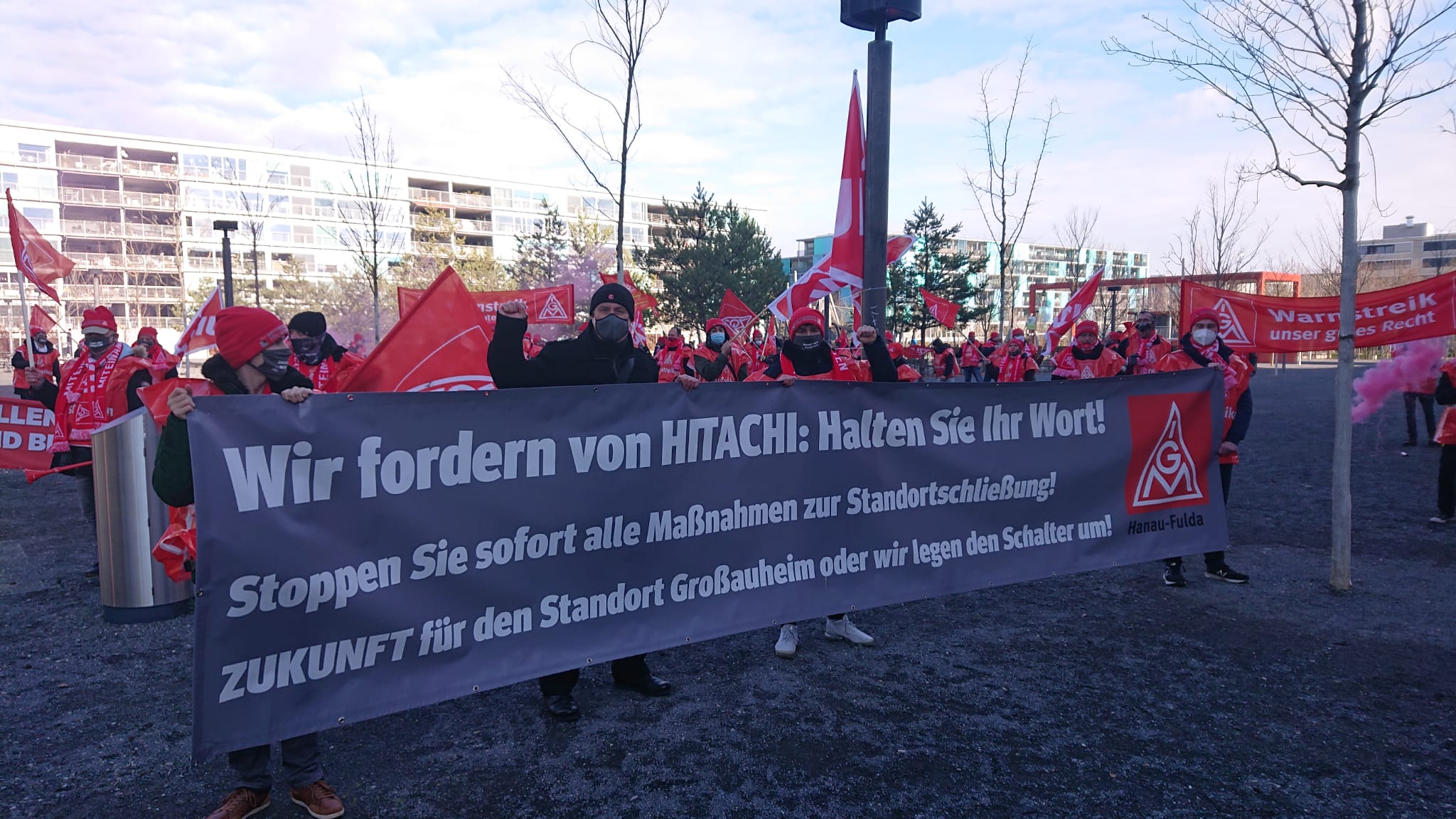
Hitachi-ABB power grids workers strike for future of the plant
Instead of following an existing agreement signed three years ago and renewed early this year, and enter into dialogue about the future of the plant with the works council and German union IG Metall, Swiss Hitachi-ABB power grids management has unilaterally decided to move production to other sites.
IG Metall called for a strike on 3 December to increase pressure on the Swiss management.
More than 100 workers from the plant in Hanau travelled to Zurich Oerlikon and rallied in front of the Hitachi-ABB Headquarter to protest against the decision. They received support from Swiss union Unia, who joined the rally and showed solidarity, as did IndustriALL Global Union and industriAll Europe.
A first strike was held on 19 November, in which also 350 workers participated.
Matthias Hartwich from IndustriALL Global Union, addressed the workers in Zurich, transmitting IndustriALL general secretary Valter Sanches‘ solidarity message:
“Company management not only ignored existing agreements; they are deliberately destroying a well-functioning site. This is unacceptable. Let us together remind management that these kinds of decisions should not be made without proper discussions and negotiations, neither in Zurich, nor in Hanau.
“IndustriALL stands in firm solidarity with you and we demand that management returns to the table and engages in a genuine dialogue with the works council and IG Metall to find a sustainable solution.”
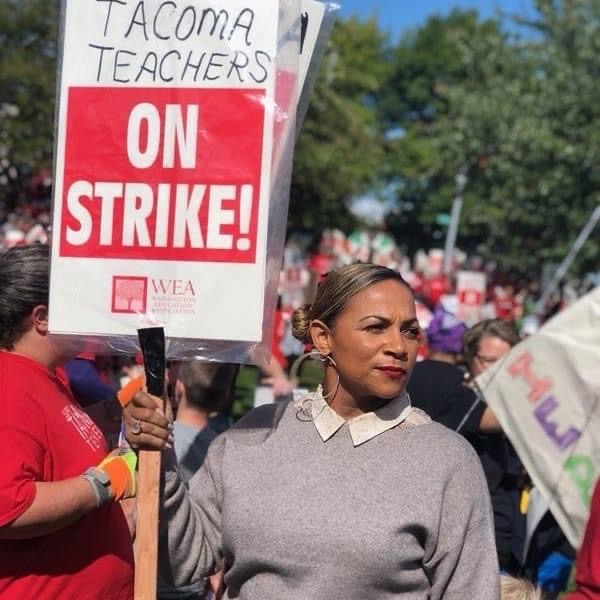
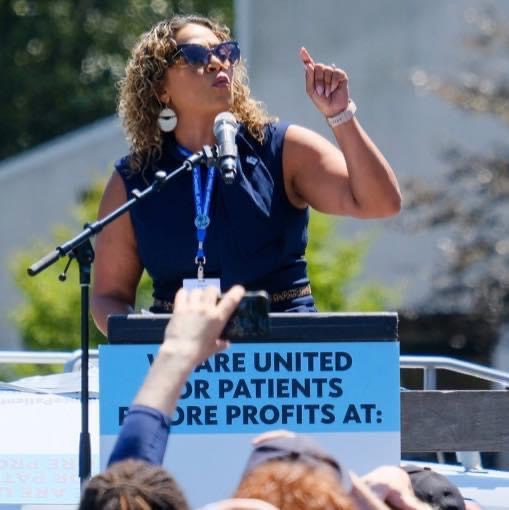
INTERVIEW: April Sims
INTERVIEW
From Global Worker No. 2 November 2020
Interview: April Sims
"It's not just about bringing another chair to the table, it is making sure that everyone at the table is dealt into the game and knows the rules so that they can compete."
How did you join the union?
I was raised by a single mom. We grew up poor so we were on and off welfare for most of my childhood. My mom struggled paying the bills and putting food on the table. She always worked really hard, but it was never enough. If we would get sick, she would have to miss work. If she missed work, she didn’t get sick leave. So she didn’t get paid, then she couldn’t pay the rent. She was subjected to harassment at work so sometimes she would just quit.
And then she got a new job. I remember her coming home from her interview and telling me, maybe if I could just get this permanent job, it would change our lives, and she was right. She went to work for the state at a hospital for the mentally ill, we didn't go from poor to middle class, but we went from poor and being economically insecure, to at least having some economic security.
I always knew that the union was a positive, even from a young age. The state reclassified her position and her union fought for back pay. She got a check for US$7,000, which was more money than we had ever had at any one time. I remember asking her where the money came from and she said it was because her union fought for her.
I always had a really positive relationship with the union. Even though my mum wasn’t active in the union, she was a single mum of three and working full time, I always knew that the union was a positive force. When I started working, and as soon as I had an opportunity to join a union, I did, and gradually got more active.
A shop steward invited me to a union meeting. At first, I was like yes, I'd love to go. Then I thought, it is late and I need to get my kids from daycare and do homework, bath time, dinner… But a shop steward in my worksite saw leadership in me, even before I saw it in myself, and he just kept asking me to get involved. He kept inviting me to union functions and one day and he said; ‘April, we have a workplace safety issue and we're going to ask our local for some help. We really need you to come to the local meeting, and if you come to the meeting and vote in favour of what we're asking for, we can really make a difference.’
"I remember going to that first local meeting and seeing a lot of really old white people, but also recognizing that I had a voice and I could help bring about change."
The reason I got active in my union is really because I was invited to a meeting and because my local, and my union at the time, was really working on leadership identification and leadership development. They invested in my leadership. And when my union was hiring a union representative I applied and they hired me. I come from ASMI Council 28, which is state and county employee’s union; it was my mum's local.
I worked as a council rep for a couple of years, with low level negotiations, processing grievances and training shop stewards. Then I moved into the legislative and political action department and worked as a statewide field coordinator for about a decade, building our member political engagement programme.
I started working for the Washington State Labor Council in 2015. As much as I love my home union, the state Labor Council was really the only labour organization that was working on other issues that I cared for, outside of wages, benefits and working conditions. The State Labor Council had a really bold progressive agenda. In 2015, they were the only ones talking about Black Lives Matter, the only ones working on criminal justice reform and climate justice. I started as the field director and moved into the political director position in 2017, and was elected secretary treasurer and started my term at the beginning of 2018.
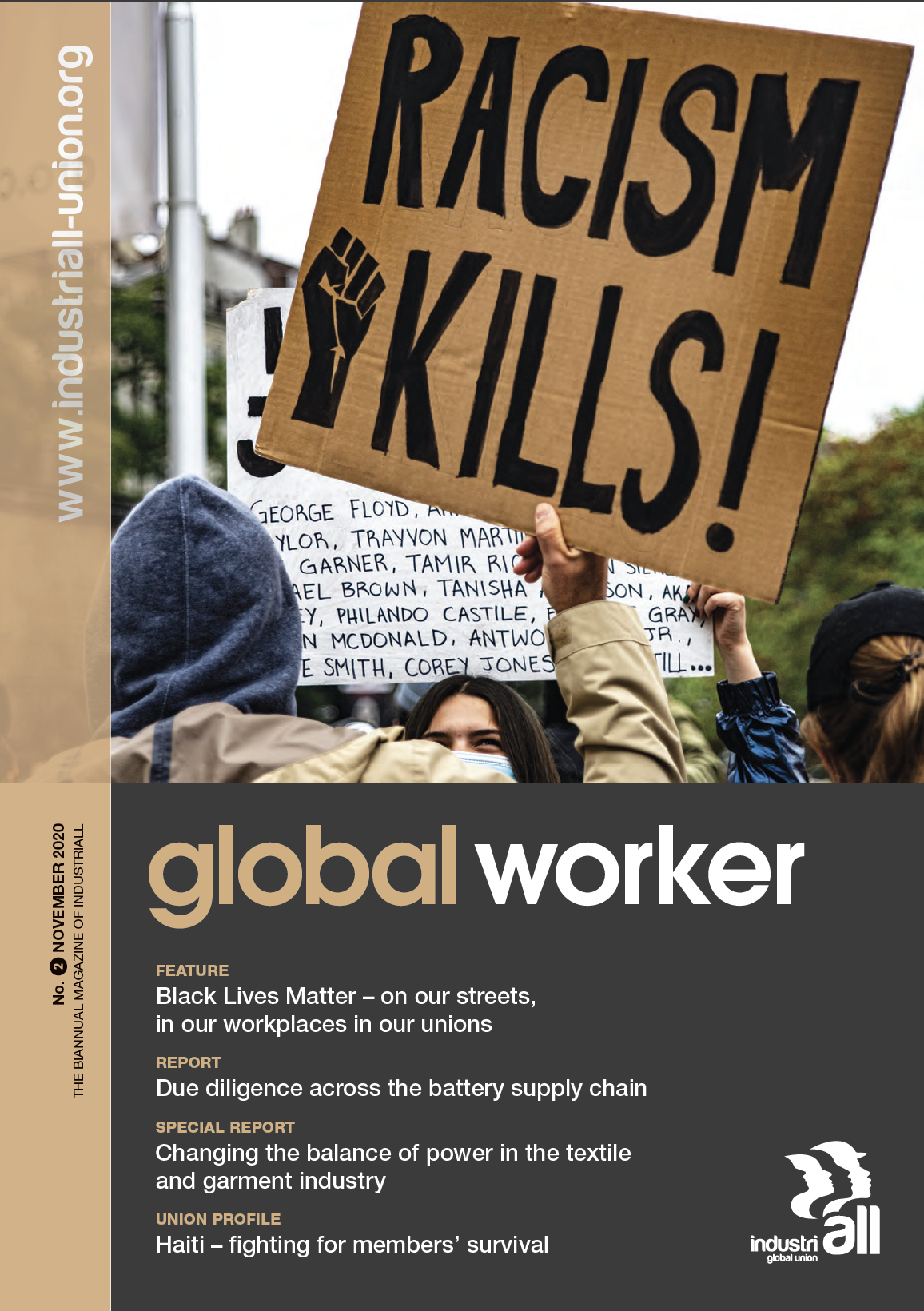
The Black Lives Matter movement spread globally and the unequal world that we live in is being unveiled for all to see. Are unions in the US playing a role within the BLM movement?
I can speak more directly for Washington State than nationally. I think that unions nationally are trying to figure out how to play a role with the Black Lives Matter movement. Our structures are so different. They say that battleships don't turn on a dime. Our institutions are like big battleships, filled with bureaucracy and process, and that doesn't always afford us the nimbleness that we need to work with movements that are fluid and not as process-heavy.
"We are trying to figure out how we play more of a role with the Black Lives Matter movement in Washington state. We are developing stronger partnerships and really trying to figure out how we use our institutional power to protect and support frontline communities, both the Black Lives Matter movement and other black-led and indigenous-led and serving organizations."
We are trying to be mindful that we don't just come in and say, you know, here's how we think we should do things and we need to march, we need to rally, without being mindful that there are communities that are literally putting their bodies on the front line. We need to figure out how we take our lead from them.
The democrats won the Presidential election and will lead a divided country. Have the unions and the Black Lives Matter movement played a role in Biden and Kamala Harris being elected?
Absolutely. If you look at the areas where Biden and Kamala won; Detroit, Philadelphia, Atlanta, Milwaukee; metropolitan, urban cities that are predominantly and historically Black cities. There is no doubt that Black Lives Matter as a movement, and as a voting bloc, made a big difference in terms of raising the consciousness, calling out Trump and his politics, calling out the racism in his administration and in his rhetoric. And for as big a difference as it made, it is still shocking to some people that Trump was able to secure so many votes. I think those are people who don't know what black and indigenous folks in this country have always known – racism is deeply embedded in our systems and institutions.
What role did women play in the election?
Biden choosing a woman to run as Vice President, and choosing Kamala Harris, allowed recognition that black voters, and specifically black women voters, have been the foundation of the Democratic Party for years. Without black women showing up, there is no way Biden could have won.
Biden apoints union leaders to transition teams
President-elect Joe Biden has made sure that the voices of working people will be heard in the transition to his administration. He has appointed more than two dozen leaders from the labour movement to the various agency review teams that will help make sure the Biden administration is ready.
See full list here of labour leaders appointed to Biden's transition teams
You have said that you spend your time working in systems and structures not designed with you in mind (meaning as a Black woman). What is needed for this to change?
"More representation!"
I don't mean to sound cliché, but leadership in the trade union movement is largely white and male. The Economic Policy Institute predicts that by 2025, women will be the majority of the labour movement, but we represent about 20 per cent of leadership positions.
There is a real lack of representation of women, and especially women of colour, and a recognition that the intersections of racism and sexism are unique for Black women. There are even fewer Black women in leadership positions in the labour movement. The only way to change this is to have more women of colour in leadership positions and more representation across the broader labour movement.
Everyone loves the idea of supporting a Black woman in leadership. I don't know that everyone is prepared for the ways in which Black women lead and how that is different. It means that there is sometimes a dynamic where people don't recognize your leadership style, as it is not the same as when traditional white men lead. The only way to change that is to have more women and women of colour. It's not just bringing another chair to the table, it is making sure that everyone at the table is dealt into the game and knows the rules so that they can compete.
It's going to take more representation, it's going to take more women, and specifically more women of colour in leadership positions, for us to change the way we view leadership. We need to identify leadership as more than someone banging their fists on the table and making decisive decisions but rather someone who is interested in creative collaboration, or soft power and sharp elbows. It is not about having all the answers, it is about asking all the questions.
The conversation around structural racism in the trade union movement is uncomfortable because of what unionism is supposed to stand for. How do you think unions can tackle this?
Our own institutions have to be willing. It is my love for the labour movement that makes me critical of it, because I know the difference that the movement makes in the lives of workers, and families and communities. It is that love that allows me to be critical and think about the ways in which we need to change and the things we need to do to make sure that we are seen as the force for good, by young people and people of colour.
The Labor Council in Washington State is building a programme designed for us to become an actively anti-racist organization. We created and filled the position for a racial and gender justice director who will help us treat this work like an active campaign. I'm both, changing and challenging the way that we talk about race and thinking about the way our institutions perpetuate racism.
We are creating space for new leadership styles and working with white leaders and white rank and file members to help them see the various manifestations of racism. We have to become more inclusive.
"We need young people and people of colour to look at the labour movement and say ‘that's the organization for me and I see a place for myself here because it is not just led by white male voices’."