Global unions call for justice for Saudi women‘s rights activist Loujain al-Hathloul
If convicted, Hathloul, one of Saudi Arabia’s most outspoken human rights activists, faces up to 20 years in prison.
Ms. Loujain Al-Hathloul has been engaged in promoting women’s rights in her country for several years, including in the movements to allow women to drive and to claim freedom of movement.
On 15 May 2018, Ms. Al-Hathloul was arrested and has since been detained on national security grounds, reportedly in circumstances that amount to arbitrary arrest and detention.
Defending human rights can never be considered a threat to national security. Women’s rights activism is not terrorism.
Loujain al-Hathloul must be immediately and unconditionally released, and all charges against her dropped.
The global trade union movement stands in solidarity with all defending human rights and fundamental freedoms and call for immediate justice for Loujain al-Hathloul.
REPORT: Due diligence across the battery supply chain
REPORT
From Global Worker No. 2 November 2020
Text: Georg Leutert
Theme: The battery supply chain
Battery production will be one of the fastest growing industrial activities in the years to come. Already today, the fight for the main raw materials, cobalt, lithium, copper and nickel, leads to gross human and workers’ rights’ violations and unacceptable environmental consequences: child labour, destruction of the living environment of indigenous peoples, ecological destruction, water shortage etc.
Today, a few East-Asian companies from China, Japan and Korea dominate global battery manufacturing and most of the raw materials are processed in Chinese refineries. The refinery of the raw materials is largely dominated by Chinese companies, which means a severe lack of transparency and a major challenge.
If the world is to reduce CO2 emissions, batteries must extend to the wide range of products, such as electric vehicles and storage battery systems, that use smart grid and green/renewable energy.
The battery supply chain is getting bigger, both in terms of actors and volume, and becoming more complex so will the demand for minerals to power the battery power technology.
As the battery supply chain is getting bigger, both in terms of actors and volume, and becoming more complex so will the demand for minerals to power the battery power technology. Therefore, it is strategically important that IndustriALL is involved in the due diligence process to secure workers’ rights and organize workers in the supply chain.
Once we have the input from all stages of the supply chain, we can then work together with all stakeholders and elaborate strategies that will concretely improve the situation on the ground.
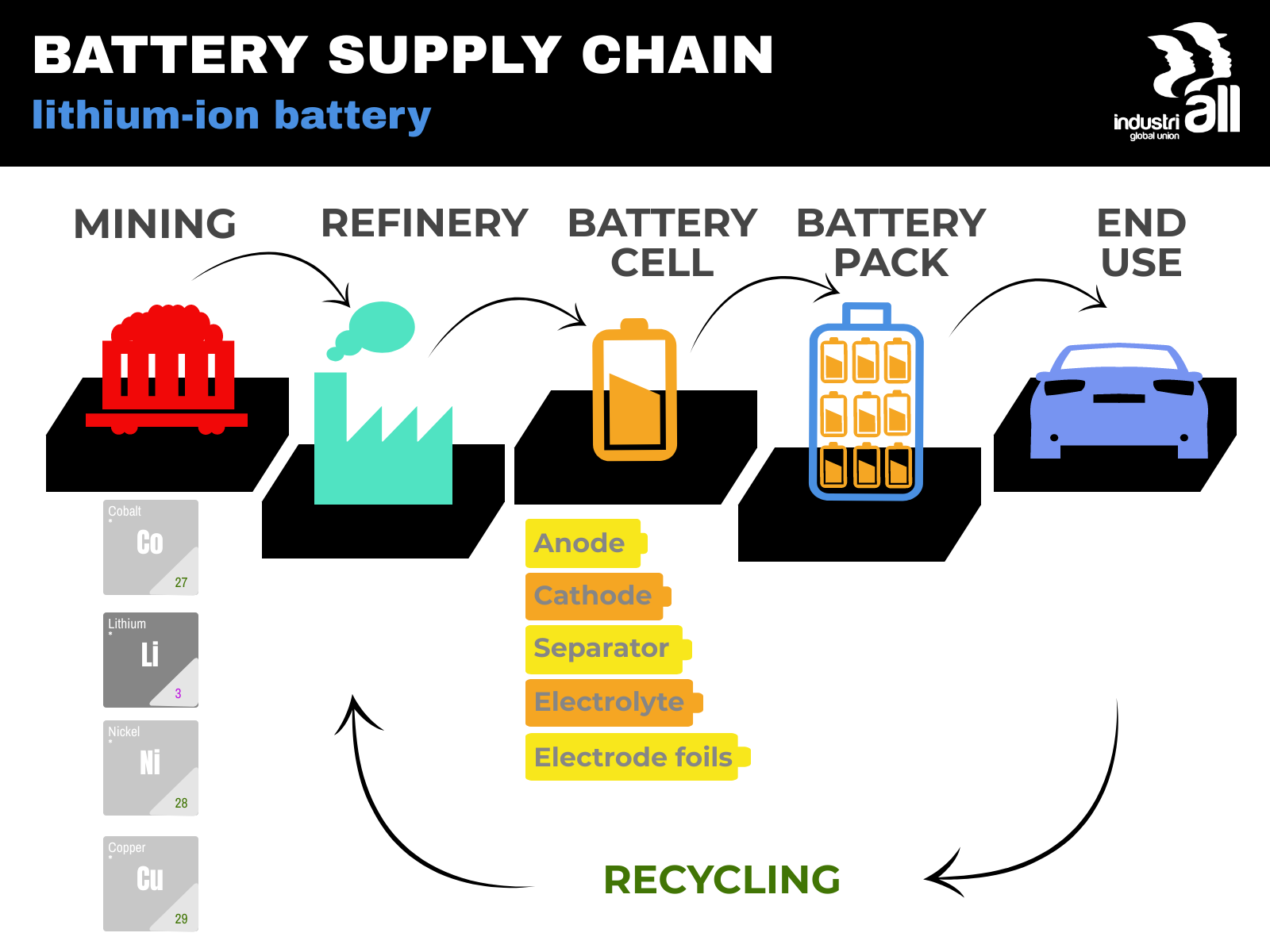
BATTERY SUPPLY CHAIN
Mining for required raw materials, in particular cobalt, lithium, nickel and copper; will grow dramatically and lead to new jobs. But issues already existing around basic trade union rights, child labour, the environment, rights of indigenous peoples etc, will also increase.
Three main players in the chemical and electronics sector from China (CATL), Japan (Panasonic) and Korea (LG Chem) dominate the battery cell production, with new players trying to enter the market.
The automotive sector has gone through an intensive make or buy discussion. Most of the auto manufacturers are deciding to buy the battery cells and then to assemble the battery packs themselves.
The energy sector mainly looks at sound solutions for the storage of (green) energy to balance out fluctuations in demand and production. The efforts mainly focus on the installation of smart grids and, in this context, e.g. the integration and utilization of batteries from car owners.
Making workers’ voices heard from mines to cars
“Decent working conditions and the realization of human and workers' rights along global supply chains are some of the most relevant and challenging topics for IndustriALL Global Union,”
says IndustriALL assistant general secretary Atle Høie.
“We want to use the momentum of the growing battery market by developing and implementing an integrated supply chain approach from the mines to the end-users.”
While major multinational companies (MNC) are well organized in their own production sites, trade union rights abuses grow rapidly down the supply chain. The responsibility MNCs have for their supply chains is well established through the UN Guiding Principles on Business and Human Rights, but without enforceable international and national regulation MNCs will not be held accountable.
Mapping the global supply chains is important to find out where we as a global federation have leverage concerning trade union rights abuses in the supply chain of MNCs. The global Auto company will be forced to care about where its cobalt and lithium is mined, how its batteries are made and how the energy is stored.
IndustriALL has applied for an FES project to develop the supply chain strategy. This includes research and mapping of the supply chain, strategic meetings with experts and global meetings with the unions organizing along the supply chain.
“The aim is to create a social dialogue scheme or platform with key stakeholders to achieve decent work for all throughout the supply chain. IndustriALL is the only global union who can coordinate unions around the world and contribute to the policy to achieve decent work around the battery supply chain. The international trade union movement becomes more important than ever,”
says Atle Høie.
What IndustriALL wants:
Genuine due diligence that makes the voice of workers heard at every single step of the supply chain (and goes beyond glossy sustainability reports)
To improve working conditions of the workers on the ground
To work together across sectors
Regulating unsustainable global supply chains and securing manufacturing jobs are key to IndustriALL’s strategic work in the wake of the pandemic.
Manufacturing must continue to be the engine of national economies. This IndustriALL initiative will address the global model of trade and production since the crisis has exposed the enormous risks to labour rights in unregulated global supply chains. We will demand that human and labour rights’ compulsory due diligence is regulated at international and national levels through binding legislation.
Alarming attacks on labour laws during Covid-19 in South Asia
The Covid-19 pandemic and the containment measures have seriously affected workers in South Asia. Across the region, governments’ mixed response to the crisis have let workers suffer wage theft, leave without pay, non-implementation of labour laws, loss of livelihood and in many cases cynical retrenchment of precarious workers with no hope for the future.
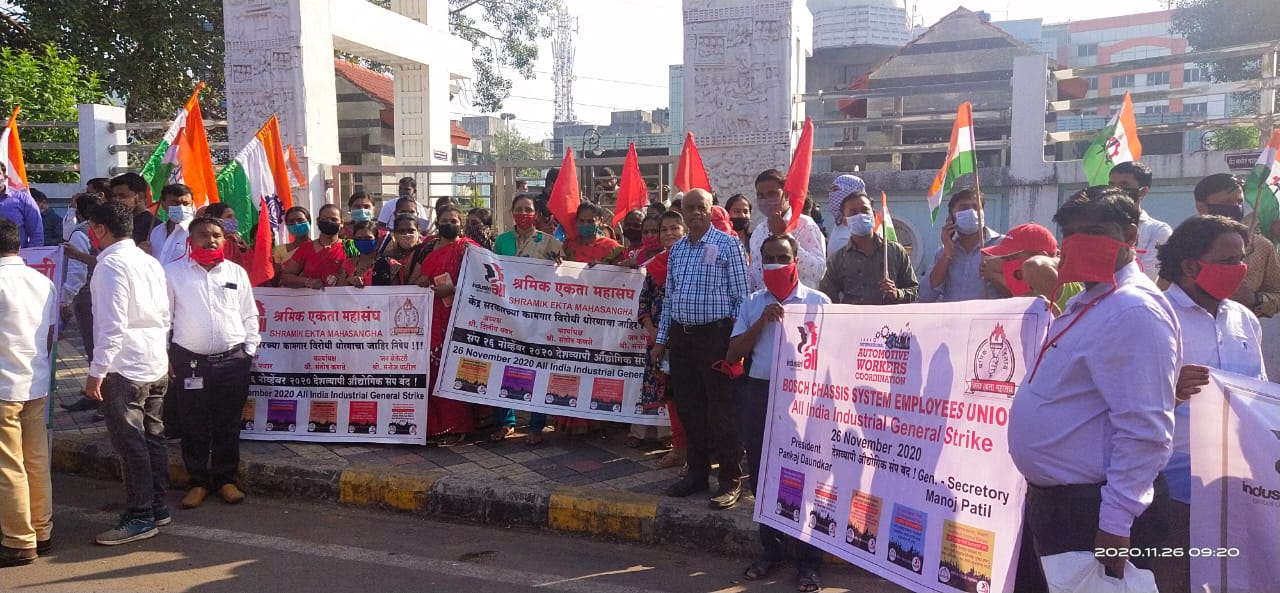
National strike in India, 26 November 2020
The regional webinar organized by IndustriALL South Asia office on 4 December highlighted that the trade unions across region fought tooth and nail to defend workers’ rights. IndustriALL executive committee members Sanjay Vadhavkar, Steel, Metal & Engineering Workers' Federation of India, and Anton Marcus, Sri Lanka Free Trade Zones and General Services Employees Union took part in the meeting.
In India, Pakistan, Sri Lanka, Bangladesh as well as Nepal there were attempts to change labour laws with negative implications for workers’ rights.
Sanjay Vadhavkar explained,
“The Indian government’s labour law changes have been passed without due parliamentary norms and process. Sweeping labour law changes encourage precarious work, limit recruitment of permanent workers, affect collective bargaining and almost eliminate the right to strike and make Indian workers more vulnerable to social and economic shocks caused by the pandemic. These labour law changes fall short of India’s commitment to fundamental principles of workers’ rights in international forums.”
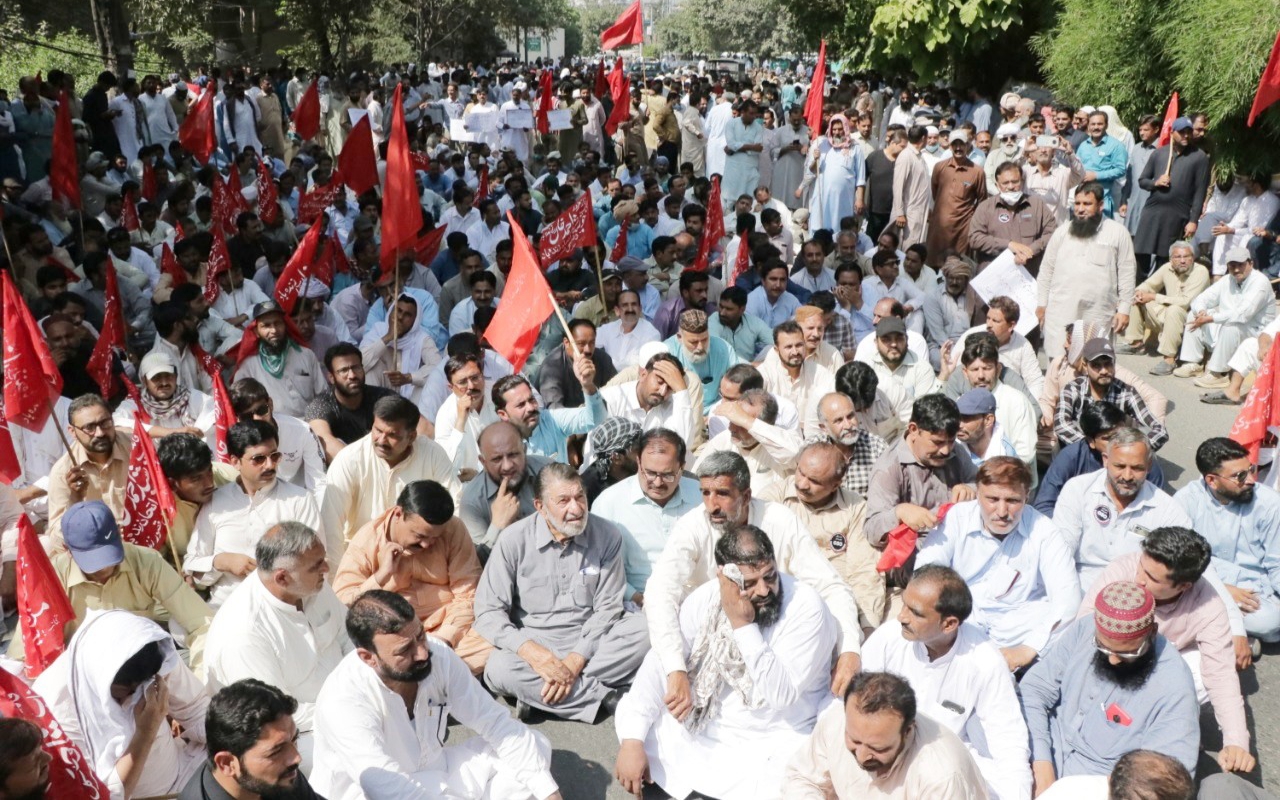
Protest action in Pakistan
Anton Marcus added,
“Employers in Sri Lanka proposed many anti-worker and anti-women workers labour law changes including increasing working hours, changed working conditions, unilateral termination of employees without government approval and even called for suspension of labour laws.”
Both Indian and Sri Lankan trade union movement vehemently opposed the anti-worker policy proposals. In India the unions held nationwide strikes and protests. Sri Lanka affiliates fought to ensure payment of wages to workers for the lockdown period. But the government and employers are continuing to call for labour law changes. Both leaders called upon the affailites of South Asia to extend their solidarity support and defend workers’ rights.
Pakistan union delegates expressed concern over proposals to stop labour inspections, lack of labour law implementation and underlined the need to progressively integrate labour laws across the provinces and institutionalize national level social dialogue.
Bangladesh union representatives highlighted the shrinking rights of working people including in readymade garment sector. Workers’ representatives in government tripartite committees dealing with labour laws are often side-lined to the detriment of the social dialogue in the country.
Kemal Özkan, IndustriALL assistant general secretary, said
“We are witnessing a big attack against democracy and democratic institutions. Covid-19 is a natural disaster, but how governments are responding is a product of their politics. Governments in collusion with employers are trying to dismantle all the gains of workers’ rights and legal protection. Laws related to wages, social security, occupational health and safety and industrial relations are modified in such a way that workers are denied fundamental workers’ rights. IndustriALL Global Union is committed to work strategically with other global union federation to support affiliates’ efforts to build unity and solidarity and resist the attacks on workers’ rights together at the national, regional and international levels.”
South Asia affiliates decided to strengthen inter-regional communications, evolve joint strategies and take further actions to defend workers’ rights.
GS corner
“The year ends with over 75 million people infected and almost 1.7 million deaths, around 500 million formal jobs and around 1.6 billion informal jobs destroyed and few signs of recovery in the short term. While immunization is starting in some countries, there are serious concerns that universal access to vaccines is unlikely to be a reality in the coming months.
“The pandemic unfortunately continues to spike with more and more record new daily cases. This has obliged us to postpone our Congress, supposed to take place last October. After a decision by our Executive Committee, Congress will be held fully online in September 2021.
“Our affiliated unions throughout the world have led the fight to protect the health, safety, jobs and income of their members, with special attention to those affected the most like women, young people, black workers, LGBTQIA+, etc. At the same time. that in some countries our affiliates managed to achieve alternative schemes to avoid dismissals like furloughs, partial unemployment, temporary lay-off, reduction of worktime, etc., around 60 per cent still lack any social protection.
“At IndustriALL, we have put all our resources to support our affiliates changing dramatically the way we work but managing to more than double the number of global and regional activities that counted with almost ten thousand participants through online mode. The access to our website more than doubled to about 200,000 views per month, and we have published four guides on health and safety.
“To this date, we have sent almost 400 letters to companies, governments, multilateral organizations, and solidarity letters to our affiliates (65 per cent more than the average of the previous four years), supporting the fight to protect the health and safety, jobs and income of their members.
“We are running more simultaneous campaigns than ever: BHP, Glencore, Shell, Convention 176, Hong Kong Convention, Convention 190 and TGSL sector. These are mere indicators on how much more we were demanded and responding to. In the report of the secretariat I delivered to the Executive Committee, I listed the number of campaigns, struggles, solidarity actions, and #UnionWin stories we were involved in this year.
“We have been shoulder to shoulder with our affiliates in celebrating achievements when they were able to fight back and win and always at their side to fight the good fight on behalf of workers. In 2021 we’ll keep fighting forward and supporting our affiliates. I herewith would like to publicly recognize the efforts and flexibility of all our staff at central and regional offices that worked tirelessly despite the challenges of working remotely the major part of the year.
“IndustriALL’s health, safety and sustainability director Brian Kohler, will be retiring from IndustriALL by the end of the year. We are very thankful for his good work, commitment and comradeship with us along the years.
“After careful consideration we decided to redistribute some responsibilities in the central office as follows:
White-collar workers is an area we have to significantly advance, given the growing share of white-collar workers among the total workforce in the industry in general as production processes are through an accelerated technological leap. We assigned this work to our colleague Armelle Seby. We will reshuffle part of the projects under her responsibility, so she can effectively perform this new task alongside with her responsibility for women.
Health & safety continues to be extremely important for our organization moreover because the pandemic puts this in the center of our affiliates’ concerns. This is something that must be part of our work in all sectors and regions. In the most important specific issues in that area, our directors have already been leading all actions as Glen for C176 and Kan for the HK Convention. Our colleague Glen Mpufane was assigned to act as reference person/focal point for OSH. Glen will keep receiving support from the regional offices for the mining sector to allow him to accommodate the addition of this new role.
Just Transition / Sustainability are and will increasingly be of extreme importance for IndustriALL as our sectors are through an accelerated process of transformation driven by the transition from fossil fuels to renewables as main sources for energy generation. Our colleague Diana Junquera was assigned to act as reference person/focal point for JT/Sustainability mostly because she is already leading a number of actions in this area as part of her responsibility for the energy sector.
Industry 4.0 will increasingly be a crucial issue that IndustriALL and especially our affiliates must be responsive to. Over the past three years we took a lot of initiatives to raise awareness of our affiliates: world conference, Action Plan, brochure (in 2017) and regional activities (in 2018 and 2019). Our directors are already taking leadership on addressing the impacts of Industry 4.0 in the various sectors and we have reached the first GFA on this with Renault in 2019 with possible others with other companies on the pipeline. Our colleague Matthias Hartwich was assigned to act as reference person/focal point for Industry 4.0. This is consistent with his responsibility for “Green Tech” as part of the mechanical engineering sector.
“I wish all the best to our colleagues in their new assignments and would like to ask for the usual cooperation from all of you.
“It is important to highlight that all sector directors and regions will continue to be fully responsible for the themes above to the extent of their impact on the respective sectors and regions. Our colleagues above were assigned as reference persons on the respective themes to provide knowledgeable assistance to the organization as a whole (to affiliates, to the leadership, to the colleagues in the central/regional offices) whenever necessary.
“I wish you a merry Christmas for those who celebrate it and a happy new year to ALL.
"In 2021, A LUTA CONTINUA along with the early preparations for our congress in September 2021 that shall deliver a strong Action Plan for the years to come!"
AMANDLA, AWETHU! UNITED FOR A JUST FUTURE!
Significant step forward for homebased workers in Sindh, Pakistan
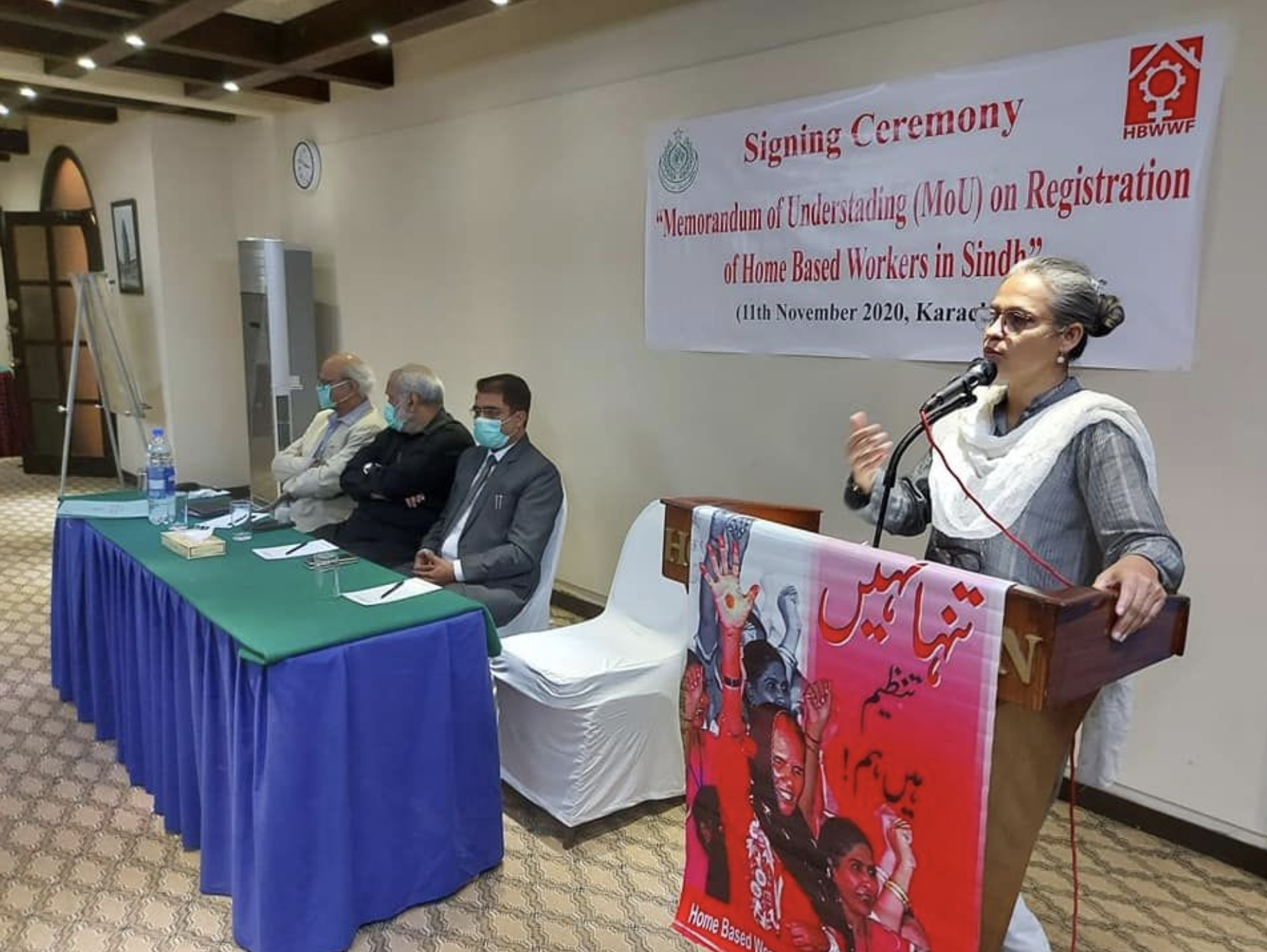
The directorate general of labour and the government of Pakistan’s Sindh province have agreed on a Memorandum of Understanding (MoU) with IndustriALL affiliate HBWWF to start the registration process of home-based workers.
According to the MoU, all home-based workers are eligible for registration and the director general of labour will set up registration facilities. HBWWF will assist in bringing the home-based workers from all over the Sindh province for registration in the respective offices.
Zehra Khan of HBWWF, says:
“This is significant step forward for home-based workers’ recognition. With the registration process we will be able to create a reliable database which will provide more and specific information about home-based workers. This will help both the government and the union to understand their needs. We are also working on a universal social security scheme with the Sindh government to cover homebased workers.”
The registration process begins in December and is expected to be completed within three months. The HBWWF will assess and monitor the registration process and extend support to the labour department officials.
Apoorva Kaiwar, IndustriALL South Asia Regional secretary says:
“We appreciate HBWWF steadfast efforts and the government of Sindh’s active cooperation with the union. HBWWF’s strategic engagement in securing social protection for home-based workers has important lessons for other provinces in Pakistan and also for other South Asian countries. Now, more than ever before, we need genuine universal social protection and we will continue to support HBWWF’s efforts on this front.”
Union settles tough wage negotiations in the garment sector in South Africa
Negotiations were conducted on virtual platforms and concluded after the union had declared a dispute. Several conciliation meetings were held to resolve the stalemate.
Over 70,000 workers will benefit from the collective agreement which will increase wages above inflation and increase bonus payments.
Most of SACTWU’s members are in the garment sector and the union also organizes in textiles, leather, and shoe sectors, as well as other industries in the value chain. According to the government, these sectors contribute about 2.5 per cent of South African manufacturing and employ mostly women.
The union says this year’s negotiations in the National Bargaining Council for the Clothing Manufacturing Industry were tough because of disruptions caused by the pandemic, including factory and retail shop closures, retrenchments, and reduced working time for some workers. Other employers even wanted to change permanent contracts to temporary ones and to freeze wages – the union fiercely resisted these proposals.
SACTWU has carried out a living wage campaign for many years and the campaign did not stop because of Covid-19. However, because of the Covid-19 restrictions, the campaign continued through social media and online platforms.
In March, SACTWU concluded a ground-breaking national collective agreement in the textile sector to ensure payment of full wages during the lockdown.
Andre Kriel, SACTWU general secretary said:
“Employer wage freeze proposals due to the Covid-19 pandemic is not an option at all. We are determined to always and without fear or favour, pursue our members’ living wage demands. We are pleased that a mutually satisfactory settlement has now been struck in the clothing industry under extremely difficult economic conditions.”
Christina Hajagos-Clausen, IndustriALL director for the textile and garment industry, said:
“Covid-19 has caused havoc in the garment sector globally and we applaud SACTWU for continuing to fight for living wages under these harsh conditions. We need to continue to stress that the pandemic should not be used as an excuse by employers not to pay living wages.”
The employer associations that signed the agreement are the Apparel & Textile Association of South Africa (ATASA), South African Apparel Association (SAAA) and the Transvaal Clothing Manufacturers Association (TCMA).
Photo: SACTWU members during a nationwide protest in 2017.
Goodyear Indonesia workers return to protest line
In April, PT Goodyear Indonesia Tbk dismissed 44 permanent workers, citing Force Majeure. The workers and and their union, Federation of Chemical, Energy, Mining, Oil and Gas Workers’ Union (FSP KEP), has been protesting against the arbitrary dismissal.
On 15 December, the workers gathered in front of the factory with banners and placards saying "don't shatter the dream of our family", "appreciate our contribution to the company", “don’t rob our rights”.
The workers have vowed to carry out collective action every day from 8am to 11am for two weeks, to protest against the company’s failure to abide by the advice of the Manpower office that acted as a mediator.
According to FSP KEP, the company declined mediation advice and instead filed the termination dispute at the labour court, with the trial scheduled to begin on 16 December.
Bambang Surjono, general secretary of FSP KEP, says:
“PT Goodyear Indonesia Tbk should obey with the mediation advice, reinstate all 44 workers with back pay and benefits. Legally they are still Goodyear workers as the labour court has yet to make a ruling, the company must pay their rights according to Manpower Act No. 13 Year 2003.
“I call on the company to walk the talk with the company slogan ‘Keep a good pride’, as the living conditions of the 44 families are worsening. Management must respect Indonesian labour laws and ensure a decent living of our members who were arbitrarily dismissed.”
IndustriALL Global Union rubber director Tom Grinter says:
“This group of workers has received special solidarity support from the tire workers' unions in Thailand, and IndustriALL Global Union. Our message to Goodyear management is simple, reinstate these 44 committed employees immediately.”
Moroccan miners hold underground sit-in
Jebel Aouam mine
The workers are striking and occupying the mine because the management of Compagnie Minière de Touissit (CMT) failed to implement an agreement signed with IndustriALL affiliate l’Union Marocaine du travail (UMT) in 2019. The agreement, signed in the presence of a representative of the Ministry of Energy, Mines and Environment and of the local authority, guaranteed improved living conditions, better working conditions inside the mine, and the provision of occupational health and safety measures.
Workers agreed a productivity target at the mine, which produces silver, gold, lead and zinc. The workers met the productivity target, but management failed to honour its side of the agreement. After continued failure by management to meet its obligations, and failure by the Ministry and local authorities to intervene, the UMT members were forced to take the desperate action of going on strike and staging an underground sit-in.
The union considers the occupation to be dangerous to the health of the miners, many of whom suffer from chronic occupational illnesses due to unsafe conditions on the mine. Their already compromised health is further threatened by the pandemic.
“It is imperative that your ministry act without delay to help establish genuine dialogue which leads to satisfactory results. We are extremely concerned for the safety of the miners, many of whom suffer from chronic occupational diseases. The situation is all the more urgent as we are in the midst of a terrible pandemic.”
The area around Jebel Aouam has been mined since 1929. CMT, a subsidiary of French-headquartered mining group Auplata, is the leading producer of lead and silver in Morocco. There has been conflict at the mine since 2017, including a previous occupation, which was resolved after the new contract was signed. Conflict erupted again this year after the company failed to honour the contract.
Unions demand: Stop dismantling at Sanofi!
With the eyes of the world turned to Covid-19 vaccine producers such as Sanofi, and with profits high for the company, the union network met this week and received concerning reports from Sanofi workers around the world. With sectoral analysis provided by IndustriALL Pharmaceuticals Director Tom Grinter, and an expert overview of the pandemic from IndustriALL’s Hector Mareque, the virtual meeting brought together 50 Sanofi union leaders.
The IndustriALL Global Sanofi Trade Union Network meets regularly, and has an established structure with elected network coordinators at the global and regional levels. Key unions in the network take leadership roles from France, Japan and Brazil. The global network is the social partner for the company and seeks official recognition and social dialogue with global management.
Aline Eysseric, the coordinator of the global network, updated colleagues on the various restructuring projects of the company. Sanofi’s consumer health products division is being made more independent within Sanofi. The measure affects 13,850 employees, spread over 175 countries and 12 factories. The Pluton project is a spin-off of the company’s chemistry business to create a new entity producing active pharmaceutical ingredients in Europe. This process does not ensure transfer of socially bargained employment benefits.
Workers in the Sanofi global support functions are facing another large redundancy plan, as are workers in the Research & Development operations. Another example of an ongoing Sanofi restructuring program is called Play to Win which is cutting jobs and leaving German employees asking what they stand to win from it.
In many cases large numbers of redundancies are coupled with increases in numbers of subcontractors at the worksites.
IndustriALL assistant general secretary Kemal Özkan said:
“Consumers and wider society are looking to companies such as Sanofi for reassurance that the health crisis will be tackled with new treatments and technologies. Governments are spending huge amounts of public money to order Sanofi vaccines. But at the same time the company is breaking the stability of its employees’ jobs, with greedy restructuring and cuts.
Sanofi management needs to build a respectful dialogue with IndustriALL and the global union network, to work through these tumultuous times with respect and dialogue for its employees.”
The Sanofi unions will continue networking, and exchanging information at a regional and global level, and will take coordinated action to oppose workers paying heavily for the ongoing restructuring at the company.
Approaches and responses to Covid-19 in MENA’s energy sector
Climate change and a continued dependence on fossil fuel revenue pose considerable threats to the economies in the region. With economies in the region slated to contract by up to 6.6 per cent, economic pressure may tempt some countries to halt their energy transition plans. This puts the future of the region at risk as energy transformation could have a positive impact on the economy and environment.
Meeting delegates discussed potential implications on workers, underlining the need to protect their rights and living standards and to deliver high-quality and sustainable industrial employment through a Just Transition in the sector.
Brahim, Benelfkih from Morocco Fédération nationale des travailleurs de l'énergie, said:
“The government is taking the opportunity of the crisis and accelerating the application of the laws concerning the privatization of the sector due to the energy transition. We insist on maintaining our workers’ rights and benefits especially the budgetary allocations for the social services to workers.”
Due to Covid-19, transportation has been halted in Algeria, a country covering more than two million square kilometers, taking a psychological toll on workers, especially those in remote areas. Some workers spend three months in remote areas where health and safety are not respected. Being frontline workers, ensuring a sustained flow of electricity, electricity workers deserve proper working conditions.
Hashmeya Alsaadawi, General Trade Union of Electricity Sector Employees of Iraq and co-chair of the MENA region, said:
“Unions in energy sector have been providing support to workers who lost their jobs due to the crisis. On 29 November, we met the advisor to the Prime Minister to discuss challenges faced by workers, like the lack of a law guaranteeing freedom of association, the non-recognition of unions in the public sector, and the delay in paying contract workers’ wages. We demanded that Iraq ratify ILO Convention 190 and expand the social insurance system to cover more workers in the private sector.”
Unions from Palestine, Kuwait and Jordan all stressed the importance of union actions during the pandemic.
Union reps from the General Union of Petrochemical Workers in Palestine distributed food, personal protection equipment and raised awareness about Covid-19, as well as requesting the government to support some factories affected by the crisis.
The Oil & Petrochemical Industries Workers Confederation in Kuwait helped the oil industry ministry in establishing medical facilities, set up in record time to alleviate pressure on health centers in the country.
The General Trade Union for Workers in Electricity in Jordan cooperated with companies to provide protection equipment. During the crisis, the government issued a decree allowing companies to pay only 50 per cent of salaries, but the union successfully negotiated with companies to pay 100 per cent of the salaries, in addition to the three additional months workers receive every year.
Abdelmajid Matoual, vice president of the MENA region, stressed the importance of the sharing experiences with colleagues in the region:
“We must share information to be able to build strong unions, to stand strong in front of the challenges and to guarantee better conditions and future for the workers.”
Kemal Özkan, IndustriALL assistant general secretary, said:
“I read a report saying that US$6 billion of this year’s projected US$30 billion investments in oil and gas in the region are already lost. Workers should not have to pay the bill. Covid-19 has triggered difficulties in the region, and these must unify us to find a common ground to build trade union solidarity on.”