Agreement on duty free woven fabrics is a breakthrough in saving South African jobs
The 5 February notice states that there will be duty free imports for woven fabrics. SACTWU says this policy shift will promote growth in the textile and garment manufacturing sectors. Further, it will stimulate local procurement and increase the sector’s contribution to the industrialization of the country.
This will save jobs in an economy where unemployment is high. According to Statistics South Africa’s 2020 4th Quarterly report unemployment is 32, 5 per cent, and as high as 42, 5 per cent if you consider the expanded unemployment rate that includes discouraged job seekers.
The notice came after four-months of negotiations with social dialogue partners including retailers, garment manufacturers and textile mills. The employers involved in the negotiations represent 75 per cent of SMMEs while SACTWU represents 90 per cent of the workers. The negotiations took place under the Retail, Clothing, Textile, Footwear and Leather (R-CTFL) masterplan.
Andre Kriel, SACTWU general secretary says:
“The consensus reached in this industrial development agreement is unprecedented. Together, these employers and labour organizations constitute the most representative industry voice on this rebate matter. Importantly, the imported fabric can only be used by companies that are signatories to the R-CTFL Masterplan and are compliant with minimum labour standards.”
The R-CTFL masterplan, launched by the Department of Trade, Industry and Competition, aims to develop the textile and garment value chain. The value chain includes spinning, woven, dyeing, knitted, and finishing of natural and synthetic fibre inputs and leather tanning.
Cut-make-trim, design houses, garment, and household textile manufacturers, as well as leather and shoe manufacturers are also part of the value chain. Locally sourced and imported products are also included while retail deals with domestic and international markets.
The social dialogue partners that took part in the negotiations are the National Clothing Retail Federation (NCRF) representing garment retailers, Apparel and Textile Association of South Africa (ATASA), the South African Apparel Association (SAAA), and Apparel Manufacturers of South Africa (AMSA) representing garment manufacturers, and the Textile Federation (Texfed) representing textile mills.
Paule France Ndessomin, IndustriALL regional secretary for Sub Saharan Africa says:
“We commend SACTWU for consistently fighting for agreements that are beneficial to workers. The garment and textile sector value chain is key to South Africa’s industrialization and the creation of decent jobs.”
The social dialogue partners presented the plan to government in September 2020. SACTWU says the breakthrough is long overdue after four decades of discussions.
What unions can do to put a stop to domestic violence
Although domestic violence may originate in the home, it can spill over into the world of work. Domestic violence is also a health and safety issue, representing a risk for the health and safety of the victims/survivors, as well as their co-workers.
16. Why should employers address the impact of domestic violence at work
Domestic violence can severely impede the health, wellbeing and safety of affected employees. All employers have a “duty of care” towards their workforce. Health and safety laws ensure workers have the right to work in a safe environment where risks to health and well-being are considered and dealt with efficiently. Murders of victims in their place of work show just how serious the consequences of domestic violence can be on work premises.
An employer can be deemed to have breached their duty of care by failing to do everything that was reasonable in the circumstances to keep the employee safe from harm.
Domestic abuse results in decreased productivity; increased absences; increased errors; increased employee turnover. It also affects other staff who may: have to fill in for absent or non-productive colleagues; feel resentful of victims/survivors; try to protect victims/survivors from unwanted phone calls and visits; feel helpless and distracted from their work; fear for their own safety.
UN gender guidance on human right due diligence provides that businesses should develop measures and remedies that are ‘transformative’, i.e. capable of “bringing about systematic changes in discriminatory power structures”. When companies send the message that domestic violence and abuse is unacceptable this can have a spin-off effect, sending a strong message to the wider community, contributing to change social norms resulting in acceptance of domestic violence as normal.
For victims/survivors of domestic violence, work represents a refuge away from their abusers where the victims/survivors work and capacities can be valued, and where exchanges with colleagues allow for reduced isolation. Work also represents a source of income and financial independence.
Domestic violence affects performance at work and the victim/survivor may face sanctions and dismissal. No one should lose their job or income as a result of experiencing domestic abuse. By losing their source of income, they lose their independence, making it more difficult for them to leave their abusers. Trade unions need to defend the rights of these members and workers.
Solidarity and equality are the main pillars of trade union’s work. Violence against women is a radical expression of discrimination. Trade unions should find ways to support and protect workers’ victims/survivors of domestic violence.
Domestic violence is also a health and safety issue, representing a risk for the health and safety of the victims/survivors, as well as their co-workers.
18. Addressing the impacts of domestic violence at work
Unions should raise awareness and educate members and workers on the impact of discrimination and gender inequality. They must challenge gender stereotypes and social norms that generate and justify violence against women, including domestic violence.
To end gender based violence, C190 calls for a “gender responsive approach” that will “tackle underlying causes and risk factors, including gender stereotypes, multiple and intersecting forms of discrimination, and unequal gender-based power relations”.
Trade unions should also take action to condemn all forms of gender based violence, including domestic violence, and raise awareness on this issue by: establishing for example, an internal policy, code of conduct or equality statement to promote a violence and harassment-free union environment; publishing articles or material about domestic violence and the workplace; collaborating with civil society organisations and associations fighting domestic violence.
The primary responsibility to address domestic violence lays with the governments. Trade unions have been campaigning, along civil society organisations and associations, to achieve paid leave and other provisions in law, like in the Philippines and New Zealand where intense campaigns led to the inclusion of ten days paid leave for victims/survivors of domestic violence, in Australia five days’ unpaid leave, or five day’s paid leave in almost all provinces of Canada.
Trade unions have been also lobbying governments to ratify ILO Convention 190 and ensure that governments and employers take their duty of care for workers affected by domestic violence seriously, whether they are public or private places of work.
19. How can trade unions support members and workers?
Victims/survivors make considerable efforts to hide what is going on, especially in the workplace. Very often women suffer in silence, too afraid, or perhaps too ashamed to seek help. Members who trust the union to challenge domestic violence and advocate for victims are more likely to come forward, and to turn to a trusted union rep.
By showing that they care, union reps can help break the victims' isolation. It is essential that anyone reporting abuse is confident that reporting such an incident will be taken seriously. It is important for the union to train its reps to recognize signs of domestic violence, listen and offer confidential support to the victims and survivors, and put them in contact with existing services.
Trade unions have put together guidelines and trainings for its reps and delegates to ensure that their attempts to help would not generate more harm or backfire and put someone in more danger, like AMWU’s Do and DON’T Guidelines for delegates.
Unifor in Canada, negotiated a Women’s Advocate programme and now has over 400 women’s advocates in workplaces across the country. The employer pays for training and office space for specialized union representatives who help women experiencing harassment or violence at work or in their personal lives. The advocates offer non-judgmental and confidential support, explain workplace and community options and help the member navigate those systems. Advocates are trained to recognize signs of abuse, make referrals and work with the employer on a safety plan.
20. What to negotiate with the employers through collective bargaining?
Developing a robust workplace policy on domestic violence is critical in addressing the impact of domestic violence at work. The employers should develop it together with teh health and safety committees or with workers’ representatives.
The policy should include:
a statement against domestic violence
trainings and awareness raising sessions for human resources and managers, as well as employees on how recognize the signs of domestic violence and how to respond to it safely and appropriately
protective measures and work arrangement for the victims/ survivors
protection against retaliation or discrimination on the basis of their disclosure
a clause of strict confidentiality
workplace safety strategies, including risk assessments and safety plans for the victims/survivors and their colleagues, when domestic violence is disclosed
Trade unions can also negotiate to include domestic violence in collective agreements at all level, national, regional, sectoral, company or workplace levels, or in policies on violence and harassment in the workplace.
They can include domestic violence as an example of violence covered by the collective agreement or policies, or negotiate standalone language that recognizes domestic violence as an important workplace concern, and requires specific follow up and protective measures. By naming domestic violence openly in health and safety workplace policies, you are working to destigmatize domestic violence.
Protective measures for victims/ survivors could include
temporary protection against dismissal for victims/survivors
work arrangement to adapt their work schedules, use pseudonyms, and have flexible working hours
allowing them to make the necessary changes to protect themselves from abusers who exploit knowledge of their working hours and location
Dedicated leave for victims/survivors of domestic violence is key, as this enables victims/survivors to flee, deal with any legal proceedings as well as to access support, services, remedies and settle safely.
Trade unions should bargain for a minimum of ten days paid leave per year in addition to existing leave provisions, extended under exceptional circumstances, as no survivor of domestic violence should have to choose between their safety and that of their family, and their job. If employers do not agree to provisions for paid leave, unpaid leave is the interim default position, provided the survivor’s job position is guaranteed.
21. What can trade unions do during lockdowns and with increased teleworking?
With the increase of domestic violence, trade unions have been active in disclosing the contact of support and emergency services for victims/ survivors of domestic violence. They have also been lobbying the government for increased support for shelters and gender-based violence support services, as well the establishment of a fund aimed at ensuring the exit of women from the spiral of violence.
Social isolation means those at risk have less contact with people who might ordinarily spot signs of abuse. A rep or co-worker may have the greatest opportunity to help – as they have a pretext to 'go behind closed doors' and check in with people via a phone or video call.
Shop stewards can stay in touch with members through union communication channels, web sites, text messaging asking if they feel safe in their homes. Trade unions should circulate regular information about domestic violence safety measures and how to seek help. Reps can spot the signs of possible domestic violence, support the victims and survivors who stay at home because of lockdown and teleworking.
Trade unions should also work and negotiate with employers to find new ways to provide support to employees’ victims/ survivors of domestic working from home and adapt and/or introduce security plans to work/home settings.
22. What to do if the perpetrator of domestic violence is worker and/or trade union member?
Finding solutions to the problem of dealing with perpetrators who may be colleagues or union members or representatives is an important and challenging issue.
Abusers may use work time or equipment to send abusive messages or to plan and carry out violent acts. They may be preoccupied or distracted, affecting their work performance. It is the employer’s responsibility to provide a safe working environment and hold workers involved in abusive behaviour accountable.
Disciplinary measures and sanctions, including dismissals, may have to applied. Employers can help perpetrators to end their abusive behaviour. Disciplinary measures can include participation in perpetrator counselling/treatment programmes.
It is important that the union has clear guidelines for trade union officers and representatives on how to have conversations, and how they will manage members who are perpetrators of domestic violence. Trade unions may advise their reps, if they are aware of a colleague or member that they think may perpetrate domestic abuse, to check in with them and signpost them to help.
In situations of disciplinary measures, the union may be required to represent perpetrators. Union representatives should review all options to reasonably accommodate. The abuser needs to know thatthebehaviour is wrong and will not be tolerated.
If the victim/survivor and the perpetrator work in the same company, action may need to be taken to ensure that the victim/survivor and perpetrator do not come into contact in the workplace. Action, like a change of duties for one or both employees or withdrawing access to information, may also need to be taken.
IndustriALL and ASOS join forces for the recovery of the global garment industry
In a move to minimize the impacts of the global Covid-19 crisis on the garment industry, IndustriALL and ASOS now reaffirm and strengthen their commitments to work together with suppliers through a joint statement with number of actions.
Cooperation has been integral to supporting the global garment manufacturing industry since the beginning of the pandemic in 2020. For ASOS and IndustriALL, this collaboration has taken place both bilaterally and in multi-stakeholder initiatives, on both a global and a national level, like the multi-stakeholder initiative of the International Labour Organization Call to Action in the Global Garment Industry (CtA).
Through a new statement signed in February 2021, ASOS and IndustriALL express their commitment to contribute to the economic recovery of the garment industry and the security of workers.
Among other things, the action points in the statement aim to:
strengthen and promote the respect of freedom of association and collective bargaining rights along ASOS’ supply chains
promote social dialogue at all levels as the main way to solve conflicts
reaffirm the commitments made since the beginning of the pandemic for stable payment terms in order to support employers’ cash flow and thus provide stability and predictability for workers
work proactively with suppliers and unions to rectify and reverse effects of unfair and unlawful actions by any of the relevant social partners in ASOS’ supply chain
work jointly with governments and business organizations in ASOS’ sourcing markets to promote their engagement under the CtA
“This joint statement with clear points of action is an important step in the recovery plan for the global garment industry. It expresses the mutual commitment for respect of unions, while protecting jobs and income of workers along the supply chain.
“We also call on other international and national stakeholders to commit to this goal and contribute to the global economic and social recovery,”
says IndustriALL general secretary Valter Sanches.
“Freedom of association, collective bargaining, and strengthened industrial relations are fundamental enablers of improved conditions for workers in the global supply chain. We’re proud to be renewing our partnership with IndustriALL Global Union and reiterating our long-term commitment to work together to contribute to the security of garment workers around the world,”
says ASOS CEO, Nick Beighton.
The statement builds on a long-standing partnership between ASOS and IndustriALL, established through the Global Framework Agreement signed in 2017.
IndustriALL demands justice for the victims of the Pasta de Conchos disaster
It has been 15 years since the explosion at Coal Mine 8, owned by mining company Grupo Mexico, in Pasta de Conchos, Coahuila. The explosion, which occurred after methane gas built up to dangerously high levels, caused the mine to collapse, trapping 65 workers inside.
"Grupo Mexico has been negligent and irresponsible on several occasions – it caused the Pasta de Conchos tragedy as well as toxic spills into the Sonora River and the Sea of Cortés, among other incidents. The company has never been held accountable for its actions,"
said Napoleón Gómez Urrutia, who is a Mexican senator and president of the Los Mineros national mineworkers' union, an IndustriALL Global Union affiliate.
At the time, the union had raised concerns about safety at the mine and demanded changes that could have helped to prevent the tragedy. And after the disaster, the union called for the bodies to be recovered, for the families to receive fair and dignified compensation, and for there to be an objective inquiry into the tragedy.
The union also filed lawsuits against the company for industrial homicide and negligence, but they were unfortunately rejected by previous governments. In addition, the company has not properly compensated families, the authorities did not conduct an objective investigation, and no company officials or shareholders have been prosecuted.
Mexico's president, Andrés Manuel López Obrador, announced in a press conference that efforts to rescue the bodies had begun. He also said that he was in constant contact with the miners' families, and that the government was playing its part in repairing the damage.
The president said that holding those responsible to account was a legal process and fell under the responsibility of the public prosecutor.
IndustriALL affiliate the United Steelworkers issued a statement calling for justice for the victims of the Pasta de Conchos disaster and for Grupo Mexico to be held accountable by the governments of both Mexico and the United States of America.
IndustriALL's deputy secretary general, Kemal Özkan, added:
"The industrial homicide at Pasta de Conchos remains fresh in our minds. We have not forgotten, we will never forget and we will never forgive. Los Mineros in Mexico will continue to fight for justice, and so will the entire global mining family here at IndustriALL."
Recognizing domestic violence
Although domestic violence may originate in the home, it can spill over into the world of work. Domestic violence is also a health and safety issue, representing a risk for the health and safety of the victims/survivors, as well as their co-workers.
8. Why has domestic violence increased during Covid-19?
There has been a global increase in reports of domestic violence during the Covid-19 pandemic.
The social consequences of the outbreak and related confinements with a loss of social interactions, may have increased tensions inherent to forced cohabitation and increased the risks of domestic violence.
Domestic violence, often committed by men, is deeply rooted in patriarchal masculinities that lead to power and control of men over women. As the crisis and the uncertainty at individual and household levels unfold, perpetrators of violence might want to reassert control and express frustrations caused by the lockdown through increased episodes of violence.
The economic downturn generated by Covid-19 with increased unemployment and loss of income, are particularly dangerous for women in abusive relationships, as economic control is a key tool for abusers. Financial insecurity may force victims to remain with their abusers. It is therefore crucial that governments prioritise intimate partner violence in all parts of their public policy response to the Covid-19 pandemic
9. Do alcohol and drugs justify domestic violence?
There is no excuse or justification for domestic violence. Attacks against women are the legacy of women being seen as objects or as property. Abusive partners are often protected by a certain level of social acceptance of violence against women being “normal”.
Stress, drugs and alcohol are factors that increase the risk of domestic violence, and may trigger attacks. But domestic abuse cannot be blamed on them. Many people are stressed, and use alcohol or drugs and are not abusive, and neither are any an excuse for any form of abuse.
There is also a widespread myth that domestic abuse is a ‘crime of passion’, a momentary loss of control. But domestic abuse is rarely about losing control, it is about taking control. The abuser has control over whom they abuse.
10. Can the behaviour victims/survivors justify domestic violence?
Too often the victims/survivors are blamed and abusive men are excused. Perhaps he was reacting to his wife’s provocative behaviour or she was asking for it. The woman may be blamed for bringing it on hersel’.
But there is no excuse for domestic violence. No-one deserves being beaten up or mentally tormented.
This widespread and deep-rooted mentally is dangerous because any reference to provocation means that we are blaming the woman and relieving the abuser of responsibility for his actions. Abuse or violence of any kind is never the fault of the victim/survivor. Only the perpetrator is to be blamed.
11. Why is victim-blaming dangerous and prejudicial?
Despite significant social changes men continue to grow up within patriarchy societies and deeply male dominated culture where violence against women is commonplace and acceptable. Sadly, it is still the case that women report that when they have been a victim, they are not believed, or are blamed for their behaviour. As for any form of gender based violence, victim-blaming is prejudicial. It serves to excuse and partly absolve the perpetrators of violence. A climate of tolerance towards this form of violence can prevent victims/survivors from seeking help or reporting the violence, and encourage the impunity of the perpetrators. It is essential that anyone reporting abuse is confident that reporting such an incident would be taken seriously and listened.
12. Can men be also victims/survivors of domestic violence?
Even though women make out the vast majority of victims/ survivors of violence, men and boys can also be victims. Many male victims/ survivors are reluctant to report it for fear of not being believed or being seen as weak.
13. Why do the victims/survivors of domestic violence stay and not report abuses?
Leaving an abusive relationship is not easy; key components of domestic violence are shame and isolation.
Many women fear not being believed and they fear losing their children, a common threat by perpetrators). These problems, together with imposed social isolation within abusive relationships, low self-esteem, financial concerns and fear of future violence, mean that women may feel that they have no option but to continue the relationship, particularly if there are children or other adults’ dependent on them.
They stay because they believe their partners have the potential to change. This makes the situation very complex and means that there are rarely any simple solutions. They feel still responsible for keeping the family together and for maintaining relationships. Furthermore, the abuser knows how to get to the victim/survivor, how to hurt the victim/survivor, often in subtle ways that may not be understood by others.
Victims/survivors may have to face the prospect of living in temporary accommodation, on benefits and in fear of having the children taken into care. Leaving may mean relocating to an unfamiliar area away from family and friends.
14. What does Convention 190 and Recommendation 206 say about gender-based violence?
The Preamble to the Convention notes that “domestic violence can affect employment, productivity and health and safety, and that governments, employers’ and workers’ organizations and labour market institutions can help, as part of other measures, to recognize, respond to and address the impacts of domestic violence”.
As such, the Convention requires Members to “take appropriate measures to … recognize the effects of domestic violence and, so far as is reasonably practicable, mitigate its impact in the world of work” (Art. 10(f)).
The Recommendation provides further guidance. It states that “Members should take appropriate measures to promote the effective recognition of the right to collective bargaining at all levels as a means of […] mitigating the impact of domestic violence in the world of work” (Pt 4 (a)).
The instrument lists possible measures to mitigate these impacts: leave for victims of domestic violence; flexible work arrangements and protection for victims of domestic violence; temporary protection against dismissal for victims of domestic violence, as appropriate, except on grounds unrelated to domestic violence and its consequences; the inclusion of domestic violence in workplace risk assessments; a referral system to public mitigation measures for domestic violence, where they exist; and awareness-raising about the effects of domestic violence (Pt 18).
15. Why is domestic violence also a workplace issue?
Although domestic violence may originate in the home, it can spill over into the world of work.
Abusive partners may follow victims to their places of work or use work-related phone or computer technologies to intimidate, harass or control them, or they may work in the same place as their victims.
Domestic violence can also spill over into the world of work through the stress and trauma it causes to victim/ survivors of domestic violence, impacting their performance at work.
People experiencing domestic abuse have to take time off work as a result of abuse and may be late to work. It affects their ability to get to work because they are injured, threatened or had their car keys or money stolen to prevent them getting to work by their abuser.
As well as affecting the safety of the individual, domestic abuse may also affect the safety of other employees and impact negatively on the working environment. Co-workers experience the negative effects of domestic violence through increased workloads, stress, calls or visits from their co-worker’s abuser, and other potential safety risks. Domestic abuse can create conflict and tension between the survivors/victims and their colleagues.
Measures put in place to deal with the coronavirus crisis, and increase of teleworking, mean that home is the new workplace for many. It's a workplace that's unsafe for women at risk of domestic abuse.
Dismissals and threats against Belarusian steelworkers
BITU members at BMZ report threats of dismissals, including fixed-term contracts not being extended.
On 21 January, BMZ fired the local union chairman Vadzim Laptsik and Dzmitry Yafremau, member of the union auditing commission. Yafremau was fired for being absent from work, despite a police certificate proving his arrest for the August protests.
Hanna Kalupakho, one of the eleven founding members, was asked to resign in August and was subsequently fired on 1 February.
The local union of BITU at BMZ has still not been registered by authorities, nor recognized by the employer.
“We need international solidarity as our members at BMZ are subject to intimidation and reprisals. The workers wanted to enjoy freedom of association and establish a local BITU union, but in response, BMZ management decided to fire them or punish in other ways. And instead of protecting its citizens’ human and workers’ rights, Belarusian authorities have launched criminal investigation against three BITU members at BMZ,” says Maksim Pazniakou, BITU chairman.
On 1 February, three BMZ workers, Ihar Pavarau, Aliaksandr Babrou and Yauhen Hovar, were sentenced to 2,5 and 3 years in jail respectively, for a strike at BMZ in August 2020. They were accused of organizing, preparing or actively participating in actions that grossly violate public order, on 17 August they had blocked the road in a protest against election fraud and police violence.
“IndustriALL strongly denounces the prosecution of protesters fighting for democracy and freedom in Belarus and condemns BMZ’s gross violations of human rights and labour rights. “We call on BMZ to reinstate all workers who have been unfairly dismissed, to stop harassing and prosecuting union members, and to engage in genuine dialogue with the BITU.”
BMZ produces wire, steel cords, pipes and other steel products. The company supplies their products to a large number of customers in tire and rubber industries.
PHOTO credits: Sputnik Belarus and TUT.BY
Nationwide strike for democracy in Myanmar
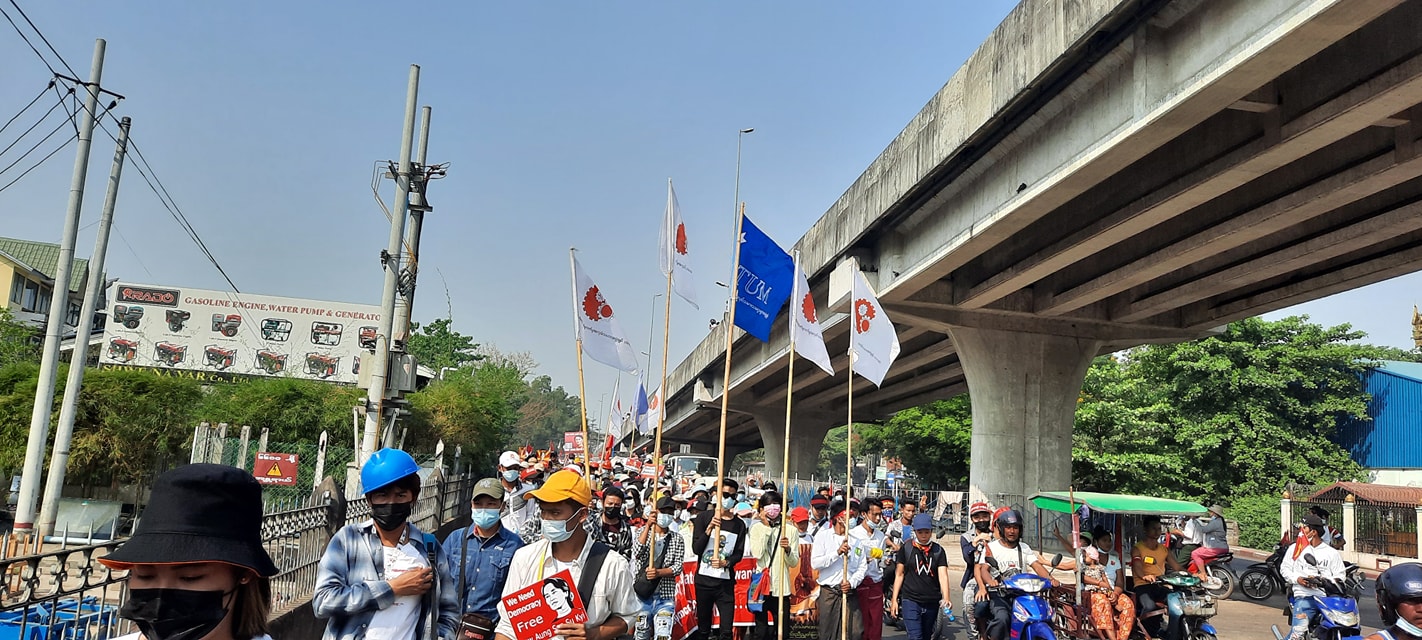
The 22222 general strike marks today’s date, 22 February 2021, was called by a general strike committee consisting of political parties, trade unions, farmers’ organizations, student movements and the other groups.
IndustriALL Global Union affiliate Industrial Workers’ Federation of Myanmar (IWFM) mobilized thousands of workers in the Hlaing Thar Yar township, Yangon. The protesting workers carried placards saying “We demand democracy”, “Free our leaders” and “Free Aung San Suu Kyi”, waiving the flags of IndustriALL affiliate Industrial Workers’ Federation of Myanmar (IWFM) and Confederation of Trade Unions in Myanmar (CTUM).
Khaing Zar, IWFM president, says:
"This is a battle for democracy. We must understand that under a military regime, there are no worker's rights or human rights, everyone will live with fear and stress, no workers’ complaint or protest will be allowed anymore.
"Before 2010, workers lived with low wages and long working hours, they could only get whatever employers gave, no guarantee of minimum wage and social security. If the dictatorship returned, investment will leave the country, many people will be out of jobs."
According to local media, hundreds of thousands of people flooded the streets of Yangon, Mandalay, Naypyitaw and Pyinmana, demanding an end to military rule. Many businesses decided to close, in sympathy with the pro-democracy movement
IndustriALL Global Union general secretary Valter Sanches says:
“We stand in solidarity with our brothers and sisters in Myanmar during their struggle to restore democracy in their country. IndustriALL will continue to provide necessary support for the workers and unions who play an important role in pushing back against the military.”
To date, more than 100 elected parliamentarians and chief ministers, including Aung San Suu Kyi, have been arrested by the military.
Ford workers in Brazil seek alternative ways to protect jobs
The Taubaté metalworkers’ union (Sindmetau) signed an agreement with Ford during a conciliation hearing at the regional employment tribunal on 18 February. It was agreed that talks would be held with the US carmaker's global management team on 25 February to try and prevent Ford from shutting down operations in Brazil.
Under the agreement, jobs, wages and benefits of Taubaté workers will be maintained until the end of the negotiations, and production will resume on 22 February.
Workers will continue to campaign to protect their jobs; they recently held a three-hour procession from the Ford plant in Taubaté.
The Camaçari metalworkers' union attended a conciliation hearing at the regional employment tribunal (TRT5-BA) on 18 February. They agreed that plant workers would return to work on 22 February, and Ford agreed to pay their wages for three months, giving time for talks to take place between the parties.
In addition, the Human Rights Committee met with representatives from the unions, the judiciary, parliament and other groups to look into the possibility of introducing a bill to nationalize the carmaker's operations in Brazil. Their aim is to reverse the impact of the plant closures and deindustrialization in the country.
Unions from around the world have sent letters of solidarity, calling for active industrial policies that put workers' interest on the same level as those of company owners.
Valter Sanches, IndustriALL Global Union general secretary, says:
"I congratulate Ford workers and unions for fighting to protect their jobs. They have already come out victorious – the employment courts have ruled favourably, paving the way for further negotiations. I'm grateful for the solidarity unions around the world have shown with colleagues in Brazil.”
ACT brands condemn Myanmar coup
This is the first public statement from any segment of the business community on the coup in Myanmar. The brands – Bestseller, C&A, Esprit, H&M, Inditex, Lidl, New Look, Next, Primark, Tchibo and Tesco – declared that “as businesses, we are committed to fully respecting human rights and labour rights in our operations and supply chains, in particular, the right to freedom of peaceful assembly, freedom of opinion, and freedom of association under the Universal Declaration of Human Rights.”
In 2019, the brands committed to Freedom of Association guidelines in Myanmar, recognizing the democratic right of workers to organize freely. Today’s statement carries this commitment into the political arena, by affirming the brand’s commitment to human rights, including freedom of assembly and speech. The statement concluded:
“Responsible business requires a context where fundamental human rights are respected.”
ACT – Action, Collaboration, Transformation – is a groundbreaking agreement between global brands and trade unions to transform the garment, textile and footwear industry and achieve living wages for workers through collective bargaining at industry level, freedom of association and purchasing practices. ACT is made up of 21 global brands and IndustriALL Global Union, representing its affiliate unions in garment producing countries.
IndustriALL condemned the military coup in a statement published on 1 February, saying:
“IndustriALL calls on the military leaders to acknowledge that the fruit of economic growth and improvement of living standard is a result of democratization and peaceful co-existence of multiple political party since 2011. Resorting to violence, conflict and undemocratic rule will defeat Myanmar’s effort to attract foreign investor and international economic development”.
IndustriALL general secretary Valter Sanches said:
“IndustriALL praises and supports this initiative of the business community that recognizes that democracy and respect for human and labour rights are imperative for business success and continuity. The reestablishment of democratic norms is imperative to keep jobs and new investments to improve the quality of life of Burmese people”.
In the statement, the brands commit to working with local factory owners and unions across more than 200 factories in the supply chain in Myanmar to ensure that freedom of association is implemented.
Three workers die under collapsing stack at ArcelorMittal South Africa
NUMSA reports that a rescue operation was carried out mainly by workers to retrieve the bodies of the deceased workers from the rubble as the company efforts were slow and inefficient. According to ArcelorMittal, a 90-metre-tall stack made of brick and stone over the coke oven collapsed and the rubble buried a monitoring booth with the three workers inside.
Kabelo Ramokhathali, NUMSA regional secretary for Sedibeng says:
“This is a terrible and devastating incident, especially for the families of the victims. They have waited and anxiously hoped that their loved ones could be found alive. Unfortunately, that was not to be. We send our deepest condolences to the family and friends of those who have passed away. NUMSA is calling on the Department of Employment and Labour to embark on a detailed and thorough investigation into the cause of this incident.”
NUMSA says ArcelorMittal has been “brutal” in the way it dealt with health and safety concerns raised by the union resulting in the dismissal of a shop steward who exposed poor health and safety protocols at the company prior to this accident.
Matthias Hartwich, director for the base metals sector of IndustriALL says:
“ArcelorMittal has promised that there will be a thorough investigation of the case, and that NUMSA will be invited to take part in the investigations.”
The sister unions forming the ArcelorMittal global union network provided their immediate solidarity. For example, in a solidarity letter Paulo Cayres and Maicon Michel, president and director of the International Affairs of the CNM-CUT of Brazil say:
“If the absence of an intervention team in charge of the company is confirmed, it is be a profoundly serious and intolerable event. We believe it is essential to establish the causes and responsibilities so that accidents like this do not have to happen again.”
Paule France Ndessomin, IndustriALL regional secretary for Sub Saharan Africa says:
“We have received the sad news of the deaths with a great shock and disbelief, and immediately joined the families of the deceased workers in mourning. The health and safety of workers should remain a priority and it is important to have emergency response teams on standby and always ready when such incidents happen. We expect the investigation will shad a light to what happened.”