Union campaign leads to South Korea ratifying core ILO Conventions

The Korean Confederation of Trade Unions (KCTU) and Federation of Korean Trade Unions (FKTU) have relentlessly campaigned for the ratification of ILO’s core Conventions. The unions held a joint press conference on 21 October 2020, calling on the government to ratify ILO Convention 87 and 98.

The ratifications of the Convention on Freedom of Association (C87), the Convention on Right to Organize and the Collective Bargaining (C98) and Convention on Forced Labour (C29) will require the South Korean government to take steps reforming its labour laws and protect workers’ rights.

Kim Man Jae, the president of Federation of Korean Metalworkers' Trade Unions (FKMTU) says:

“We will continue to fight for the ratification ILO Convention 105 on Abolition of Forced Labour. The government now needs to revise the Trade Union Act and must stop excessive interference in industrial relations.”

South Korea’s government has been under pressure from the European Union to ratify ILO’s fundamental conventions, as stated in the EU-Korea Free Trade Agreement, in force since 2011.


On 25 January this year, an EU panel of experts concluded that the Korean government violated the labour commitments in the agreement.
 
Kim Ho Gyu, president of IndustriALL affiliate the Korean Metal Workers' Union (KMWU) says:

“The ratified conventions are important legal guideposts for a comprehensive labour law reform to end union busting, to bring law and practice in line with freedom of association and to guarantee union rights for industry-level unions.”

“We thank the international trade union movement for the solidarity during our thirty years of struggles for ratification of the ILO conventions. We pledge that KMWU will continue the struggle throughout the supply chains of the Korean chaebol.”

International Trade Union Confederation (ITUC), European Trade Union Confederation (ETUC) and International Federation for Human Rights (FIDH) made an official submission to the panel of experts on 15 January 2020.
 
IndustriALL general secretary Valter Sanches says:

“The long history of workers’ rights violations in Korea seems to have come to an end thanks to the tireless historical fight and campaign of the Korean unions that led to this important victory.

As we welcome the ratifications of ILO’s core conventions, we expect South Korea’s government to promptly amend the labour legislation accordingly and most of all implement the conventions’ provisions.”
Sintracarbón fights for 450 jobs at Cerrejón, Colombia

According to IndustriALL Colombian affiliate Sintracarbón, on 23 February, Cerrejón threatened 450 workers with dismissal if they didn’t accept retirement. Some of the workers suffer from occupational health disorders.

According to the union, Cerrejón hired a law firm to communicate with the workers instead of engaging in a good faith dialogue with Sintracarbón. The company is offering the workers a sum; if they accept it is called a mutual agreement. If they don’t, they are dismissed without just cause and the sum will be lower. The workers are given a mere two hours to make the decision.

“We reject this unjustified massacre on labour. Sintracarbón’s national board of directors has just met and is evaluating what political or legal action to take,”

says Igor Diaz, Sintracarbón president.

Cerrejón, owned by multinationals Glencore, BHP and Anglo American, and Sintracarbón signed a collective agreement in November 2020, ending a 91-day conflict. The workers launched the historic strike to defend the collective agreement. In addition, the union rejected a work shift that would affect workers' health and eliminate 1,250 jobs.

Sintracarbón argues that the company has been looking for ways to reduce staff to save costs. However, the union believes that coal prices have begun to rebound and that, so far in 2021, the company has seen revenues of US$124.5 million, with profits above US$37.9 million, while exporting 2.5 million tons of coal.

Igor Diaz says that this shows that "the company is and will continue to be sustainable in the international coal market."

In a letter to Cerrejón, IndustriALL general secretary Valter Sanches, calls on the company to desist from its unfair labour practices.

“We urge Carbones del Cerrejón Limited to act in good faith, in accordance with the current collective agreement and to take into account the invaluable contribution and sacrifice of workers, to both the profitability and sustainability of the company.

“We ask you to reverse the massive layoffs and abandon the shift changes introduced earlier this year, as we believe it has led to a reduction of the workforce,”

says Valter Sanches.

Zambian mineworkers protest delays in redundancy payments

According to the Mineworkers Union of Zambia (MUZ), affiliated to IndustriALL Global Union, Vedanta Resources issued redundancy notices to 3881 mineworkers in December 2020 and promised that the workers would receive the benefits in three payments beginning on 1 March and then at six months intervals. But court challenges have put the payments on hold.

The workers were addressed by union leaders, the Member of Parliament for Nchanga Constituency, Chali Chilombo, and the District Commissioner for Chingola, Agnes Tonga, who concurred that Vedanta must stop its delaying tactics and pay the workers.

Speaking to the workers after the march, Joseph Chewe, MUZ president said:

“It is unfortunate that Vedanta always runs to the courts and delays the transition of the mining company. The company is using the law as a scapegoat to cling onto the mine which they have failed to run in the past. The courts must also consider the plight of the mineworkers when they decide on the Vedanta application in the Lusaka High Court.”


Responding to the protests, Vedanta says it is urging MUZ and other unions to open “a constructive dialogue with Vedanta and all parties to the benefit of KCM stakeholders, including KCM employees and the Copperbelt community.” Vedanta claims that it is willing to reinvest over US$1.5 billion to restart mining operations and is challenging the liquidation initiated by the state-owned Zambia Consolidated Copper Mines-Investment Holdings (ZCCM-IH).

Vedanta, which holds 79.4 per cent of KCM shares, has been in legal wrangles in the last two years with the government of Zambia which owns 20 per cent through ZCCM-IH. The government has invited bids from mining companies from Australia, Canada, China, Russia, Turkey, and other countries to buy KCM and says Vedanta violated its mining license and not paying taxes.

Paule France Ndessomin, IndustriALL regional secretary for Sub Saharan Africa says:

“When workers are retrenched, they lose their only source of income and are unable to provide for their livelihoods and those of their families. Vedanta should pay the mineworkers their benefits in a timeous manner to avoid worsening their suffering.”

IndustriALL, ITF and TUAC urge action on export credit to revive global economy

IndustriALL Global Union, the International Transport Workers’ Federation (ITF) and the Trade Union Advisory Committee (TUAC) are calling for OECD countries to protect jobs and revive the global economy by strengthening and coordinating:

“In theory, aviation is expected to be back at previous levels in 2025. But if it is to survive we need to keep the industry going now. Export credits are a way forward to stimulate the aerospace industry as that would facilitate orders and then deliveries,”

said Atle Høie, IndustriALL assistant general secretary.

“In addition, OECD policies on export credits would ensure the promotion of decent jobs and working conditions.”

Rob Johnston, ITF Assistant General Secretary said that it is vitally important that ECAs consider labour standards and sustainability issues before granting access to finance as this is the only way to ensure a level playing field.

“Both ITF and IndustriALL understand the importance of export credit agencies as millions of jobs rely on them. But it is also critically important to ensure that we link corporate behaviours to improving global labour practices,”

said Johnston.

ECAs could also promote the renewal of airline fleets, which will be necessary for the industry, not least from a climate perspective to reduce CO2 emissions in future aviaton.

The call for action follows months of cooperation between the global unions on export credits, culminating in a formal submission to the OECD Export Credit Agency in October 2020.

Heightened competition between countries has led to individual ECAs lowering their own policies that support jobs. Trade unions are particularly alarmed at competition from non-OECD members that are not party to the Common Approach framework. This underscores the need for OECD member states to work harder to coordinate policies to restore the global economy.

Human rights due diligence must also be strengthened and involve trade unions and other NGOs, especially during the ongoing pandemic. Workers can be the most effective means of identifying, monitoring, reporting and remedying negative environmental and human rights violations in businesses, industries and supply chains.

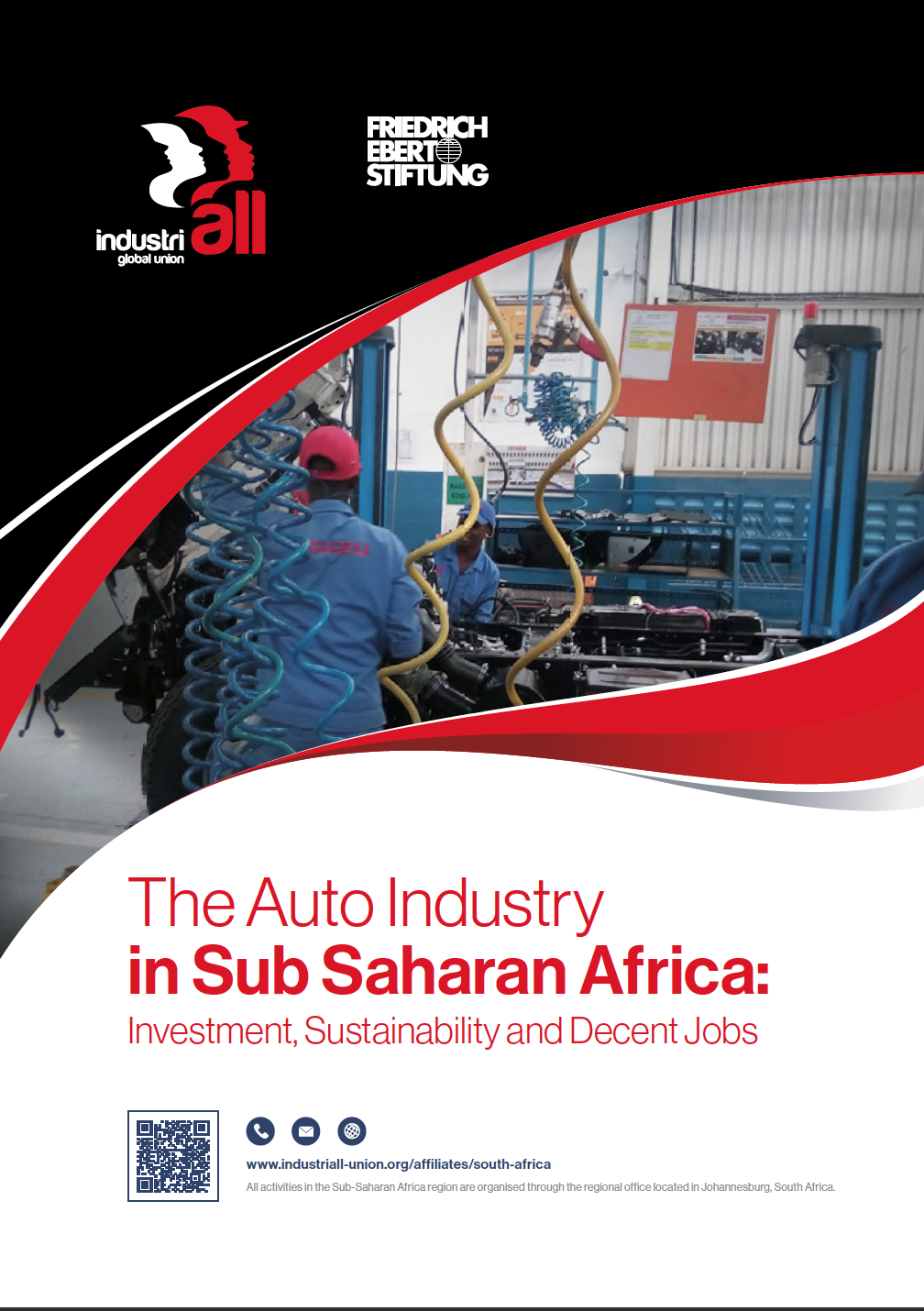
We want decent jobs in Sub Saharan Africa

According to a research report, The auto sector in Sub Saharan Africa: Investment, sustainability and decent jobs , commissioned by IndustriALL Global Union and the Friedrich Ebert Stiftung, IndustriALL affiliates in the region who organize auto workers are well aware that proper strategies are required to turn potential new investments announced by big auto companies into new opportunities for people and societies.

REPORTPAMPHLET
The auto industry in Sub Saharan Africa: Investment, sustainability and Decent JobsWe want decent jobs! Sustainable investment in the SSA auto industry

According to the report industrial policy strategies in most African countries include the auto sector. This is particularly true for Ghana, Ethiopia, Kenya, Namibia, Nigeria, Rwanda, and South Africa. Traditional industrial policies on auto manufacturing are aimed at attracting foreign direct investment through incentives that include tax exemptions, and establishment of special economic zones. In this context, some countries have signed agreements with major global auto players that include VW, Nissan, BMW, Toyota, and others.

Some countries and entrepreneurs try to go beyond the normal pattern and invest in genuine local brands and products. Ethiopia and Rwanda are exploring the production of electric vehicles. The report emphasizes that the effectiveness of the investments depends on “triggering local development and ensuring that any economic growth will have shared local benefits, create linkages with local economic activities, and generate quality employment opportunities.”

However, the region continues to face structural issues that include poor infrastructure, massive imports of used vehicles, skills deficits, financial instability, and unreliable energy supplies. Further, the Covid-19 pandemic has delayed the implementation of most of the investment plans.

Unions interviewed in the report say they want to fight the precarious nature of the industry to ensure that there are more permanent decent jobs to reverse the current trend. For example, in Nigeria over 70 per cent of the workforce in the auto sector is employed as precarious workers on a contract basis. This is the case in most of the other countries. The unions also want the auto employers to pay living wages.

Social and tri-partite dialogue are flagged in the report as important platforms for industrial policy engagement. This opens opportunities for targeted and joint policies regarding skills, working conditions, occupational health and safety and many other important items. Moreover, the coverage of collective bargaining needs to be expanded at all levels.

Paule France Ndessomin, IndustriALL regional secretary for Sub Saharan Africa says:

“This is an important report because it brings out how unions can influence job creation in the auto sector through policy engagement. Unions can also work together in solidarity in the region to address the common issues they are facing and participate in networks to improve wages and working conditions.”

Pulp and paper workers in Latin America fight for collective bargaining

Union leaders from Argentina, Brazil, Chile, Colombia, Peru and Uruguay met with regional and global representatives from IndustriALL to discuss the situation of paper and pulp workers in the region and come up with a work plan and timetable for the sector in 2021.

Kemal Özkan, IndustriALL's assistant general secretary, and Tom Grinter, director of chemicals and pharmaceuticals, pulp and paper, and rubber industries at IndustriAL, both addressed the meeting. Özkan spoke about how companies are constantly attacking workers' rights, particularly in the context of the global pandemic.

"We see workers' fundamental rights being undermined as a result of Covid-19 restrictions. In a number of countries, workers cannot negotiate collectively or hold strikes and peaceful assemblies. And reforms are being brought in to dismantle employment legislation. We need to show a united front and stand together to overcome these challenges,"

said Özkan.

Both IndustriALL's regional secretary, Marino Vani, and the deputy regional secretary, Cristian Alejandro Valerio, agreed that is was important to remain united and keep moving forward with plans in order to address current challenges.

In addition, Grinter provided details of the union agenda for his sectors in 2021. He spoke about the need to strengthen company-wide union networks, especially in firms such as International Paper, Essity, Stora Enso, Amcor, Sappi, WestRock, Kimberly Clark, Norske Skog and CMPC.

Participants expressed their support for the workers of Finnish forestry company UPM, which has announced that, from 2022, it will no longer engage in any kind of collective agreements for salaried employees and that all terms of work will be negotiated on an individual basis. The company’s workers are being completely stripped of their rights to bargain and to equal pay and terms of employment.

This comes after the Finnish Forest Industries Federation announced that it was reforming its statutes and would no longer take part in nationwide collective bargaining. Instead all negotiations on working conditions will be conducted at the company level.

The Latin American unions expressed their concerns that this approach would spread to other countries and companies. In response, they agreed to continue working together in solidarity to fight for domestic legislation that safeguards their fundamental rights.

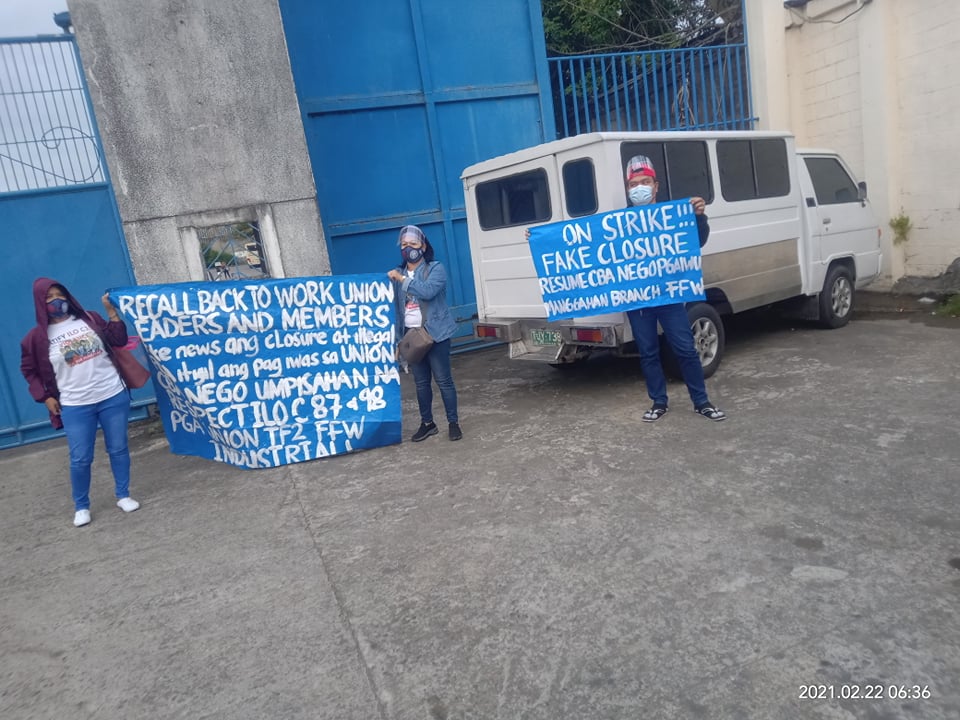
Strike action in Philippines over illegal factory closure

On 5 November 2019, IndustriALL affiliate Trade Federation on Garments, Textile, Footwear, Plastic, Leather and Allied Industries (TF2-KD) successfully organized the workers at PGA, obtaining the status of sole and exclusive bargaining agent (SEBA) for the PGA Union.

But instead of bargaining with the union in good faith, the company filed a petition for a cancellation of SEBA with the department of labour and employment, who re-affirmed the union’s status as bargaining agent.

However, on 21 September 2020, management informed all 173 workers that the factory would be permanently closed within a month. Severance pay cheques were distributed to all workers but rejected by local union officials, as it is in violation of the labour code.


The union has lodged a complaint of unfair labour practice with the district office of the department of labour. Union members have been on strike and held a rally in front of PGA head office in Makiling, Calamba City, on 24 February 2021.

Laudicia Casana, TF2-KD president, says:

“Local union leaders discovered that the company had opened a new factory in the export processing zone in Sto Tomas, Batangas, with same management team. This is an unscrupulous tactic commonly used by employers to avoid unions.

"The company must respect the union and convene a collective bargaining meeting immediately and all workers must be reinstated at the Manggahan factory with back pay.”

In a letter to the company, IndustriALL general secretary Valter Sanches condemned the union busting and urged the company to enter into social dialogue with TF2-KD:

“The employer must act in full accordance with national labour law and international core labour standards, please reinstate all workers and resume collective bargaining.”

IndustriALL calls on the ILO and the EU to intervene in Belarus

IndustriALL Global Union is again strongly denouncing the continuing violations of fundamental human and workers’ rights, attacks on independent unions and repression of union leaders and activists, in breach of international labour standards and norms, ratified by Belarus.

The recent police raids on the offices and homes of trade union activists clearly show that authorities are trying to intimidate everyone in order to discourage people from fighting for democracy and human rights.

During the brutal search of the office of IndustriALL affiliate, the Belarusian Radio and Electronic Industry Workers' Union (REP), police found a shotgun cartridge, which the union leadership claims had been planted to justify further repression. The find may result in allegations of terrorist activity with lifetime imprisonment or death penalty. Given the systematic violations of human rights and the lack of justice in Belarus, REP chair Vasily Zavadsky left the country to escape a very likely illegal detention.

IndustriALL affiliate Free Metalworkers' Union (SPM) has pointed out that employment contracts at Belarusian companies include clauses prohibiting participation in protests, freedom of opinion and its free expression; unprecedented violations of human and workers’ rights. This is the case of the large state-owned Minsk Automobile Plant, that employs 15,000 workers and exports heavy vehicles to dozens of countries worldwide.

Trade union rights and freedoms, including freedom of association, the right to organize union activities independently, are no longer guaranteed. IndustriALL affiliate Belarusian Independent Trade Union (BITU), reports that authorities deny registration of local unions, including the one at the Byelorussian Steel Works.

In a letter to the ILO, IndustriALL calls for urgent intervention, adopting all possible measures to stop the interference in trade union affairs by law enforcement agencies, and to end repression of independent trade union leaders and activists.

In the joint letter, IndustriALL Global Union and industriAll European Trade Union calls on the European Commission to once again review the current political and economic relationship with Belarus and use all possible measures to stop the anti-democratic and violent acts, to put an end to attacks on the independent trade union movement, and to demand the immediate release of all independent trade union leaders, activists and workers, and withdrawal of all charges against them.

IndustriALL general secretary Valter Sanches says:

“The independent and democratic trade unions play a critical role in promoting democracy, constructing a democratic governance and society in all countries around the world, and Belarus is no exception. At this important and difficult time of Belarusian pro-democracy uprising followed by repression, the independent union movement must be supported through high level political intervention from the European Union”.

Mongolian unions stop social insurance premium hike

On 26 Feb, while chairing the national tripartite meeting with representatives of trade unions and employers’ association, Mongolia’s minister of labour and social protection, A. Ariunzaya, conceded to the unions’ demands and announced that the government would scrap the controversial policy.

The social insurance premium in Mongolia covers various benefits, including pensions, industrial accidents, unemployment and health insurance. Prior to the hike, employers’ and employees’ contribution rates were 12.5 per cent and 11.5 per cent, respectively.

The president of Federation of Energy, Geology and Mining Workers’ Trade Unions of Mongolia (MEGM), Buyanjargal Khuyag, says :

“We thank the government for listening to the voice of workers. The majority of Mongolian workers oppose the premium hike, since they cannot enjoy many benefits after their retirement at 60. The average lifespan of Mongolian men and women are 66 and 76.”


Early February, the Confederation of Mongolian Trade Unions (CMTU) mobilized its 200.000 members in its 14 sectoral and 22 regional affiliates and held nationwide online demonstrations or face-to-face protests, demanding that the government stop the premium hike.

IndustriALL Global Union’s two Mongolian affiliates, MEGM and Mongolian Industrial Workers Trade Union Federation (MITUF) are affiliated to the CMTU.

Working together with CMTU, MEGM’s all branches started a petition campaign to stop the premium hike, until today it has collected 4,759 signatures from members in energy and mine sectors.

MEGM organized several online briefings with branch leaders, getting members to join social media campaigns by snapping and sharing photos online. Union members are advised to send text messages of their concerns to their members of parliament.

IndustriALL South East Asia regional secretary Annie Adviento says:

“We congratulate our affiliates on this union win. The government should amend the law to allow workers’ next of kin to receive the benefits, pension funds belong to workers.”  

Military in Myanmar cracking down on unions

Earlier this week, hundreds of thousands of people participated in peaceful mass demonstrations across Myanmar. As the peaceful civil disobedience movement continues to protest against the military takeover in Myanmar, authorities are cracking down on unions and their leaders.
 
Police have issued arrest warrants for 20 union leaders, the majority from the Industrial Workers Federation of Myanmar (IWFM), including the union vice president, Soe Lay.
 
According to reports from the union, plain clothes police are trying to find the union leaders who participated in the nationwide strike on Monday.
 
IWFM president Khang Zar says in a statement:

“IWFM has worked relentlessly to protect the rights and improve the lives of garment workers and their families since we were allowed back into the country after the previous dictatorship, back in 2012.

“Together, Myanmar’s people and the international community can bring back democracy. Through civil disobedience, protest and strikes, the people of Myanmar are speaking up clearly and loudly. We need the international community to do the same. We need you to stand by our side to make this coup collapse.”

To date, more than 100 elected parliamentarians and chief ministers, including Aung San Suu Kyi, have been arrested by the military.

“Unions play an important role in the fight to return democracy to Myanmar. We give our unequivocal solidarity support to our affiliates in the country and call for a return to the civilian-led government elected by the people,”

says Valter Sanches, IndustriALL general secretary.