ILO urges Belarus to stop repression and respect workers’ rights

Those who opposed the repressive regime and tried to peacefully exercise their fundamental human and workers’ rights have faced dismissals, intimidations, searches, interrogations, beatings, arrests, fines and heavy prison sentences, with a total ban on strikes. More cases of arrests are added every day.

On 23-24 March, several activists of the Belarusian Independent Trade Union (BITU) were detained, and the union links all arrests to the pressure on BITU and members of the strike movement. In Novopolotsk, police detained unionists at the oil company Naftan; the BITU deputy shop steward Sergei Lapunov, the deputy chairman of the BITU local union Andrei Shkirenko, the BITU local union activist and lawyer Alexander Kapshul.

Their homes were searched and all three were sentenced to 15 days of administrative arrest for an unauthorized picket. In Zhlobin, police detained BITU member Hanna Kalupakho, she was sentenced to ten days of administrative arrest for a video message, considered by the court as an unauthorized mass event. 

In the report, the ILO urges the government of Belarus to prevent human rights violations, ensure full respect for workers’ rights and freedoms, and requests, among other things, that

The ILO calls on the government of Belarus, with its assistance and in consultation with the social partners, to take the necessary steps to fully implement all outstanding recommendations without further delay.

IndustriALL assistant general secretary Kemal Özkan says:

“IndustriALL expects the government of Belarus to implement the recommendations, to comply with core international standards on human and workers’ rights and to immediately stop the repression against civil society.”

IndustriALL has called on the ILO for its urgent intervention to protect freedom of association and stop repression against independent trade union leaders and activists in Belarus.

Trade unionist killed in the Philippines

Dandy Miguel was shot eight times by unknown assassins while riding a motorcycle home from his workplace. Just before, Miguel had lodged a complaint with the Commission of Human Rights, criticizing extrajudicial killings of nine labour and NGO activists on 7 March, also called Bloody Sunday, in Calabarzon.

The Bloody Sunday happened after Philippine president Rodrigo Duterte openly called on security forces to gun down communists if they carried guns. But all of the victims were unarmed rights activists and community organizers attached to legal organizations.

“The assassins of Miguel must be arrested and brought to justice immediately. The family of Miguel and other victims must be entitled to state remedy and reparation,”

says IndustriALL general secretary Valter Sanches.

“IndustriALL joins the calls of the Commission of Human Rights that all crackdowns against human rights defenders, such as illegal arrests, harassment and terrorist tagging of trade unionists in the country, must end.”

Last year, the Council of Global Unions staged a global day of action against the extrajudicial killings and red-tagging of trade unionists in the Philippines. The Philippine government has yet to respond.

Miguel was president of Fuji Electric Philippines Union and vice chair of Pamantik-KMU, affiliated to IndustriALL through MWAP.

MWAP spokesperson Julius Carandang, says:

“We vehemently condemn the killing of Miguel, who was fighting for workers’ rights in the province. His murder is further proof of a widespread culture of impunity and a hostile climate for independent trade unionism in the country.

“The anti-terrorism law, the national task force to end local communist conflict has enabled the military, police and followers to label trade unionists and unarmed activists as terrorists. We join unions in the country to fight against violence and lawlessness.”

An ILO high-level mission on the killings of trade unionists is still pending due to the Covid-19 pandemic.

Fatalities explode at ArcelorMittal – unions demand urgent action

Unions decry the deteriorated health and safety conditions which resulted in a number of fatal incidents occurred at the sites of ArcelorMittal in Kazakhstan, Ukraine, Poland and Spain and most recently in South Africa where on 16 February three workers lost their lives under collapsed building at the ArcelorMittal plant in Vanderbijlpark.

On 9th March, the signatories of the ‘’Agreement on minimum requirements for Plant level Joint H&S Committees’’ with ArcelorMittal, IndustriALL Global Union, IndustriAll Europe and USW have sent a letter to the company, demanding an urgent health and safety committee meeting. In absence of an initial reaction from the company and given the urgency of the matter, on 24 March, worker representatives of the global committee and the signatory unions signatories came together and discussed the situation.

Having examined the existing worrying situation with health and safety at the sites of ArcelorMittal, the participants of the meeting adopted the “Statement of the Workers’ Group of the ArcelorMittal Joint Global Health and Safety Committee” which was officially forwarded to the company.  

In the statement, worker representatives and the signatory unions have stressed the necessity of joint efforts to protect the health of the workers at ArcelorMittal sites, particularly in time of pandemic. The participants have also payed attention to the extremely worrying escalation of fatalities at ArcelorMittal sites and the necessity of immediate joint action. At the same time, it was reminded to the company that trade unions consistently raised concerns about the lack of investment in site maintenance and health and safety at local level.

Worker representatives of the committee once again called for immediate actions that has to be taken by the company.

Ultimately, ArcelorMittal has responded announcing that a meeting of the joint global health and safety committee will take place in the coming weeks.

Goodyear and Cooper Tire unions committed to solidarity

On 25 March, more than 50 union activists from 16 countries attended a network meeting. Because of the announcement of the acquisition of Cooper Tire, representatives from that company attended as well. The acquisition of Cooper is expected to be completed in the third quarter of 2021, following the agreement of Cooper shareholders and the regulatory authorities.

The meeting was opened and chaired by Kevin Johnsen of the United Steelworkers, who celebrated the longstanding network, and stressed that the pandemic had shown how crucial unions are. Covid-19 has run rampant through non-union plants like Kumho Tire in Macon, Georgia, while workers at Goodyear’s unionized facilities have been protected.

IndustriALL Global Union assistant general secretary Kemal Özkan said:

“The long history of cooperation at Goodyear has served as a model for global unionism by bringing together the shopfloor representatives of a major multinational. This cooperation continues to deliver for our members as the industry goes through a new set of challenges.”

Özkan spoke about changes to production due to new technology, and changing mobility patterns that are affecting the auto sector and the industries that supply it. Tyre manufacturers are changing their portfolios and developing new products in cooperation with auto companies.

IndustriALL sector director Tom Grinter gave an overview of the company and the global tyre sector. Grinter spoke about industrial relations flashpoints in Indonesia and Mexico, and about the importance of the network in providing solidarity. He highlighted the case of the 44 union members in Indonesia who had been fired without cause in June 2020. They had been able to maintain their struggle for justice due to generous donations from the Thai unions.

In a number of countries, factories are running at full capacity with model Covid-19 adaptations and union representatives spoke about good plant-level industrial relations. According to reports, workers are tested regularly, and those who cannot work due to health concerns have been deployed or given leave on full pay.

Alaadin Sari, president of Turkish affiliate Lastik-İş, thanked the network for support which helped the union win a new contract with the company in 2020 covering all 2,100 workers at both plants.

Worker representatives of Cooper Tire and Goodyear in several countries expressed their concerns about the possible effects of the merger on their jobs and sites staying open.

The global network’s message to Goodyear management will be to reject any effort to play workers off against each other, to provide security for jobs, earnings and benefits with protections and to demand a long-term commitment to the existing sites.

Building union power at Stellantis, Morocco

The auto industry in Morocco is booming and its supply chain widening fast with the arrival of new players from across the world. With its 135,000-strong workforce, the industry has become primary export sector and plays a pivotal role in the country’s development.

The Stellantis plant in Kenitra comes out of a major investment by French auto giant PSA in recent years. Since 2019 the workforce has grown to 3,000 employees, and there are plans to make it the largest automotive operation in Morocco.

Often unions face difficulties in organizing and operating in the special economic zones (SEZ) as employers try to keep them out. UMT reached a first major breakthrough in 2012, when organizing the Renault factory in the Tanger SEZ. In both the case of Renault and that of Stellantis, the global framework agreements IndustriALL has signed with the car manufacturers, together with global solidarity, played important roles.


There was a first meeting between the PSA management in Morocco and the unions in 2018, during the IndustriALL MENA auto network meeting in Casablanca.

UMT general secretary Miloudi Moukharik says:

"This success is the result of our continuous work to strengthen union work in the relatively new industries in Morocco, including aerospace and automotive, where large numbers of multinational companies and their supply chains operate. International solidarity from IndustriALL has been important. We are prioritizing a fruitful dialogue with the company with the aim of developing a collective agreement that promotes stability and cooperation between the union and the management.”

After years of groundwork, UMT Kenitra leaders and young union leaders who have been trained within the framework of the IndustriALL youth programme, have played an active role in organizing at the factory.

At a crucial moment of wining the recognition, the new union successfully organized a general assembly with the participation of 300 workers, as more members joined the union. Trainings for the new union members are expected to start next month. 

“Organizing workers at Stellantis is an important step forward and the result of many years of work with the support from  union building programmes, global framework agreements and company networks.

“IndustriALL will continue to support UMT’s efforts for the establishment of a national metal federation, bringing together the auto and wiring, electronics and ICT, steel and aerospace sectors,”

says Ahmed Kamel, MENA regional secretary.

“Throughout the organizing drive in Morocco we had no doubts that PSA management would honour the fundamental rights of freedom of association,”

says IndustriALL automotive director, Georg Leutert.

Stellantis N.V. was formed in January 2021, through the merger of Fiat Chrysler Automobiles and Groupe PSA. IndustriALL is currently in preliminary talks with the new company regarding continued transnational social dialogue and the application of fundamental labour rights.

Tackling overcapacity and health and safety in the steel industry

The over 120 governmental and employers’ delegates discussed recent developments in the steel sector during the Covid-19 pandemic. Global steelmaking capacity again increased in 2020 by over 1.5 per cent, reaching 2.45 billion tons at the end of 2020, despite a weak market and despite the pandemic. At the same time, actual steel production dropped sharply in many regions of the world, namely in North America and Europe.

Increasing overcapacity is a concern and urgent action is needed as global overcapacity can flood the international market and artificially drive down steel prices. Now more than ever workers call for international action to ensure a fair global level playing field which allows for fair international trade. TUAC, the Trade Union Advisory Committee to the OECD, is entitled to give workers a voice in the OECD Steel Committee.

On behalf of TUAC, Matthias Hartwich, IndustriALL steel director, addressed the delegations and submitted a statement:

“For us, it is essential to make sure that the employees who toil in the steel industry every day do not pay with their jobs and with their lives for the prosperity and the future of the steelmaking, regardless of whether it is in India, Europe, North America, Latin America, Australia or Asia. The health and safety of the employees in the steel industry have to be respected, and to this end we need real dialogue with the workers and their unions. This is crucial not only to tackle the consequences of the pandemic, but health and safety in general.“

Matthias Hartwich, IndustriALL

The steel industry plays an important role in achieving the goals of the Paris Climate Deal.  Investments in clean technology must come alongside concerted Just Transition plans for steelworkers, negotiated with the workforce and its unions.

Filip Stefanovic, economic policy advisor at TUAC, said:

“The Covid-19 crisis has negatively impacted the steel sector, with global output falling by approximately 1 per cent in 2020, mitigated by China, whose production grew by an impressive 9.5 per cent compared to a year before. Despite the fall in aggregate output in 2020, global capacity has increased by 1.6 per cent. The decline in steel trade and increasing global production overcapacity are not a consequence of Covid-19, but rather a long-term issue that accelerated in the context of the current economic downturn.

“International cooperation and an agreement to reduce illegal capacity are crucial in order to consolidate and improve sectoral resilience, which is key to defending existing jobs and paving the way towards a Just Transition in the steel industry.”

The growing overcapacity adds pressure on workers. Job losses must be limited, but the steady incline of fatal accidents among steelworkers, like lately in India, Spain, South Korea and South Africa, must be brought to a halt.

Unions argue that health and safety measures combined with real participation of workers and their representatives are the best way to keep Covid-19 infection rates low and also protect workers’ lives.

Judith Kirton-Darling, deputy general secretary, industriAll Europe, said:

‘’We need a global level playing field which ensures high levels of employment and environmental standards worldwide. Trade unions continue to call on the OECD steel committee to tackle global overcapacity and the dumping of cheap steel. This would allow for truly joint international efforts towards the production of high-quality green steel with all steelworkers’ employment rights being respected. The steel industry, and its workers, will play a vital role in achieving the goals of the Paris Climate Deal and companies need to invest both in clean technologies and their workforces.’’

Union in Georgia wins substantial wage increase

The collective bargaining agreement for 2021-2024 was signed on 26 February after six of online and office meetings between the Trade union of metallurgy, mining and chemical industry workers of Georgia and JSC Mina, with online participation of Şişecam Istanbul head office.

The average wage is currently GEL1150 (US$ 345); according to the new collective agreement, workers’ income may increase by up to 20 per cent.

Eleven percent income increase would be achieved through an annual wage indexation in line with the inflation rate, the payment of a 13th salary, a 50 per cent increase in the nightwork tariff, a ten per cent increase in the New Year's bonus, and a wider health insurance.

In addition, a bonus system will be in place, with an additional increase of up to nine per cent, provided targets are met throughout the year.

The first 3-year collective agreement was signed in August 2017 after more than a year of negotiations that followed on a month-long strike of 170 workers, paralyzing factory operations in March 2016.

Since then, social dialogue has imporved significantly. TUMMCIWG president Tamaz Dolaberidze says:

“Despite the periodically disputes, we have been able to successfully establish a way of communicating that contributes towards solving routine problems, and we can build the relationship based on the principle of constructive social partnership."

IndustriALL assistant general secretary Kemal Özkan says:

“We congratulate the union on this strong collective agreement benefitting the workers. We expect the company to fulfill its obligations, and the parties to continue the genuine social dialogue.”

The glass container factory in Ksani (JSC Mina) employs 160 workers and is owned by the Turkish company Şişecam, with 42 production plants and 22,000 workers in 14 countries.

Nexperia union launches campaign to reinstate leader

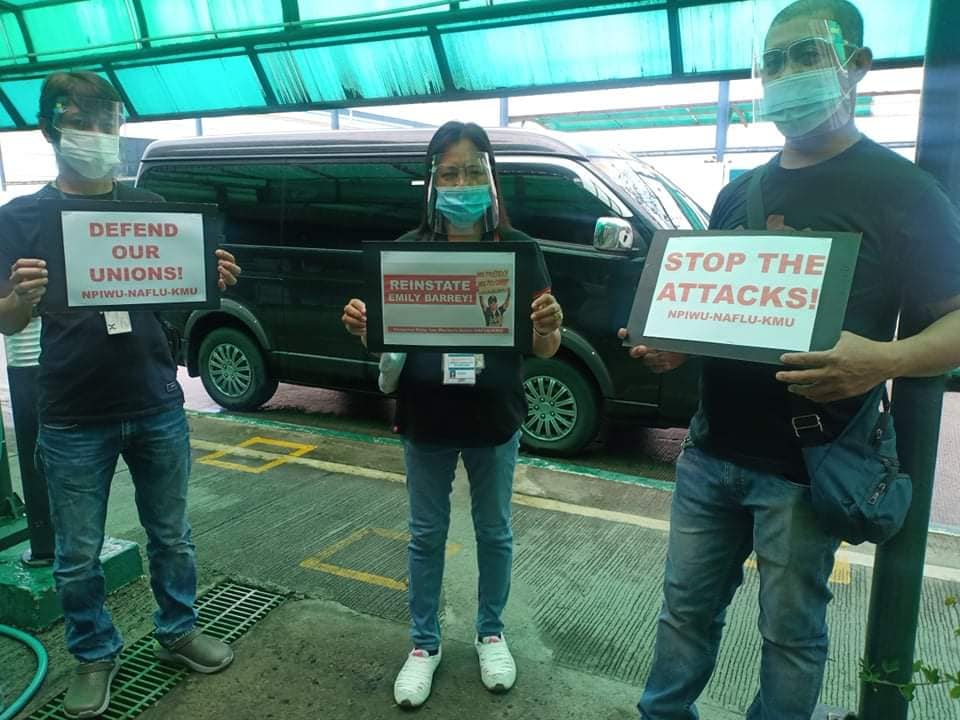
On 19 January, Nexperia Philippines Inc dismissed Emily Barrey for breaking the rule of maximum passengers in a company shuttle bus on 15 December 2020.

In an explanation to the company’s human resource department, Barrey says that she requested the bus driver to fetch four workers in addition to the maximum 28, as the night shift workers felt unsafe to stay at dark pick-up points at 9:30 in the evening.

The pick-up point has a history of crime, and in addition to worrying about their safety, workers were concerned about reaching the company in time for the start of their shift at 10 pm.

While respecting the health protocol set by the Covid-19 Inter-Agency Task-Force (IATF), the Nexperia union argues that dismissing a veteran union leader over a minor offence is not justifiable.


Despite the union fighting the dismissal, Nexperia refused to accept the reasons given and ended Barrey’s employment on 9 February. Another grievance procedure meeting was scheduled for 24 March, but company has informed the union that this is not needed as their decision to dismissed Emily is final.

MWAP spokesperson Julius Carandang, says:

"Emily has been a dedicated union leader and rights defender in Nexperia for nearly three decades. In the context of heightening attacks against unionists in the country, her dismissal by Nexperia is tantamount to union busting. We strongly denounce this act and we call for the immediate reinstatement of Emily."

Annie Adviento, IndustriALL regional secretary for South East Asia says :

“The Covid-19 pandemic has become an easy weapon for employers to attack trade unions and remove its leaders. IndustriALL is  fully support the campaign to reinstate sister Barrey; together, we will fight the rising authoritarianism in workplaces and societies.”

The Nexperia union is affiliated through IndustriALL Global Union through Metal Workers’ Alliance of the Philippines (MWAP).

Union in Hungary fights for increased salaries

Renegotiating the collective agreement, B Braun in Hungary are offering wage increases of between zero and five per cent, depending on the employee category, and are proposing to increase bonuses. The union is demanding an eight per cent increase of the base salary for all staff and is rejecting increased bonuses. According to the union, the bonus system, unilaterally introduced by the employer, often has unreachable targets.

During the month of March, the union organized a number of warning strikes, with nearly 100 per cent participation. For the first strike, the employer responded by sending the striking workers outside in freezing weather. After the union intervened, the workers could continue the strike in the warehouse.


“During this last year, employees have worked hard to meet targets as production continued throughout the lockdown. We can't accept the pandemic being used as
an excuse, and that all the burden is put on the employees,” says Balázs Bábel, Vasas vice-president.

“The employer is trying to create uncertainty among the workers, saying that our demands may lead to massive layoffs. But negotiations are continuing, and we are hopefully getting closer to a solution.”

Writing to the workers, general secretaries of IndustriALL Global and IndustriAll Europe jointly said:

“At this time of global pandemic, your employer should be taking extra steps to show its appreciation and respect for its employees. We know that Hungary has strict lockdown measures due to the virus. Moreover, we know that you made a serious effort to maintain the factory’s high level of production during the pandemic.”

Vasas and its members are receiving solidarity support from the B Braun Latin American trade union network, as well as from German unions and the Works Council, and Hungarian union VDSz.
 
The Gyöngyös plant of multinational B Braun produces medical devices and employs ,1600 employees. Around 1,000 of them are blue collars, out of which 650 are union members.

Finnish forest company UPM attacks workers’ fundamental rights

UPM is a multinational company having production plants in 12 countries and employing 18,000 employees among others represented by IndustriALL affiliates. The company is specialized in production of pulp and paper, timber and wood-based and associated goods and services.

Nearly 40 representatives of UPM’s employees in Finland wrote an open letter to the company management to express their deep concern over UPM’s inappropriate action.

The workers are outraged, as only in January the company promised to renew negotiations of the terms of employment and underlined how the collective labour agreements are beneficial to both the employees and the business.

However, already on 8 February UPM suddenly announced about their decision not to negotiate the terms of employment of its salaried employees at any level. Instead, the conditions would be determined without any collective agreement, meaning in practice that they would be unilaterally dictated by the employer.

In their open letter, the UPM employees strongly question the consistency of this conduct with the company’s values about mutual trust and believe this will inevitably affect their work motivation. Workers demand that the company keeps its promises and demonstrates its responsibility by undertaking collective bargaining negotiations on salaried employees with unions representing them.

In full solidarity IndustriALL Global Union joined the demands of the UPM workers and their unions. In his letter to the company Valter Sanches, IndustriALL general secretary said :

"IndustriALL Global Union finds your attempt to jettison a well-established system of collective negotiation unacceptable. If UPM continues down this path, it will be a long-remembered betrayal of your employees that came in the centre of a global pandemic that is already causing massive damage and upheaval for workers and their communities. There can be no other explanation for breaking such a well-established collective bargaining system, other than to facilitate a subsequent company attack on rights and conditions of all employees. We will oppose this."

Sanches further wrote:

"We urge UPM to desist from trying to impose individual terms and conditions of employment via individual appraisals. Instead, UPM should live up to its promises and demonstrate its responsibility by undertaking collective bargaining negotiations with our affiliated unions, Finnish Paper Workers’ Union Paperiliitto, the Finnish Industrial Union Teollisuusliitto, and Trade Union Pro."

In February the union delegates of the network of federations and unions of the pulp and paper sector in Latin America expressed their solidarity with their Finnish colleagues. Latin American unions are concerned that UPM’s way of acting could spread to other companies and countries. Therefore, they pledged to work together in solidarity to demand legislative measures in their countries that would protect workers’ fundamental rights.


PHOTO CREDITS:

Shutterstock / Riverlake, Upm Kaukaa paper plant pipes in Lappeenranta, Finland

rikumakela / Shutterstock.com, UPM paper mill chimneys, February 14th, 2020