Kan Matsuzaki was elected Assistant General Secretary of IndustriALL Global Union at its 3rd Congress on 14-15 September 2021. He was previously ICT, electrical & electronics and shipbuilding-shipbreaking sector director at IndustriALL.
Earlier in his career, in 1998, Matsuzaki joined the Japan Council of Metalworkers’ Unions (JCM), an umbrella organization representing a broad range of unions in Japan’s metal industry such as automobile, steel, shipbuilding, machinery, electrical and electronics. He was responsible for coordinating and instituting industrial policies on strengthening the manufacturing base and securing sustainable jobs. He was given specific tasks to promote international solidarity throughout metalworkers in Southeast Asia.
In August 2010, he joined International Metalworkers’ Federation(IMF) and was responsible for Shipbuilding and Non-Manual workers until the formation of IndustriALL in 2012, when he was appointed director of ICT, Electrical and Electronics and Shipbuilding and Shipbreaking. In the both sectors, he has been active in expanding union networks, promoting sustainable industrial policy and leading organizing projects (for shipbreaking workers in South Asia and ICT EE workers in Southeast Asia), which have been successful in organizing precarious workers.
IndustriALL’s 3rd Congress elects new leadership to overcome challenges
The world's unions and their workers face several crises, growing inequality, changing forms of work, climate change and now the pandemic. Workers need strong organizations to build a pathway through these crises, and to ensure that workers don't pay the price.
IndustriALL’s 3rd Congress was a crucial meeting for the global trade union movement, as it will influence the priorities of unions in the mining, manufacturing and energy sectors across the world for the next four years. A virtual meeting meant that more people could participate; the Congress welcomed more than 3,000 delegates and observers from more than 100 countries.
Although the meeting was held virtually and not in South Africa as planned, the spirit of the anti-apartheid struggle was present throughout the Congress, with music, historic posters and a video. Delegates were reminded of how Black workers organized into unions to take on the might of the apartheid state and bad bosses, and won. What lessons do they have for today’s labour movement?
Delegates paid a fond farewell to Valter Sanches, who stepped down as general secretary.
Online elections were held for a new leadership team. Atle Høie, former assistant general secretary, was elected as general secretary. Jörg Hofmann, president of German union IG Metall will continue as president of IndustriALL. Kemal Özkan was re-elected as assistant general secretary, and was joined by Kan Matsuzaki, previously ICT, electrical & electronics and shipbuilding-shipbreaking sector director at IndustriALL, and Christine Olivier, international secretary at South African union NUMSA.
There are also six new vice-presidents from IndustriALL regions:
Asia-Pacific – Akira Takakura, Japan
Latin America and the Caribbean – Lucineide Varjao, Brazil
Middle East & North Africa – Abdelmajid Matoual, Morocco (2021-2022), Hashmeya Al Saadawi, Iraq (2022-2023), Saleh Kandil, Morocco (2023-2024), Habib Hazami, Tunisia (2024-2025)
North America – Anna Fendley, USA
Sub-Saharan Africa Joseph Montesetse, South Africa
Europe – GarbineaEspejo, Spain (first two years) Marie Nilsson, Sweden (next 2 years)
Winning the war on workers’ rights
In his opening statement, IndustriALL and IG Metall president Jörg Hofmann spoke about the need for vaccine justice: the pandemic has left millions without income, too many have died, human and workers’ rights have worsened, and there has been a rise of discrimination and segregation. Poor countries have very low access to the vaccines.
“This is profoundly unjust: we need a fair, global distribution of vaccines.”
As Congress delegates debated the proposed action plan for the next four-year period, IndustriALL general secretary Atle Høie stressed the need for input from affiliated unions:
“Workers’ rights are trampled on and under attack every day of the year. We have every right to expect that these rights, recognized by the OECD, UN bodies and many governments, are respected. We are the organized force that stands between multinational corporations and complete dictatorial power over the entire production process. How do we win the war of rights?"
IndustriALL general secretary Atle Høie
Assistant general secretary Christine Olivier spoke about building union power:
“We need to go back to basics, to build democratic, worker-controlled unions that deliver. Any agreements reached, including global agreements with multinationals, must advance workers' rights.”
Assistant general secretary Kan Matsuzaki made an introduction on confronting global capital:
“We need more powerful international tools to impose binding obligations to multinational companies, not only asking them to respect the fundamental workers’ rights.”
Introducing the discussion on sustainable industrial policy, assistant general secretary Kemal Özkan said:
“The global labour movement has a historic responsibility to confront the megatrends that influence the future of work, including climate change, digitalization and industry 4.0. We demand a Just Transition.”
After many speakers took to the floor to discuss and debate, Congress delegates moved to adopt the ambitious action plan on advancing workers’ rights, building strong unions, confronting global capital and sustainable industrial policy.
Solidarity is central to IndustriALL, and Congress adopted a number of resolutions. Trade union leaders from Algeria, Belarus, Korea, Eswatini, Indonesia and Myanmar spoke of the difficult situations in their respective countries, where trade union work is paralyzed due to the massive attacks on workers’ rights.
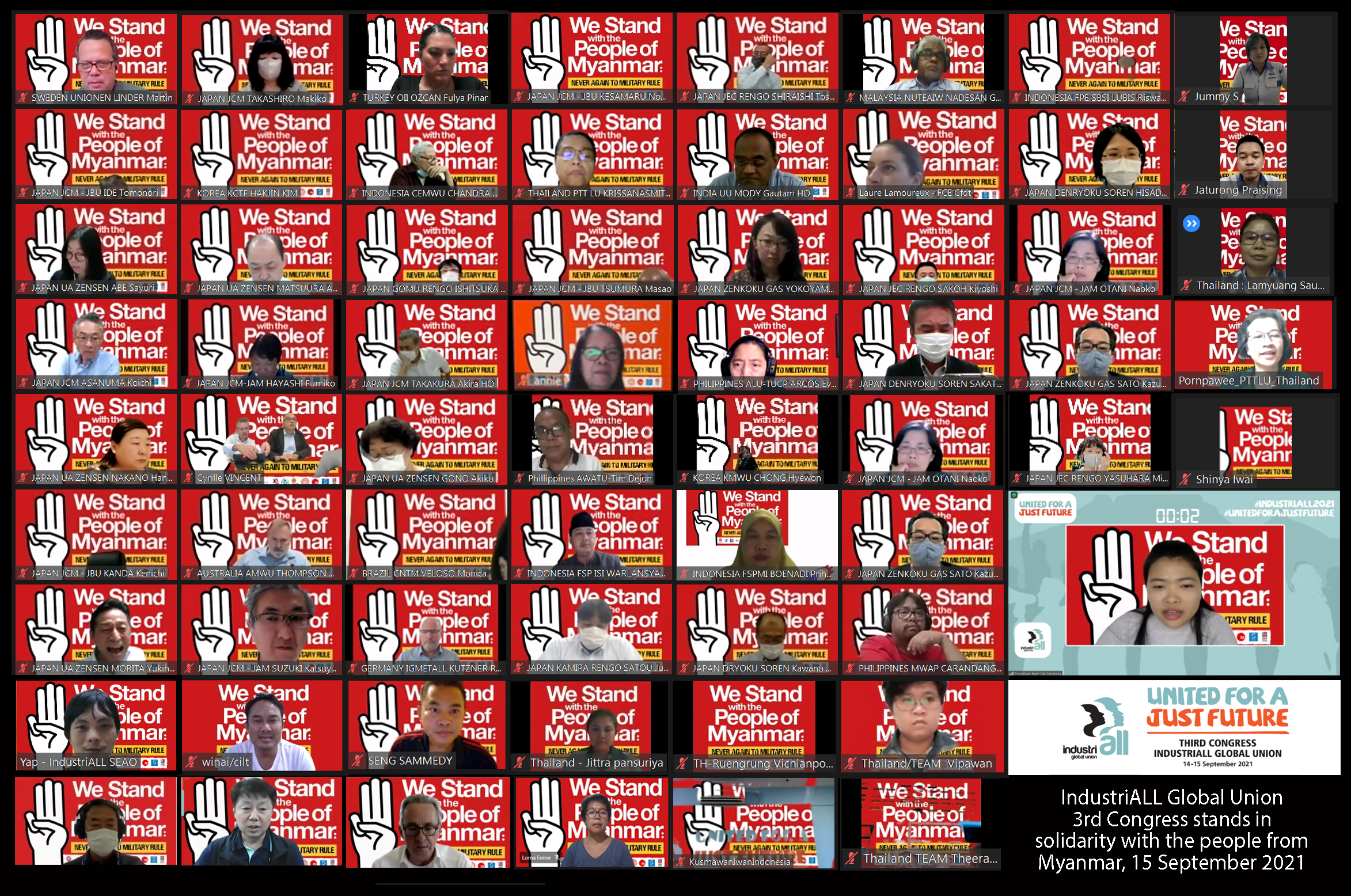
Khaing Zar, president of Industrial Workers Federation of Myanmar (IWFM), introduced the resolution on Myanmar, which coincided with the global union day of action on Myanmar.
“My country is run by military thugs, killing and imprisoning working women, men and activists. It is time to intensify the campaign; workers in Myanmar need your help now more than ever. Thank you for your solidarity and support.”
Maksim Pazniakou of Belarus reminded Congress of the terrible repression being experienced in Belarus, where many of his trade union colleagues have been imprisoned and how the support of the international union movement is crucial.
Discussing the resolution on youth, Amy Bracegirdle from AMWU, Australia, said:
“The structures that have enable many union leaders to develop their skills and commitment to the cause of labour have changed. Young workers are often at the sharp end of rights violations. To advance workers’ rights, Congress should pass the youth resolution, to create more space in union structures for young workers.”
Congress also adopted resolutions on Afghanistan, on cooperation with other global unions, on building a strong, united and vibrant Industriall Global Union and to address sexism and gender-based violence in union structures.
Monica Veloso, of CNTM Brazil, spoke of how the pandemic made the precarious situation of women worse:
“We must fight for the ratification of ILO C190 to fight against violence and harassment in the world of work. There is no future without equality: we need to send a message to the world’s working class that women leadership in our global union is critical to the future of the global trade union movement.”
For more coverage of Congress, along with images and quotes from the more than 200 speakers please visit YouTube, Flickr, Facebook and twitter.
Resolutions
Building a Strong, United and Vibrant Industriall Global Union
Three Zimbabwean textile, garment, shoe, and leather unions merge
The three unions that merged – the National Union of the Clothing Industry (NUCI), the Zimbabwe Leather, Shoe and Allied Workers Union (ZLSAWU), and the Zimbabwe Textile Workers’ Union (ZTWU) – agreed to work collectively in strengthening recruitment and organizing towards building a stronger union. As part of its plans to be inclusive, the CLTWF also formed youth and women committees during the launch.
However, the CLTWF is confronted by many of the challenges that the sector is facing globally. Further, in Zimbabwe the challenges are worsened by an economic crisis that has seen factories close and workers retrenched while wage theft is spreading.
The working conditions in the sector are precarious. In some instances, working days have been reduced and wages are low with some workers saying they earn $8 000 Zimbabwe Dollars (US$94 on the official rate and US$57 on the parallel market). The Consumer Council of Zimbabwe says a family of six needs over $40 000 Zimbabwe Dollars per month, and this means the current wages are not enough for workers to pay for their basic needs.
According to reports, the decline in manufacturing industries caused by the country’s deindustrialization, weakened the cotton-to-clothes value chain and leather and shoe manufacturing. Further, the unstable local currency, foreign currency shortages, high inflation, and huge imports of second-hand and cheap clothing is adversely affecting the sector. Economic policies are also failing to revive the textile and garment industries.
Joseph Tanyanyiwa, the newly elected general secretary of CLTWF says:
“Although the merger is long overdue, it is an opportunity to plan collectively and shape the future of our sectors by fighting for workers’ rights, living wages, and organizing more members. We would also like to thank IndustriALL, national affiliates, and unions in Sub Saharan Africa for supporting the merger and for giving us support in developing our five-year strategic plan.”
“We welcome the merger as it brings unity and strength to the union. This is important in building union power in the textile, garment, shoe and leather sectors in Zimbabwe considering the challenges that have been brought by the Covid-19 pandemic and the economic crisis,”
says Paule France Ndessomin, IndustriALL regional secretary for Sub Saharan Africa.
Union adopts a decent work campaign strategy for organizing artisanal and small-scale miners in Ghana
The union explained its strategy at the Friedrich Ebert Stiftung-IndustriALL crossing the divide project workshop on 2-3 September in Accra. The project aims to complement the International Labour Organization Recommendation 204 on transition from the informal to the formal economy and promotes the use of innovation by trade unions in engaging with the miners.
The aims of the workshop were to bring together key stakeholders: trade unions, researchers, civil society organizations, government, ASM associations, traditional authorities, communities, and other stakeholders to find ways of improving the sector. According to the GMWU, this could be done through using the decent work pillars of full and productive employment, rights at work, social protection, and promoting social dialogue and international labour standards. Further, emphasis was put on health and safety.
The hybrid workshop had 20 participants in the conference room whilst others attended online. The participants included officials from the Ministry of Lands and Natural Resources, representatives from the Ghana National Association of Small-Scale Miners and from the trade think tank, Third World Network Africa. Others came from the GMWU and the FES-Ghana and South Africa Offices.
Abdul-Moomin Ggbana, the general secretary for GMWU said:
“Calls to formalize artisanal and small-scale mining fit into the mission of the Ghana mineworkers. We want the miners to be involved in social dialogue, enjoy their rights at work, and to have their operations registered. This will promote decent work which will benefit ASM.”
“Ghana is amongst the important actors that provide us with a model of recognition, formalizing, and organizing ASM that is inclusive of women’s rights. Following our meeting in Johannesburg in 2019, there were recommendations on taking the programme forward through learning and sharing of strategies and tactics. This is one of the purposes of this workshop,”
said Shane Choshane, FES-Trade Union Competence Centre, project manager.
He added that while South Africa is currently considering formalizing ASM, Ghana is a step ahead and already has laws for the registration and licensing of the sector.
Glen Mpufane, IndustriALL director for mining said:
“It is important to create a decent working environment and due diligence in ASM. Occupational health and safety are important for the sector. With informality, workers are exposed to dangerous working conditions including landslides and dangerous chemicals such as mercury. Other dangerous work includes manual rock crushing, and this means miners are at risk of injury and death every day when they enter the mining sites with no protection.”
Gender inequality and gender-based violence were other areas of concern that were discussed in the workshop and the situation in Ghana was presented by a labour and gender expert Bashiratu Kamal.
“Like in most mining activities, women in ASM do the least important tasks, earn the lowest money, and face gender-based violence and sexual harassment. This is caused by gender inequality that is common in mining operations which is worsened by informality. This is where stakeholder engagement by trade unions on gender responsive due diligence is essential as an intervention,”
said Armelle Seby, IndustriALL gender coordinator.
According to reports there are about one million artisanal and small-scale miners in gold mining in Ghana who are producing about 35 per cent of the country’s gold. This is about 60 per cent of the country’s labour force. The miners are said to look after households that make up about 4.5 million people.
The Ghana workshop is the first in series of meetings that will take place in the Democratic Republic of the Congo and Zambia to discuss ways of improving mining and working conditions in the ASM sector.
IndustriALL Congress joins global day of action against military junta in Myanmar
Since the military seized power in Myanmar on 1 February this year, hundreds of thousands of citizens and workers have participated in peaceful demonstrations. Trade unions have been central to the organization of the Civil Disobedience Movement (CDM) against the coup and the brutal violation of human rights, extrajudicial killings, arrests, rapes and the destruction and burning of villages, hospitals, churches.
At least 1,088 people have been killed by the military, over 8,100 people have been arrested and over 1,983 arrest warrants have been issued. The UN estimates that 230,000 people have been displaced since 1 February.
Trade unionists and workers taking part in the demonstrations are being hounded by the military. Many trade union leaders have gone into hiding, several have been arrested and many have had their passports declared void.
During its third and wholly virtual Congress, a resolution on Myanmar was adopted, introduced by Khaing Zar, president of Industrial Workers Federation of Myanmar (IWFM).
“My country is run by military thugs, killing and imprisoning working women, men and activists. It is time to intensify the campaign; workers in Myanmar need your help now more than ever. Thank you for your solidarity and support.”
The resolution calls for, among other things:
Support for the campaign for comprehensive economic sanctions against the military junta by calling on governments to put pressure on multinational companies and global brands to cease their operations, divest, stop placing new orders and halt their business relations in Myanmar
Demand the withdrawal of all arrest warrants against trade unionists and labour activists for their solely peaceful activities, and to demand an end to the attacks
Exert pressure on their national governments to demand for NUG credential recognition at the UN General Assembly
IndustriALL president Jörg Hofmann urged the 3,000 unionists who had gathered online to support the campaign on Labour Start, calling on the UN to reject the credentials of the illegitimate military junta of Myanmar.
IndustriALL closely coordinates its activities with the ITUC and other global unions under the the Council of Global Unions (CGU) to effectively end the military junta’ s reign of terror and restore Myanmar on the path to a democracy where working people and their representatives can return to the free exercise of their fundamental rights.
Eleven global unions are calling on their affiliates worldwide to support today’s global day of action on Myanmar, and have published a joint statement:
“A democratic system is fundamental to the exercise of trade union rights and fundamental freedoms. We express our strongest solidarity with the workers of Myanmar in every sector and from every profession who have sacrificed their lives, freedom and jobs to persist in the CDM, paralyse the military’s administration of the country and shut down its major economic activities.”
Follow IndustriALL Global Union Congress 2021 here!
Workers call for solutions after DOW announces plant closure in Argentina
Once the plant in Puerto General San Martín, Argentina, is closed, DOW will supply the whole of South America from its factory in Brazil. The multinational says that the decision has nothing to do with the economic crisis – the factory is a success, turns a profit and plays a key role in the country's economy. The firm's move is part of a global restructuring affecting factories in other countries as well.
After the shutdown was announced, the San Lorenzo General Workers’ Union (CGT) expressed its support for the SOEPU union of petrochemicals workers at DOW and said that it was ready to take action. The unions are calling for a dialogue in order to find a solution and intend to exhaust all possible avenues for negotiation.
"The CGT stands ready to help the union and is prepared to take any regional measures necessary,"
said Jesús Monzón, CGT's general secretary.
DOW has been reluctant to negotiate and intends to lay off the workers and shut down the factory. It would appear that DOW wants to maintain its monopoly and control over prices and is not prepared to negotiate with a potential competitor.
After a press conference at the San Lorenzo CGT headquarters, Mauricio Brizuela, SOEPU's secretary general, said:
"We want the plant will be declared a public utility, and we will keep campaigning if DOW doesn’t come up with a solution."
The workers want to keep their jobs and are calling for other companies to take over the running of the factory. Several companies have come forward and said that they would like to keep the factory running, like Petroquímica Río Tercero, part of the Piero Group producing related products. Some mattress producers have also shown interest.
Tom Grinter, director of chemicals and pharmaceuticals, pulp and paper, and rubber industries at IndustriALL, said:
"The SOEPU union at DOW is a key component of the international network of DOW and Du Pont unions. The network, which is run by USW, has the full support of IndustriALL Global Union. We stand firmly with our friends as they fight to keep the factory open."
IndustriALL Global Union condemns arrest of KCTU president YANG Kyeung-soo and demands his immediate release
An arrest warrant had been issued 20 days earlier by the Seoul Central District Court for organizing a rally, allegedly violating the Criminal Act provisions against general obstruction of traffic, the Assembly and Demonstration Act and the Act on Infectious Disease Control and Prevention.
IndustriALL Global Union vehemently condemns the arrest and considers it an outrageous, unacceptable attack on fundamental workers’ rights to freedom of association and peaceful assembly.
IndustriALL joins the International Trade Union Confederation in labelling the arrest warrant “wrong and disproportionate”, as participants observed social distancing rules and necessary precautions to prevent the spread of Covid-19, including wearing of masks and temperature checks.
IndustriALL Global Union demands that YANG Kyeung-soo is immediately released and that the Korean government stop using the pandemic as an excuse to crack down on the democratic union movement.
IndustriALL expresses its solidarity with KCTU.
Chinese smart phone producer violates workers’ rights in Turkey
Salcomp produces smart phones for Chinese Xiaomi, the second largest smartphone maker in the world. Salcomp was acquired by Chinese Lingyi ITech in 2019, but is headquartered in Finland with a production site in Turkey. There are around 800 workers on the site in Istanbul, with plans to increase the workforce to 2,000.
Working conditions at the Salcomp Turkey plant in Istanbul are untenable. During the pandemic, workers were forced to work eleven hours per day, although their contracts say eight hours. Overtime was imposed without workers’ consent and only partly paid. Breaks could only be taken at the managers’ discretion and since there was no canteen, workers had to eat in containers for a while. Many workers have been infected with Corona.
As a large part of the workers decided to join IndustriALL affiliate, Turkish Metalworkers’ Union (Türk Metal), Salcomp management launched a union busting campaign. Workers were intimidated, threatened and nine union members were dismissed, allegedly over a decline in performance.
However, it is clear to the workers and the union that the dismissals were done to scare off others from joining Türk Metal.
Salcomp management summoned workers to say that “union members have to resign from their affiliation with Türk Metal”, and that “the company will make the necessary improvements in their wages and working conditions”.
Management surrounded the factory with wire mesh to prevent any demonstrations. Workers are banned from using use their mobile phones, cutting off their communication with other workers.
Although the Turkish constitution rules that “workers have the right to form and join a union of their choice, and no one should be forced to withdraw from membership”, the reality is very different.
Earlier this year, company management proposed to provide shelters for workers to sleep in, to save time on transport. Dormitories in the workplace is a well-known concept for workers in Turkey.
IndustriALL assistant general secretary Kemal Özkan says:
“It is wholly unacceptable to treat workers like this in the 21st century with low wages, bad working conditions and union busting union. We urge Salcomp to immediately reinstate the dismissed union members and engage in good faith negotiations with Türk Metal, and we urge Xiaomi to assume its responsibilities and put an end to the exploitation.
"Chinese companies must learn to treat workers with dignity."
Xiaomi is a multinational electronics company founded in April 2010 and headquartered in Beijing. Xiaomi makes a wide range of electronics products, such as smartphones, laptops, home appliances, and consumer electronics.
Zimbabwean unions campaign against Covid-19 vaccine hesitancy
The unions announced their plans during an online health and safety meeting on 20 August. Several topics and questions were discussed during the meeting, including whether it is lawful for the employer to ask workers to produce vaccination certificates or negative Covid-19 test results taken in the last 24 hours as a condition for reporting for work. Health and safety rights that workers enjoyed during a global pandemic were discussed with reference to Zimbabwean labour laws and international labour standards.
The unions raised the issues as a response to a recent trend in which employers in the country were demanding vaccination cards, or negative Covid-19 test results when workers reported for work. This began after the government announcement that although workers will not be forced to vaccinate, those who chose not to will not be offered jobs, will be banned from commuting on public buses, and be excluded from Covid-19 benefits. However, unions say the employers must engage workers through social dialogue platforms and consult with unions to address vaccine hesitancy before issuing the notices.
As a response to the employers’ notices, the Zimbabwe Congress of Trade Unions has gone to court to challenge actions by state-owned telecommunications company TelOne which wrote to workers informing them that the unvaccinated would no longer receive Covid-19 allowances and be required to take immediate leave.
“Whilst workers have mixed emotions on Covid-19 vaccination, employers on the other hand must ensure the health and safety and well-being of workers. However, it seems information gaps are negatively impacting on the uptake of vaccines but slowly some workers are beginning to see the benefits after vaccination. As unions we are emphasizing that workers should be given enough information to convince them to agree to vaccination,”
says Eustace Chidhindi, the affiliates' occupational health and safety coordinator.
“It has been proven that vaccines can stop severe disease and death when one becomes infected with the coronavirus and encourage Zimbabwean workers to get vaccinated. Further, we urge workplace cooperation between unions and employers, and social dialogue on Covid-19 prevention and workers health and safety,”
says Paule France Ndessomin, IndustriALL regional secretary for Sub Saharan Africa.
According to the Ministry of Health and Childcare, the country has procured 13 million vaccines and vaccinated 2,582,705 people (single dose) and 1,636,498 (double dose) using mainly the Sinopharm vaccine from China. Current cumulative confirmed positive cases on 31 August were 124,773 with 4,419 deaths and 113,057 recoveries. The ministry says to reach population immunity 10 million people must be vaccinated.
IndustriALL affiliates in Zimbabwe are National Union of Metal and Allied Industries of Zimbabwe (NUMAIZ), National Union of the Clothing Industry (NUCI), the Zimbabwe Chemical, Plastics and Allied Workers Union (ZCPAWU), Zimbabwe Diamond and Allied Minerals Workers Union (ZDAMWU), Zimbabwe Energy Workers Union (ZEWU), Zimbabwe Leather, Shoe and Allied Workers Union (ZLSAWU), and the Zimbabwe Textile Workers Union (ZTWU).