Molex Malaysia must stop union busting

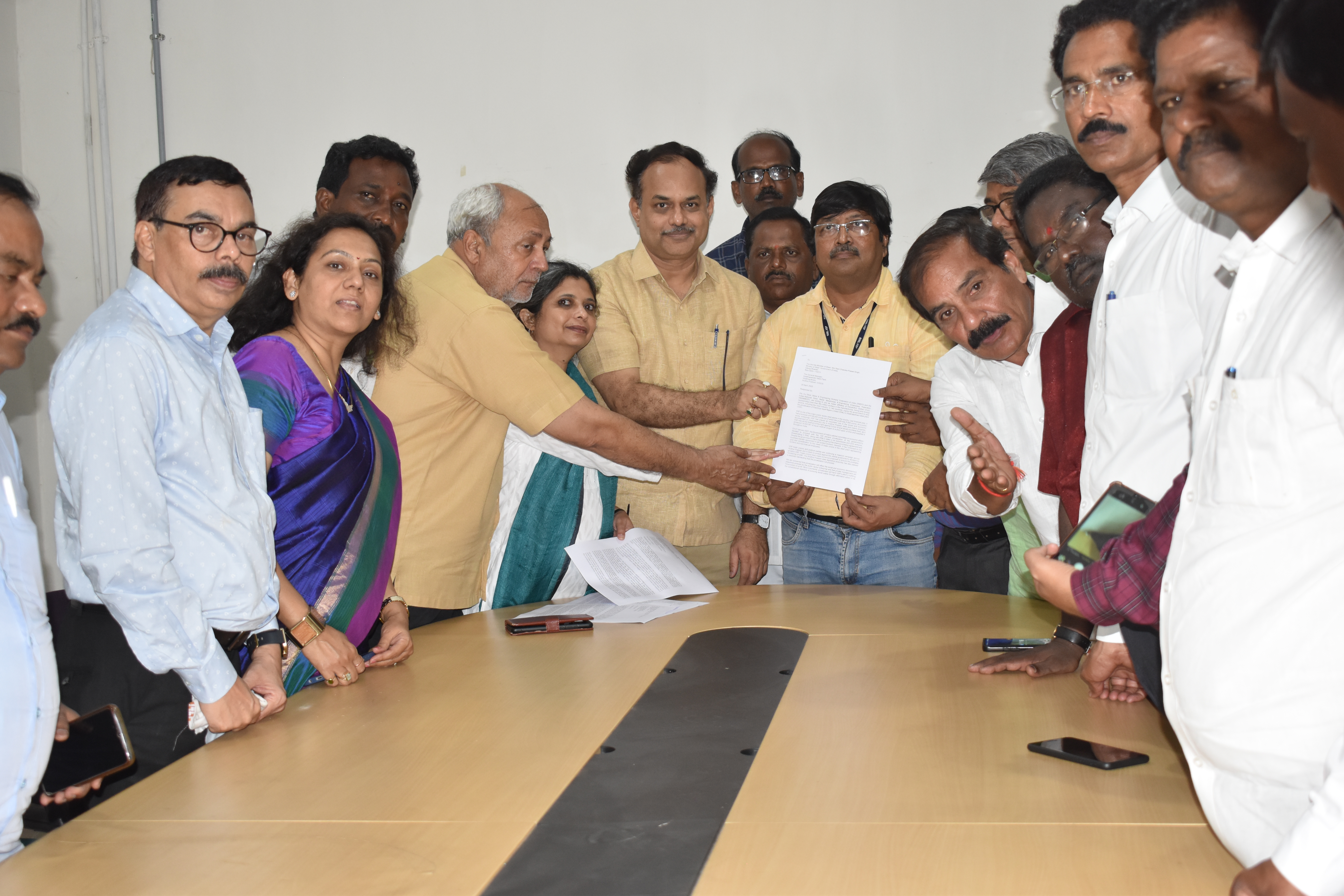
During a briefing at Molex Malaysia's Penang Plant on 7 February, management of Molex Malaysia warned workers not to vote for the Electronics Industry Employees Union Northern Region (EIEUNR).

According to the union, Molex Malaysia's management threatened workers that they won't receive bonuses and will have no future if they voted for the union.

A secret ballot scheduled for 22 February has been suspended by the Industrial Relations Department after the union lodged a complaint over the union busting.

EIEUNR president Mohd Razi bin Rahim says:

“Molex Malaysia has unfairly interfered in the process of claiming recognition. We demand a proper worker briefing provided by EIEUNR and the Industrial Relations Department to mitigate the damage done by the management.”

Malaysia's labour law prohibits employers from interfering in union organizing, yet workers in Malaysia often face intimidation when exercising their right to join a union.

In a letter to Molex chief executive officer Joe Nelligan, IndustriALL Global Union general secretary Atle Høie urges Molex to stop intimidating the workers and respect their freedom of association.

"We wish to remind Molex that through its code of conduct is committed to the non-discrimination principle and lawful employment practices, including respect for workers' freedom of association.”

The electrical and electronics industry is a key manufacturing sector in Malaysia, accounting for 35 per cent of the country’s total exports, employing about 560,000 workers.

Molex is a global manufacturer of electronic, electrical and fiber optic connectivity systems for various industries like data communications, medical, industrial, automotive and consumer electronics. The company employs more than 45.000 employees worldwide.

Unions call for policy intervention to save jobs at South African oil and gas refineries

Last week shareholders of Sapref, a refinery jointly owned by BP and Shell, announced that they will suspend operations by the end of March. Sapref refines 35 per cent of imported crude oil in Durban. The statement comes on the back of the closure of Chevron’s Astron and Engen’s Wentworth refineries, which will potentially lead to the retrenchment of thousands of workers.

South Africa imports most of its crude oil from the Middle East and African countries. In addition, Sasol produces refined petroleum products for domestic use through crude oil refining, coal-to-liquid fuels, and gas to liquid fuels. Additionally, natural gas to liquid fuels production is done by state-owned enterprise, Petrosa, which has also shut down its refinery.

IndustriALL Global Union affiliates that organize in the petroleum sector, the Chemical, Energy, Paper, Printing, Wood and Allied Workers Union (CEPPWAWU) and the National Union of Metalworkers of South Africa (NUMSA), say the government must intervene through sustainable industrial policies to save jobs. The unions say the closure of refineries will affect the downstream value chain activities that include the refining, transportation, and marketing of petroleum products.

Irvin Jim, NUMSA general secretary says:

“Government must put a stop to the clearly orchestrated agenda by multinational oil companies such as Shell and BP, Engen, Sapref and Chevron where these companies have taken a conscious, greedy decision to close refineries in South Africa and simply import the finished product, diesel and petrol into the country, using propaganda that crude oil is unaffordable, and citing government’s strict regulation on sulphur pollution.

“Our message to the government is that in the interest of the country, in particular the importance of stimulating economic growth and to preserve and create jobs, government must not allow these greedy multinational oil companies who have chosen a get quick rich scheme, to shut down our local refineries and to simply import finished products, abusing licences to import.”

“Multinational oil and gas companies must negotiate with unions to save jobs and protect workers’ interests and livelihoods instead of closing down refineries and retrenching thousands of workers. Whilst the move to cleaner energy sources is necessary to reach net zero, the transition to cleaner fuels and renewable energy must be done in consultation with, and include unions, workers and affected communities,”

says Paule France Ndessomin, IndustriALL regional secretary for Sub Saharan Africa.

Photo: File image of NUMSA members marching for Just Transition

Unions put pressure on UPM customers as Europe faces paper shortage

The prolonged strike will force the company to break commercial contracts to supply paper and is expected to lead to a Europe-wide paper shortage. Intergraf, the European printing industry association, has written to UPM calling for an end to the strike, warning that 40 per cent of the paper required by its members will not be available if the strike continues. UPM makes backing sheets for labels, which are used to label goods in all sectors, as well as material for packaging goods and publishing media.

Print and packaging companies are warning of an existential threat to the industry, saying that the unavailability of paper will hasten the shift to digital. UPM has written to some of its customers warning of its inability to meet its commitments, and claiming force majeure, a clause that limits liability for breaking contracts due to an unavoidable catastrophe, such as the Covid-19 pandemic.

Unions are calling on UPM customers to reject this claim, as the situation was avoidable, and is created by the company’s refusal to negotiate. In a 2021 judgement, the European Court of Justice ruled that force majeur was not applicable in a case of industrial action that met legal requirements.

UPM is trying to break decades of collective bargaining practice in the industry and at the company by refusing to negotiate unless its preconditions are met. Meeting these preconditions would dramatically weaken labours' bargaining position in future, and would leave groups of workers without representation. Workers at the company, represented by IndustriALL Global Union affiliates Paperiliitto (Paper Union), and Ammattiliitto Pro (Trade Union Pro), have been taking industrial action since 1 January.

Convenors for the Unite trade union – also an IndustriALL affiliate – at WestRock and Antalis in the UK were told by their employers of the impending paper shortage and UPM’s claim of force majeure. They approached the Finnish unions for clarity. At a global meeting of pulp and paper unions, the Finnish unions explained the situation and called on unions in other countries to put pressure on their employers to reject the force majeure claim.

The unions explain in a statement that the company can end the crisis by returning to the negotiating table and reaching an agreement that complies with general labour market policy in Finland:

“The Paperworkers’ Union and the Trade Union Pro consider that a ”force majeure” situation does not exist, but this is a conflict caused by the company pursuing its ideological objectives.”

Petri Vanhala, president of Paperiliitto, said:

“We want to get back to work at UPM. The industry standard has been set by our collective agreements with the other companies in the sector. The only barrier we face is an anti-union attack by UPM management, for ideological rather than business reasons.”

IndustriALL industry director Tom Grinter said:

“At a time when economic recovery from the pandemic is still fragile, we face a totally manufactured supply chain crisis. We need paper for everything: food labels, packaging, paper towel and print.

“UPM is holding Europe to ransom with its stubborn insistence on breaking collective bargaining. The company hopes to dodge its responsibilities by claiming force majeure. Unions will approach UPM’s customers directly to expose this tactic for the hollow sham that it is.”

IndustriALL affiliates represent UPM workers in Finland, Germany, Austria, France, UK, US, and Uruguay.

The president of the Timber and Related Industries Workers Union of Russia shows solidarity

Take Action

Download the poster below, print it out and take a picture of yourselves and your colleagues holding it.

A new supply chain industrial relations model for the textile and garment industry

Workers have borne the brunt of the breakdown of the textile and garment supply chain, brought on by the effect of the Covid-19 pandemic on the sector’s unsustainable business model.

Order cancellations have driven wholesale closure of thousands of garment factories, with millions of workers laid off in countries with no social safety net. This has highlighted the precariousness of the sector’s business model and the urgent need to establish sustainable models of supply chain industrial relations.

The recently negotiated International Accord further validates a new supply chain model of industrial relations, one that is cantered around binding rules, holding brands accountable for their impact on workers, rather than voluntary initiatives.

IndustriALL and its affiliates see this model as one that can be applied to other systemic problems in the supply chain. We intend to start the narrative on the change needed in the sector, including an urgent need for social protection for garment workers.

By social protection, we mean protective measures that are part of a worker’s basic rights and that underpin a robust and more equitable workplace. Among others, those measures include:

The current model, where severance is the only form of social protection, led to wage theft during the pandemic.

This is a continuum – from the Bangladesh Accord, which addressed worker rights and safety in one specific country, to the International Accord, that aims to extend those gains beyond Bangladesh, to an initiative for universal social protection that will seek to implant deep rooted and positive change for an entire sector.

Join us at our side session panel at the OECD Garment Forum on Tuesday, 22 February at 16:00CET for a discussion on a new supply chain industrial relations.

Speakers include: Jason Judd, ILR School/Cornell University, Ruwan Subasinghe, International Transport Federation, Kalpona Akter, BGIWF, member of IndustriALL executive committee, and Elizabeth Umlas, IndustriALL senior advisor on capital strategies.

Register here

Join us!

The Coats global trade union network was established last year. It’s the first union network made up of unions affiliated to IndustriALL in the Coats group, the world’s largest apparel thread and zipper manufacturer. Trade union networks are important tools in building global union structures through linking trade unions within a company.

The British multinational has operations in 27 countries. Several plants remain unorganized and working conditions vary from country to country, but members of the Coats global network are unified on building a strong global network. Through the creation of the Coats network, IndustriALL is addressing these issues and has written to the company and requested a dialogue to ensure sustainable industrial relations throughout the supply chain.

With no positive response from the company, the network called for a global day of action on 11 February. Coats unions who are members of the network urged unorganized workers to join them to make the network stronger. COATS unions all over the world took action by making videos, using the flyers for taking photos, posting them on social media, urging unorganized workers to join the network and make the network stronger.

Says Christina Hajagos-Clausen, IndustriALL textile and garment director:

“Workers and their unions throughout the Coats supply chain – from India to Brazil to Germany – took joint action to strengthen their network and to ask their co-workers to join them in their demand for a platform for global social dialogue with the company management.

"IndustriALL calls on Coats management to enter into a global dialogue to ensure sustainable industrial relations, to harmonize and support productive relations throughout the supply chain.”

Lingerie brands urged to pay 1,388 Thai workers US $7.4 million

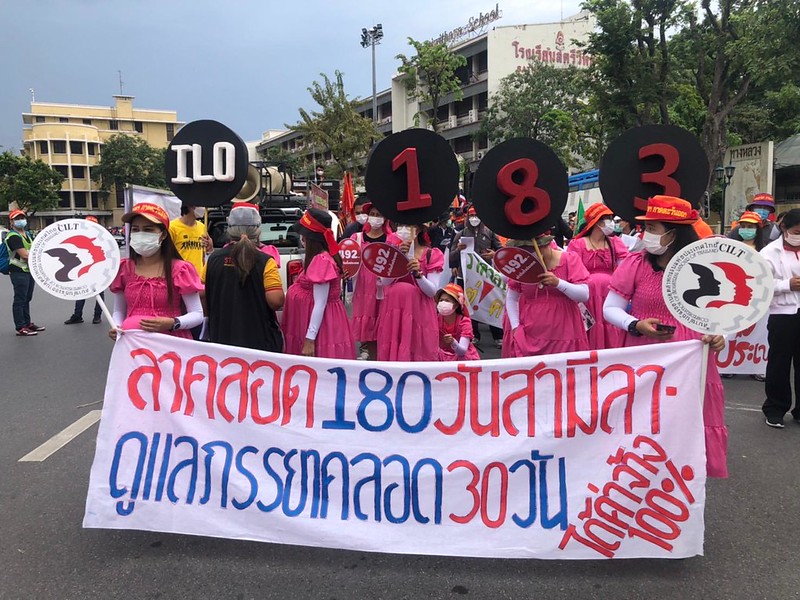
The regional day of action was held in support of members of IndustriALL affiliate Confederation of Industrial Labour of Thailand (CILT), who were fired without notice in March 2021 as the factory suddenly closed. The workers, mostly women, were left in dire conditions in the midst of the Covid-19 pandemic. To date, the workers have yet to receive wages, overtime, holiday and severance pay owed.

“The workers have been waiting for compensation for almost a year now and they need it as soon as possible,”

says CILT president, Prasit Prasopsuk.


Unionists from Australia, Indonesia, Japan, Korea, Malaysia, Mongolia, Philippines and Thailand participated in store action, a social media campaign and sending protest letters to the brands, demanding that the workers are paid immediately.

Members of IndustriALL’s Asia Pacific women’s committee joined the regional day of action virtually at their meeting on 14 February.

“Solidarity is always in fashion and this fight is very important. We are calling on Victoria’s Secret and other big brands to pay the workers the US$ 7.4million they are owed,”

says Jenny Kruschel, co-chairperson of IndustriALL Asia Pacific women’s committee, and textile, clothing and footwear national secretary of the CFMEU manufacturing division.

Shinya Iwai, IndustriALL South East Asia regional secretary, says:

“IndustriALL will continue the fight against unscrupulous employers. Brands must exercise due diligence and take responsibility when rights are violated in their supply chain.”

Haitian protestors met with police violence

On Thursday, for the second day in a row, police fired tear gas and beat protestors with batons outside the SONAPI Free Trade Zone in Port-au-Prince.

Last month a coalition of unions, including IndustriALL affiliate GOSTTRA, called on Prime Minster Ariel Henry to increase the minimum wage in the garment industry from 500 gourdes a day (4.80 USD) to 1,500 gourdes. According to the Labour Code, wages must be adjusted when inflation exceeds 10 percent in the year. In recent months, inflation has already topped 23 percent.
 
Says GOSTTRA Coordinator Reginald Lafontant:

“The cost of food, rent, health care and transport is going up every day, yet our wages have stayed the same for the past three years. Workers are earning less than a third of what they need to survive.  Life is a daily struggle, and people are desperate.”

Haiti’s garment factories mainly export to retail markets in the US and Canada. Says Lafontant:

“Haitian workers are not earning a fair share of the wealth we produce. A garment worker would need to work four days to afford to buy the T-shirt she sews. I know Haiti is a poor country, but this is ridiculous.”

The situation is made worse by the widespread violations of labour rights in the garment industry, most recently at Centri Group where some 60 workers have been dismissed for protesting at unfair wage practices, while the Ministry of Labour turned a blind eye.
 
In a letter addressed to the Haitian Prime Minister, IndustriALL General Secretary Atle Høie warned that brands and retailers are under increasing pressure to ensure due diligence in their supply chains.

“Paying starvation wages and repressing workers who protest is severely damaging the reputation of your country as an acceptable country in which to do business,”

said Høie.
 
IndustriALL has urged the Prime Minster to engage in meaningful dialogue with the signatory unions with a view to adjusting the minimum wage. It has further called on the government to take urgent steps to ensure national laws and international standards are upheld in the garment industry, and in particular to ensure the reinstatement of workers at Centri Group.

Reports of abuse in Dyson factory, Malaysia

On 10 February, British Channel 4 News broadcast a report from a group of migrant workers in Malaysia, working in a factory producing mainly for Dyson. The migrant workers detailed that while employed at ATA Industrial, they had their passports taken away, effectively trapping them into work.

They were forced to work long hours, sometimes up to 18 hours a day including overtime. Workers were told that refusing overtime when ordered, would prevent them from any overtime in the future, which would make it impossible to live from their wages. Some days the workers earned less than US$10.

Many of the workers lived in unsanitary and overcrowded living conditions, where up to 80 people shared a room, and their movements were restricted by security guards.
 
Recruitment fees, poor living conditions, passport retention, excessive hours, enforced overtime, and restrictions on movement are all clear indicators of forced labour, as defined by the International Labour Organisation.
 
IndustriALL UK affiliate the Unite the Union is calling for reforms to the Dyson supply chain following allegations of the abuse of migrant workers at a factory in Malaysia that manufactures products for the well-known brand.

Unite’s international director Simon Dubbins says:

“Unite joins the international labour movement in demanding Dyson ensures that human and labour rights abuses do not occur in any part of the company’s supply chain. Independent trade unions must also be allowed across the company and its supply chains so workers’ rights are protected and consumers can be confident they are not buying products that are made at the misery of others.”

Ignoring long-running reports of abuse at ATA Industrial contradicts Dyson’s public claims of responsible sourcing. And when ending the contract with ATA Industrial in November last year over audit findings, Dyson did so without putting any remedies in place for the workers.
 
N. Gopal Kishnam, secretary of IndustriALL Malaysia Council and general secretary of National Union of Transport Equipment and Allied Industries Workers (NUTEAIW), says:

“The National Action Plan on Forced Labour must be implemented immediately to end all kinds of abuse. We call on the Malaysian government to thoroughly investigate the complaint and take action in accordance with the laws.”

Atle Høie, General Secretary of IndustriALL states:

“This case at Dyson shows that poorly constructed and executed audits are used to present a clean bill of health. Like at Dyson, we have seen many problematic audit cases in the supply chain that don’t reflect the reality. A credible audit includes workers’ voices.
 
“Dyson must ensure fundamental workers’ rights according to the international standards in its supply chain. The best way to avoid exploitation is to ensure that workers, including migrant workers, can exercise their right to organize and collective bargaining to improve wages and working conditions.”

Founded in the UK in 1993, Dyson moved its head office to Singapore in 2019. In 2007, Dyson closed its UK factory and moved manufacturing to Malaysia. ATA Industrial predominantly produces products for Dyson’s vacuum cleaner, lighting, haircare, heaters and fan ranges.
 

File photo of migrant women workers, Petaling Jaya, Malaysia. Credit: UN Women

Worker killed at Kabir Steel shipbreaking yard

The deceased, Mohammad Ariful Islam Sujan — a young cutter — was cutting down a joist girder at night when the accident happened. Shipbreaking yards operate at night in highly unsafe conditions despite a court order in 2011 prohibiting shipbreaking work at night. Another worker was injured in an incident at the same shipyard last week.

IndustriALL Global Union affiliates — Bangladesh Metal Workers Federation (BMF) and Bangladesh Metal, Chemical, Garment and Tailor Workers Federation (BMCGTWF ) — have continuously raised these issues. Seven accidents were reported last year at other yards, Madanbibir Hat and Gamarital, run by Kabir Steel.

Management is trying to pass off the death as an incident where, according to Abdullah Al Sakib Mubarrat, deputy inspector general of the Department of Inspection for Factories and Establishments, Chattogram, “Ariful suddenly felt sick, vomited and fell down.” IndustriALL affiliates in Bangladesh are resisting what they see as a cover up, and demand that the dead workers’ family be paid full compensation.

A human chain was organised by trade unions on 2 February, which the local police tried to disrupt. After the police intervention, union leaders turned the human chain into a massive rally. Organizers of BMF and BMCGTWF met the deceased worker's family and helped them prepare documents to claim compensation.

Union members meet with family members

The unions held talks with the Department of Inspection for Factories and Establishments over the issue of compensation, and intend to maintain this communication. The company has reportedly deposited 0.2 million BDT (US $2,327) with the labour court, according to the practice established by 2018 amendments to the Bangladesh Labour Act, but an outstanding amount of 0.5 million BDT (US $5,816) still needs to be provided to the victim’s family.

Bangladesh affiliates of IndustriALL have continuously raised the issue of unsafe working conditions in shipbreaking yards, and will fight until the deceased’s family receives full compensation. IndustriALL is calling on the Bangladeshi government to ratify the Hong Kong Convention on the Safe Recycling of ships.

Last year, a total of 50 shipbreaking workers were injured and 12 were killed in 43 different accidents across the country. So far this year, two workers have been killed and two injured.

BMF president AM Nazim Uddin and BMCGTWF (Chattogram Committee) general secretary Md. Nurul Absar issued a statement saying:

"BMF and BMCGTWF have always been concerned regarding the frequency of accidents in the shipbreaking sector of Bangladesh and constantly demanding measures by the owners and the government that may help prevent the accidents. It therefore comes as a complete surprise to the unions that the Deputy Inspector General of the Department of Inspection for Factories and Establishments, Chattogram and the Kabir Steel Limited owner have painted a completely different picture of the accident at Kabir Steel Limited which raises serious questions regarding their intent and integrity. We demand that the government takes appropriate action against such unlawful activities of the owner and the government officials. We also demand that the families of the affected workers be given a full share of the compensation due."

Apoorva Kaiwar, IndustriALL regional secretary said:

“It is the responsibility of the owners to ensure that workers who are working for them don’t die at work, rather than get away with paying paltry compensation for the death of a worker.”

Photo: A file image from a Chittagong yard. CC Stéphane M. Grueso

INTERVIEW: Daniela Cavallo – a team player focusing on solutions

INTERVIEW

From Global Worker No. 2 November 2021

Who: Daniela Cavallo

Text: Alexander Ivanou

Daniela Cavallo, the daughter of an Italian immigrant who came to Germany in search of a better life and worked at Volkswagen in Wolfsburg, also started working at Volkswagen more than 27 years ago. Now, she is the chair of the works council of the largest plant in Wolfsburg, chair of the national works council in Germany, and president of the European and World Group Works Councils of Volkswagen. Daniela is also a member of the company’s supervisory board, in addition to other responsibilities in the complex world of Volkswagen.

Daniela’s extensive experience in the company brings a lot to her position. Throughout the years she has witnessed many developments, both favourable ones, but also some critical. She has worked in different roles; starting as an apprentice in office administration to a works council member in the “Auto 5000” subsidiary, a project established to secure new jobs and investments in VW in Germany while accepting lower wages and more flexible working times. There she also participated in the negotiation of collective agreements. 

Over the years Daniela has represented different groups of employees and has gained a lot of experience. Her work has allowed her to build a huge network, not only among the workers but also on the management side at different levels, which helps her in her current position.

Daniela believes one of her strengths is her ability to work with different people. 

“I’m a good team player and I always look for solutions. People may have different opinions and it is important to accept that, to have discussions even when there is a controversy and always search for solutions.”

Daniela considers herself too impatient sometimes and prefers making things change rapidly. In a way this is an advantage, as it helps her to continue insisting and eventually achieving the results, but others may consider it as being too pushy.

Although excited when elected president of the works council, Daniela did not have a lot of time to think about it. 

“I was immediately thrown into the deep end.”

In the beginning, there was a bit of “let’s wait and see” attitude towards here, which Daniela does not link to her being a woman. 

“I had already worked with many of my colleagues for years. However, I did notice that during meetings, discussions and appointments, the higher you are in the hierarchy the less women you see.”

Since 2002, works councils in Germany have a quota for women and as a result there are more women present. 

“How things are discussed, the way you work and how you search for solutions change when there are more women present, and this is enriching.”

While this remains an important part of her daily work, Daniela’s main focus is on the changes taking place in Volkswagen affecting current and future jobs.

The auto industry is going through a deep and comprehensive transformation towards electro vehicles and new mobility concepts. This transformation means changes in the work, leading to potential job losses due to digitalization and technological changes, but also to opportunities of new jobs in new areas. In 2016, VW Management and the General Works Council signed a pact for the future. Signing the pact meant – although managed in a socially responsible way – drastic job losses and setting up a new system with a shift to new tasks and jobs with a budget for qualification and upskilling. 

“We had presented the elements of the pact for the future, and although we had to make some compromises, in return we received from management the guarantees to secure jobs,”

says Daniela.  

With a digital transformation roadmap, the focus was on the indirect areas, meaning those jobs not directly linked to manufacturing. With the adopted roadmap, Volkswagen pledged to invest in creation of new jobs related to digitalization mainly in IT.

One of the examples for upskilling is the Faculty 73 program. Through this, Volkswagen trains software developers and upon successful completion offers them permanent employment. The remarkable thing about this is that workers from the assembly line can also join the project if they show talent for IT related matters. A similar concept now has also been implemented at SEAT in Spain.

Volkswagen is a pioneer when it comes to transnational cooperation and global bodies of employee representatives. Global charters like the Social Charter, Charter on temporary work, Charter on training and education etc. were implemented and allowed unions in other VW plants around the world to benefit from the strong co-determination rights in Germany and in VW. 

Germany has a legal basis for a system of co-determination and co-decision culture in the workplace. This means cooperation between management and workers in decision-making, among others by the representation of workers on supervisory boards. 

VW’s policy charters are unique and an important contribution to the protection of workers’ rights globally. These charters can also be the basis for implementing minimum rights in countries where workers face insufficient respect of their rights. 

“Consultation and information rights in different countries are an important topic of exchange. These exchanges can help, but if the company does not take the claims seriously, I have to support the workers concerned. The different charters can contribute to the process and help to implement co-determination and co-decision processes, not only on the employees’ and unions’ side, but also on the management side.”

The Covid-19 pandemic has brought a wide discussion on what kind of social protection measures can be put in place. Daniela recalls about complaints from colleagues abroad over the reduced time of work. The broad footprint of the VW Group in Germany and related agreements between the company and the works council has often helped to safeguard jobs, not only during the pandemic:

"In Germany, staff from Volkswagen was sent to Porsche, or from Audi to VW Sachsen, while at plants in other countries, like at VW and Audi in Mexico, there was very little exchange. Two plants did not really support each other in difficult situations and each plant struggled on their own with their problems",

says Daniela.

Agreements between the Volkswagen Group & the European/Global Group Works Councils

Daniela believes that IndustriALL’s participation in the international charters is very important, referring also to the case of Volkswagen’s only unorganized plant, the one in Chattanooga, Tennessee, USA. 

IndustriALL affiliate, the United Autoworkers (UAW), tried to organize the plant in 2014 and 2019. Both times, the company enlisted a company to help with union busting in order prevent UAW from winning the union elections. IndustriALL even suspended the global framework agreement with Volkswagen.

Influence of politicians, both on state and federal levels, clearly played a role during the elections in Chattanooga. Daniela admits the complexity of the topic and continues her consultations with UAW. She pledges her support to organizing the plant and believes the current situation in the US with the new president can bring changes, 

“It is a new game and maybe this is a moment for new collaborations. There are lots of different factors and facets. I can’t promise my arrival will change everything; I can only promise that I will do everything I can,”

says Daniela.

Developing the charters continues and new topics are added. Currently, the VW works council is working on a new Charter on Digital Responsibility, which will define certain principles based on how digitalization impacts employees and what consequences it brings for the workforce. 

“This is something we continue to address; it is part of the company culture,”

says Daniela.

Company investment strategy is also on the agenda. 

“It is crucial for employees’ representatives to have influence on sourcing and investment decisions in VW, and not only in Germany. Without this possibility, we would be reduced to mere caretakers”,

Daniela concludes.

PHOTOS: by Kevin Nobs and Carsten Heidmann