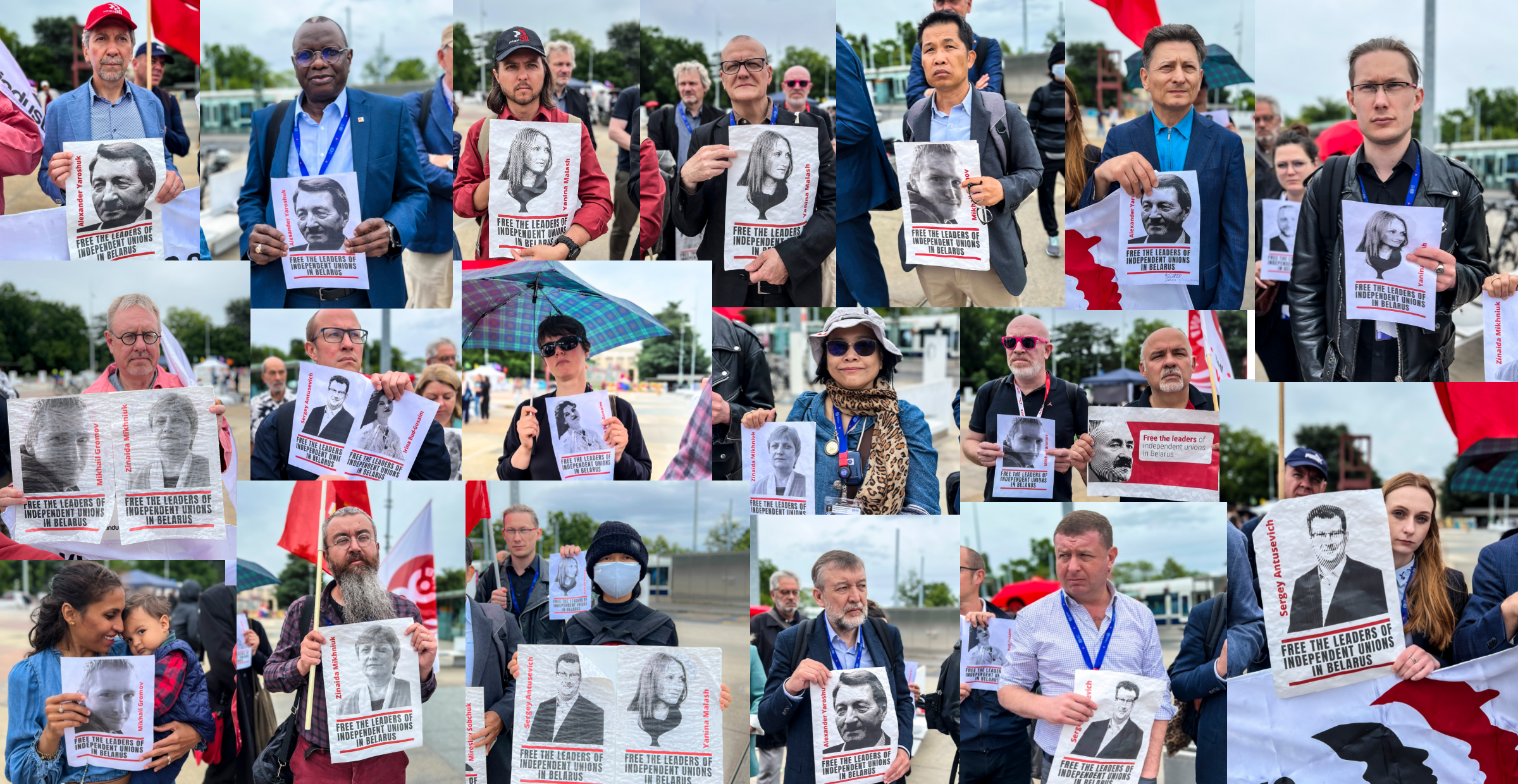
Belarus tightens grip on independent trade unions

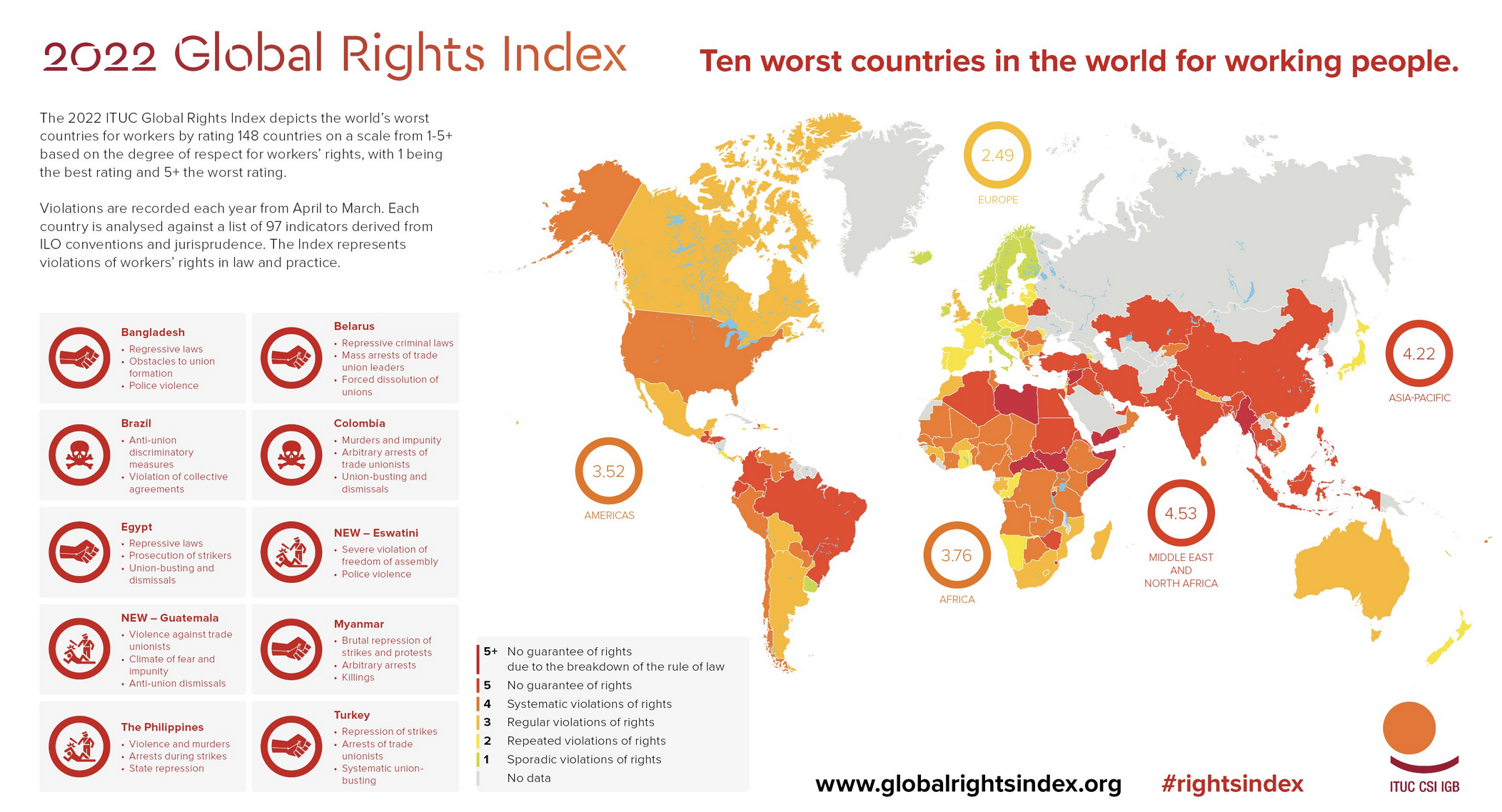
According to reports yesterday, Alexander Yaroshuk, chairman of the Belarusian Congress of Democratic Trade Unions (BKDP), Sergei Antusevich, BKDP deputy chairman, BKDP accountant Irina But-Gusaim, Nikolai Sharakh, chairman of the Belarusian Free Trade Union are being held under on Organization and preparation of actions that grossly violate public order, or active participation in them Article 342 of the Criminal Code, which carry prison sentences up to four years.

The 66-year-old deputy chairman of the Free Trade Union of Metalworkers, Alexander Evdokimtchik, is still behind bars. He was detained on 19 April and is currently held in the KGB pre-trial detention centre. Evdokimtchik is also held under Article 342 of the Criminal Code and has not been allowed to see a lawyer of his choice, but has been given a state-appointed lawyer.

On 27 April, Volha Brytsikava, union chairman at Naftan, was sentenced to 15 days of arrest for the fifth time. She has now been in jail for more than two months.
 
The last few days have seen two more independent unions falling victim as the authorities are tightening their grip. JSC “Mozyr OF” was excluded from the official trade union register, which effectively terminated the organization. In a statement, the prosecutor's office of Belarus’ Grodno region labelled the primary organization of JSC “Grodno Azot” extremist, prohibiting its activities and ordering liquidation.

International solidarity is needed

We need to raise the pressure as much as possible.

We therefore ask you to take action in support of independent unions in Belarus.

Photo: Alexander Evdokimtchik, the 66-year-old deputy chairman of the Free Trade Union of Metalworkers, is still behind bars.

Finnish paper workers end historic UPM strike in settlement

The IndustriALL affiliated Paperiliitto led an inspirational strike against the company’s attack on union rights and employment conditions. The 2,200 members resisted the strike breaking efforts of management, with the strong industrial action receiving significant solidarity support in Finland and internationally.

The conflict was resolved with both parties accepting a final proposal of the National Mediator. Under the proposal, five separate collective bargaining agreements are signed, one for each industrial segment of the company, with a duration of four years and salary renegotiation after two years.

The strike was unprecedented in size in the sector in Finland, and was caused by the anti-union beliefs of UPM’s executive management, determined to break union power held by its blue collar employees, members of Paperiliitto.

This UPM management attack failed to destroy the union, failed to break the collective bargaining system, and failed in its attempt to set pay and conditions unilaterally without Paperiliitto representing workers.

UPM also failed with its insistence to reduce employment conditions including by adding considerable amounts of annual working hours with no increase in wages. The strong strike ultimately forced UPM into accepting the union demand for conditions in line with the industry standard. The new agreement also delivers salary increases that are in line with the industry standard.

UPM’s financial losses from the strike were estimated between two and three million Euros per day, on top of the long term damage done to the company’s reputation with customers, both socially and on its reliability to deliver contractual obligations. Up to €300 million was the estimated total cost to the company of the strike.


The strike also cost members and the national union financially. The Finnish Industrial Union, Teollisuusliitto, another IndustriALL affiliate contributed €2.2 million to the Paperiliitto strike fund.

The company’s ideological attack against union power was also targeted at IndustriALL affiliated white collar union Ammattiliitto Pro. This union’s 500 members at UPM working in white collar positions have had their right to bargain collectively broken by the company’s re-categorization of their contracts. By law UPM is required to maintain the existing labour conditions for these employees, and the union will continue to provide legal advice if the company attempts to reduce benefits.

IndustriALL sector director Tom Grinter said:

“Paperiliitto members at UPM have inspired all paper workers around the world. By standing strong and united against the powerful company’s attack, Paperiliitto members send the message to all paper companies that union rights will not be broken, and the message to all paper workers that collective action can win tough battles.”

Paperiliitto President Petri Vanhala said:

"Thanks to Paperiliitto members at UPM holding the strike strong, a collective agreement was achieved for all of the company. This strike defended the right to bargain. UPM’s behavior was a bad example of industrial relations and we expect that now companies will respect workers more when they see they are capable of 112 days of strike."

Gender based violence and harassment is a health and safety issue

Women workers represent a large share of the labour force in global electronics supply chains, particularly in the assembly of small components.

“There are few women in supervisory positions and promotions are often dependent on women going along with the men and accepting this kind of sexual banter,”

says a factory union leader from CNM-CUT, Brazil.
 
The jobs are often in large factories in special economic zones; many women workers are young and migrant workers. The electronics sector is characterised by fluctuating orders, “just in time” production and short product cycles. This results in a high level of temporary and agency work, and high levels of overtime. Poor working conditions, involuntary overtime, insufficient rest/time off and exposure to toxic chemicals, put women at risk of GBVH.

“It is mainly verbal harassment in the factory…when there are production pressures…in one hour when they have to produce 2,400 pieces, this is where the pressure happens [and the] discrimination starts such as not allowing women to go to the toilet, this is harming women,”

says a union representative from Indonesia.  
 
There is limited data on GBVH in the Information, Communications and Technology (ICT), electrical and electronics sector.

“Many workers are not aware; they think that only physical abuse [sexual assault] is sexual harassment. It has been important to help them understand that it can be psychological, and we have programmes in the union on awareness,”

says Sanjyot Vadhavkar, national secretary, SMEFI, India.
 
Unions play a critical role in preventing GBVH and ensuring that it is a central part of health and safety programmes, including risk assessments.

“As a trade union we are trying to promote gender equal participation and in OSH to prevent GBV. But by raising awareness in every workplace, including unorganised ones, we can improve this awareness as a whole society, leading to better enactment of laws,”

says a union leader in Japan.  
 
Women’s leadership and participation in unions is key to address GBVH. Organizing women and youth has helped to transform unions in the sector, with more women leaders who give priority to GBVH.

The women interviewed recommend:

IndustriALL ICT director Alexander Ivanou says:

"Three years ago, the ILO Convention on Violence and Harassment was adopted. IndustriALL’s research has revealed that close to half of the surveyed worksites reported cases of GBVH. At the same time, only a third of the unions had a policy on GBVH. So the seriousness of the problem cannot be underestimated. We, the unions fight for equal rights and opportunities for all workers and with this research we turn another page in this fight.

"In addition to numerous revelations about GBVH in the workplace, the research gives a clear set of recommendations on how to create greater visibility and awareness about GBVH in the sector. IndustriALL is already conducting GBVH-related trainings, which we will continue to make sure to root out this evil from our ranks, our workplaces and our homes."

The research documents the findings from interviews held with 22 union leaders and representatives in the electronics sector, in Indonesia (FSPMI and LOMENIK factory-based unions), India (SMEFI, SEM, Ever Electrics Pune union, Siemens Kalwa Unit union, Siemens Goa Unit union), Japan (JEIU, JC Metal, Hitachi Workers Union, Murata Manufacturing Workers Union) and Brazil (CNM-CUT).

Photo: © ILO/Asrian Mirza

Brands must sign International Accord

Out of the rubble, the Bangladesh Accord on Fire and Building safety was born. It’s a landmark, legally binding agreement which has made the garment industry safer for the people who work in it.
 
Employers have a duty of care for the health and safety of its workers. Everyone should go to work in the morning, safe in the conviction that they will return home alive.
 
Last year, the Bangladesh Accord transformed into an International Accord, extending the scope to countries outside of Bangladesh. To date, over 170 brands have signed up, but the majority of North American brands are conspicuously lacking from the list of signatories.

“It is critical that North American brands and retailers to get off the sidelines to join the global effort to safeguard workers' lives on a global scale. It is unacceptable that these brands are unwilling to commit to ensuring that health and safety of the workers in their global supply chain. IndustriALL will continue to demand and campaign for all global brands and retailers to sign the agreement,”

says IndustriALL textile director Christina Hajagos-Clausen.


IndustriALL is joining the global call to make health and safety in the workplace a fundamental right at the International Labour Conference in June this year.

Fighting for a safe and responsible steel industry

“The members of IndustriALL’s affiliated unions are the ones who make the steel. They are the ones who either live or die, who return in either good or bad health from their workplaces in the steel industry. If anything goes wrong, they pay with their health, or even with their lives. That is why we support every effort to improve working conditions and occupational health and safety measures.

“IndustriALL is a member of ResponsibleSteel as it is important to represent our affiliates in a growing organization aimed at producing steel in a responsible way. Within ResponsibleSteel, we, as a global trade union can give the men and women working in the industry a voice in the discussions on Responsible Steel’s standards and on what producing steel in a responsible manner means for workers and their unions around the world. Having this multi-stakeholder approach is crucial.

“A general understanding and respect for ILO Core Labour Standards and Fundamental Principles and Rights at Work are crucial in every steel and mining operation that seeks to be certified by ResponsibleSteel.

“Today, on International Workers' Memorial Day, we are remembering our colleagues who have died or have been left disabled in the steel sector. A core question is to make sure that the ILO conventions on health and safety are respected and reviewed during certification procedures. The conventions are:

“It is also crucial to adopt a general approach of Just Transition in the steel industry. We think that a changing steel industry needs the workers’ perspective when it comes to piloting through the upcoming changes in our important industry.

“A global standard for the steel industry can help to protect workers’ rights. Workers’ and unions’ rights must become indispensable when certifying steel. ResponsibleSteel can deliver and support this – especially if we train our certification bodies accordingly.

“Steel producers along the value chain must accept responsibility for fair treatment of their employees, including sub-contractors. The ILO conventions above are key. If all steel producer in the world applies these standards, we will make huge progress for the workers, but also for the industry as a whole.

“We demand what we call Just Transition. This simply means that no worker – regardless of blue or white collar, regardless of directly employed or subcontracted – is left behind in the transition process that the steel industry will go through.

“In other words: we want to see a climate-neutral steel industry that still offers clean, healthy and good workplaces, were men and women in the industry are proud to contribute to responsibly produced, climate-neutral steel. This is what sustainability is all about.”

The fundamental right to be safe at work

“A fundamental rights approach to health and safety provides a human rights lens. The UN Guiding Principles on Business and Human Rights include a duty and responsibility to protect the health and safety of workers. Such a human rights-based approach will have the effect of creating coherence between human rights and occupational health and safety standards and reinforce the principle that all workers share the right to a safe and healthy working environment,”

says IndustriALL assistant general secretary Kan Matsuzaki.

While IndustriALL Global Union applauds the ILO Governing Body’s decision in March to agree to put forth the discussion for an amendment to the ILO Declaration on Fundamental Principles and Rights at Work to include occupational safety and health during the International Labour Conference in June 2022, we demand no less than an agreement. It has been three years since the ILO Centenary Conference agreed to the amendment and in that time

“around 8.1 million people have died as a result of their work and even more now live with life-altering injuries and illnesses,”

says ITUC general secretary Sharan Burrow.

According to an estimate by the Workplace Safety and Health Institute, across the world in 2017, 2.78 million deaths were the result of occupational accidents or work-related diseases. The biggest share of work-related mortality was from work-related illnesses, which accounted for 2.40 million (86.3 per cent) of the total estimated deaths. Fatal injuries accounted for the remaining 13.7 per cent.
In 2019, the World Health Organization estimated that workplace-related deaths exceed the average annual deaths from road accidents (999,000), war (502,000), violence (563,000) and HIV/AIDS (312,000).

“Many of IndustriALL’s sectors, like mining, shipbreaking, chemicals and textile and garment, mirror these statistics, which also show a stark regional difference,”

says IndustriALL mining and health and safety director Glen Mpufane.


In combination with other fundamental principles and rights, recognizing health and safety as a fundamental principle offers workers a fighting chance to win the war. IndustriALL is calling on its more than million members across the world to participate in events and activities on 28 April, demand that employers and governments act by: 

Let us know what action you are taking in making the demand for the recognizing of health and safety as a fundamental principle and right – it could be webinars, protests, online statements, petitions, workplace inspections. Please tag IndustriALL on social media and use the hashtag #IWMD22

The ILO is hosting a webinar, Act together to build a positive safety and health culture – World Day for Safety and Health at Work 2022, with ILO Director General Guy Ryder and global leaders and experts. You can register here.

Cover photo: Marcel Crozet / ILO

Poland’s mines claim more lives

Five people were killed and seven are still missing after an accident at the Pniowek mine on 20 April. Only three days later, an accident at the Zofiowka mine claimed one life and several people are missing.

According to reports, the accidents are believed to have been caused by methane blasts, exploding around 1,000 meters below the surface. Both mines are believed to be owned by Jastrzębska Spółka Węglowa SA.

Over recent years, Poland has experienced several accidents relating to mining.

“We urge authorities to carry out a thorough investigation, with the participation of trade unions, and implement measure to avoid similar accidents in the future. It is unacceptable that Polish mineworkers continue to die in coal mining, considering the advances in safety technology and knowledge,”

says IndustriALL mining and health and safety director Glen Mpufane.

“But there is a solution; ratifying and implementing ILO Convention 176 on Safety and Health in Mines. The Convention provides the organizing space for unions to build a workplace safety culture from the ground up.”

28 April is a day to remember and honour workers who were injured or died in the course of their work. While ILO Convention 176 is key to resolving the challenge of occupational safety and health in the mining industry, and IndustriALL reiterates the call on Poland’s government to ratify the Convention, the expected recognition by the ILO of health and safety as a fundamental principle and right at work, will contribute significantly to efforts to improve health and safety in Poland’s coal mines.
 

Mexico to host the World Social Forum: “Another world is possible”

The 14th edition of the World Social Forum, “Another world is possible”, will be a hybrid event, combining in-person and online activities. The overarching aim is to foster dialogue processes capable of boosting alliances, projects and initiatives at national and international level.

The forum will provide participants with an opportunity to articulate their visions and formulate common global agendas. They will also work on developing strategies capable of addressing the major structural problems they are confronted with in their respective countries.

An international Facilitating Group made up of over 100 organizations has been meeting online, on a weekly basis, since February, to coordinate the event, and will continue to do so until the start of the forum in May. The aim is to facilitate a horizontal and decentralised meeting, with hundreds of activities and self-organised action initiatives.

Some of the central themes are:

•    Democracy, political participation and critical global citizenship building
•    Emancipatory economies, work and workers, the struggle against the debt system and socioeconomic justice
•    Defending life and territories in the face of the global crisis of civilisation and ecocide, occupation and dispossession, agroecology, the right to the city, health and climate justice
•    Original, indigenous, ancestral, black, Afro-descendant and diaspora peoples, self-determination and the fight against racism
•    Peacebuilding, disarmament and strategies to deal with war, structural violence and migration.

Activities will be organised on specific issues linked to the central themes, such as the United States-Mexico-Canada Agreement (USMCA) and its impact on workers or environmental and workplace disasters such as Brumadinho, in Brazil, or Pasta de Conchos, in Mexico, and labour rights violations by mining companies.

Sessions will also be held on the energy transition, sustainable development, sustainable industrial policies and the challenges faced by women in the context of precarious work, issues which are among the strategic priorities set out in IndustriALL’s 2021-2025 action plan.

IndustriALL’s regional secretary, Marino Vani, said:

"We invite all affiliates, union leaders and workers to take part. It is crucial that trade unions participate in the debates and contribute to the political articulation of our agenda and the challenges of the working class. Another world is possible if we succeed in taking part, in being agents of change and coordinating dreams, projects and alternatives. We have to build the power and the will of the people to fight together for the world we dream of."

CMPC union network highlights company's growth in Latin America region

Union leaders met online on 7 April to exchange experiences about the conflicts facing their organisations, the company's productivity levels and next steps as a network. The group has a good track record of conducting physical and virtual activities, meeting with the company, supporting each other and visiting major factories in Chile and Brazil.

IndustriALL Global Union's director of chemicals, pharmaceuticals, pulp, paper, and rubber industries, Tom Grinter, provided an overview of the situation of the pulp and paper sector globally, with a special focus on CMPC. He explained that the pulp and paper sector was considered an essential sector during the pandemic, and that it is performing very well globally in 2022.

He said that there was a significant supply chain disruption in the industry during the pandemic. Although the situation has now improved, problems remain. For example, he mentioned that raw material from Russia was largely removed from the supply chain due to the invasion of Ukraine.

In relation to CMPC's situation in the region, the Brazilian union leaders pointed out that the company is becoming a very strong power and is investing money in various production units. In Rio Grande do Sul, for example, it has created 7500 direct jobs. It is also trying to reduce its environmental footprint.

In the case of Chile, workers said that "CMPC is living a moment of glory" with high profit levels. They explained that they recently completed a collective bargaining process at the end of which they were able to reach a good agreement with the company.

The picture was different in the other countries. In the case of Uruguay, workers reported problems with the number of jobs. They explained that the company has been restructuring for the last three years, reducing jobs due to technological change and the loss of market share. They said that the factory is selling less and less, due to the import of products from Argentina and Brazil.

The situation did not seem to be much different in Peru either, where workers explained that CMPC Protisa does not want to give workers a share of its profits and is cutting jobs due to organisational restructuring. So far the company has dismissed 10 employees affiliated to the union, and the union is trying to negotiate with the company to avoid further dismissals.

Members of the CMPC union network agreed that they will continue to work together to fight the problems they are facing in some countries. They said they will develop further online meetings and will probably hold a face-to-face meeting.

Military vehicle rams into trade unionists, three detained in Yangon, Myanmar

The arrested activists in the detention camp. Left: unknown protester, middle: Khaing, right: Ei.

The Confederation of Trade Unions of Myanmar (CTUM) has confirmed that Khaing Thinzar Aye, the head of communications at CTUM, and Ei Phyu Phyu Myint, a member of IndustriALL Global Union affiliate the Industrial Workers Federation of Myanmar (IWFM) are among the detainees.

The demonstration was organized by umbrella body the Myanmar Labour Alliance, CTUM and IWFM. The Alliance demands the restoration of a democratic society and end of military rule.

CTUM president Maung Maung issued a press statement to condemn the inhuman and violent attack against the women unionists. He called for the immediate release of Khaing Thinzar Aye, Ei Phyu Phyu Myint and another unknown protester.

Khaing Zar, the treasurer of CTUM and president of IWFM, says:

“The escalating violence against citizens and unionists shows the military regime is turning the country into a killing field. No one is spared from violent repression, including young women, who are the economic backbone of the garment industry in Myanmar.

“How can businesses continue their operation when every day massacre happens side by side with the business?”

Four months earlier, a military truck hit a group of demonstrators in Yangon. A person was critically injured and another two were injured. The soldiers arrested 11 people.

Atle Høie, IndustriALL general secretary of IndustriALL said:

“IndustriALL condemns the absurd crackdown and demands the immediate release of the three young women, including two trade union activists. We reiterate our call that businesses cannot continue to operate under such abnormal circumstances.

“The international community must heed the call of the Myanmar Labour Alliance and impose comprehensive economic sanctions now with the aim of restoring civilian rule and saving lives.”

According to the Assistance Association for Political Prisoners, as of 20 April 2022, 1,779 people had been killed and 10,271 are in currently being arbitraryly detained by the junta.

Dozens of trade unionists have been killed, and tens of thousands of workers participating in the civil disobedience movement have been dismissed or blacklisted.