Kenyan union signs collective agreement with Isuzu East Africa
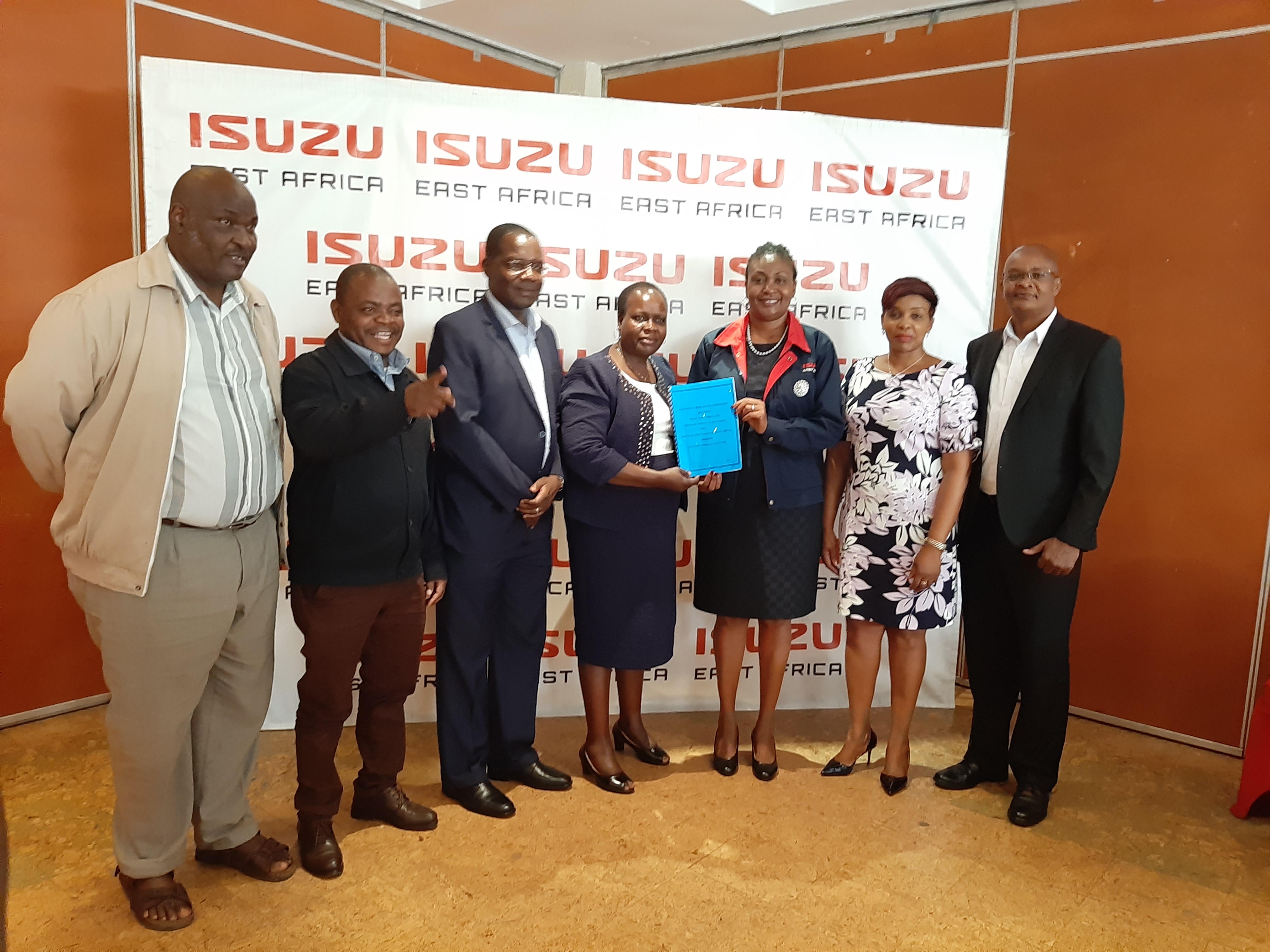
IndustriALL Global Union affiliate the Amalgamated Union of Kenya Metalworkers (AUKM) signed the agreement on 8 May, after five months of negotiations. The agreement strengthens a long history of cordial relations between Isuzu East Africa and AUKM, which contributes to building a harmonious relationship between unions and automotive companies.
Isuzu East Africa employs 228 workers, of whom 27 are contract workers and only 13 are women — an issue that the AUKM is campaigning on by encouraging the employment of more women and creating a conducive environment for women workers.
According to the agreement, wages will be increased by 8 to 9.7 per cent, with a wage range from Kenya Shillings 51,560 to 85,329 (US $517 to $855). The increase will remove inequalities by closing wage gaps between different grades of workers doing similar work. Travel allowances will be increased by 8 per cent and housing allowances by 10 per cent. Other benefits that were increased include the shift allowance. The company also has a social security benefit of 20 per cent of the worker’s wage that is paid by the employer.
Rose Omamo, the general secretary of AUKM said:
“This is one of the best collective bargaining agreements that the parties have negotiated and comes from the good will and trust that we have built over time. Collective bargaining agreements are the backbone of a strong trade union and that is why we are happy when we sign them.”
Paule-France Ndessomin, IndustriALL regional secretary for Sub Saharan Africa said:
“The signing of the collective bargaining agreement should be applauded because better working conditions improve the livelihoods of workers and their families. Improved benefits lead to living wages that we are campaigning for the automotive sector to pay.”
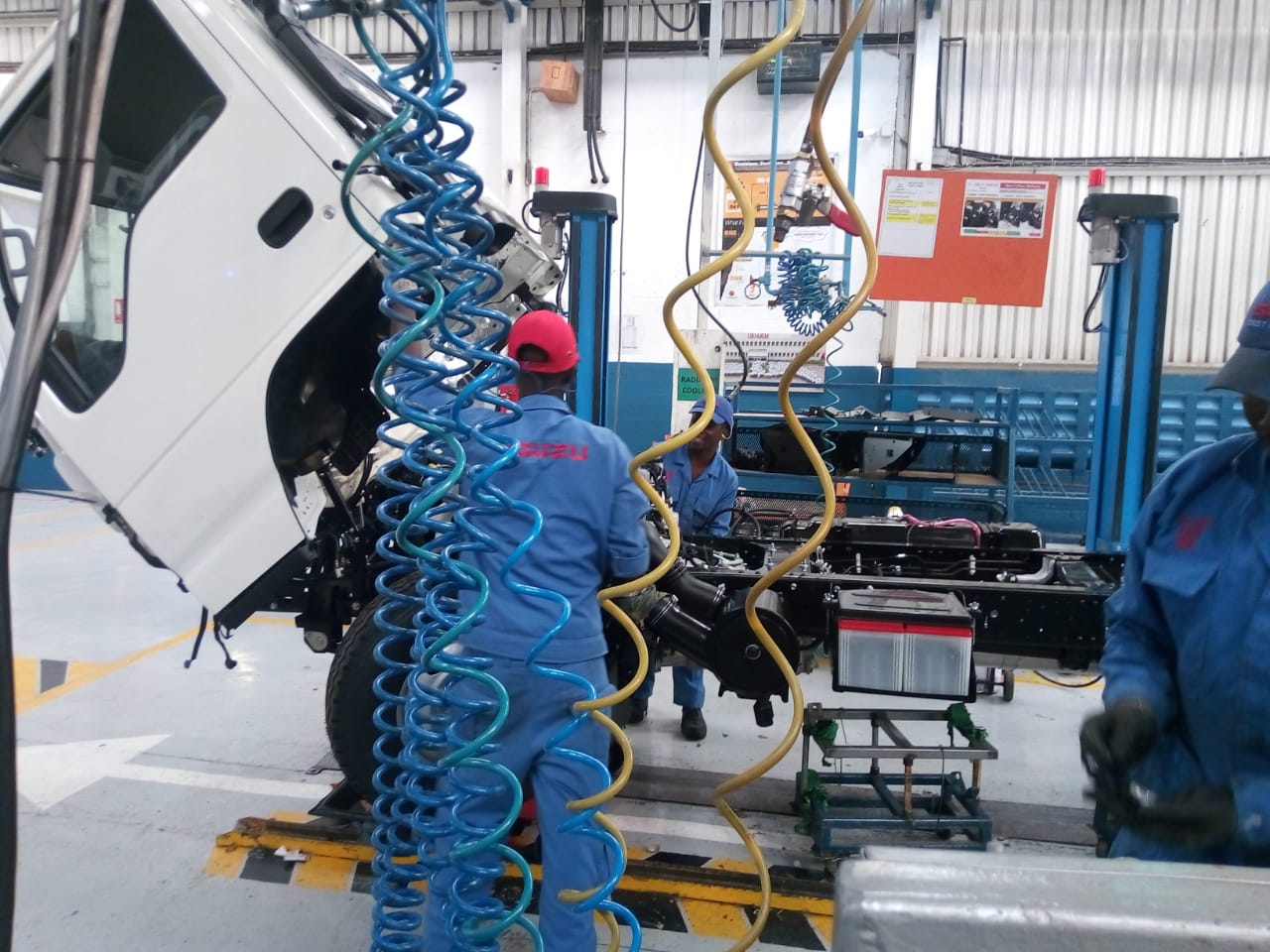
Isuzu East Africa, formerly General Motors East Africa, manufactures light commercial vehicles. To attract local manufacturing and as part of industrialization efforts, the government of Kenya has introduced tariff exemptions to imports of vehicle components. The government is also giving first preference to locally assembled vehicles in its purchases as a boost to local manufacturing.
3,000 jobs lost expose precarious working conditions in Zambia’s copper mines
While Mopani says the shafts are old and costly to maintain, the unions say the mining companies don’t care about job security. The current global dialogue between IndustriALL Global Union and London Stock Exchange (LSE) listed Glencore is meant to improve industrial relations and the mine closures are a test of Glencore’s commitment. The announcement is a cause of concern for IndustriALL which expects Glencore to be transparent in its engagement with unions, specially to mitigate the impact of the closures on mineworkers and communities.
On Vedanta Resources’ Konkola Copper Mine, also listed on the LSE, the unions say it is better for the company to resume operations instead of mothballing the shafts. Mining operations at Nchanga underground and open pit mines stopped in January resulting in the retrenchment of 905 workers. The mining sector employs over 65,000 workers, 30,000 directly and 35,000 through contractors. However, the contractors employ workers under precarious working conditions on short contracts, and low wages and benefits with an appalling adherence to health and safety standards which has led to deaths and injuries.
At a press conference with two other Zambian unions, NUMAW and UMUZ, on 10 May, Joseph Chewe, the president of the Mineworkers Union of Zambia, which is affiliated to IndustriALL, said:
“Mopani Copper Mine should ensure that the affected workers are redeployed to other operations. It’s sad that it is now a risk to work for Mopani because of the uncertainty and job insecurity. The claim that the mine is investing in the future is hollow as this is being done at the workers’ expense. Workers are targeted in cost cutting measures by management whenever there is a challenge. To protect workers’ interests the unions are demanding to be part of the technical team that will inspect the shafts.”
Glen Mpufane, IndustriALL director for mining, said the multinational companies should implement fair labour practices:
“The era of discarding mine workers who toiled for many years digging valuable minerals from which the mining companies enjoyed profits and sending them home with a pittance has to come to an end. Mining companies must act responsibly by either reassigning workers to other shafts or paying fair compensation for the job losses. Workers must not be retrenched into poverty as has happened in the past.”
Law amendment will rid sham cooperatives from South Africa's textile sector
The previous law treated workers in cooperatives as self-employed and exempt from paying minimum wages and conforming to labour standards. However, this will change with the Regulations for the Cooperative Amendment Act (2013) which came into effect on 1 April.
According to the new regulations, cooperatives must comply with labour laws and demonstrate their protection of members’ interests – a requirement that will make it difficult for false coops to exist.
“In the clothing industry alone, an estimated 15,000 workers are abused by such cooperatives that are exploiting workers. They are established through threats by factory owners to retrench workers unless the workers become members of the cooperative, which remains under the control of the factory owner who decides on working hours and conditions of work.
"If workers raise concerns about anything they are disciplined and fired on the spot,” says Andre Kriel, general secretary of IndustriALL affiliate Southern African Clothing and Textile Workers Union (SACTWU).
Paule-France Ndessomin, IndustriALL regional secretary for Sub Saharan Africa said it is commendable when legal gaps that allow worker exploitation are closed.
“It is important for laws to continue strengthening workers’ rights to living wages and decent working conditions. Allowing environments where workers’ rights are trampled upon with impunity is unacceptable.”
Garment factories in Isithebe, in the KwaZulu-Natal province, are infamous for using bogus cooperatives and paying low wages, and have been accused of human rights abuses including human trafficking. In February, 100 undocumented workers from Lesotho and Eswatini were found living in squalid conditions at textile factories in New Castle during a provincial government exercise to check business compliance with regulations. The workers lived in a small unventilated room at the factories which were built with high walls to conceal the shocking living conditions.
UK court rules in favour of hearing case of mine water pollution in Zambia
IndustriALL Global Union affiliate, the Mineworkers Union of Zambia, welcomed the court ruling in which Vedanta Resources will be tried for polluting water and making it toxic for drinking, irrigation, and for livestock thus destroying the livelihoods of local farmers in the villages around the Nchanga Copper Mine owned by the company’s subsidiary Konkola Copper Company.
In 2015, 1,826 villagers from communities living around the mining operations in Chingola District took the case to the UK courts. Although Vedanta wanted the case to be heard in Zambia, the court ruled that the villagers had the right to choose where they wanted the case to be heard.
The villagers probably took this route because of little adherence by mining companies to Zambian laws including the Environmental protection and Pollution Control Act (1990), Mines and Minerals Development Act (2008), and the Environment Management Act (2011). Lackluster enforcement by the policy bodies also diminishes the villagers confidence in ever getting justice.
Said Joseph Chewe, the president of the Mineworkers Union of Zambia: “The union wants to see justice prevail and hopes that the affected villages whose main source of survival is farming get proper compensation from the mining giant. The ruling sends a warning to mining companies that pollute the environment and threaten the lives of communities. The Zambia Environmental Management Authority must strictly supervise the mines to ensure that environmental regulations are adhered to.”
Civil society organization under the banner of the recent 2nd Copperbelt Alternative Mining Indaba in Chingola, said companies not only pollute the environment, but also promote precarious working conditions with short contracts and low wages. This has resulted in most workers living in poverty. The indaba also called on mining companies to create decent jobs.
Glen Mpufane, IndustriALL director for mining, said:
“Mining must be carried out in a sustainable way that considers the livelihoods of affected communities and should benefit communities and not poison their water sources. Further, the communities should also benefit from decent jobs and living wages.”
African textile, leather and garment unions meeting strategizes on AGOA
A strategy workshop organized by the Solidarity Centre Kenya in Nairobi 16-17 April, attended by 27 participants that included IndustriALL Global Union affiliates from Ethiopia, Eswatini, Kenya and Lesotho, confederations from the four countries, and regional bodies, EATUC and SATUCC, discussed how workers’ rights can be protected using the US trade law, the African Growth and Opportunity Act (AGOA).
AGOA, from which 40 African countries are beneficiaries, and 26 enjoy duty free garment exports to the US, has provisions to protect workers’ rights including freedom of association and collective bargaining. Eswatini’s removal and restoration of AGOA benefits was discussed as a case study on how the trade law can be used to protect workers’ rights.
The US law also aims to promote industrialization through economic policies that reduce poverty, develop infrastructure and provide social services as well as support private enterprise. The integration of African economies into global trade through building trade capacity and linking African to US businesses are some of the goals.
However, the law is silent on women workers’ rights, the environment, and Just Transition issues. It doesn’t also adequately cover supply chains and brands that are sourcing from the AGOA benefiting countries. For instance, targeting brands and supply chains is important for the living wage campaign that unions are carrying out. Most AGOA benefitting countries are not paying living wages and regrettably promoting a race to the bottom on wages. For instance, in the garment sector in Ethiopia wages are as low as US$30.
The AGOA Forum, a civil society grouping that includes trade unions, criticizes the trade law for missing an opportunity to stimulate the transformation of African economies and for using a discredited economic model based on oil and mineral extraction with very little value addition. The Forum says AGOA can do better on women and historically marginalized communities instead of becoming yet another elite project.
Speaking at the workshop Jeffrey Vogt, Solidarity Center’s director for the rule of law department said:
“Recognizing that AGOA has failed to promote trade, the US government included a requirement for beneficiary countries to develop a utilization strategy on a biennial basis as to how more effectively and strategically they will utilize benefits available under AGOA.”
Paule France Ndessomin, IndustriALL regional secretary for Sub Saharan Africa said:
“International trade laws such as AGOA are important to Africa’s industrialization, which is lagging behind other continents. AGOA’s support for regional integration is in line with the African Union Agenda 2063 and the African Continental Free Trade Area. By boosting exports, through duty-free access to US markets, AGOA has potential to create jobs in Sub Saharan Africa.”
Unions in Sub-Saharan Africa strengthened by solidarity
During an IndustriALL mission to Nairobi, Kenya, IndustriALL Global Union general secretary Valter Sanches and regional secretary Paule France Ndessomin met the six IndustriALL affiliates to discuss issues faced by Kenyan workers, including precarious work. Precarious work is prevalent in most sectors, including the automotive, textile and garments, oil and gas, and manufacturing and is threatening the existence of the union.
Bata shoe company, Total, and Kenya Vehicle Manufacturers (KVM) which assembles cars for Volkswagen, are some examples where precarious work is found. KVM counts 39 permanent workers and more than 300 precarious workers. The latter are denied full benefits, including leave as guaranteed by the labour laws. They also work from 8 am to 5 pm without a lunch break.
Trying to put a stop to these abusive practices, the unions are organizing precarious workers. Employers often respond by dismissing workers who join a union. The unions have taken the unfair and unlawful dismissals to court in order to reverse the decisions.
Women often work in dire conditions with low wages, experience violations of maternity leave rights, and sexual harassment and rape is not unusual.
Rose Omano, the chairperson of the IndustriALL Kenya Women’s Council said:
“We appeal to IndustriALL to give more support to women activities since the Kenyan labour movement is highly dominated by men. Women issues are union issues and must be given more attention.”
Valter Sanches said,
“IndustriALL has global campaigns against multinationals to improve working conditions, respect freedom of association and improve wages. Unions must also be more involved in the legislative agenda in their respective countries to enable workers to influence policy processes,”"
Building union power in Lesotho
The textile and garment sector in Lesotho, like most countries in Sub Saharan Africa, employs mostly women, and sexual harassment is an issue.
At the Nien Hsing garment factory, the Independent Democratic Union of Lesotho (IDUL) confronted the company over a sex-for-jobs hiring scandal which resulted in the resignation of a human resources manager. IDUL also fought hard, with support from IndustriALL, to have Nien Hsing reinstate a collective bargaining agreement that it had withdrawn.
In the mining sector, IndustriALL wrote to the UK-based diamond mining company, Firestone Diamonds, to remind them of its obligation to respect workers’ and human rights. The company’s Liqhobong mine in Butha-Buthe district in the Maluti mountains is denying IDUL access to organize workers. This is disappointing from a company that is gaining a reputation for digging big stones while workers have little to show for it.
“The IDUL face a range of challenges; from precarious work, low wages, unfair labour practices, and violation of human and workers’ rights including sexual harassment. The adverse conditions caused by precarious work and union busting employers cannot go unchallenged and IndustriALL and our global diamond network will continue to support IDUL.”
Valter Sanches
Training workshops on how to counter sexual harassment will be held as part of the IndustriALL campaign to end gender-based violence in the workplace.
“The power of unions comes from fighting together”
Valter Sanches in Eswatini
“The power of unions comes from fighting together”
Valter Sanches in Eswatini
Uniting workers to fight for their rights and for living wages is important for unions in Eswatini, formerly Swaziland, and Sub-Saharan Africa.
Speaking to thousands of garment workers at Nhlangano factories, Valter Sanches, said:
“Some employers in the textile and garment sector are notorious for threatening workers in Eswatini with job losses with the ploy that they will take the production to Ethiopia.
"In turn Ethiopian workers receive similar threats when employers say they will relocate to Bangladesh. The employers do this to pay low wages, but we will not accept these games. IndustriALL will take the fight and that is why we unite workers from Eswatini, Lesotho, and South Africa. If we fight together, we will succeed.”
The Eswatini affiliates said they were under “attack from different fronts” and welcomed the international solidarity and committed to “dirtying their hands in building a strong united workforce.”
Swaziland Electricity Supply Maintenance and Allied Workers Union is fighting for the reinstatement of four workers and the reversal of the suspension of 13 workers by the eSwatini Electricity Company who were suspended after taking part in a strike.
The Amalgamated Trade Unions of Swaziland (ATUSWA) is fighting against the victimization of its members. For instance, a factory at Fashion International at Matsapha is known to demote union leaders or threaten those that join the union. ATUSWA also faces the legal threats of being banned or deregistered.
Botswana union challenges leader’s unfair dismissal
The union is demanding her immediate reinstatement and an end to all of forms of victimization and union busting. Botshome, who has worked for the company for nine years, was dismissed in November 2018 on allegations of poor work performance and negligence, but she is challenging the dismissal in the Industrial Court in Gaborone.
She says the disciplinary process that she went through at Pluczenik is a sham. BDWU, an IndustriALL Global Union affiliate, adds that the decision is “unprocedural, harsh, vindictive and calculated to eliminate a staunch union leader.”
Pluczenik is funded by the US government agency, the Overseas Private Investment Corporation.
Diamond companies in Botswana are increasingly ignoring the labour laws and victimizing workers, but the BDWU is equally determined to confront them on malpractices. The union is campaigning for real wages in the diamond cutting and polishing sector and feels that workers are being excluded from enjoying the diamonds profits. It argues that only diamond companies and their shareholders, and the government enjoy the benefits at the workers’ expense. The union adds that training and localization policies meant to upskill workers are being implemented half-heartedly with expatriates still occupying top well-paying positions.
The companies are even failing on health and safety standards by not properly cleaning factory toilets, and not issuing of personal protective equipment to protect workers from dust, chemicals, and injuries.
On retrenchments, the union says workers are getting raw deals. For example, Eurostar Diamonds is left with only 70 workers from a previous workforce of over 500. The union expected government intervention to ensure saving jobs and fair retrenchments, but this did not happen. Precarious working conditions of short-term contracts are common even for workers with 10 years-experience at the same company. Further, freedom of association is being hindered when the union is ignored. Workers’ right to leave is being denied and doctors’ notes for sick leave ignored at diamond companies including KGK, Dalumi, Yerushalmi, Laurelton, Leoschter and Msuresh.
The IndustriALL director of mining, diamonds, gems, ornaments and jewellery production, Glen Mpufane, is shocked by the violations:
“We demand the immediate reinstatement of comrade Goleba and condemn the appalling impunity with which diamond companies are operating in Botswana. This is against national labour laws and the International Labour Organization Conventions. As a counter measure, the IndustriALL Global Diamond Network will launch a campaign to end the employers’ tyranny and anti-union behaviour.”
These violations validate IndustriALL’s complaint to the ILO Committee of Application of Standards on the Botswana government’s violation of trade union rights in 2018.
Organizing diamond mineworkers in Lesotho
The rough terrain is no deterrent to IndustriALL Global Union affiliate, the Independent Democratic Union of Lesotho (IDUL), which is increasing its membership against all odds and began organizing diamond mineworkers in a similar drive last year. The union aims to recruit over 50 per cent of the 659-strong workforce at Storm Mountain to enable negotiating for a collective bargaining agreement with the company.
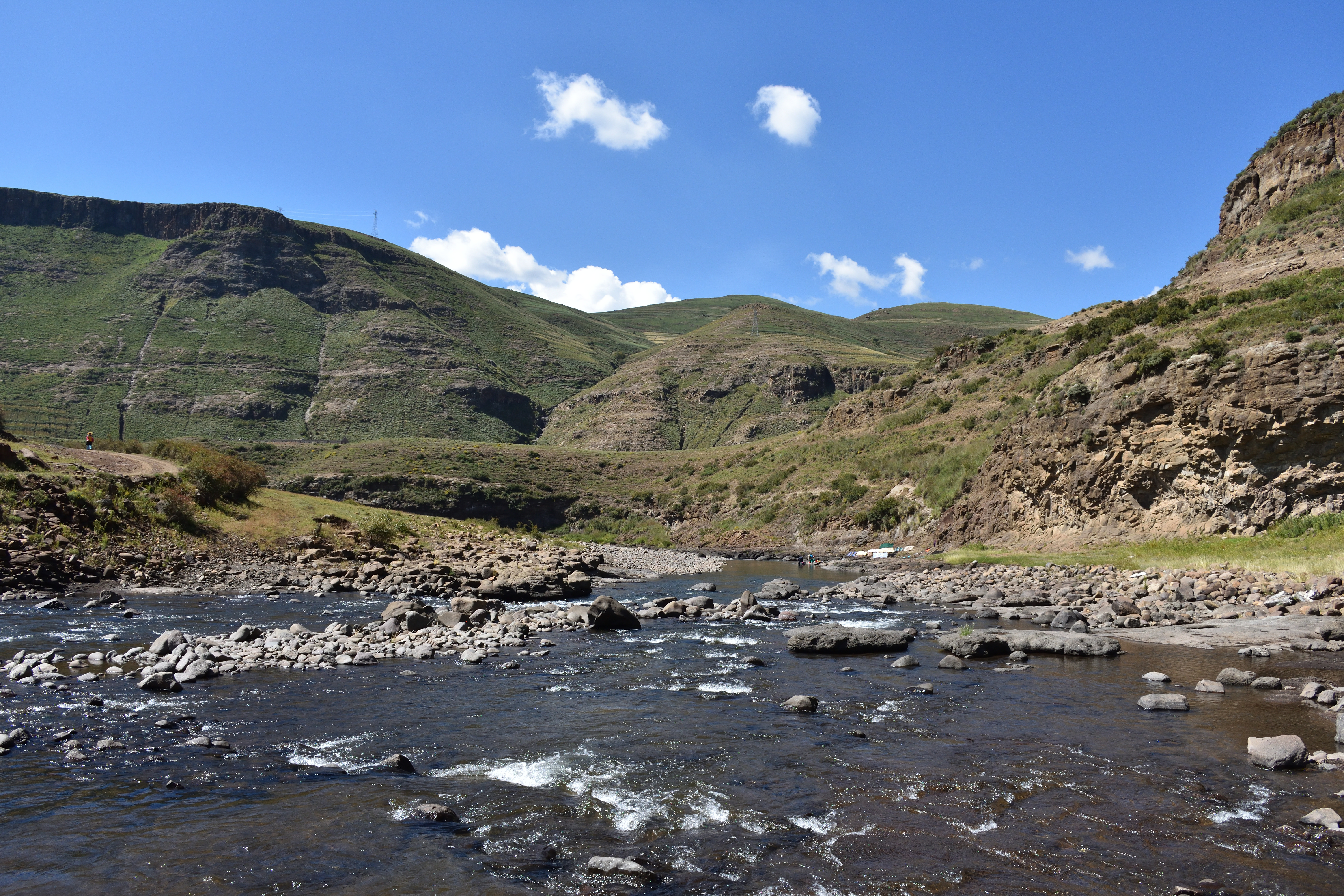
The Maluti Mountains. Photo: IndustriALL
The Maluti Mountains are behind Lesotho’s emerging status as one of Africa’s significant new diamond producing countries and home to global diamond mining companies. The UK’s Firestone Diamonds, which owns the Liqhobong Diamond Mine in Lesotho, employes over 550 workers and recently dug up a 72-carat whole “makeable” — which allows for a large diamond to be cut.
However, the union is facing stiff resistance from management at the Liqhobong mine, who are refusing the union access to meet its members. Although the country’s labour code gives unions access to the mines to organize, there are clauses in the Mining and Minerals Act which allows for “exemptions”. The unions are fighting for the clauses to be removed.
Says IDUL general secretary, Dan Theko:
“We will not be intimidated by management’s intransigence and will continue to demand just labour laws. We stand firm against union busting tactics and condemn employers’ refusal to process signed membership forms. We also have a right to meet and organize workers, and its illegal for employers to deny us that right.”
The team included the IndustriALL director of mining, diamonds, gems, ornaments, and jewellery production (DGOJP), Glen Mpufane, and the programme officer for the IndustriALL Sub Saharan Africa region, Charles Kumbi. Lesotho is part of IndustriALL’s union building project.
As part of the IndustriALL Global Diamond Network (IGDN) meeting resolution to support IDUL’s organizing drives, made in Johannesburg in 2018, three South African affiliates sent their organizers and educators — Lucky Mabiletsa (National Union of Mineworkers), Joseph Mosia, (National Union of Metalworkers of South Africa) and Thabo Mpete (United Association of Southern Africa). They shared strategies on dispute resolution, collective bargaining, understanding labour laws, and building skills on health and safety at a two-day workshop for 20 shop stewards. Besides training, the affiliates are supporting IDUL’s initiative to set up an office at Kao and will invite the union to their international schools, as well as help in securing an all-terrain vehicle.
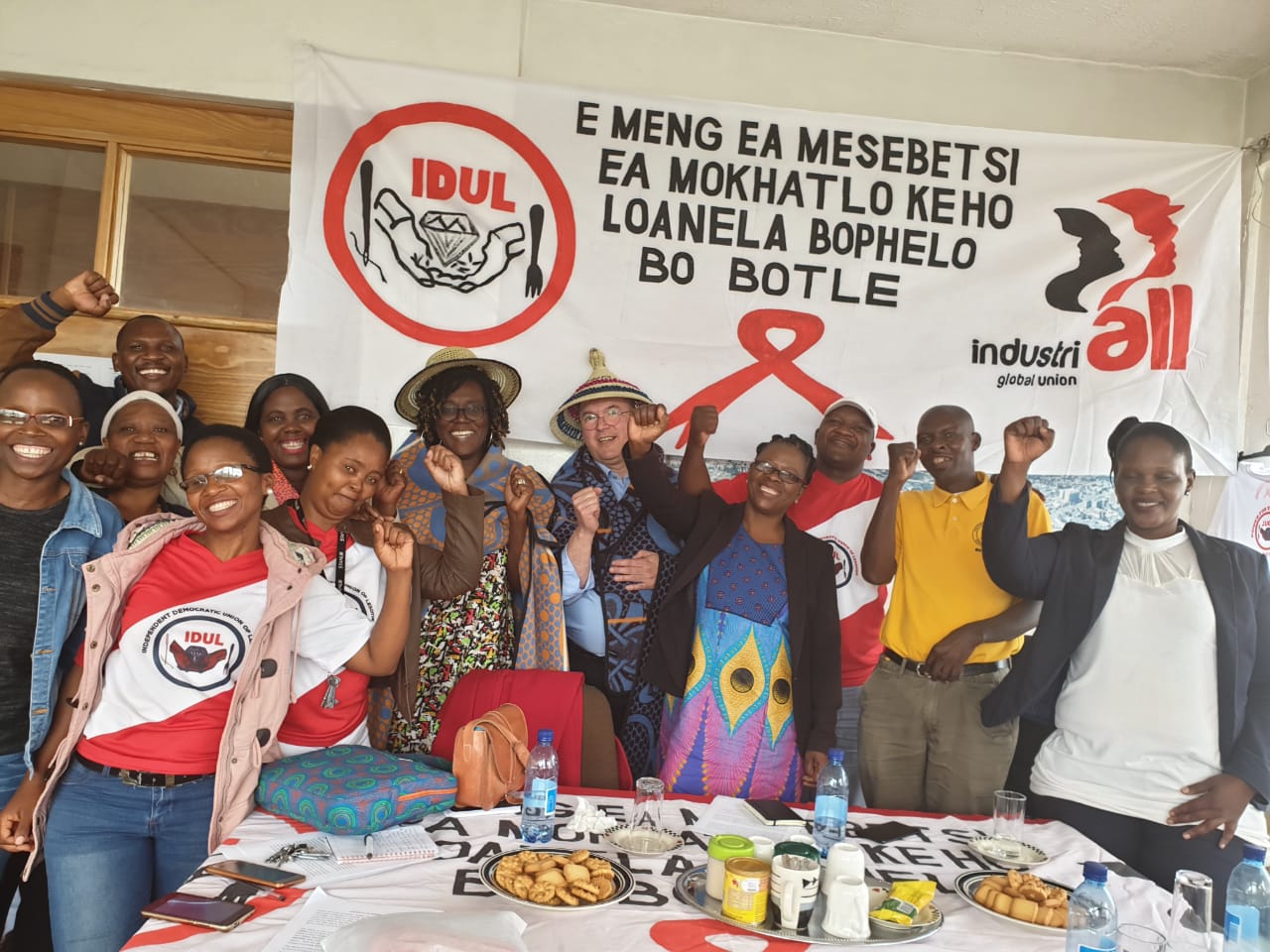
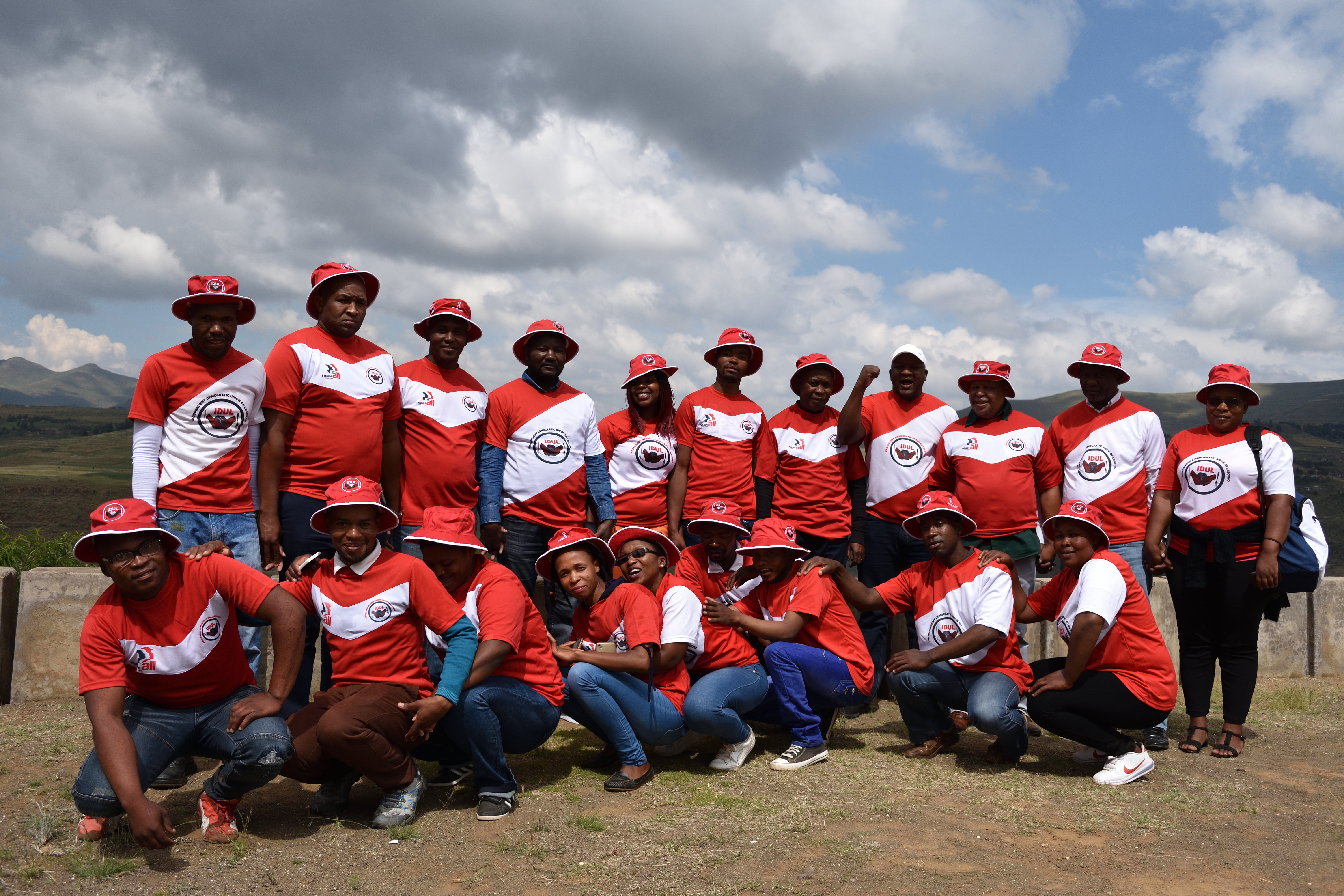
Shopstewards from the Independent Democratic Union of Lesotho. Photo: IndustriALL
Glen Mpufane, IndustriALL mining director, applauded the solidarity:
“Regional solidarity is crucial and shows the strength of the unions’ collective power. It is also an assurance to diamond mineworkers in Lesotho that they are not in an isolated struggle but are part of a global workforce fighting for workers’ rights and better working conditions through the global diamond network.”
South African women’s council pickets against sexual harassment at UNISA
The picket took place at the main campus of the university in Pretoria on 29 March, and was supported by other civil society groups. INWC-SA consists of IndustriALL affiliates, the Chemical Energy Paper Printing Wood and Allied Workers Union, the National Union of Mineworkers, National Union of Metalworkers of South Africa (NUMSA), the Southern African Clothing and Textile Workers Union and the United Association of South Africa.
Gugu, who is a NUMSA member and was at the picket, is challenging her dismissal by the University of South Africa Centre of Early Childhood Education (UCECE) and says she was sexually harassed and unfairly dismissed. When she demonstrated outside the the seat of government and the President's office, the Union Buildings in Pretoria, a few weeks ago, she was roughed up and arrested by the police. She has made reports to the police and the Commission for Conciliation Mediation and Arbitration. Further, the Commission for Gender Equality, an official body set up by South Africa’s constitution, is also looking into her case.
Officials from UNISA and UCECE received the petition and said they will reopen investigations into the matter and will meet with the INWC-SA on 2 April. The petition, which was read and signed by Ruth Ntlokose, the second deputy president of NUMSA stated:
“Gugu Ncube, like many survivors of sexual assault and/or sexual harassment who have taken the brave step of naming their abuse or abusers have routinely encountered disbelief, trivialization or minimalization of their experience or expectation, doubt and undermining of their accounts. Sexual harassment causes harm and trauma; it forms part of the continuum of violence against women that includes sexual assault, exploitation and abuse.”
Says Paule France Ndessomin, IndustriALL regional secretary for Sub Saharan Africa:
“We stand for Gugu’s fight for justice in line with the IndustriALL Pledge which is our commitment to stand firm and say no to sexual harassment at the workplace. We are committed to uprooting all forms of gender-based violence from the workplace.”
In 2018 the South African government convened a national summit against gender-based violence and femicide and recently opened a sexual offences court to curb violence against women.
Zambian union on organizing blitz for contract mineworkers
Of the country’s 65,000 mineworkers, nearly half, 30,000, are employed through contractors.
The Mineworkers Union of Zambia (MUZ) is on a recruitment drive for contract workers who are often employed on short-term contracts with low pay and little or no benefits. The same workers are put under pressure to perform dangerous work to meet targets sometimes with disregard to health and safety standards. However, when injuries and death happen, employers shift the blame to the contractors.
On 18-19 March MUZ, affiliated to IndustriALL Global Union, with support from the Sub Saharan regional office had a recruitment and organizing blitz in Chililabombwe district at EMR’s Lubambe, and the London-listed Vedanta Mining Resources’ Konkola Shaft 3 copper mines, where the union emphasized the importance of belonging to a union to fight for workers' rights collectively. At Lubambe, all contracts will end in August, creating an uncertain future.
In the last few months, MUZ has signed recognition agreements with the multinational mining contractors, Reliant Drilling and Redpath Rig Resources, among other mining companies. One of the benefits of these agreements is the extension of contracts from three months to two years, but the goal for MUZ is for permanent jobs for the workers.
Brenda Mufika, IndustriALL coordinator for MUZ says:
“Short contracts make workers reluctant to join a union because there is no job security. To counter the short contracts, we are campaigning for decent work and permanent jobs.”
Charles Kumbi, IndustriALL project officer says:
“Organizing is key to building union power as it allows the union to effectively engage the employer in collective bargaining. Recognition agreements are an important tool not only to increase membership but to build the strength of the union.”
Zambia is in the IndustriALL union building programme, which also includes seven other countries in the Sub Sahara region.