Global network meeting resolves to pursue dialogue with Anglo American
Senior executives from Anglo American attended the meeting, comprising over 30 delegates from IndustriALL affiliates that represent the company’s workforce in Australia, Botswana, Brazil, Lesotho, Namibia, South Africa, and Zimbabwe. The Friedrich Ebert Stiftung Trade Union Competence Centre for Sub Saharan Africa also attended the meeting, which was chaired by Lucineide Varjão Soares, the sector co-chair and president of CNQ-CUT in Brazil.
Nolitha Fakude, chair of the management board of Anglo American in South Africa, lead the company delegation and said the company is committed to improving workers and communities’ lives through responsible mining. She was accompanied by Froydis Cameron, international and government relations, and Hermien Botes, head of sustainability engagement.
The proposed framework of global dialogue between Anglo American and IndustriALL will be a platform for meaningful conversation about issues and challenges facing the company at global level, such as improving industrial relations, occupational health and safety, gender equity, Just Transition measures for climate change and the impact of Industry 4.0.
Further, the dialogue is an opportunity for exploring working together on Anglo American’s Sustainable Mining Plan and the UN Sustainable Development Goals. This will provide an opportunity to work jointly on diverse issues that include health, education, livelihoods, youth development, and community safety and health. The dialogue will also deal with responsible mining and the commitment to the Initiative for Responsible Mining Assurance (IRMA), a multi-stakeholder governance standard and independently third-party auditing initiative.
The global network agreed to continue with efforts to organize and strengthen collective bargaining.
Kemal Özkan
IndustriALL assistant general secretary Kemal Özkan said:
“As a global union we are effective organizers with capacity to improve the lives of mineworkers, and we are also campaigners for living wages. Our success comes from working together through global solidarity from Australia, to Africa and Latin America and sharing information and experiences.
“We would like to build on previous meetings with Anglo American to negotiate a formal agreement that will meet some of our demands.”
Unions in Mozambique empowering workers
Union presence in Mozambique has been centred around the capital, Maputo. Through the project with the Finnish trade unions PRO and Teollisuusliitto and Finnish trade union solidarity centre SASK, union density in the provinces has grown significantly between 2015 and 2018:
Sindicato Nacional dos Trabalhadores da Indústria Metalúrgica Metalomecánica e Energia (SINTIME) 20 per cent growth
Sindicato Nacional dos Trabalhadores da Indústria Quimica e Afins (SINTIQUIAF) 61 per cent growth, and
National Union of Construction Industry, Wood and Mine Workers of Mozambique (SINTCIM) 22 per cent growth.
However, local structures have remained weak, the next phase focuses on empowering local structures and incorporating more women and youth.
The effort to raise the profile of unions has meant empowering local shop-stewards, woman, and youth through training. Local shop stewards have been trained as “circle study leaders”, and have then organized local workshops facilitating discussions with members around trade union issues.
“Everyone has basic workplace knowledge and experience. They then come to these discussions and learn through exchanging; it’s not just training it’s learning through experience and reflection. The idea is that they take the method back to their workplace and spread the knowledge. Through the study circles we can already see the leaders of tomorrow,”
says Sarah Flores, IndustriALL youth project officer.
Jointly within the three unions, women and youth have been working on policies. The policies will then need to be approved by their national council before they can be adopted. Each union will develop an implementation strategy, ensuring inclusion of women and youth throughout their structures.
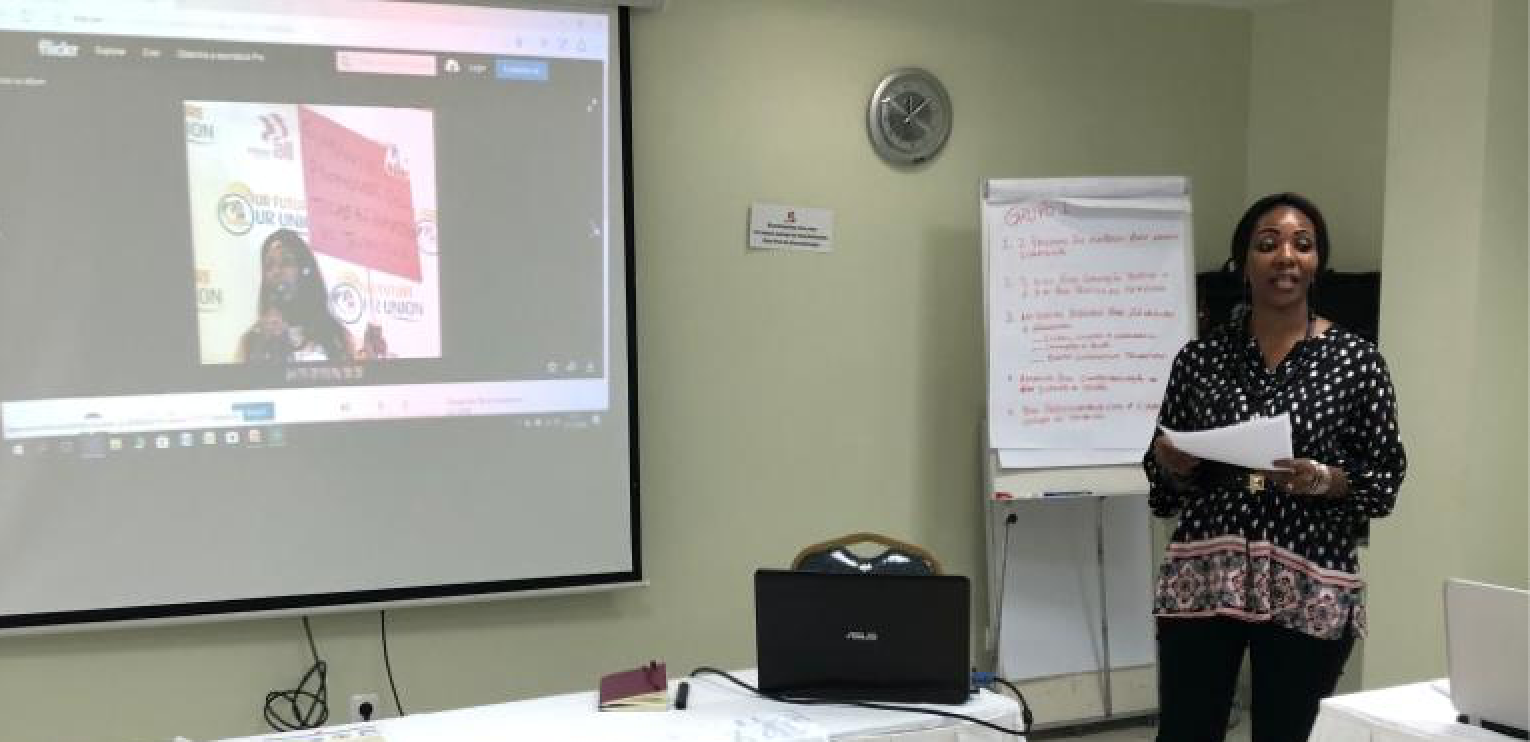
Sonia Nhampossa from SINTIME
“It is important to have policies for youth and women because we have seen violations of their rights in the workplace. Women and young people must be encouraged to occupy decision-making roles within unions,”
“This is a great example of how long-term work in the spirit of unity can make unions stronger, we are looking forward to these policies being adopted and implemented,” says Atle Hoie, IndustriALL assistant general secretary.
Garment workers in Ethiopia need strong unions
The industrial parks' strategy is meant to transform rural towns into industrial manufacturing zones.
However, an interview with workers from the park on 28 November confirm that they do not belong to trade unions but working conditions are rather negotiated through employers/workers committees formed by the factory owners.
The committees discuss wages, working conditions, skills training, health and safety, transport for workers and disciplinary issues.
Wages for the garment workers remain low, especially for sewing machine operators whose basic salary is 750 Ethiopian Birr. In addition, the workers are paid 300 Birr for accommodation and a further 100 Birr for reporting for work.
The total, 1,150 Birr, equals around US$38. Yet a room in Hawassa costs about 2,000 Birr. To make ends meet in some instances four workers share a single room.
During a factory visit by IndustriALL Global Union, workers said the shirts they were making would sell in the US for about US$70, which is substantially more that their monthly wages. The factory makes 3,500-3,750 shirts per 8-hour shift and employs 450 workers.
Worsening matters is the irregular pay day; sometimes wages are paid 11 days late. Although production bonuses sometimes bring relief, workers say it is not every week there is a production bonus. They need to earn better wages.
At some factories the lunch break is only 30 minutes. Some factories provide food at canteens, while others do not. With the low wages, workers who do not have lunch provided can sometines go without food until the end of the shift and will only eat when they get home.
IndustriALL director for the textile and garment sector Christina Hajagos-Clausen says:
“We are supporting our affiliate in Ethiopia, the Industrial Federation of Garment Leather Textile Workers Union, in their efforts to unionize workers at Hawassa.
“As a collective the workers can demand minimum living wages and better working conditions. Without representation by a strong union the workers will continue to work under terrible conditions. We will also discuss with international brands sourcing from Hawassa to respect workers’ rights and pay living wages.”
Leading American brand PVH has a factory at the park and is one of several brands that are sourcing garments from Hawassa.
Mondiaal FNV is working with the IFTLGWU on organizing workers in the Hawassa Industrial Park and also supporting research on minimum and living wages in Ethiopia.
Swedish and Zambian unions tackle gender issues
These are some of the recommendations from a gender workshop whose goal was to identify ways to develop policies to stop sexual harassment in unions, to educate women workers, and come up with procedures to prevent unwanted behaviours.
The 18 participants who attended the workshop in Lusaka on 26 November were from the IndustriALL Global Union Sub Saharan Africa regional office, Zambian IndustriALL affiliates, and Swedish unions.
The workshop discussed norms and gender roles, linking them to power analysis, which is important in sexual harassment cases. Gender inequality was discussed as one of the drivers of sexual harassment.
Issues discussed included definitions of feminism and patriarchy considering similarities and differences in the Zambian and Swedish contexts. Other concepts discussed included empowerment and disempowerment and structural oppression.
The concept of intersectionality and how different systems of power, like age, gender and nationality, interact in oppression and how this shaped gender was discussed.
Karin Ström, international policy officer, and Lina Andersson, gender policy officer from Unionen and Fanny Högrell, trade union officer, IF Metall, explained their unions systematic work on gender equality, the long struggle for recognition on these issues, the battles won and the challenges ahead.
Paule France Ndessomin IndustriALL regional secretary for Sub Saharan Africa, said:
”Global solidarity is important in building the capacity of unions to confront sexual harassment and gender based violence. The campaign for countries to adopt ILO C190 on violence and harassment in the world of work is gaining momentum. We are calling on our affiliates to put pressure on their governments to ratify the convention.”
Ethiopia: towards a common collective bargaining strategy
The workshop, which took place in Addis Ababa 25-26 November was attended by 30 union leaders from factory unions in the textile and garment sector. The participants came from some of the 125 factory or basic unions that make up the Industrial Federation of Textile Leather and Garment Workers Union (IFTLGWU), affiliated to IndustriALL Global Union.
The unions agreed to work together towards a common set of demands for collective bargaining, which would then be put collectively to the employers.
If this plan succeeds, the unions will move away from the current negotiations in which they bargain with employers as individual unions at factory level. According to the unions, this set up weakens the unions and exposes the leadership to intimidation by some employers. Some workers even declined to take up union positions for fear of victimization.
Mesfin Adenew, IFTLGWU president said:
“We need to strengthen unions in Ethiopia. A weak union does not have the power to confront employers, but strong unions can achieve far more.
Like our sister union the Southern African Clothing and Textile Workers Union (SACTWU) in South Africa that has carried out a successful living wage campaign. Interunion solidarity is important in Sub Saharan Africa to build union power.”
The unions agreed on the need for a national bargaining conference to consolidate their demands, including those for living wages and better health and safety at work. However, before this happens the unions must strengthen leaders’ skills in recruiting and organizing and fighting for the rights of the workers according to Ethiopia’s constitution and labour laws.
These rights include the protection of women workers against gender-based violence and sexual harassment. Improving skills in negotiation, conciliation, mediation, and arbitration were identified as key to improving collective bargaining and protecting workers interests.
Tigist Fisseha from ILO outlined the decent work and inclusive industrialization programme in Ethiopia which supports collective bargaining.
The workshop was held with support from Mondiaal FNV and facilitated by Hlokoza Motau, former head of organizing, campaigns and collective bargaining at National Union of Metalworkers of South Africa, who explained the tactics South African unions have successfully used in collective bargaining.
The workshop is a follow up to an earlier solidarity visit by Ethiopian unionists to SACTWU in South Africa.
REPORT: The African Continental Free Trade Area – will it promote fair trade, economic development and decent work?
We ask the continent’s trade unions for their view.
“We are far away from the ideals of Pan Africanism. The AfCFTA will not make our dreams come true. There are fears that many large African economies will disproportionately benefit while others will not be able to save their domestic industries from the dumping of imported goods.”
Reeaz Chutto, Mauritius
In Africa’s post-colonial landscape, dictatorships and rampant corruption thrive. Countries are underdeveloped and highly indebted. Economies have not transformed after independence. Most African economies remain primary producers of agricultural goods, oil and gas, and minerals with little or no value addition. They are heavily dependent on foreign aid. Unemployment is high, especially of the youth, and most people make a living in the informal sector. Poverty is common, including that of the working poor.
The AfCFTA is a project of the African Union (AU), designed to facilitate intra-African trade. Originally launched in 2012, its instruments have not yet fully come into force. When they do, many argue it has the potential to transform the economy of the continent.
The support for the AfCFTA by African countries since its launch and particularly since negotiations began in 2015 is overwhelming, with only Eritrea still to sign. Nigeria, the continent’s biggest economy, was initially reluctant, fearing that the country would be flooded by cheap imports, but eventually signed.
“The long-awaited solidarity between African countries is finally happening. It is time for African countries to have strategic trade agreements to bring together the resources and labour that the continent is rich in and attain strong and sustainable industrial development.”
Rose Omamo, Kenya
African countries trade more with Asia, China, Europe and the USA than amongst themselves. African trade unions, which are promoting the industrialization of the continent, see this as a lost opportunity. African countries are competing for the same international markets, and duplicating efforts, instead of specializing, pooling expertise and trading with each other. However, unions are concerned that increasing trade will not automatically benefit people if workers’ rights are not prioritized.
Increasing trade will not automatically benefit people if workers’ rights are not prioritized.
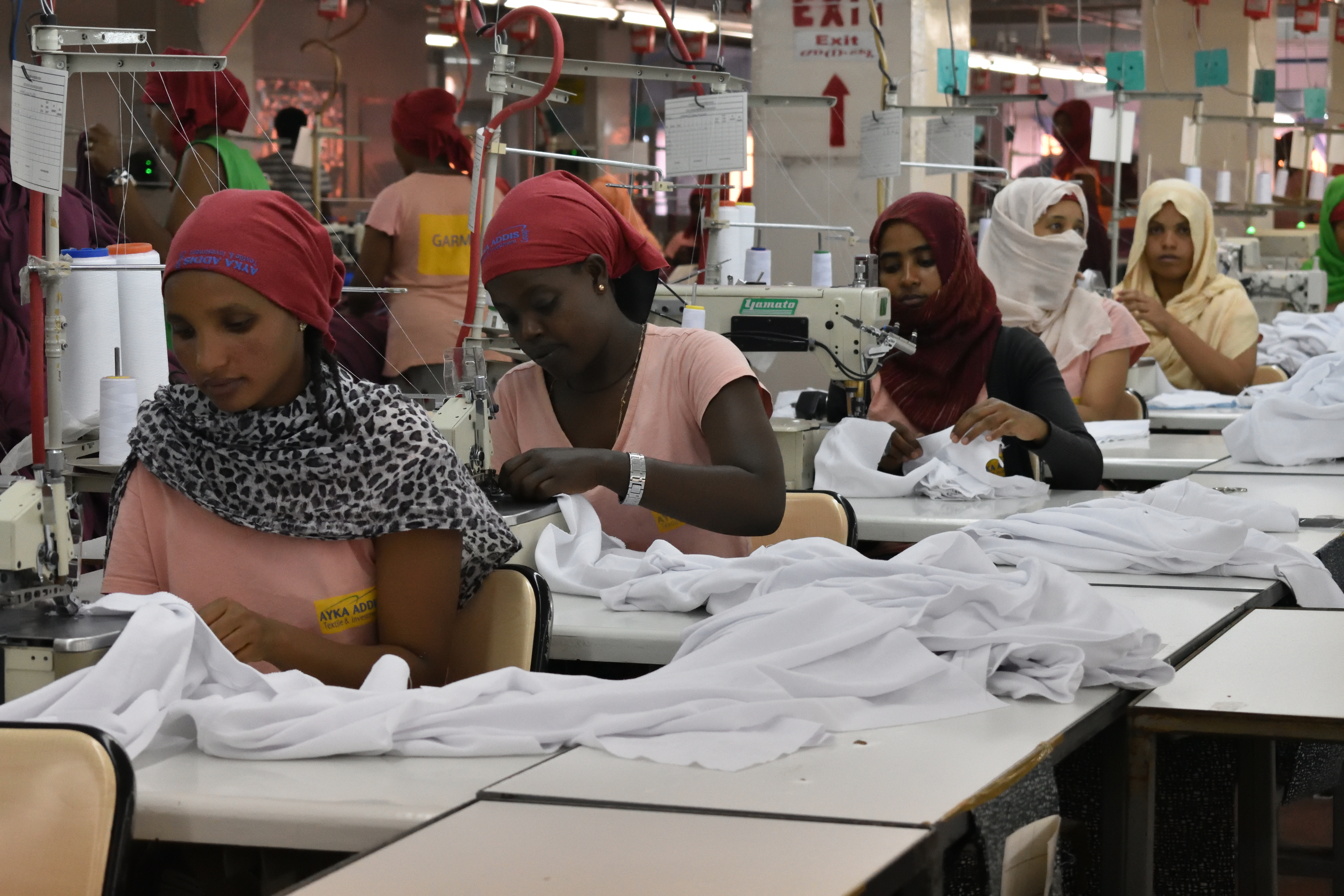
Ayka Addis Factory, Addis Ababa, Ethiopia
When it is fully implemented, many believe the AfCFTA could be a critical breakthrough to improving intra-regional trade, cross border trade and economic integration, creating jobs and contributing to the sustainable industrialization of the continent.
Although trade unions recognize this potential, they have been excluded from the consultations that led to the signing and ratification of the agreement. Trade unions, civil society organizations and communities that will be directly affected have not been given a chance to represent their interests. They argue that this exclusion is against the people-centred approach and transparency of the African Charter on Human and People’s Rights, and fair-trade principles that promote partnerships based on dialogue, transparency and mutual respect.
What is the AfCFTA?
The AfCFTA a wide-ranging agreement that covers trade in goods and services, investment, intellectual property rights, and competition policy. The AfCFTA aims to “promote and attain sustainable and inclusive socio-economic development, gender equality and transformation of state parties.” Further, the agreement intends to “promote industrial development through diversification and regional value chain development, agricultural development and food security.”
According to the United Nations Conference on Trade and Development, in 2017 intra-African trade accounted for only 16 per cent of total exports. The main trader is South Africa which imports petroleum products and exports maize and other items. It is followed by Nigeria and Egypt which export crude petroleum and petroleum gas and garments and textiles and import other products.
Globally, African trade only accounts for 2.6 per cent and mainly trades with Europe. Trade with India and China is also growing.
The AfCFTA aims to achieve transformation through implementing existing continental initiatives, including the Industrial Development Africa, Programme for Infrastructural Development of Africa, Action Plan for Boosting Intra-African Trade and the Comprehensive Africa Agriculture Development Programme. Other projects include the Single Africa Air Transport Market and free movement of people.
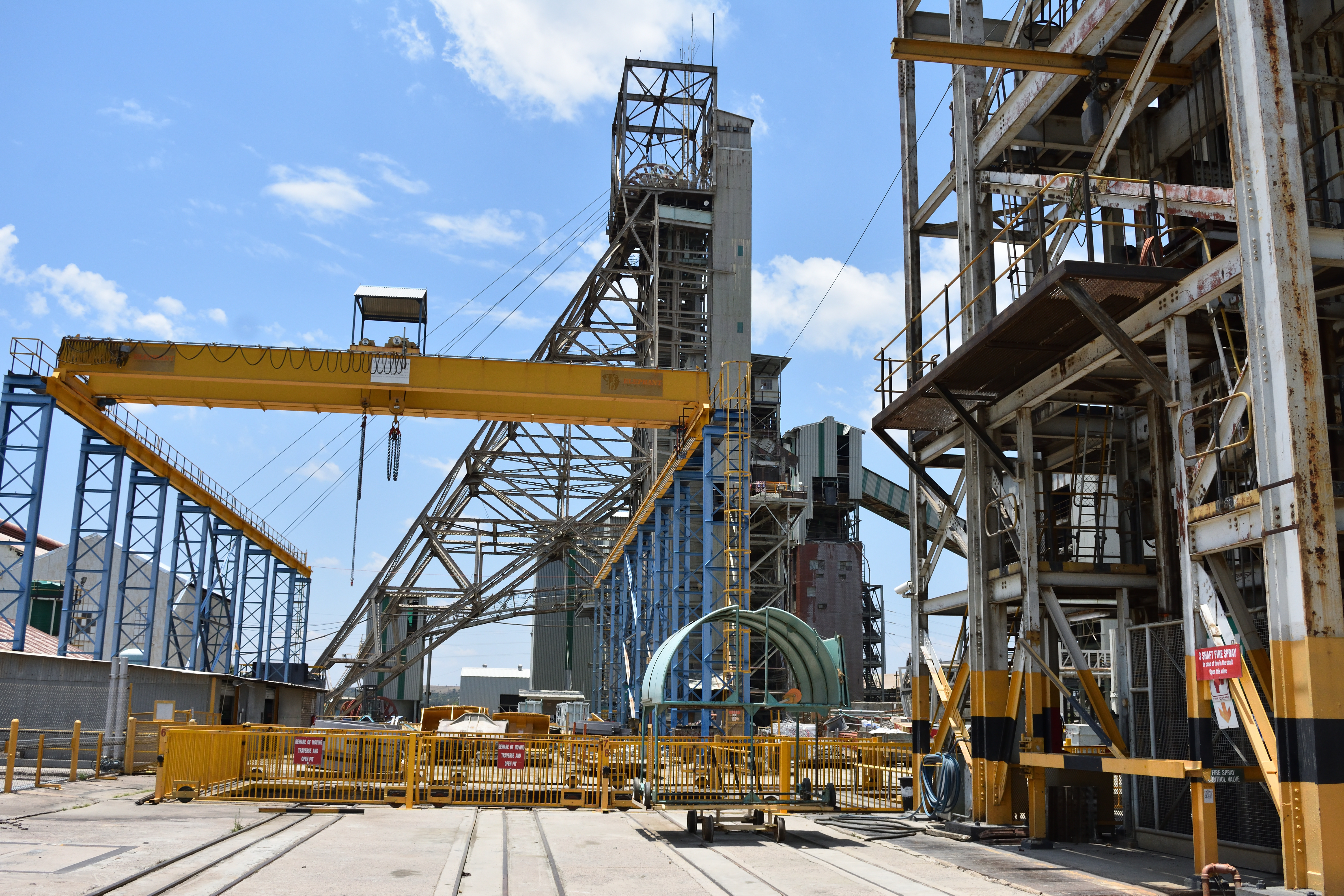
Cullinan Diamond Mine, South Africa
With support from the AU and United Nations Economic Commission for Africa (UNECA), the AfCFTA is driven by ministers and heads of states and government. The agreement has a secretariat which will be based Ghana.
The AfCFTA will create a single market for goods and services for a population of 1.2 billion people and a combined gross domestic product of US$3.4 trillion. The single market will create free movement of people, traders and investments leading to the establishment of a common customs union. According to UNECA, the AfCFTA will become the world’s largest free trade area since the formation of the World Trade Organization (WTO).
When fully functional, the AfCFTA aims to boost intra-African trade by over 50 per cent through the development and promotion of regional and continental value chains. The agreement, which is one of the strategies of the AU’s Agenda 2063 programme for transformation and development, will lead to the achievement of some of Sustainable Development Goals of Agenda 2030.
Benefits of the agreement include increased manufacturing and diversification in emerging economies including Ethiopia, Morocco and Rwanda that are implementing policies that promote manufacturing and industrialization. This means small countries will take advantage of the economies of scale and the huge market provided by the AfCFTA.
The agreement also has provisions that have allowed the struggling economies of Djibouti, Ethiopia, Madagascar, Malawi, Sudan, Zambia and Zimbabwe to benefit from reduced tariffs. According to the Global Manufacturing Competitive Index most of the manufacturing on the continent currently takes place in South Africa, Egypt and Nigeria.
The AfCFTA aims to improve coordination and facilitation of trade across the regional economic blocs. Integration will include bringing together regional economic communities – Arab Maghreb Union, Common Market for Eastern and Southern Africa, Economic Community of West African States, East African Community, the Community of Sahel-Saharan States, and the Economic Community of Central African States, Intergovernmental Authority on Development and Southern Africa Development Community. Among other things, the AfCFTA wants to end competition between the regional economic communities and replace it with cooperation.
The AfCFTA compliments other strategies of the AU including the African Mining Vision (AMV). The AMV identifies sustainable development corridors as a tool for promoting trade and investment, optimizing the use of infrastructure, encouraging value addition, and enhancing the competitiveness of African economies.
The corridors are geographical areas where resources are pooled together to achieve maximum impact.
“The African Spatial Development Programme provides a means to facilitate integrated economic development platforms based on the production of key large-scale anchor (usually in mineral beneficiation) investments and related upstream and downstream investments. They also provide a strategy to catalyse sustainable sectors (agriculture, tourism and resource-processing) and in doing so, provide a tool for introducing a spatial focus to planning for Africa’s infrastructure and economic development.”
The AMV also makes a case for artisanal and small-scale mining to be recognized by governments through policies and regulations. In most countries artisanal miners are criminalized with little or no effort to recognize and formalize their operations. How minerals mined by artisanal and small-scale miners can become part of the mining value chain is also important for the AfCFTA.
The operational instruments of the AfCFTA are rules of origin, the online negotiating forum, the monitoring and elimination of tariff and non-tariff barriers, a digital payment system and the African Trade Observatory – a platform for policymakers and the private sector to make data-driven and evidence-based trade related policies and decisions.
Will it work?
Is the AfCFTA charting a new path?
Africa has never been short of economic and policy documents. The African trade and investment policy landscape is littered with failed grand plans and ambitious policies that have not succeeded in bringing about much-needed trade.
The Organization of African Unity, which became the African Union in 2002, was formed in 1963 in Addis Ababa, Ethiopia, with great emphasis put on economic
co-operation. There were claims that Africa should not depend on aid from the Global North, but develop through trade and investment. Hence ideas of developmental states. Despite this, very little has changed on the ground.
The AfCFTA recognizes existing trade agreements, making it possible for them to complement the AfCFTA rather than compete with it. These include the African Growth and Opportunity Act, Economic Partnership Agreements, and agreements with the WTO. However, existing trade policies have failed to provide the impetus required for industrialization and economic development to take off in Africa.
Further, economic policies sponsored by the International Monetary Fund and the World Bank have not led to sustainable growth, with structural adjustment programmes bringing the worst results. Trade liberalization saw the collapse of most local industries as their products could not compete with those imported from other countries. The privatization of public entities made public goods and services expensive for the continent’s poor.
It remains to be seen if the AfCFTA can transform the economies of the continent from the dependency on primary commodity exports. According to the UNCTAD, this dependency makes African economies vulnerable to the unstable prices on the international market. For instance, the low international oil prices have adversely affected the Nigerian economy while low uranium spot prices have led to the mothballing of Langer Heinrich mine in Namibia, leading to the loss of hundreds of jobs.
What do unions say?
Rose Omamo, the general secretary of the Amalgamated Union of Kenya Metal Workers, which is affiliated to IndustriALL Global Union remarks:
“The long-awaited solidarity between African countries is finally happening. It is time for African countries to have strategic trade agreements to bring together the resources and labour that the continent is rich in and attain strong and sustainable industrial development.
"The AfCFTA is very promising. If the conditions are conducive, then I believe that the transfer of skills, classification of labour and compensation of African workers will be guaranteed. However, I am not sure if there are clear policies to address the labour issues.”
She continues:
“A policy must be developed to guide labour migration. The question of who invests in what country must be addressed to guide foreign direct investment. The movement of labour must include social protection across borders. In case of work injury, compensation should be clearly stipulated within a well-structured occupational safety and health policy.”
Reeaz Chutto, president of the Confederation des Travailleurs des Secteurs Publique et Prive, in Mauritius, also affiliated to IndustriALL, urges a cautious approach:
“The creation of the AfCFTA will inevitably boost trade within the African Continent but will bring opportunities and threats at the same time.
“We should not get into an overwhelming feeling that by increasing trade, this will bring more prosperity to a vast majority of Africans in all the countries that have signed the agreement. Only capital, goods and services will be free to move from one country to the other, not human beings.”
“We are far away from the ideals of Pan Africanism. The AfCFTA will not make our dreams come true. There are fears that many large African economies will disproportionately benefit while others will not be able to save their domestic industries from the dumping of imported goods.”
“The creation of the AfCFTA cannot exist in absolute terms to eliminate trade barriers. The main reason remains that countries will not play on a level field. Some larger economies have the infrastructure and resources to produce good quality goods at lower production cost as they have access to the latest digital technologies. Unfortunately, other countries do not have the proper inland infrastructure to ensure connectivity even inside the country.”
Jane Ragoo, the general secretary of CTSP says trade agreements should cater for social needs:
“Should we close our frontiers, or should we open them according to supply and demand as dictated by market forces? We need to conduct trade that put people first and not the greed of the capitalist system. Trade cannot be free without considering our social, cultural and traditional contexts.”
“We need to protect and value our traditional and artisanal products. Exports of food and agricultural products should be done only after satisfying the local demand and prices should be affordable for all.”
“It is important to focus on land connectivity among African countries to favour a more ecological and affordable transport system of human beings and goods. This will ensure that small and medium sized producers also benefit from the AfCFTA. Better connectivity among African countries will enhance regular migration. Further, it is important for the AfCFTA to promote fair trade which guarantees an equitable livelihood to small farmers through income distribution in the supply chain.”
Unions argue that most of the documents signed so far – the agreement establishing the AfCFTA, the Kigali Declaration and the protocol for the establishment of the African economic community relating to the free movement of persons, right to residence and right to establishment – should include workers’ rights and decent work as protected by International Labour Organization (ILO) conventions, especially Convention 87 on the freedom of association and the right to organize and Convention 98 on the right to organize and collective bargaining. Most African countries have ratified and domesticated these conventions into their national labour laws.
There remains a window of opportunity for a union voice to be heard in the operational phase of the AfCFTA, which was launched on 7 July at the Niger Summit of the African Union, and in negotiations for future protocols. In the operational phase, in which countries develop their implementation plans, important topics such as the future of work and Industry 4.0 can be included.
At the Executive Committee in Mexico City in December 2018, IndustriALL adopted an action plan on international trade and manufacturing policies to help affiliates become more involved in talks concerning multilateral trade agreements and treaties.
Focus on industrialization in Africa
With its 500 million work force expected to increase to 676 million workers by 2030, according to the International Labour Organization, Africa can take advantage of the demographic dividend if it fixes some of its fundamentals including increased government policy support for industrial development.
The Industrialization in Africa conference that was organized by IndustriALL Global Union’s sub Saharan region recommended how government policies can promote interlinkages between production and trade in goods and services, technological innovation, investing in manufacturing, redesigning products, and lower transport costs.
Further, infrastructure, skills and stronger institutions were identified as key. Participants at the conference said these changes were necessary for Africa to compete in the global value chains.
Valter Sanches, IndustriALL Global Union general secretary says:
“Sustainable industrialization has the potential to create employment, especially in the manufacturing sectors of African economies. With more decent jobs that pay living wages, we believe that poverty will be eradicated. Currently Sub-Saharan Africa has the highest poverty levels especially in low income and conflict-affected countries.
“It also has the highest number of the working poor. Unemployment remains high especially for the youth with most making of them making a living in the informal sector. Sustainable industrialization can reverse this and turn the workers fortune around.”
At below 10 per cent of GDP, Africa’s global manufacturing continues to lag other continents with manufacturing concentrated only in a few countries that include South Africa, Egypt, Nigeria and Morocco. Manufacturing value addition is also low.
However, there is potential in industries that are based on information and communications technology which are in common with Industry 4.0. Such industries give workers skills for the digital economy that include advanced data analysis necessary in future workplaces.
Africa’s heavy manufacturing consist of transport vehicles, appliances, electronics and industrial equipment. Foreign direct investment is also favouring manufacturing. At the African Investment Forum organized by the African Development Bank in Johannesburg, South Africa 13-15 November investors pledged over US$40 billion in various projects that will be implemented in 25 countries.
Textile and garment is another sector important for Africa’s industrialization. In Ethiopia and Kenya global brands are working alongside small and medium scale enterprises to create tens of thousands of jobs.
Mine closure huge blow to workers
IndustriALL Global Union affiliate SYNTRAMIN are pushing the Compagnie Minière d’Akouta (Cominak) management and the government of Niger to keep the mine in operation. The union wanted to present its proposals at the majority owner’s shareholder meeting in France in September, but management refused its participation.
Moutari Aboubacar, SYNTRAMIN general secretary, says: “It is as if workers don’t matter; as if our lives have no value in their eyes. They behave as if we are just a shop that they open and close when they want; without worrying about the consequences of their action.”
“We disagree with the decision of the board of directors of Cominak and call for national and international solidarity to highlight the harsh consequences a closure will have on workers, permanent as well as contractors.”
Niger has the world’s fourth largest uranium reserve, and the union does not agree that the ore is exhausted. Instead, SYNTRAMIN is proposing that the government, who owns 31 per cent of Cominak, look for additional shareholders to continue operations.
In a letter to the majority owner Orano, IndustriALL Global Union is urging the government of Niger to consider the workers’ interests:
“We hope and expect the government will keep its promise for workers to be offered favourable packages, and that Cominak workers will continue to be employed. We support SYNTRAMIN’s demands for special bonuses for workers who have been employed by the mine from one to 20 years.
“IndustriALL Global Union joins its affiliate SYNTRAMIN in urging the company and the government to engage in negotiations for a plan for a Just Transition.”
The main shareholders of Cominak is Orano (France) with 34 per cent, Sopamin (Niger) with 31 per cent, Ourd (Japan) with 25 per cent, and Enusa Industrias Avanzadas SA (Spain) with 10 per cent.
Union-made blazers for South Africa's Rugby World Cup champions
The House of Monatic is a garment factory in Cape Town that specializes in suits and formal wear. It has made suits for South African President Cyril Ramaphosa and recently blazers for the Rugby World Cup champions, the Springboks.
Buy local is a campaign initiated by SACTWU, affiliated to IndustriALL Global Union, to source textile, garments, footwear and leather products in the country instead of importing.
The campaign aims to create jobs in the sectors which are important in a country with high unemployment levels. SACTWU is working with the South African Rugby Union (SARU) to produce, among other things, replica shirts for rugby supporters. The union is also working with the South African Football Association and Cricket South Africa on the local procurement campaign.
Part of the union’s victory is that the buy local campaign demands are included in the retail, clothing, textile, footwear and leather masterplan which was signed at the second South Africa Investment Conference in Sandton, Johannesburg on 6 November.
Welcoming the signing of the masterplan, which will create 70,000 new manufacturing jobs, the union says that the plan provides “a firm basis for future growth and sustainability” of the sectors. The masterplan was signed by major retailers, manufacturers, labour, and government.
Andre Kriel, SACTWU general secretary, says:
“Major retailers will procure more clothing, textile, footwear and leather goods locally, up to 65 per cent, and manufacturers will increase investment in modernizing productive capacity in our industry. We are pleased with the commitments made by the government to help strengthen the inspections and compliance enforcement capacity of the South African Revenue Services to stamp out illegal imports and under-invoicing.”
“We look forward to the constructive and effective implementation of this new and innovative tripartite social compact; the first of its kind to be signed by our industry's major stakeholders.”
Proudly SA, a company that promotes locally manufactured products, is also a partner in the campaign.
Photo credit: The South African rugby team celebrates. Photo: GCIS/South African Government
Unionists, human rights activists and opposition politicians under siege in Zimbabwe
“We were at the balcony of the ZCTU offices when the police started manhandling the [ZCTU] President [Peter Mutasa]. I thought it would be a good idea for us all to either sit down or follow the president to the police vehicle.
“That was when one of the police officers dragged me outside and began hitting me with a baton all over my body. He then bundled me into the police vehicle, together with President Mutasa and others,”
he says, narrating his ordeal to Equal Times. “They beat us all the way to the police station, where we spent the night before appearing in court the following day,” he adds.
Chirowamari and six others arrested on that day were charged with bigotry (words or deeds that can result in a crime against public order) although the charges were later withdrawn.
And in September, the acting president of the Zimbabwe Hospital Doctors Association, Dr Peter Magombeyi, made international headlines after he was abducted from his home in Harare by suspected state security agents for organising a strike by government doctors to demand better salaries.
Magombeyi was discovered four days later after being dumped in the bush 40 kilometres west of Harare. Allegedly tortured and poisoned by his captors, he underwent medical treatment in South Africa.
Worsening climate of fear
The stories of Chirowamari and Magombeyi are shared by hundreds of other trade unionists, opposition politicians and human rights activists whose right to freely assemble and associate is being trampled on by the Zanu-PF government, currently headed by President Emmerson Mnangagwa.
While Zimbabwe has ratified a number of international laws, including the International Labour Organization’s Right to Organise and Collective Bargaining Convention (No. 98) and the Freedom of Association and Protection of the Right to Organise Convention (No. 87), the country lags dangerously behind in terms of implementation.
The repression of trade unionists has been a permanent scar on Zimbabwe’s political landscape since the early 1990s, but ever since President Mnangagwa took over from the late President Robert Mugabe in 2017, many say the climate of fear has worsened.
According to the Zimbabwe Association of Doctors for Human Rights, at least 18 people have been killed in demonstrations since Mnangagwa took power.
Meanwhile hundreds of trade unionists and campaigners continue to be harassed, arrested, raped and abducted for peacefully gathering to express their frustration at living in a country with the second highest inflation rate in the world after Venezuela (161.8 per cent according to the IMF, although some economists have talked about an inflation rate of 570 per cent).
Zimbabwe is also a country where unemployment levels and the cost of living continue to soar beyond all reasonable proportions, even by the minute, and where those who have jobs are rarely paid enough to survive – if they are paid at all.
ZCTU leaders President Peter Mutasa and Secretary General Japhet Moyo are currently on trial for “attempting to overthrow a constitutionally elected government or alternatively inciting violence” as a result of organising a six-day work ‘stay away’ in January 2019 against inflation, rising fuel costs and shortages of daily food essentials.
Mutasa, Moyo, other members of the ZCTU leadership and their families have faced harassment and death threats in recent weeks. The court case has been postponed until 20 November and Moyo and Mutasa are facing a 20-year jail term if convicted. Twenty other trade unionists in the eastern border town of Mutare are also on trial (for bigotry) for engaging in a demonstration.
In February this year, Kwasi Adu Amankwah, secretary general of the International Trade Union Confederation’s (ITUC) regional body ITUC-Africa was detained for several hours while visiting Zimbabwe on a solidarity mission with the ZCTU.
“A toxic environment”
In September, thanks in part to lobbying from the international trade union movement, the Zimbabwe government invited the United Nations Special Rapporteur on the Rights to Freedom of Peaceful Assembly and of Association, Clément Nyaletsossi Voule, to assess the situation in the country – the first such visit to Zimbabwe by an expert appointed by the United Nations Human Rights Council.
During his 10-day mission, Voule met with the ZCTU leadership, opposition political party leaders, community and civil society leaders, chiefs, the judiciary, the UN’s country team and a number of government ministers (though, notably, not the Minister of Labour, Sekai Nzenza).
Although a final report from the Togolese human rights expert will be presented at the Human Rights Council meeting in June 2020, he told members of the press at the end of mission:
“Due to the current economic situation the country is facing, mass striking appears to be taking place regularly in the country. However, reactions by the authorities do not appear to be in line with their constitution and international commitments.”
Voule said he had heard “extremely disturbing reports of excessive, disproportionate and lethal use of force against protesters, through the use of tear gas, batons and live ammunition” and how trade union leaders had spoken of the “toxic environment of constant retaliation and fear” currently facing labour activists.
Although the draconian Public Order and Security Act of 2002 – which gives police the power to restrict marches, demonstrations and protests actions – will soon be replaced by the Maintenance of Peace and Order Bill, Voule said the latter still falls short of protecting the rights of citizens to peacefully assemble as it continues to “give law enforcement agencies broad regulatory discretion and powers”.
During his visit, Voule went to Hwange in north-west Zimbabwe to meet with the female relatives of workers at the Hwange Colliery who have not been paid in full since 2013. Until last year, the women had been peacefully camping on the mine premises in protest over US$4.6 million in unpaid salaries on behalf of their husbands, fathers and brothers, who were unable to strike for fear of dismissal.
The company took the women to court on civil and criminal charges for trespassing, and some of the protesters received death threats. Voule described the Hwange case as demonstrating the “the role that non-state actors also play in creating an environment of fear” in Zimbabwe.
Government “desperate for re-engagement”
Voule also expressed concern at the slow pace in which much-needed labour law reforms are taking place. Zimbabwe’s unions urgently want public sector workers to enjoy the same rights to collectively bargain and strike as workers in the private sector. Amongst other measures, unions are also calling for an end to the casualisation of labour, an end to the late and non-payment of wages, the introduction of minimum redundancy packages and end to the victimisation of workers’ representatives.
The special rapporteur called on the government to create an enabling environment for civil society, protect the rights of citizens to organise and assemble, and withdraw all criminal charges against trade unionists. But Moyo tells Equal Times that he sceptical that Zanu-PF are prepared to make the radical changes necessary to improve the situation for Zimbabwe’s people.
“We still do not believe that the government is honest in its dealings with the United Nations. They are just desperate for [international economic] re-engagement with Zimbabwe but they have not displayed any real willingness to reform,”
says Moyo.
”The government does not need the special rapporteur to motivate reforms; it needs the political will to do things differently.”
Mnangagwa has been trying to restore ties with the United States and the European Union since he came to power in November 2017, and although his ‘open for business’ mantra was meant to attract foreign capital to the country, investors have largely stayed away. Meanwhile, the government is unable to borrow from international lenders due to an outstanding external debt of US$9 billion.
On Voule’s recommendation for the government to the drop charges against trade union leaders, Moyo says that the International Labour Conference had made a similar demand in June but that in response, unions have faced nothing but escalating violence and threats against their families.
”The government has failed to protect its citizens and has become an accomplice to rogue elements that are freely tormenting those perceived to oppose the government policies,”
says Moyo.
This article was originally published on Equal Times