Union seeks justice for worker shot dead by police in Nigeria

The use of disproportionate force by security forces during the lockdown has been condemned by the unions, civil society organizations and the country’s National Human Rights Commission (NHRC). The NHRC says the police and other security forces killed 11 people during the enforcement of the Covid-19 lockdown and violated several human rights.

Most of the violations included on freedom of movement, unlawful arrests and detention, confiscation of property, sexual and gender-based violence, torture and inhumane and degrading treatment, and extortion.

Okameme was a petrol attendant employed by Greenmac Energy in Aba City. NUPENG wants the Okameme family to be compensated and for the government to investigate the murder.

The president and general secretary of NUPENG, Williams Eniredonana Akporeha and Afolabi Olawale say in a statement:

“Workers lives are precious, and we shall do all we can to get justice. An investigation must be properly carried out and other appropriate steps taken to serve as a deterrent to other trigger-happy officers. Police officers must be guided to know that minimum force is expected at this time when they are among an unarmed civilian population.

“However, we are seriously disturbed by the unfortunate silence of Abia State government over the gruesome murder of a worker on the frontline of the struggle against Covid-19 and urgently call on the Federal government to step into this matter before it degenerates further.”

IndustriALL regional secretary for Sub Saharan Africa, Paule France Ndessomin says:

“The heavy-handedness of the police in Nigeria in dealing with the coronavirus pandemic lockdown regulations is appalling. Public order policing during the pandemic should aim at campaigning for hygiene, social distancing and testing, and not the use of deadly force on unarmed workers and civilians.”

With the pandemic still far from over, the lockdowns have been extended in some states and eased in others depending on various local factors.

According to the Nigeria Centre for Disease Control, on 12 May the country had 4,787 confirmed Covid-19 cases while 959 were recovering after being discharged from hospital. So far, 158 deaths have been recorded, with Abia State having two cases.
IndustriALL raises questions ahead of Shell AGM

On 13 May, Shell will hold an online shareholder’s engagement meeting ahead of the 19 May AGM. Shareholders were invited to submit questions two weeks before the engagement meeting. Shell will respond to questions by email instead of at the public meeting.

IndustriALL Global Union has ongoing concerns about conditions at Shell workplaces around the world, and has consistently campaigned against the very high level of casualization at Shell. IndustriALL has previously raised questions and also joined demonstrations outside the Shell AGMs in The Hague in 2018 and 2019.

IndustriALL’s primary concern is Shell’s behaviour in resource-rich developing countries, where the company’s large footprint perverts the development of the local economy and entrenches an extractive industry that is heavily reliant on foreign companies.

A prime example is Nigeria, where Shell’s presence has led to decades of environmental degradation, corruption, human rights abuses and union busting. Nigerian unions call for the sustainable industrialization of their country, and a programme of beneficiation that will see the country’s oil wealth raise standards of living for everyone.


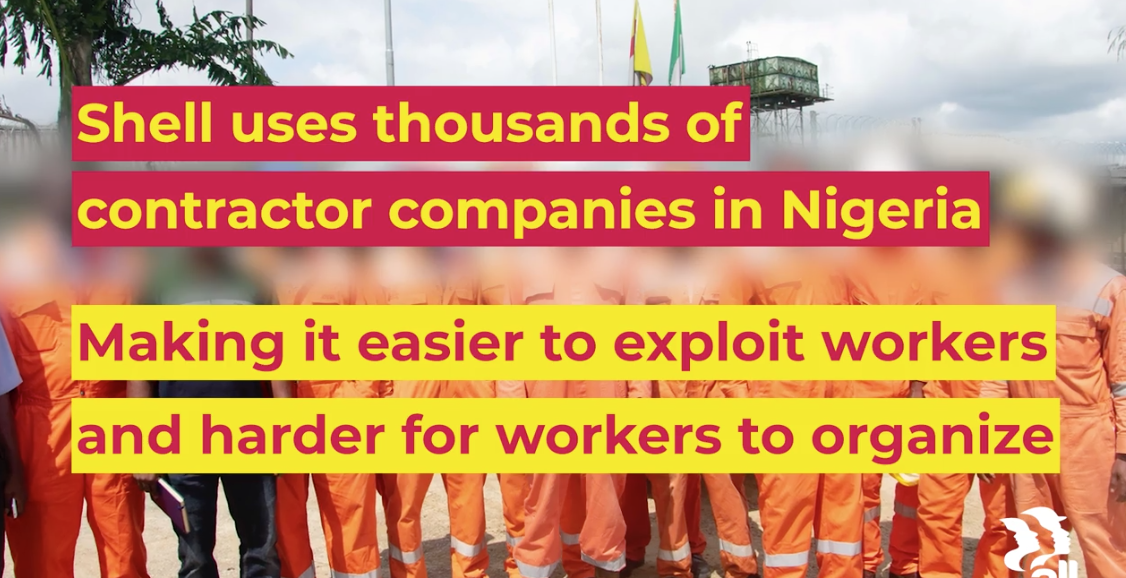
But 82 per cent of Shell’s workers are contract workers who live in poverty with no job security, poor healthcare and little regard for health and safety. Workers who attempt to unionize, raise health and safety issues or report injuries are dismissed. Because Shell is the largest company in the Nigerian oil sector, its actions set a precedent, and many other companies in the sector show similar behaviour.

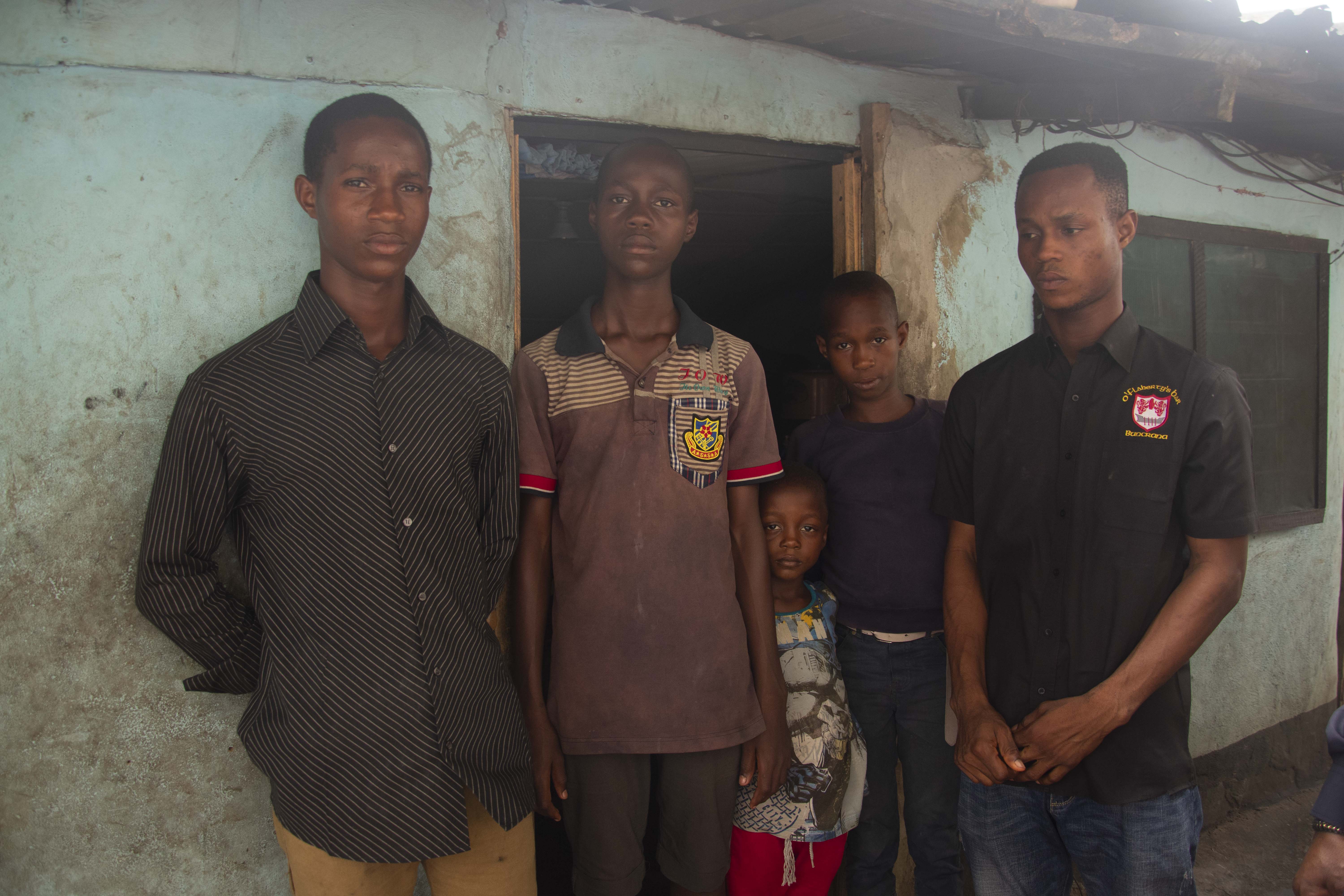
The children of a deceased Shell contract worker, visited by IndustriALL in 2018

Unions in Nigeria report numerous cases of workers dying or becoming permanently disabled because they have been too afraid to raise safety concerns. Last year, IndustriALL reported Shell’s treatment of contract workers to the UN Human Rights Council.

IndustriALL’s primary demand is that Shell engage in social dialogue at a global level with workers’ representatives. So far, Shell has categorically refused the offer of international dialogue.

In questions submitted ahead of the AGM, IndustriALL raised the contradictions between the principles that Shell claims to adhere to in publications like its Sustainability Report, and well-documented evidence that Shell fails to meet these standards. IndustriALL submitted the following questions:

  1. Why Shell does not exercise due diligence on contractors to ensure that they are socially responsible?
  2. Why Shell does not control and provide proper health insurance for all their workers and contractors?
  3. Will a representative of Shell agree to meet with IndustriALL Global Union to establish dialogue with the aim of addressing and resolving these violations?

Energy director Diana Junquera Curiel said:

“We have consistently raised these issues with Shell, and we have never had an adequate response. However, there is real suffering at Shell workplaces, and we are determined to change this. We remain committed to dialogue and working with Shell to resolve these issues.”

“We will be killed by hunger before the coronavirus gets us”

Thandi, a garment worker at Fashion International in Matsapha, says:

“We have not been paid and are trying to survive with the little money we have. It is hard. The employer must give us our money so that we can buy food. Some of the women in the factory are widows and it is extremely difficult for them.

“We will be killed by hunger before the coronavirus gets us. We need our wages as we cannot buy even salt. We are struggling to pay rent. Why is the employer not paying us when they have the money?”

Another worker, Sizwe, from FTM factories in Nhlangano, says:

“When my child got sick, I had no money to take him to hospital, and ended up begging. With the low wages that I earn, I have little savings.”

The Amalgamated Union of Swaziland (ATUSWA), affiliated to IndustriALL Global Union, is demanding that the workers be paid from the provident fund they contribute to.

“We are campaigning for employers to pay living wages to workers and not for them to even fail to pay the low wages that workers struggle with every month. This non-payment is even more painful under the tough lockdown conditions. The Eswatini National provident fund can be used to pay wage of at least Emalangeni 1400 (US$76) but our long-term goal is for wages to be over E3500 (US$190),”

says Wander Mkhonza, ATUSWA general secretary. 

IndustriALL general secretary Valter Sanches says:

“In the midst of a pandemic that is killing thousands of workers daily, employers must act responsibly by not worsening an already dire situation. Workers must be paid their wages timely. Expecting workers to stay at home without food for their families is unacceptable.”

In a letter to Eswatini Prime Minister, Ambrose Mandvulo Dlamini, Sanches stresses:

“We sincerely hope that the current negotiations between the government, employers and labour will be able to entail urgent actions to support the workers by immediate payments rather than expose them to a dual crisis of Covid-19 and poverty.”

Average wages are E1,700 (US$92) per month.

GSK factory in South Africa to reopen after 99 workers test positive for COVID-19

CEPPWAWU responded to workers’ pleas after COVID-19 positive cases continued to increase at the factory. The first case at the factory was reported on 7 April. However, when the factory temporarily closed on 22 April, 99 workers had tested positive. The workers are on quarantine at home receiving treatment.

The management says the factory has been deep cleaned and that personal protective equipment and sanitisers will be provided to workers. Further, the workers will be screened, and measures taken as per the company’s international supply chain protocols. Transport will also be provided to and from work between shifts and social distancing will be practised when the factory reopens. The department of labour and employment has approved the reopening. GSK makes medicines, vaccines and consumer health products and is an essential service as per lockdown regulations.

Welile Nolingo, CEPPWAWU, general secretary said:

“When workers told us they were working in fear after their colleagues tested positive to the coronavirus we met with the management and agreed that the factory be closed. We reminded the employers of their responsibility to take swift action on COVID-19.”

CEPPWAWU coordinated through IndustriALL with the GSK European Works Council, chaired by Unite shop steward Tomas O'Curraoin. In the spirit of international solidarity, Tomas raised the South African case directly with GSK’s most senior management and ensured that the proper process was followed to protect the workers’ safety at the Epping site.

Tom Grinter, the IndustriALL director of chemicals and pharmaceuticals said:

“The health and safety of workers is critical, especially when faced with the COVID-19 pandemic. GSK employs IndustriALL affiliates’ members around the world, and we are working to expand our relations with this global pharmaceuticals employer.”

Recent statistics from the National Institute of Communicable Diseases (NICD) state that the Western Cape province is the epicentre of the coronavirus in the country, with 2,135 positive cases. According to the NICD, most infections take place at factories and shopping centres.

Some of the workers at GSK live in overcrowded conditions in informal settlements which make it impossible to exercise social distancing. The pandemic is exposing the poverty and inequality in South Africa with some informal settlements only managing to get regular supplies of water now because of government efforts to stop the spread of the coronavirus.

South Africa went on lockdown on 26 March which continues with some factories and mines opening, but under stringent conditions that include operating at 50 per cent capacity.

South African court blocks Mondi from exploiting workers

IndustriALL Global Union affiliates the Chemical Energy Paper Printing Wood and Allied Workers Union (CEPPWAWU) and the United Association of South Africa (UASA) argued that employers cannot change conditions in collective bargaining agreements without negotiating with unions.

The Mondi Group wanted permission to extend shifts from eight to 12 hours during the lockdown period without complying with existing collective agreements and wage rates. The company did not want to pay overtime and requested the Labour Court in Durban to allow it to suspend conditions in the collective agreements signed with the unions.

However, on 16 April the court ruled in favour of the unions and dismissed the application.

Welile Nolingo, CEPPWAWU general secretary says:

“We applaud the Labour Court for dismissing the application and for protecting workers rights to fair wages. Employers should never be allowed to tamper with collective agreements that we fought so hard for them to be signed.”

Tom Grinter, IndustriALL director for pulp and paper, says:

“We welcome the unions’ court victory against the Mondi Group. It is unacceptable that an employer tries to use the Covid-19 pandemic to exploit workers. Collective agreements should always be respected to protect workers’ incomes, especially for those reporting for duty at the risk of infection from the deadly coronavirus.”

The pulp, paper, packaging, recycling and tissue value chains are some of the industries designated as “essential services” according to the lockdown regulations in South Africa. The sector produces paper for printing, stationery such as note pads, for packaging and toilet tissue paper. Other products include hospital gowns, masks and personal protective equipment for medical use. Currently, the hygiene and medical products are crucial in the efforts to stop the spread of the coronavirus.

South Africa is one of the world’s top producers of pulp and paper for domestic consumption, as well as for exports. According to the Department of Environment, Forestry and Fisheries, the pulp and paper sector employs about 24,000 workers who are part of a value chain of over 150,000 workers. These include informal workers who supply recycled fibre to the paper mills.

Protecting workers’ rights during lockdown in Mauritius

The lockdown in Mauritius started on 20 March and will end on 4 May.
 
In a letter to the Prime Minister, IndustriALL Global Union affiliate, the Confédération des travailleurs des secteurs public et privé (CTSP), is proposing the introduction of a universal minimum wage to cater for workers who will lose jobs as a result of the pandemic. Further, the union wants the national tripartite forum to be set up immediately as per the provisions of the Workers’ Rights Act, as this will promote social dialogue during the pandemic.
 
Reeaz Chutto and Jane Ragoo, president and general secretary of CTSP respectively, say:

“The proposal of the private sector to move for the derogation of some sections of the Workers’ Rights Act (2019) is the worst signal that your government can send to the workers, if their wish is granted. The introduction of the Workers’ Rights Act has not been made to increase corporate expenditure. Workers consider it as a law that has restored social justice to the working class.”

Unions in Mauritius are against attempts to reduce the amounts payable for years of service under the Portable Retirement Gratuity Fund and describe this as “social blackmail” of the government by employers, especially as it comes with threats of job losses.
 
Unions also recommend setting up a solidarity fund to support informal sector workers. The banking sector, parliamentarians, corporates, and individuals will contribute to the proposed fund. Further, refunds to the private sector for training should go to the workfare programme that gives immediate assistance to retrenched workers to find other jobs or to go for skills training. The programme should also benefit contract workers and prioritize Mauritian workers in job placements.
 
The unions want amendments to the Operational Health and Safety Act to include provisions for workers’ access to hygienic facilities at workplaces. COVID-19 sensitization and basic hygiene campaigns should also include migrant workers and be made available in their native languages.
 
Paule France Ndessomin, IndustriALL regional secretary for Sub Saharan Africa, says:

“The Covid-19 pandemic calls on us to reimagine the workplace in terms of workers’ rights, health and safety, decent work, and the future of work after the pandemic. It is commendable that the CTSP is taking this initiative.”

Namibia: 1,500 workers to be retrenched as mine closes

Nambian Broadcasting Corporation news report

The Mineworkers Union of Namibia (MUN) says the decision was made before exhausting alternatives to continue operations, including selling the mine. MUN argues that the mine which has a supergene zinc ore body, mines zinc oxides and a refinery would not have problems finding other investors.

The mine closure will lead to a loss of over 1,500 jobs. One of the contracted companies, Basil Read, whose contract was terminated will retrench about 400 workers.

Skorpion Zinc said they had to bring forward the suspension of mining due to the COVID-19 partial lockdown in Namibia from 27 March to 17 April.

The MUN Skorpion branch chairperson, Peterson Kambinda says:

“Despite the implementation of a tripartite agreement to maintain harmonious labour relations, ensure job security and business accountability in the labour and employment sector during the State of Emergence period, Vedanta Resources (who owns the mine) has made a decision that would result in job losses to thousands of Namibians.

”The government of Namibia must intervene to stop the retrenchments.”

Glen Mpufane, IndustriALL mining director, says:

“Globally, mining companies are developing COVID-19 protocols to safeguard jobs, and most are putting moratoriums on retrenchments in the face of the pandemic. It is outrageous that Vedanta Resources announces retrenchments amid this crisis; it is out of sync with what is happening globally and should be condemned.”

According to Skorpion Zinc, pit failures at the opencast mine are to blame for the closure as they make mining unsafe. A safe entrance cannot be constructed because of rocks not strong enough to support openings or heavy loads without collapsing.

But the MUN says that there are three other mines operating in the area under the same geological formations. The union says other safer mining methods can be explored to save jobs.

Unions warn of looming COVID-19 catastrophe in Zimbabwe

Martin Chikuni, ZEWU general secretary, says:

“Whilst Zimbabwean statistics to date of infected people and confirmed deaths due to the coronavirus seem low; we believe there is a looming possibility of a massive catastrophe given our already compromised health delivery system. The situation is worsened by the socioeconomic crisis, which has gripped the country for two decades.

“ZEWU is concerned that Zimbabwe’s collapsed health delivery system, underequipped hospitals and the complex equipment required to combat COVID-19 are clearly beyond the country’s capacity. How will Zimbabwe handle a crisis of this magnitude?”

Official statistics from the Ministry of Health and Childcare say as of 31 March it conducted only 274 tests. The figures also state that over 16,000 travellers who arrived from countries with known COVID-19 cases were neither screened nor tested.

An infectious diseases hospital in Harare identified as a treatment centre for the coronavirus that it had no ventilators. The hospital is now under renovations.

One of the COVID-19 prevention methods is washing hands with soap and water, but Zimbabwean cities, including the capital Harare, have no regular water supplies. The residents have resorted to digging wells.

Joseph Tanyanyiwa chairperson of the Zimbabwe IndustriALL national coordinating council which represents five affiliates in the chemicals and plastics, energy, garment and textile, leather and shoe says Zimbabwe’s response to COVID-19 is ad hoc and reactive.

“It seems the strategy for the lockdown is for people to stay at home, and only when they get sick will they be screened and tested. The lockdown will be difficult for the informal workers who are the majority. Most of them don’t have contingency plans and 21 days is a long time without an income.”

The union says it is worried that the country continues to face shortages of basic food, like the staple maize meal or mealie-meal and fuel.

“People are stampeding for basic commodities, thereby making it difficult to exercise social distancing. Shortages of fuel and the use of public transport, especially overloaded buses, compromise the situation.”

ZEWU is campaigning for paid leave and job security for workers during the 21-day lockdown. The union also wants employers to provide personal protective equipment to slow the spread of the coronavirus as most of its members are from workplaces where they interact with the public.

The union is also providing information on COVID-19 to its members and have set up a common communications centre for members to contact the union when they need help.

South African textile union wins full pay guarantee during coronavirus lockdown

The agreement comes as South Africa enters a strict three week coronavirus lockdown at midnight tonight. All non-essential businesses, including clothing and textile factories, will shut. People will be confined to their homes except under strictly controlled circumstances.

SACTWU brokered South Africa's first Covid-19 lockdown national collective agreement with the National Bargaining Council for the Clothing Manufacturing Industry late Tuesday afternoon. The unique agreement ensures workers will continue to be paid their full salary for the next six weeks.

Speaking to television news in South Africa, SACTWU general secretary Andre Kriel said:

“We can’t run to government for everything. We must look at our own resources. It is our duty to rise to the call of the nation and combat Covid-19.

“So we said, let’s look at the institutions that exist in our industry and smooth some of the administrative problems.”

The agreement brings together different labour market institutions in an innovative, problem-solving attempt to ensure that workers don’t suffer loss of earnings.

Workers and employers in South Africa pay into an Unemployment Insurance Fund (UIF) that pays between 20 and 60 per cent of a workers’ salary if they lose their job. Usually, workers have to apply individually for UIF payments at department of labour offices. The lockdown means that there is likely to be a huge backlog.

The agreement will see a collective claim made on behalf of workers in the sector. The funds due to them will be transferred to a bank account managed by the bargaining council. From there, funds will be transferred to companies and topped up by employers so that workers receive 100 per cent of their salaries. It will then be integrated into company payroll systems and paid out directly to workers.

In a press release, the union said:

“We are conscious that it might not be a perfect agreement, but are determined to give it our best shot.

“We specifically want to thank workers and employers of our brave industry for their willingness to mandate their leadership to take the necessary patriotic risks to conclude what we hope is a pioneering centralized bargaining agreement that will be a small contribution to our country's national effort to decisively defeat the spread of Covid-19.”

IndustriALL sector director Christina Hajagos-Clausen said:

“In this unprecedented period, the landmark agreement reached in South Africa demonstrates that trade unions and industry can come together to find ways to support garment workers and to also ensure the viability of the industry. SACTWU has once again demonstrated that industry wide agreements are vital to the textile and garment sector.”

The agreement also establishes a rapid response task team which will manage practical issues. SACWTU has taken a proactive stance on confronting coronavirus, starting a workers’ education programme several weeks ago.

African trade unions want mining companies to follow COVID-19 protocols

Unions are advocating for responses to the pandemic that include best practices from occupational health and safety as seen in past campaigns on silicosis, tuberculosis and HIV and AIDS. Most unions are promoting the thorough washing of hands and have cancelled most of their activities to maintain social distancing.

Abdul-Moomin Gbana, the general secretary of the Ghana Mine Workers Union said:

“We are deeply concerned by the global COVID-19 and the potential consequences on the health and safety of our members, as well as the operational business implications for the mining companies, and the industry at large. In difficult times such as what the world is currently grappling with, the union is urging all employers in the industry to continuously leverage their longstanding experience as health and safety champions to stop the spread of COVID-19 from wreaking havoc in Ghana’s mining industry.”

David Sipunzi, National Union of Mineworkers (NUM) general secretary said:

“After meeting with the Minerals Council of South Africa, we are happy that the mining companies are coming on board. They are taking this pandemic seriously.”

The mining companies promised to assist by making their clinics available to deal with the pandemic.

An example of the COVID-19 protocols is the Minerals Council of South Africa’s 10-point plan. The plan includes health workers’ readiness, ensuring access to consumables, a proactive influenza vaccination programme, understanding the potential impact on workers with compromised immunities, case management and contact-tracing, isolation of positive cases, reporting, monitoring and travel advice.
The NUM is urging mining companies to implement the plan and says “mining companies must develop urgent policies that address commitment and responses to the pandemic to reduce the risk of transmission at the workplace. Companies should improve hygiene through providing sanitizers, soap, gloves and masks. Those with minor flu and coughing must be given masks to prevent the spread of the coronavirus disease.”
 
The union recommends identifying and treating workers at risk early. The NUM says workers who contract the disease at work, including healthcare workers at mine clinics, should receive compensation through the Compensation for Occupational Diseases Act. Workers must be allowed to take sick leave due to coronavirus symptoms or quarantine periods. Further, it is important to decongest and disinfect waiting areas, communal spaces and shared facilities and for COVID-19 information to be accessible.
 
The Mineworkers Union of Zambia has successfully campaigned for the use of alcohol breathalyzer tests to be discontinued as they can easily spread the coronavirus. Some mining companies that include Mopane Copper Mines, Lubambe Copper Mine, Kanshanshi and Barrick Lumwana complied. Additionally, biometric systems in which workers used fingers are also unsafe.