Gas is the future for the Nigerian economy, say unions

The Federal Government of Nigeria announced on 30 June that the construction of the 614km gas pipeline had begun.

The National Union of Petroleum and Natural Gas Workers (NUPENG) and the Petroleum and Natural Gas Senior Staff Association (PENGASSAN), both affiliated to IndustriALL Global Union, see the development as an opportunity to create decent jobs and reduce the high levels of unemployment. According to the country’s National Bureau of Statistics, unemployment is over 23 per cent or 21 million unemployed, and underemployment is 20.1 per cent or 18 million. The underemployed are those who work less than 40 hours a week.

The government and the state-owned enterprise, the Nigeria National Petroleum Corporation, said the pipeline will provide gas for power generation and stimulate the creation of new industries in the towns of Kogi, Niger, Kaduna, and Abuja. It is hoped that the new industries will create thousands of local jobs, transfer technology and promote local manufacturing. The pipeline will also benefit existing industries that rely on gas.

The construction is being carried out as part of China’s new Silk Road, where energy investments supported by China’s Belt and Road Initiative (BRI), which Nigeria joined in 2019. Through this initiative, the Bank of China and Sinosure (China Export Credit Agency) will finance the pipeline by $2.8 billion. Chinese construction and engineering companies are contracted, and the Nigerian partner is Oilserve, an oil and gas company.

Nigeria’s current production of 7,000 megawatts falls short of the country’s electricity demands for domestic and industrial use. It is hoped that the pipeline will close the gap by adding 3,600 megawatts to the national grid. Upon completion of the project, 2.2 billion cubic feet per day of gas will be produced according to the government.

The pipeline will join the Trans-Saharan gas pipeline which will export the natural gas to Europe. With Nigeria’s oil reserves expected to last three or four decades, the huge gas deposits allow for economic diversity.

Lumumba Ogbawa, the general secretary of PENGASSAN says:

“We welcome this development. Gas is the future of Nigeria, and developmental efforts like these from the government are appreciated. The 600 km pipeline from Ajaokuta to Kano will run through several communities – creating jobs along the way during the construction phase. This is the diversification of the economy that we have been clamouring for. It is a timely strategic development.”

Diana Junquera Curiel, IndustriALL director for energy says:

“Natural gas will be the main energy source in the transition from fossil fuels to green energies. It has the potential to develop economies and improve the livelihoods of workers and communities through decent jobs. It is also an important source of energy for households and factories. We hope this gas pipeline will meet the expectations.”

Picture: A pipeline being fabricated on Snake Island, Lagos. Photo CC by Alex Aghomi.
Mauritian employers use Covid-19 to push back against labour laws

Mauritian unions, including IndustriALL affiliate the Confederation of Workers in the Public and Private Sectors (CTSP), celebrated new labour law amendments as an important win after 16 years of sustained pressure on government. The new laws were a big step forwards in protecting workers in all industries, including migrant and precarious workers.

But shortly after the new laws were passed, the Covid-19 global pandemic forced the country into confinement. The labour law amendments would have been a tremendous benefit to workers during the pandemic – but employers were quick to lobby government into going backwards.

“The CTSP sincerely believed that with Covid-19 we could never go back to business as usual and everybody without exception will have a change of heart and truly understand that we have to put our heads together and push for a new normal.

“Employers from the biggest companies in Mauritius used this time to lobby Government so that the law gained with so much effort be changed to their own advantage,”

said Reeaz Chutto, CTSP president.

In May 2020, the government amended clauses of the new Workers’ Rights Act to benefit employers. Trade unions fought hard to keep as much of the original law as possible, but only managed to block one of the amendments.

The provision that the unions managed to keep is the Portable Severance Fund, which protects workers who are laid off, including precarious workers. All employers have to contribute to the fund for each worker, regardless of contract type. Workers who lose their jobs are able to draw from the fund.

The Prime Minister, Pravin Jugnauth, told the unions that the amendments would be returned to workers by 2024. Trade unions made it clear that they would not sit idly and wait: they will continue their fight to have all of the amendments restored to benefit workers.

The CTSP has seen union membership increase since the pandemic. Employers are on the offensive, using tactics to intimidate and threaten workers, and undermine their conditions. Workers are seeking union support to keep their previous working conditions.

CTSP has recruited more than 250 migrant workers from the textile and garment, seafood, and construction sectors. These migrant workers are mostly from Madgascar, India and Bangladesh.

“Many migrant workers have not received their salaries for over three months and the CTSP is currently in negotiation with the Minister of Labour to have a special redeployment desk for them.  We are also advocating for a One Stop Shop office for their voices to be heard so that they do not have to run to many ministries and departmenst to raise their issues,”

said Jane Ragoo, CTSP general secretary.

“IndustriALL congratulates the CTSP for their resilience in these difficult times. The union fought hard to achieve this legislation. However, the government has now, under pressure from employers, taken unfortunate steps backwards. Unions are seeing increased membership because they defend workers. This is the time where workers see the value of being part of a fighting union”

said IndustriALL general secretary Valter Sanches.

Covid-19 union solidarity from Canada to Madagascar

With Covid-19 affecting livelihoods of farming and fishing communities in Madagascar, IndustriALL Global Union affiliated unions are working together to respond. The SHF was created by IndustriALL affiliate, the United Steelworkers (USW), and is funded in Canada by individual union member contributions.

The objective of the project is to reach 600 households and benefit over 2,100 people from the farming and fishing communities as well as the informal sector around QMM operations in Fort Dauphin.

The SHF is funding the project with CAN$18,800, and SVS and SEKRIMA will conduct activities in the communities of Andrakaraka and Amposinahampoina. Activities will include Covid-19 awareness campaigns, distribution of masks, soap, and setting up of water points in every home, and providing food baskets for the most vulnerable.

Paule France Ndessomin, IndustriALL regional secretary for Sub Saharan Africa, says:

“Covid-19 is a global pandemic and this requires us to be responsive to local contexts. It is commendable that the SHF, SVS and SEKRIMA are joining forces for Covid-19 prevention in communities. This is a reminder that trade unions represent workers who live in communities, and that it is in their interests to ensure that the spread of the coronavirus is stopped.”

Ken Neumann, SHF president and Canadian National Director for the USW, says:

“Solidarity means that we, as trade unionists, have to be concerned with the needs of the vulnerable in the community, and to respond when we can. The pandemic threatens to further impoverish already poor communities in Fort Dauphin near Rio Tinto’s QMM mine.

"Our union members are employed by the same global mining company in Canada, and we are pleased to be able to support the community outreach of our partner unions.”

The World Bank estimates that poverty will increase by 23 per cent in Sub Saharan Africa because of Covid-19. Regulations to control the disease introduced by most countries including Madagascar have led to the contractions of economies by 30 per cent and increased the number of those living in poverty.

With Covid-19 cases picking up, it is feared that the region will be the worst affected because of inadequate and poorly equipped health care facilities that are operate with limited resources.

Workers protest unpaid wages and retrenchments at South African gold mines

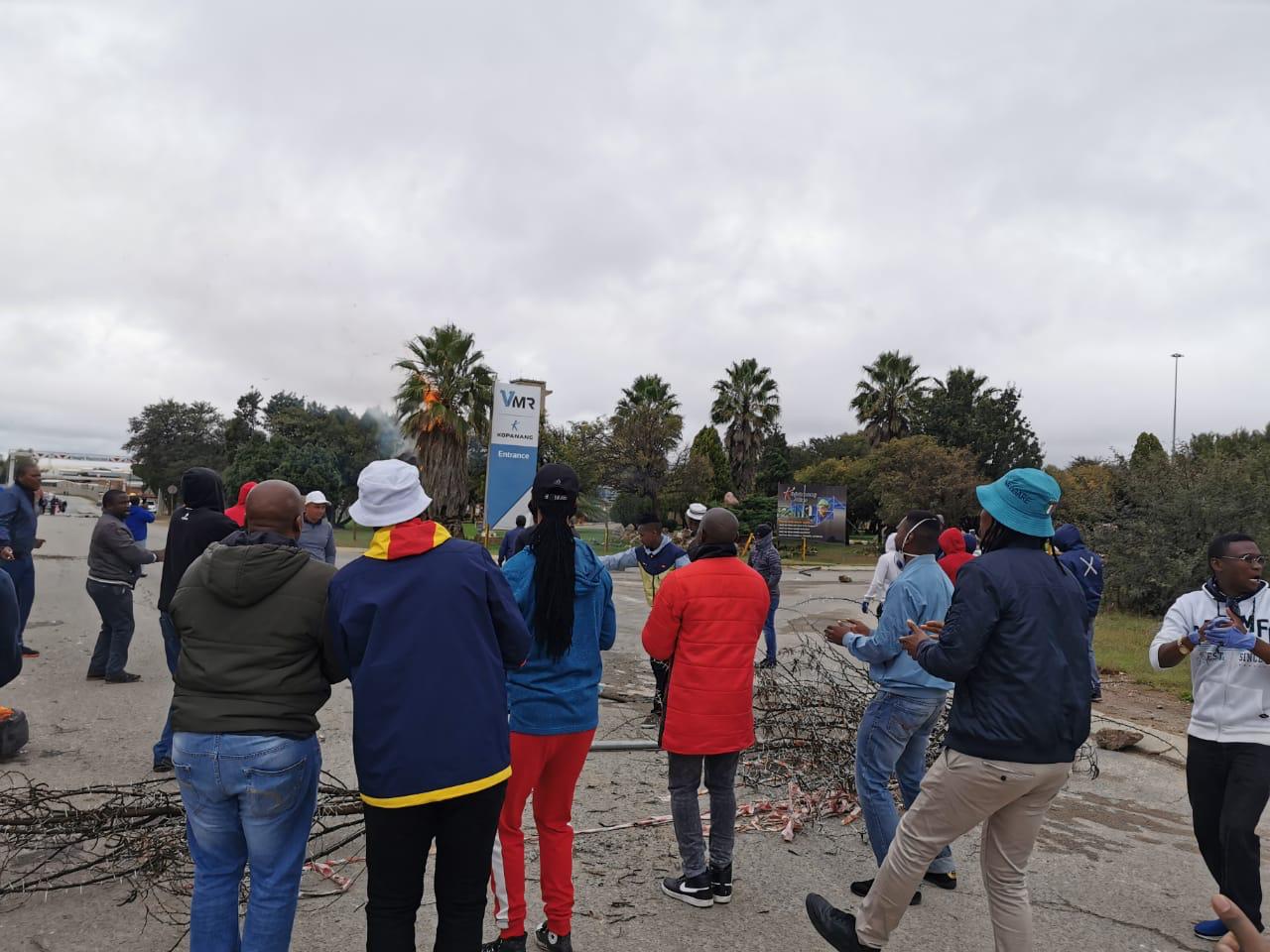
The workers, who include members of IndustriALL Global Union affiliates the National Union of Mineworkers (NUM) and the National Union of Metalworkers of South Africa, have been picketing since April for the payment of wages and for the retrenchments to be stopped.

Picketing worker, Junior Kgoedi, from Kopanang mine says:

“If the retrenchments were made during the lockdown; why can’t we protest during the lockdown? Why did they decide to retrench during our absence? They took advantage because most workers had gone home to other provinces.”

1,500 migrant workers from Botswana, Eswatini, Lesotho, and Mozambique working at the operations, have not been paid since South Africa went into lockdown in March. The workers are unable to travel to their home countries because of closed borders. A further 146 local workers are also unpaid.


Realeboha Majara, from Lesotho, has worked at Kopanang mine for 30 years, from his first job of maintaining pipes. His past positions are locomotive operator, driller, supervisor, team leader, and miner before becoming a shift boss. He is the NUM branch chairperson at the mine and says the situation is dire for the migrant workers.

“We are demanding the immediate payment of the wages. Without income workers are struggling and surviving on handouts from friends. Although workers qualify for Unemployment Insurance Benefits under the Covid-19 Temporary Employee Relief Scheme, they are yet to be paid.”

NUM is challenging the retrenchments in court and demanding VMR to respect existing collective bargaining agreements that have been signed with unions. The issues are also before the Commission for Conciliation, Mediation and Arbitration.

Joseph Montisetse, NUM president says:

“We are appealing to the department of mineral resources to reject the irregular retrenchment notices that were issued without due process as per labour laws.”

Glen Mpufane, IndustriALL director for mining says:

“Mining companies must consult unions on retrenchments and mine closures. Covid-19 is not an excuse to trample on workers’ rights and VMR must adhere to fair labour practices.”

Village Main Reef (VMR), owner of the mines and plant, is part of the Hong Kong-based Heaven-Sent Gold Group. VMR bought the operations as going concerns from AngloGold Ashanti in 2017.

Wage discrimination and corruption at Medis Dakar in Senegal

The unions say that the financial difficulties the company is facing are due to mismanagement and corruption. In a memorandum to the Medis Dakar management, which was also sent to government ministries of health, industry, and labour, the unions say it has become routine for the company to declare losses of billions of francs every year and announce that it is close to bankruptcy.
 
According to the union, which organizes 116 of the company’s 316 workers, the hope that came when the company was bought by the Medis Group from Winthrop Pharma Senegal in 2017 has vanished.
 
The unions wrote:

“The arrival of the Medis Group seen as a new beginning gave workers hope. However, this was for a short while as workers quickly became disillusioned as the financial situation worsened. The managers said this was caused by cash shortages, inadequate raw materials and packaging items and unexplained technical problems.”

 
The unions were not convinced and carried out their own investigations, which found some financial misappropriations that included overcharging for vehicle maintenance and excessive use of fuel by the management, payment of bonuses to some workers while excluding others, some unexplained deductions on pay slips, and wage differences for workers doing the same work.
 
To get the company out of the difficulties the unions are recommending improvements in financial and human resources management. This will allow workers to focus on their work priorities and contribute to the company's success. The workers also reaffirm their willingness to work with the Medis teams to sustain and develop the workplace and help in resolving technical and financial problems.
 
Paule France Ndessomin, IndustriALL regional secretary for Sub Sahara Africa says:

“Medis Dakar must engage in fair labour practices according to Senegal’s labour laws. The company must practice equity by paying workers doing work of equal value the same wages and must meet with unions to explain some management decisions that are unfair to the workers. Dialogue between Medis Dakar and the unions is key to building better industrial relations at the company.”

Union protests lockout at Nycil chemical plant in Nigeria

The picketing workers have vowed to continue assembling at the gates until they are opened, and they can resume work. The workers are members of the National Union of Chemical Footwear Rubber Leather And Non-Metallic Products Employees (NUCFRLANMPE), affiliated to IndustriALL Global Union.

Although the company has not stated the reasons for the lock-out, NUCFRLANMPE suspect that they want to retrench the workers. The union is demanding dialogue with the company, saying that the company cannot make unilateral decisions without meeting with the union.

The union says the situation has been worsened by the “anti-worker attitude” of the owner of Nycil, Adetola Adebayo, who has consistently refused to engage with the union. Industrial relations worsened at the company when it was bought by the current owner in 2014, and NUCFRLANMPE’s efforts towards dialogue with the employer have been unsuccessful.

The ministry of labour and employment has been approached to intervene to end the lock-out at Nycil – a company that workers describe as “one of the worst employers in Nigeria”.

Tunde Olagoke, NUCFRLANMPE deputy national secretary said:

“We received information that Nycil wants to embark on a redundancy exercise. The union is rejecting this because Covid-19 is not the making of anyone. We need a collective strategy to manage the situation without job losses of the toiling workers.”

Workers disagree that Covid-19 should be used as an excuse at Nycil where operations were not affected by the pandemic.
 
Paule France Ndessomin, IndustriALL regional secretary for Sub Saharan Africa said:

“It is unacceptable for Nycil to lock-out workers. The management must meet with the union to address the issues. They cannot make unilateral decisions as this violates Nigerian labour laws, destroys trust and is unfair to the workers.”

Nycil Nigeria is a chemical manufacturing company specializing in the manufacture of synthetic polymers, acrylic polymers, polyester resins, and homo polymers emulsion among other products. These are used in the making of paints, textiles, packaging, and stationery.

Unions in Africa campaign for ratification of ILO C190

“Workers must be part of creating a solution to end gender-based violence in the world of work by creating a space to end unacceptable behaviours and a culture of silence to create change in the workplace. We need to create a workplace that is free of violence and harassment,”

says Rose Omamo, general secretary of Amalgamated Union of Kenyan Metal Workers and IndustriALL Global Union Executive Committee member.

The Namibian cabinet has approved the proposal for ratification for ILO convention 190 and 189, which will soon be submitted to parliament for ratification.

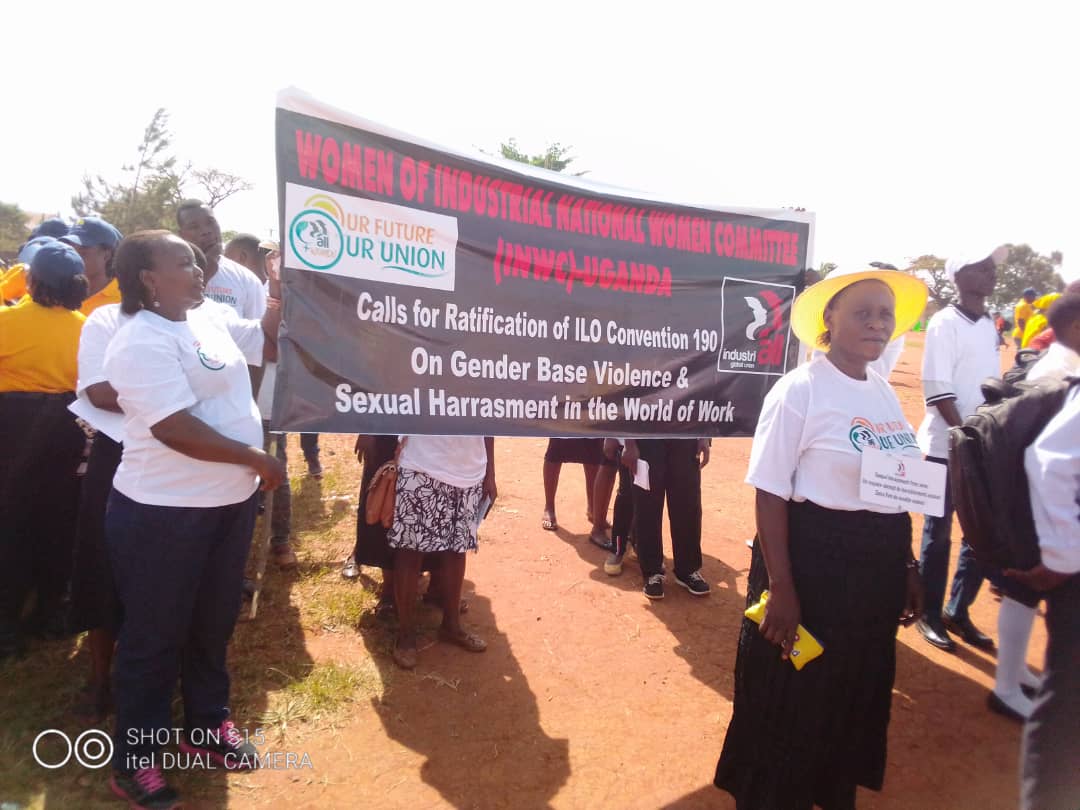
The IndustriAll National Women Committee of Uganda is calling for the ratification of C190 at a rally in the Mbale region attended by union leaders, the President,the Speaker of Paliament and other dignitaries.

In Zimbabwe, the unions are meeting with the ministries of labour and social welfare and the women affairs before the ratification is brought to parliament.

The Mineworkers Union of Zambia celebrated International Women's Day on 8 March with a call for solidarity to the Zambian Congress of trade unions to push the government on the ratification of the ILO C190.

Trade unions in Africa are encouraged to lobby their governments to ratify C190. The Southern African Clothing and Textile Workers Union (SACTWU) has a daily social media campaign.
 
Andre Kriel, SACTWU general secretary says:

“Our main intention is to keep this matter in the public eye, until the ratification. We have consistently raised the matter at the Congress of South African Trade Unions (COSATU) Central Executive Committee (CEC), and COSATU has now taken up the campaign and raised ratification directly with the Minister of Employment and Labour, Thulas Nxesi. In addition, a call was raised directly with South Africa’s President Cyril Ramaphosa when he addressed the February 2020 CEC.”

COSATU has also raised the issue with the employment and labour portfolio committee in parliament.
 
21 June was the first anniversary of the adoption of ILO Convention 190 and Recommendation 206 on Violence and harassment in the world of work. Uruguay is the first country to have ratified C190, with reports that Fiji will soon follow. 12 months after Fiji does so, C190 will enter into force.
 
Armelle Seby, IndustriALL gender coordinator says:

“The adoption of C190 is important in ending gender-based violence and sexual harassment at the workplace. In South Africa, several women have been killed at work; in the mines, at power sub-stations and other workplaces, and working women are raped in the communities where they live and killed in their homes.”

Precarious working conditions of diamond cutting and polishing workers in Botswana expose jewellery brands

Companies, including Yerushalmi Brothers Diamonds, Motiganz Botswana, Dalumi Diamonds, Leo Schachter Diamonds, and Signet Jewelers have dismissed staff. At Safdico Botswana, BDWU, successfully challenged the retrenchments resulting in their reversal. The union is also challenging the job losses with the country’s labour department, while some cases have gone to the Industrial Court. Some workers were retrenched because they are union members. In other cases, workers were dismissed after dubious disciplinary actions.

Over 51 workers have been retrenched at Signet Jewelers since March with Covid-19 cited as the reason for the retrenchments. In some instances, the companies refuse to disclose the reasons.

Most employers in Botswana’s diamond cutting and polishing sector use union busting to weaken unions, like encouraging the formation of associations at factories and not recognizing registered unions.

The sector is plagued by low wages; workers are paid from 1300-3500 Pula (US$113-303) per month.

The BDWU says that in addition there is no job security for local workers, with some having been employed for ten years on short term contracts. This makes it hard for the workers to access bank loans as they are considered risky clients and are unable to buy their own homes.

Employers are failing to fulfil training requirements for Batswana, whose contracts say foreign workers should train locals in special skills. Instead, workers are hired to simply do the job.

Dominic Obusitse Mapoka, BDWU vice chairperson, says:

“Despite the industry making huge profits every month, workers are getting paid a pittance. The wages are low, and we want our members to be paid living wages. Local workers should also be trained in special skills that are required in the sector.”

On 21 February, the BDWU met with the Minister of employment, labour productivity and skills development, and the Commissioner of labour, who promised to assist. However, there has since been no further communication from the government.

Glen Mpufane, IndustriALL director for mining, gems, diamonds, ornaments and precious stones, stresses that employers must stop paying starvation wages.

“Workers toil daily cutting and polishing precious diamonds and yet are unable to buy food and other basics because of poor wages. The companies must pay decent wages, respect workers’ rights and labour standards. They must also consult with unions on COVID-19 protocols.”

Tanzanian union goes digital to organize, defend workers’ rights

Between 2015 and 2018, IndustriALL and Unifor Canada assisted the union to establish an information communication technology (ICT) department and structure which reaches out to all TUICO’s branches at national level.

With most workers restricted to working from home because of COVID-19, TUICO is using digital platforms and social media to reach its members and officials. The union has moved meetings to online platforms.

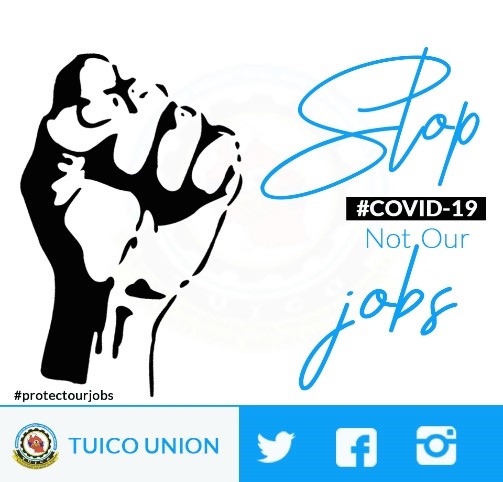
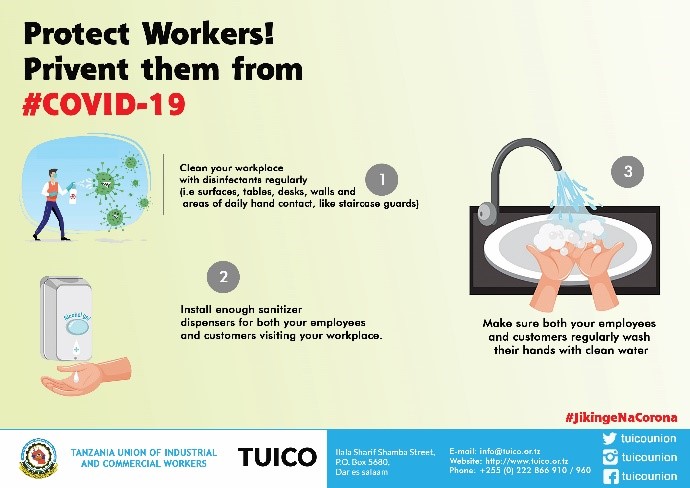
COVID-19 awareness e-posters on prevention were designed, and short videos that demonstrated how workers can protect themselves produced. Social media campaigns were carried out on recruitment and organizing, grievance handling, and collective bargaining.

Boniface Y. Nkakatisi, the general secretary of TUICO said:

“Using ICT services during the pandemic period proved effective. Most activities on our three-month plan were completed and we managed to recruit 903 members from the sectors that we organize such as cement, garment and textile, and petroleum. We also resolved 15 disputes with various employers.”

Nkakatisi says the union negotiated collective bargaining agreements online with cement companies, Tanga and Tanzania Portland and wage increases with some companies.

“We set up meetings with the employer to discuss the union’s bargaining proposals. In the meetings we had union leaders from the companies present. After discussions, we reached agreements. However, it is not the same as long negotiations. Questions are limited and queries deferred to the local union leader. Everything happens within limited time.”

He added that recruiting members online is unique:

“The local organizer calls for a meeting with a few workers, tells them the importance of joining a union, and gives out joining forms to pass on to those not present. We have learnt that under COVID-19 the strength of the union lies in the local organizer. Therefore, we are prioritizing the training of 1,000 organizers.”

The union has also set up management information systems for collecting union dues.

However, there were challenges as the union was not ready for a full online rollout when the first coronavirus cases were reported in Tanzania. Further, internet access is unreliable and data cost high.

Valter Sanches, IndustriALL general secretary said:

“It is important that TUICO is using digital technologies to raise awareness on COVID-19, and to advance union work. Unions must be ready to overcome any barriers and stand up for workers’ rights and demands in whichever platform possible. The amazing capacity to adapt and succeed showed by TUICO is an example to be followed.”

TUICO also launched a news portal which publishes news, events, and the activities of the union on www.tuico.or.tz. The union can be reached on these social media handles:

@TuicoUnion

Instagram: TuicoUnion


#HakiHaipotei Women Leaders at Mazava stand firm against '#unjust closure of Mazava Textile in Morogoro. . Wanawake viongozi wa TUICO wapigania haki zao dhidi ya jaribio la kufunga kiwanda cha Nguo Mazava mkoani Morogoro. #HakiHaipotei #protectourjobs #stopcovidnotjobs

A post shared by TUICO (@tuicounion) on May 19, 2020 at 5:11am PDT

Call for Expression of Interest – Research on new investments in the automotive sector in Sub-Saharan Africa

Country studies for Ethiopia, Ghana, Kenya, Namibia, Nigeria, Republic of South Africa and Rwanda (one researcher per country study)

One leading / coordinating researcher, based in South Africa

Background

A number of multinational vehicle manufacturers (BMW, BYD, Ford, Geely, Honda, Hyundai/Kia, Nissan, PSA, Renault, Tata, Toyota, VW and others) have announced major investments into automotive manufacturing in Sub-Saharan Africa. The countries targeted for these investments are in particular Ethiopia, Ghana, Kenya, Namibia, Nigeria, Republic of South Africa and Rwanda.

These investments are mainly based on the assumption that there is and will be a significant and sustainable growth of income and therefore of the middle class, hence, an ever-increasing market opportunity. The investments have the potential to significantly increase industrial manufacturing in the region and to create urgently required new jobs. Since jobs are urgently required almost everywhere in Sub-Saharan Africa most if not all governments will engage themselves in fierce competition around FDI and therefore, a race-to-the-bottom with regards to working conditions and tax incentives is very likely.

As there is not yet a stable and sufficient number of customers, the companies will implement their projects at the lowest economic risk possible. In most of the cases, this means to avoid the construction of proper full-scale production facilities and to focus on the assembly of SKD and CKD kits by African contract manufacturers first. Such production patterns also help the companies to circumvent high import duties for finished vehicles. The required skills of the workers to assemble the kits are rather low. There are numerous examples for larger scale automotive investments that have failed to bring about sustainable industrial structures and decent jobs (e.g. India, Malaysia, some countries in Latin America and in the Middle East).

In SSA one notable past attempts to resuscitate the auto industry has been in Nigeria. The depreciation of the Naira, poor performing economy and cheap vehicles entering the Nigerian economy stifled these attempts. The recent attempt was through the Nigerian Automotive Industry Development Plan which aimed at providing incentives including fiscal incentives to grow assembly plants and attract new investments of other OEMs (original equipment manufacturer).

The Republic of South Africa (RSA) is today the only country in Sub-Saharan Africa with a significant automotive industry, decent jobs and sustainable industrial relations. The successful development of such structures in the past two decades can be partly used as blue print for the other African countries. The new investments in other countries of Sub-Saharan Africa can easily put competitive pressure on the well-established sector in the RSA.

Some OEMs are making progress in growing their business in SSA. VW recently signed memorandums of understanding (MOU) in Kenya, Rwanda, Ethiopia, Ghana and Nigeria to establish vehicle assembly facilities, assess the mobility concepts and establish training academies for production and after sales. Toyota has operations in Nigeria, Ghana, South Africa, Kenya and in various other parts of SSA. Companies such as Uber and taxify use Toyota vehicles to ferry customers and this increases the market for the OEM. The VW business in Rwanda is structured around tapping from the Uber and taxify and government business too and build the mobility industry from these platforms (VW Mobility solutions).

In a nutshell: How can trade unions trigger/initiate and support the creation of decent jobs based on sustainable industrial structures in the automotive sector in Sub-Saharan Africa?

Application procedure

Step 1

Review the attached document “Background information and Terms of Reference” and select the country research (Nigeria, Kenya, Ghana, South Africa, Kenya, Ethiopia or Rwanda) you would like to undertake / select the position of lead researcher (must be based in South Africa).

Step 2

Write a cover letter that provides a brief outline of your competencies and experiences in doing similar work / provide your CV.

Step 3

Provide a proposed work plan and an indicative budget for doing the research – including the research methodology (please stick to the timeline outlined in the TORs).

Step 4

Email the Cover letter, CV, proposed work plan budget to undertake the research and submit to:

IndustriALL Global Union, Geneva/Johannesburg
Mr. Kenneth Mogane, Regional Officer, Sub-Saharan Africa Office,

Copied to:
FES TUCC, Johannesburg
Dr. Iris Nothofer, Junior Expert, FES TUCC

Deadline

The deadline for submitting the expression of interest is Friday, 3 July 2020. Applications must be received by IndustriAll not later than 5pm Pretoria time. Any application after this deadline will not be considered.

Language

The expression of interest, including related documents, shall be prepared in English. Applications in other languages will not be accepted.

For further information, please contact Kenneth Mogane or Iris Nothofer

Selection criteria

All applications that have submitted all required documentation will be reviewed by a joint committee of IndustriAll and FES-TUCC. Both organisations, IndustriAll Global Union as well as FES TUCC are striven to increase the number of female researchers/activist in academia, science, trade union education and activism. Applications from female researchers are therefore explicitly welcome. Applicants will be notified accordingly.