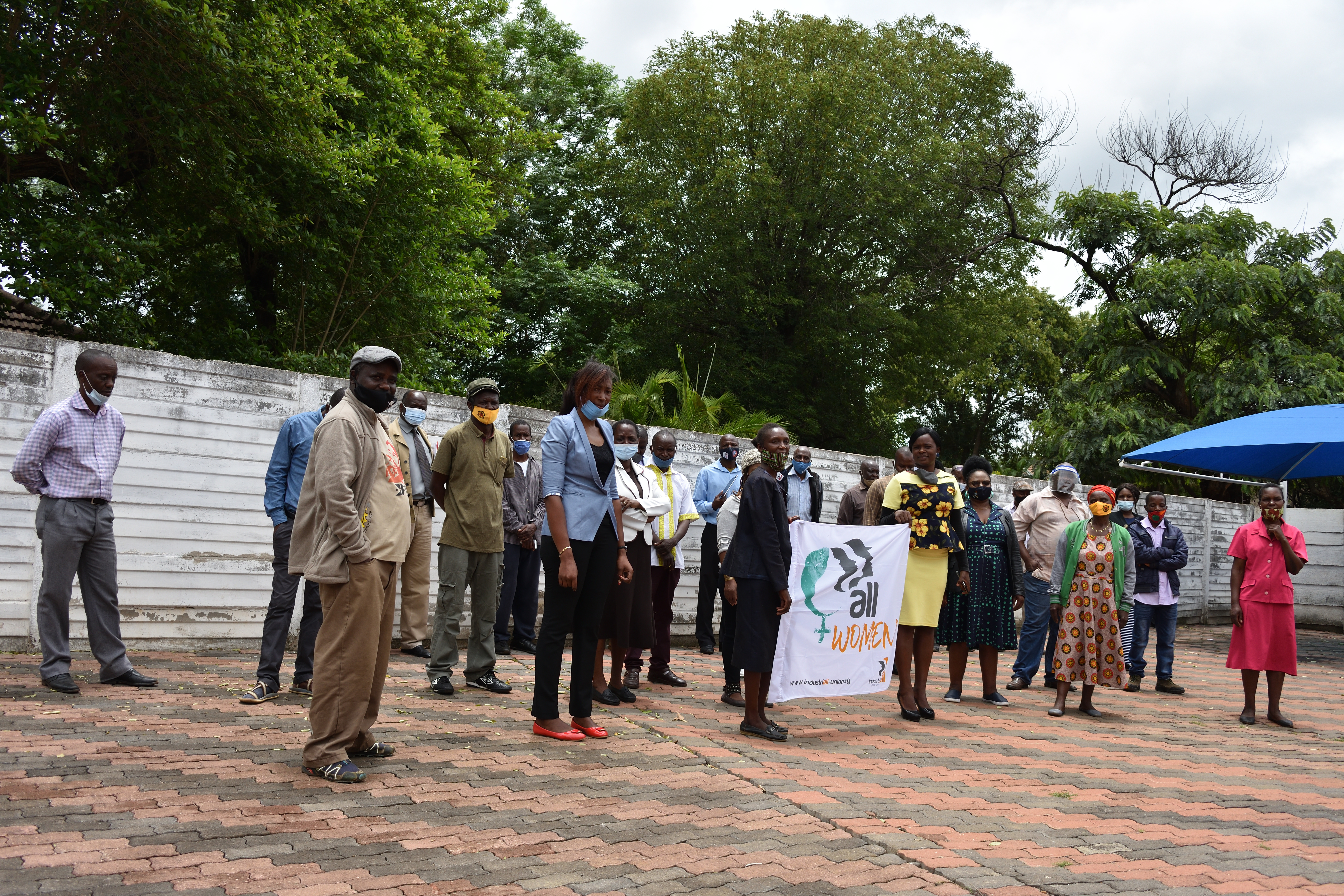
Zambian mineworkers protest delays in redundancy payments

According to the Mineworkers Union of Zambia (MUZ), affiliated to IndustriALL Global Union, Vedanta Resources issued redundancy notices to 3881 mineworkers in December 2020 and promised that the workers would receive the benefits in three payments beginning on 1 March and then at six months intervals. But court challenges have put the payments on hold.

The workers were addressed by union leaders, the Member of Parliament for Nchanga Constituency, Chali Chilombo, and the District Commissioner for Chingola, Agnes Tonga, who concurred that Vedanta must stop its delaying tactics and pay the workers.

Speaking to the workers after the march, Joseph Chewe, MUZ president said:

“It is unfortunate that Vedanta always runs to the courts and delays the transition of the mining company. The company is using the law as a scapegoat to cling onto the mine which they have failed to run in the past. The courts must also consider the plight of the mineworkers when they decide on the Vedanta application in the Lusaka High Court.”


Responding to the protests, Vedanta says it is urging MUZ and other unions to open “a constructive dialogue with Vedanta and all parties to the benefit of KCM stakeholders, including KCM employees and the Copperbelt community.” Vedanta claims that it is willing to reinvest over US$1.5 billion to restart mining operations and is challenging the liquidation initiated by the state-owned Zambia Consolidated Copper Mines-Investment Holdings (ZCCM-IH).

Vedanta, which holds 79.4 per cent of KCM shares, has been in legal wrangles in the last two years with the government of Zambia which owns 20 per cent through ZCCM-IH. The government has invited bids from mining companies from Australia, Canada, China, Russia, Turkey, and other countries to buy KCM and says Vedanta violated its mining license and not paying taxes.

Paule France Ndessomin, IndustriALL regional secretary for Sub Saharan Africa says:

“When workers are retrenched, they lose their only source of income and are unable to provide for their livelihoods and those of their families. Vedanta should pay the mineworkers their benefits in a timeous manner to avoid worsening their suffering.”
We want decent jobs in Sub Saharan Africa

According to a research report, The auto sector in Sub Saharan Africa: Investment, sustainability and decent jobs , commissioned by IndustriALL Global Union and the Friedrich Ebert Stiftung, IndustriALL affiliates in the region who organize auto workers are well aware that proper strategies are required to turn potential new investments announced by big auto companies into new opportunities for people and societies.

REPORTPAMPHLET
The auto industry in Sub Saharan Africa: Investment, sustainability and Decent JobsWe want decent jobs! Sustainable investment in the SSA auto industry

According to the report industrial policy strategies in most African countries include the auto sector. This is particularly true for Ghana, Ethiopia, Kenya, Namibia, Nigeria, Rwanda, and South Africa. Traditional industrial policies on auto manufacturing are aimed at attracting foreign direct investment through incentives that include tax exemptions, and establishment of special economic zones. In this context, some countries have signed agreements with major global auto players that include VW, Nissan, BMW, Toyota, and others.

Some countries and entrepreneurs try to go beyond the normal pattern and invest in genuine local brands and products. Ethiopia and Rwanda are exploring the production of electric vehicles. The report emphasizes that the effectiveness of the investments depends on “triggering local development and ensuring that any economic growth will have shared local benefits, create linkages with local economic activities, and generate quality employment opportunities.”

However, the region continues to face structural issues that include poor infrastructure, massive imports of used vehicles, skills deficits, financial instability, and unreliable energy supplies. Further, the Covid-19 pandemic has delayed the implementation of most of the investment plans.

Unions interviewed in the report say they want to fight the precarious nature of the industry to ensure that there are more permanent decent jobs to reverse the current trend. For example, in Nigeria over 70 per cent of the workforce in the auto sector is employed as precarious workers on a contract basis. This is the case in most of the other countries. The unions also want the auto employers to pay living wages.

Social and tri-partite dialogue are flagged in the report as important platforms for industrial policy engagement. This opens opportunities for targeted and joint policies regarding skills, working conditions, occupational health and safety and many other important items. Moreover, the coverage of collective bargaining needs to be expanded at all levels.

Paule France Ndessomin, IndustriALL regional secretary for Sub Saharan Africa says:

“This is an important report because it brings out how unions can influence job creation in the auto sector through policy engagement. Unions can also work together in solidarity in the region to address the common issues they are facing and participate in networks to improve wages and working conditions.”

Agreement on duty free woven fabrics is a breakthrough in saving South African jobs

The 5 February notice states that there will be duty free imports for woven fabrics. SACTWU says this policy shift will promote growth in the textile and garment manufacturing sectors. Further, it will stimulate local procurement and increase the sector’s contribution to the industrialization of the country.
 
This will save jobs in an economy where unemployment is high.  According to Statistics South Africa’s 2020 4th Quarterly report unemployment is 32, 5 per cent, and as high as 42, 5 per cent if you consider the expanded unemployment rate that includes discouraged job seekers.

The notice came after four-months of negotiations with social dialogue partners including retailers, garment manufacturers and textile mills. The employers involved in the negotiations represent 75 per cent of SMMEs while SACTWU represents 90 per cent of the workers.
The negotiations took place under the Retail, Clothing, Textile, Footwear and Leather (R-CTFL) masterplan.

Andre Kriel, SACTWU general secretary says:

“The consensus reached in this industrial development agreement is unprecedented. Together, these employers and labour organizations constitute the most representative industry voice on this rebate matter. Importantly, the imported fabric can only be used by companies that are signatories to the R-CTFL Masterplan and are compliant with minimum labour standards.”

The R-CTFL masterplan, launched by the Department of Trade, Industry and Competition, aims to develop the textile and garment value chain. The value chain includes spinning, woven, dyeing, knitted, and finishing of natural and synthetic fibre inputs and leather tanning.
 
Cut-make-trim, design houses, garment, and household textile manufacturers, as well as leather and shoe manufacturers are also part of the value chain. Locally sourced and imported products are also included while retail deals with domestic and international markets.

The social dialogue partners that took part in the negotiations are the National Clothing Retail Federation (NCRF) representing garment retailers, Apparel and Textile Association of South Africa (ATASA), the South African Apparel Association (SAAA), and Apparel Manufacturers of South Africa (AMSA) representing garment manufacturers, and the Textile Federation (Texfed) representing textile mills.

Paule France Ndessomin, IndustriALL regional secretary for Sub Saharan Africa says:

“We commend SACTWU for consistently fighting for agreements that are beneficial to workers. The garment and textile sector value chain is key to South Africa’s industrialization and the creation of decent jobs.”

The social dialogue partners presented the plan to government in September 2020. SACTWU says the breakthrough is long overdue after four decades of discussions.

Photo credit: ©EIF/Simon Hess, Flickr

Three workers die under collapsing stack at ArcelorMittal South Africa

NUMSA reports that a rescue operation was carried out mainly by workers to retrieve the bodies of the deceased workers from the rubble as the company efforts were slow and inefficient. According to ArcelorMittal, a 90-metre-tall stack made of brick and stone over the coke oven collapsed and the rubble buried a monitoring booth with the three workers inside.

Kabelo Ramokhathali, NUMSA regional secretary for Sedibeng says:

“This is a terrible and devastating incident, especially for the families of the victims. They have waited and anxiously hoped that their loved ones could be found alive. Unfortunately, that was not to be. We send our deepest condolences to the family and friends of those who have passed away. NUMSA is calling on the Department of Employment and Labour to embark on a detailed and thorough investigation into the cause of this incident.”

NUMSA says ArcelorMittal has been “brutal” in the way it dealt with health and safety concerns raised by the union resulting in the dismissal of a shop steward who exposed poor health and safety protocols at the company prior to this accident.

Matthias Hartwich, director for the base metals sector of IndustriALL says:

“ArcelorMittal has promised that there will be a thorough investigation of the case, and that NUMSA will be invited to take part in the investigations.”

The sister unions forming the ArcelorMittal global union network provided their immediate solidarity. For example, in a solidarity letter Paulo Cayres and Maicon Michel, president and director of the International Affairs of the CNM-CUT of Brazil say:

“If the absence of an intervention team in charge of the company is confirmed, it is be a profoundly serious and intolerable event. We believe it is essential to establish the causes and responsibilities so that accidents like this do not have to happen again.”

Paule France Ndessomin, IndustriALL regional secretary for Sub Saharan Africa says:

“We have received the sad news of the deaths with a great shock and disbelief, and immediately joined the families of the deceased workers in mourning. The health and safety of workers should remain a priority and it is important to have emergency response teams on standby and always ready when such incidents happen. We expect the investigation will shad a light to what happened.”

Somalia ratifies C190 and six other ILO conventions

The Federation of Somali Trade Unions (FESTU) says the ratification will benefit workers during the current Covid-19 pandemic and will assist in “resilient social and economic recovery.” IndustriALL affiliate, the Somalia Union of Petroleum and Gas Workers (SUPEGW), which also belongs to FESTU, took part in the ratification campaign.

FESTU secretary general Omar Faruk Osman says:

“We championed the ratifications by pursuing  the ILO principles of tripartism, social dialogue, harmonious labour relations and met with the Prime Minister, Mohamed Hussein Roble, the Ministry of Labour and Social Affairs, and the Somali Chamber of Commerce and Industry. By ratifying these internationally recognized frameworks that set legal guarantees for workers, the Somali government is now obliged to ensure that the country’s domestic laws and policies are aligned to international standards and practice.”

FESTU says C190 — Violence and Harassment Convention — will promote gender equality at the workplace and help stop sexual and gender-based violence which is adversely affecting women in the world of work. The convention will also assist unions in their campaigns for the introduction of a sexual offences bill in the federal parliament.

Convention 144 on tripartite consultation will promote better industrial relations and improve stakeholder relations with government, employers, and trade unions.

Further, Conventions 187 and C155 on health and safety protect workers’ rights and will help to end unsafe working conditions that have injured many workers and will also improve workers well-being.

According to FESTU, Conventions 97 on migration for employment, C143 on migrant workers and C181 on private employment agencies seek to address the abuse and exploitation faced by Somali migrant workers abroad by providing legal protection. An ILO report states that most Somali migrant workers are employed as casual and domestic workers in the Intergovernmental Authority on Development region made up of Djibouti, Eritrea, Ethiopia, Kenya, South Sudan, Sudan, and Uganda, to which Somalia also belongs, and the Middle East, especially Yemen. The unions say the conventions lay a foundation on which the country can build a national labour migration policy.

The country’s federal parliament endorsed the ratification on 26 December 2020 and documents have since been submitted to the ILO. The unions attribute the success of the campaign to the willingness of social dialogue partners to work together and ensure that the country adheres to international labour standards.

Paule France Ndessomin, IndustriALL regional secretary for Sub Saharan Africa says:

“It is commendable that FESTU successfully campaigned for the ratification of multiple conventions which is strategic in that it provides wider instruments to deal with diverse issues affecting workers. We continue to urge unions to vigorously campaign for the ratification of C190 and the adoptions of recommendation 206 as a strategy to end violence against women at work.”

Photo of Somalia's flag from Wikimedia Commons

Alternative Mining Indaba discusses sustainable mining under Covid-19

Participants included trade unions, faith-based organizations, community-based organizations, civil society organizations, mining companies, and other stakeholders.

The AMI, which supports a “just and people centred” approach to mining, started as a civil society and community grassroots organizations platform to engage with the business-oriented African Mining Indaba, held annually in Cape Town, South Africa. This year, both events were hosted virtually.

This year’s AMI theme was “Building forward together pivoting the extractives sector for adaptation and resilience against Covid-19” – reinforced previous resolutions on how to transition to sustainable mining. One of the AMI’s declarations stated:

“The Covid-19 health pandemic is a moment of crisis but also presents us with an opportunity to agitate for a broad scale green transition, and this requires an unprecedented level of international cooperation and solidarity. This is the time for mining corporates to change the way they do things particularly with regards to corporate social responsibility, social labour plans and ecological responsibilities, and to forge social cohesion.”

Glen Mpufane, IndustriALL director for mining says:

“Trade unions are an important constituency in the AMI because workers and their families are part of the mining communities. As labour, we support the mobilization of mineral resources for community development, and for sustainable industrialization of Africa.”

The AMI said mining companies should promote health and safety and be involved in Covid-19 awareness campaigns, provide personal protective equipment and hand sanitizers to mineworkers and communities.

Issues discussed included accountability on tax justice by mining companies as one of the ways to deal with tax evasion and how to stop illicit financial flows. There were recommendations to use the African Minerals Governance Framework to curb the illicit financial flows. According to the United Nations Office on Drugs and Crime, Africa loses US$88.6 billion in illicit capital flight.

Discussions also focused on demands for the implementation of the African Mining Vision (AMV). Other debates focused on dealing with corruption, campaigning for debt cancellation for African countries to release resources towards Covid-19, and how to make regional and legislative policy frameworks effective. Environmental justice and Just Transition issues were identified as key to community development.

Mining affected communities said they have learnt from past experiences that when mining companies started operations, this came with poverty, inequality, and marginalization. In some instances, they lost their agricultural land through environmental degradation and air, water, and soil pollution. Further, the communities received little or no compensation for this loss of land and livelihoods. The AMI concluded that laws and regulations that existed in most countries should be enforced to protect communities.

However, the AMI heard that the Initiative for Responsible Mining Assurance (IRMA) has useful tools that can be used by mining affected communities to demand accountability from mining companies. These include the IRMA Standard for Responsible Mining and as well as some strategies for working together between large scale mining companies and artisanal and small-scale miners. To protect community interests, South African-based Mine Affected Communities United in Action (MACUA) is represented in IRMA while IndustriALL is the labour representative.

Photo from last year's Alternative Mining Indaba

Unions push to ratify ILO Convention 190

Latin American unions continue to work for the ratification of C190. On 17 January, Ecuador voted and approved the ratification of C190.

The Confederation of Free Trade Union Organizations (CEOSL) said that the campaign by its affiliate, the National Union of Domestic Workers and related workers, together with the National Council for Equality, UN Women Ecuador and the Simón Bolívar Andean University played a fundamental role.

On 26 January, Chile voted and approved a draft agreement requesting that steps be taken to ratify C190 and adopt ILO recommendation 206. It is a big step forward, following on CUT’s campaign, #TrabajoSinViolencia, with the participation of the International Trade Union Confederation and the Friedrich Ebert Foundation (FES Chile).

More countries are in line to ratify C190. On 11 January, South African President Cyril Ramaphosa pledged to ratify the convention. Violence in the world of work affects a large part of women workers in the country. A study from 2018 estimated that 30 per cent of women were victims of unwanted sexual advances in their workplaces. IndustriALL affiliates are campaigning for the ratification of C190 and it has been taken up by the President and the parliament.

Data shows that domestic violence has exploded during the pandemic, with reports of a global increase of domestic violence.  Social consequences of the outbreak and related confinements leading to a loss of social interaction may have increased tensions inherent to forced cohabitation and increased the risks of domestic violence.

Trade unions are reporting cases where women have been asked for sexual favours in return for equipment to protect against Covid-19. The past shows that women are at an elevated risk of abuse and quid-pro quo sexual harassment during an economic downturn and when jobs are fewer.

“With the current pandemic and its economic consequences it is even more urgent to fight against violence against women. Trade unions should continue their efforts for ratification of C190 in their countries. In the countries where the convention has been ratified, the unions and their campaigns made a difference,”

says Armelle Seby, IndustriALL gender coordinator.

Unions urge Petro South Africa to reconsider retrenching 500 workers

PetroSA says it does not have enough money to continue operations.

However, IndustriALL Global Union affiliate the Chemical, Energy, Paper, Printing, Wood and Allied Workers Union (CEPPWAWU), says there are ways to avoid retrenchments, including accessing funds from the national fuel levy which can be used to transform the company.

Mhlangabezi Melani, CEPPWAWU regional secretary for the Western Cape, says:

“The consultations according to Section 189 of the Labour Relations Act were not done in good faith. It seems that the recommendations we made to save jobs at PetroSA were ignored and the company went ahead to issue the retrenchment letters. But we are convinced that if our proposals are considered there will be no need for the retrenchments.”

CEPPWAWU also supports the merger of PetroSA, the Strategic Fuel Fund and iGas into a single national oil company. According to the union, a diversified oil company has better potential for job creation and preservation. The three companies in the proposed merger are state-owned companies that are subsidiaries of the Central Energy Fund.

Paule France Ndessomin, IndustriALL regional secretary for Sub Saharan Africa, says:

“We urge PetroSA to engage with the union to avoid job losses. Retrenchments should a last resort and saving jobs should always be prioritized.”

Gender audits in Zambia and Zimbabwe to protect women’s rights at work

The gender audits stressed that although the unions are complying with labour laws on gender more needs to be done to protect the rights of women workers.

ILO Convention 190 provides an opportunity to address gender-based violence and harassment in the world of work. It is argued in the audits that if Convention 190 is ratified and domesticated in Zambia and Zimbabwe, gender relations and equality will improve.

The unions in the two countries are involved in consultations on the ratification processes that are taking place with government ministries and labour federations.


The gender audits recommend that union constitutions be gender inclusive. This can be done by having more women in leadership positions and introducing quota systems that elevate women in the union.

Union gender policies should be regularly updated and be implemented and monitored. They should also integrate clauses to address violence and sexual harassment. The gender audits also recommend that unions must develop reporting mechanisms to enable victims of violence to seek recourse.

Capacity development programmes for women and men in unions are needed on topics that include gender mainstreaming.  More women-to-women engagement in union activities should be promoted, and the use of digital networking and social media encouraged to facilitate discussions on gender equality. Collective bargaining agreements should also include gender clauses.

Paule France Ndessomin, IndustriALL regional secretary for Sub Saharan Africa says:

“The gender audits point out that we do not only need to be firm but must act to stop sexual harassment and exploitation in the union and the world of work. Our campaigns for the ratification of Convention 190 must make this a priority. Women workers need protection and must not continue to suffer in silence.”

The audits were conducted with support from Union to Union as part of the IndustriALL Sub Saharan Africa Union Building Project, drawing on best practices from the women participation and integration work with Swedish unions Unionen and IF Metall.


Participating unions from Zambia: Mineworkers Union of Zambia, the National Union of Building, Engineering and General Workers, National Union of Commercial and Industrial Workers.

Participating unions from Zimbabwe: Zimbabwe Chemical Plastic and Allied Workers Union, Zimbabwe Diamond and Allied Minerals Workers Union, Zimbabwe Energy Workers Union.

Namibia: CNNC Rössing Uranium mine must reinstate nine dismissed union members

The nine members of the former branch executive committee at the mine are accused of gross negligence, bringing the mine owner, China National Nuclear Corporation (CNNC) Rössing Uranium, into disrepute, and for breaching confidentiality.

The charges came after the nine refused to accept CNNC’s proposals to amend the existing collective bargaining agreement. The union says the dismissed leaders also asked “uncomfortable questions” on the irregular appointment of some senior managers at the mine. The managers, who were recruited from China, had work permits for another company and not for Rössing.

MUN says when CNNC bought Rössing Uranium mine from Rio Tinto in July 2019, guarantees were made that working conditions would remain the same and that existing collective bargaining agreements would be respected.

However, a few months later, CNNC wanted changes in the agreement, including on leave, medical aid, wages, and retrenchment provisions. After facing resistance from the union and being notified of impending strike action, the company instead targeted the union leadership.

“These sound industrial relations, built over many years with Rio Tinto, are not only guaranteed as part of the asset sale to the current owners but are guaranteed in the constitution of Namibia. Unfortunately, the violations reflect a disturbing pattern of abuse by Chinese Investment in Africa which will not be allowed,”

says Glen Mpufane, IndustriALL mining director.

The matter is now before the labour commissioner for arbitration and conciliation.

Valter Sanches, IndustriALL general secretary, says:

“CNCC is intent on busting the union through intimidation and attempting to instil fear in workers to stop them from joining the union. This anti-union approach to labour relations is against the existing collective bargaining agreements and threatens the cordial relations that exist with the workers.

“We urge the employer to respect the existing collective agreements and to not temper with the rights of workers to demand better working conditions.”

Rössing Uranium is an open pit mine whose lifespan is expected to last until 2032.

Photo Credit: Conleth Brady / IAEA