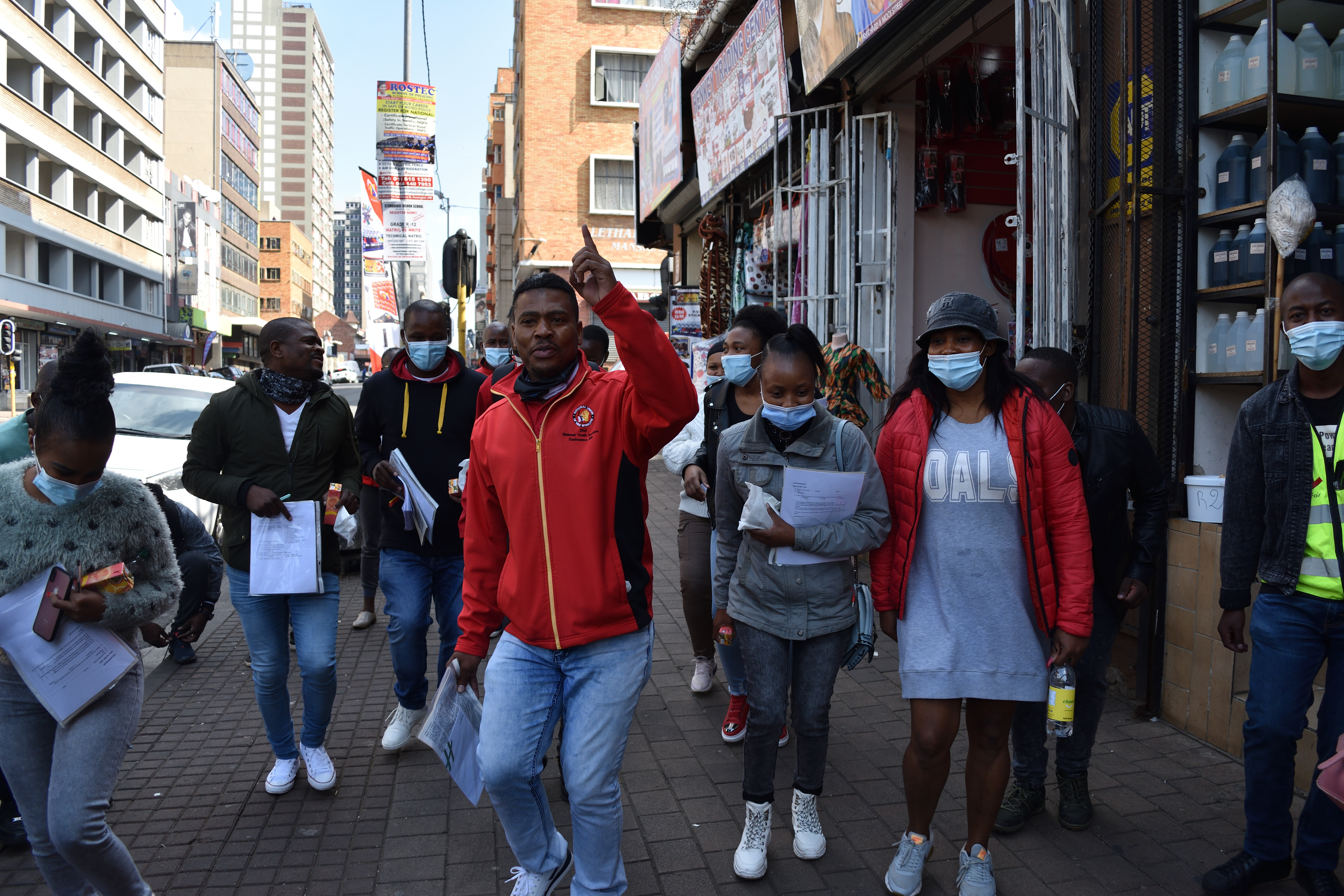
Union-run clinics in South African garment sector certified for Covid-19 vaccination

On 3 July, 15 workers received their vaccine jabs at a trial which was done at a clinic in Durban. The clinics, which have the capacity to vaccinate at least 6,000 workers per week, will be linked to the national vaccination roll-out programme.

The union-run clinics have been providing health facilities to garment workers for many decades – the first was established in 1942 – and are part of the union’s health and safety strategy. They are managed with support from the National Bargaining Council for the Clothing Manufacturing Industry as part of South Africa’s tripartite industrial relations system.

The union efforts are contributing to a national roll-out programme to vaccinate as many workers and people as possible against a ravaging wave of Covid-19 infections which have recently multiplied because of the more contagious delta variant now dominant in the country. Unions are expressing concern over the slow pace of vaccination.

Andre Kriel, SACTWU general secretary says:

“This exciting development follows on the recent conclusion of successful negotiations for a historic Covid-19 Vaccine Rollout Framework Agreement for our industry, which was signed between SACTWU and all clothing employer associations in April. Part of the framework agreement states that we will make available our industry health care clinics and its qualified medical staff to assist with the Covid-19 vaccine rollout campaign.”

Paule France Ndessomin, IndustriALL regional secretary for Sub Saharan Africa says:

“We commend the efforts by SACTWU which is a leading union in the campaign to contain Covid-19 in the factories and workplaces for prevention and vaccination. It is important that the union has integrated Covid-19 in its health and safety activities, and this justifies why Covid-19 must be recognized as an occupational disease.”

South Africa has the highest Covid-19 infections in Sub Saharan Africa, and over 63,000 people have died. According to the South African Medical Research Council excess deaths of 176,700 have been recorded in the country since the outbreak of the Covid-19 pandemic.

Further, according to the department of health, on 7 July the country had 195,493 active cases with 411 people dying from Covid-19 related complications per day. The country is recording 21,427 new infections per day. So far 3,819,730 have been vaccinated, but this is far much less than the 40 million people that are targeted for the country to reach population immunity. Reports indicate that some of the country’s hospitals in Covid-19 hot spots like Johannesburg are running out of hospital beds for patients that need admission.

Unions demand democratic reforms in Eswatini

According to hospital records confirmed by the unions, 24 people have been killed while 150 others are in hospital being treated for gunshot wounds after the police and the army opened fire on protesters. Several other people are feared dead, and to have been secretly buried or burnt to ashes by the security forces.

Instead of police and army brutality, and the government’s shut down of the internet, the unions are proposing dialogue and the opening of democratic spaces in the kingdom.

Eswatini is the last absolute monarchy in Africa. The kingdom has been ruled by King Mswati III since 1986. The King has a reported net worth of $200 million and is accused of using his country’s money to fund a lavish lifestyle for himself and his fifteen wives. Political parties were banned in 1973 and are severely restricted under the kingdom’s constitution. The protestors are demanding the introduction of a democratic system of government.

Unions are advising workers to remain at home for their safety and have requested employers to allow workers to stay away until the situation improves.

The unions say the protests, which began in May, started when the government refused to accept petitions for democratic reforms that included reducing the powers of the monarchy and allowing the Prime Minister to be democratically elected. Currently the Prime Minister, ministers and some Members of Parliament and Senate are appointed by the king.

Wander Mkhonza, general secretary of Amalgamated Trade Union of Swaziland (ATUSWA) which is affiliated to IndustriALL, says:

“We  find ourselves in this situation because we have a leader who has decided to be indifferent despite our persistent demands for democratization. The king talks about dialogue on the international stage but does the contrary in the country. He hides behind those that he sends to deal with dissenting voices. The king must accept that his absolute rule has ended abruptly.”

 “We are calling upon the government to open the political playground and be accommodative to dialogue on dissenting political views. The federation shall be engaged in an urgent in-depth internal consultation to contribute towards a speedy resolution of the current impasse as it is proving to be very costly to industrial peace and the general enjoyment of fundamental rights and freedoms,”

wrote the Trade Union Congress of Swaziland (TUCOSWA) in a statement. The affiliates belong to TUCOSWA.

Paule France Ndessomin, the IndustriALL regional secretary for Sub Saharan Africa says:

“We are in solidarity with the workers and people of Eswatini in their demands for democratic reforms. As trade unions we believe that social and political dialogue is important in resolving conflict and urge the government of Eswatini to facilitate inclusive dialogue.”

IndustriALL affiliates in Eswatini are ATUSWA and the Swaziland Electricity Supply, Maintenance and Allied Workers Union (SESMAWU).

Photo: People's Dispatch

Unions concerned by slow Covid-19 vaccination in Sub Saharan Africa amid surging infections

With hospitals, clinics and other public health facilities overwhelmed and running out of intensive care beds, unions say vaccination is now a matter of urgency in a surging pandemic that has increased deaths by 40 per cent in the last few months. According to the Africa Centre for Disease Control, on 27 June, there were 140 976 deaths and 4 736 725 recoveries, 52 059 658 tests had been taken.

Reports indicate that the highly contagious delta variant has been detected in some countries, and infections in the region are currently growing the fastest globally, with some governments including the Democratic Republic of the Congo, Kenya, Namibia, South Africa, Uganda, and Zimbabwe tightening lockdowns and Covid-19 regulations to contain the spread.

The unions, that organize in mining, textile, garment, shoe and leather, chemical and pharmaceutical and manufacturing sectors are expressing concerns at the slow pace at which Covid-19 vaccinations are taking place in their countries.

Sipho Mungwe, the National Union of Mineworkers (NUM) South Africa health and safety secretary says:

“The NUM is deeply concerned about the increasing prevalence of Covid-19 infections at the workplaces and is sending a clarion call in support of a speedy vaccine roll out. However, the vaccination programme should respect workers’ rights.”

According to reports, vaccination programmes are the lowest in the world with less than 3.7 doses per 100 people inoculated against Covid-19 in Africa compared to 67 per 100 in Europe and 73 per 100 in North America.

Unions say the surge is worsening a public health and economic crisis that has seen thousands of workers getting ill and dying. Millions of workers have lost jobs, while wages are sometimes delayed or unpaid. Weak social security systems have worsened the situation with poverty and unemployment increasing.

Unions see vaccination as one of the solutions to the crisis and are supporting the Covax facility that was set up to procure vaccines for developing countries. Covax, a partnership between CEPI, Gavi, UNICEF and WHO, is anchored on global collaboration on development, production, and equitable access to Covid-19 tests, treatments, and vaccines.

“We have launched an online campaign on social media to promote vaccination and have also created an online messaging platform for our shop stewards to engage management and sensitize workers on the need for vaccination to counter misinformation. We are also using the messaging platform to reach our members. This is how we are able to campaign because we are under a lockdown,”

says Justina Jonas the general secretary of the Metal and Allied Namibian Workers Union.

Further, unions support the African Vaccine Acquisition Task Team which aims to achieve 60 per cent immunization on the continent, and bilateral agreements of vaccines.

Unions are also supporting local manufacturing. For example, in South Africa, the unions support the manufacturing of the Johnson and Johnson vaccine through local pharmaceutical company, Aspen Pharmacare.

Further, the unions support the TRIPS waiver proposals made to the World Trade Organization (WTO) by India and South Africa as this will improve vaccine manufacturing.

The unions also want Covid-19 to be declared an occupational disease so that workers can receive compensation when they get ill or die from the disease and continue to carry out awareness campaigns, promote wearing of masks, hand sanitizing, and better ventilation of indoor spaces as part of their health and safety programmes.

Paule France Ndessomin, IndustriALL regional secretary for Sub Saharan Africa, says:

“Concerted effort is needed by unions, governments, social partners, and global initiatives that include Covax and the TRIPS waiver campaign. The local manufacturing of vaccines is also key to making vaccines accessible. Vaccine equity is required because Covid-19 is a global pandemic and developed countries cannot hoard vaccines that are urgently needed in Sub Saharan Africa and other developing countries.”

Malawi court rules in favour of compensation in sexual harassment case

Tamara Kabowa  was sexually harassed by her general foreperson, Joaquim Carvalho, successfully sued her employer, Mota Engil Engenharia Construcao Africa, for damages. The court heard that Carvalho forcefully caressed Kabowa and attempted to undress her using a “a six-gear knife to rip the trousers apart.” Carvalho resigned and left Malawi before the case was heard in court.
 
The court ruled that Kabowa should be compensated by her employer, Mota Engil, the defendant in the case, for “aggravated and exemplary damages for the injury to her dignity as a woman, emotional and psychological trauma among others as a result of the negligent failure of the defendant to curb her sexual abuse at the hands of one of its officers who was her senior.”

Further, the court ruled that Mota Engil “breached its duty as employer under section 13 of the Occupational Safety and Health and Welfare Act to ensure a safe workplace.”
 
IndustriALL affiliates in Malawi welcome the firm approach that the courts are taking to combat sexual and gender-based violence and are involved in campaigns for the ratification of C190 under the Malawi Decent Work Programme II. Affiliates are also involved in campaigns as members of the Malawi Congress of Trade Union and with civil society organizations on gender mainstreaming and gender equality. The IndustriALL affiliates are the Building, Construction, Civil Engineering and Allied Workers union (BCCEAWU), Chemical Energy, Mining and Allied Workers Union (CEMAWU), Commercial, Industrial and Allied Workers Union (CIAWU) Escom Staff Union (ESU) and Textile, Garment, Leather and Security Services Workers (TGLSSWU).

“We welcome recent judgements in which courts are giving stiffer sentences and penalties for perpetrators of sexual and gender-based violence at work,”

says William Mnyamula, ESU general Secretary.
 
Paule France Ndessomin, IndustriALL regional secretary for Sub Saharan Africa says:

“We salute women who are standing up against sexual harassment at the workplace. The employer has a duty to protect women workers and to ensure their safety. The ratification of Convention 190 by Malawi becomes the necessary next step considering that the courts are supportive.”

In Sub Saharan Africa, Namibia and Somalia have ratified the convention while other countries are at various consultative stages towards ratification.

Unions address accountability as Glencore prepares to reopen Mutanda mine

During the closure, 500 workers from Mutanda were transferred to Kamoto Copper Company (KCC) – a joint venture between Glencore which owns 75 per cent and the state-owned Gecamines which owns 25 per cent. At its peak Mutanda mine employed over 3,000 workers.

Glencore, which owns Mutanda Mine, an open-pit copper and cobalt mine, closed the mine in 2019 citing increasing costs, low cobalt prices and higher taxes. However, since the beginning of 2021 prices of cobalt have increased by more than 40 per cent. Current prices at the London Metal Exchange are US$42500 per tonne for cobalt and US$9508 per tonne for copper.

The news of the opening of Mutanda coincided with the DRC battery supply chain and gender workshop on 10-11 June, which discussed due diligence, health safety and gender equality in the copper and cobalt supply chains. The supply chains include mining, initial processing for export, shipping, processing into powder form, battery manufacturing and other industrial uses, and batteries for electric vehicles and smartphones among other products.
 
The workshop discussed the Organization for Economic Cooperation and Development (OECD) guidelines for multinational enterprises as some of the few international instruments that trade unions could use to fight for due diligence and adherence to international labour standards and decent working conditions by multinational corporations.

Further, the guidelines which are signed by governments had important recommendations on employment, industrial relations, human rights, transparency, the environment, and anti-corruption. Due diligence also allows for the end-to-end traceability of cobalt to avoid cobalt mined through child labour and conflict.
 
Glen Mpufane, IndustriALL director for mining says:

“Due diligence compels multinationals to respect human and trade union rights. Enterprise and trade union agreements – collective bargaining agreements, global framework agreements, protocols and memorandum of understanding – are a means of due diligence.”
 
The workshop further discussed that unions must hold companies like Glencore to account on the OECD guidelines. As Glencore claims that it implements OECD guidance risks, and is part of the Fair Cobalt Alliance, the unions organizing at Mutanda and KCC want Glencore to exercise due diligence at its operations, and for the company to respect collective agreements that it has signed with unions.
 
The DRC affiliates organizing at the Glencore operations that attended the workshop are Organization des Travailleurs Unis du Congo (OTUC), Secretariat des Syndicats de IndustriALL (CSC), Secretariat des Syndicats de IndustriALL de la CDT (CDT), Secretariat IndustriALL Global (UNTC) and Travailleurs Unis des Mines, Metallurgies, Energie, Chimie et Industries Connexes (TUMEC). Other delegates were from the Friedrich Ebert Stiftung DRC office in Kinshasa.

Kenyan unions campaign against workers’ rights violations at Style Industries

KUHABWO has recruited 3,811 workers out of a workforce of 6,000 of whom 85 per cent are women, but the company only remits union dues for 70 workers. According to the union, to discourage workers from joining the union, 150 workers were dismissed last month. Those who have remained union members have been threatened with dismissals.

Since 2015, Style Industries, a manufacturer of synthetic hair made of fine plastic fibres that look like human hair, has refused to recognize the union. The dispute was deadlocked at conciliation, and the case went to the Employment and Labour Relations Court which issued a restraining order against the company in 2017. The order instructed Style Industries to stop “victimizing, intimidating, coercing, harassing, and indulging in unfair labour practices” and allow for the case to be finalized in court. 

Further, the court said the company must stop terminating contracts and dismissing union members because of their union membership. The court further stated that the company’s actions are meant to “disorganize the union.” However, despite the firm approach by the courts, the company’s union busting tactics have continued ,resulting in the unions launching the campaign.

Margaret Ndiritu, KUHABWO deputy general secretary, says:

“The management of Styles Industries is anti-union and workers are being dismissed without fair hearings because they are union members.”

Speaking at a press conference after a campaign meeting of the affiliates on 7 June, Julius Maina, chairperson of the IndustriALL Council of Kenya said:

“Style Industries management threaten workers with victimization if they join the union. When they join the union, they are sacked. When union officials come to recruit workers during breaks or lunch time, the employer uses the police to harass and arrest the workers to stop them from exercising their rights at the workplace.

“The management must respect workers’ rights to freedom of association to join, form and participate in union programmes as outlined in the Kenyan Constitution, the Labour Relations Act, and International Labour Organization Conventions 87 (Freedom of Association and Protection of the Right to Organize) and 98 (Right to Organize and Collective Bargaining).”

“We support KUHABWO in its long fight for a recognition agreement and collective bargaining rights at Style Industries, and we applaud the Kenyan affiliates for the unity and solidarity that they are giving to the union,” says Paule France Ndessomin, IndustriALL regional secretary for Sub Saharan Africa.

IndustriALL affiliates in Kenya are the Amalgamated Union of Kenya Metal Workers (AUKMW), Kenya Engineering Workers Union (KEWU), Kenya Glass Workers Union (KGWU), Kenya Petroleum Oil Workers Union (KPOWU), Kenya Shoe and Leather Workers Union (KSLWU), Tailors and Textile Workers Union (TTWU) and Kenyan Union of Hair and Beauty Workers (KUHABWO).

Lesotho workers strike over government failure to announce wage increases

The strike is over a wage dispute arising from the government’s failure to announce wage increases for textile, garment, shoe, and leather workers in the last two years. The last wage gazette was published in 2019 and wages for the workers have not been increased since. According to the labour laws, the wages gazette must be published yearly, but the government is using the Covid-19 pandemic as an excuse for not increasing the minimum wages.

This prompted an indefinite national strike in which over 40,000 workers took to the streets in protests. The government  responded with force, with the police attacking and injuring several striking workers.

Mamakalo Mohapi, IDUL president and garment worker at Precious Garments in Maseru says:

“Instead of resolving the dispute by announcing new wages, the government is resorting to the use of excessive force. Two workers have died: one was hit by a truck while the other was shot by the army. Several workers have also been injured and hospitalized.”

Mohapi says employers are also using divide and rule tactics.

“With non-unionized workers being asked to report for work when unionized workers are on strike, the employers are also turning workers against each other. Employers are also bribing workers to break the strike.”

Minimum wages in the textile sector for workers with less than a year’s experience are LSL1900 (US$138) for a general worker and trainee machine operator, and LSL2042 (US$148) for a machine operator per month. Those with experience over a year earn LSL2120 (US$155). Workers are demanding a 20 per cent increase to improve the low wages that are not enough to pay for their living expenses.

“The government must announce the wage increases and be sensitive to the livelihoods of workers who have waited for two years for an increase. The workers’ rights to freedom of association must be respected, and the police must stop using force against the striking workers. We support IDUL’s fight for minimum living wages,”

says Paule France Ndessomin, IndustriALL regional secretary for Sub Saharan Africa.

Photo: IDUL at a rally in Lesotho, 2019

Union fights sexual harassment at Hippo Knitting garment factory, Lesotho

Taiwanese-owned Hippo Knitting in Maseru, Lesotho, supplies workout wear to Fabletics, a brand co-founded by actor Kate Hudson.

Three women workers and members of IDUL, confirm that sexual harassment and verbal abuse is common at the factory, taking many forms, including being asked to undress during searching. Verbal abuse including comments on the women’s bodies and other derogatory remarks are a daily occurrence.

The management also snoops into the women’s private lives including their relationships and uses the information when deciding who should report for duty during the weekend for overtime work.

Mathabiso Moshabe, a shop steward at the factory says:

“The company asks women workers to undress during searches when they knock off work and justifies this by saying they suspect that the workers are stealing from the factory. But we are refusing the body searches which are humiliating, disrespectful and against our dignity.

“One of the human resources managers teases workers that since they undress for others to take photos; why not undress for body searches. The manager also makes fun of their bodies, mocks how they dress, and the shoes they wear.”

Of the 1,000 workers at Hippo Knitting, 538 are IDUL members of whom 479 are women. With more than 50 per cent members at the factory, the union is preparing to sign a recognition agreement with the factory as per labour laws as more members continue to join.

 Workers meeting at Hippo Knitting, Maseru

However, Hippo Knitting has cancelled the stop order agreement for union dues following recent action by workers demanding the gazetting of new wages by the government.

Mamahlomola Ntikoane, IDUL treasurer and a shop steward at Hippo Knitting says: 

“A woman was sexually harassed by a supervisor, but the human resources department did not act. Instead, the perpetrator was transferred to another factory. The managers are also involved in sexual harassment. One female manager followed a worker into the toilet and attempted to grab his genitals.”

Hippo Knitting is not the first factory where IDUL is fighting sexual harassment. At Nien Hsing, IDUL together with other unions and international partners, campaigned for an agreement to be reached to end sexual harassment at the factory.
 
Christina Hajagos-Clausen, IndustriALL textile director says:

“We condemn sexual and gender-based violence at Hippo Knitting which is a violation of human and trade union rights and the dignity of the women workers. We support IDUL in its campaign to end the abuses in Lesotho’s garment factories.”

Lesotho’s garment sector employs over 40,000 workers, 70 per cent of whom are women. The factory supplies the garments under the African Growth and Opportunity Act which allows duty free exports from Lesotho to the US.

Photo credit: Lesotho garment factory, Enhanced Integrated Framework, Flickr

South African youth activist school discusses the future of trade unions

The activist school, which also had online participants from Kenya, Nigeria, and Zimbabwe, heard that unions are facing difficulties that have been worsened by the Covid-19 crisis, including retrenchments, precarious work, wage cuts, and loss of benefits especially among the youth. The school emphasized the need to strengthen union power, unity, and global solidarity.

The participants said they are supporting union campaigns for the ratification of ILO Convention 190, which aims to stop violence and harassment in the world of work, and the adoption Just Transition policies.
 
The school urged trade unions to form partnerships with artisanal and small-scale miners and other informal sector workers. Further, the land inequality must be addressed to benefit workers and communities.

Abigail Moyo, from UASA said:

“I learnt about feminism and gender equality in society and workplaces, the relevance of unions today and the impact of the Fourth Industrial Revolution on the job market. We will discuss these issues with the youth in our union, and in the sectors we organize.”

"Pamela Bonga from NUM added:

"To attain gender equality, women must be given support and encouragement to take up leadership positions in the union. Unions were also reminded that they can use the health and safety provisions in the Constitution to advance workers’ rights.”

A

A visit to the Workers Museum in Johannesburg.

On stopping xenophobia, Sboniso Nkomonde, from SACTWU said:

“Employers continue pitting local workers against migrant workers whom they pay low wages. They take advantage because some of workers do not have work permits, and fear being deported. Unions must find ways to stop the exploitation of migrant workers.”

Uta Dirksen, the director of the Friedrich-Ebert-Stiftung South Africa office which supported the activist school said:

“Young workers must build union power and harness that power to push for their demands. Dialogue with members is important in reshaping the union and maintaining its strength. As union strength is also found in the society where workers live; unions should be part of social movements that are demanding social justice.”

Paule France Ndessomin, IndustriALL regional secretary for Sub Saharan Africa said:

“It is significant for the youth in the unions to learn about feminism because it advances the interests of young women workers and workers in general. Feminism is also educational and empowering as it addresses gender inequality and sexual and gender-based violence at work.”

The IndustriALL affiliates that participated are the Chemical Energy Paper Printing Wood and Allied Workers Union (CEPPWAWU), National Union of Mineworkers (NUM), National Union of Metalworkers of South Africa (NUMSA), the Southern African Clothing and Textile Workers Union (SACTWU), and UASA – The Union.

Presenters included a gender expert from Ghana while others were drawn from the Congress of South African Trade Unions, SADC-NGO, Khanya College, and the University of the Western Cape.

SPECIAL REPORT: Campaigning for safer working conditions in Zimbabwe’s artisanal and small-scale mining

SPEACIAL REPORT

From Global Worker no. 1 May 2021

Country: Zimbabwe

Theme: Zimbabwe’s artisanal and small-scale mining

Campaigns by trade unions, civil society organizations and mine affected communities for the formalization of artisanal and small-scale mining (ASM) are meant to end the deadly working conditions of the miners in Zimbabwe. In addition, formalization will introduce decent working conditions.

Hundreds of artisanal and small-scale miners in the country are dying in flooded and collapsing mines which are trapping miners underground. Rock falls often block escape routes and toxic gases suffocate the miners in poorly ventilated mines. Most rescue operations carried out by the government’s ill-equipped teams are never completed, and only a few miners are rescued before the operations are abandoned. 

Sadly, some mines where accidents have happened are now grave sites of the mainly youthful miners. The mine accidents in the last few years include Ran Mine, Bindura where an old derelict gold mine shaft collapsed on 6 November 2020. Only six miners were rescued and 24 trapped underground when the rescue mission ended. At Cricket and Silvermoon Mine in the Battlefields area near Kwekwe over 40 miners died. Most of the accidents have happened at mines that were no longer operational and whose mining licences were in dispute. 

Commenting on the country’s quick abandonment of rescue operations, the Parliament of Zimbabwe says there is no compassion in the way the country deals with artisanal miners’ deaths with rescuers failing to save miners from shallow depths of about 60 metres.

Zimbabwe’s labour laws allow for health and safety in the mines and the country has also signed the International Labour Organization Convention 176 on Safety and Health in Mines. But these legal frameworks are less useful in an informal working environment that is sometimes controlled by syndicates and gangs.

With no other source of income, over one million miners, or 14 per cent of the country’s labour force, continue to look for minerals, especially gold, to eke out a living. The vicious cycle continues as accidents in the unsafe mines continue to claim the lives of the workers. With the country’s decades long economic crisis, unemployment remains high with over two million people living in poverty. Child labour is common along rivers, with some children dropping out of school to pan for gold.

Terrance Sakala (25) an artisanal miner working at a small scale mine with seven other workers near Kadoma, says: 

“My working day begins by pumping water from the 30 metre deep mine using a submersible water pump and waiting for four hours before we drill three holes into the earth using a jack hammer. After that, we put explosives and blast and wait for another four hours before we go into the mine to scoop the ore. We get paid weekly, but this depends on the gold that we get after milling. When there is no gold; there is no money. In a good week you can get as much as US$500 but in a bad one the amount can be US$100 or nothing. We live in hope and faith. Artisanal mining is about endurance. This is not large-scale industrial mining.” 

The Zimbabwe Auditor General’s report confirms that there is non- compliance with occupational health and safety in ASM. This is worsened by situations where the mining takes place at sites where there are ownership disputes and mining may be considered by the authorities as unlawful. There have also been incidents of violence when knife wielding gangs attacked some artisanal miners and communities in violent clashes over land use. 

Unions in Zimbabwe have long identified the risks of ASM as unsafe and poorly ventilated pits. Further, the shafts and tunnels are prone to collapse and flooding, especially after heavy rains. There is also lack of personal, protective equipment and exposure to dust. The miners are also exposed to other risks from hard labour as the work involves digging with picks and shovels repetitively over long hours. Most miners or their employers cannot afford to buy mining equipment and machinery. There is also exposure to hazardous substances such as mercury.

On the increasing calls for formalization of ASM, Justice Chinhema, general secretary, Zimbabwe Diamond and Allied Minerals Workers Union, says: 

“As a union representing the interests of mine workers across the country, we urge the government to advance the rights of artisanal and small-scale miners by giving them mining concessions and improved access to mineral rights. The lack of such concessions, where legal titles are available for the formalization of ASM, is a major barrier. We would also like technical support to be given to ASM through regulation that will promote formation of mining cooperatives, provision of social security and the setting up of pension funds.” 

Zimbabwe is in the process of amending the Mines and Minerals Act to include artisanal miners and introduce formalization and better regulation. Further, civil society organizations and mine affected communities are calling on the country’s authorities to adopt the recommendations from the African Mining Vision on the integration of ASM as one of the strategies for resource-based development and poverty reduction. 

On illicit financial flows, there are recommendations to stop the smuggling of gold. For example, gold worth over US$1.8 billion was smuggled out of the country in 2020. An investigative report by South African’s Daily Maverick, Cartel power dynamics in Zimbabwe, concluded that gold smuggling is controlled by cartels and that most of the smuggled gold which found its way to South Africa and the United Arab Emirates is mined by ASM who “in 2019 produced 63 per cent of the gold marketed formally in Zimbabwe.” This is more than the gold produced by large scale mines.

However, the mining and working conditions of ASM in Zimbabwe mirror what is happening in most Sub-Saharan African countries where 10 million artisanal and small-scale miners dig for minerals through panning, open cast, and shaft mining. The minerals include tin, tungsten, tantalum, gold, cobalt, and other rare earth metals used in the manufacturer of electric cars batteries, smartphones, and other products.

To improve conditions in ASM, IndustriALL has facilitated meetings with affiliates in Sub Saharan Africa to discuss the implementation of ILO Convention 176 and the adoption of ILO Recommendation 204 on the transition from informal-to-informal work. Among other issues, the recommendation aims to “facilitate the transition of workers and informal units to the formal economy, while respecting workers fundamental workers’ rights and ensuring opportunities for income security, livelihoods and entrepreneurship.”

IndustriALL affiliates from Zimbabwe and other African countries including Burkina Faso, the Democratic Republic of Congo, Ghana, and South Africa, have participated in the Alternative Mining Indaba (AMI), held annually in parallel to the Mining Indaba, where resolutions have been adopted to support ASM and recognize the role miners play in sustaining the livelihoods of marginalized and rural communities. 

One of the resolutions for the AMI states:

“ASM contributes to the livelihoods of millions of Africans. As such we affirm that this must be recognized in laws and policies of the countries and must not be criminalized. This includes strengthening ASM right to access and ownership of mining rights, a decent work framework aimed at ensuring fair beneficiation along the value chain, access to social protection and safety nets and decent working conditions.”

Glen Mpufane, IndustriALL director for mining says: 

“IndustriALL supports formalization of ASM to address the appalling health and safety conditions and decent work deficits in Zimbabwe and other African countries. It is distressing that miners continue to lose their lives in preventable accidents that could otherwise be prevented by national laws and international labour standards. Formalization comes with compliance, and knowledge and technical capacity on mining governance as explained in the African Minerals Governance Framework.”

Resolutions have also been adopted for better mineral resource governance at the AMI and the curbing of illicit financial flows which, according to the United Nations Conference on Trade and Development, drain the African continent of over US$88 billion dollars which leaves the continent illegally for offshore accounts.