Union adopts a decent work campaign strategy for organizing artisanal and small-scale miners in Ghana

The union explained its strategy at the Friedrich Ebert Stiftung-IndustriALL crossing the divide project workshop on 2-3 September in Accra. The project aims to complement the International Labour Organization Recommendation 204 on transition from the informal to the formal economy and promotes the use of innovation by trade unions in engaging with the miners.

The aims of the workshop were to bring together key stakeholders: trade unions, researchers, civil society organizations, government, ASM associations, traditional authorities, communities, and other stakeholders to find ways of improving the sector. According to the GMWU, this could be done through using the decent work pillars of full and productive employment, rights at work, social protection, and promoting social dialogue and international labour standards. Further, emphasis was put on health and safety.

The hybrid workshop had 20 participants in the conference room whilst others attended online. The participants included officials from the Ministry of Lands and Natural Resources, representatives from the Ghana National Association of Small-Scale Miners and from the trade think tank, Third World Network Africa. Others came from the GMWU and the FES-Ghana and South Africa Offices.

Abdul-Moomin Ggbana, the general secretary for GMWU said:

“Calls to formalize artisanal and small-scale mining fit into the mission of the Ghana mineworkers. We want the miners to be involved in social dialogue, enjoy their rights at work, and to have their operations registered. This will promote decent work which will benefit ASM.”

“Ghana is amongst the important actors that provide us with a model of recognition, formalizing, and organizing ASM that is inclusive of women’s rights. Following our meeting in Johannesburg in 2019, there were recommendations on taking the programme forward through learning and sharing of strategies and tactics. This is one of the purposes of this workshop,”

said Shane Choshane, FES-Trade Union Competence Centre, project manager.

He added that while South Africa is currently considering formalizing ASM, Ghana is a step ahead and already has laws for the registration and licensing of the sector.

Glen Mpufane, IndustriALL director for mining said:

“It is important to create a decent working environment and due diligence in ASM. Occupational health and safety are important for the sector. With informality, workers are exposed to dangerous working conditions including landslides and dangerous chemicals such as mercury. Other dangerous work includes manual rock crushing, and this means miners are at risk of injury and death every day when they enter the mining sites with no protection.”

Gender inequality and gender-based violence were other areas of concern that were discussed in the workshop and the situation in Ghana was presented by a labour and gender expert Bashiratu Kamal.

“Like in most mining activities, women in ASM do the least important tasks, earn the lowest money, and face gender-based violence and sexual harassment. This is caused by gender inequality that is common in mining operations which is worsened by informality. This is where stakeholder engagement by trade unions on gender responsive due diligence is essential as an intervention,”

said Armelle Seby, IndustriALL gender coordinator.
 
According to reports there are about one million artisanal and small-scale miners in gold mining in Ghana who are producing about 35 per cent of the country’s gold. This is about 60 per cent of the country’s labour force. The miners are said to look after households that make up about 4.5 million people.
 
The Ghana workshop is the first in series of meetings that will take place in the Democratic Republic of the Congo and Zambia to discuss ways of improving mining and working conditions in the ASM sector.
Zimbabwean unions campaign against Covid-19 vaccine hesitancy

The unions announced their plans during an online health and safety meeting on 20 August. Several topics and questions were discussed during the meeting, including whether it is lawful for the employer to ask workers to produce vaccination certificates or negative Covid-19 test results taken in the last 24 hours as a condition for reporting for work. Health and safety rights that workers enjoyed during a global pandemic were discussed with reference to Zimbabwean labour laws and international labour standards.

The unions raised the issues as a response to a recent trend in which employers in the country were demanding vaccination cards, or negative Covid-19 test results when workers reported for work. This began after the government announcement that although workers will not be forced to vaccinate, those who chose not to will not be offered jobs, will be banned from commuting on public buses, and be excluded from Covid-19 benefits. However, unions say the employers must engage workers through social dialogue platforms and consult with unions to address vaccine hesitancy before issuing the notices.

As a response to the employers’ notices, the Zimbabwe Congress of Trade Unions has gone to court to challenge actions by state-owned telecommunications company TelOne which wrote to workers informing them that the unvaccinated would no longer receive Covid-19 allowances and be required to take immediate leave.

“Whilst workers have mixed emotions on Covid-19 vaccination, employers on the other hand must ensure the health and safety and well-being of workers. However, it seems information gaps are negatively impacting on the uptake of vaccines but slowly some workers are beginning to see the benefits after vaccination. As unions we are emphasizing that workers should be given enough information to convince them to agree to vaccination,”

says Eustace Chidhindi, the affiliates' occupational health and safety coordinator.

“It has been proven that vaccines can stop severe disease and death when one becomes infected with the coronavirus and encourage Zimbabwean workers to get vaccinated. Further, we urge workplace cooperation between unions and employers, and social dialogue on Covid-19 prevention and workers health and safety,”

says Paule France Ndessomin, IndustriALL regional secretary for Sub Saharan Africa.

According to the Ministry of Health and Childcare, the country has procured 13 million vaccines and vaccinated 2,582,705 people (single dose) and 1,636,498 (double dose) using mainly the Sinopharm vaccine from China. Current cumulative confirmed positive cases on 31 August were 124,773 with 4,419 deaths and 113,057 recoveries. The ministry says to reach population immunity 10 million people must be vaccinated.

IndustriALL affiliates in Zimbabwe are National Union of Metal and Allied Industries of Zimbabwe (NUMAIZ), National Union of the Clothing Industry (NUCI), the Zimbabwe Chemical, Plastics and Allied Workers Union (ZCPAWU), Zimbabwe Diamond and Allied Minerals Workers Union (ZDAMWU), Zimbabwe Energy Workers Union (ZEWU), Zimbabwe Leather, Shoe and Allied Workers Union (ZLSAWU), and the Zimbabwe Textile Workers Union (ZTWU).

Sierra Leone ratification of ILO instruments is opportunity to transform industrial relations, says union

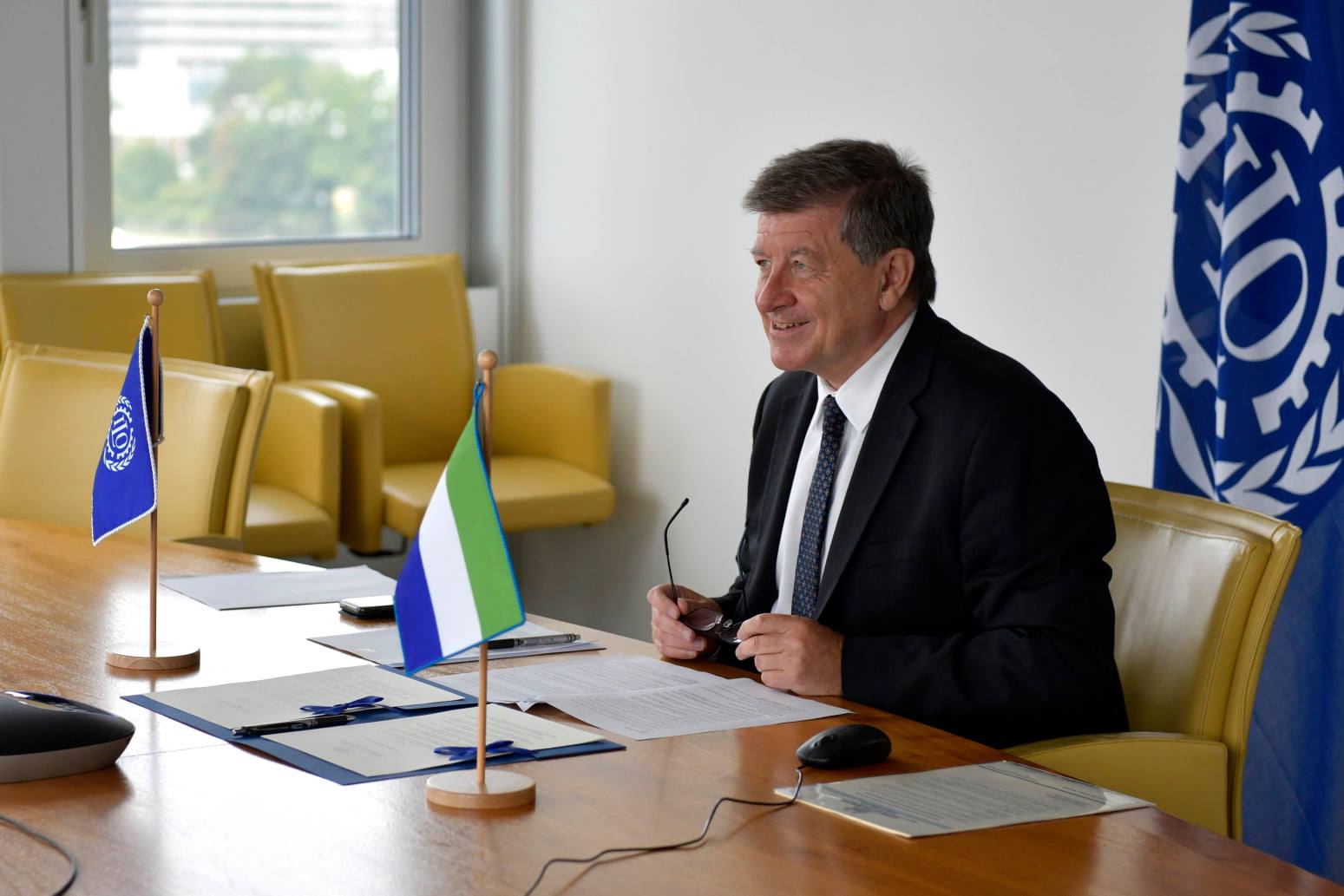
ILO general secretary Guy Ryder at the signing. Photo: ILO

The ILO says the ratifications of eight conventions and a protocol, which took place on 25 August, were unprecedented. The eight conventions are the Migration for Employment Convention (Revised, 1949) (C97), Migrant Workers (Supplementary Provisions) Convention, 1975 (C143), Occupational Safety and Health Convention, 1981 (C155), Labour Statistics Convention (C160), Private Employment Agencies Convention, 1997 (C181), Promotional Framework for Occupational Safety and Health Convention, 2006 (C187) and Domestic Workers Convention, 2011 (C189).

The conventions are aimed at addressing the decent work deficit common among workers in the country, including for migrant workers, and improving working conditions for precarious workers who have no job security and are poorly paid. In most instances, precarious workers are employed through third parties such as private employment agencies who often exploit them and violate their rights. The conventions include those on occupational health and safety, which has been worsened by the Covid-19 pandemic.

The 2014 protocol to the forced labour convention 1930 was also ratified. This is important for ending human trafficking of migrant workers and women in the country and abroad. Forced labour has been reported in the country involving migrant workers, while thousands of Sierra Leoneans have been victims of slavery in other West African countries, Libya, and the Middle East.

Muluku Tarawally, general secretary of ASGEmU says:

“This is one of the best things that has happened for the workers of Sierra Leone in a long time. It is an opportunity to complete the labour law review activities in which unions are participating. Additionally, the ratification of the conventions strengthens union demands for the inclusion of all ratified conventions into national labour laws. It is important that government is backing the adoption of international labour standards, and this shows that it is committed.”

Paule France Ndessomin, IndustriALL regional secretary for Sub Saharan Africa says:

“The ratification of the nine instruments shows the power of social dialogue in which unions and the government show commitment towards decent work. This ensures the protection of workers’ rights and better working conditions for workers through national laws and international labour standards. It is important that unions are not only supporting but are also taking part in the domestication of the conventions into national labour laws.”

South African union demands reversal of retrenchment notice for 200 miners

According to NUM, when the company took over the mine in 2012, they promised to improve the maintenance of the mine shaft and the pumping of water from underground. CAPM also promised to create 10 000 jobs and had said it would start by hiring 2,000 workers.

Instead of the retrenchments, the union is proposing that workers be put on rotational layoffs at 50 per cent wages to allow the company to fix the winders at the mine. Workers will then return to work when the mine is fully operational.

Further, the union wants CAPM to apply for the employee temporary relief scheme. The Unemployment Insurance Fund Covid-19 Temporary Employee/employer Relief Fund falls under the department of labour and employment and was created to assist companies in distress because of the pandemic.

“The retrenchment is a double blow for us after being passed from Aurora to CAPM as the mine changed hands. We have not been paid by Aurora and the case is being finalised in court. And now we are being retrenched,”

says Mguga Mava. He has worked at the mine’s engineering department for 12 years and says workers are still owed money by Aurora which went under liquidation.

The Pamodzi Gold mine has a troubled history. CAPM took over the mine in 2011 and was reported to have demanded that workers in South Africa waive their labour rights in its new agreement with Pamodzi Gold. The controversy was resolved with the National Union of Mineworkers with CAPM reportedly committing to “ constructive engagement in the future, based on mutual trust and goodwill”.

"The NUM disagrees with CAPM on cutting jobs by 66 per cent. We are disappointed that it is the same former Aurora workers who will be affected by these retrenchments. The NUM hoped that when the mine re-opened, the unemployment in the region would be reduced, and that the conditions of workers in this mine would be aligned to those of the industry as undertaken by the company.

"We are very much disappointed to find ourselves back paddling as the mine faces closure and is going into care and maintenance,"

says Masibulele Naki, NUM regional secretary for Matlosana.

The union says Chinese owned companies like CAPM are exploiting workers “without showing the slightest respect for the basic labour laws.”
 
The NUM went on strike at the mine in 2018 for better health and safety conditions to avoid situations in which workers would be forced to work under dangerous conditions. At the time there were no risk assessments being carried out as per mining regulations. The strike forced the department of mineral resources and energy to inspect the mine and ask the employer to comply.

However, workers say some issues related to winder engines, cables and communication bell recorders for operators are yet to be resolved.

“Jobs should be preserved, especially under the harsh conditions of Covid-19. CAPM should have a dialogue with NUM and the government to find ways to save jobs. It is important to always remember that workers have families to look after and their welfare should be seriously considered before deciding on retrenchments,”

says Paule France Ndessomin, IndustriALL regional secretary for Sub Saharan Africa.

South African unions and civil society march for democracy in Eswatini

The march to the Office of the United Nations High Commissioner for Human Rights in Pretoria on 13 August was followed by the handing over of a memorandum, demanding that the United National Human Rights Council (UNHRC) convenes an urgent meeting to respond to continuing human rights violations including the right to life, and the rule of law. Further, the UNHRC must emphasize on Eswatini’s responsibility to promote and protect human rights and fundamental freedoms as specified in the UN Charter and the Universal Declaration of Human Rights.
 
According to a memorandum by the United Eswatini Diaspora to which NUMSA and other civil society organizations signed, the UNHRC must investigate and act upon stopping:

“The human rights violations by the government  and the absolute monarchy which have assumed a number of forms  including the killing of 72 civilians, severe injuries to more than 200 people, harassment, arbitrary detention, persecution of pro-democracy Members of Parliament, censorship of the media, state intimidation and threats, the promulgation and use of laws that violate fundamental rights to freedom of expression and association, and unlawful state efforts to undermine bar or crack down on peaceful protests.”


The memorandum states that over 600 people, including children, have been arrested. Speakers during the march said the whereabouts of several hundreds of people remains unknown.

“For a longtime the people of Eswatini have been fighting for freedom against the repression. As trade unions we support the struggle to end their suffering and call upon the UN and the Southern African Development Community (SADC) to intervene,”

says Jerry Morulane, the NUMSA regional secretary for Hlanganani which includes Pretoria.
 
Recently, IndustriALL affiliates in Eswatini, The Amalgamated Trade Union of Swaziland (ATUSWA) and Swaziland Electricity Supply Maintenance and Allied Workers Union (SESMAWU), took part in a workers’ march to parliament in Lobamba to demand democratic reforms and a constitutional monarchy. The march was organized by the Swaziland Congress of Trade Unions and coincided with the global day of action by IndustriALL and the ITUC.

“IndustriALL continues to call on the government of Eswatini to facilitate social and political dialogue that will lead to democratic reforms. The country must respect human rights and adhere to the UN Charter and the Covenant on Civil and Political Rights that it has signed,”

says Paule France Ndessomin, IndustriALL regional secretary for Sub Saharan Africa.

Eswatini is Africa’s last absolute monarchy and political parties were banned in 1973. The country has been ruled by King Mswati III since 1986 and he appoints the prime minister and other key officials. Mswati, whose net worth is over $50 million according to reports, is infamous for an opulent lifestyle that includes buying a fleet of Rolls-Royces for his family of 15 wives and 23 children while most of the population lives in poverty and faces high unemployment especially amongst the youth. The country also faces a high prevalence of HIV and AIDS.

Take action for eSwatini!

Unions in eSwatini are urging the government to undertake democratic reforms. Tomorrow, 6 August, unions in the country are marching to parliament. Join our day of action together with the ITUC and send letters to the eSwatini government, as well to your own government, supporting the protestors and calling for urgent pressure on the eSwatini government.

The protests began in May as the government refused to accept petitions for democratic reforms that included reducing the powers of the monarchy and allowing the Prime Minister to be democratically elected. Currently the Prime Minister, ministers and some Members of Parliament and Senate are appointed by the king.

“Global solidarity can make a difference, and we urge you to take action supporting our fellow unionists in eSwatini. IndustriALL calls on the government to engage in an inclusive dialogue to resolve the situation,”

says IndustriALL general secretary Valter Sanches

IndustriALL affiliates in eSwatini, ATUSWA and the Swaziland Electricity Supply, Maintenance and Allied Workers Union (SESMAWU), call

“upon the government to open the political playground and be accommodative to dialogue on dissenting political views”.


Union in South Africa prepares for strike over deadlock in wage negotiations

Although NUMSA commits to further negotiations, the union says it will call for a strike and solidarity strikes in other sectors that includes automotive, energy, mining, and tyre manufacturing if the wage negotiations remain deadlocked. Another IndustriALL affiliate, UASA, is involved in the negotiations.
 
The union, which wants an 8 per cent increase, rejected the 4.4 per cent offer made on 12 July by the Southern Africa Steel and Engineering Industries Federation of Southern Africa (SEIFSA) on behalf of the engineering employers. There were no wage increases in the sector in 2020 after an agreement was reached with the union and the employers not to increase the wages because of the Covid-19 pandemic.
 
Irvin Jim, NUMSA general secretary says: “We reject government and business hiding behind Covid-19 to advance their consistently adopted attitude, which is to refuse to give workers their deserved wage increases and accord workers a living wage. It is important to state that just like businesses and government, workers carry the same burden in facing the tough socio-economic conditions. Workers provide for extended families, and in a stagnant economy, that further erodes their own buying power.”
 
“We signed the standstill agreement to secure the future of the industry amid economic lockdowns and challenges to suppliers and value chains. Together with our members, we ensured the smooth operation of businesses which are now breaking even, and some are making profits. We made such compromises being very clear that preservation of companies should translate to job security.”
 
NUMSA says it is disappointed that despite the workers’ sacrifices the companies “retrenched workers to strengthen their balance sheets and to make profits as they always see workers as the weakest link in the chain to be attacked.”
 
Paule France Ndessomin, IndustriALL regional secretary for Sub Saharan Africa says: “Engineering employers should commit to paying living wages that are above inflation and to consider the NUMSA demands for an outcome that benefits the workers. The Covid-19 pandemic should not be used as an excuse to pay low wages.”
 
Reports by the South African Revenue Service indicate that the economy is beginning to recover because of the current high prices of metals and precious metals exports that include platinum, gold, and iron ore as well as vehicle and transport equipment, chemicals, and other exports. The engineering supply chain is an important part of mining’s upstream and horizontal linkages and is benefiting from the high commodity prices.

Tanzanian union addresses gender-based violence in textile and garment factories

During the visit, the union learnt from workers that supervisors were targeting young women workers for sexual harassment leading to stressful conditions that affected performance. To bring this to an end, TUICO organized a five-day conference, 22-26 July, at Sunflag in Arusha to sensitize workers on how to stop GBHV at the factories.

The conference was attended by 101 participants, of whom 53 were women. The training programme emphasized that workers’ rights were protected by national labour laws, and international labour standards. These included the rights to maternity protection which were the most violated as workers were denied maternity leave.

Discussions emphasized the importance of the International Labour Organization Convention 190 on eliminating violence and harassment in the world of work, as one of the tools to fight GBVH. The workshop discussions and group work defined forms of harassment that included inappropriate language, gender discrimination, threats, and inappropriate jokes. Further, C190 and Recommendation 206 broadened the world of work to include hotels where meetings took place, changing areas at workplaces, training venues, marketplaces and during travelling to work.

TUICO is campaigning for the ratification of C190 by Tanzania. In Sub Saharan Africa the convention has been ratified by Namibia, Mauritius, and Somalia.

TUICO says it has set up mechanisms for reporting GBVH which includes encouraging affected workers to inform their colleagues, report at the union branch office at the workplace, investigations by the gender desk, reporting to the police, and taking the matter to courts or for mediation.

“It is powerful to talk to workers about sexual harassment and gender-based violence. We are expecting big changes to be made at this factory so that the grievances by workers are addressed. The union targeted this factory after receiving reports of abuses. We met with workers, forepersons, supervisors, heads of units and departments of Sunflag,”

said Maria Bange, TUICO’s head of women, the disabled, occupational health and safety and the environment.

Paule France Ndessomin, IndustriALL regional secretary for Sub Saharan Africa says:

“Sensitizing workers to demand their rights and demand workplaces free of GBVH is important especially in the garment factories where sexual harassment is common. IndustriALL will support TUICO to extend the training and awareness campaigns to other manufacturing sectors.”

The conference was held with support from the IndustriALL regional office for Sub Saharan Africa and the NITO project. NITO is a Norwegian trade union organization for engineers and technicians and supports IndustriALL Tanzanian affiliates through an organizing project that addresses gender, youth and union building efforts.

Kenya unions support proposals for unemployment insurance fund

The proposed fund, which will become operational in 2022, will also benefit workers who have lost their jobs because of the Covid-19 pandemic. According to the Kenya Bureau of Statistics over 1.7 million jobs were lost at the beginning of the pandemic last year.

The fund, which will be under the department of social protection of the Ministry of Labour and Social Protection, will pay workers part of their wages for up to six months in the event of retrenchment. Kenya is also implementing cash transfer schemes for poverty alleviation.

According to reports, the fund will be like South Africa’s Covid-19 Temporary Employer/Employee Relief Scheme (TERS) which has so far paid over $4 billion to workers whose jobs were affected by the Covid-19 pandemic. TERS is part of the Unemployment Insurance Fund in which workers and employers contribute. Workers can claim benefits from the fund when they lose jobs. In addition to UIF, South Africa provides universal old age and disability pensions, and child grants.

Social protection policies benefit workers who in most cases provide not only for their own families but for relatives as well. Social protection, which includes income security, has been identified as one of the strategies to attain the United Nations Sustainable Development Goals.

Rose Omamo, Amalgamated Union of Kenya Metalworkers general secretary says:

“Unions have long fought for income security and unemployment benefits for retrenched workers. We support the setting up of the unemployment insurance fund and will continue to engage the government in the negotiations towards the launch of the fund. We have made demands for such schemes through collective bargaining and in social dialogues platforms that we are involved in as labour.”

 “Income security is important in the context of the Covid-19 pandemic that has caused massive job losses. Millions of workers have lost jobs in Kenya and other African countries. With limited income security because of low wages and inadequate basic healthcare, most of the workers are forced into poverty as they fail to provide for their livelihoods. In this respect, the proposals to introduce an unemployment fund will provide some much-needed income security to the retrenched workers,” says Paule France Ndessomin, IndustriALL regional secretary for Sub Saharan Africa.

IndustriALL affiliates in Kenya are the Amalgamated Union of Kenya Metalworkers, Kenya Engineering Workers Union, Kenya Glass Workers Union, Kenya Petroleum Oil Workers Union, Kenya Shoe and Leather Workers Union, Kenya Union of Hair and Beauty Workers, Tailors and Textile Workers Union.

South African unions condemn unrest, violence, and looting

Over the last few days, South Africa has been engulfed by what began as protests following the imprisonment of former president Jacob Zuma on contempt of court charges. Zuma was summoned to appear before a judiciary commission of enquiry on state capture and boycotted some of the sessions.

However, amid widespread poverty exacerbated by the pandemic, and the recent withdrawal of a Covid-19 grant, the protests, mainly in Gauteng and KwaZulu-Natal provinces, turned into food riots and general unrest.

This led to the looting of shopping malls, grocery shops, food and industrial warehouses, garment and shoe shops, and furniture stores, among others. Some factories and malls were burnt in the mayhem including a garment factory in KwaZulu-Natal province. 

According to reports, 117 people have been killed and several injured. Some of the rioters have been arrested. The government says it is taking steps to curb further violence by deploying soldiers to the hotspots to assist the police.

Andre Kriel, the general secretary of the Southern African Clothing and Textile Workers Union (SACTWU) says:

“We cannot accept that while, together with national government and employers, we have been working extremely hard to save and create local industrial jobs, the future sustainability of our efforts is being undermined by such horrific and unashamed criminal activity.”

“For example, in Isithebe, a brand-new clothing factory, Kingspark Manufacturers, which was set up only in September last year, has been completely destroyed. Machinery and raw materials have been looted, and nothing remains. In the process, 600 much-needed jobs supporting 3,000 family members in the poorest part of the country are now lost.”

William Mabapa, National Union of Mineworkers, acting general secretary says:

“In the aftermath of this situation many workers will lose their jobs. Many families will be left with no means of earning a living as many shops and trucks are completely burnt and destroyed. The looting of these businesses destroys the working class families' source of earning and sustainability. While we support effective law enforcement, unnecessary deaths resulting from such interventions should be avoided.”

Phakamile Hlubi-Majola, the spokesperson of the National Union of Metalworkers of South Africa adds:

“We are deeply concerned about the acts of criminality and the unrest but believe the uprising was inevitable after two decades of neoliberal capitalism that has caused the crisis of inequality, poverty and unemployment. The working class and the poor have been under pressure for a long time. We need reforms and economic policies that benefit the working class.”

South Africa is one of the most unequal countries in the world, with high wage inequality and the poor having limited access to education and healthcare. Nearly half of the adult population, mostly women, live in poverty. With job losses caused by Covid-19 lockdowns, poverty levels are increasing.

The union federation COSATU yesterday tabled a Disaster Relief Package at Nedlac, South Africa’s tripartite industrial relations council. The federation recognizes that hundreds of thousands of jobs will be lost, and that this represents a “national disaster”.

COSATU is calling for a range of immediate measures, including food parcels, the restoration of the Covid-19 grant, and economic stimulus to help business to recover. The federation is also calling for long term measures to transform the economy.

Paule France Ndessomin, the IndustriALL regional secretary for Sub Saharan Africa says:

“Over many years South Africa has developed social dialogue mechanisms to address social and economic problems. These should be used to diffuse the current tensions, while the government has a responsibility for law enforcement while protecting workers’ and human rights.”

Photo: Community volunteers clean up after rioting, by Athi Geleba