Union fights over unpaid wages and workers’ rights violations at Galba Nigeria

The workers are owed wage arrears of 350 million Naira (US$920, 000) for four years whilst some have retired without even receiving their benefits.

According to AUTOBATE, some workers have since died before being paid their wages whilst those who remain at work are suffering and failing to pay for their living expenses. Some workers with more than 25 years of experience retired without any pension benefits or gratuities when management at Galba Nigeria told them to “go and rest”.

AUTOBATE says the company has not been remitting dues already deducted from the workers to the union since 2013, in violation of trade union rights that are protected by national labour laws and international labour standards.

“The situation is pathetic because to date we have recorded over 14 deaths of staff from complications of blood pressure, hypertension, and stroke because they could not pay their bills including rents, school fees, medical fee and household expenditure for their families,”

says Olusola Joel Olorunfemi, AUTOBATE general secretary.

In its fightback against the violations, AUTOBATE has organized pickets and demonstrations outside the company premises in Port Harcourt. The union has also taken Galba Nigeria to the National Industrial Court of Nigeria over the non-payment of wages and the workers’ rights violations. The court action came after efforts by the Trade Union Congress of Nigeria to mediate in the dispute failed. The union also sought intervention from the Federal Ministry of Labour and Employment to no avail.

Paule France Ndessomin IndustriALL regional secretary for Sub Saharan Africa says:

“The level of wage theft and workers’ rights violations at Galba Nigeria is shocking and unacceptable. We support AUTOBATE in its demand for the payment of wage arrears at Galba Nigeria and for defending workers’ rights and standing firm on the adherence to fair labour standards and decent working conditions.”

Galba Nigeria is an engineering company that provides services to oil companies in Port Harcourt and Rivers State.

Photo credit: stock imge, Port Harcourt, Nigera

Vaccine roll-out framework agreement reached in South Africa’s garment sector

SACTWU says the agreement aims to reach an immunity target of at least 80 per cent of the workers and will be extended to other sectors in which the union organizes that include textile, leather, and shoe.
 
The framework agreement reached on 6 April with the National Bargaining Council for the Clothing Manufacturing Industry of South Africa which represents five garment employer associations, aims to building a close working relationship with the national government and the Department of Health.
 
The agreement also encourages the development of workplace guidelines and plans that will facilitate vaccine rollouts which will be made available to the workers.
 
On workers’ rights, the agreement states that there will be no employment contract that will discriminate a worker based on whether the worker has been vaccinated or not. Additionally, to counter fake information, the agreement also aims to debunk myths on Covid-19 vaccines, provide credible information and training of shop stewards on the vaccine rollout campaign.
 
The agreement promotes initiatives to fast-track the buying of adequate and affordable vaccines for the country. These include supporting plans to produce vaccines locally. For example, there are plans for Aspen, a South Africa pharmaceutical company to start delivering the Johnson and Johnson vaccine in June from its factory in Gqberha formerly Port Elizabeth. The vaccine will be received in a frozen state then thawed and packaged for local distribution.
 
The South African government has ordered about 43 million vaccines and is expecting deliveries from Pfizer and the Covax facility. In the long term, the agreement supports the development of a domestic Covid-19 vaccine. So far 278,909 health care workers have been vaccinated.
 
Christina Hajagos-Clausen, IndustriALL director for the textile and garment industry says:

“Covid-19 is a call to innovate in the way we carry out campaigns as trade unions. In this sense, we commend SACTWU for being a pioneer and campaigning for the prevention of Covid-19 when the pandemic started; to now campaigning for vaccine access, equity and rollout amongst garment workers.”

 André Kriel, SACTWU, general secretary says:

“The union regards this as an important next step to help combat the spread of the COVID-19 pandemic. We are pleased that clothing employers have embraced this campaign and have consented to this framework agreement and contributed constructively to its finally agreed-to terms.”

International solidarity ends precarious work at Kenya auto plant

This is welcome news to the workers. For instance, Anisa, who has worked at KVM for 20 years on a piece rate basis says:

“We are delighted that our wages have increased and look forward to longer contracts that will give us job security. Currently we are on monthly contracts. Job security is important to us as it improves our livelihoods and those of the families that we provide for.”

Rose Omamo, AUKMW general secretary says:

“We applaud this move by the KVM management which we consider a victory for the workers. This is an important step in ending precarious working conditions in the automotive sector in Kenya, and we are grateful for the support that we received from our comrades in the Works Council of Volkswagen. This follows up from our engagements in the Sub-Saharan Africa VW network.”

Bernd Osterloh, president of the European and World Group Works Council of Volkswagen AG, says:

“We are pleased that the 42 piece-rate workers at KVM have received a proper contract through our support. This is also a strong achievement of the AUKMW. This success could not have been achieved without the passionate commitment of the colleagues of this trade union. As the World Group Works Council at Volkswagen, we are committed to improving working conditions worldwide, both in our own plants and at our suppliers. An important key for this is our culture of cooperative conflict management. KVM also shows that it takes responsibility for its workforce and cooperates with the union.” 

 Dariusz Dabrowski, secretary general of the European and World Group Works Council of Volkswagen AG, says:

“The cooperation through the Sub-Saharan network, which we have established together with various trade unions in the region, the Friedrich Ebert Foundation and IndustriALL, shows through this example an exemplary opportunity for international solidarity. We look forward to continuing this cooperation with our sibling unions in Africa in the future.”

KVM is involved in contract assembly at its Thika plant – about 40km outside Nairobi. It assembles vehicles for VW and other clients, including models from Nissan, Land Rover, Foton and Hyundai. Other manufacturing operations by KVM include bus body building, fabrication, and surface branding. With 35 per cent of the company’s shares, the Government of Kenya is the majority shareholder.

Building sustainable unions in Malawi

The unions discussed how to develop communications strategies and the importance of using digital organizing tools and social media to improve the efficiency of the union.

The unions carried out self-evaluation of the activities that were implemented in the last three years. Emphasis was put on how improving competencies and coordination can assist in union growth.

The project activities, which were implemented with support from SASK, included strengthening recruitment and organizing, negotiating for better collective bargaining agreements, understanding labour laws, grievance handling, improving service to members, and prioritizing youth and women integration.

However, in 2020 the project was adversely affected by the impact of the Covid-19 pandemic as some workers were paid reduced wages whilst others were retrenchments. The unions also discussed how they are fighting workers’ rights violations by some Chinese owned companies that ignored national labour laws.

The unions which are affiliated to IndustriALL are Building Construction, Civil Engineering and Allied Workers Union (BCCEAWU) Chemical Energy Mining and Allied Workers Union (CEMAWU), Commercial Industrial and Allied Workers Union (CIAWU), Escom Staff Union (ESU), and Textile, Garment, Leather and Security Services Workers Union (TGLSSWU).

Simião Simbine, Trade Union Solidarity Centre of Finland (SASK) Regional Representative for Southern Africa said:

“The aim of doing self-assessments is to identify gaps that are stopping unions from achieving their goals. Once the gaps are addressed, the union is then able to progress and build on its strengths. The information from the assessments identifies what needs to be done and is a useful resource from which the unions can learn.”

Tendai Makanza, IndustriALL regional officer for Sub Saharan Africa said:

“It is important for unions to think strategically when planning project activities. For example, what changes does the union want to make in the future? If it wants to improve services to members, how will that be done? It is also important to include the youth and women in building union power as this strengthens union democracy and lays solid foundations for the future leadership of the labour movement in Malawi.”

Strengthening the digital capacity of IndustriALL affiliates

With the Covid outbreak, unions faced a new challenge and were in dire need to develop their digital capacity. Being increasingly reliant on technology has uncovered a divide where not all unions have access to the equipment; in many parts of the world, information technology infrastructure is poor and underfunded, resulting in reduced connectivity.

“The contact between members and union officials is crucial, especially as we see workers’ rights under attack around the world and there are health and safety emergencies every day. With limited resources, equipment is often not made a priority. As IndustriALL, we wanted to support coordinating information sharing between affiliates and their membership, as well as between affiliates and IndustriALL,”

says IndustriALL assistant general secretary Atle Høie.

Last year, IndustriALL conducted a survey which showed that 117 unions had serious difficulties in participating in our activities due to a lack of digital capacities. IndustriALL has since provided those affiliates with laptops, tablets, smart phones, multi-media projectors, cameras, printers/scanners, broadband/internet connections, Zoom licenses, as well as training on how to use the equipment and Zoom, depending on the needs and providing affiliation fees are paid in full.

"We have faced intensified attacks on worker’s rights, so activities around joint central trade union movement’ struggles and building international solidarity, internal union meetings and collective bargaining negotiations have been held online.

"As the pandemic continue to limit our physical movements, the support of IndustriALL by providing hardware and software tools have further strengthened our capacity to carry out day to day union activities over online and serve our members more effectively,”

says Sanjay Vadhavkar, general secretary of Indian union SMEFI and IndustriALL executive committee member.

“In addition to the challenges imposed by the economic crisis and the spread of Covid-19, our office was severely damaged by the Beirut blast last year, and this has significantly impeded our work. IndustriALL’s support has had a positive impact in enhancing our capabilities to improve digital communication skills and resume our work remotely during this critical period,”

says Sleiman Hemdan, president of Professional union of syndicates for workers & employees of chemical materials and alike, Lebanon.

Wander Mkhonza, general secretary, ATUSWA, E-Swatini, welcomes and appreciates the support which has eased communication during these difficult times.

“Virtual meetings are becoming the new normal and without the necessary gadgets it would be almost impossible to run trade unions.”

Reginald Lafontant, coordinator of IndustriALL Haitian affiliate GOSTTRA, says that since the outbreak of the pandemic, Haitian garment workers have faced greater challenges than ever before. The situation became even more dire in February when President Jovenel Moïse refused to leave power at the end of his term and protests erupted.

“The support we have received has allowed us to operate and address these problems as best we can. Our executive is now able to meet via zoom, and we have been able to work with our national centre in developing a trade union response to the constitutional crisis in coordination with many other unions.

“We are also in regular contact with our affiliates, receiving regular updates from them and providing information on health and safety and other issues. Namely, since the outbreak of the violence, we have been able to alert workers who are on their way to work about police raids or gang attacks.”

The digital support has enabled affiliates to optimize the use of various online platforms and social media for promoting programmes, campaigns and organizing workers. Technology has enabled unions to intervene in conflicts related to collective bargaining, using remote meeting technology to negotiate with the employers and reach solutions.

Khaing Zar, IWFM president, Myanmar, says:

“With the support, IWFM has set up a hotline for both members and non-members and held online meetings to give updated information of Covid-19. Many of our members have been laid-off, temporarily or permanently, due to factory closures and employers have been union busting. We have been able to connect, provide protection and overcome difficult issues for our members during pandemic.”

Youth leaders and young union members have played a crucial role in covering technological gaps. This has given youth more visibility in union work and provided them access to union work at a different level.

"The effectiveness of trade union activities is due to lively communication with its members, but due to the restrictions in connection with the Covid-19 pandemic, the way we work has completely changed. With IndustriALL’s support, we have been able to successfully overcome this challenge. Now staff can carry out their activities and we can maintain communication with trade union leaders,”

says Tamaz Dolaberidze, president of Trade Union of Metallurgy, Mining and Chemical Workers of Georgia.
Migrant Resource Centre protects migrant workers in Mauritius against exploitation

Over 50,000 skilled migrant workers are currently working in Mauritius and employed mainly in the garment and textile industries, and other sectors. About 35 per cent are from Bangladesh.

According to IndustriALL Global Union affiliate, Confédération des Travailleurs des Secteurs Publique et Privé (CTSP), some agents claim that for workers to make it in the paradise island all they must do is “lift rocks and they will find gold.” CTSP says this fake information is misleading as the workers end up working in hazardous conditions and are paid low wages during their three-year contracts.

This makes it difficult for the migrant workers to pay back huge loans they would have incurred to fund the journey to Mauritius. Saving enough money to send to their families becomes hard and the workers often return to their home countries with little to show for the three years in Mauritius.


There are also cases of debt bondage when a worker is forced to work to pay off a debt. In such cases the workers come to Mauritius to work for the debt they would have incurred in their home countries. According to Anti-Slavery International the value of the work becomes greater than the original amount borrowed.

According to ASOS, which sources garments from suppliers in Mauritius, and participated in planning meetings for the setting up of the MRC, workers should only pay the travel cost and not the expensive recruitment agencies’ fees which can be as high as US$800. There is ongoing work to engage other brands in supporting the centre.
 
The violations of migrant workers’ rights include confiscation of passports, being beaten up by employers, being forced to work long hours, non-payment of wages and overtime, being paid below the minimum wage, being forced to live in squalid conditions in dormitories, failure by employers to provide transport, being asked to do work without prior training, and language barriers.
 
To counter this exploitation of the migrant worker, CTSP, IndustriALL and Anti-Slavery International set up the Migrant Resource Centre (MRC) in 2018 to raise awareness on the violation of migrant workers’ human and workers’ rights which are protected by Mauritian laws.

The MRC, which provides support to migrant workers by encouraging them to join a union and to know their rights, has carried out 16 awareness campaigns that have reached over 700 workers. Information is also provided on the cultural diversity in Mauritius and how to keep safe in the country. The MRC also houses workers who are unfairly dismissed by employers and has produced pamphlets in different languages to address the violations.
 
Most migrant workers joined the CTSP members after getting information from the centre and have filed complaints with the Ministry of Labour.

IndustriALL, CTSP and ASOS have developed a smartphone app where workers can file complaints and grievances without risking repercussions from employers.

Reeaz Chuttoo, President and Jane Ragoo, general secretary of CTSP said:

“The MRC is an important tool for the migrant workers and has so far been of great help. Further, the CTSP is engaging with the Minister of Labour so that a migrant workers house be set up that can also be used as a refuge centre.”

Christina Hajagos-Clausen, IndustriALL director for the garment and textile industries, says:

“The MRC is a model of international solidarity that can help to stop the violation of migrant workers’ rights and international labour standards and ensure that remedy is found. We commend the CTSP for continuing to defend the rights of the migrant workers in Mauritius.”

Zambian mineworkers protest delays in redundancy payments

According to the Mineworkers Union of Zambia (MUZ), affiliated to IndustriALL Global Union, Vedanta Resources issued redundancy notices to 3881 mineworkers in December 2020 and promised that the workers would receive the benefits in three payments beginning on 1 March and then at six months intervals. But court challenges have put the payments on hold.

The workers were addressed by union leaders, the Member of Parliament for Nchanga Constituency, Chali Chilombo, and the District Commissioner for Chingola, Agnes Tonga, who concurred that Vedanta must stop its delaying tactics and pay the workers.

Speaking to the workers after the march, Joseph Chewe, MUZ president said:

“It is unfortunate that Vedanta always runs to the courts and delays the transition of the mining company. The company is using the law as a scapegoat to cling onto the mine which they have failed to run in the past. The courts must also consider the plight of the mineworkers when they decide on the Vedanta application in the Lusaka High Court.”


Responding to the protests, Vedanta says it is urging MUZ and other unions to open “a constructive dialogue with Vedanta and all parties to the benefit of KCM stakeholders, including KCM employees and the Copperbelt community.” Vedanta claims that it is willing to reinvest over US$1.5 billion to restart mining operations and is challenging the liquidation initiated by the state-owned Zambia Consolidated Copper Mines-Investment Holdings (ZCCM-IH).

Vedanta, which holds 79.4 per cent of KCM shares, has been in legal wrangles in the last two years with the government of Zambia which owns 20 per cent through ZCCM-IH. The government has invited bids from mining companies from Australia, Canada, China, Russia, Turkey, and other countries to buy KCM and says Vedanta violated its mining license and not paying taxes.

Paule France Ndessomin, IndustriALL regional secretary for Sub Saharan Africa says:

“When workers are retrenched, they lose their only source of income and are unable to provide for their livelihoods and those of their families. Vedanta should pay the mineworkers their benefits in a timeous manner to avoid worsening their suffering.”

We want decent jobs in Sub Saharan Africa

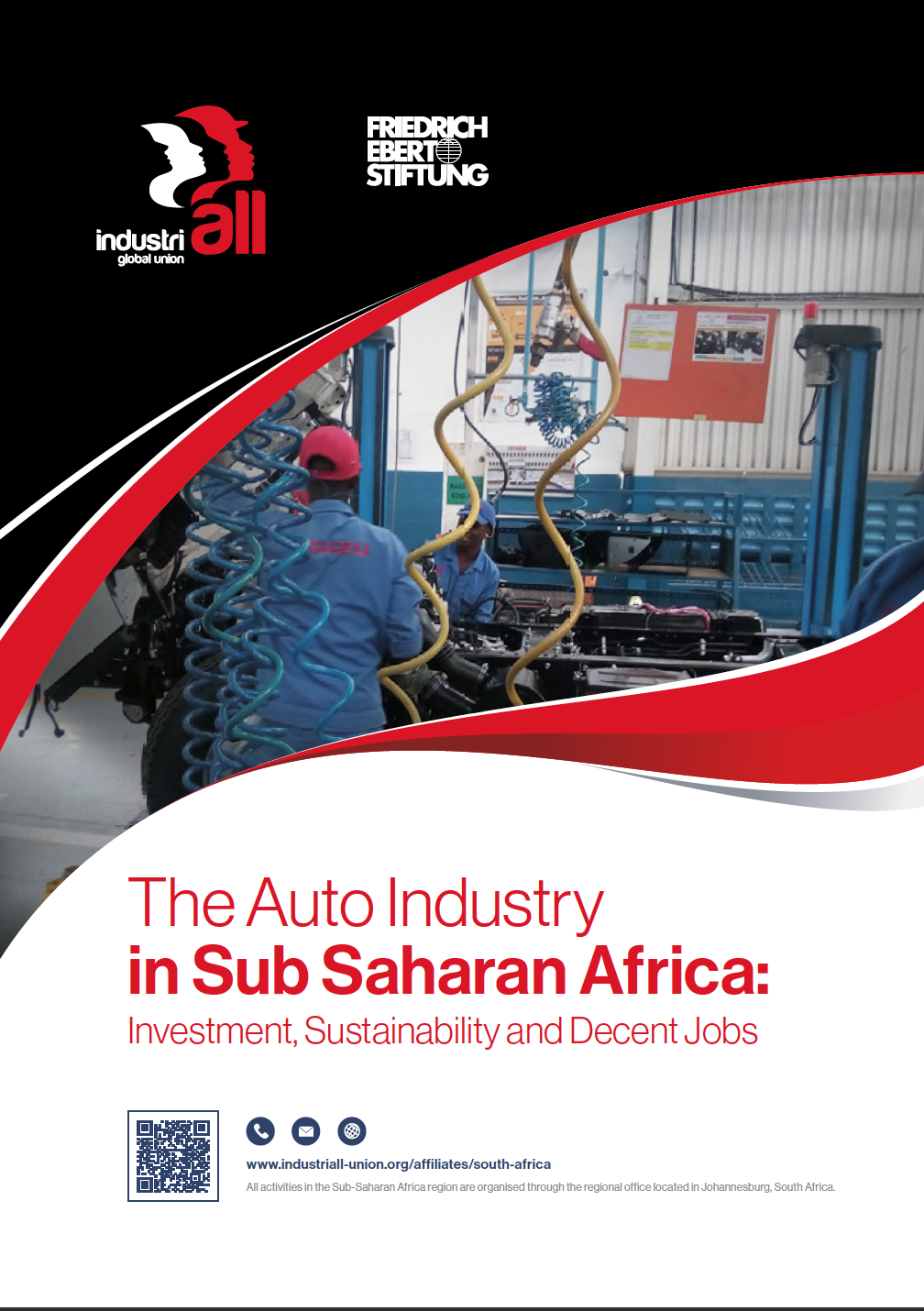
According to a research report, The auto sector in Sub Saharan Africa: Investment, sustainability and decent jobs , commissioned by IndustriALL Global Union and the Friedrich Ebert Stiftung, IndustriALL affiliates in the region who organize auto workers are well aware that proper strategies are required to turn potential new investments announced by big auto companies into new opportunities for people and societies.

REPORTPAMPHLET
The auto industry in Sub Saharan Africa: Investment, sustainability and Decent JobsWe want decent jobs! Sustainable investment in the SSA auto industry

According to the report industrial policy strategies in most African countries include the auto sector. This is particularly true for Ghana, Ethiopia, Kenya, Namibia, Nigeria, Rwanda, and South Africa. Traditional industrial policies on auto manufacturing are aimed at attracting foreign direct investment through incentives that include tax exemptions, and establishment of special economic zones. In this context, some countries have signed agreements with major global auto players that include VW, Nissan, BMW, Toyota, and others.

Some countries and entrepreneurs try to go beyond the normal pattern and invest in genuine local brands and products. Ethiopia and Rwanda are exploring the production of electric vehicles. The report emphasizes that the effectiveness of the investments depends on “triggering local development and ensuring that any economic growth will have shared local benefits, create linkages with local economic activities, and generate quality employment opportunities.”

However, the region continues to face structural issues that include poor infrastructure, massive imports of used vehicles, skills deficits, financial instability, and unreliable energy supplies. Further, the Covid-19 pandemic has delayed the implementation of most of the investment plans.

Unions interviewed in the report say they want to fight the precarious nature of the industry to ensure that there are more permanent decent jobs to reverse the current trend. For example, in Nigeria over 70 per cent of the workforce in the auto sector is employed as precarious workers on a contract basis. This is the case in most of the other countries. The unions also want the auto employers to pay living wages.

Social and tri-partite dialogue are flagged in the report as important platforms for industrial policy engagement. This opens opportunities for targeted and joint policies regarding skills, working conditions, occupational health and safety and many other important items. Moreover, the coverage of collective bargaining needs to be expanded at all levels.

Paule France Ndessomin, IndustriALL regional secretary for Sub Saharan Africa says:

“This is an important report because it brings out how unions can influence job creation in the auto sector through policy engagement. Unions can also work together in solidarity in the region to address the common issues they are facing and participate in networks to improve wages and working conditions.”

Agreement on duty free woven fabrics is a breakthrough in saving South African jobs

The 5 February notice states that there will be duty free imports for woven fabrics. SACTWU says this policy shift will promote growth in the textile and garment manufacturing sectors. Further, it will stimulate local procurement and increase the sector’s contribution to the industrialization of the country.
 
This will save jobs in an economy where unemployment is high.  According to Statistics South Africa’s 2020 4th Quarterly report unemployment is 32, 5 per cent, and as high as 42, 5 per cent if you consider the expanded unemployment rate that includes discouraged job seekers.

The notice came after four-months of negotiations with social dialogue partners including retailers, garment manufacturers and textile mills. The employers involved in the negotiations represent 75 per cent of SMMEs while SACTWU represents 90 per cent of the workers.
The negotiations took place under the Retail, Clothing, Textile, Footwear and Leather (R-CTFL) masterplan.

Andre Kriel, SACTWU general secretary says:

“The consensus reached in this industrial development agreement is unprecedented. Together, these employers and labour organizations constitute the most representative industry voice on this rebate matter. Importantly, the imported fabric can only be used by companies that are signatories to the R-CTFL Masterplan and are compliant with minimum labour standards.”

The R-CTFL masterplan, launched by the Department of Trade, Industry and Competition, aims to develop the textile and garment value chain. The value chain includes spinning, woven, dyeing, knitted, and finishing of natural and synthetic fibre inputs and leather tanning.
 
Cut-make-trim, design houses, garment, and household textile manufacturers, as well as leather and shoe manufacturers are also part of the value chain. Locally sourced and imported products are also included while retail deals with domestic and international markets.

The social dialogue partners that took part in the negotiations are the National Clothing Retail Federation (NCRF) representing garment retailers, Apparel and Textile Association of South Africa (ATASA), the South African Apparel Association (SAAA), and Apparel Manufacturers of South Africa (AMSA) representing garment manufacturers, and the Textile Federation (Texfed) representing textile mills.

Paule France Ndessomin, IndustriALL regional secretary for Sub Saharan Africa says:

“We commend SACTWU for consistently fighting for agreements that are beneficial to workers. The garment and textile sector value chain is key to South Africa’s industrialization and the creation of decent jobs.”

The social dialogue partners presented the plan to government in September 2020. SACTWU says the breakthrough is long overdue after four decades of discussions.

Photo credit: ©EIF/Simon Hess, Flickr

Three workers die under collapsing stack at ArcelorMittal South Africa

NUMSA reports that a rescue operation was carried out mainly by workers to retrieve the bodies of the deceased workers from the rubble as the company efforts were slow and inefficient. According to ArcelorMittal, a 90-metre-tall stack made of brick and stone over the coke oven collapsed and the rubble buried a monitoring booth with the three workers inside.

Kabelo Ramokhathali, NUMSA regional secretary for Sedibeng says:

“This is a terrible and devastating incident, especially for the families of the victims. They have waited and anxiously hoped that their loved ones could be found alive. Unfortunately, that was not to be. We send our deepest condolences to the family and friends of those who have passed away. NUMSA is calling on the Department of Employment and Labour to embark on a detailed and thorough investigation into the cause of this incident.”

NUMSA says ArcelorMittal has been “brutal” in the way it dealt with health and safety concerns raised by the union resulting in the dismissal of a shop steward who exposed poor health and safety protocols at the company prior to this accident.

Matthias Hartwich, director for the base metals sector of IndustriALL says:

“ArcelorMittal has promised that there will be a thorough investigation of the case, and that NUMSA will be invited to take part in the investigations.”

The sister unions forming the ArcelorMittal global union network provided their immediate solidarity. For example, in a solidarity letter Paulo Cayres and Maicon Michel, president and director of the International Affairs of the CNM-CUT of Brazil say:

“If the absence of an intervention team in charge of the company is confirmed, it is be a profoundly serious and intolerable event. We believe it is essential to establish the causes and responsibilities so that accidents like this do not have to happen again.”

Paule France Ndessomin, IndustriALL regional secretary for Sub Saharan Africa says:

“We have received the sad news of the deaths with a great shock and disbelief, and immediately joined the families of the deceased workers in mourning. The health and safety of workers should remain a priority and it is important to have emergency response teams on standby and always ready when such incidents happen. We expect the investigation will shad a light to what happened.”