Covid-19 vaccination hesitancy comes under the spotlight at Sub Saharan Africa occupational health and safety meeting

However, the unions say the hesitancy can be reversed through awareness campaigns and providing educational information to counter false information mainly from social media platforms. According to the African Union’s African Centres for Diseases Control and Prevention only 5.8 per cent of the continent’s population is vaccinated.

The unions met online on 10 November to discuss health and safety strategies under the Covid-19 pandemic. The discussions included tensions created by vaccine hesitancy which could be eased if government involved unions in their national vaccination plans.

The online meeting, attended by participants from 10 countries organizing in the chemical, metals, mining, textile, and garment, and other sectors discussed how unions were involved in campaigns for vaccination and the respect for workers’ rights.

The unions said mandatory vaccination as proposed by some governments infringed on workers’ rights to choose. Instead, the unions preferred engagement that persuaded workers to get vaccinated. Drawing similarities with the earlier days of the HIV and AIDS pandemic in which there was stigma associated with testing, the unions said lessons could be learnt from the strategies that were used then.

The meeting heard that some unions were conducting initiatives to improve health and safety. Rudi De Koker from the Southern African Clothing and Textile Workers Union (SACTWU) said the union with support from employers continued to provide affordable primary health care services to members through its clinics. The South African national department of health has recognised the clinics as part of the Covid-19 vaccination sites and as pilot projects for the national health insurance.

Another strategy that is working to cub hesitancy involve joint efforts by employers and trade unions. For example, Vacus Kun from United Workers Union of Liberia (UWUL) said the union is working with ArcelorMittal in Liberia to promote vaccination, and over 80 per cent of the workers have been vaccinated.

Further, the unions said most International Labour Organization need to have their accompanying codes of practices update to keep up with developments.

“We have conventions that are outdated, yet so much has changed. We need conventions that address our current realities and challenges including the Covid-19 pandemic,”

said Ousman Diop from SNTICS Senegal.

Convention 190 on violence and harassment, which unions want ratified, was highlighted as valuable to curbing gender-based violence and harassment and to improving safety at work.

Health and safety remained at the core of trade union work argued the unions saying members joined the union for safer workplaces through collective bargaining agreements.

Most countries, including Nigeria and Zimbabwe, had laws and regulations that promoted health and safety. However, the Zimbabwe Diamond and Allied Minerals Workers Union (ZDAMWU) said health and safety in the mines is deteriorating with increasing injuries and deaths from accidents caused by non-compliance by mining companies.

“Occupational health and safety cuts across most of the trade union’s activities and is a useful tool for advancing workers’ rights, building union power, and ending precarious working conditions. Due diligence is also about health and safety,”

said Glen Mpufane, IndustriALL director for mining.
Unions uneasy over South African Just Transition finance deal announced at COP26

However, they say that the multilateral Just Energy Transition partnership agreement announced by United States' President Joe Biden at COP26 on 2 November, lacks details on how the energy transition will happen. The partnership worth US$8.5 billion aims to assist South African plans to close coal mines earlier and move to renewable energy sources.

The partnership, which will provide funds for the energy transition from carbon intensive coal to low carbon renewable energy sources that include solar and wind, was signed by the governments of South Africa and France, Germany, United Kingdom, US, and the European Union. It will be implemented over three to five years. The agreement is the first of its kind and a possible model for other developing countries.

South African president Cyril Ramaphosa described the partnership, which is made up of concessional finance, as a “watershed moment” that will increase the country’s energy security by “creating jobs and harnessing new opportunities for investment, with support from developed economies.”
 
“Climate change is an existential challenge that confronts us all and South Africa is committed to playing its part in reducing global emissions” he said, adding that there will be investments in electrical vehicle manufacturing and green hydrogen.

According to the government, the agreement will benefit coal miners and communities. Unions say over 100,000 coal miners will lose jobs. Another 100,000 people in the communities, who make a living from the coal value chain, will need compensation when the mines are closed. Studies estimate that the just transition cost for coal mineworkers will include compensation, retraining, relocation and rehabilitation of communities and other costs related to regional economic development.

The partnership is also expected to provide funds to power utility Eskom for the decommissioning of coal-fired power stations that are concentrated in the Mpumalanga Province. South Africa is the world’s 12th highest polluter and the highest in Africa.

Irvin Jim, NUMSA general secretary says:

“We are concerned that this announcement will accelerate a rush to close coal fired power stations before a viable solution for a consistent energy supply is found. Currently renewable energy cannot meet the needs of industry. If there is to be a transition, the government must deliver a social plan to develop provinces and regions that will be affected, with specific pathways on how to replace jobs and industries.”


“While funding the transition is key, the process followed is more important to the union. The union needs assurance that workers and working-class communities will not be negatively affected. Presently, it is not clear what this money will be used for, under what conditions it will be accessed, and if a significant part of it will be used to protect workers and communities. The unions remain uneasy about the deal,”

says William Mabapa, National Union of Mineworkers (NUM) acting general secretary.

The country’s energy transition policies include the nationally determined contributions (NDCs) that are part of the Paris Agreement. Additionally, the Integrated Resource Plan (2019-2030) outlines how coal will be replaced by renewable energy and gas sources.

Diana Junquera Curiel, the IndustriALL director for the energy industry says:

“This is an important partnership because climate change mitigation needs global cooperation especially between the developed and developing countries. Further, the South African government must further engage with trade unions and negotiate with them to protect the interests of the workers and communities. This can be done through a detailed Just Transition plan which stipulates on fair compensation, training and other benefits for workers, and communities.”

South African mine workers union commits to recruitment and better service to members

The conference was attended by over 400 delegates and the issues discussed included strategic organizing and improving services to members, including representation in conciliation and mediation, union engagement on mining policies, the mining charter, energy policies, cement manufacturing, gender-based violence and harassment, and updates on processes to adopt International Labour Organization Convention 190. Health and safety and Covid-19 vaccination were the other issues discussed. There were calls to include more women and young workers in the union’s activities and decision making.

On workers welfare, there were discussions on living wages through negotiating for collective bargaining agreements that maintained decent wages and working conditions that the union has organized over the years. So far, the union has signed wage agreements with 13 mining companies. There were also discussions on retirement benefits and plans to trace retired workers who have not yet claimed their pensions. The union discussed models that can be adopted to provide decent housing to the workers. Additionally, the conference debated the importance of building the capacity of the union shop steward in a changing world of work and to provide skills to counter precarious work through union organizing.

The conference heard that mining continued to contribute to the country’s GDP and that it is amongst the sectors leading in the economic recovery from the Covid-19 pandemic. Most NUM members are from the mining sector including gold, platinum, coal, and other metals. The union is against the mothballing of mines, which has led to tens of thousands job losses resulting in the union losing members.

The union said it is opposed to the privatization of the public power utility, Eskom. Instead, it favours the involvement of the state-owned enterprise in the renewable energy sector currently dominated by independent power producers and the protection of jobs.

On the Just Transition, one of the most discussed topics at the conference, William Mabapa, NUM acting general secretary said:

“The debate on the abandoning of coal and moving to renewable energy without considering the interests of the coal mineworkers and power station workers is dangerous. Abruptly stopping coal mining will destroy the economy of the Mpumalanga province which is dependent on the fossil fuel. In that sense, navigating the energy transition is important for miners and communities. Further, we must secure the energy supply before moving to renewables and therefore need an energy mix policy that includes nuclear.”

Paule France Ndessomin, IndustriALL regional secretary for Sub Saharan Africa says:

“Trade unions, like most organization go through a life cycle. As it approaches its 40th anniversary, the NUM is maturing as a strong union and the discussions that took place at the policy conference reflect this. It is strategic that the NUM is discussing the future of work and redefining its role as a trade union in the current digital age.”

Union wins as strike action ends in three-year wage agreement

IndustriALL affiliate NUMSAsigned the agreement with the Steel and Engineering Industries Federation of Southern Africa (SEIFSA), which represents most of the employers in the sector.

The union wants the agreement to be extended to other employer organizations that include South African Engineering and Founders Association (SAEFA) and National Employment Association of South Africa (NEASA) who the union says are “anti-worker and union bashers.” NUMSA wants these employer associations to sign the agreement and not be “free riders” who implement the wage deal without being party to the agreement. The union says all workers in the industry should benefit from the wage agreement.

On 25 October, Macsteel, a large steel manufacturing company, heeded the call by NUMSA and became one of the first employers from SAEFA to sign the agreement.

The strike began when wage negotiations were deadlocked with the union demanding eight per cent and rejecting the initial employers offer of 4.4 per cent. The union argued that workers sacrificed for the survival of the industries when they agreed to no wage increases in 2020 to mitigate the impact of Covid-19 on the sector.
 
Irvin Jim, NUMSA general secretary says:

“We have taken a conscious decision that as a union we will compromise and accept the current offer from SEIFSA of six per cent on minimums for the sole purpose of settling the current strike in the best interest of our members. It is NUMSA members who have paid a heavy price during the strike, and it is in their interest that the union does everything possible to ensure that we resolve the strike as soon as possible, as each day on a strike is a sacrifice – according to the no-work-no-pay rule. The agreement further safeguards the industry rates of pay and workers will receive their backdated pay from 1 July, 2021.”

Paule France Ndessomin, IndustriALL regional secretary for Sub Saharan Africa says:

“We applaud NUMSA on its tough negotiating strategy which resulted in this wage deal that is crucial as it will maintain living wages in the engineering and metals sector for the next three years.”

Unions fear job losses if AGOA eligibility is withdrawn from Ethiopia

AGOA, which gives special access to US markets for 6,500 products from Sub-Saharan African countries is set to expire in 2025. These products include textiles and garments, motor vehicles and parts, leather products, chemicals, machinery and equipment, agricultural products, and other goods.

Under AGOA, Ethiopian exports to the US increased from US$29 million in 2000 to US$525 million in 2020. However, the balance of trade still favours the US whose exports to Ethiopia increased from US$165 million to US$868 million in the same period.

Garment manufacturing is the largest beneficiary under AGOA and over 80 per cent of workers in the sector are young women.

In an online meeting with Ethiopia’s trade negotiator, Mamo Mihretu, the United States trade representative ambassador Katherine Tai, “raised the ongoing violations of internationally recognised human rights amid the ongoing conflict in Northern Ethiopia, which could affect Ethiopia’s future AGOA eligibility if unaddressed”.
 
Angesom Gebre Yohannes, president of IndustriALL affilaite, the Industrial Federation of Textile Leather and Garment Workers Trade Union (IFTLGWTU) says:

“If AGOA benefits stop, workers will be badly affected. Factories, which includes the PVH factory in Hawassa Industrial Park that exports primarily to the US, will be forced to close and workers will lose their jobs. This is not in the interests of the union. Workers at PVH are anxious about their future and expressed worry when they got the news on AGOA.”

The PVH factory is the largest in the industrial park and recently the IFTLGWTU has been on a recruitment and organizing drive after a breakthrough following years in which unions were not allowed to recruit in the park. Other factory owners are from Europe and Asia and brands that include Children’s Place and Levi Strauss & Co. source from the park.
 
In a letter to the ambassador, Kassahun Follo, president of the Confederation of Ethiopian Trade Unions (CETU) to which IFTLGWTU is also affiliated, wrote:

“As a progressive trade union organization committed to human rights, peaceful resolution of differences and respect for universal democratic values, our confederation condemns in no uncertain terms human rights violations all over Ethiopia, and the perpetrators of the violations. We also recognize the importance of AGOA eligibility requirements on the protection of internationally recognised workers’ rights. Our confederation, however, firmly believes that removing Ethiopia from the AGOA eligibility list at this time will make things worse for Ethiopian workers and their families.”

Follo states in the letter that the textile, garment, shoe, and leather sector, has created over 200,000 direct jobs and over a million indirect jobs which are now at risk. Ethiopia’s industrial policies have prioritised export-based manufacturing which is seen as having potential to create jobs for hundreds of thousands of young workers.

Atle Høie, IndustriALL general secretary says:

“Trade union rights violations have to end. Withdrawing AGOA now will put in jeopardy the work we have done with our Ethiopian affiliates over the last years, but the threat is also a very clear warning to Ethiopian authorities that they have little time to secure fundamental trade union rights.”

Unions campaign for recognition at Chinese-owned textile and garment factories in Uganda

The factory owners refuse to sign recognition agreements for purposes of collective bargaining as required by the law when a union organizes more than 50 per cent of workers in a factory. According to the IndustriALL Global Union National Coordinating Council of Uganda (INCCU), made up of IndustriALL affiliates in the country, the factories, which include Bode, Euro Vision, Fine Spinners, Jinguo, Sunbelt Textile Company, Tonyong, Unistar, and Wilima are ignoring letters from the Ministry of Gender, Labour, and Social Development instructing them to recognize UTGLAWU.

To push for recognition, the unions are conducting joint campaigns under the East Africa Union Building Project which is supported by the Danish Trade Union Development Agency (DTDA) and the Norwegian Society of Graduate Technical and Scientific Professionals (TEKNA). The unions met with the labour ministry on 30 September to demand that the government enforces the labour regulations and for the Industrial Court to speed up the cases. Further, they are planning to meet with the Minister of State for Labour, Charles Okello Engola.

“We appreciate government efforts in coming out boldly to order the employers to recognize the union. Despite the challenges of Covid-19, the number of employers retrenching workers without informing the Ministry of Labour is increasing, yet they are getting stimulus packages from the government. Other employers are frustrating union efforts to collect dues from its members.

“However, we are calling upon the government to organize a meeting with non-complying Chinese employers – some of whom claim not to understand English – to give them a chance to respond to our demands before we take court action. The employers must respect the union, and the fundamental and constitutional rights of the workers,” wrote the unions in a statement.

Paule France Ndessomin, IndustriALL regional secretary for Sub Saharan Africa says:

“Textile and garment factory owners in Uganda must recognize national and international labour standards by recognizing the union, and we support the campaign by Ugandan unions for the respect of trade union and workers’ rights.”

Unions that are participating in the campaign in support of UTGLAWU are the Uganda Printers, Paper, Polyfibre, and Allied Workers Union (UPPAWU), Uganda Chemical, Petroleum, and Allied Workers Union (UCPAWU), National Union of Clerical Commercial Professional and Technical Employees (NUCCPTE), and Uganda Hotel, Tourism, Supermarket and Allied Workers Union (HTS-U).

Currently the garment industry is dominated by small to medium scale enterprises. According to the country’s National Development Plan III, Uganda aims to increase cotton production, domestic value addition, and to create over 50,000 new jobs along the cotton to clothes value chain.

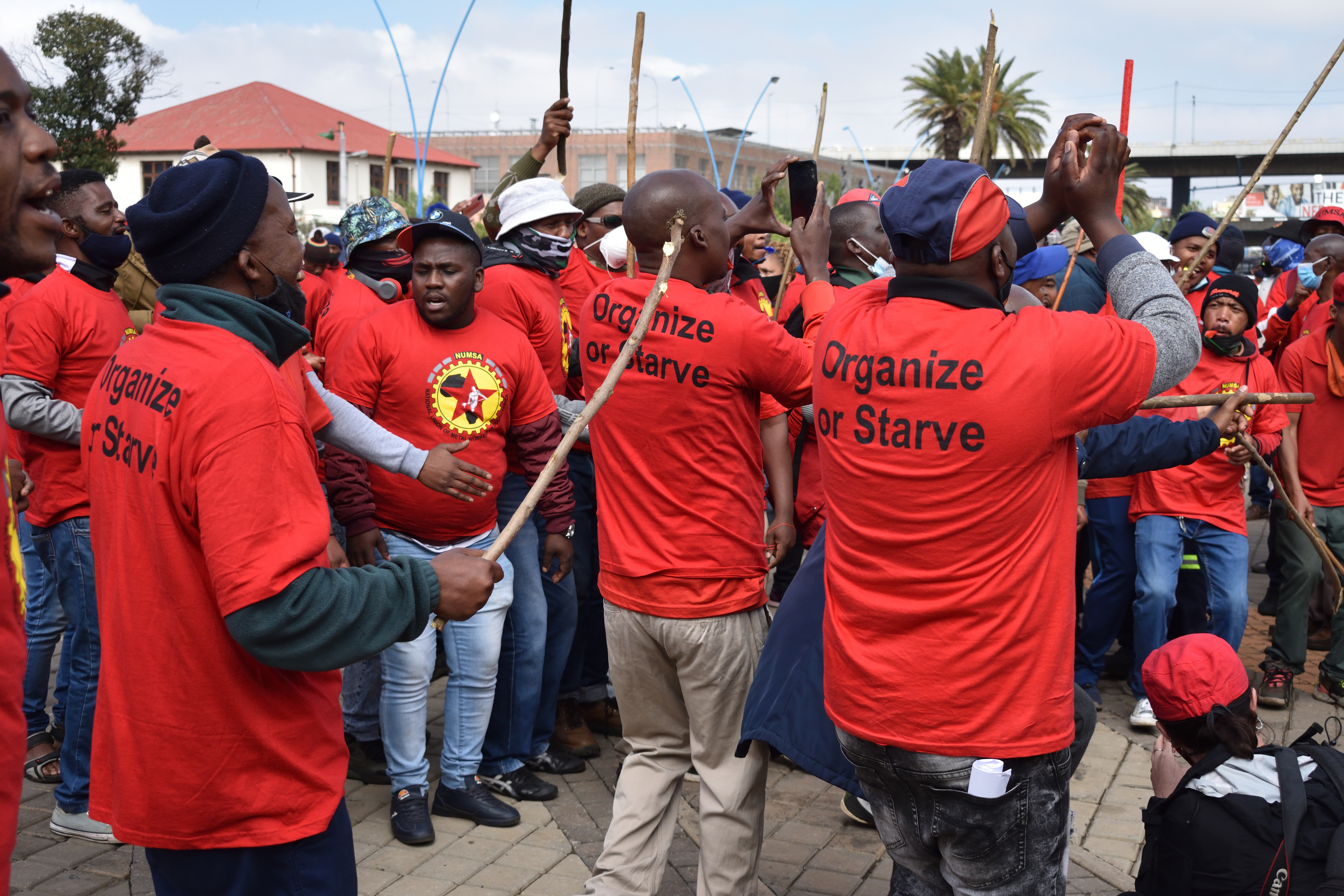
South African engineering workers on strike for living wages after failed negotiations

In Johannesburg, the workers marched to the Metal Engineering and Industries Bargaining Council (MEIBC) offices where they presented a petition of their demands. Employers represented in the MEIBC include the National Employers Association of South Africa (NEASA), Steel and Engineering Industries Federation of Southern Africa (SEIFSA), and the South Africa Engineers and Founders Association (SAEFA).

Bargaining councils are part of South Africa’s industrial relations system and their responsibilities include resolving disputes and facilitating collective bargaining agreements between trade unions and employers.

The workers went on the indefinite strike after negotiations failed to award them a wage increase of 8 per cent that they are demanding. Instead, the employers offered 4.4 per cent which IndustriALL Global Union affiliate, the National Union of Metalworkers of South Africa (NUMSA) says is an “insult” to the workers. Initially, NUMSA wanted a 15 per cent wage increase.


“The employers cannot offer us 4.4 per cent when last year we got nothing because of the Covid-19 pandemic. Workers lost jobs through retrenchments, and others were put on short time work in which they lost income as they were paid less than their regular wages. Hence, we are firmly behind our union in the demands for higher wage increases,” argues one of the strikers.

Irvin Jim, NUMSA general secretary says:

“We are on an indefinite strike until our demands are met. We will not allow the super exploitation of labour in the engineering sector to continue unchallenged. The decision to strike was arrived at after the failure of protracted negotiations in which employers tabled a pitiful offer, thus frustrating the workers."

“Through this strike action we are demanding living wages for the engineering workers. This is the time for unity in action. We are not going to beg for living wages; we are demanding them,”

reiterated Andrew Chirwa, NUMSA president.

“Workers in the engineering sector made significant contributions to keep the industry afloat during Covid-19, enduring wage cuts and short working hours. Sanity must prevail upon employers to improve on their current offer,”

says Mawonga Madolo, metals sector coordinator, from another IndustriALL affiliated union, the National Union of Mineworkers (NUM), in a solidarity message for the strike.

“Covid-19 has caused retrenchments and created precarious working conditions which impoverished workers in the engineering and metal sectors. With workers facing these hardships, employers must be sensitive to their plight and ensure that the workers do not further lose the value of their wages. The employers must pay wage increases towards living wages,”

says Paule France Ndessomin, IndustriALL regional secretary for Sub Saharan Africa.

NUMSA is arguing that with workers being part of economic recovery, they deserve to be paid living wages. With the South African Covid-19 lockdown regulations being eased to Alert level 1 which has the least restrictions for industrial activities, the economy is expected to start recovering after an annual growth rate of 4.6 per cent in the first quarter which further increased in the second quarter according to Statistics South Africa.

The country is following global trends in which the recovery in the sectors has been far stronger and faster than expected at the beginning of the pandemic. Additionally, high global commodity prices of metals that include platinum, gold and iron ore are also contributing to the economic recovery.

IndustriALL 3rd Congress calls for an end to violence in Eswatini

There have been national pro-democracy demonstrations in the country and a Global Day of Action organized by global unions in support of the trade unions of Eswatini took place on 6 August.

During the demonstrations, over 72 people were killed through excessive use of force by the police and the army against pro-democracy protesters and hundreds were injured while some are still missing. Some activists have gone into hiding and others fled into exile.

It is against this background that the IndustriALL 3rd Congress, 14-15 September, adopted a resolution for the democratization of Eswatini that includes the respect for the right to life, freedoms of association, assembly, and expression.

Irvin Jim of South African union Numsa introduces the resolution on eSwatini

Irvin Jim of South African union Numsa introduces the resolution on eSwatini

“We call for national dialogue for reforms that will allow for the democratic election of the Prime Minister and to review the country’s constitution to allow for the transfer of executive powers from the king to a democratically elected leadership”

reads one of the demands the resolutions.

Atle Høie, IndustriALL general secretary, has written a letter to the Eswatini Prime Minister, Cleopas Dlamini, urging him to act on ending

“gross human rights violations and the use of excessive and lethal force against protesters.” Another letter to the Office of the High Commissioner for Human Rights (OHCHR) requests for “a thorough investigation into the death of civilians and the fate of the missing and recommend that the Human Rights Council consider this matter urgently.”

According to a petition to the United Nations office in Mbabane delivered by unions and civil society organizations, the UN must intervene for “an all-inclusive dialogue, unbanning of political parties, transitional council, democratic constitution, and multiparty democracy.” The UN must also “force the king to dialogue with the people rather than killing them.” Further, petitioners want King Mswati III to be tried at the International Criminal Court for “the ruthless killing of unarmed civilians.”

IndustriALL affiliates in Eswatini, the Amalgamated Trade Union of Swaziland (ATUSWA) and Swaziland Electricity Supply, Maintenance and Allied Workers Union (SESMAWU) took part in the march to present the petition.

“As Eswatini workers we appreciate the support that we are receiving globally for our demands for democratic reforms. International workers solidarity in the fight to remove the undemocratic regime that is causing abject poverty in our country is important to the struggle. We appreciate the support from our sister affiliates in IndustriALL. Injustice anywhere is a threat to justice everywhere,”

says Wander Mkhonza, general secretary of ATUSWA.

The petitioners say over 65 per cent of the country’s population is living in poverty on less than US$1.25 per day. “Poverty has been worsened by the dispossession of the people’s livelihoods by the king who evicts people from their lands, properties and businesses. The country is experiencing untold poverty because of the misappropriation of national resources to finance the lavish lifestyles of the royalty.”

Eswatini is Africa’s last absolute monarchy and King Mswati lives an extravagant lifestyle of expensive cars and private jets for his family of 15 wives. He banned the photographing of his cars after a public outcry. The king’s net worth is over $200 million, and he controls Tibiyo Taka Ngwane an investment company worth over $140 million supposedly in trust for the people of Eswatini.

Zimbabwean union confronts Afrochine Smelting over workers’ rights violations

According to a shop steward who works at Afrochine, over 1,500 workers are employed at the ferro chrome plant which is about 75 km from Harare.

“We are working in fear with no job security and being humiliated every day. You are beaten up by supervisors who are Chinese nationals, and if you report to the police, you will be unfairly dismissed before the conclusion of the case. With fewer jobs available in Zimbabwe, workers are suffering in silence. We are supporting the call for strike action against Afrochine to stop the workers’ rights violations,”

says the shop steward who witnessed some of the beatings.

Conciliation efforts at the National Employment Council of the ferro alloy industry – a social dialogue platform – failed as the ferro chrome smelting company did not show up at a meeting on 22 September. In the absence of dialogue, the union says it will take the grievances to the courts.
 
Henry Tarumbira general secretary of NUMAIZ says:

“The union will not stand by and watch while its members are abused. We are fighting to stop the unfair retrenchments and harassment and will take necessary action as provided by the labour laws to demonstrate against the violations as well as go to the courts to stop the abuses. Workers are continuously exposed to poor working conditions while health and safety standards are ignored. There is also wage theft and under payment of wages. IndustriALL affiliates in the country will be mobilized and are expected to join the strike and other actions in solidarity with the workers at Afrochine.”

Paule France Ndessomin, IndustriALL regional secretary for Sub Saharan Africa, says:

“The management at Afrochine must respect workers dignity, national labour laws and international labour standards. We commend NUMAIZ for standing up for workers’ rights and decent working conditions.”

Afrochine is a subsidiary of the world’s biggest stainless steel product manufacturers Tsingshan Holding Group which trades on the London Metals Exchange. China is the largest importer of chromium and other metals which are key raw materials for its steel industries, and some of the chrome is mined in Zimbabwe which produced over 300,000 tonnes in the first quarter of this year.

Three Zimbabwean textile, garment, shoe, and leather unions merge

The three unions that merged – the National Union of the Clothing Industry (NUCI), the Zimbabwe Leather, Shoe and Allied Workers Union (ZLSAWU), and the Zimbabwe Textile Workers’ Union (ZTWU) – agreed to work collectively in strengthening recruitment and organizing towards building a stronger union. As part of its plans to be inclusive, the CLTWF also formed youth and women committees during the launch.
 
However, the CLTWF is confronted by many of the challenges that the sector is facing globally. Further, in Zimbabwe the challenges are worsened by an economic crisis that has seen factories close and workers retrenched while wage theft is spreading.
 
The working conditions in the sector are precarious. In some instances, working days have been reduced and wages are low with some workers saying they earn $8 000 Zimbabwe Dollars (US$94 on the official rate and US$57 on the parallel market). The Consumer Council of Zimbabwe says a family of six needs over $40 000 Zimbabwe Dollars per month, and this means the current wages are not enough for workers to pay for their basic needs.
 
According to reports, the decline in manufacturing industries caused by the country’s deindustrialization, weakened the cotton-to-clothes value chain and leather and shoe manufacturing. Further, the unstable local currency, foreign currency shortages, high inflation, and huge imports of second-hand and cheap clothing is adversely affecting the sector. Economic policies are also failing to revive the textile and garment industries.
 
Joseph Tanyanyiwa, the newly elected general secretary of CLTWF says:

“Although the merger is long overdue, it is an opportunity to plan collectively and shape the future of our sectors by fighting for workers’ rights, living wages, and organizing more members. We would also like to thank IndustriALL, national affiliates, and unions in Sub Saharan Africa for supporting the merger and for giving us support in developing our five-year strategic plan.”

“We welcome the merger as it brings unity and strength to the union. This is important in building union power in the textile, garment, shoe and leather sectors in Zimbabwe considering the challenges that have been brought by the Covid-19 pandemic and the economic crisis,”

says Paule France Ndessomin, IndustriALL regional secretary for Sub Saharan Africa.