Union calls for ratification of ILO Convention 176 after explosion kills 13 and destroys Ghana village

Some houses were flattened whilst others were severely damaged by the blast. The Minerals Commission of Ghana is carrying out an investigation into the explosion and the mining licence of explosives manufacturer, Maxim Ghana, has been suspended together with its sub-contractor who was transporting the explosives.

Chirano Gold Mines is run by Canadian-based Kinross Gold Corporation.
 
According to reports, the explosives should have been transported with police escort, which was not the case. The government of Ghana and other organizations have since launched relief efforts to support the community.
 
The Ghana Mine Workers Union (GMWU), affiliated to IndustriALL Global Union, says this explosives’ disaster could have been averted if health and safety protocols were followed.

The union further emphasizes that this is an opportune time for the government of Ghana to ratify the International Labour Organization Convention 176 on safety and health in the mines, and to domesticate it into national laws as one of the strategies to stop similar accidents from happening in the future.
 
Abdul-Moomin Gbana, GMWU general secretary, says:

“The union commiserates with the entire Appiatse community some of whom are our members and their families for the loss and wish to assure them of our fullest support in these very troubling times.

“Mining communities need to be assured that mining and related activities will not endanger lives and livelihoods. The surest way to do that is to focus more on the preventive side by educating the citizenry, ensuring strict enforcement and compliance with safety standards, and punishing transgressors frontally.”

Paule France Ndessomin, IndustriALL regional secretary for Sub Saharan Africa, says:

“It is horrific that so many lives were lost due to negligence and failure to adhere to health and safety measures. We will support the GMWU in their campaign for the ratification of C176, and in carrying out health and safety awareness among workers and communities.”

Three Holcim workers killed and 8 injured in fire in Uganda

According to Building and Woodworkers International (BWI), the Hima plant has long been known for its hostile attitude towards workers. A BWI report on the January incident says that five years ago, more than 300 workers organized a trade union at the plant. In November 2020, Hima Cement retrenched 28 workers and half of them were union members. A year ago, half of the remaining members of the local trade union in the plant were dismissed.
 
Today, the plant operates with only 135 directly employed workers, the rest are subcontracted or third-party workers.

“IndustriALL expresses condolences to the families of the perished workers and joins BWI in calling on Hima Cement to engage in constructive dialogue with unions, stop union-busting  and end the abuse of subcontracted and third-party workers,”

says IndustriALL general secretary Atle Høie.  
 
The tragedy in Uganda is yet another one at Holcim operations. IndustriALL is working closely with BWI in the cement industry, and combined reports on accidents in Holcim over the last years paint a very disturbing picture. All efforts to engage in a meaningful social dialogue with Holcim, which would contribute to safer operations, have so far been in vain.
 
In India in November 2021, one worker was killed and five other injured at the Marwar cement plant and another worker was seriously injured at the Maratha Cement Works. Both plants are owned by a Holcim subsidiary, Ambuja cement.
 
And in the month before, two fatalities occurred in the space of one week at two separate ACC cement plants in India. ACC is owned by Holcim.
 
Atle Høie concludes:

“Holcim’s abusive subcontracting policies depriving workers of their right to regular and secure jobs must stop. The company must resume bipartite safety committee meetings in all operations and strengthen the inspection and monitoring system.”


South African union condemns brutal murder of woman worker

The NUM, affiliated to IndustriALL Global Union, condemns the brutal murder which it describes as femicide. According to the union, her car’s tyres were slashed with a knife by the spouse at a shopping mall slowing down her escape. As she sought help at a nearby garage, the spouse followed and killed her. The alleged killer is charged with murder and is out on bail following a court appearance.

“Her two young sons are traumatised and going through a difficult time after the tragic loss of their beloved mother. The NUM conveys its deepest condolences to the family of comrade Jessica, colleagues, and friends. We remember her as a bubbly, loving and caring person,”

says Kay Pholoba, NUM regional secretary for Highveld.

“This is a tremendous loss to the NUM. Painfully so as it happened in the hands of a person who claims to have loved and cared for her. We are inundated with stories of women and children falling victim to the high levels of femicide in the country. The NUM calls upon gender formations to unite and take action to end these gruesome and senseless killings,"

she adds.

Christine Olivier, IndustriALL assistant general secretary says:

“As an organization, we reiterate the message that we will never tolerate gender-based violence and harassment (GBVH) and will continue to support campaigns that seeks to outroot GBVH. ”

Research by IndustriALL that included the mining and textile, garment, shoe, and leather sectors, concluded that domestic violence is a prevalent issue for women workers in these sectors. It has a negative impact on women’s participation at work, especially on safety issues.
 
IndustriALL, with support from Friedrich Ebert Stiftung, organized a series of online workshops in 2021 to build union capacity on curbing GBHV in the world of work, using International Labour Organization Convention 190 as one of the tools. During the training, domestic violence was singled out as a daily threat to women workers’ lives and that unions must work with civil society organizations and other stakeholders to curb it.

IndustriALL has put together guidelines for trade unions on how to respond to domestic violence impacts in the world of work.
 
The training was attended by over 40 shop stewards in the mining and textile and garment sectors from South Africa and other Sub Saharan African countries and will be extended to other sectors this year. The shop stewards are also expected to carry out further training as “multipliers” of the skills and strategies to stop GBVH in their unions and countries.
 
South Africa ratified Convention 190 to end violence and harassment in the world of work in 2021. However, unions say the implementation of the convention and other national laws is urgently needed to eliminate the scourge of domestic violence and GBVH.

Organizing in Ghana’s growing automotive sector moves into fast gear

This year Toyota and Volkswagen plants were commissioned with the latter expected to produce up to 20,000 vehicles per year.

The union has organized 1982 workers in the auto companies including those that sell components and parts. Only 154 of the workers are women, and the union is calling on the auto industry to have gender equity in their recruitment policies.

The ICU says it will ensure that the workers in the sector are paid living wages and wants the companies to be involved in collective bargaining and social dialogue, and to adhere to better health and safety standards including Covid-19 protocols. Additionally, the union wants the companies to invest in automation that will upskill Ghanaian workers. The union is also part of the VW Network which includes unions from Kenya, Namibia and South Africa and the VW European Works Council. The aims of the network include promoting decent work for VW workers.

Morgan Ayawine, ICU general secretary says:

“Importantly, at VW Ghana we have a collective agreement, and the earnings are above the minimum wages. Members have access to all the statutory benefits as specified in the labour laws including social security. Further, ICU has been able to negotiate additional benefits for the workers such as free or subsidized medical care among other benefits.“

According to the National Tripartite Committee minimum wages in Ghana for 2021 are 12.53 Cedis per day or 301 Cedis monthly (US$49). However, the Anker Research Institute estimate living wages for a family of two adults and two children to be about US$250.

The growth of the automotive sector is supported by government policies that include the Industrial Development Programme which aims to attract major automobile manufacturing companies to the country. The policy also seeks to create highly skilled jobs in auto assembly and the manufacturing of components and parts.

The signing of the African Continental Free Trade Area (AfCFTA) is also seen as bringing benefits to the automotive industry in Ghana that include exporting locally assembled vehicles to neighbouring countries at reduced tariffs. The automotive industry in Sub Saharan Africa (SSA) and some African governments, including Ghana, are exploring possibilities of setting up automotive manufacturing hubs under the AfCFTA.
 
Further, the Ghana Automotive Development Policy (GADP) gives 5 and 10-years tax holidays for the importing semi-knocked down (SKD) and complete knock down (CKD) kits, respectively. Imports of material and equipment to build the plants are also exempted from duties and other charges.

“Growth of the automotive sector in Ghana is creating much-needed jobs in the country and the ICU should increase its organizing efforts in the growing sector. Recruiting more members and attaining majority thresholds at the workplaces will enable the union to be better positioned in demanding decent working conditions and advancing workers’ rights in the sector,”

says Paule France Ndessomin, IndustriALL regional secretary for SSA.
 
ICU, which has a membership of 140 000 workers, organizes in sectors that include the automotive, metal, paper, printing, and textiles, garments, shoe, and leather and the informal sector.

South African union and communities march against privatization of Eskom

According to government announcements there are plans to split Eskom into generation, transmission, and distribution units to improve the availability of electricity and end frequent power cuts caused by increasing demand and ageing infrastructure among other factors.

During the march, the National Union of Mineworkers (NUM) which is affiliated to IndustriALL Global Union, presented a list of demands to the Eskom management. These included stopping the unbundling, dissolving the Eskom board and the immediate resignation of the management. The union also wants conditions of service for workers to be reinstated and for a 15 per cent wage increase to be given. Additionally, it demands that the “premature” closing of coal power stations be halted.

Further, the NUM wants the renewable energy power purchase agreements to be reviewed to include Eskom as one the power producers. Currently, renewable power production is done by independent power producers. The union says it supports an energy mix policy that protects jobs, ends poverty, and stops the “looting” of state resources through corruption. The NUM is also urging Eskom to negotiate affordable payment terms with communities in Soweto, Johannesburg, whose power supplies were disconnected.

William Mabapa, NUM acting general secretary says the union is against plans to transform the power utility into a profit-making entity.

“The NUM is against the privatization of state-owned enterprises. Our government must put the interests of the people first before those of private businesses. Eskom is a vital and strategic public utility for the South African economy’s development needs and electricity must be considered a public good.”

Paule France Ndessomin, IndustriALL regional secretary for Sub Saharan Africa says:

“Job security and preservation of benefits are crucial issues for our affiliates – the NUM and the National Union of Metalworkers of South Africa – that organize at Eskom. Additionally, the unions are demanding that community and social interests should be protected in the Just Transition to renewable energy sources. To protect these interests, we call upon the Eskom management to consult with unions and affected communities before any changes are implemented.”

An agreement signed at COP26 will see rich countries funding the decarbonization of Eskom. However, unions are concerned that this will be used as a pretext for privatization, and demand that the parties stick to the Just Transition Declaration.

PROFILE: Divided we beg, united we bargain, says Eswatini union

UNION PROFILE

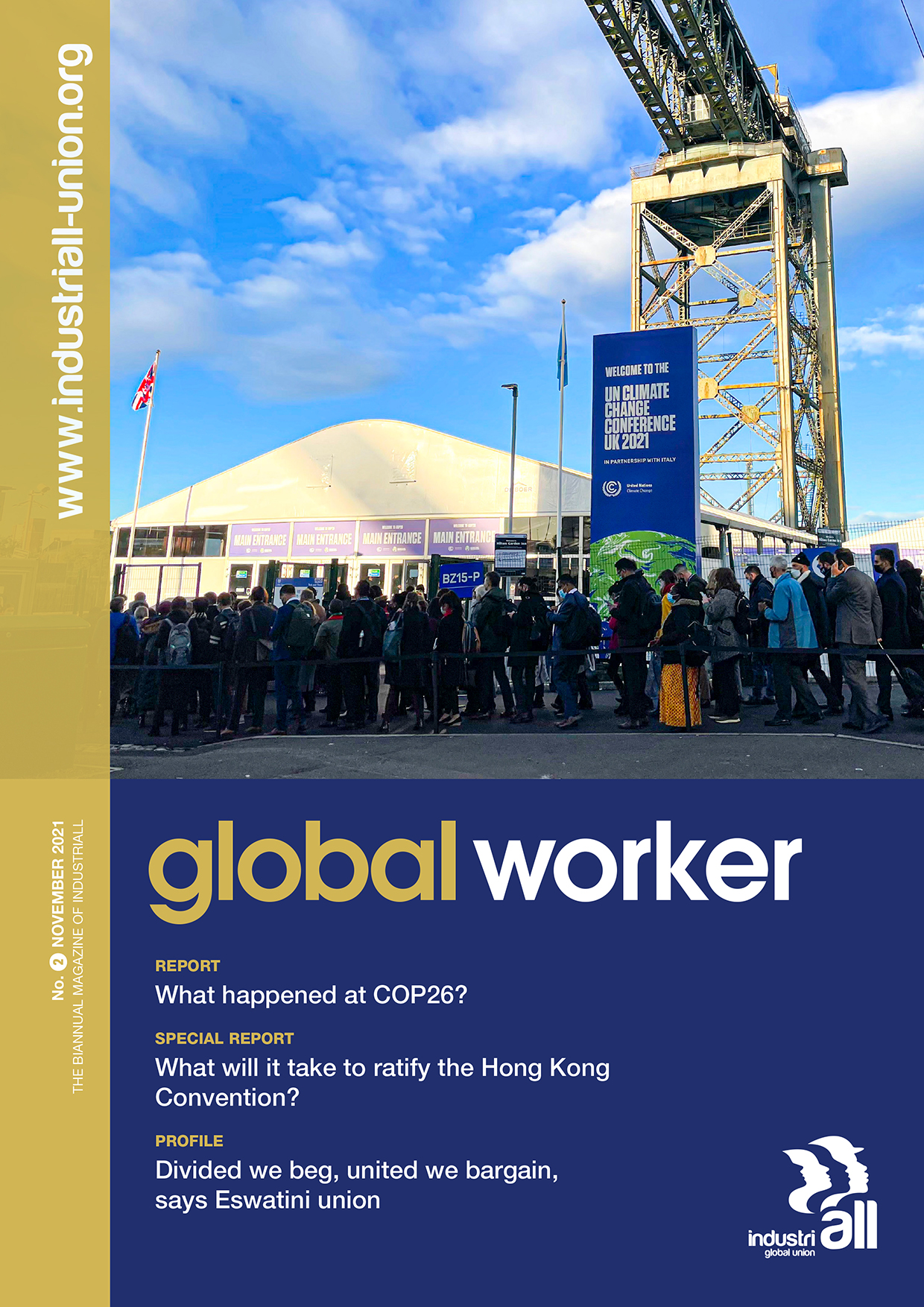
From Global Worker No. 2 November 2021

Country: eSwatini

Union: Amalgamated Trade Union of Swaziland (ATUSWA) 

Text: Elijah Chiwota

Formed in 2013 from a merger of three unions including the Swaziland Processing and Allied Workers Union (SPRAWU) and MQAWUS, ATUSWA has 4,000 members, 65 per cent of whom are women. 

After a turbulent foundation, ATUSWA, is beating the odds, and continuing to grow its membership by organizing more workers in the textile and garment, and other manufacturing sectors. 

A typical ATUSWA recruitment and organizing drive involves going to factory premises, waiting for the lunch break, and then persuading workers to join the union. Although this strategy is limited in a Covid-19 lockdown situation, the union is adapting and using other methods that include mobile apps and social media. For instance, the union has developed an app that links workers to union documents and core labour laws. Further, the union successfully campaigned for the payment of benefits to workers who were retrenched because of the pandemic. This resulted in over 20,000 workers benefiting from the Eswatini National Provident Fund.

The union says it visits workplaces regularly to investigate and confront employers when workers report violations. Xolile Dlamini from Swazi Africa Textile who has been an ATUSWA member for five years explains why joining the union is one of the best decisions she has made:

“Non-unionized workers are ill-treated and insulted. The employers put us under a lot of pressure to meet targets that sometimes you feel like crying. And the union is the organization to go to when you feel abused. Every so often the employers tell you that you will do whatever they ask you to do. But once we become union members, we are able to tell them to stop the verbal abuse and to respect our rights.”

As a tactic to attract and retain members, the union is campaigning for permanent jobs, and against the employment of workers through labour brokers. Additionally, the union want minimum wages of at least E3500 (US$229), rental housing policies that protect workers, and unemployment benefit funds against Covid-19 job losses. 

“The workers of Eswatini must unite and fight for a living wage and decent working conditions. As we campaign for living wages, we are demanding wage increases that cover the increasing cost of living and price hikes,”

said ATUSWA secretary general Wander Mkhonza.

Retaining members is not always easy as some workers join the union and leave after a few months. To deal with this the union is considering increasing its benefits to members and negotiating agency shop agreements that benefit all workers. This can attract those workers who are reluctant to join the union.

Although there is potential for the union to increase the membership often it faces resistance from some employers. For example, after organizing 1200 workers at Juris Manufactures, the company only submitted dues for 482 members. The employers behave this way even when the union has signed recognition agreements. 

ATUSWA also supports labour law reforms that will protect unions from union busting and bashing by employers. According to the union, Taiwanese-owned FTM Garments continue to violate trade union rights especially the right to organize and collective bargaining, while other employers are dragging the union to the courts. Currently the union has five pending court cases on recognition agreements whilst other cases are at the Commission for Mediation Arbitration and Conciliation. According to the union these cases are an attempt by employers to bankrupt the union as they take long, and the legal fees are expensive.

Currently, the union’s collective bargaining forums are not centralized, and the union would like to change this. In proposed amendments to the Industrial Relations Act, the union wants the collective bargaining forums to be centralized as this is beneficial to workers.

The union sees workers education as fundamental to trade union development and the capacity development of its members. To this end the union has trained four educators and intends to increase the numbers to commit at least 20 per cent of its funds to education.

ATUSWA is part of the unions and civil society organizations that are demanding democratic reforms and an end to Africa’s last absolute monarchy in Eswatini which is ruled by King Mswati III. The union believes the struggles of the community are also the struggles of workers.

“ATUSWA is demanding change. We want democracy, freedom, and equality. Pro-democracy MPs, Mduduzi Bacede Mabuza and Mthandeni Dube, who are facing ‘terrorism’ charges must be released and freedom of expression respected. National wealth cannot be in the hands of the king alone, but must be shared equitably,”

says Jabu Chauke, ATUSWA, 1st deputy secretary general and senior shop steward at garment manufacturer Fashion International Swaziland.

Union campaign pays off as Covid-19 vaccination rates hit 74% in South Africa’s garment sector

To promote workers vaccination, IndustriALL affiliate SACTWU entered into a strategic agreement with employers to facilitate vaccination through the union’s primary health care clinics. A report from the Covid-19 Vaccination Rollout Campaign Framework Agreement that the union signed with employers’ state:

“Out of a sample of 33 906 persons registered with the clothing industry's health care clinics, a total of 25 107 (or 74%) have now been vaccinated.”

The vaccination rate is more than double the national average of 35 per cent.

SACTWU says the report showed that out of 320 hospital admissions of garment workers, 295 (or 92 per cent) were unvaccinated, 21 (or 7 per cent) partially vaccinated and 4 (or 1 per cent) fully vaccinated.

Further, of the 56 Covid-19-related deaths recorded among the garment workers, 49 (or 88 per cent) were among the unvaccinated, 7 (or 13 per cent) partially vaccinated and none among the fully vaccinated, concludes the report.

“The union clinics are providing an essential service to workers and communities. When I went to the clinic, I got some education on why the vaccine is crucial in protecting me from Covid-19. I am now using this information to educate and encourage others to vaccinate especially the youth who must lead by example,”

says Nomandla Sizani, a SACTWU organizer, who got her jab at the Salt River health care centre in Cape Town.

Andre Kriel, SACTWU general secretary welcomes the report:

“We are pleased with this progress, which brings us within reach of the 80 per cent vaccination rate which the framework agreement sets as a target for our industry. We will continue to encourage all our members, in the sectors that we are organised, to get vaccinated.”

Atle Høie, IndustriALL general secretary says:

“We commend the union for the ongoing vaccination campaigns. All efforts to make our members take the vaccine save lives. IndustriALL and other global unions are calling on the global community to remove obstacles to universal access to Covid-19 vaccines, including a TRIPs waiver on intellectual property rights to allow for the local production of vaccines in South Africa and other developing countries. This will improve vaccine equity and access in countries of the Global South.”

IndustriALL and other global unions recently called for universal access to Covid-19 vaccines, health products and technologies | IndustriALL
 
The South African government’s national vaccination programme which aims to vaccinate 40 million people or 67 per cent to reach population immunity, is facing vaccine hesitancy. Although the country has secured enough vaccines, fewer people are turning up for inoculation. According to the department of health by 7 December, 26, 6 million vaccines had been administered. However, four million people over the age of 50 and 13 million aged 18-34 are unvaccinated.

The vaccine hesitancy, mainly caused by anti-vaccination sentiments on social media platforms, has prompted the government to consider mandatory vaccination at workplaces and as a requirement to access public services. With the detection of the highly transmissible Omicron variant by South African scientists, it has been observed at one of the country’s largest hospitals, Baragwanath in Johannesburg, that most of the recent severe Covid-19 cases that require hospitalisation are among the unvaccinated aged below 35. For the vaccinated, the symptoms are said to be mild. According to the National Institute for Communicable Diseases, over 90 000 people have died from Covid-19 complications since the outbreak of the pandemic.

To increase the vaccination uptake, the minister of employment and labour Thulas Nxesi said at a meeting of the country’s social dialogue council, the National Economic Development and Labour Council (NEDLAC), that a committee has been set up to explore how mandatory vaccination can be conducted. But mandatory vaccination appears not to be the only strategy being used by the government, there are also cash prizes for getting vaccinated.

South Africa submits documents to ratify ILO Convention 190

Confronted by this horror, trade unions continue to fight against GBVH and the campaign for the ratification of International Labour Organization (ILO) Convention 190 which seeks to eliminate violence and harassment in the world of work and the adoption of Recommendation 206, are part of sustained actions to stop GBVH and create safer workplaces.

On 29 November, the South African government submitted its documents to the ILO as part of the ratification process. The documents were submitted at a meeting in Johannesburg with the ILO, the department of employment and labour, and trade unions that are part of the National Economic Development and Labour Council – the country’s social dialogue platform. The Congress of South African Trade Unions (COSATU) represented unions.

When Convention 190 is ratified, it will complement national legislation that includes the Gender-Based Violence and Domestic Violence Amendment Bills as well as the Criminal Law (Sexual Offences and Related Matters Amendment Bill) that have been passed by parliament and will become law once signed by President Cyril Ramaphosa. Further, the country has a national strategic plan aimed at ending GBVH.

Unions are conducting awareness campaigns against GVBH and forming strategic alliances with civil society organizations that are targeting men, who have been identified by research as the main perpetrators of GBVH and domestic violence. Unions say GBVH is worsened by gender stereotypes found in harmful social and cultural practices, poverty, inequality, high unemployment, and weak law enforcement which promotes impunity.

Lydia Nkopane, from the National Union of Mineworkers, who is also the chairperson of the IndustriALL Sub Saharan Africa women’s committee says:

“We are optimistic that the domestication of Convention 190 into South African law will help to stop the scourge of GBVH especially in the mining and other male dominated industrial sectors where the abuses are rampant. Women should enjoy freedoms to go to work, come back to their families and live without fear of sexual harassment, rape, physical beatings, and even death perpetrated by their workmates or partners.”

Christine Olivier, IndustriALL assistant general secretary, says:

“The ratification of C190 provides a valuable tool to address risk factors and prevent GBVH. The development of workplace policies will empower and protect workers by removing barriers to the implementation of existing laws. However, South African unions must remain vigilant to ensure the implementation of C190 and must conduct awareness campaigns for workers to understand the convention.”

According to reports incidences of GBVH and domestic violence increased during the Covid-19 pandemic lockdown prompting the government to respond through laws and other policies. The government national command centre on gender-based violence recorded 120,000 cases in the first three weeks of the lockdown in 2020.

Fighting for African industrialization

IndustriALL Global Union affiliates in Sub Saharan Africa (SSA) met online on 19 November to grapple with the obstacles during an Africa Industrialization Day webinar under the theme “Trade union approaches and engagement on African industrialization and the promotion of manufacturing for job creation, decent work, and sustainable development”.

The unions have been carrying out this campaign for the last five years. The webinar, hosted jointly with ITUC-Africa, and attended by 70 participants, came after national workshops in Nigeria, Kenya, and Uganda where there were discussions on national industrial policies between unions and governments. The webinar discussed the role that trade unions can play to influence policymaking, implementation and monitoring of industrialization plans in SSA.

The unions called upon the African Continental Free Trade Area (AfCFTA) to prioritize the decent work agenda after unions pointed out that the agreement is silent on creating decent jobs, workers’ rights, social protection, and social dialogue. According to the unions, this exclusion can lead to the violation of international labour standards and national labour laws.

The AfCFTA agreement which began trading this year has been signed by 54 countries and has an estimated combined GDP of U$3 trillion with potential to increase intra-African trade by 50 per cent.

Peter Serwoono, senior advisor to the AfCFTA said stakeholders including unions will be invited to “participate in discussions at the national and regional levels on the development of AfCFTA implementation strategies.”

ITUC-Africa has already started working with the AfCFTA on the inclusion and is launching a guide titled Trade Unions and trade: A guide to the AfCFTA to help workers to understand the agreement.

Eric Manzi, ITUC-Africa deputy general secretary, said:

“Some of the lessons learn learnt from the Covid-19 pandemic that are useful to African industrialization strategies include adopting a multisectoral approach, effective policies for job creation growth, poverty reduction, strengthening economies and ending corruption. Further, technical training, public investments, education and training and building institutional capacities are key for sustainable industrialization.”

Vishwas Satgar, a climate expert from the University of the Witwatersrand emphasized the repurposing of industries and the creation of green jobs in the renewable energy sector in what he termed “climate emergency manufacturing” and “indigenous industrialization” models that included “socially-owned renewables.”
 
African industrialization is hampered by the economies that are mainly based on exporting raw materials that include minerals, oil and gas, and agricultural products. Manufacturing has remained subdued at less than 10 per cent of GDP. Additionally, industrial policies have been partly implemented while illicit financials flows are common.
 
Kemal Ozkan, IndustriALL assistant general secretary, said:

“Workers must have a say in industrial policies that will determine the future of their industries. We must challenge the narrative that Africa is poor; the continent is sufficiently rich in minerals and other resources, but the wealth is stolen through corruption. To counter this, we need structural change that enables sustainable industrialization that will address issues of mobility, energy decarbonisation, Just Transition, global supply chains and the future of work.”

Union intensifies calls for urgent dialogue on multiparty democracy in Eswatini

The congress was attended by 60 delegates from the union’s 20 branches from the textile and garment sector and other manufacturing industries.

The congress was held under the theme: Reasserting worker control in the defence of fundamental rights. The national congress discussed how ATUSWA “can maximize its contribution towards democratization of the country in order to have a government that listens to the plight of the workers.”


The union says judging by recent events workers’ and human rights including freedom of association continue to be violated.

Wander Mkhonza, ATUSWA general secretary says:

“On 21 October, while at a meeting in Matsapha, and as a build-up to the textile strike action that was interdicted by the Industrial Court, the police without warning threw tear-gas at the workers and union officials. This happened even though the police had been informed of the meeting.”

Further, the union states that over 100 people, including union members, were shot and killed by the police and army while several were injured in recent pro-democracy protests. The injured and dead include high school students. Schools, colleges, and universities are still closed with only a few opening for examinations.


“There must be urgent dialogue now and not in three months’ time. This is the time for decisive action. We cannot afford to delay when state security agents continue to use excessive force,”

says Mkhonza.

Despite the violence, the union continues to encourage workers to take part in the pro-democracy campaign and argues that workers, as members of communities, should be involved in community struggles.

“For a long time, the people of Eswatini have faced brute force and persecution from the security forces and the courts when they demonstrated. We want democratic reforms and not an absolute monarchy headed by a king more concerned about the luxuries of the royal family at the expense of citizens who live in poverty. We want meaningful dialogue, and will continue protesting until our demands are met,”

said one worker.

Petitions have been presented to the United Nations Human Rights Council by unions and civil society organizations calling upon the government to respect human rights.

Atle Høie, IndustriALL general secretary, wrote to the Eswatini Prime Minister, Cleopas Dlamini:

“At the IndustriALL Global Union Congress, on 14-15 September, 3000 online delegates from 434 organizations in 111 countries adopted unanimously a resolution, which expresses deep concern about the continuing violence in Eswatini and calls for democratic reforms in the country.”

The Southern African Development Community, chairperson for the organ on politics, defence and security, South African President Cyril Ramaphosa met with King Mswati III as part of diplomatic efforts “to end violence and conflict and maintain peace and calm in the kingdom as work commences on the national dialogue process.”

Protests erupted in Eswatini, Africa’s only absolute monarchy, when communities, unions and civil society organizations took to the streets to demand democratic reforms including a review of the 2005 constitution, a repeal of the 1973 proclamation that banned political parties, and other repressive laws.

King Mswati III, who has executive, judicial, and legislative powers, makes key appointments of ministers and the prime minister. An extravagant lifestyle of the king and the royal family – of luxury cars and private jets – amidst poverty, inequality and unemployment has angered unions, communities, and civil society. The king, who is listed among the richest monarchs has an estimated net worth of $200 million. His family of 15 wives and 23 children benefits from a national budget allocation of over $65 million per year for the royal household.

According to the World Food Programme, Eswatini has a poverty rate of 58.9 per cent and the country’s 26 percent HIV prevalence is amongst the highest in the world. Unemployment is estimated to be over 40 per cent.