Union takes Zheng Yong garments to court over dismissal of 20 workers in Eswatini

The five-week strike took place from April 5 to May 9 with the main demand being wage increases of at least E15 per hour or E2983 (US$179) per month. However, the employers awarded a paltry 7.25 per cent increase or E12 per hour.

The union says instead of engaging on the workers demand, the employers teamed up with the government and used strike breaking tactics and violence against the workers including teargassing them in their homes and threats of violence. According to the ITUC Global Rights Index for 2022, Eswatini is amongst the “10 worst countries for working people.”

Further, it’s been over three months since the garment manufacturer gave the dues that it is collecting from 1247 workers to the union. By not surrendering the dues as per the labour laws, Zheng Yong, which employs about 4000 workers, is flouting national labour laws, says ATUSWA which is affiliated to IndustriALL Global Union. The union says withholding the dues is a form of union busting as it violates Section 43 of the Industrial Relations Act which states that an employer “shall promptly remit” union dues after collection. ATUSWA argues that the employer’s actions can be construed as punishing workers for going on strike which is against the law.

To resist the push back, ATUSWA is taking Zheng Yong to the Industrial Court to challenge the dismissals and for violating workers freedom of association. Additionally, the union says the employer must respect trade union rights.

Wander Mkhonza, ATUSWA secretary general says:

“Zheng Yong and other employers must improve working conditions in the garment and textile sector and not always resort to threats and legal action. Employers must engage with the union when there is a dispute instead of taking drastic action such as dismissing workers for striking for living wages.”

“Adopting an anti-union stance is detrimental to promoting industrial harmony between ATUSWA and Zheng Yong. The employer must pay living wages especially after recent increases in the cost of living. We recommend approaches that promote social dialogue and mediation and arbitration to resolve the dispute,”
says Paule France Ndessomin, IndustriALL regional secretary for Sub Saharan Africa.

Union calls for tougher sentences after 8 women are gang-raped in South Africa

Over 80 suspects have appeared in court facing charges of 32 counts of rape and attempted murder. The attackers are allegedly part of criminal syndicates that are involved in artisanal and small-scale mining in some abandoned mines in South Africa.
 

The women aged 19-35 were part of a production crew of 12 women and 10 men that was shooting a music video at a mine dump when they were attacked by heavily armed men on 28 July. The crew was also robbed of personal belongings.
 

Although South Africa has passed laws and legislation to end gender-based violence and harassment, that include the Criminal Law (Sexual Offences and Related Matters) Amendment Act, Criminal and Related Matters Amendment Act and the Domestic Violence Amendment Act, the cases keep increasing and unions want the courts to prosecute more cases and convict the offenders. South Africa ratified International Labour Organization Convention 190 in 2021 which aims to eliminate violence and harassment in the world of work.
 

The country also has a national strategic plan on gender-based violence and femicide. In the plan, President Cyril Ramaphosa describes gender-based violence and harassment as a scourge in which “rape and sexual violence have become hyperendemic” and that “South Africa holds the shameful distinction of being one of the most unsafe places in the world to be a woman.”

“The location of a video set is a workspace at that moment. Artists are deemed a vulnerable sector based on the type of work that they do, and as a trade union it is our right and joint responsibility with other formations to uphold and adhere to Convention 190 that commits to the right of everyone to a world of work free from violence and harassment, including gender-based violence,”

says Mathapelo Khanye, NUM national secretary for the women’s structure.
 

Paule France Ndessomin, IndustriALL regional secretary for Sub Saharan Africa says:

“We are appalled by the rape and sexual violence which continue to traumatize South African women, and support unions and civil society organizations in their campaigns to eliminate rape, and gender-based violence and harassment (GBVH).” 

The Sub-Saharan Africa regional office continues to carry out training and campaigns to sensitise and equip unions with strategies for the prevention of GBVH, and the adoption of workplace policies that provide safe working environments.

Young workers commit to active participation in transforming trade unions in Botswana

The second Sub-Saharan Africa IndustriALL Global Union-Friedrich-Ebert-Stiftung (FES) youth activist school program this year took place in Gaborone, Botswana, 20-23 July. Over 20 young workers participated,11 were women.

The activist school was held in partnership with IndustriALL, FES and the Botswana Federation of Trade Unions (BFTU). A third session of the will take place in November.

The first school program for 2022 took place in Tanzania, previous schools were held in 13 African countries, before the learning events were disrupted by the Covid-19 pandemic. The next activist school programme will take place in South Africa, Kenya and Ghana.

The young workers' list of priorities on transforming unions include strategies to advance the decent work agenda, and the future of work. On advancing workers’ rights, the importance of national labour laws and international labour standards was highlighted.

The participants came from 10 unions that organize in the automotive, diamond, energy, garment and textile, mining, the public sector, and others.

Discussions included knowledge and skills that are needed for young workers to play effective roles in the union. The BFTU highlighted the history, legal frameworks, and the national trade union context, while the Southern African Trade Union Coordination Council (SATUCC) presented on effective approaches to collective bargaining. The FES presented engagement and successful negotiations. These sessions explored the collective bargaining culture in Botswana and how to make it more effective. 

There were discussions on international worker solidarity, inclusive social dialogue processes that catered to young women and men and focused on strengthening non-adversarial industrial relations. Feminist approaches to trade union campaigns included discussions on gender equity and equality and developing workplace policies using International Labour Organization Convention 190 on eliminating violence and harassment in the world of work. Gender role plays exposed how women workers had more roles than their male colleagues, and how this impacted on their participation in union activities.

“As young workers we welcome the youth activist school because it offers practical workers education which is key to effective trade unionism. In addition, for unions to stand for fair and just societies, they must be inclusive of young workers in all spheres of union life,”

said Vanessa Nakedi, BFTU youth secretary.

Tumelo Awee, Botswana Mine Workers Union (BMWU) added that  

“The activist school challenges us to evaluate and play effective roles as young workers. With the new learning from the activist school, we are now better prepared to engage employers.”

Thilo Schöne, FES Botswana resident representative says: “The youth activist school is an important revival of interactive, union-related and justice-motivated training for young Batswana. I am impressed by the solidarity, dynamism, and motivation of young trade unionists to become more involved in their unions in the future and to work for better working conditions.”

Paule France Ndessomin, IndustriALL regional secretary for Sub Saharan Africa explained that,

“The youth activist schools are a strategy to create a vibrant trade union youth network in Africa that is innovative in using digital tools in union organizing. This network aims to build an activist and learning community that will advocate for social transformation. Additionally, we want the youth network to be a space where young workers will become organisers, negotiators, and gender champions through capacity development and networking.”

The Botswana Diamond Workers Union (BDWU), BMWU, and the Botswana Power Corporation Workers Union (BPCWU) who are affiliated to IndustriALL and the BFTU also participated in the activist school.

Massive job losses reverse union gains in Ethiopia’s Hawassa Industrial Park

The closures began after the announcement by the United States government that Ethiopia would no longer benefit from the African Growth and Opportunity Act (AGOA)’s duty-free access to US markets from 1 January this year. The reasons given for the termination of the preferential trade benefits are “gross violations of internationally recognized human rights by the government of Ethiopia and other parties” in the war in the northern part of the country.

Most of the factories in Hawassa that were exporting to the US had their orders cancelled leaving them stranded. However, with the on-going peace talks in the country, the union hopes for a peaceful breakthrough that will bring back trade and a new lease of life to the Hawassa Industrial Park which at its peak employed over 35,000 workers.

The IFTLGWTU says Best International Garments, an Indian owned company, with a factory in the park, has retrenched over 3000 workers. Further, the closure of one of the largest factories in the park by Phillip Van Heusen (PVH) in November 2021, is having a ripple effect as over 15 companies in the park received orders from PVH under third party manufacturing contracts.
 
The union says currently, there are plans to scale down production by other garment factories that include Sumbiri Hela Intimates which has put 260 workers on a month paid leave after which there is uncertainty. The factory is jointly owned by Sri Lanka based Hela Indochine Apparel and Sumbiri Intimate Apparel. Quadrant Apparel Group has also put 300 on paid leave while Epic Apparel Plc, a Hong Kong-based Epic Group subsidiary, has retrenched workers after paying six months’ wages. In June, Chargeurs Fashion Technologies, a French company, also retrenched 22 workers.

“In this job losses crisis, workers are anxious because job security is no longer guaranteed in the factories that are still operational. We are trying our best to ensure that workers are paid their terminal benefits according to the labour laws and hope that the end of the conflict will bring back AGOA benefits to ease the plight of the suffering workers,”

says Angesome Gebre Yohannes, the president of the (IFTLGWTU) which is affiliated to IndustriALL Global Union.
 
Paule France Ndessomin, IndustriALL regional secretary for Sub Saharan Africa says:

“The Ethiopian industrial parks industrialization strategy remains one of the most effective models in creating jobs in the garment and textile sector in Africa. We were hoping for more jobs and not the retrenchments that we are witnessing. However, IndustriALL continues to support the IFTLGWTU in ensuring that employers respect workers’ rights and international labour standards during the retrenchments.”

Union wins in wage negotiations in South Africa

According to Statistics South Africa, inflation peaked at 6.6 per cent in May.
 
SACTWU signed some of the agreements in the bargaining councils that were set up as part of the country’s industrial relations mechanisms. For instance, in the footwear sector the union settled for 6.8 per cent effective from 1 July to 30 June 2023 after negotiations and a wage dispute. The collective agreement was signed in the National Bargaining Council of the Leather Industry of South Africa on 11 July. Employers were represented by the Southern African Footwear and Leather Industries Association.
 
Similarly, in the leather tanning sector, the union and the South African Tanning Employers Organisation signed a 7.25 per cent wage increase deal in the National Bargaining Council of the Leather Industry, which will benefit 2500 leather tanning works in 24 factories. The agreement, signed on 8 July is for a year.
 
In yet another agreement on 6 July, the union says it signed for a 7.5 – 8 per cent with the worsted textile employers which will be for two years. The negotiations took place under the National Textile Bargaining Council, with employers represented by the National Association of Worsted Textile Manufacturers.
 
Additionally, the union negotiated for benefits that include the family responsibility leave as per the Basic Conditions of Employment Act.
 
SACTWU, affiliated to IndustriALL Global Union, also sent the agreements to the department of labour for extension to non-unionized factories and workplaces. South African labour laws allow for collective agreements that meet certain requirements to be extended to non-party employers who in turn will pay agency fees.
 
Andre Kriel, SACTWU general secretary says: 

“The signed collective agreements for the footwear sector, leather tanning, and worsted textiles, will be submitted to the minister of employment and labour, with a request for gazetting and extension to non-party employers. Agreements have also been signed in the woven and crochet textile, the cotton textile, and the general goods and handbags sub-sectors.”

“The strategic ways in which SACTWU’s collective bargaining teams approach negotiations allow for the maintenance of living wages and better working conditions in the textile, garment, shoe, and leather sectors and should be emulated by other unions. Extending the agreements allows non-union members to benefit as well strengthening solidarity and building union power,”

says Paule France Ndessomin, IndustriALL regional secretary for Sub Saharan Africa.
 

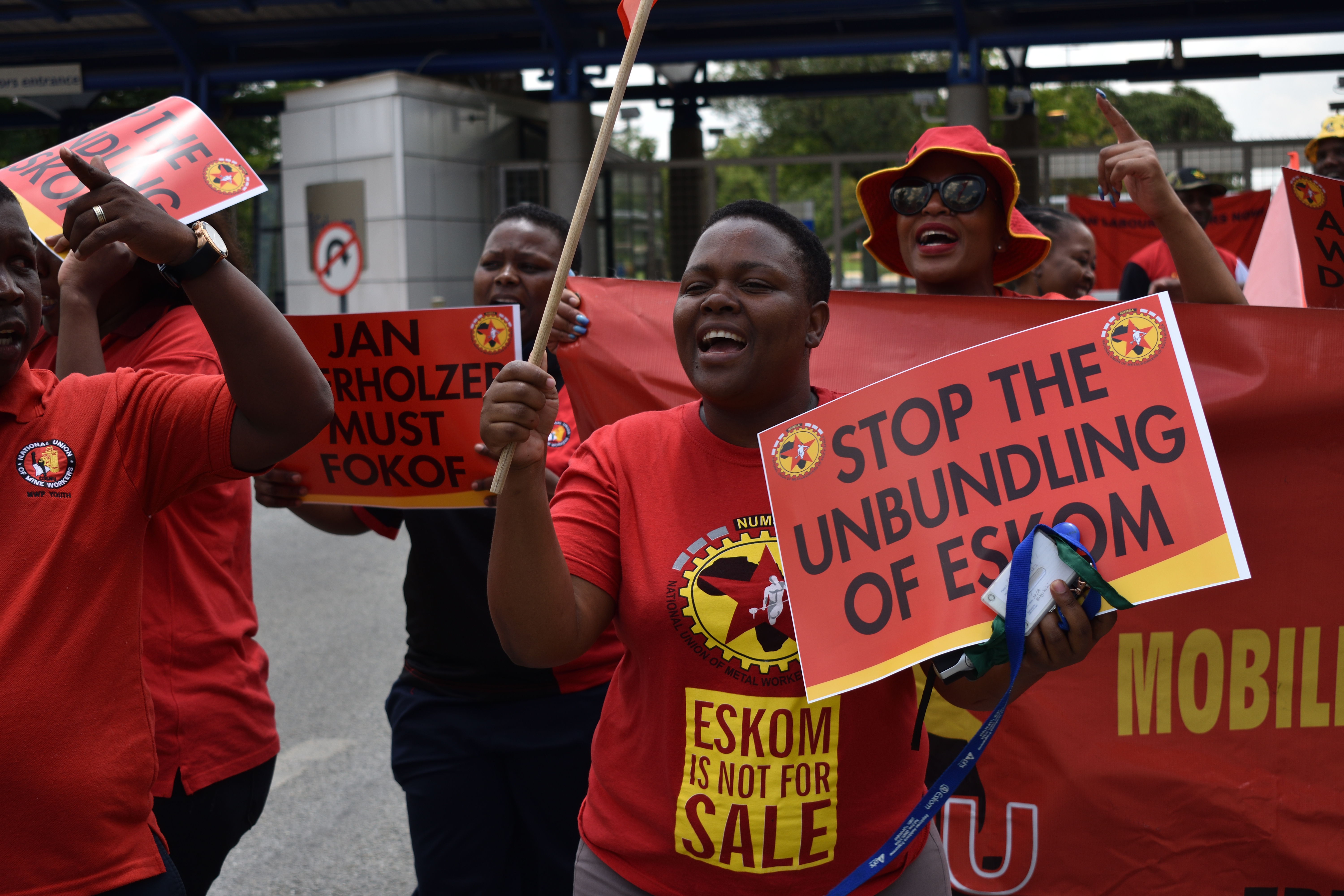
Unions sign wage deal at power utility Eskom in South Africa

The deal, which was signed at the Central Bargaining Forum (CBF), includes a 7 per cent wage increase over a year (1 July 2022 to 30 June 2023), a R400 (US$24) housing allowance increase, and a commitment to continue negotiations to improve wages and working conditions.

Additionally, the deal reinstates working conditions prevailing on 30 June in which workers would have lost R9 000 (US$547) in benefits had the unions not protested. The CBF, which represents 28,300 workers at the state-owned enterprise, is a forum where employers negotiate with the unions.

“We are pleased to have finally resolved this round of wage talks, particularly given the difficult circumstances we faced. The conditions of service, which were unilaterally withdrawn and caused so much pain to our members, have been restored. We have also secured an improvement from last year, after Eskom imposed 1.5 per cent, and we want to thank the negotiating team for their tireless efforts in finding a solution. NUMSA will always fight to improve the conditions of the working class,”

says Irvin Jim, NUMSA general secretary.

During the strike and the negotiations, which deadlocked after Eskom management declared a dispute and walked out of the talks, the workers argued that Eskom could afford the increase and were against an increase that was below inflation increase as what happened last year. Inflation in the country for 2021 was 5.9 per cent.

“The NUM wishes to express its sincere gratitude to its members at Eskom for their conduct during the negotiations until when they gave us a mandate to sign the agreement. On disciplinary and grievance procedures and the recognition agreement a task team will be established consisting of at least three persons from each party. The task team will report back to the CBF within three months,”

says William Mabapa, NUM general secretary.


On-going electricity outages due to insufficient power generation were blamed by some media outlets on the striking workers as part of a disinformation campaign, says the unions. For example, fake news announced that an agreement had been reached before the unions had even signed or consulted their members on the wage offer.

“We call on media houses to be responsible in their reporting. When they publish fake news, this can have a detrimental impact on the negotiations,”

cautioned NUMSA and the NUM, who are affiliated to IndustriALL, in a statement.

Paule France Ndessomin, IndustriALL Global Union regional secretary for Sub Saharan Africa says:

“We are pleased that NUMSA and the NUM continue to fight for living wages and better working conditions for workers at Eskom. As Eskom embarks on a transition to renewable energy sources, workers' interests remain paramount and must be protected. This is why IndustriALL campaigns for a Just Transition that is inclusive of the decent work agenda.”

Unions reject poverty minimum wages in Zimbabwe

The money can only buy two dozen loaves of bread. The unions say to avoid living in poverty, the workers must be paid over ZWL $130,000 or US$400, and that the government must engage trade unions through social dialogue platforms before making the wage announcements.

The wage crisis in the country is leading unions to negotiate for shorter collective bargaining agreements with clauses stating that the wages must be adjusted to the inflation rate. Unions are also requesting employers to pay workers in the more stable US dollar.
 
Some grocery stores have stopped selling goods in the local currency, which is fast losing value. This puts workers into in a dilemma as they are forced to buy the US dollars on the streets where the rate is higher. According to the Reserve Bank of Zimbabwe, year-on-year inflation in May was 131.7 per cent while the current exchange rate to the US dollar is ZWL$325.56.
 
The Zimbabwe Congress of Trade Unions, to which some IndustriALL affiliates are members, says the country’s workers are the working poor as they earn below the poverty line. With high unemployment, estimated to be 47 per cent by Zimbabwe National Statistic Agency using the expanded rate, the workers are likely to be the breadwinners in their households. with most workers employed under precarious conditions in the informal sector, unions dispute the official unemployment rate as low.
 
Joseph Tanyanyiwa, the chairperson of the IndustriALL National Council for Zimbabwe says:

“It is our strong view that the gazette minimum wage is too paltry and in no way related to the prevailing macro-economic fundamentals in Zimbabwe. The reality on the ground is that the prices of basic commodities are rising while the ZWL continues to depreciate against the Unites States Dollar. It is with this gloomy scenario that we wonder what criterion the minister used to set such a low minimum wage. A minimum wage of ZWL$25 000 is unreasonable, inadequate and a slap in the face of the workers.”

“For years, Zimbabwean workers have been losing savings, pensions, and the value of their wages to hyperinflation and the unresolved economic crisis. When we thought the crisis was over, we are shocked to see that hyperinflation is again eroding workers’ wages. We call upon the Government of Zimbabwe to implement sustainable economic policies that will protect the value of the workers’ wages, improve living conditions, and stop the precarious working conditions prevailing in the country,”

says Paule France Ndessomin, IndustriALL regional secretary for Sub Saharan Africa.
 

South African unions end three-month strike in the gold sector

The collective agreement is for three years, and miners and artisans as well as officials will get an increase of 5 per cent or R1000 (US$62) to the standard rate of monthly pay in the first year, 5.5 per cent or R900 (US$56) in the second year, and 5 per cent or R750 (US$47) in the third year. Further, the workers will be given a once-off hardship allowance of R3000 (US$187).

At a Congress of South African Trade Unions organized May Day rally in Rustenburg the striking workers forced President Cyril Ramaphosa off the stage before finishing his speech demanding that he intervenes to resolve the wage dispute. The workers sang during the speech making it hard for others to hear the address.

The NUM, which is affiliated to IndustriALL Global Union, commented that it was unfortunate that workers “disrupted their own event” while also recognizing that the rally was “a workers’ platform” to express their demands. This led to the convening of meetings between the strikers and the department of mineral resources and energy.
 
The unions also argued that if Sibanye Stillwater could pay the chief executive officer, Neal Froneman, R300 million per annum ($18.67 million), the mining company could afford to pay the workers’ demands.
 
William Mabapa, NUM, general secretary says:

“The 2022 wage negotiations were very tough and took more than a year to be concluded – the longest wage negotiations in the history of the NUM. The pressure that the unions exerted on Sibanye Stillwater through the rolling mass actions and the strike to force the company to sign the wage agreement has yielded good results. The union wishes to express sincere gratitude to its members at Sibanye-Stillwater on a successful strike that ran concurrently with negotiations until they gave us the mandate to sign this wage agreement.”

“The unity of the workers during strikes and negotiations is key to building workers power in the gold mines. We also join the workers in their joy after winning in the negotiations and commend the NUM for working in solidarity with AMCU,”

says Glen Mpufane, IndustriALL director for mining.


Union in deal to donate confiscated garments to South African flood victims

So far, the agreement has resulted in the donation of 1,600 blankets, garments, textile, footwear, and leather products, to the flood victims. The donated goods were seized at ports of entry by the South African Revenue Service (SARS) for customs regulations’ flouting by some importers.
 
The framework agreement aims at stopping the smuggling and to mitigate against market disruptions, corruption, and the threat to jobs. Additionally, it promotes industrial and trade policy tools aimed at securing and growing local jobs and manufacturing industries. The agreement was signed under the auspices of the Retail, Clothing, Textile, Footwear and Leather (R-CTFL) masterplan.
 
Importantly, the agreement was bolstered by a recent court case in which SARS won against the smuggling syndicates. The court confirmed that SARS acted lawfully by seizing 19 containers of undervalued imported garments in 2020. The union says the undervaluation is a common strategy used by corrupt importers to avoid paying import taxes.
 
In a statement, SACTWU says:

“We applaud SARS for its reinvigorated campaign to obliterate customs fraud in the garment, textile, footwear, and leather industries. We hope that this outcome sends a strong message to fraudsters and expect that swift seizures, arrests, and criminal charges will become the norm on illegal imports.”

“We initiated and concluded this new framework agreement as a determined effort to contribute concretely towards the alleviation of severe hardships that flood victims are experiencing, while simultaneously protecting our members’ jobs,”

 says André Kriel, SACTWU general secretary.

“This initiative is a testimony that tripartite agreements, as shown by the R-CFTL masterplan, are key instruments to ending the smuggling of garments and textile goods. We support SACTWU efforts to save local manufacturing industries,”

says Paule France Ndessomin, IndustriALL regional secretary for Sub Saharan Africa.
 
In April heavy rains of over 450 mm were recorded in some areas over 48-hours. The unusual down pours, attributed to extreme weather conditions caused by the climate crisis, caused havoc in KwaZulu-Natal, the Eastern Cape, North West, and Free State provinces. According to the South African government over 489 people lost their lives whilst over 63 were reported missing. Further, 4 000 homes were destroyed, and over 40 000 displaced.
 
The signatories to the agreement are SACTWU, another union, and the employers’ organizations: the South African Apparel Association, the Apparel and Textiles Association of South Africa, the Apparel Manufacturers of South Africa, the Textile Federation of South Africa, and the South African Footwear and Leather Export Council. The government is represented by the Department of Trade, Industry, and Competition, and SARS.
 
Retailers that signed are the National Clothing Retail Federation, representing Mr Price Group, the Foschini Group, Truworths, Woolworths, Pick ‘n Pay, Cotton On, Cape Union Mart, and Queenspark. Pepkor, Superbalist, and Retailability also signed.
 

Young trade unionist’s deportation ordeal in Zimbabwe

Mamisa arrived at Robert Gabriel Mugabe International Airport in Zimbabwe from Nairobi at 3 am on 30 May, to attend a capacity development workshop on advancing due diligence in the energy transition supply chain in Sub Saharan Africa.
 
When asked by an immigration official what she did for a living, Mamisa replied that she was a trade unionist.

“This sent the official into a fury. He took me to an office where they were two other officials, and they said ‘we don’t want trade union activists in our country. And we decide who comes in and who doesn’t. You are going back home,’”

says Mamisa.

“They gave me a form to sign. And I refused saying that I cannot sign a form before reading it. They then threatened me and said I was wasting their time by requesting to read the form. If I refused to sign, they will lock me up at a police station, and even the meeting organizers will not know where I am. After that scary threat I signed the form. I pleaded with them to explain why I was being treated this way — as if I had committed a crime. And they kept saying they did not want trade union activists and non-governmental organizations in Zimbabwe, and that her name did not appear on the data base for the ministry of foreign affairs,”

narrated Mamisa, who was detained for four hours, before boarding the next plane to Nairobi. There was no Internet connection at the airport, and the Zimbabwean officials refused to explain why she was being deported.
 
The section of the law that was used to deny her entry requires a visitor to the country “to produce documentary or other evidence relative to his (her) claims to enter or leave Zimbabwe.” Mamisa says she presented the required documents to the officials. Surprisingly, a young worker she was travelling with to the workshop was allowed to enter the country whilst she was denied entry. When the colleague asked why, he was told not to talk to a “suspect” or risk being “questioned.”
 
It was only in Nairobi that she was able to get her passport back – after another four hours without food or water. She was also given the form. Even after reading the deportation form, Mamisa says it is not clear why she was deported, except that she was a trade unionist.
 
Joseph Tanyanyiwa, chairperson of IndustriALL Global Union national council for Zimbabwe says:

“We are disappointed by this treatment of unionists by the immigration officials. If the Government of Zimbabwe says it is open for business, it should also be open for trade union activities.”

“I find it deplorable that three young trade unionists were denied entry into Zimbabwe and deported to their home countries of Tanzania and Uganda after being harassed and threatened with arrest. They were denied of their rights and never given a chance to explain that they were in the country to attend a youth capacity development workshop. The invitation letters and documents that they presented to the officials were ignored. Shockingly, they were told by the officials that trade union activism is not allowed in Zimbabwe,”

says Atle Høie, IndustriALL general secretary.
 
The workshop which was attended by 25 participants including from IndustriALL offices in Geneva, Switzerland and the Sub-Saharan Africa regional office in Johannesburg, South Africa, FES Zimbabwe, and FES Trade union Competence Centre for Sub Saharan Africa. The discussions ranged from the roles that young workers can play in the Just Transition and their demands, the future of the energy mix and developing a Just Transition plan that included a decent work agenda.