Union wins in wage negotiations in South Africa

According to Statistics South Africa, inflation peaked at 6.6 per cent in May.
 
SACTWU signed some of the agreements in the bargaining councils that were set up as part of the country’s industrial relations mechanisms. For instance, in the footwear sector the union settled for 6.8 per cent effective from 1 July to 30 June 2023 after negotiations and a wage dispute. The collective agreement was signed in the National Bargaining Council of the Leather Industry of South Africa on 11 July. Employers were represented by the Southern African Footwear and Leather Industries Association.
 
Similarly, in the leather tanning sector, the union and the South African Tanning Employers Organisation signed a 7.25 per cent wage increase deal in the National Bargaining Council of the Leather Industry, which will benefit 2500 leather tanning works in 24 factories. The agreement, signed on 8 July is for a year.
 
In yet another agreement on 6 July, the union says it signed for a 7.5 – 8 per cent with the worsted textile employers which will be for two years. The negotiations took place under the National Textile Bargaining Council, with employers represented by the National Association of Worsted Textile Manufacturers.
 
Additionally, the union negotiated for benefits that include the family responsibility leave as per the Basic Conditions of Employment Act.
 
SACTWU, affiliated to IndustriALL Global Union, also sent the agreements to the department of labour for extension to non-unionized factories and workplaces. South African labour laws allow for collective agreements that meet certain requirements to be extended to non-party employers who in turn will pay agency fees.
 
Andre Kriel, SACTWU general secretary says: 

“The signed collective agreements for the footwear sector, leather tanning, and worsted textiles, will be submitted to the minister of employment and labour, with a request for gazetting and extension to non-party employers. Agreements have also been signed in the woven and crochet textile, the cotton textile, and the general goods and handbags sub-sectors.”

“The strategic ways in which SACTWU’s collective bargaining teams approach negotiations allow for the maintenance of living wages and better working conditions in the textile, garment, shoe, and leather sectors and should be emulated by other unions. Extending the agreements allows non-union members to benefit as well strengthening solidarity and building union power,”

says Paule France Ndessomin, IndustriALL regional secretary for Sub Saharan Africa.
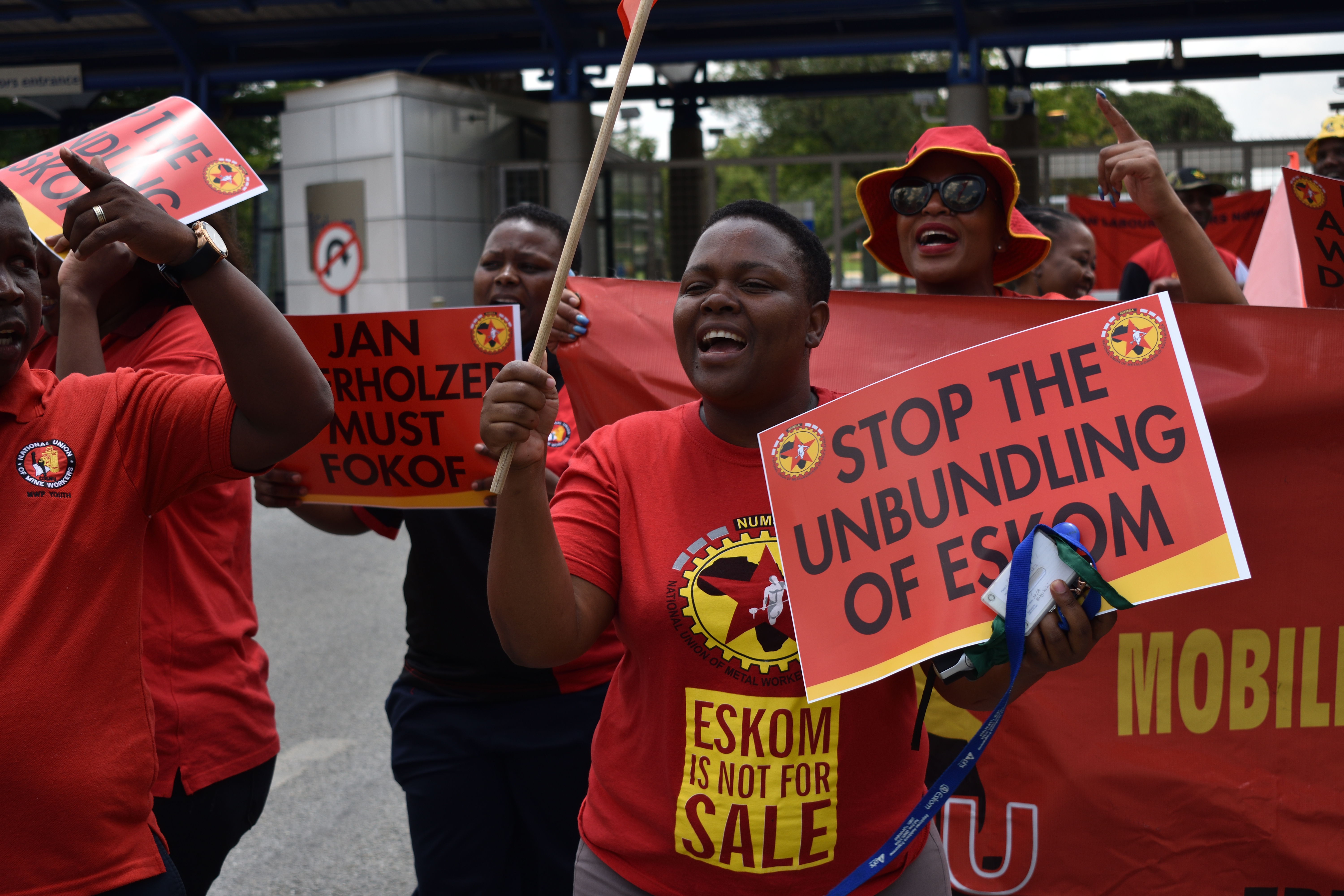
 

Unions sign wage deal at power utility Eskom in South Africa

The deal, which was signed at the Central Bargaining Forum (CBF), includes a 7 per cent wage increase over a year (1 July 2022 to 30 June 2023), a R400 (US$24) housing allowance increase, and a commitment to continue negotiations to improve wages and working conditions.

Additionally, the deal reinstates working conditions prevailing on 30 June in which workers would have lost R9 000 (US$547) in benefits had the unions not protested. The CBF, which represents 28,300 workers at the state-owned enterprise, is a forum where employers negotiate with the unions.

“We are pleased to have finally resolved this round of wage talks, particularly given the difficult circumstances we faced. The conditions of service, which were unilaterally withdrawn and caused so much pain to our members, have been restored. We have also secured an improvement from last year, after Eskom imposed 1.5 per cent, and we want to thank the negotiating team for their tireless efforts in finding a solution. NUMSA will always fight to improve the conditions of the working class,”

says Irvin Jim, NUMSA general secretary.

During the strike and the negotiations, which deadlocked after Eskom management declared a dispute and walked out of the talks, the workers argued that Eskom could afford the increase and were against an increase that was below inflation increase as what happened last year. Inflation in the country for 2021 was 5.9 per cent.

“The NUM wishes to express its sincere gratitude to its members at Eskom for their conduct during the negotiations until when they gave us a mandate to sign the agreement. On disciplinary and grievance procedures and the recognition agreement a task team will be established consisting of at least three persons from each party. The task team will report back to the CBF within three months,”

says William Mabapa, NUM general secretary.


On-going electricity outages due to insufficient power generation were blamed by some media outlets on the striking workers as part of a disinformation campaign, says the unions. For example, fake news announced that an agreement had been reached before the unions had even signed or consulted their members on the wage offer.

“We call on media houses to be responsible in their reporting. When they publish fake news, this can have a detrimental impact on the negotiations,”

cautioned NUMSA and the NUM, who are affiliated to IndustriALL, in a statement.

Paule France Ndessomin, IndustriALL Global Union regional secretary for Sub Saharan Africa says:

“We are pleased that NUMSA and the NUM continue to fight for living wages and better working conditions for workers at Eskom. As Eskom embarks on a transition to renewable energy sources, workers' interests remain paramount and must be protected. This is why IndustriALL campaigns for a Just Transition that is inclusive of the decent work agenda.”

Unions reject poverty minimum wages in Zimbabwe

The money can only buy two dozen loaves of bread. The unions say to avoid living in poverty, the workers must be paid over ZWL $130,000 or US$400, and that the government must engage trade unions through social dialogue platforms before making the wage announcements.

The wage crisis in the country is leading unions to negotiate for shorter collective bargaining agreements with clauses stating that the wages must be adjusted to the inflation rate. Unions are also requesting employers to pay workers in the more stable US dollar.
 
Some grocery stores have stopped selling goods in the local currency, which is fast losing value. This puts workers into in a dilemma as they are forced to buy the US dollars on the streets where the rate is higher. According to the Reserve Bank of Zimbabwe, year-on-year inflation in May was 131.7 per cent while the current exchange rate to the US dollar is ZWL$325.56.
 
The Zimbabwe Congress of Trade Unions, to which some IndustriALL affiliates are members, says the country’s workers are the working poor as they earn below the poverty line. With high unemployment, estimated to be 47 per cent by Zimbabwe National Statistic Agency using the expanded rate, the workers are likely to be the breadwinners in their households. with most workers employed under precarious conditions in the informal sector, unions dispute the official unemployment rate as low.
 
Joseph Tanyanyiwa, the chairperson of the IndustriALL National Council for Zimbabwe says:

“It is our strong view that the gazette minimum wage is too paltry and in no way related to the prevailing macro-economic fundamentals in Zimbabwe. The reality on the ground is that the prices of basic commodities are rising while the ZWL continues to depreciate against the Unites States Dollar. It is with this gloomy scenario that we wonder what criterion the minister used to set such a low minimum wage. A minimum wage of ZWL$25 000 is unreasonable, inadequate and a slap in the face of the workers.”

“For years, Zimbabwean workers have been losing savings, pensions, and the value of their wages to hyperinflation and the unresolved economic crisis. When we thought the crisis was over, we are shocked to see that hyperinflation is again eroding workers’ wages. We call upon the Government of Zimbabwe to implement sustainable economic policies that will protect the value of the workers’ wages, improve living conditions, and stop the precarious working conditions prevailing in the country,”

says Paule France Ndessomin, IndustriALL regional secretary for Sub Saharan Africa.
 

South African unions end three-month strike in the gold sector

The collective agreement is for three years, and miners and artisans as well as officials will get an increase of 5 per cent or R1000 (US$62) to the standard rate of monthly pay in the first year, 5.5 per cent or R900 (US$56) in the second year, and 5 per cent or R750 (US$47) in the third year. Further, the workers will be given a once-off hardship allowance of R3000 (US$187).

At a Congress of South African Trade Unions organized May Day rally in Rustenburg the striking workers forced President Cyril Ramaphosa off the stage before finishing his speech demanding that he intervenes to resolve the wage dispute. The workers sang during the speech making it hard for others to hear the address.

The NUM, which is affiliated to IndustriALL Global Union, commented that it was unfortunate that workers “disrupted their own event” while also recognizing that the rally was “a workers’ platform” to express their demands. This led to the convening of meetings between the strikers and the department of mineral resources and energy.
 
The unions also argued that if Sibanye Stillwater could pay the chief executive officer, Neal Froneman, R300 million per annum ($18.67 million), the mining company could afford to pay the workers’ demands.
 
William Mabapa, NUM, general secretary says:

“The 2022 wage negotiations were very tough and took more than a year to be concluded – the longest wage negotiations in the history of the NUM. The pressure that the unions exerted on Sibanye Stillwater through the rolling mass actions and the strike to force the company to sign the wage agreement has yielded good results. The union wishes to express sincere gratitude to its members at Sibanye-Stillwater on a successful strike that ran concurrently with negotiations until they gave us the mandate to sign this wage agreement.”

“The unity of the workers during strikes and negotiations is key to building workers power in the gold mines. We also join the workers in their joy after winning in the negotiations and commend the NUM for working in solidarity with AMCU,”

says Glen Mpufane, IndustriALL director for mining.


Union in deal to donate confiscated garments to South African flood victims

So far, the agreement has resulted in the donation of 1,600 blankets, garments, textile, footwear, and leather products, to the flood victims. The donated goods were seized at ports of entry by the South African Revenue Service (SARS) for customs regulations’ flouting by some importers.
 
The framework agreement aims at stopping the smuggling and to mitigate against market disruptions, corruption, and the threat to jobs. Additionally, it promotes industrial and trade policy tools aimed at securing and growing local jobs and manufacturing industries. The agreement was signed under the auspices of the Retail, Clothing, Textile, Footwear and Leather (R-CTFL) masterplan.
 
Importantly, the agreement was bolstered by a recent court case in which SARS won against the smuggling syndicates. The court confirmed that SARS acted lawfully by seizing 19 containers of undervalued imported garments in 2020. The union says the undervaluation is a common strategy used by corrupt importers to avoid paying import taxes.
 
In a statement, SACTWU says:

“We applaud SARS for its reinvigorated campaign to obliterate customs fraud in the garment, textile, footwear, and leather industries. We hope that this outcome sends a strong message to fraudsters and expect that swift seizures, arrests, and criminal charges will become the norm on illegal imports.”

“We initiated and concluded this new framework agreement as a determined effort to contribute concretely towards the alleviation of severe hardships that flood victims are experiencing, while simultaneously protecting our members’ jobs,”

 says André Kriel, SACTWU general secretary.

“This initiative is a testimony that tripartite agreements, as shown by the R-CFTL masterplan, are key instruments to ending the smuggling of garments and textile goods. We support SACTWU efforts to save local manufacturing industries,”

says Paule France Ndessomin, IndustriALL regional secretary for Sub Saharan Africa.
 
In April heavy rains of over 450 mm were recorded in some areas over 48-hours. The unusual down pours, attributed to extreme weather conditions caused by the climate crisis, caused havoc in KwaZulu-Natal, the Eastern Cape, North West, and Free State provinces. According to the South African government over 489 people lost their lives whilst over 63 were reported missing. Further, 4 000 homes were destroyed, and over 40 000 displaced.
 
The signatories to the agreement are SACTWU, another union, and the employers’ organizations: the South African Apparel Association, the Apparel and Textiles Association of South Africa, the Apparel Manufacturers of South Africa, the Textile Federation of South Africa, and the South African Footwear and Leather Export Council. The government is represented by the Department of Trade, Industry, and Competition, and SARS.
 
Retailers that signed are the National Clothing Retail Federation, representing Mr Price Group, the Foschini Group, Truworths, Woolworths, Pick ‘n Pay, Cotton On, Cape Union Mart, and Queenspark. Pepkor, Superbalist, and Retailability also signed.
 

Young trade unionist’s deportation ordeal in Zimbabwe

Mamisa arrived at Robert Gabriel Mugabe International Airport in Zimbabwe from Nairobi at 3 am on 30 May, to attend a capacity development workshop on advancing due diligence in the energy transition supply chain in Sub Saharan Africa.
 
When asked by an immigration official what she did for a living, Mamisa replied that she was a trade unionist.

“This sent the official into a fury. He took me to an office where they were two other officials, and they said ‘we don’t want trade union activists in our country. And we decide who comes in and who doesn’t. You are going back home,’”

says Mamisa.

“They gave me a form to sign. And I refused saying that I cannot sign a form before reading it. They then threatened me and said I was wasting their time by requesting to read the form. If I refused to sign, they will lock me up at a police station, and even the meeting organizers will not know where I am. After that scary threat I signed the form. I pleaded with them to explain why I was being treated this way — as if I had committed a crime. And they kept saying they did not want trade union activists and non-governmental organizations in Zimbabwe, and that her name did not appear on the data base for the ministry of foreign affairs,”

narrated Mamisa, who was detained for four hours, before boarding the next plane to Nairobi. There was no Internet connection at the airport, and the Zimbabwean officials refused to explain why she was being deported.
 
The section of the law that was used to deny her entry requires a visitor to the country “to produce documentary or other evidence relative to his (her) claims to enter or leave Zimbabwe.” Mamisa says she presented the required documents to the officials. Surprisingly, a young worker she was travelling with to the workshop was allowed to enter the country whilst she was denied entry. When the colleague asked why, he was told not to talk to a “suspect” or risk being “questioned.”
 
It was only in Nairobi that she was able to get her passport back – after another four hours without food or water. She was also given the form. Even after reading the deportation form, Mamisa says it is not clear why she was deported, except that she was a trade unionist.
 
Joseph Tanyanyiwa, chairperson of IndustriALL Global Union national council for Zimbabwe says:

“We are disappointed by this treatment of unionists by the immigration officials. If the Government of Zimbabwe says it is open for business, it should also be open for trade union activities.”

“I find it deplorable that three young trade unionists were denied entry into Zimbabwe and deported to their home countries of Tanzania and Uganda after being harassed and threatened with arrest. They were denied of their rights and never given a chance to explain that they were in the country to attend a youth capacity development workshop. The invitation letters and documents that they presented to the officials were ignored. Shockingly, they were told by the officials that trade union activism is not allowed in Zimbabwe,”

says Atle Høie, IndustriALL general secretary.
 
The workshop which was attended by 25 participants including from IndustriALL offices in Geneva, Switzerland and the Sub-Saharan Africa regional office in Johannesburg, South Africa, FES Zimbabwe, and FES Trade union Competence Centre for Sub Saharan Africa. The discussions ranged from the roles that young workers can play in the Just Transition and their demands, the future of the energy mix and developing a Just Transition plan that included a decent work agenda.

Union reaches wage agreement with ArcelorMittal South Africa

The increase, signed on 25 May, means that housing, retention, compulsory overtime, pension, shift, standby and other allowances will also increase by the same percentage. According to NUMSA, the increases will be backdated by June and workers will also receive ex-gratia once off cash payments of R5000 (US$320) each.
 
The strike started on 11 May with demands for a seven per cent increase. During the strike NUMSA, affiliated to IndustriALL Global Union, highlighted that the steel manufacturing company had declared high profits in 2021.

ArcelorMittal, with plants in Vanderbijlpark, Vereeniging, Saldanha and New Castle, wanted to stop the strike through the courts, but lost. The union argued in the Labour Court that the workers have a constitutional right to strike, protected by labour laws. The court concurred with NUMSA's arguments that the strike could not be stopped because ArcelorMittal had a pending application for workers in some sections of its steel production to be declared essential services – where workers would be barred from going on strike. The strike continued after the court ruling, while negotiations continued.
 
Says Irvin Jim, NUMSA general secretary:

“We signed a one-year agreement effective from April and expiring on 31 March 2023. The employer started by offering zero per cent, and we have moved significantly to achieve this result. This agreement is a victory for all NUMSA members who made the ultimate sacrifice to fight for improved wages and conditions. They did not do this only for themselves, but also, for future generations of workers. To achieve an above-inflation increase during the Covid-19 pandemic is a major achievement and it would not have been possible without them. We also wish to thank NUMSA officials for working extremely hard to secure this deal on behalf of employees.”

“We congratulate NUMSA for this wage settlement which comes at a time when the cost of living is increasing in South Africa. It is commendable that the union remains resolute and militant when fighting for living wages and improved working standards,”

says Paule France Ndessomin, IndustriALL regional secretary for Sub Saharan Africa.

Strike continues at ArcelorMittal South Africa after Labour Court ruling

Earlier, ArcelorMittal South Africa had won an urgent temporary interdict which sought to ban workers operating coke batteries, blast furnaces and some sections of steel production from joining the strike arguing that they were part of essential services.

The workers’ cases are before the essential services committee for determination of whether they are essential services or not. Although going on strike is a constitutional right, the Labour Relations Act allows for some strikes to be stopped if there are deemed to part of essential services.


Kabelo Ramokhathali, NUMSA Regional Secretary for Sedibeng says:

“We argued in court that there is a pending investigation on this matter, and that it is well-established that a court will not interdict a strike based on a pending essential services committee investigation. ArcelorMittal SA was being opportunistic, and the goal was simply to undermine the right to strike. We view this as an attempt to divide workers. The right to strike is a sacred constitutional right which should not be tampered with.”

On 24 March, the workers marched to the ArcelorMittal SA plant in Vanderbijlpark and presented a petition of their demands to the management. In the petition NUMSA cites reports that the company made profits nationally of 6.86 billion rand (US$436 million) and performed well globally. This means the company can afford to pay the wage increases of 7 per cent across the board and cash payments of R5000 (US$318) each to the workers. The union says workers only got a 5 per cent increase in 2020 and a paltry 2 per cent in 2021.
 
On the company’s profits the NUMSA, which is affiliated to IndustriALL Global Union, says in the petition:

“This incredible performance was only possible because workers at ArcelorMittal SA put in the extra effort to ensure that the company makes generous profits. Workers increased production, and it is their sweat and blood that enabled this company, not only to survive during the Covid-19 pandemic but to thrive as well!”

“We are in solidarity with NUMSA in its demands for wage increases at ArcelorMittal SA. Workers must also benefit when multinational corporations make profits. The wage increases that workers are striking for will help to cushion them against high inflation and the increasing cost of living as recently seen in transport and food price hikes,”

says Paule France Ndessomin, IndustriALL regional secretary for Sub Saharan Africa.
 

Organizing Madagascar’s textile and garment industries

The strategies and tactics discussed at the workshop included having an active trade union membership, shop steward training that improves negotiation skills, how to engage effectively in collective bargaining, representing workers’ interests in social dialogue, defending workers’ rights through enterprise committees, fighting gender-based violence and harassment in factories, and electing effective and democratic trade union leadership.

Further, shop stewards were urged to study and understand the labour code and important provisions including on labour inspectors, and international labour standards, and how to leverage on existing global framework agreements. Currently, there are global framework agreements with ASOS and Inditex.
 
The workshop also discussed the importance of learning about the textile and garment industry global supply chains, and how they were affected by the Covid-19 pandemic. Knowledge about the supply chains is important to collective bargaining.

On living wages, the workshop agreed to demand living wages of at least 600 000 Malagasy Ariary (US$150). The government’s proposed 260 000 Ariary (US$65) is seen by workers as a poverty wage. The workshop stated that some of the negotiating strategies and tactics that were useful in wage negotiations involved having valid arguments that are backed by statistics and data on wages. This bolstered the living wage demands.
 
Lovasoa Fetra Harinoro, the women’s chairperson for IndustriALL Madagascar which is made up of IndustriALL affiliates from island and one of the facilitators said:

“One of the goals of this workshop is to build dynamic unions in Madagascar. When unions are dynamic, they can quickly embrace change and are always learning new ways of organizing and developing new union cultures. Being dynamic allows unions to adapt to change and deal with challenges.”

Barson Rakotomanga also from IndustriALL Madagascar was the co-facilitator.
 
Paule France Ndessomin, IndustriALL regional secretary for Sub Saharan Africa said:

“This is a valuable shop stewards’ workshop as it builds on the skills acquired through previous training. These skills are key to unions’ capability to demand improved working conditions and living wages in the textile and garment sector. We commend IndustriALL Madagascar for facilitating this crucial workshop, and for their active participation by the shop stewards and trade union representatives. Unions are living in a changing world and must keep adapting their skills set to meet the needs of the changing factories and the future of work.”

The workshop, which was held with support from the Sub-Saharan Africa regional office and FES Madagascar, was attended by 39 participants from factories in Antananarivo and Antsirabe who are members of IndustriALL affiliates FISEMA-SEMPIZOF and SEKRIMA. Other participants joined the meeting online.
 

Rescue efforts for miners trapped underground for 33 days in Burkina Faso continue

Hopes that the workers, six Burkinabe, a Tanzanian, and a Zambian, could have made it to the rescue chamber were dashed when the chamber was found empty. A rescue operation is in progress with reports indicating that millions of gallons of water have been pumped out from the mine. But the muddy water has made it difficult for the rescue operations.

Ouindpanga Ouedraogo, Federation des Travailleurs de la Metallurgie, general secretary, says:

“The rescue effort has always been a race against time, and we are devastated that no one was found in the rescue chamber. As unions we are always insisting on accident prevention through elimination of risk to avoid such disasters. We sympathize with the workers families who are anxiously waiting to hear what happened to their loved ones.”

The Burkinabe government has called for a judicial inquiry to investigate the flooding and find out whether the mining company is complying with the national laws on occupational health and safety. The government concurs with the unions that the adoption of safer work practices by mining companies will improve safety in the mining industry in the country.
 
Trevali, a Canadian base metals mining company with operations in Burkina Faso, Canada, Namibia, and Peru, owns the mine, and says it is working with the government in the rescue efforts. Operations at the mine were suspended after the flooding.

Paule France Ndessomin, IndustriALL regional secretary for Sub Saharan Africa says:

“Multinational mining companies have a responsibility to provide a safe working environment for workers, and for conducting risk assessments to prevent accidents. The flooding of the zinc mine at Perkoa could have been prevented through early warning systems and mine safety protocols. There is also a case to be made for Burkina Faso to ratify ILO Convention 176 on safety and health in mines. The convention provides an international framework which specifies that employers should eliminate risks, control them at the source, and adopt safe work systems.”