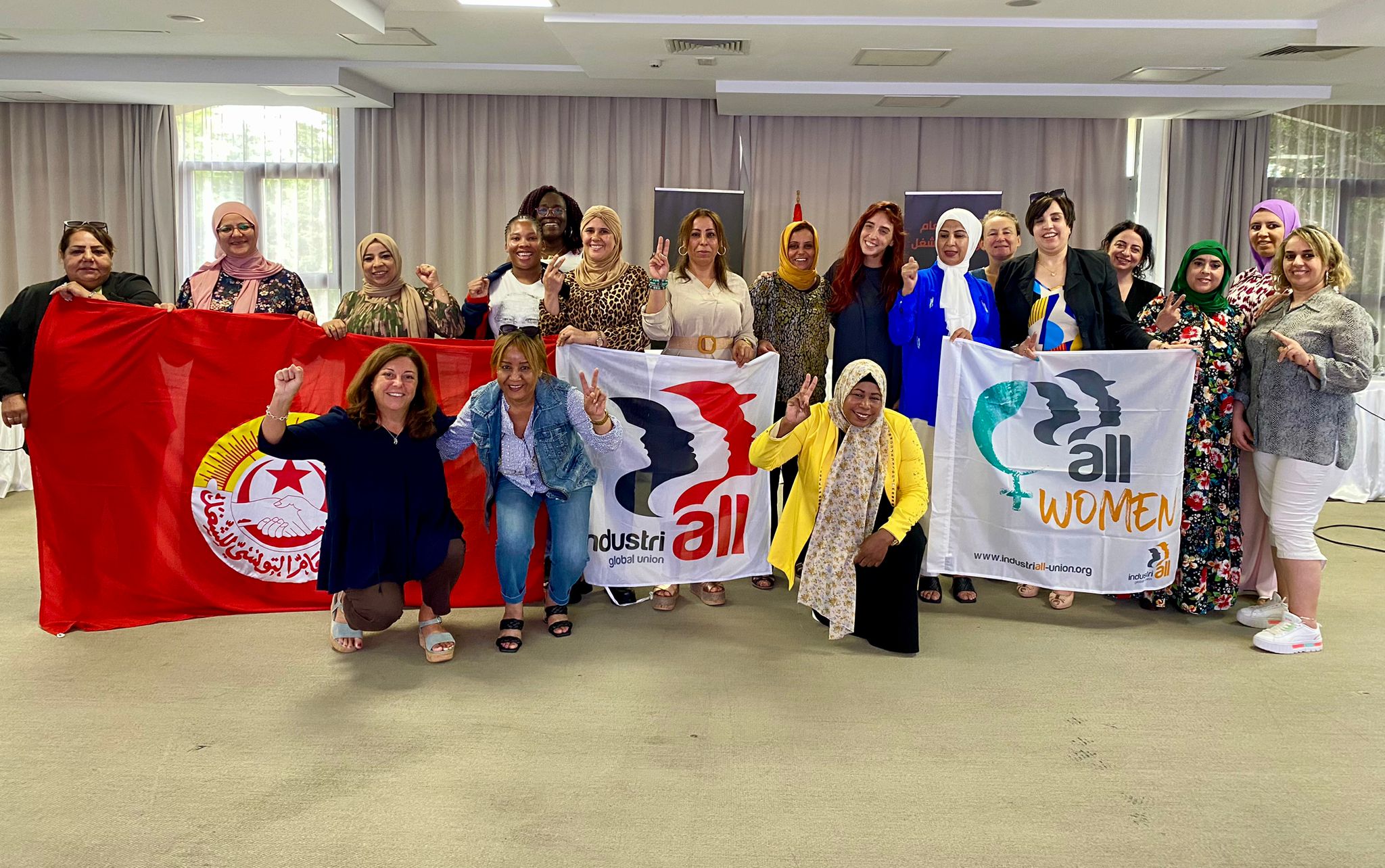
New centre for Tunisia’s women garment workers

Welcoming the opening of the women’s centre, Christina Hajagos-Clausen, IndustriALL textile and garment director, said: 

“This is about shining a light on the challenges women in the garment sector face daily—whether it's issues around occupational health and safety or gender-based violence and harassment (GBVH). Workers deserve access to remedies, and we are acting in line with international conventions, including ILO C190, to ensure that they get that."

FGTHCC-UGTT general secretary Habib Hazemi stressed the need for awareness raising and educating women workers about their rights.

IndustriALL regional secretary Ahmed Kamel said:

"This is another step forward in the implementation of our action plan to support women workers in the industrial sector and a unique initiative to use the GFA in the region. Our sister leaders of IndustriALL MENA women network and IndustriALL Tunisian women network fight every day for more space for women. We trust that this new centre will contribute to the promotion of women's actions and the workplans of the respective women's structures."

Emphasizing ASOS’ commitment, as well as the importance of the centre, Ceren Isat from ASOS’ human rights department, said:

“We’re proud to be part of this project. This will be a place where women can access the support they need, including legal advice, and feel empowered to stand up for their rights,”

In 2017, IndustriALL signed a global framework agreement with ASOS. The women’s centre is part of a larger effort, ensuring women in the garment sector have the support they need to fight for better conditions and fair treatment. ASOS’s sponsorship of the women’s centre aligns with the company’s Fashion with Integrity strategy, which aims to address human rights issues throughout its supply chain.

Speaking about the company's broader goals, Adil Rehman, head of human rights at ASOS, said:

“For us, it's not just about ticking a box when it comes to corporate social responsibility. We’re committed to making real progress by investing in resources on the ground and ensuring long-term sustainability.”

Unions unite for women’s rights

The centre was opened during the MENA textile workers’ week, which included a women’s meeting and session on promoting women engagement and leadership in TGSL unions.

At the meeting, global issues facing women in the garment industry were brought to the forefront. Delegates from across region and Africa spoke about the harsh realities women face.

Women union leaders from Palestine, Morocco, Tunisia and Jordan emphasized women’s exposure to violence in the workplace and the need for creating space and power for women inside the unions, as well as in the workplace. There is not enough legislation protecting women, and where there is, enforcement is often lacking. Unions are calling for the ratification of ILO C190.

A representative from Mauritius pointed to the poor sanitary conditions in some factories, where hundreds of workers are forced to share a single toilet.

In Lesotho, sexual harassment and exploitation is rife in the industry. Last year, the country ratified ILO Convention 190 and a new occupational health and safety law has been introduced. This, along with national committees focused on ensuring compliance in companies, is giving trade unions the tools to fight back.

Lieketseng Leteka from Independent Democratic Union of Lesotho provided key points on the need to ensure an enabling environment for women workers to report violence and harassment at work. She noted that it is important to make women feel safe by establishing a system that takes into account workers native languages, provides expert councilors/educators and a functioning grievance mechanism.
Malawi: Conference strategizes on skills training in just energy transition

The conference emphasized on technical and vocational skills training in the renewable energy sector in Malawi which includes solar and wind, highlighting the Zantchito – Skills for jobs programme which is providing short-term vocational skills training courses on renewable energy which also caters for small to medium-sized enterprises. The training is being held jointly with trade unions as represented by the Malawi Congress of Trade Unions and the Malawi Technical Entrepreneurial and Vocational Education and Training Authority (TEVETA) includes the installation of solar panels and on renewable energy technologies. The conference highlighted that this is key to upskilling and job creation during the energy transition.
 
The skills training supports Malawi’s national energy policy which aims to increase affordable and reliable access by improving electricity access by 80 percent in 2035 through investment in solar and other renewable energy sources. Further, the policy aims to reduce the energy deficit through investments in decentralized mini-grids, independent power producers, and energy technologies. Currently only 15 percent Malawians have access to electricity. This leaves over 15 million Malawians without electricity access and relying mainly on biomass – firewood, charcoal, and crop residue – for cooking according to government reports.
 
Malawi’s energy mix is dominated by hydropower which generates 95 percent of electricity and renewable energy that includes solar and geothermal, imported petroleum-based products such as liquefied petroleum gas, and biomass. However, hydropower is vulnerable to floods and droughts.
 
There were also discussions on the challenges of the unbundling and privatization of state-owned enterprises in Malawi, South Africa, and Zimbabwe and the implications on trade union organizing.
 
Over 50 participants who participated at the conference were drawn from Kenya, Malawi, Tanzania, South Africa, and Zimbabwe. The conference was supported by the United Federation of Danish Trade Unions (3F) and other partners including the British Council, Danish Industries, Danish Trade Union Development Agency (DTDA), and the European Union who are also supporting the skills training programme.
 
Other organizations that participated in the conference are the ministry of labour, Ministry of Energy, Employer Consultative Association of Malawi (ECAM), Malawi power utility Electricity Supply Corporation of Malawi (ESCOM), Electricity Generation Company of Malawi (EGENCO), Malawi Energy Regulatory Authority (MERA), TEVETA, Mzuzu University, and others.
 
The Sub-Saharan Africa regional office and IndustriALL affiliates from Ghana, Malawi Zimbabwe and participated in the conference. The conference was hosted by the ESCOM Staff Union (ESU) while other IndustriALL affiliates in Malawi – the Chemical Energy Mining and Allied Workers Union (CEMAWU) and the Textile, Garment, Leather, and Security Services Workers Union (TGLSSWU) also participated. ESU is part of the Sub-Saharan Africa Energy Network (SSAEN).
 

“The conference welcomed feasibility partnerships with TEVETA on green energy transition learning from a practical project under the European Union,”

said Bjorn Haar, 3F programmes coordinator.
 
William Mnyamula, ESU secretary general said:
 

“The just energy transition is a crucial topic in global and African development, and in Malawi as it focuses on sustainable, affordable, and long-term energy solutions critical to achieving sustainable development goals (SDGs).”

“Skills development is an integral part of the energy transition as new jobs are created in the renewable energy sector, and it is critical for unions and vocational training colleges to work together as is currently happening in Malawi,”

said Paule France Ndessomin, IndustriALL regional secretary for Sub-Saharan Africa.

Photo: Shutterstock
 

Making the textile and garment industry in MENA and Africa safer

In his opening remarks, UGTT general secretary Noureddine Taboubi welcomed participants and stressed the union's commitment to work for legislation that strengthens human and labour rights. He was joined by Habib Hazami, general secretary of Tunisia's General Textile Federation who reiterated that occupational health and safety is a fundamental pillar of the union's work in the country's textile and garment sector.

The textile and garment industry represents hundreds of thousands of workers in the MENA region. This year marks ten years of IndustriALL work in the sector in the region.

Says IndustriALL regional secretary Ahmed Kamel:

"When we started, workers faced issues on collective bargaining, the right to organize, occupational health and safety, sectoral agreements and precarious work. After ten years of intensive work together with our affiliates, we have addressed many issues and see an increasing participation of women and youth, implementation of global framework agreements, social dialogue with brands that produce in the region.

"But the main challenge is the sustainability of the work we have achieved, like women participation at union leadership positions, industry wide agreements, and incorporation of legally binding agreements like the International Accord."

The meeting heard of serious challenges to health and safety from participating unions. The situation in Ethiopia's textile and garment sector is alarming, where massive retrenchments are causing suffering and increasing poverty among garment workers.

Wage theft is a recurring problem in the sector throughout the whole region, as is gender-based violence and harassment. Not least in Lesotho where female garment workers are often asked for sexual favours in exchange for jobs.

But despite a dire picture, women in Lesotho now has a framework to come forward and report GVBH, thanks to a partnership co-chaired by the US government and the ITUC. This has led to progress in addressing GBVH violations in the factories. In addition, the country has adopted a new labour code and has also ratified ILO Convention 190.

Showing how addressing wage theft through collective bargaining, IndustriALL regional secretary Paule Ndessomin shared the example from South African union SACTWU.

"The CBAs they have negotiated for the sector allow for the maintenance of living wages and better working conditions. The agreements are also extended to non-union members."

In both Jordan and Mauritius, migrant workers make up a large part of the workforce in the industry. Migrant workers in Mauritius don’t benefit from same laws as domestic workers; as they don’t contribute to social protection, at the end of their contract, workers don’t benefit from pension etc. Health and safety conditions are often ignored, with some workers getting injured at work while squalid conditions in workers dormitories are common. To counter exploitations, in 2022, IndustriALL affiliate CTSP and ASOS teamed up together with Anti-Slavery International to open a migrant resource centre.

A lack of standards and dated labour laws form part of the challenge with occupational health and safety in Morocco and Tunisia. Although Tunisia has ratified ILO C187 OHS, unions say the Convention has yet to be translated into practice.

What is needed for the textile and garment industry to become safer?

In 2022, the ILO adopted a resolution making a safe and healthy working environment a new fundamental principle and right at work. As the declaration is universal, it means that ILO member-states have an obligation to respect, promote and realise the principles concerning fundamental rights.

Beatriz Cunha, sectoral specialist at the ILO presented the ILO code of practice for textile and garment industry, a reference for guiding industrial practices that has been translated into 15 languages. Although not legally binding, among other things, unions can use it to
raise awareness of the importance of safety and health, to identify the main risks in the sector or workplace, and to provide guidance for the development and negotiation of control measures to address risks.

The OECD due diligence guidance for responsible supply chains in the garment and footwear sector recommends that businesses engage workers and trade unions on labour rights through the six steps of the due diligence framework, and uphold rights of freedom of association and collective bargaining.

Says Christina Hajagos-Clausen, IndustriALL textile and garment director:

“IndustriALL’s campaign Garment workers need safe factories continues. We need legally binding agreements in the sector and continue to advocate for due diligence legislation and working to raise institutional investor awareness and encourage investors to engage their companies to become signatories.”

The International Accord for Health and Safety in the Textile and Garment Industry was established in 2013 following the tragic Rana Plaza factory collapse in Bangladesh, which claimed the lives of more than 1,100 garment workers who didn't have the right to refuse unsafe work. Reflecting on the progress in Bangladesh, Clara Kamphorst from the Accord told participants that to date the Accord has

In 2022, the Accord was extended to Pakistan, where it

Says IndustriALL general secretary Atle Høie:

"The textile and garment sector has experienced some of the worst tragedies in the world of work, making the work on occupational health and safety even more critical. Listening to participants, this meeting has shown that there are similar challenges in all countries in both MENA and Sub-Saharan Africa. This provides a strong incentive for further cooperation to find solutions.”

Labour inspection exposes sexual exploitation at Dharm Cutting Works Botswana

Dharm’s whose head office is in India which is its top sourcing country for the diamonds.
 
After a complaint was made by Botswana Diamond Workers Union (BDWU), an IndustriALL affiliate, to the ministry, labour inspectors carried out an investigation at Dharm and interviewed six women workers who were sexually harassed. The inspectors also interviewed three women, who have since left the company because of the sexual harassment by the manager who has since been suspended pending an investigation.
 
According to the inspectors’ report, the forms of sexual harassment brought against the general manager included rape, inappropriate touching and quid pro quo sexual harassment – which happens when employment, pay, and benefits are promised on condition of submitting to unwelcome sexual advances. In one of the incidences, cited in the report, the general manager sexually harassed some diamond polishers after asking them to clean his house. The inspectors said this violated the National Industrial Relations Code of Good Practice (Models Procedures and Agreements) 2006 which defines sexual harassment as “persistent, unsolicited, and unwanted sexual advances or suggestions by one person to another. There is a clear case of sexual harassment, and the perpetrator is the general manager.” 
 
The inspectors wrote that the manager used his financial power to sexual harass the workers in violation of even the company’s human resources manual. The manual, which aims to stop sexual harassment, states that “sexual harassment includes conduct of a sexual nature, including unwelcome jokes, touching, comments, pornographic displays and the like which unreasonably interferes with an employee’s ability to perform his or her job because of the hostile environment.”
 
Further, the inspection condemned the inclusion of the general manager in the investigation of the sexual harassment and questioned how an alleged perpetrator can play a dual role as “player and referee.” “By sitting through the proceedings of an investigation against him he pre-empted the findings of the investigation and rendered the process null and void,” states the report which was sent to Dharm. 
 
Beside sexual harassment the inspection report also mentioned that Dharm had restored workers benefits that it had withdrawn without engaging with the union.
 
Dominic Obusitse Mapoka, BDWU chairperson said: 

“While we welcome the action taken by Dharm against the general manager, we look forward to the adoption of workplace policies to curb sexual harassment. As a union, we are hoping for an amicable solution on other issues that we have raised with the ministries of labour and home affairs.”

“It is shameful that a general manager who is supposed to provide oversight on sexual harassment is the perpetrator. We applaud the BDWU for standing up for the rights of women workers against sexual harassment and for taking up this issue with the ministry of labour and social protection,”

said Paule France Ndessomin, IndustriALL regional secretary for Sub-Saharan Africa.

Photo: Shutterstock

Belgian and Malagasy unions cooperate on building union power

The critical role of international trade union solidarity was emphasized at a union building workshop in Tamatave, 20 and 21 August. Additionally, the workshop stressed on the importance of locating Just Transition debates within a workers’ rights framework that included women miners’ rights at work. Malagasy unions campaign for the ratification of International Labour Organization (ILO) Convention 190 to end violence and harassment in the world of work were also highlighted. Further, there were recommendations on the government of Madagascar to implement national labour laws including the mining code to enhance decent working conditions.
 
The participants included three union leaders from CSC-BIE and mine workers from Ambatovy’s nickel-cobalt mining sites in Moramanga and Tamatave. The mineworkers are members of Syndicalisme et Vie des Societes (SVS). Both CSC-BIE and SVS are affiliated to IndustriALL Global Union. Besides Madagascar, CSC-BIE also supports human rights due diligence along the supply chains in Sub-Saharan Africa and union building activities in Senegal that include innovative recruitment and organizing.
 
The workshop discussed how the energy transition from high carbon to low carbon economies impacted on workers and communities in Madagascar and is an opportunity to build union power. Participants also mentioned that Madagascar is a producer of cobalt, nickel, ilmenite, and chromium ores – which are some of the critical minerals needed for the energy transition. Additionally, the beneficiation of these minerals had potential to create decent jobs and spur economic development on Africa’s biggest island.
 
The workshop emphasized on increased efforts to recruit more members to the union. For example, there were recommendations for unions to develop a gender responsive organizing strategy, to counter discrimination when hiring women and increase women’s access to unions. The strategy would also include minimum living wages, ending precarious working conditions for women, and reducing the gender pay gap.
 
On human rights due diligence, Jan Franco, CSC-BIE international officer, said:

“This is an approach that unions can use to discuss Just Transition plans. The importance of human rights due diligence is that it addresses labour violations along supply chains, and seeks remedies from the violating companies or businesses, and that cases can also be heard in European courts.”

In May the European Union approved the EU Corporate Sustainability Due Diligence Directive.
 

“Global solidarity on trade union organizing is key to cooperation between unions in the global north and global south. It gives the labour movement the chance to learn and reflect from experiences in different countries that are far apart and yet committed to advancing workers’ rights and interests,”

said Paule France Ndessomin, IndustriALL Sub-Saharan Africa regional secretary.

Top Nigerian union leader faces terrorism charges

The letter warned: “Be informed that in the event of failing to honour this letter, this office will have no alternative than to activate a warrant of arrest.” 
 
In reply, NLC lawyers said that the police must explain the “details and nature of the allegations” and that Ajaero will go for the interview on 29 August.
 
The charges Ajaero face arise from trade union participation in national mass action against the cost-of-living crisis whose social media identity is #EndBadGovernanceInNigeria. 
 
However, the government’s heavy-handed response led to the death of 13 protestors and the imprisonment of several others. Nigerian workers took to the streets as they are facing increasing financial hardships because of high inflation of over 34 per cent, underemployment, low wages, and high poverty. This was worsened by the removal of petroleum subsidies which led to price hikes. As some of the ways to ease workers’ plight, the unions are demanding economic policies that will lead to economic development, industrialization, and the creation of decent jobs.
 
The unions see the letter from the police as an act of continued harassment of leadership of the Nigeria Labour Congress and other labour leaders. “We view this as a calculated attempt to weaken and destabilize the labour movement, which has always stood as a bastion of democratic principles and the voice of the Nigerian masses,” wrote the NLC in a statement.
 

“IndustriALL urges the Federal Government of Nigeria and the police to stop the repressive actions and intimidation against trade unions and civil society organizations. Instead, the government must engage in meaningful social dialogue with trade unions, and take necessary actions to stop this injustice,”

said Atle Høie, IndustriALL general secretary.

Ajaero is also the general secretary of the National Union of Electricity Employees, an IndustriALL Global Union affiliate. Other IndustriALL affiliates in Nigeria organize in the chemical, energy, engineering, oil and gas, ship building and ship breaking, textile and garment, and other sectors.
 

Madagascar young workers strategize on peer recruitment

They argued that young workers had inadequate information about trade unions that can attract them to join. Yet the youth could be reached through social media messages, and be invited to union meetings, discussion groups, sports events, and other social events where music was played.

The training workshop heard that there is a demographic shift in the trade union movement in Madagascar with some unions now having over 50 per cent of their members below the age of 35. 

The United Nations(UN) has described this as a “demographic dividend” which will benefit trade unions as well. According to the UN a demographic dividend can result in increased economic growth when better educated and skilled young workers enter the labour market. Some of these skills include digital skills needed for platform economies that are being established in Madagascar as confirmed by the participants.
 
The importance of trade union transformation that included young workers in union activities through increased participation, representation, integration, and capacity development through worker education was also on the agenda. The transformation should also include gender equality as young women were the majority in some industries that included the textile and garment sector.
 
Discussions highlighted the importance of enhancing trade unions' understanding of the changing world of work which is influenced by digital technologies, and that trade unions should continue the fight against precarious working conditions that disproportionately affected young workers. 

The young workers should also fight for fundamental rights at work specifically trade union rights and collective bargaining as well as campaigning for job creation and against drug addiction especially among unemployed youth. 

Tree planting was given as one of the activities that young workers can do in the communities in which they live. The youth should be involved in climate change,  through their union activities on the Just Transition from high to low carbon economies.

Leontine Mbolanomena, IndustriALL national project coordinator for Madagascar said:

“We continue to encourage the youth especially the young women that the union is their organization and that they are the future leaders. In our meetings we are ensuring that young workers have access to information about the labour laws and regulations as well as appraise them on international campaigns for trade union rights.”

Paule France Ndessomin, IndustriALL Sub-Saharan Africa regional secretary said:
 

“The changing demographics in the union, with young workers becoming the majority, is something that must be embraced in the context of the changing world of work. The trade unions in Madagascar and in Africa must ensure that the youth are catalysts in this transformation.”

The 22 participants were from IndustriALL affiliates Federation des Syndicats Autonomes des Travailleurs de l’Industrie (FESATI), Federation de Syndicat des Travailleurs des Entreprises Frances et Textile (SEMPIZOF), and Syndicalisme et Vie des Societes (SVS) that organize workers in the mining and textile and garment industries.
 
The workshop was held with support from IndustriALL affiliate, ACV-BIE, Belgium, as part of the union building project.


Botswana: Union fights union busting in the diamond supply chain

In letters written to government departments, including the ministries of labour and social security and home affairs, the Botswana Diamond Workers Union (BDWU) wants an end to workers’ rights violations on the diamond cutting and polishing supply chain.
 
For instance, the companies employ migrant workers whom they pay low wages are in violation of the immigration and labour laws. The companies also ignore dispute resolution mechanisms. When it comes to union recruitment and recognition, the companies victimize workers, while others are dismissed or retrenched for joining their chosen union. Even where the union meets the requirements to be recognised by the employer at the factories, as per labour laws, often the union must fight the employer for compliance.
 
Although, the BDWU, an IndustriALL affiliate, approached the labour inspectorate to conduct inspections and assist in resolving the disputes. The union was surprised that the report from the inspections omitted some of the union’s grievances which included deteriorating working conditions in long working hours, non-payment of overtime, and removing benefits without engaging with workers. For example, at Dharum Cutting Works the employer withdrew attendance bonuses, transport allowances, medical aid, and performance bonus.
 
In the diamond manufacturing industry, there is also non-compliance with occupational health and safety standards, disregarding the employment of locals and skills training, increasing sexual harassment, precarious working conditions in which short contracts were used to deter workers from joining the union, and reduction of wages. Additionally unfair dismissals and retrenchments were common. These grievances were highlighted at the IndustriALL global diamond network meeting in Lesotho in February, this year.
 
The union’s proposals for social dialogue with the Diamond Hub, the Botswana Diamond Manufacturers Association, De Beers Botswana, and Business Botswana were ignored. However, the BDWU maintains that social dialogue will assist in improving working conditions.
 
The union gave examples of the offending companies which include Venus Jewel Botswana where the labour inspectors intervened for the union to be recognised.

At Yerushalmi Bros Diamond Botswana, where the union has a recognition agreement, there is engagement to end violations. At Dharum Cutting Works Botswana cases of sexual harassment were reported by the union to the ministry of labour. According to a report by the labour inspectorate, at Dharum, a general manager sexually harassed workers through inappropriate touching, unwanted sexual advances, sexual solicitation and overtones and graphic comments.
 

“The diamond cutting and polishing sub-sector needs urgent attention or else our diamonds will be tainted by the increasing workers’ and human rights violations. The union calls upon the ministries of labour and home affairs as well as other relevant departments to act swiftly and ensure compliance on workers’ rights,”

said Dominic Obusitse Mapoka, BDWU chairperson general.
 
Paule France Ndessomin, IndustriALL regional secretary for Sub-Saharan Africa said:
 

“The union busting in the diamond manufacturing in Botswana is appalling. The diamond cutting and polishing companies must respect trade union and workers’ rights. Further, the companies must protect women workers against sexual harassment. We commend the BDWU for a sustained fight for workers’ rights.” 

Armed forces raid Nigerian union offices amid protests

The break-in and occupation of the union offices occurred following weeklong national protests aimed at addressing the rising cost of living, which unions argue is leading to hunger and poverty in Africa’s most populous country. Armed forces have occupied the offices and refuse to leave. The ransacking took place on the same day as an NLC meeting, where the ongoing mass protests under the social media handle #EndBadGovernance were discussed.

During the meeting, the NLC highlighted that freedoms of assembly, association, expression, and speech were under threat, citing that police and security forces shot and killed 13 protesters and injured several others.

“The NLC condemns in the strongest terms the human rights violations perpetrated by security forces against peaceful protesters. The right to protest is a fundamental democratic right, and its suppression through violence is unacceptable. The attempt to criminalize protest is deplorable, especially in a democracy. The hiring and use of sponsored thugs and divisive propaganda to scuttle the protests is unfortunate,” the NLC said in a statement.

The mass action began when the government removed petroleum subsidies, sparking immediate protests from trade unions in 2023, including a national shutdown in June this year.

Furthermore, the NLC stated that the government must address the grievances of the workers and the people rather than resort to violence. It stressed that the government’s policies, backed by the International Monetary Fund (IMF) and World Bank, were bringing misery to the people. According to the FGN’s National Bureau of Statistics, 63 per cent or over 133 million people face multidimensional poverty, which includes cooking with dung, wood, or charcoal rather than cleaner forms of energy. Additionally, there is inadequate access to healthcare, limited sanitation, food insecurity, and poor housing. The recently agreed-upon minimum wage of 70,000 Naira ($USD44) is not a living wage.

Joe Ajaero and Emmanuel Ugboaja, the NLC president and general secretary respectively, emphasized:

“We must maintain our commitment to non-violence and ensure that our actions are lawful and disciplined. The NLC remains committed to defending the rights and welfare of Nigerian workers and the broader population. We will not relent in our efforts to ensure that justice, equity, and good governance prevail in our nation.”

 Ajaero is also general secretary of the National Union of Electricity Employees (NUEE), which is affiliated with IndustriALL Global Union.

 “The Federal Government of Nigeria must respect workers and human rights and stop the violence and intimidation. The government must also engage with the unions in social dialogue to find ways to end the crisis,”

said Paule France Ndessomin, IndustriALL regional secretary for Sub-Saharan Africa.

IndustriALL affiliates that are members of the NLC include the National Union of Chemical, Footwear, Rubber, Leather, and Non-Metallic Employees (NUCFRLANMPE), National Union of Petroleum and Natural Gas Workers (NUPENG), National Union of Textile, Garment, and Tailoring Workers of Nigeria (NUTGTWN), and Steel and Engineering Workers of Nigeria (SEWUN).

Unions fight new Mauritius law exploiting migrant workers

In Mauritius, many migrant workers are trapped in debt bound to agents, repaying loans taken to cover exorbitant recruitment fees. Others endure appalling living conditions and face unfair labour practices and intimidation from employers, exposing them to forced labour.

Most migrant workers in Mauritius are employed in manufacturing, including textile and garment industries. They come from countries such as Bangladesh, India, Madagascar, China, Sri Lanka, and Nepal.

IndustriALL affiliate, the Confederation des Travailleurs des Secteurs Publique et Prive (CTSP), is actively campaigning against the amendments. The changes would exempt employers from contributing to migrant workers' retirement funds and social protection schemes. In protest, the union plans to picket outside the Ministry of Labour offices on 10 August, marking the United Nations World Day Against Trafficking in Persons.

Mauritian laws stipulate that migrant workers should enjoy the same terms and conditions of service as local workers. This includes protection under the Workers’ Rights Act (2019), which safeguards against discrimination based on gender, race, nationality, and sexual orientation.

The Employment Relations Act (2008) guarantees freedom of association, the right to organize, and collective bargaining. Additional laws protect workers' occupational health and safety rights.

According to the CTSP, the amendments undermine existing collective bargaining agreements and propose to reduce migrant workers' salaries by up to 20 per cent for work of equal value.

“Labour contractors will not contribute anything towards social protection and pensions, yet they will enjoy guaranteed cheap labour. Unions are against models that rely on cheap labour to the detriment of migrant workers,”

said Reeaz Chuttoo, CTSP president.

Paule France Ndessomin, IndustriALL regional secretary for Sub Saharan Africa, emphasised:

“There is a need for social dialogue between the government, unions, and other stakeholders on the implications of these amendments. Laws should strengthen existing legislation, not undermine it. It is commendable that the CTSP has consistently protected workers’ rights in Mauritius through the Migrant Resource Centre, which the union operates at its office building.”