Women in mining and energy map out path from participation to power

The conference was the first to bring women from both sectors together. It follows IndustriALL’s last Global Women in Mining Conference in 2021 and the adoption of the feminist resolution at IndustriALL’s 2025 congress.

Key takeaways

From participation to transformation

Opening the conference, IndustriALL Women’s Committee co-chair Regina Nambahu said the goal was not simply more women in the sector:
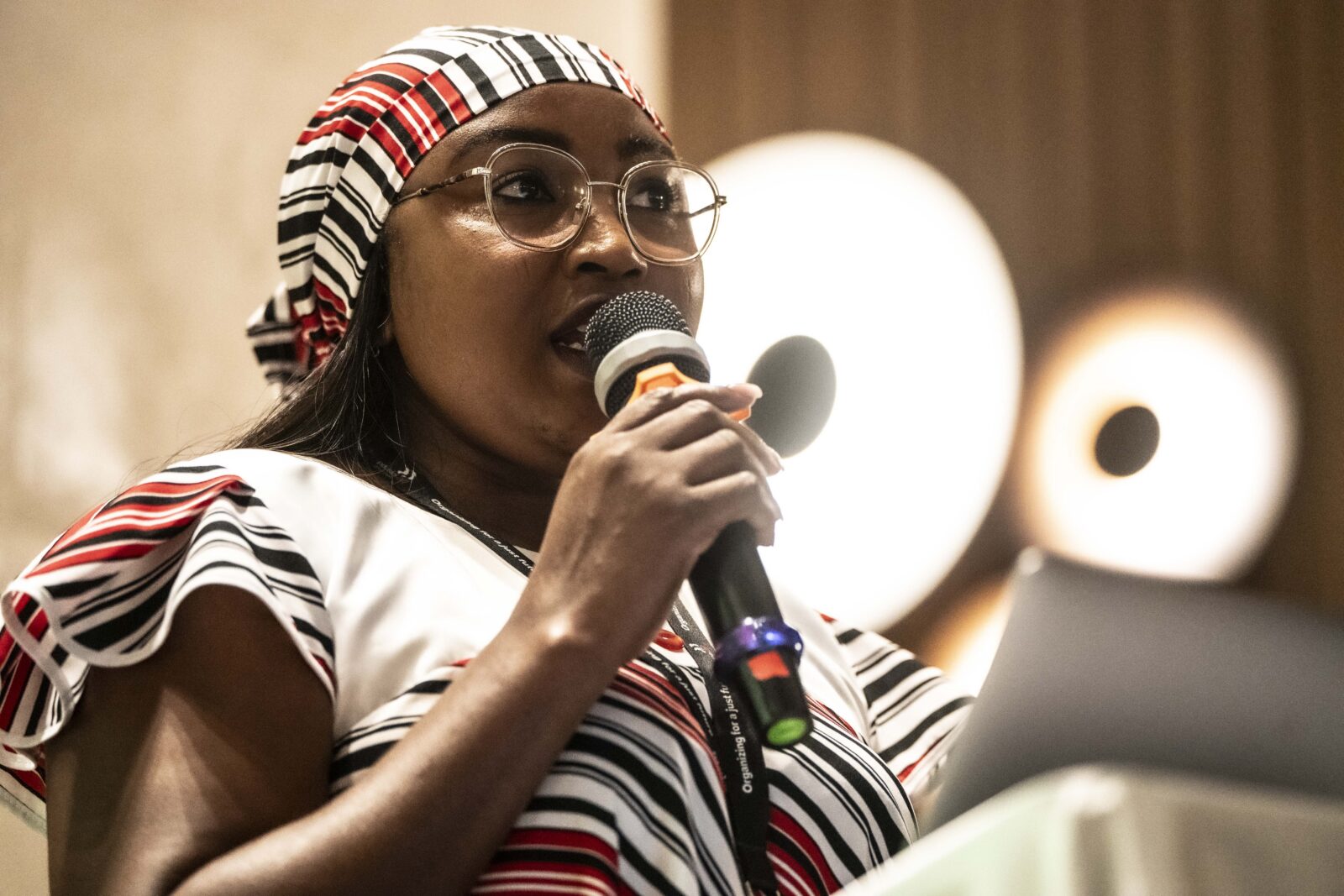
Regina speaks at opening of Women in Mining and energy conference

“We do not just want participation, we want transformation.”

She challenged participants to ask who sits at the negotiating table, who benefits from the energy and technology transition and who is always left out. Moderator Paule France Ndessomin, IndustriALL regional secretary for Sub-Saharan Africa, added a further question: why?

IndustriALL assistant general secretary Kemal Özkan described an inequality emergency in the world, with gender at its heart. IndustriALL assistant general secretary Christine Olivier said a gender-transformative approach means changing the systems themselves:

“Women should not simply be expected to fit into systems that were designed without them and not for them.”

Where women stand

Speakers agreed that the data on women in mining is incomplete. Olivier cited a 2024 International Women in Mining report which found that 35 of the top 100 mining companies studied did not publish gender-disaggregated workforce data. Among those that did, women made up only about 15 per cent of the workforce.

Camila Pereira Rego Meireles of the International Labour Organization (ILO) said the key question is not only how many women work in mining, but what jobs they do and whether they have an equal voice. Women face a “leaky pipeline”, with their numbers falling mid-career due to long shifts, remote sites, inadequate facilities and PPE and unequal access to training.

She warned that the boom in demand for critical minerals will not automatically deliver equality:

“The mine of the future is not predetermined. It is still being negotiated.”

Courtney Smith of the Mining and Energy Union (MEU) in Australia said public gender targets can backfire when employers fail to invest in training and inclusive workplace cultures. In Australian mining, women hold only 16 per cent of jobs in the highest-paid quarter.

Violence and harassment is a safety issue

Speakers returned repeatedly to gender-based violence and harassment. Meireles said ILO Convention 190 on violence and harassment covers far more than the mine site, including camps, transport and the journey to work.

Participants raised the killings of 11 women in Ekurhuleni, South Africa and asked Anglo American what it is doing to protect its workers. Tana Van Straaten of Anglo American’s Living with Dignity Hub described measures including safe company transport, avoiding early and late shifts for vulnerable workers and trauma counselling.

“Women feel that asking them to be careful is not good enough,”

she said.

Smith said class actions in Australia raised a serious question for the whole industry: can a woman who reports harassment trust she will be protected rather than punished?

In the plenary, a participant from the National Union of Mineworkers (NUM South Africa) described a woman worker being strip-searched, which participants condemned as degrading and unacceptable. Others said rights are most eroded among subcontracted workers and that many women still do not feel safe raising concerns.

Making hidden health risks visible

Dr Vincent Kouame, a senior public health physician, said occupational diseases kill far more workers than accidents, but often go unrecorded. Women’s exposure is overlooked because they often work in jobs seen as secondary, such as cleaning near crushers or in laboratories.

“Just because a disease is not recorded, does not mean it is not occupational,”

he said.

On pregnancy, his message was clear: act on the hazard, don’t exclude the woman.

Gender expert Dr Amanda Odoi warned that extreme heat is now unavoidable and some responses make things worse for women. Heat tolerance screening could push women out of underground work, while toilet access and ill-fitting PPE lead some women to avoid drinking water. She called for cooling rights for all workers, PPE designed for women and non-punitive rest breaks.

Bargaining for change

IndustriALL director of mining and energy Emmanuel Adjei-Danso set out how unions can use collective bargaining to advance gender equality:

“Feminism is not a fight against men. It is a fight against patriarchy,”

he said.

Özkan urged affiliates to share model collective agreement language on gender-based violence. He said the gender pay gap is narrower where there is a union and a collective agreement.

Ndessomin said IndustriALL can provide training and expertise, but change depends on unions at the workplace:

“The emphasis is on how strong you are as a union in the workplace.”

What happens next

Sub-Saharan Africa: Nothing for women without women

A resolution born in the region

IndustriALL’s feminist resolution, born in the sub-Saharan Africa’s feminist schools, was adopted unanimously at the 2025 Congress in Sydney.

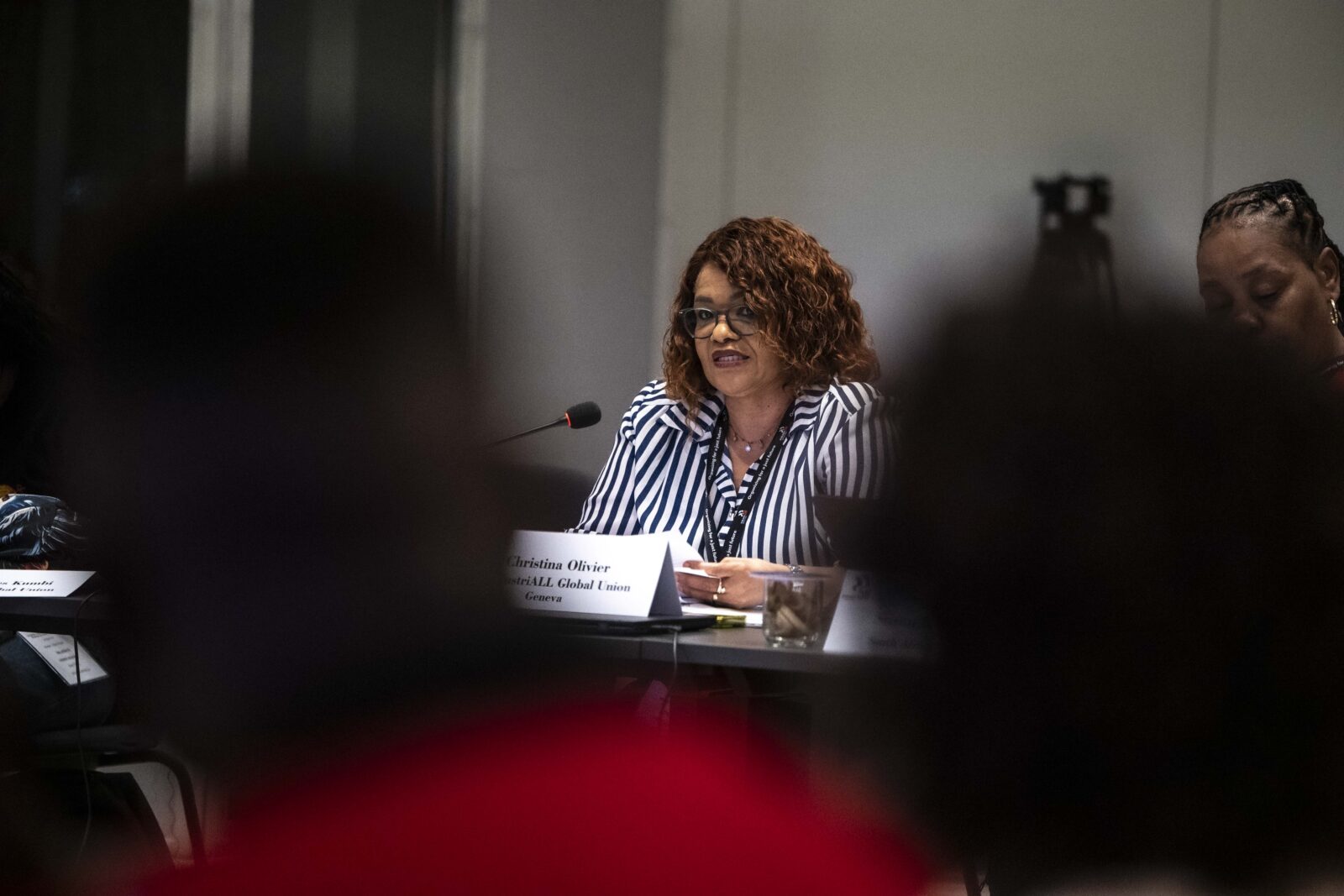
IndustriALL assistant general secretary Christina Olivier said the resolution goes further than a standard gender policy:

“It is not only about getting women in the room. It is about changing the room, changing the rules and changing who has power.”

She said feminist trade unionism must shape collective bargaining, health and safety, care work, the Just Transition and corporate accountability. Union budgets, programmes and leadership development must also reflect that commitment.

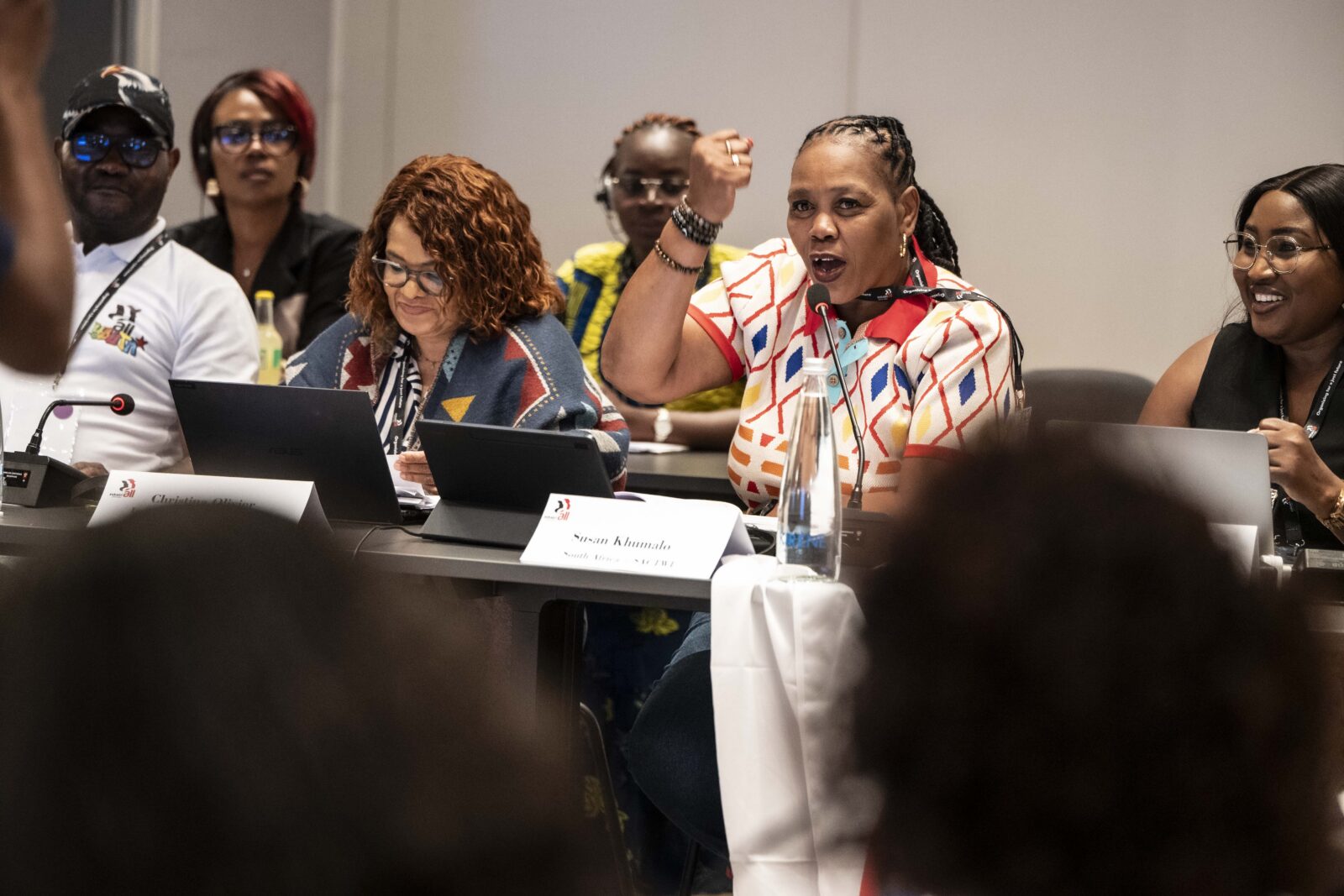
IndustriALL Sub-Saharan Africa co-chair Susan Khumalo said the region has moved beyond a focus on quotas and representation towards a gender-transformative agenda.

Susan Khumalo SSA women's committee Abidjan 2026
Susan Khumalo speaking at IndustriALL’s sub-Saharan Africa regional women’s committee meeting in Abidjan, Côte d’Ivoire.

Gender sensitive or gender responsive?

Regina Nambahu of the Mineworkers Union of Namibia (MUN), co-chair of the regional women’s committee, said the challenge now is implementation:

“It is not just a theme. It is a political commitment, a call to action.”

She asked the 60 delegates in the room to consider what would change for women workers as a result. Would women gain greater access to leadership? Would workplaces be free from sexual harassment? Would gender equality show up in collective bargaining?

IndustriALL regional secretary Paule France Ndessomin used the example of a breastfeeding room at a mine site in Ghana. Installing the facility may be gender sensitive. Being gender responsive means first asking women what they need. Do women actually want to breastfeed on a mine site?

Participants were clear about where past efforts went wrong: measures for women were introduced without consulting them. Nothing can be done for women without women.

Agnes Ama Agamasu said the region is driving the feminist agenda, but not everyone understands it yet, including some in union leadership. Women should expect resistance and build resilience to meet it.

Some leaders act as gatekeepers of patriarchy, she warned, using language to shut women out. But women don’t need feminist theory to fight for their rights, because their working lives already teach them what they need to know.

The task, she said, is to break the agenda down so that every sister can see herself in it. Many of the demands women already make, such as menstrual leave, are part of the gender-transformative agenda.

“Sometimes you don’t need to go and read the whole book.”

She acknowledged that not every woman will back another woman. But women face the same struggles across the region, and that common cause unites them.

When a woman identifies a need, she said, it is real, and it does not need validation from men.

Different countries, shared struggles

Although national contexts differ, the stories from across the region showed how similar the issues are:

The region’s mentorship programme supported by LO Norway currently has six mentors. Two of them were mentees who completed the programme last year and are now mentoring others.

A fight that cannot stop

The meeting took place as anger grew in South Africa over the killings of eleven women whose bodies have been found in Ekurhuleni, east of Johannesburg, since July.

IndustriALL sub-Saharan Africa co-chair Susan Khumalo told the meeting that

“Comrades, eleven women were brutally killed in South Africa. These are our sisters, our daughters and our mothers. While poverty, inequality and unemployment remain rife, it is women who carry the heaviest burden, at home, in our communities and at work. As women, we have a responsibility to channel our own issues, and we will not stop fighting until every woman is safe.”

For the women in the room, the killings were a painful reminder that gender-based violence is not a distant issue. It shapes women’s lives at home, in their communities and at work. Ending gender-based violence and harassment is one of the priorities of the regional action plan. It commits affiliates to campaigns on ILO Convention 190, workplace policies, training for workplace representatives and survivor-centred support systems.

The action plan

The meeting reviewed a regional action plan for 2026 to 2029, to be approved by the regional executive committee. Its priorities are: women’s mobilization and leadership, engaging men as allies, pay equity, gender-based violence and harassment, gender-transformative occupational health and safety, gender-responsive human rights due diligence, unpaid care work, maternity protection and confronting anti-feminist backlash.

Once approved, affiliates will develop national and workplace action plans. The plan will be a living document, reviewed every year.

Nambahu said:

“The women workers of sub-Saharan Africa are not asking us for promises, they are asking us for action.”

Young workers in Abidjan demand a say in the Just Transition

New youth-led research presented at the workshop reveals deep inequalities facing young workers in mining and energy in the DRC, South Africa and Zimbabwe.

The workshop, held under the theme “Promote inclusivity in the world of work”, opened a week of regional meetings.

“Do not wait for permission to lead”

IndustriALL assistant general secretary Christina Olivier addresses young trade unionists at the opening of the sub-Saharan Africa youth workshop in Abidjan, Côte d'Ivoire.
Christina Olivier opens IndustriALL youth workshop in Abidjan

Opening the workshop, IndustriALL assistant general secretary Christina Olivier urged young workers to claim their place in the movement:

“Continue to challenge us when youth participation becomes symbolic instead of meaningful. And do not wait for permission to lead. If you wait for permission to lead, you will wait forever.”

Olivier pointed to the latest International Labour Organization (ILO) youth report. Global youth unemployment rose to 12.4 per cent in 2025, leaving 67 million young people out of work. More than 257 million are not in employment, education or training.

“Young people are often told the problem is a lack of skills, when the real problem is a lack of decent work,” she said.

She also called on participants to engage with IndustriALL’s draft youth policy, which goes to the Executive Committee for adoption. 

Jobs must not be the price of climate action

Regional co-chair Susan Khumalo said poverty, inequality and unemployment remain rife across Africa, fuelling unrest and tension. She called for human-centred migration policies and African unity.

“We don’t want climate policies that destroy jobs in our communities,” said Khumalo. “As young workers, you must be at the forefront of these struggles.”

Regional youth committee chair Kelvin Ayemhenre, from the Steel and Engineering Workers’ Union of Nigeria (SEWUN), challenged participants to analyse their societies from a left political framework rather than a capitalist mindset.

Young workers navigating an “age of confusion”

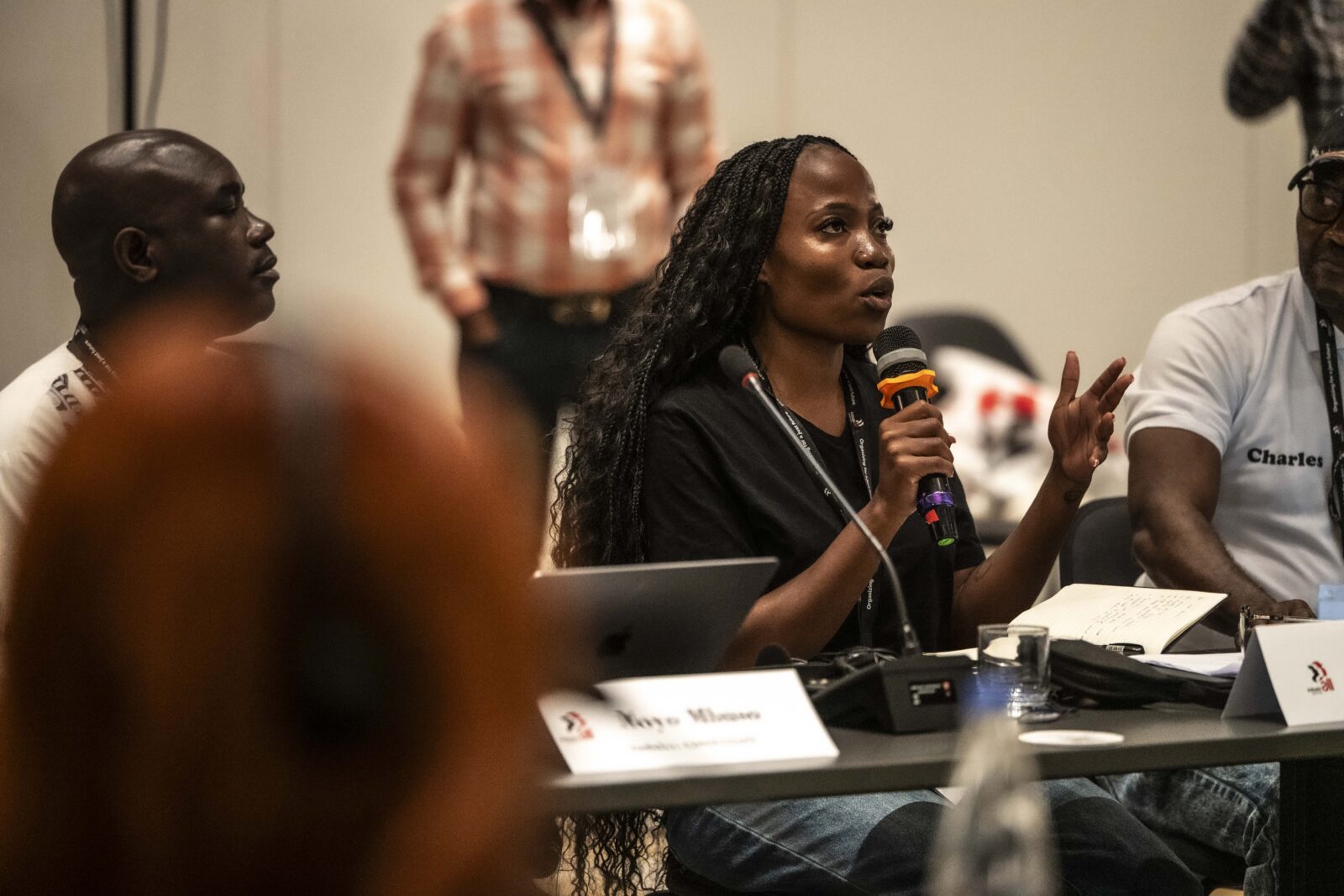
Dr Mbuso Moyo, an academic at the University of the Witwatersrand, presented the research, titled Young workers in transition: structural inequalities, industrial transformation and the Just Transition in the DRC, South Africa, and Zimbabwe, carried out by the IndustriALL youth committee with his support.

Dr Mbuso Moyo of the University of the Witwatersrand addresses young trade unionists at the IndustriALL sub-Saharan Africa youth workshop in Abidjan, Côte d'Ivoire
Dr Mbuso Moyo presents youth-led research on young workers in mining and energy at the youth workshop in Abidjan, Côte d’Ivoire, on 28 September 2026.

Drawing on Antonio Gramsci, he described the present as an “interregnum”, an age of confusion. Its symptoms include “waithood”, where young graduates wait for jobs that never come. 

He warned that the Just Energy Transition risks becoming “palliative care”: promises that absorb workers’ demands without solving the structural crisis. Renewable energy projects may not replace coal jobs, nor be built where coal workers live.

What the research found

The findings, based mainly on existing studies, paint a stark picture:

In all three countries, young women face wage gaps, the risk of gender-based violence and a lack of protective equipment designed for them.

What needs to change

Moyo set out key recommendations from the research:

Unions respond to a changing world of work

Participants split into three groups to reimagine an inclusive and equitable world of work. 

The groups identified automation, artificial intelligence, precarious work and the green transition as the biggest pressures on young workers. They noted that young workers are often the first to lose their jobs under “last in, first out” rules. 

Participants shared union responses, including:

From general concerns to hard evidence

Responding to the group discussions, Moyo said participants’ contributions lacked specificity. He challenged unions to name the exact mines closed, jobs lost and policies responsible in their own countries.

“We can’t afford to speak in generalities,” he said. “As trade union leaders, we must be able to say: in my country, because of these policies, these are the effects.”

He called on unions to build their own research capacity, so their demands rest on solid evidence.

Looking ahead

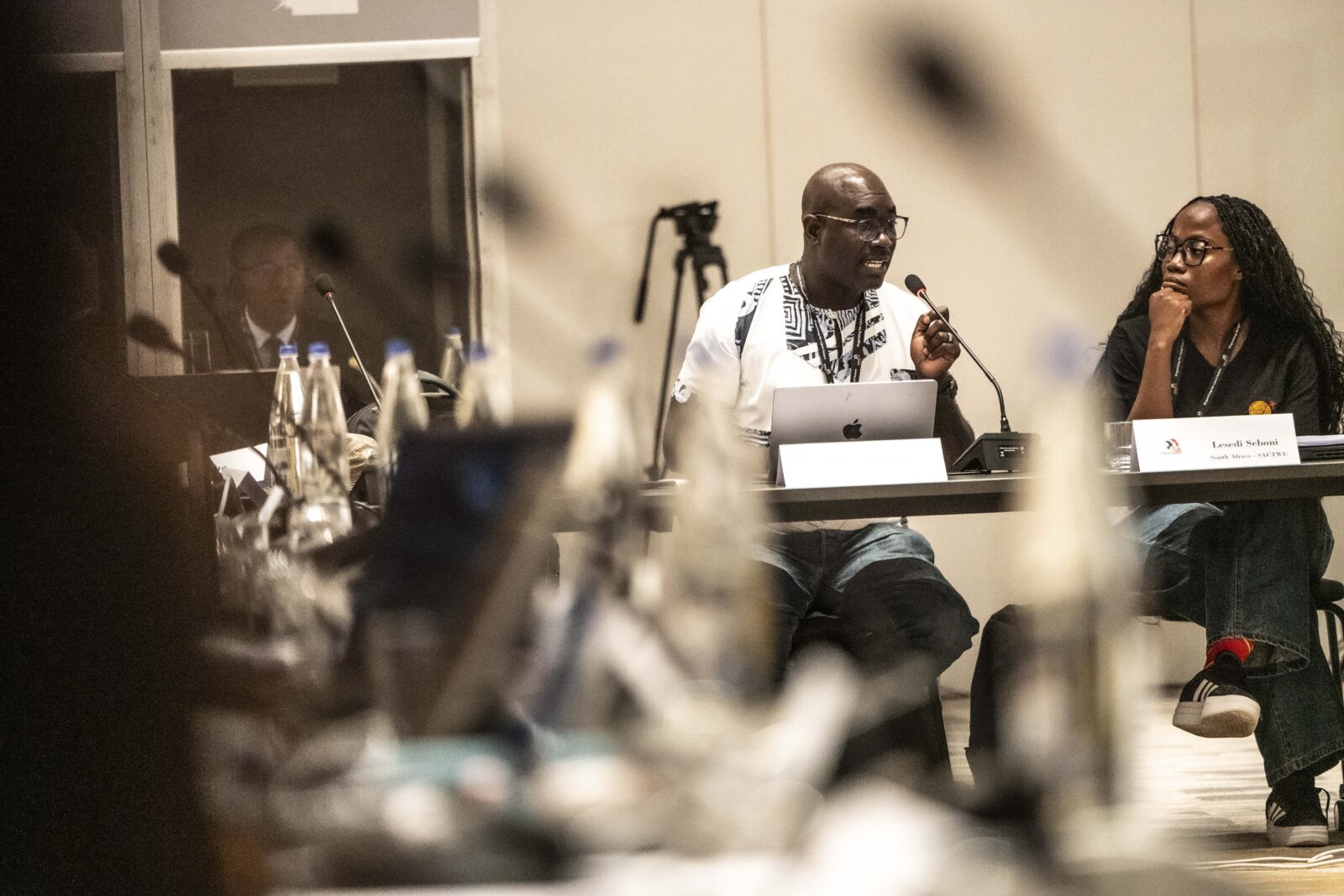
Closing the workshop, IndustriALL youth secretary Lesedi Seboni challenged participants to link the Just Transition to what is happening on the ground:

Lesedi Seboni, SACTWU, addresses young trade unionists at the close of the IndustriALL sub-Saharan Africa youth workshop in Abidjan, Côte d'Ivoire.
Lesedi Seboni closes IndustriALL youth workshop in Abidjan

“How can we decarbonize while ensuring that jobs are secure and at our own pace as African countries?”

Regional co-chair Susan Khumalo summed up the spirit of the day:

“The future is youth and youth is the future.”

African unions form network to challenge Dangote

Unions representing thousands of Dangote Industries workers met in Mtwara, Tanzania, 23 and 24 September 2026. The meeting marked an important moment for the Dangote trade union network as the delegates agreed to press the company to open social dialogue on freedom of association, trade union rights, occupational health and safety, job security, gender equality and women’s employment. This applies across its cement, fertilizer, oil and gas and petrochemicals operations.

The 27 delegates, representing IndustriALL Global Union affiliates in Ghana, Nigeria, South Africa, Tanzania and Zambia, formed the Dangote trade union network. The new network will coordinate union engagement with the pan-African conglomerate. This conglomerate was founded by Aliko Dangote.

During the meeting, delegates toured Dangote’s Mtwara cement plant, including the limestone extraction pit, power station and manufacturing line. The visit gave representatives from other countries a first-hand view of the operations. In addition, it helped them assess workplace standards that could be improved and promoted across the group.

In its closing statement, the network welcomed the cooperation of the Mtwara plant management. It said it would seek non-confrontational engagement with Dangote’s central management to protect workers’ rights across the company. Moreover, it also called for Aliko Dangote to become personally involved in the dialogue.

The network wants Dangote Industries to commit to genuine recognition of all unions across the company. It identified Mtwara as the starting point and called on management to deepen its industrial relations with the Tanzania Union of Industrial and Commercial Workers (TUICO). Furthermore, the network also prioritised occupational health, safety and environmental concerns. It requested a meeting with central management within six months.

African unions formed the network as Dangote Industries continues to expand while facing scrutiny over its labour practices. The group has grown from a Nigerian cement and sugar business into one of Africa’s most influential industrial conglomerates.

A bitter 2025 dispute at its flagship Lagos oil refinery drew particular attention from unions. Labour relations across the group have been strained. In 2025 disputes hit the refinery after management dismissed 880 workers for joining the union. Dangote has since reinstated 854, while unions negotiate to reinstate the remaining 26.

Petroleum and Natural Gas Senior Staff Association (PENGASSAN) and National Union of Petroleum and Natural Gas (NUPENG), said Dangote must stop anti-union discrimination. Dangote management cited sabotage and operational disruption. Meanwhile, the Nigerian government mediated a settlement in which Dangote reinstated most workers. The cement business has seen fewer public disputes, though wages, contractor labour and safety remain recurring concerns.

A network built for the long term

The Mtwara meeting produced more than a statement. Delegates agreed on a year-long work plan designed to maintain pressure, strengthen coordination and turn the new network into an active organizing structure.

“It is important for unions to build collective power in multinational corporations in Africa as this is key to collective bargaining,” said Silvester Mrope, TUICO general secretary.

Tom Grinter, IndustriALL materials director said:

“We are calling for dialogue with Dangote Industries to improve working conditions across its pan-African operations as identified by the trade union network.”

Dangote Group, headquartered in Lagos and built around the fortune of Aliko Dangote, amongst Africa’s richest, is one of the continent’s largest industrial conglomerates. Its core businesses are cement, oil refining and fertilizer. Additionally, it is active in sugar, salt, food processing, logistics and ports.

Dangote Cement is Africa’s largest cement producer, with plants in more than 10 countries including Nigeria, Ethiopia, Senegal, South Africa, Tanzania, Zambia, Cameroon, Ghana and Sierra Leone. The group reported cement revenue of about ₦4.3 trillion (US$3.2 billion) in 2025. This is up to about 20 per cent year-on-year.

The group’s most significant recent project is the US$20 billion Dangote Petroleum Refinery near Lagos. The refinery is one of the world’s largest single-train refineries with capacity for 650,000 barrels a day. It is reshaping Nigeria’s fuel market and now exports to Europe and beyond. A large fertilizer expansion is next, including a planned mega-project in Ethiopia.

Zimbabwean bulldozer operator breaks barriers in lithium mining

PLZ, which operates the mine near Harare, holds reserves estimated at 42.3 million tonnes of ore grading 1.19 per cent lithium oxide. These reserves are among the largest in the country. Nelia Chipako spends her shifts at the controls of a bulldozer and says the job is one women can do just as well as anyone. She believes proper training and experience are essential for that.

 In an interview with IndustriALL Nelia Chipako described the double standards women still face in mining.

“Women face double jeopardy at work. we are doubted by employers and even once we get the job, we are underrated by our colleagues. But women should be given an equal opportunity to prove themselves. We can do better when we are given the chance,”

said Nelia Chipako. 

The message has become central to her union work: women need the same chance to prove themselves in mining jobs. These jobs have long been treated as men’s work.

Balancing the job with family life adds another layer of pressure, Nelia Chipako explained.

“Being a parent in a difficult economy like Zimbabwe is not easy for women. We make sacrifices and carry our parental responsibilities, even under difficult conditions. The working conditions are demanding, there are no fixed off days and sometimes we work during the weekend,”

said Nelia Chipako. 

Her experience reflects a wider struggle in Zimbabwe’s lithium sector. Women are entering jobs once treated as male-only. But many still face bias, insecure work and weak protection against harassment. 

A seat at the table on human rights due diligence

Nelia Chipako was one of 41 delegates from South Africa, Zambia and Zimbabwe at an IndustriALL and Competence Centre for HRDD workshop in Harare on 18 August. Union representatives from the gold, copper, platinum and diamond sectors discussed using human rights due diligence (HRDD) as a bargaining tool. For them, it should not be a corporate box-ticking exercise. The Zimbabwe Diamond and Allied Minerals Workers Union (ZDAMWU) is piloting this at Bikita Minerals and PLZ. In particular, they are focusing on freedom of association, ending gender-based violence and harassment, and extending short-term contracts from three to twelve months.

“Labour safeguards must address the inequalities, gender discrimination, gender pay gaps and stereotypes that continue to exclude women,”

Nelia Chipako told participants at the workshop.

Nelia Chipako belongs to the Zimbabwe Diamond and Allied Minerals Workers Union (ZDAMWU), an IndustriALL affiliate. Zimbabwe, Zambia and South Africa are testing HRDD as an organizing tool in the critical transition minerals sector. They are applying it to gold, platinum, copper, diamonds, and lithium minerals. These minerals are in growing demand as the world shifts to low-carbon energy. Thousands of women, including Nelia Chipako, work in these mines. 

“We now have a voice”

Nelia Chipako credits ZDAMWU’s arrival at Arcadia mine with changing the terms of the engagement with management.

“The union’s biggest achievement is that we now have a voice. In previous years, management made decisions without consulting workers. Now things have changed: we have suitable personal protective clothing, 12-hour shifts and adherence to health and safety standards,”

said Nelia Chipako. 

“Mining can change lives, but only if it is done in an inclusive and sustainable way. If PLZ adopts HRDD in full, it could set an example for lithium mining across Zimbabwe,”

said Paule-France Ndessomin, IndustriALL Sub-Saharan Africa regional secretary.

PLZ is wholly owned by China’s Zhejiang Huayou Cobalt, a top lithium-ion battery materials producer. It took full control of Arcadia in a 2021–22 deal worth US$422 million. Zimbabwe holds some of Africa’s largest lithium deposits and is now the continent’s top producer. This growth is driven by EV and renewable-energy battery demand. Chinese firms dominate ownership, and the government, pushing for more local processing, banned raw ore and concentrate exports earlier this year. The goal is to capture more value through local beneficiation.

Guinea union in organizing push at Simandou despite hurdles

Simandou, the vast iron-ore, rail and port development in south-eastern Guinea, is entering its operational phase. The first commercial shipments left the country in December 2025.

The project covers two mining concessions and a shared rail and port network. Blocks 1 and 2, known as Simandou North, are held by Winning Consortium Simandou (WCS) and Baowu Winning Consortium Simandou (BWCS). China’s Baowu Steel became the majority shareholder in January with 51 per cent, alongside Winning International Group and China Hongqiao/Weiqiao.

Blocks 3 and 4 or Simandou South, are held by Simfer S.A., led by Rio Tinto with Aluminium Corporation of China (Chalco). The Guinean government holds a 15 per cent stake in both concessions and in the rail and port infrastructure jointly owned through La Compagnie du TransGuinéen (CTG).

Union membership rises

FSPMCICA, an IndustriALL affiliate, said Guinean law allows the appointment of a union representative once a workforce reaches 25 workers, including subcontractors. Membership has increased over the past year after an organizing campaign and expansion into companies where the union previously had no presence, though Simandou’s heavy reliance on subcontracting remains one of the union’s main concerns. However, employment is expected to fall from a peak of about 60,000 workers to fewer than 15,000 as operations scale down. On the anticipated wave of redundancies as the project moves past its construction peak, the union described the job losses as a sad reality. As the workers affected are on fixed-term contracts, it said its role is to ensure redundancies are carried out according to labour laws while pushing for improved severance provisions.

FSPMCICA now represents more than 85 per cent of Guinea’s mining sector. Dues collection has also become harder since the abolition of the automatic check-off payroll deduction system. The union must now collect its annual membership fee of 65,000 GNF (USD $7) directly from members.

According to FSPMCICA, work at Simandou runs 24 hours a day, seven days a week, in eight-hour shifts with overtime, rest periods and holidays. The union has raised safety concerns with operators including Simfer, WCS/BWCS and CTG, covering site and camp standards, working hours, rotas, rest periods for extended and night shifts, personal protective equipment, quality and replacement, training, accommodation, food, sanitation, drinking water and union involvement in health and safety matters. Collective bargaining at Simandou does not happen union-to-company but between the Guinean Chamber of Mines and the employers’ federation FEPAMGUI on one side and the union on the other.

Expatriates pay secrecy

Guinean workers are paid in Guinean francs (GNF) on the 25th of each month. Among manual grades, unskilled workers start on 7 million GNF (US$ 792), supervisors on 15 million GNF (US$ 1,698) and executives on 20 million GNF (US$ 2,264) — well above the national minimum wage of 550,000 GNF (US$ 62). The union said this secrecy has bred frustration among Guinean managers, who feel it leaves them with no visible path to promotion. The wage disparities and failure to comply with labour laws on equal pay and collective bargaining led to a strike in May by 3000 workers at Simandou North.

The union wants transparency at Simandou. Despite being a civil society member in the Extractive Industries Transparency Initiative (EITI), it said repeated requests for publication of the Simfer/Rio Tinto contract have been refused. Site visits, it added, are selective with access requests routinely turned down on security grounds.

Marliatou Diallo, FSPMCICA assistant general secretary said: “Our membership is growing due to the union’s recruitment and organizing campaign. We will continue to demand transparency on expatriate wages, which are kept strictly confidential. In similar roles occupied by local workers, the pay gap can be as high as tenfold.”

“We continue to support organizing efforts by FSPMCICA and their fight for equal pay and better working conditions at Simandou,”

added Paule-France Ndessomin, IndustriALL Sub Saharan Africa regional secretary.

Diamonds are forever, what about the jobs?

“We had a chance to mourn when Ekapa announced liquidation plans; but we chose to fight. A job loss is more than not receiving a pay slip; it is a loss of livelihoods for workers,”

said Andile Zitho, NUMSA regional secretary for Free State and Northern Cape. NUMSA recently won a court order placing Ekapa Mining into business rescue instead of liquidation, preserving Kimberley-area jobs while a restructuring plan is developed. Delegates cited it as proof that unions can resist closures and force companies into processes that protect livelihoods.

Affiliates of IndustriALL Global Union, including Botswana Diamond Workers Union (BDWU), Botswana Mine Workers Union (BMWU), Independent Democratic Union of Lesotho (IDUL), Mineworkers Union of Namibia (MUN), National Union of Mineworkers (NUM), National Union of Metalworkers of South Africa (NUMSA), Tanzania Mining Energy and Construction Workers Union (TAMICO), the Zimbabwe Diamond and Allied Minerals Workers Union (ZDAMWU) met company representatives to discuss retrenchments, restructuring and the industry’s response to weaker demand for natural diamonds.

De Beers chief executive Kevin Smith told delegates that “diamonds are forever” and that a sustainable future for natural stones is necessary.

“Diamonds are about economies, communities, and development, and diamond mining should embrace integrity, consumer confidence, and be conflict free,”

he said.

Naseem Lahri, managing director of Lucara Botswana, pointed to the company’s governance standards and union relations.

“We are governed by standards such as Towards Sustainable Mining (TSM), are part of the Responsible Jewellery Council, and maintain productive engagement with the unions,”

she said.

HB Botswana displayed its high-tech skills development programme in cutting and polishing during a visit to the Diamond Technology Park by the delegates.

Producer countries and companies are also coordinating their response. Under the Luanda Accord, signed in June 2025, Botswana, South Africa, Angola, Namibia, Sierra Leone, the Democratic Republic of Congo, and De Beers agreed to direct part of rough-diamond revenue into a Natural Diamond Council campaign promoting natural stones over synthetic alternatives.

Emmanuel Adjei-Danso, IndustriALL director for mining and diamonds, said the transition must not come at workers’ expense. “Diamond mining is going through a transition, and workers are part of this transition. This is why we must continue to emphasize on freedom of association, job security, health and safety, and ending gender-based violence and harassment,”

he said.

This regional context explains why unions want a coordinated response: diamonds support public revenue, suppliers, communities and thousands of jobs now exposed to weaker demand and restructuring.

Regional pressure points for workers

Across the six countries, diamonds remain tied to revenue, exports, suppliers and mining-town livelihoods. Botswana leads through Debswana and Lucara but has cut output as demand weakens. South Africa’s diamond belt faces costly operational changes and retrenchment fears. Lesotho, Namibia, Tanzania and Zimbabwe differ in scale and geology but face the same question: how to protect jobs, rights, and communities as natural diamonds adjust to lab-grown competition and restructuring.

Certification can protect the integrity of natural diamonds, but not workers on its own. IndustriALL’s global diamond network must now turn regional unity into bargaining power that protects jobs, upholds rights, improves safety and ensures workers and mining communities do not carry the burden of the diamond transition.

Deploying human rights due diligence in African mines

At a workshop in Harare, Zimbabwe, on 18 August, three IndustriALL Global Union affiliates presented pilot cases showing how HRDD can be turned into a practical union strategy in the mines. The National Union of Mineworkers (NUM) in South Africa, the Mineworkers Union of Zambia (MUZ) and the Zimbabwe Diamond and Allied Minerals Workers Union (ZDAMWU) shared examples from gold, copper, platinum and diamond mining.

The workshop brought together 41 delegates from the three countries, alongside UNI Global, Zimbabwe’s Ministry of Public Service, Labour and Social Welfare, the National Employment Council for the Mining Industries, Competence Centre for HRDD and IndustriALL.

HRDD comes from the UN Guiding Principles on Business and Human Rights. It is increasingly part of European supply-chain law, including the Corporate Sustainability Due Diligence Directive and the German Supply Chain Act. It requires companies to identify, prevent and account for human-rights violations tied to their operations.

For unions, the strategic value discussed at the workshop is clear. HRDD can move from a corporate compliance process to an organizing, bargaining and accountability tool. This helps workers challenge violations across mining operations and supply chains.

Combating gender-based violence in South Africa’s gold mines

NUM’s HRDD work is anchored on the pilot case at goldmine Sibanye Stillwater. It singles out gender-based violence and sexual harassment, particularly in isolated underground mines as rife. The union’s findings describe a workplace culture still shaped by male dominance, stereotyping and the exclusion of women. This holds even as female representation has grown.

Women made up about 18.8 per cent of the workforce and 29.4 per cent of management positions at the company, according to Sibanye’s 2025 report. But the mining industry has not caught up with that shift. Personal protective equipment and underground facilities were historically designed around the male body, leaving women workers inadequately protected and accommodated.

NUM’s analysis points to further problems: the physical demands of shift and night work, bias in recruitment and promotion, and unaddressed psychological-safety concerns.

The company has responded with several measures that include the Women of Sibanye-Stillwater network, Women’s Voice workshops, gender-based violence support centres, equal-pay audits, leadership-development programmes and upgraded PPE and facilities. NUM’s HRDD work will test how far these initiatives translate into a demonstrably safer and more equal workplace.

Fighting for workers’ rights in Zimbabwe’s platinum and diamond mines

ZDAMWU’s pilot cases at Bikita Minerals and Prospect Minerals Zimbabwe centre on defending workers’ rights, protecting freedom of association and ending gender-based violence and harassment. They also challenge short-term contracts, pushing for extensions from three to 12 months.

The cases raise concrete concerns: precarious employment, weak collective bargaining power and unsafe reporting conditions. Workplace practices also leave workers and communities with limited voice when violations occur. The union’s approach also extends beyond the mine gate, through collaboration with affected communities.

Demanding freedom of association on Zambia’s copperbelt

In Zambia, MUZ is pressing for HRDD-compliant grievance mechanisms at CNMC Luanshya Copper Mines and Sino Metals Leach Zambia. The union is calling for channels that are safe, accessible and properly structured. These would let mineworkers report labour-rights violations, occupational health and safety hazards, discrimination and harassment. They could do so without fear of retaliation. The union frames functioning grievance mechanisms as a precondition for freedom of association on the Copperbelt. There, reporting workplace concerns has often carried real risk for the worker who speaks up. MUZ also wants remedies for workers and communities that were affected by the tailings dam spill at Sino Metals.

Binta Mutale, programme manager for the Competence Centre for HRDD said: 

“Participants learnt concrete tools to bring HRDD into their organizing strategies and were reminded that legal frameworks are only as strong as the organized workers supporting them.”

“HRDD is a broad framework that trade unions can leverage to defend rights and working conditions and to make local and global capital accountable. The emerging success stories from the unions show the tremendous potential for HRDD tools in union organizing and building trade union power,” 

emphasized Paule-France Ndessomin, IndustriALL regional secretary for Sub-Saharan Africa.

White-collar unions win recognition in Türkyie and South Africa

Türkiye: a court ruling opens the door

Turkish labour law long defined “worker” as someone physically engaged in labour, shutting white-collar staff out of representation. Around 40 per cent of manufacturing workers had to negotiate pay and conditions individually. In March 2025, the Constitutional Court ruled only two groups can be excluded from bargaining. The two are those who represent management and those who negotiate with unions on employers’ behalf.

Lastik-İş moved fast. It has successfully concluded agreements in principle with Goodyear, Pirelli, Bridgestone and Prometeon to bargain for white-collar staff. The agreements with around 70 companies across the tyre sector aims to secure representation for white-collar workers.

“Lastik-İş’s victory in negotiating such an agreement is a groundbreaking event for trade unions in Turkey, who have been prevented from organizing white-collar workers,”

says IndustriALL assistant general secretary Kemal Özkan.

South Africa: NUMSA defends its mandate in court

NUMSA’s Central Committee voted to expand its scope to technicians, engineers, ICT and other white-collar workers across the value chain. The government registrar challenged this in court. NUMSA won in 2024, and has since used both legal action and workplace organizing to push back on employer resistance. Where bargaining councils exclude white-collar staff on representation thresholds, NUMSA now negotiates workplace recognition agreements directly.

New workers, new tactics

Legal wins are just the start. White-collar workers in Türkiye have not traditionally seen industrial unions as their representatives; Lastik-İş is committed to adapt its structures and bargaining agendas to fit their concerns.

NUMSA is leaning harder into digital organizing to reach a workforce unlike its 1980s and 90s base. It is also investing in training: partnering with the Sector Education and Training Authority on AI and automation, and running courses through the Mbuyiselo Ngwenda Bursary Fund to keep members’ skills relevant as industries digitize.

Why do these victories matter?

In Türkiye, unions previously could reach only around 60 per cent of the workforce, short of the 50 per cent plus-one threshold needed for recognition. Now they can organize up to 95 per cent. And the stakes go beyond these two unions: white-collar workers already make up over half the manufacturing workforce in Germany, France and Sweden, as industry 4.0 and AI reshape the sector everywhere.

“Organizing white-collar workers is not only a question of equality, it is also a question of survival for trade unions,”

says Christine Olivier.

“As work evolves, unions must evolve too.”

Court victory stops Ekapa Minerals liquidation

The ruling, delivered on 27 July, protects workers’ livelihoods and gives the company a chance to restructure instead of closing. More than 1,000 jobs were at risk after Ekapa applied for liquidation following a fatal mud rush in February where five miners died. NUMSA criticized the company for seeking liquidation while the workers were still missing and before meaningful consultation with the union or government.

The court agreed with IndustriALL affiliate NUMSA over the urgency. Liquidation would threaten workers, creditors and the Kimberley mining community. It also confirmed NUMSA’s right, as a recognized trade union representing Ekapa workers, to apply for business rescue.

Ekapa had argued that the mine had no viable future, but the court rejected this position. Evidence showed that the mud rush was localised and that other mines remained functional and commercially viable. Ekapa has three mines namely Du Toitspan and Bultfontein which were affected by the flooding. The third mine, Wesselton, was not affected. 

According to the court ruling, business rescue will allow Ekapa to preserve its mining right, access financing and restructure operations. Under the proposed plan, about 500 direct jobs could be saved immediately, with the possibility of better returns for creditors than under forced liquidation.

NUMSA has 369 members at Ekapa. The union has met workers to discuss how they can claim unpaid wages and benefits as part of the business rescue.

“NUMSA salutes its members at Ekapa for their resilience throughout this difficult period and commends our legal team, Lerato Lenyehelo Attorneys, for delivering this victory for the working class. NUMSA remains committed to fighting for every single job and ensuring that workers’ lives and livelihoods always come before corporate profit,”

said Andile Zitho, NUMSA regional secretary for the Northern Cape and Free State.

Paule-France Ndessomin, IndustriALL regional secretary for Sub-Saharan Africa, said mining companies must not rush to close operations and retrench workers. 

“Retrenchments must be the last resort. We will continue to support NUMSA in its fight to defend jobs and workers’ livelihoods at Ekapa.”